Importance
and Development
of the Reindeer
Industry in Alaska
HERBERT C. HANSON .
Research Professor, Department of Biology, The Catholic University of America, Washington, D. C.
PRESENT STATUS
T
HE chief use that can be made of much of the tundra and adjoining forest in western and northern Alaska is the raising of reindeer. Aamodt and Savage (‘49, p. 101) as a result of their, special exploratory investigations in 1946 on cereal, forage, and range problems and possibilities in Alaska concluded: “The vast tundra area of northern, western, and other parts of Alaska may be utilized to best advantage for the production of reindeer, caribou, musk oxen, and pos- sibly yak. This extensive and largely undeveloped domain is deserving of reconsideration for these purposes.” The total potential area has been estimated as high as 400,000 square miles by Gros- venor (‘03), and as late as 1945 by Palmer (‘45A) at 150,000 square miles. Probably a total of about 100,000 square miles could be found now, but it would be safer to figure on about 50,000 square miles because of barren and worthless range, such as rocky slopes, gravel bars, lakes, marsh lands, overgrazed areas, burned-over lands, winter range that ices over frequently or where the snow be- comes too deep, and areas frequented by caribou herds or subject to wolf predation where control is inadequate. Reindeer are dependent during the winter upon lichens chiefly, during the summer upon shrubs and herbs. Overgrazing .and trampling in the past have depleted the lichens over a lo- to 20-mile wide strip along the seacoasts, so it is no longer suitable for winter range. In some areas, such as the western part of Seward pen-insula, good winter range is so far away from the summer range that it is difficult to use either. In general there is insuffi- cient good winter lichen range at present to make use of the large areas of summer shrub-herb range.
If a grazing requirement of 100 acres per reindeer yearlong (Palmer, ‘45A) is used, then 50,000 square miles would support 320,000 head, but even this estimate is unreliable because of the numerous problems and difficulties, and the small amount of basic data on which to base management of the reindeer and the range. The present policy of the Bureau of Indian Affairs of the Depart- ment of the Interior is apparently feasible with respect to encouraging the industry to expand in accordance with the selec- tion of dependable Eskimos for pur- chasing herds as individuals and the assignment of areas for grazing that are free from caribou invasions and uncon- trolled wolf predation, and where good winter range is accessible within a reason- able distance. Additional research is needed on range resources and on rein- deer to meet the needs of the industry.
169 families secured part of their cash income from reindeer. The estimated value of the reindeer in Alaska was $546,900.
Aerial and ground surveys by the writer (Hanson, ‘52), chiefly in the sum- mer of 1951, and to some extent in 1950 and 1949, showed that areas which had been heavily utilized during the period of large herds, or which had burned over, now have a sparse growth of *lichens. Good lichen range does, however, occur in places 10 to 15 miles inland from coasts, especially near and in open spruce forests east of Norton and Kotzebue sounds, and in the southeastern part of Seward peninsula.
GROWTH AND DECLINE OF
REINDEER INDUSTRY THE
In 1891 Sheldon Jackson inaugurated the introduction of reindeer into Alaska from Siberia. By 1902 when the importa- tions ceased, a total of 4795 head had been introduced, mostly in the western end of Seward peninsula, where W. T. Lopp and B. Gibson in 1891 had shown that lichens were abundant. In 1894 and 1898 Lapps, Finns, and Norwegians were brought to Alaska for teaching and working in the industry. From 1898 to 1904 damage to the range by fires, often started by miners, was pointed out. In 1911 the first shipment of reindeer meat, 125 carcasses, was made to the States. In t’his year counts showed 33,629 head in 46 herds, 60 percent owned by 460 Natives, 11 percent by the Government,
14 percent by missions, and 15 percent by Lapps. In 1912 there were 1281 head used as sled reindeer. In 1913 W. C. Shields stated that it was difficult to find summer grazing in several sections. In 1914 the Lomen Bros. of Nome organized a company to produce and export reindeer meat on a large scale. Between 1914 and 1921 this company
purchased about 8600 head at $18 to $30 each. It built corrals, slaughter and cold-storage plants, warehouses, etc.
The U. S. Biological Survey, now a part of the Fish and Wildlife Service, started research on reindeer in 1920 and this was continued until about 1935. The research resulted in publications by Hadwen and Palmer (‘22)) several by Palmer (‘26, ‘29, ‘34, ‘45A, ‘45B), Palmer et al. (‘33)) and Palmer and Rouse (‘45).
In 1925 twelve caribou bulls were *landed on Nunivak Island for crossing with reindeer. In 1929 the supervision of the Alaskan reindeer industry was trans- ferred to the Governor of Alaska. The trek of 3400 reindeer, starting from the Kotzebue region in 1929, reached the Mackenzie River delta in Canada in 1935. *About 2,500,OOO pounds of reindeer meat and 20,000 hides were shipped from Alaska in 1930. In 1931 a Reindeer Council, consisting of 5 members, was appointed to administer reindeer affairs ;
this was changed in 1932 to advisory capacity only. In 1932, when the peak number of about 641,100 head was re- ported, two representatives of the Sec- retary of the Interior found that problems of personnel, trespassing, herding, and marketing were aggravated by animosity, competition in trade, insufficient super- vision, and neglect. Wolves were in- creasing in numbers. In 1937 the Reindeer Service was transferred to the Office of Indian Affairs and assigned to the Divi- sion of Education.
REINDEER INDUSTRY IN ALASKA 245
Government was to assist the Natives in the conduct of the reindeer industry on a subsistence basis. Administration of the industry, including the use of the range, was transferred in 1941 to the Division of Extension and Industry and the Division of Forestry and Grazing. In 1949 the Alaska Game Commission reported killing in Alaska 488 wolves and 355 coyotes; in 1950, 1070 and 800 re- spectively. In 1950 the number of reindeer were estimated at 25,000, possibly the low point in the downswing. Belcher (‘52) reported that at the close of 1951 wolf predation was serious among the herds in the Kotzebue region and on the Kaka- ruk herd on the Seward peninsula, and the Fish and Wildlife Service had in- adequate funds to carry on predator control.
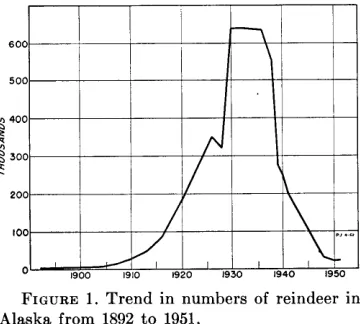
FIGURE 1. Trend in numbers Alaska from 1892 to 1951.
of reindeer in
The numbers of reindeer in various years between 1892 and 1951 are shown in the graph in Figure 1. This graph is very instructive in showing the course of the industry. It shows the gradual in- crease in numbers up to about 1902, the moderate rate between 1902 and about 1912, the very rapid rate from 1912 to about 1930, the levelling off between 1930 and about 1934, the gradual decline to about 1938, the very rapid decline
from 1938 to about 1945, then a gradual decline to about 1950, and a slight in- crease in 1951. The ascending part of this curve is typical of the growth of a popu- lation of animals in the presence of abun- dant food and in the absence of serious pressure by enemies such as predators, parasites, and diseases. This curve “pro- vides a numerical measure of the popu- lation’s past history up to the time of most recent observation; summarizes a wealth of knowledge about the group in question; and in so doing raises particular questions for analysis and synthesis” (Allee, et al. ‘49, p. 330).
since then in a state of semi-equilibrium (Allee, et al. ‘49, chap. 21). It is more difficult to maintain a partly domesti- cated animal, as the reindeer, in a state of semi-equilibrium, but the goal should be to determine the proper point for levelling off (the asymptote) at which numbers could be maintained at a mean stability for a long time.
The curve in Figure 1, with such a rapid positive rate, followed by the steep negative rate, shows that insufficient consideration was given to the supply of food plants, range allotments, proper herding, etc., and the influence of these factors on the growth and maintenance of the reindeer herds. In fact, during the first 35 or 40 years, the forage, especially the lichens, was regarded (if at all) as almost limitless, and no one apparently thought they would ever be depleted. During this expansion period “Every- one was optimistic. No one issued warn- ings that the balance of nature would operate inexorably, that in this unhealthy development of wild reindeerlay the seeds of the reindeer business’s destruction. Reindeer owners, Native and white, made effort to acquire as many reindeer as possible. . . . Owners made no effort . . . to limit the number of reindeer to
the amount of plant life the ranges would support in perpetuity” (Rood, ‘45, pp. 5-6). The over-optimism, as late as 1934, is shown by Palmer (‘34, p. 5) who esti- mated the area of grazing land suitable for reindeer in Alaska at 200,000 square miles with a carrying capacity of 4,000,- 000 head, and an annual surplus of l,OOO,- 000 hides and 10,000,000 pounds of meat.
“Apparently .in every area where rein- deer have been introduced they have increased rapidly in numbers to a peak, and then a decline has set in. This is a biological cycle in a natural state, as animals increase in numbers until feed is insufficient to carry the greater number or
predators increase to a point where the host cannot support them. The primary animals then decrease rapidly and the feed supply builds up or the predators die or migrate. With better food or fewer predators the primary animals start increasing again on another cycle. Man upsets this course in domestic animals by the safeguarding of feed or protection from predators, and theoretically should be entitled to the surplus or harvest. Where no surplus exists the cause is usually attributable to neglect-vol- untary or otherwise. In the reindeer industry this neglect is ordinarily lack of herding” (Burdick, ‘40, p. 25).
At present it seems hardly believable that lichens were ever abundant near the coasts, where the reindeer were mostly located during the positive growth period. But statements by various observers indicate that they were. Palmer (‘34, p. 24) wrote : “When reindeer were first
REINDEER INDUSTRY IN ALASKA 247
depletion did not occur until after 1932. This shows a striking relationship to the beginning of the decline in the growth curve of the reindeer population (Fig. 1).
Other indications of the abundance of lichens near the coasts are given by vari- ous writers. Smith (‘13) stated that rein- deer moss was abundant on the hill slopes between the mouth of the Noatak River and Cape Krusenstern and was being grazed by reindeer. The region now has only poor growth of lichens. Shields (Anon. ‘16) reported that in 1916 lichens were stored for feeding his sled reindeer before his arrival at Candle, Nome, Chiniak, Council, Kotzebue, Teller, and Sinuk. In 1950 and 1951 it was impossible to find enough lichens for such a purpose in most of these places. Jackson (‘01) reported that lichens were abundant the whole distance from near Unalakleet to St. Michael and then to Bethel during a reindeer drive. John Muir (‘17) described “the furred bed of lichens and mosses on which the bright leaves and berries were painted” in the Kotzebue Sound region in 1881.
The decline in the number of reindeer after about 1932 was due to many causes and should not be attributed to only one. This is usual in the crash of animal populations (Trippensee, ‘48, p. 391). The chief cause was undoubtedly the depletion of the ranges that were used and the failure to move herds to good unused ranges. Another chief cause was inadequate herding. Predation by in- creased numbers of wolves became more serious, but undoubtedly many losses due to other causes were attributed to wolves. Careful herding would probably have prevented much loss by wolves, but their predation appears difficult to prevent in brush and timber and during the winter. Even today in northern Nor- way losses due to wolves are often heavy. The depletion of the range was due to
excessive grazing and trampling, during both summer and winter in many areas. This was accentuated by the concentra- tion of reindeer on limited areas. Fire was serious, especially in the destruction of lichens. Inadequate herding was due to the unwillingness of herders to endure the hardships and inconveniences of following the herd, crude range facilities in places, conflicts between herders and owners, village attractions, absentee own- ership, lack of adequate regulations and enforcement, and lack of enough knowl- edge and appreciation of the range and the habits and requirements of the rein- deer not only among the owners and herders but also among the supervisory officials. During the thirties interest in reindeer declined, brought on partly by the system of joint ownership, partly by the low value of reindeer products, partly by marketing difficulties some of which were caused by objections in the states to importation of reindeer meat in com- petition with that of domestic livestock. Poor herding, or the lack of any herding, contributed to losses from wolves, and probably some from bears, to starvation in severe winters and the springs follow- ing, and to straying off with caribou or in search of better range. Other causes of the decline in numbers were the excessive slaughtering, not only for human food, but for dog food, fox bait, etc.; losses by parasites and diseases, especially in weakened animals ; inbreeding ; excessive
agencies especially after the transfer of ownership from Whites t,o Natives, when the industry was changed from a com- mercial to a subsistence basis. It is no wonder that t,he decline in numbers mais so rapid, and that by 1941 reindeer raising in Alaska was “a very sick in- dustry,” as report,ed by Arnold, et al. (‘41).
should not be established until reliable, trained, and cooperative operators and herders are secured. Regulations govern- ing the use of the range and management of the reindeer are in preparation, and conformance to them under efficient supervision will be essential. It is the opinion of the writer that Eskimos in- t,erested in the reindeer business can be
F~URE OF THE REINDEER INDUSTRY IN ALASKA
In view of the numerous problems and difficulties, and the sad history, there appears to be litt,le question that the development of the industry should be gradual. The locating of herds should be controlled so that only areas where there is an adequate supply of lichens on the winter range (Fig. 2) and on the fawning range will be used,where there is freedom from invasions by caribou, and where wolf control can be obtained when needed. The prevalence of diseases and insect pests also needs consideration. Xew herds
repayment in kind, appear, on the u-hole satisfactory.
The development of the industry will also be governed by the opportunities for marketing meat and hides. It appears that marketing should be limited chiefly to the home needs of the Eskimos and to markets in Alaska. “Invest,igations and studies of the reindeer industry should be made in order that the herds will play the greatest possible part in the general development of northern and western Alaska. Food and clothing requirements of the natives should be the first concern of the industry” (Burdick, ‘40, p. 2.5). Heintaleman (‘36) stated that it teems reindeer product,ion should be restricted to local needs and abandoned BS an export
earlier berause planes can be made available in most places when needed,
Sound development of the industry requires that the range resources of each grazing unit should be surveyed for major range types (Hanson ‘51, ‘52), classified into range condition classes, and the carrying capacities estimated. A graxing plan is needed for each unit, which will show the seasons of use, routes of travel, camps, frequency of grazing, rota- tion plan, places and time of handling (Fig. 3). Regular reports should be ob- tained from operators at least once a year regarding conformance with the grazing plan, numbers and sex of fawns, deaths due to predators or disease, num- ber slaughtered, castrated, etc.
insula. August 3, 1!151.
business. At, present, there is much greater demand in Alaska for reindeer meat than can be supplied. The export of meat to the States involves many additional problems and need not be considered at present, at least not until t,he industry has grown considerably, the Alaska con- ~umer demand is sat,isfied, and the de- mand for meat in the States exceeds available supplies. Transportation of meat and hides is not, so great a problem as
and topographic conditions that influence management are the dates of freezing and thawing of the ground, rivers, lakes, and the sea; the amount and duration of soil moisture contents; frost action in the ground; kind of soil; ice action along the coasts, relief; ruggedness, etc. Biotic factors to consider are diseases and para- sites, predators, caribou, forest and shrubs for fuel, shelter, etc. Fire, because of its destructiveness is almost in a class by itself, but it is usually started by man. Other human factors to consider are the abilities and inclinations of owners and herders, market needs, transportation facilities, etc.
The operator who is building up a rein- deer herd should be given necessary kinds of assistance such as instruction in better methods of management of reindeer and range, in securing herd dogs, and in the construction of facilities. Cabins are needed especially during the winter and at handlings. Whenever possible encourage- ment should be given and interest shown in solving his problems. The giving of the proper kinds of assistance, not doles, re- quires direct and personal knowledge, gained on the ground, of the problems and needs of each operat,or. At present this is impossible with the very small staff engaged in reindeer administration ;
consisting of the part time of the Assistant Director of Resources in the Juneau office of the Alaska Native Service, part time of the Administrative Assistant in Nome, another in Kotzebue, and part time of a few teachers. All of these people have so many other duties that it is impossible for them to keep in close touch with the needs of the operators and with the con- dition of each herd and range. Further- more, most of them lack the needed kind of technical knowledge for this work. At least two scientifically trained assistants are needed to work under the Assistant Director of Resources. One should be
competent in research, the other in ex- tension work and administration.
Before sound, long-term range manage- ment procedures and plans can be formu- lated, much additional knowledge must be secured by research. A few of the problems that need the services of a competent research man are surveys to determine the locations of range suitable for the different seasons, effects of various frequencies of grazing, values of different species of plants at various times of the year, rate of recovery from various in- tensities of grazing, nature and extent of wolf predation, control of losses due to caribou, and the needs and habits of the reindeer. Sample plots, to be examined and measurements taken about every two years, should be installed in several range types and under different conditions of use. Examinations of the range, of the reindeer, and of the influencing conditions need to be made at all seasons of the year. So little has been done, and there is so much to do, that the full time of one man should be given to research. This is little enough, in view of the extent of the rein-’ deer country and the need of the industry for basic information, if it is to become established on a technically sound founda- tion.
REINDEER INDUSTRY IN ALASKA 251
tion of the Alaska Native Service schools and the Territorial schools in the rein- deer industry and in the training of ap- prentices. At every opportunity he would point out the destructive and long-lasting damage wrought by fire, excessive tram- pling, and other abuses, especially to the lichen range; and the need for cooperation by all in the development of a sound reindeer industry.
Note
In a paper received after this article was in page proof, Scheffer (‘51) ascribed the decrease in reindeer on St. Paul Island to a number of causes, primarily overpopu- lation.
ACKNOWLEDGEMENTS The work on which this article is based was supported in part by the Arctic In- stitute of North America with funds pro- vided by the Office of Naval Research. For numerous courtesies and facilities thanks are extended to the Arctic Insti- tute of The Catholic University of America and to the Bureau of Indian Affairs of the U. S. Dept. of the Interior.
LITERATURE CITED
AAMODT, 0. S., AND D. A. SAVAGE. 1949. Cereal, forage, and range problems and possibili- ties, in Report on exploratory investiga- tions of agricultural problems in Alaska. U. S. Dept. Agr. Misc. Pub. 700: 87-124. ANONYMOUS. 1912. Report on the education of
the Natives of Alaska and the Reindeer Service, 1910-1911. U. S. Bur. Ed., Alaska School Serv. Whole No. 484. 91 pp. -. 1911-17. Reports on the work of the
Bureau of Education for the Natives of Alaska. U. S. Bur. Ed., Buls. 31, 32, 36, 47, 48.
ALLEE, W. C., A. E. EMERSON, 0. PARK, T. PARK, AND K. P. SCHMIDT. 1949. Principles of animal ecology. W. B. Saunders, Phil- adelphia. 837 pp.
ARNOLD, L. D., A. C. COOLEY, F. B. LENZIE, AND J. M. COOPER. 1941. Report on the management of reindeer and the reindeer range in Alaska. 23 pp. Typed.
BELCHER, D. M. 1952. Personal communication. January 11.
BURDICK, C. G. 1940. Report to the Secretary of the Interior. Reindeer Acquisition Unit. 33 pp. Mimeo.
GROSVENOR, G. H. 1903. Reindeer in Alaska. Smithsn. Inst. Rpt. for 1902: 613-623. HADWEN, S., AND L. J. PALMER. 1922. Reindeer
in Alaska. U. S. Dept. Agr. Bul. 1089. 74 PP.
HANSON, HERBERT C. 1951. Characteristics of some grassland, marsh, and other plant communities in western Alaska. Ecol. Monog. 21: 317-378.
- . 1952. Vegetation types in northwest- ern Alaska. Ms.
HEINTZLEMAN, B. F. 1936. Reindeer grazing, Sen. Dot. 74 Cong. 2 Sess. 199: 581-598. JACKSON, S. 1891-1908. Annual reports on in-
troduction of domestic reindeer into Alaska. Nos. 1-16. Govt. Prtg. Off. MOUNTJOY, C. R. 1951. Personal communica-
tion. November 19.
MUIR, JOHN. 1917. The cruise of the Corwin. Houghton, Mifflin Co., Boston. 303 pp. PALMER, L. J. 1926. Progress of reindeer in-
vestigations in Alaska. U. S. Dept. Agr. Bul. 1423. 37 pp.
-. 1929. Improved reindeer handling. U. S. Dept. Agr. Cir. 82. 18 pp.
- . 1934. Raising reindeer in Alaska. U. S. Dept. Agr. Misc. Pub. 207.41 pp. - . 19458. The Alaska tundra and its
use by reindeer. U. S. Dept. Int., Off. Ind. Aff. 28 pp. Mimeo.
-. 1945B. A standard method for proper butchering and dressing of reindeer. U. S. Dept. Int., Off. Ind. Aff. 22 pp. Mimeo. ---_-_ N. R. ELLIS, AND G. L. BARNUM.
1933:‘The vitamin content of lichens. Jour. Nutr. 6: 443454.
- AND C. H. ROUSE. 1945. Study of the Alaska tundra with reference to its reac- tions to reindeer and other grazing. U. S. Dept. Int., Fish and Wildl. Serv. Res. Bul. 10,48 pp.
ROOD, J. S. 1945. Building a reindeer business. Reindeer Serv. Cir. 73. 23 pp. Mimeo. Nome.
SCHEFFER, V. B. 1951. The rise and fall of rein- deer herd. Sci. Monthly 73: 356-362.
SMITH, P. S. 1913. The Noatak-Kobuk Region, Alaska. U. S. Geol. Surv. Bul. 536, 157 pp. TRIPPENSEE, R. E. 1948. Wildlife management.