ISSN: 2319-8753
I
nternational
J
ournal of
I
nnovative
R
esearch in
S
cience,
E
ngineering and
T
echnology
(An ISO 3297: 2007 Certified Organization)
Vol. 2, Issue 10, October 2013
Design of PC Controlled Automatic Solar
Tracker Robot
B.Suchitha Samuel
1, B.Bharathi
2, J.Mrudula
3Post Graduate Scholar, Department of Electronics& Communication Engineering, Geethanjali College of Engineering and Technology, Keesara, Andhra Pradesh, India1
Post Graduate Scholar, Department of Electronics& Communication Engineering, Geethanjali College of Engineering and Technology, Keesara, Andhra Pradesh, India 2
Associate Professor, Department of Electronics& Communication Engineering, Geethanjali College of Engineering and Technology, Keesara, Andhra Pradesh, India3
Abstract:Most of the solar powered vehicles are powered using fixed solar panels placed on top of the vehicle, where the solar panel remains in the direction of vehicle irrespective of the direction of the sun. This project provides the best solution for this by aligning the tracker setup continuously toward the sun irrespective of the direction of the robot/vehicle. The project is PIC microcontroller based robot where the base of the robot can move in all directions and tracker-base itself will align the solar panel to track the sun exactly. Intelligent feedback is provided with the help of digital compass for perfect solar tracking. This project does not need any installation since it is portable and can be located in a free space exposed to direct sunlight. The use of solar energy for powering the robot makes the project distinctive.
This project is mainly intended to design a mobile robot that is powered by a solar tracking system with an intelligent feedback system. The project is implemented using PIC microcontroller, H-Bridge motor drivers, LDR sensors, and digital compass and a tracker setup.
Keywords: Solar Tracker Robot, LDR Sensors, Digital Compass, Solar Panel, H-Bridge Motor Drivers
I. INTRODUCTION
From many centuries, sun has been the primary source of energy for the globe. In any solar application the conversion efficiency is improved when the modules are continually adjusted to the optimum angle as the sun traverses the sky. A Solar Tracker is a device onto which solar panels are fitted which track the motion of the sun across the sky ensuring that the maximum amount of sunlight strikes the panels throughout the day.
The technical improvement together with the need for high performance robots created faster, more accurate and more intelligent robots. The most important part of any robot design is the power supply. In the case of wired
robots efficiency isn’t major issue for power supply but for wireless robots, warfield and surveillance robots it is of much importance. As robots become increasingly common and capable, there will be an increasing need for an intuitive system for remotely controlling the robots. In many situations it is advantageous to have the robot tele-operated.The remote control signals can be sent through a wire, through a local wireless system (like Wi-Fi), over the Internet or by satellite. [1]
ISSN: 2319-8753
I
nternational
J
ournal of
I
nnovative
R
esearch in
S
cience,
E
ngineering and
T
echnology
(An ISO 3297: 2007 Certified Organization)
Vol. 2, Issue 10, October 2013
II. BACKGROUNDOFRELATEDWORK
As of now there are many projects related to solar tracking system that are proposed to improve it such as the
Microprocessor Based Solar Tracking System Using Stepper Motor where themicroprocessor is being used to control the tracking system by interfacing with others components. However, it requires external components to implement program memory [8]. A Miniature Solar Tracker was built which is microcontroller based and single- axis tracking system using DC motor. This project is simple, since the tracking system is supported by a tripod [9]. Different Tracking Strategies for Optimizing the Energetic Efficiency of a Photovoltaic System were followed using fuzzy logic neural controller and dual-axis tracing systems[10].They use more electrical and mechanical parts which increase the difficulty and complexity .
III.METHODOLOGY
This project is mainly intended to design a mobile robot that is powered by a solar tracking system with an intelligent feedback system. In this project, the tracking system of the robot will be controlled by two Light Dependent Resistors (LDRs) placed on the tracker set up. Two PIC Microcontrollers are used one for the tracker and the other for the robot. Limit switches are provided on either side of the tracker to avoid the total rotation of the tracker. Indication is provided
through LED’s on reaching extreme limits. The digital compass data will give feedback to the microcontroller which is displayed on the LCD. In the controller part, it consists of PIC16F877A chip, DC motors interfaced to the robot, and
LED’s for display. H-Bridge drivers are used in order to tolerate changing power requirements. To control the direction of the robot we are using Zigbee modules one as transmitter and the other as receiver synchronized with a PC.
A. System Architecture
Whole system includes light sensors, digital compass, limit switches, four DC motors, and H-Bridge motor drivers. Two major parts, from the figure are tracker and the base. The PIC16F877A microcontroller on the control circuit is the main processor which will control the whole system.
Solar Tracker Robot
PIC Micro controller
Regulated power supply
LED indicators DC Motor
driver Crystal
Oscillator
DC motors Reset
Button
Battery Solar
Plate
LCD driver
LCD Voltage
Measuring circuit Digital
Compass
Buzzer
driver Buzzer Limit
Switch LDR sensor
ISSN: 2319-8753
I
nternational
J
ournal of
I
nnovative
R
esearch in
S
cience,
E
ngineering and
T
echnology
(An ISO 3297: 2007 Certified Organization)
Vol. 2, Issue 10, October 2013
Solar Tracker Robot
1. Transmitter section
RS232 Interfacing Zigbee
PC
Fig. 2 Architecture of base of solar tracker robot transmitter section
Solar Tracker Robot
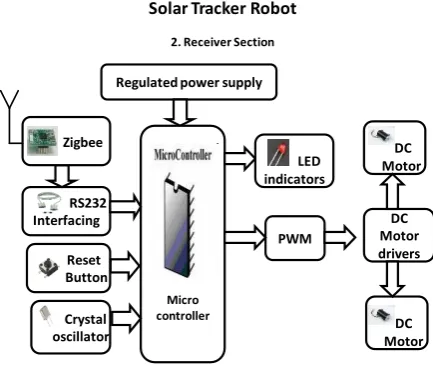
2. Receiver Section
Regulated power supply
Micro controller
PWM
Crystal oscillator
LED indicators
DC Motor
DC Motor drivers DC Motor
RS232 Interfacing
Zigbee
Reset Button
Fig. 3 Architecture of base of solar tracker robot receiver section
B. Hardware Description
1) LDR Sensors: To detect the present of sunlight we have used LDR sensors. LDR is a special type of resistance whose value depends on the brightness of the light, which is falling on it. It has resistance of about 1 mega ohm when in total darkness, but a resistance of only about 5k ohms when brightness illuminated. When west cell (W) is in shadow, tracker rotates to east, while when east cell (E) in shadow, tracker will rotate to west [7].
ISSN: 2319-8753
I
nternational
J
ournal of
I
nnovative
R
esearch in
S
cience,
E
ngineering and
T
echnology
(An ISO 3297: 2007 Certified Organization)
Vol. 2, Issue 10, October 2013
3) Digital Compass (HMC6352): The HMC6352 is a fully integrated compass module that combines 2-axis
magneto-resistive sensors with the required analog and digital support circuits, and algorithms for heading computation. The HMC6352 communicates via a two-wire I2C bus system as a slave device. The digital compass provides the feedback to the robot with respect to the tracker.
4) Microcontroller (PIC16F877A):PIC16F877A from Microchip is a single microcontroller which is very easy to be
assembled, programmed and also the price is very cheap. One unit of PIC16F877A microcontroller can be programmed and erased so many times.PIC includes features for entire analog as well as digital form of operations. Two PIC microcontrollers are used in the project. It plays a major role as the coordination between different components in the circuit is maintained by the microcontroller.
5) Zigbee: Zigbee is a wireless technology developed as an open global standard to address the unique needs of low-cost, low-power, wireless sensor networks. This network is one of the widely used open source wireless network available in the market. In the project we use Zigbee (RF Transceiver). The PC provides the information to the Zigbee module. The Zigbee at the robot receives the command and microcontroller (on board computer) controls the direction respectively.
6) DC Motors: A DC Motor is a mechanically commutated electric motor powered from direct current (DC). Modern
DC motors are often controlled by power electronics systems called DC drives. H-Bridge circuits are often used in robotics and other applications to allow DC motors to run forwards and backwards. H bridges are available as integrated circuits, or can be built from components. The H-bridge arrangement is generally used to reverse the polarity of the motor.
V. RESULTS
The project is designed such that the solar powered robot/vehicle with tracker set up using DC motor; limit switch and LDR sensors is controlled using the PC successfully. The robot when placed in the sunlight since morning to evening, the tracker could track the maximum sunlight and the power obtained through it could be used to operate the robot according to the commands given through the PC.
VI.CONCLUSION
Based on the results, the objective of developing the project has been achieved. Integrating features of all the hardware components used have been developed in it. Presence of every module has been reasoned out and placed carefully, thus
contributing to the best working of the unit. Secondly, using highly advanced IC’s with the help of growing technology,
the project has been successfully implemented. The project demonstrated that implementing solar tracking on mobile robots can be done successfully. Thus the project has been successfully designed and tested.
VII.FUTURE SCOPE AND RECOMMENDATIONS
In future we can use this project in several applications by adding additional components to it. The project can be extended by using sensors which detects any leakage of LPG gas, smoke or any fire and alerts the user through alarm. It can be used for warfield and monitoring applications in far off areas. The solar tracking robot involves wired connections which makes it water sensitive. It can be made more powerful by more mechanical advancements.
ACKNOWLEDGEMENT
ISSN: 2319-8753
I
nternational
J
ournal of
I
nnovative
R
esearch in
S
cience,
E
ngineering and
T
echnology
(An ISO 3297: 2007 Certified Organization)
Vol. 2, Issue 10, October 2013
REFERENCES
[1] Zhao mingguo, Zhao jie, Cui ze, “Remote operation of robot system based on Internet –Tele robot,” Journal of Harbin University of Science and Technology, 2001.
[2] C. Saravanan, Dr. M. A. Panneerselvam, and I. William Christopher,” A Novel Low Cost Automatic Solar Tracking System,” International Journal of Computer Applications, 31(9), pp.62-67, October 2011.
[3] S. Abdullah and S. Nijmeh, “Two-Axis Sun Tracking with PLC Control,” Energy Conversion and Management, vol. 45, p.1931-1939, 2004.
[4] A. Canova, L. Giaccone, and F. Spertino, “Sun Tracking for Capture Improvement,” in 22nd European Photovoltaic Solar Energy Conference EUPVSEC, WIP Renewable Energies, Milano, p.3053- 3058., September 2007
[5] H.D. Mohring, F. Klotz, and H. Gabler, “Energy Yield of PV Tracking Systems,” in 21st European Photovoltaic Solar Energy Conference - EUPVSEC, WIP Renewable Energies, Dresden, p. 2691-2694, September 2006.
[6] L. Narvarte and E. Lorenzo, “Tracking Gains and Ground Cover Ratio," in 22nd European Photovoltaic Solar Energy Conference - EUPVSEC, WIP Renewable Energies, Milano, p.3153-3156., September 2007.
[7] Iovine, Robots, Androids, and Animatrons: 12 Incredible Projects You Can Build, New York: McGraw-Hill, 2002.
[8] Gadewadikar. J, “Microprocessor Based Solar Tracking System Using Stepper Motor,” S G S Institute of Technology and Science, Indore, 1997. [9] Jong Kiun Kiet, “Miniature Solar Tracker,” Degree Thesis, University Tun Hussien Onn, Malaysia, 2006.
[10] Alexandru C. and Pozna C, “Different Tracking Strategies for Optimizing the Energetic Efficiency of A Photovoltaic System,” Transylvania