Serialization of Proof-of-work Events: Confirming Transactions via
Recursive Elections
Yonatan Sompolinsky, Yoad Lewenberg, and Aviv Zohar
School of Engineering and Computer Science, The Hebrew University of Jerusalem, Israel
{yoni sompo,yoadlew,avivz}@cs.huji.ac.il
Abstract
Bitcoin utilizes the Nakamoto Consensus to achieve agreement on a consistent set of transactions, in the permissionless setting, where anyone can participate in the protocol anonymously. Since its rise, many other permissionless consensus protocols have been proposed. We present SPECTRE, a new protocol for the consensus core of cryptocurrencies that remains secure even under high throughput and fast confirmation times. At any throughput, SPECTRE is resilient to attackers with up to 50% of the computational power (reaching the limit defined by network congestion and bandwidth constraints). SPECTRE can operate at arbitrarily high block creation rates, which implies that its transactions confirm in mere seconds (limited mostly by the round-trip-time in the network).
SPECTRE’s underlying model falls into the category of partial synchronous networks: its security depends on the existence of some bound on the delivery time of messages between honest participants, but the protocol itself does not contain any parameter that depends on this bound. Hence, while other protocols that do encode such parameters must operate with extreme safety margins, SPECTRE converges according to the actual network delay.
1. INTRODUCTION
Bitcoin is a novel cryptocurrency system, and an accompanying protocol, invented and deployed by Satoshi Nakamoto [13]. Transactions made in the currency are organized in a public ledger,the blockchain. Eachblock in the chain is a batch of transactions that were published by users of the currency. The blockchain contains consistent transactions only, as new blocks that extend it are required to maintain consistency.
Unfortunately, Nakamoto Consensus has severe scalability limitations [5], [18], [14]: adjusting the protocol to support a high transaction throughput – by creating larger or more frequent blocks – requires stronger assumptions on the underlying network, hence smaller safety margins.
In this paper we propose a new protocol, SPECTRE, that achieves high scalability. Transactions in SPECTRE can be confirmed within seconds, and the throughput can be improved by orders-of-magnitude over Bitcoin; it is limited by the network infrastructure and capacity only. The protocol thus alleviates the security-scalablility trade-off imposed by Nakamoto Consensus. In SPECTRE, every block is counted and integrated into the ledger. Technically, SPECTRE generalizes Nakamoto’s blockchain into a direct acyclic graph – a block DAG. By maintaining a full DAG of blocks, SPECTRE can allow miners to create blocks concurrently and much more frequently. This design is intended to avoid the need for nodes to reconcile their different world views regarding the identity of a selected chain at the time of block creation.
Reasoning about the consensus properties of SPECTRE requires a new formal framework. Indeed, previous work that formalized the robustness of Nakamoto Consensus [7], [15] focused on robustness of blocks in the ledger. Extending this to the robustness of transactions in SPECTRE is not immediate, because all blocks are incorporated into the DAG, but individual transactions embedded in the DAG may still be rejected due to conflicts.
Thus, this paper contains two contributions: (1) an inherently scalable protocol, SPECTRE; and (2) a formal framework for cryptocurrency payment protocols that do not necessarily use a chain of blocks to represent their ledger (in this respect we differ from previously proposed frameworks). We apply it on SPECTRE, and provide rigorous analysis of SPECTRE’s robustness properties.
The main technique behind SPECTRE is a voting algorithm regarding the order between each pair of blocks in the DAG. The voters are blocks (not miners); the vote of each block is interpreted algorithmically (and not provided interactively) according to its location within the DAG. We show that the majority’s aggregate vote becomes irreversible very fast, and we use this majority vote to extract a consistent set of transactions. Essentially, Bitcoin’s longest chain rule can be seen as a voting mechanism as well – each block adding one vote to every chain that contains it – the highest-scoring chain being also the longest one. However, Bitcoin’s selection of a “single winner chain” makes it inherently unscalable, as we demonstrate below.
2. FORMALSTATEMENT OF THEPROBLEM
In this section we describe a generic framework for reasoning about the security and scalability properties of cryptocurrency protocols. Generally, in our framework, a cryptocurrency protocol specifies two sets of instructions – the mining protocol, regarding the creation of blocks and formation of the block ledger, and the TxO protocol, interpreting the ledger and extracting from it a consistent subset of valid transactions. Since transactions in the protocol are accepted with increasing probability as time goes on, users additionally run the Robust TxO protocol, to quantify therobustness of an accepted transaction – a bound on the probability that it will ever be reversed, when a malicious attacker attempts to do so (Bitcoin transactions for example, can be reversed if the attacker manages to produce a longer alternative chain on which they are not present – this event occurs with decreasing probability as time passes). Next, we present our framework in the abstract sense, so as to keep it as general as possible. In Section 4, we present a protocol that meets the requirements and uses a block DAG to do so. We defer the specifics of the solution and the mining protocol, till then. We will use our framework to make clear the sense in which SPECTRE avoids the security-scalability trade-off that Bitcoin suffers from.
Transactions. A transaction is typically denoted tx. inputs(tx) is the set of transactions that must be accepted before tx can be accepted; these are the transactions that have provided the money that is being spent in tx. Two different transactions tx1 and tx2 conflict if they share
a common input, i.e., they double spend the same money; we then write tx2 ∈conf lict(tx1)
(this is a symmetric relation).
Mining protocol.We denote byN the set of nodes, aka miners. Miners maintain and extend the ledger, by adding transactions to it and propagating messages, according tothe mining protocol. The propagation time of a message of sizeB KB to all nodes in the system is assumed to be under D=D(B) seconds. For now, we regard the mining protocol as an abstract set of rules that miners must follow. We denote byhonestthe set of nodes that always follow the protocol’s instructions, and bymaliciousthe complementary of this set.
In the family of protocols we focus on, miners possess computational power and perform proof-of-work (PoW). We denote byα the attacker’s relative computational power. Formally, it is the probability that the creator of the next PoW in the system belongsmalicious; this is well defined, as PoW creation is modeled as a memoryless process [13], [18], [17].
Formation of ledger.The result of the mining protocol is an (abstract) public data structure G
containing transactions (to be instantiated later, in our solution proposal, as a block DAG), aka the ledger. Nodes replicate the ledger locally. As they might hold slightly different views of the ledger (e.g., since blocks take time to propagate to all nodes), we denote byGv
t the state of the ledger as observed by node v at time t; we writeGt when the local context is unimportant.
TxO protocol. Given a public ledger G, the TxO protocol extracts a consistent subset of transactions from G, denoted T xO(G). Every transaction in this set must have its inputs in it as well, and cannot conflict with another transaction in the set.
will remain so forever. GivenGt,the RobustTxO protocolspecifies a subset ofT xO(Gt), denoted
RobustT xO(Gt), which represents the set of accepted transactions that are guaranteed to remain so forever, up to an error probability of. RobustT xO takes as inputGvt (the local replicate of
v), and the values of D,λ,α, and.1 A tx in (Robust) T xO is said to be(robustly) accepted.
Desired properties.Thus, the following properties are essential for a cryptocurrency protocol:
Property 1 (Consistency). The accepted set is consistent: For any ledgerG, 1) iftx∈T xO(G) and tx2 ∈inputs(tx) then tx2 ∈T xO(G).
2) iftx∈T xO(G) and tx2 ∈conf lict(tx) then tx2 ∈/T xO(G).
Property 2 (Safety). If a transaction is robustly accepted by some node, then w.h.p. it will be robustly accepted forever by all nodes, and the expected waiting time for this event is constant. Formally,∀ >0,∀v∈ N, iftx∈RobustT xO(Gvt, D, λ, α, ), then w.p. of at least1−, there exists a timeτ ≥tsuch that ∀u∈ N,∀s≥τ :tx ∈RobustT xO(Gus, D, λ, α, ). If this event occurs, the expected value of τ−tis constant.
Property 3 (Weak Liveness). If a transaction is published in the ledger, it is robustly accepted by any node after a short while, provided that its inputs are robustly accepted and that no conflicting transactions are published. Formally, let v ∈ N, tx ∈ Gvt, and > 0. Define by ψ(t, D, λ, α, ) := min{s≥t:tx∈RobustT xO(Gvs, D, λ, α, )} the waiting time for its robust acceptance by v. Then, E
h
ψ−t|inputs(tx)⊆T xO(Gψv)∧conf lict(tx)∩Gvψ =∅i
is constant.
Definition 1. Thesecurity threshold of a cryptocurrency protocol is defined by the maximal α
(attacker’s relative computational power) for which Properties 1-3 hold.
The expected values of τ−tandψ−t, as written in Properties 2 and 3, define the expected waiting time for confirmation of transactions in the given protocol.
The “weakness” of the Liveness property corresponds to the fact that we do not guarantee (though it is still hard for an attacker to prevent) a resolution in case conflicting transactions were published soon one after the other. Contrast this to traditional consensus protocols, where all conflicts are required to be decided in finite time, a property usually referred to as Liveness. Observe, however, that an honest user of the system will never publish conflicting transactions, and will transfer money only after he robustly accepted the original funds (the inputs) himself; payments of honest users are thus guaranteed to meet the conditions formalized in Weak Liveness, and to be robustly accepted. On the other hand, an attacker trying to defraud must keep his attack secret before publishing the conflict, until the victim robustly accepts; but then the victim is guaranteed that w.h.p. his transaction will not be reversed. Therefore, these two properties together ensure that payments of honest users will be robustly accepted in constant expected time, and that they remain robustly accepted forever, w.h.p.
In this work we set out to design a protocol that can support a large throughput, and achieve fast confirmation times, while maintaining a high security threshold.
3. SPECTREVSBITCOIN– OVERVIEW
SPECTRE adopts many of Bitcoin’s solution features. In particular, miners create blocks, which are batches of transactions. A valid block must contain a solution to the PoW puzzle (Bitcoin for example, uses PoW that is based on partial SHA256 collisions). The block creation rate, denoted λ, is kept constant by the protocol by occasional readjustments of the PoW difficulty; we elaborate on this mechanism in SPECTRE in Appendix D. The size of a block is limited by some B KB.
Bitcoin’s throughput can be increased by increasing either the block size limit (which in turn increases D) or\and the block creation rateλ. Alas, it is well established that the security threshold of Nakamoto Consensus deteriorates asD·λincreases:
Theorem 2. [Bitcoin is not scalable] The security threshold of the Bitcoin protocol goes to zero asD·λincreases.
The proof of this theorem appears in various forms in previous works, see [18], [15], [7]. To maintain a high security threshold, Bitcoin suppresses its throughput by keepingλlow – 1/600 blocks per second. This large safety margin is needed because λ (and B) are decided once and for all at the inception of the protocol. Consequently, even when the network is healthy and D is low, Bitcoin suffers from a low throughput – 3 to 7 transactions per second, and slow confirmation times – tens of minutes. In contrast, SPECTRE’s throughput can be increased without deteriorating the security threshold:
Theorem 3. [SPECTRE is scalable] For any D·λ, SPECTRE’s security threshold is 50%.
Therefore, in the context of the Distributed Algorithms literature, SPECTRE falls into the partial synchronous setup, as it remains secure for any value ofD. Theorem 3 is proven rigorously in Appendix E.
Of course, λcannot be increased indefinitely or otherwise the network will be flooded with messages (blocks) and become congested. Theorem 3 “lives” in the theoretical framework (specified in Section 2), which does not model the limits on nodes’ bandwidth and network capacity. Practically, these barriers allow for a throughput of thousands of transactions per second, by settingλ= 10andb= 100, for instance. For further discussion refer to Appendices B and D.
Asymptotically, SPECTRE’s confirmation times are in Oλln(1(1−/2α)) +1−D2α
4. THESPECTRE PROTOCOL
A. The generation of the block DAG
As in Bitcoin, participating nodes (calledminers) create blocks of transactions by solving PoW puzzles. A block specifies its direct predecessors by referencing their ID in its header (a block’s ID is obtained by applying a collision resistant hash to its header); we will describe in the next subsection how these predecessors are chosen. This results in a structure of a direct acyclic graph (DAG) of blocks (as blocks can only reference blocks created before them), denoted typically
G= (C, E). Here,Crepresents blocks andErepresents the hash references. We will frequently writez∈Ginstead of z∈C.
past(z, G)⊂C denotes the subset of blocks reachable fromz, and similarlyf uture(z, G)⊂ C denotes the subset of blocks from which z is reachable; these are blocks that were provably created before and after z, correspondingly. Note that an edge in the DAG points back in time, from the new block to previously created blocks which it extends. A node does not consider a block as valid until it receives its entire past set. We denote bycone(z, G)the set of blocks that the DAG directly orders with respect toz:cone(z, G) :=past(z, G)∪ {z} ∪f uture(z, G), and by anticone(z) the complementary of cone(z, G). The set past(b, G) is fixed once and for all at the creation of b (in sharp contrast to f uture(z, G) and anticone(z, G) that may grow as blocks are added later to the DAG), hence we can simply write past(b) without noting the context.
The unique blockgenesis is the block created at the inception of the system, and every valid block must have it in its past set. In addition, we relate to a hypothetical block,virtual(G). This block satisfies past(virtual(G)) = G. While its role is merely methodological, virtual(G)
can also be thought of as representing the next block that a node whose current observed DAG isG attempts to create.
Gvt denotes the block DAG observed by node v ∈ N at time t. This DAG represents the history of all (valid) block-messages received by the node, instantiating the abstract data structure assumed in Section 2.
B. The mining protocol
SPECTRE’s instructions to miners are extremely simple:
1) When creating or receiving a block, transmit the block to all peers.
2) When creating a block, embed in its header a list containing the hash of all leaf-blocks (blocks with in-degree 0) in the locally-observed DAG.
Note that these instructions allow miners to operate concurrently irrespective of potential conflicts in the contents of their blocks.
C. TheT xO protocol
a way that will be agreed upon by all nodes (eventually) is the main challenge of SPECTRE. We now describe how this is done.
The topology of a block DAG G induces a natural precedence-relation over blocks: if x is reachable from y (i.e., x ∈ past(y)) then x precedes y, as it was provably created before it. SPECTRE extends this relation into a complete relation overG’s blocks, denoted≺. This order is immediately translatable into an order over transactions inG: tx1 precedes tx2 if the block
containing the former precedes that containing the latter. This relation, in turn, induces a natural subset of accepted transactions: tx is accepted if it precedes all of its conflicting transactions in G. The relation ≺ is generated by a pairwise vote procedure that occurs independently for every pair of blocks. The operation of this layer will be explained in the next subsections.
Although we may at times refer to ≺ as though it orders blocks, we stress that ≺ is not necessarily a transitive relation. It is possible to have a series of blocks that precede each other cyclically.2 The lack of a total linear ordering over blocks is in fact the way SPECTRE utilizes the weaker consensus requirements of our framework, as a linear order is equivalent to solving the consensus problem [3].
Pairwise ordering of blocks. The basic layer of SPECTRE involves deciding on a pairwise order over the block DAG. Fix two blocks x, y ∈ G. In order to decide if x ≺ y or y ≺ x, we interpret the structure of the DAG as representing an abstract vote. Every block z ∈ G is considered a voter with respect to the pair(x, y), andits vote is inferred from the structure of the DAG. We represent a vote by a number in {−1,0,+1}, and we denote z’s voting-profile on all pairs byvote(z, G).votex,y(z, G) =−1representsxprecedingy(x≺y),votex,y(z, G) = +1 representsy preceding x, andvotex,y(z, G) = 0 represents a tie. Importantly, vote(z, G) is an asymmetric relation: votey,x(z, G) =−votex,y(z, G).
To simplify presentation, we associate a vote with virtual(G) as well. Recall that the virtual block of G is a hypothetical block which satisfies past(virtual(G)) = G. The vote of virtual(G) represents essentially the aggregated vote of the entire block DAG. The basic rules of z’s vote, for any z∈G∪ {virtual(G)}, are as follows:
1) if z ∈G is in f uture(x) but not in f uture(y) then it will vote in favour of x (i.e., for
x≺y).
2) ifz∈Gis inf uture(x)∩f uture(y)thenz’s vote will be determined recursively according to the DAG that is reduced to its past, i.e., it has the same vote as virtual(past(z)). If the result of this vote is a tie,z breaks it arbitrarily.3
3) ifz∈Gis not in the future of either blocks then it will vote the same way as the vote of the majority of blocks in its own future.
4) ifz is the virtual block ofG then it will vote the same way as the vote of the majority of blocks in G.
5) finally, (for the case where z equals x or y), z votes for itself to succeed any block in
past(z) and to precede any block outsidepast(z). 2
This is related to the Condorcet paradox in social choice [2].
DAG used in recursive call for block 12
(X<Y)
(X<Y)
(X<Y) (X<Y)
(X<Y)
(X<Y)
(X<Y)
(Y<X)
(Y<X)
(X<Y)
(X<Y)
(Y<X) (Y<X)
(X<Y)
1
2
3
4
X
5
Y
6
7
9
10
8
12
11
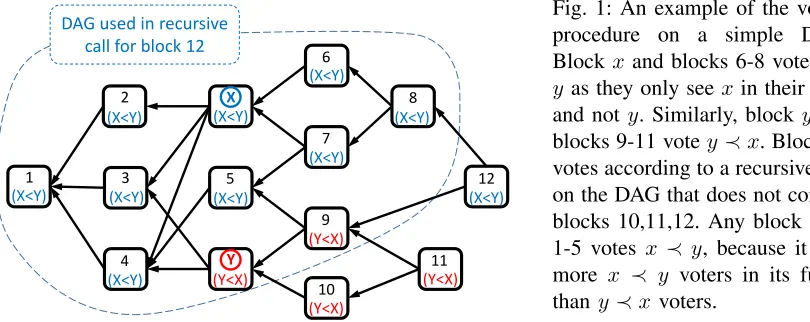
Fig. 1: An example of the voting procedure on a simple DAG. Block x and blocks 6-8 vote x≺ y as they only seexin their past, and not y. Similarly, block y and blocks 9-11 votey≺x. Block 12 votes according to a recursive call on the DAG that does not contain blocks 10,11,12. Any block from 1-5 votes x ≺ y, because it sees more x ≺ y voters in its future than y ≺x voters.
Intuitively, the first rule dictates that a block that was honestly published gain votes over blocks that are secretly withheld, as honest nodes keep adding new blocks to its future set. The second and fourth rules together guarantee majority amplification, as new blocks add votes that comply with and enhance previous decisions. The third rule is the most subtle; basically, it allows blocks in past(x) (in addition to those in f uture(x)) to vote in its favour against y, in casey was withheld for a long time. This is needed to counter a pre-mining attack scheme, which will be described in future sections. Notice that all votes respect the DAG’s topology: If
x is reachable from y then all blocks vote unanimously x≺y.
Figure 1 illustrates the voting procedure with regards to a single pair of blocks (x,y). Additional examples along with intuition regarding this key algorithm are provided in Appendix A.
The voting procedure is implemented in Algorithm 1 below. In the algorithm,sgng(n) =−1
forn <0,sgng(n) = +1forn >0, andsgng(0) = 0. To see that the recursion calls from line 4 halt, observe that they take as inputs DAGs strictly smaller thanG(becausepast(z)(G), and
hence eventually all arrive at the base case G =∅ and return. The algorithm is written in its na¨ıve form, for the sake of readability, with a run time of O(|G|3). We have written a more sophisticated implementation of this procedure, which runs in expected time of O(d·λ). We will make the code available online in the full version.
The pairwise ordering of SPECTRE has the following highly valuable property:
Property 4. Once a block is published, the set of blocks that precede it in the pairwise ordering closes fast—w.h.p. it consists only of blocks published before or right after its publication.
Algorithm 1 CalcV otes
Input: G– a block DAG
Output: vote(virtual(G))– a pairwise ordering of blocks inG 1: ifG=∅ then
2: returnan empty ordering 3: for allz∈Gdo
4: vote(z, past(z))←CalcV otes(past(z))and break ties arbitrarily 5: for allz∈Gin some topological order (from leaves to root) do 6: for allx, y∈G(x6=y) do
7: if x∈past(z)∧y /∈past(z)
∨(x∈past(z), y=z)then 8: votex,y(z, G)← −1
9: else if y∈past(z)∧x /∈past(z)
∨(y∈past(z), x=z)then 10: votex,y(z, G)←+1
11: else ifx, y∈past(z)then
12: votex,y(z, G)←votex,y(z, past(z)) 13: else ifx, y /∈past(z)then
14: votex,y(z, G)←sgng
P
z0∈f uture(z,G)votex,y(z0, G)
15: vote(virtual(G), G)←sgng P
z∈Gvote(z, G)
16: returnvote(virtual(G), G)
Accepting transactions. Equipped with the pairwise relation over blocks, we now turn to construct the set of accepted transactions. To maintain consistency, we mark a transaction as accepted iff all three conditions below hold true:
1) all of its inputs have been accepted.
2) all conflicting transactions from its anticone set (i.e., that are not related to it topologically) are contained in blocks that are preceded by the block containing the transaction.
3) all conflicting transactions from its past set (i.e., that precede it in the DAG, topologically) have been rejected.
Algorithm 2 implements these rules, and outputs a set of accepted transactions. It operates recursively, and should be initially called with T xO(G, G) (we later denote this simply by
T xO(G)). In the algorithm, the notation ZG(tx) stands for all blocks in G that contain tx. Some complexity arises due to possible multiple copies of the same transaction in the DAG; we denote by[tx] the equivalence class containing all oftx’s copies.
The third part of the SPECTRE protocol, namely, the RobustT xO procedure, is rather involved. We defer its description to Appendix C.
5. HIGH-LEVELOVERVIEW OF THEPROOF
Algorithm 2 T xO
Input: G – a block DAG, subG – a subDAG of G which is the past of a (possibly virtual) block
Output: T x– a hyper-set of valid transactions in G
1: vote(virtual(G))←CalcV otes(G) 2: T x← ∅
3: for all z1 ∈subG do
4: for all tx∈z1 do
5: for all tx2 ∈G∩conf lict(tx) do
6: for allz2 ∈ZG(tx2)∩anticone(z1, G) do
7: if votez1,z2(virtual(G))≥0then 8: break (to line 4 and pick next tx) 9: if[tx2]∩T xO(G, past(z1))6=∅ then
10: break (to line 4 and pick next tx) 11: for all [tx3]∈inputs(tx) do
12: if[tx3]∩T xO(G, past(z1)) =∅ then
13: break (to line 4 and pick next tx) 14: addtx to T x
15: return T x
security properties of transactions (as we do formally in Appendix E). Concretely, we wish to prove the following statement (in the proposition, Gpubr :=∪u∈honestGur):
Proposition. Assume blockxwas published at timetpub (x∈Gpubtpub), andynot published before
time tacc (y /∈Gpubtacc).
4 Let T =t
acc−tpub. Then the probability that x will not always precede
y (Pr (∃u∈honest,∃s≥tacc:votex,y(virtual(Gus))≥0)) decreases exponentially in T.
Proof overview. Assume that the event in which y comes to precede x in some future DAG occurs. Lets be the earliest moment in time that such an event occurred at some node. Notice that y cannot be in the past of x or in its future (otherwise their order is determined by the topology and cannot be reversed). We thus assume henceforthy∈anticone(x).
The block race after x is published. We first consider the votes of blocks created after the publication of blockx:
• (Almost) all honest blocks created between tpub and tacc vote forever in favour of x≺y, as
they have x in their past but not y. Denote byn1 the number of such blocks.
• All honest blocks created between tacc and svote in favour ofx≺y, as well, by the choice of s. Denote by n2 the number of such blocks.
• Denote by m1 and m2 the number of blocks created by the attacker in the time intervals
corresponding to n1 andn2. Honest nodes possess a fraction 1−α > αof the computational 4
power. Consequently, for any positive constantC, the probability that the relationm1+m2+ C−(n1 +n2) ≥0 will ever be satisfied decreases exponentially with n1. This is typically
analyzed as the probability that a biased random walk on the integers, beginning at C, returns to the origin (see [13], [17], [18]).
The term m1+m2−(n1+n2) represents the aggregate vote betweenx and y, considering
only blocks created after x’s publication. We now show that blocks that the attacker prepared in advance before x’s publication, in a preparatory “pre-mining” stage, do not give him more than some constant advantage (which will be counted into C above).
The pre-mining stage.Honest blocks that were created beforex was published are typically in its past (apart from a small set of blocks) and hence have their vote decided by the majority of votes in their future (as per Alg. 1). Their vote is thus possibly subject to change as the DAG grows, and as the attacker publishes blocks.
For every block z in the past of x we must therefore consider the number of blocks above it that vote in favour of x and those that vote against it. Denote by Xz the gap between the number of attacker blocks and honest blocks in the future ofz, up to timetpub. In Lemma 24 we show that the worst case gapXz (over all blocks z∈past(x)) can be modeled as a reflecting random walk over the nonnegative integers, with bias towards the origin. Consequently, the best gap that the attacker can secretly gain over a block in past(x) has an exponentially decaying tail, and, in particular, is bounded by a constant w.h.p.
All in all, as tacc−tpub grows, the number n1 of votes, or “confirmations”, thatx receives
increases linearly, and the probability that the attacker will be able to reveal enough blocks so that some z ∈ past(x) will have more y ≺ x votes in its future than x ≺y votes, decreases exponentially inn1. Since this holds for all z∈past(x) uniformly, it implies in particular that
thegenesis block has morex≺y votes in its future thany ≺x votes (unless an exponentially unlikely event occurred). The vote of the virtual block is determined by that of the genesis
block (this is easy to see, and is proven in Lemma 13), completing the argument.
The proposition above is the gist of Lemmas 14 and 15. In the above sketch, we abstracted out many additional subtleties and details. For instance, honest blocks that were createdDseconds around tpub, tacc, or s may not have contributed votes in favour of x. In our formal analysis (Appendix E) we count these as attacker blocks, accounting for the worst case, and add them to the aforementioned constant C. We additionally show how the user can measure n1 correctly,
even if the attacker publishes his blocks in an attempt to delay acceptance. 6. RELATED WORK
Previous research has produced several suggestions for protocols that attempt to address the security-scalability challenge, but all protocols still provide a total order over blocks:
Due to the reliance on a chain, Inclusive mitigates but does not avoid the security-scalability trade-off. The Inclusive paper further includes a game theoretic analysis of the incentives of nodes to embed different transactions in their blocks (without the ability to coordinate).5
Bitcoin-NG [6] provides a clever chain structure that is composed of two types of blocks: key blocks that require PoW but contain no transactions, and mini-blocks that do not require PoW but do contain transactions. Bitcoin-NG manages to obtain a significant scalability increase, but its key blocks are still generated slowly, hence, confirmation times remain high. Another line of work bootstraps PoW to instantiate a committee that is later used to run classical BFT protocols. Examples from this line of research include Byzcoin [9], a work by Decker et. al. [4], Hybrid Consensus [16], and recently Solidus [1]. Protocols built in this manner are highly scalable, building upon work in consensus protocols, but lack some of the properties achieved by Bitcoin. They typically require large committees and require committee members to remain online for long periods of time, making them susceptible to network isolation and DoS attacks. [9], [4], [1] additionally fail without recovering if the committee is ever composed of a high fraction of malicious entities (Bitcoin, on the other hand, is self-stabilizing). Moreover, they require forward secrecy. If the cryptographic keys of a sufficient fraction of the committee at any point in the past is compromised, the attacker can create an alternative equally acceptable version of events. The Algorand protocol [11] is a proof-of-stake based algorithm that uses the ownership of currency itself to achieve a scalable consensus protocol. It utilizes additional techniques (based on VRFs) to hide the committee members that take place in the consensus protocol. In contrast, miners in SPECTRE are not directly involved in any explicit consensus protocol and moreover can operate with little regard of other nodes’ synchronization status. Honey Badger [12] is an atomic broadcast protocol that is oblivious to network parameters and does not require tuning under different network conditions (similarly to SPECTRE). It is set in the classical permissioned setting where identities of the participants are known.
7. CONCLUSION
In this work we presented SPECTRE, a new cryptocurrency protocol that is inherently scalable. Unlike Bitcoin and its many variants, SPECTRE is secure against attackers with less than 50% of the computational power, even when its throughput is increased and the propagation delay becomes non-negligible. Our results demonstrate that SPECTRE can achieve incredibly low confirmation times, especially compared to Nakamoto Consensus. Further work to improve and tighten the acceptance policy we derived can lower confirmation times further. Key to SPECTRE’s achievements is its willingness to delay the decision regarding visibly double-spent transactions. It thus solves a weaker problem than traditional consensus protocols. This fact also makes it less suitable for systems like Ethereum, where a total order over transactions is required The core algorithm of SPECTRE – the pairwise voting procedure (Alg. 1) – is nontrivial. We encourage the reader to refer to Appendix A for intuition and illustrations about its operation.
5
REFERENCES
[1] Ittai Abraham, Dahlia Malkhi, Kartik Nayak, Ling Ren, and Alexander Spiegelman. Solidus: An incentive-compatible cryptocurrency based on permissionless byzantine consensus. arXiv preprint arXiv:1612.02916, 2016.
[2] Kenneth J Arrow, Amartya Sen, and Kotaro Suzumura. Handbook of Social Choice & Welfare, volume 2. Elsevier, 2010.
[3] Miguel Correia, Nuno Ferreira Neves, and Paulo Ver´ıssimo. From consensus to atomic broadcast: Time-free byzantine-resistant protocols without signatures. The Computer Journal, 49(1):82–96, 2006.
[4] Christian Decker, Jochen Seidel, and Roger Wattenhofer. Bitcoin meets strong consistency. InProceedings of the 17th International Conference on Distributed Computing and Networking, page 13. ACM, 2016.
[5] Christian Decker and Roger Wattenhofer. Information propagation in the bitcoin network. In 13th IEEE International Conference on Peer-to-Peer Computing (P2P), Trento, Italy, September 2013.
[6] Ittay Eyal, Adem Efe Gencer, Emin G¨un Sirer, and Robbert Van Renesse. Bitcoin-ng: A scalable blockchain protocol. In 13th USENIX Symposium on Networked Systems Design and Implementation (NSDI 16), pages 45–59, 2016.
[7] Juan Garay, Aggelos Kiayias, and Nikos Leonardos. The bitcoin backbone protocol: Analysis and applications. In
Annual International Conference on the Theory and Applications of Cryptographic Techniques, pages 281–310. Springer, 2015.
[8] Aggelos Kiayias and Giorgos Panagiotakos. On trees, chains and fast transactions in the blockchain. Cryptology ePrint Archive, Report 2016/545, 2016.
[9] Eleftherios Kokoris-Kogias, Philipp Jovanovic, Nicolas Gailly, Ismail Khoffi, Linus Gasser, and Bryan Ford. Enhancing bitcoin security and performance with strong consistency via collective signing. In 25th USENIX Security Symposium, USENIX Security 16, Austin, TX, USA, August 10-12, 2016., pages 279–296, 2016. [10] Yoad Lewenberg, Yonatan Sompolinsky, and Aviv Zohar. Inclusive block chain protocols. InInternational
Conference on Financial Cryptography and Data Security, pages 528–547. Springer, 2015.
[11] Silvio Micali. Algorand: the efficient and democratic ledger. arXiv preprint arXiv:1607.01341, 2016.
[12] Andrew Miller, Yu Xia, Kyle Croman, Elaine Shi, and Dawn Song. The honey badger of bft protocols. In
Proceedings of the 2016 ACM SIGSAC Conference on Computer and Communications Security, pages 31–42. ACM, 2016.
[13] Satoshi Nakamoto. Bitcoin: A peer-to-peer electronic cash system, 2008.
[14] Rafael Pass, Lior Seeman, and Abhi Shelat. Analysis of the blockchain protocol in asynchronous networks.
IACR Cryptology ePrint Archive, 2016:454, 2016.
[15] Rafael Pass, Lior Seeman, and Abhi Shelat. Analysis of the blockchain protocol in asynchronous networks.
IACR Cryptology ePrint Archive, 2016:454, 2016.
[16] Rafael Pass and Elaine Shi. Hybrid consensus: Efficient consensus in the permissionless model. Cryptology ePrint Archive, Report 2016/917, 2016.
[17] Meni Rosenfeld. Analysis of hashrate-based double spending. arXiv preprint arXiv:1402.2009, 2014. [18] Yonatan Sompolinsky and Aviv Zohar. Secure high-rate transaction processing in bitcoin. InInternational
Conference on Financial Cryptography and Data Security, pages 507–527. Springer, 2015.
APPENDIXA
INTUITION ANDEXAMPLES
In this section we provide some basic explanations and intuitions regarding the operation of SPECTRE. We focus primarily on explaining the ideas underlying Alg. 1 that is at the core of the protocol. We later go on to present examples for simple attacks that shed some light on how resilience is achieved.
(over other unknown blocks), and given that honest nodes publish their blocks quickly, hidden attacker blocks lose votes.
Intuition 2 (Majority amplification). Given blocks x, y that contain potential conflicts, blocks that are generated by honest participants after their publication reference both of them in the DAG. According to Alg. 1, these new blocks adopt the vote of the sub-DAG in their past with regards tox andy. Thus, if blockx precedes blocky, additional votes that support this decision are added, and the attacker will find it more difficult to reverse the vote.
Intuition 3 (Referencing recent blocks is beneficial). Blocks from the past vote according to their future. Thus if an attacker creates a block that does not reference recent blocks, it is at a disadvantage compared to other blocks that do (it loses votes from recent blocks it did not reference and did not “convince”).
4
5 6 7 8
9 10 11
1 2 3
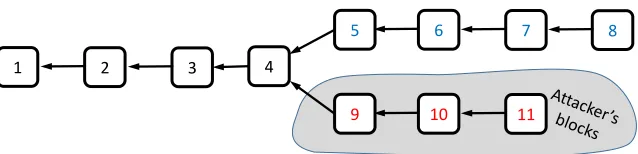
Fig. 2: SPECTRE coincides with the longest-chain rule when it is applied to “simple” chains of blocks. In the depicted DAG, the chain ending at block 8 is longer and would be selected in the longest chain protocol. In SPECTRE each one of the blocks 5,6,7,8 precedes each of the blocks in 9,10,11. Consider for instance blocks 6 and 10 and the pairwise vote that involves them. Blocks 6-8 vote strongly6≺10, as they see block 6 in their past but not block 10. Block 5 is a weak voter, as it sees neither 6 nor 10 in its past, hence it votes as the majority of its future (thus voting 6 ≺ 10 as well). For similar reasons, blocks 9-11 all vote 10 ≺ 6. Block 4, at the fork of the two chains, is a weak voters as well, as it sees neither 6 nor 10 in its past; it therefore votes according to the majority of future blocks. As block 4 sees four votes in favour of6≺10, and three votes in favour of 10≺6, it will vote in favour of 6≺10. Blocks 1-3 similarly vote according to their future, and see an increasing number of votes for 6≺10, adding their own vote to the result. Thus, the end result is that 6 precedes 10.
A. Equivalence to longest-chain
We now demonstrate how SPECTRE coincides with Bitcoin’s longest-chain rule, in the case of a “simple” fork between two chains. Consider the DAG illustrated in Fig. 2. In Bitcoin, the longer chain would be selected. Similarly, in the pairwise ordering of SPECTRE, each of the blocks in the longest chain 5,6,7,8 would precede each of the blocks in the shorter one 9,10,11. To see why this is true refer to the caption of the figure.
We now turn to examine two different attack scenarios, which we name double-spending, and censorship. Recall the requirement from our miner protocol: each miner is required to (i)
reference recent blocks, and to (ii) publish his blocks immediately. Each attack is basically a violation of one of these requirements. In the double-spending attack, the attacker delays the publication of a set of blocks (that includes a conflicting transaction), and in the censorship attack he publishes blocks but “ignores” a certain block and transactions inside it, hoping to convince nodes that it did not secure enough votes, and thus cannot be accepted.
B. Example of a double-spending attack
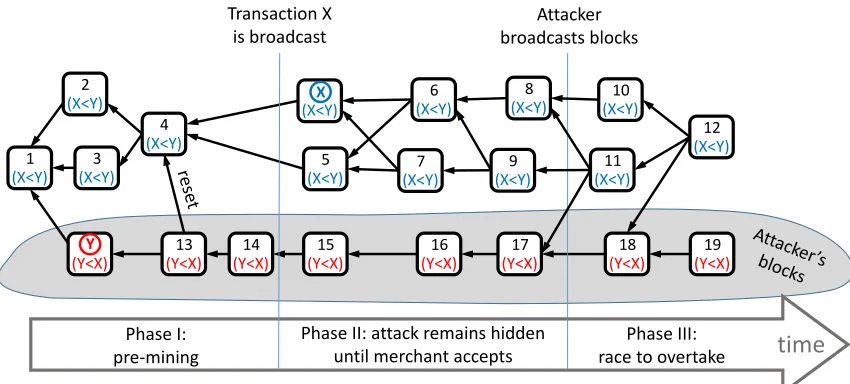
Fig. 3 depicts an (unsuccessful) double-spending attack. The attack is composed of three main phases:
(X<Y) 1
(X<Y)
3 (X<Y)
4
(X<Y) 5 (X<Y)
2
(X<Y) (X<Y)
6
(X<Y) 7
(Y<X) (Y<X) 13
(Y<X) 14
(Y<X) 16
(Y<X) 17
(Y<X) 18
Phase I: pre-mining
(X<Y) 8
(X<Y) 9
(Y<X) 15
time
Phase II: attack remains hiddenuntil merchant accepts
(X<Y) 11 Transaction X
is broadcast
Attacker broadcasts blocks
Phase III: race to overtake
(Y<X) 19 (X<Y)
10
(X<Y) 12
Y
X
Fig. 3: An example of the voting procedure on a DAG in which a double-spending attack is (unsuccessfully) attempted. Block x and blocks 6-8 vote strongly x ≺y as they only see x in their past, and noty. Similarly, blocky and blocks 13-19 vote stronglyy≺x. In the DAG which is the past of block 11, each of the blocks 1-5 sees more x≺y voters in its future thany≺x voters, hene each of them votes x ≺y. Block 11 votes (as the virtual block of its past votes), according to the majority in its past, thus it too votesx ≺y. A similar argument goes for the the vote of 11 and 12. Finally, aggregating the vote of all blocks in the DAG,x got more votes hence x≺y.
form a chain, and due to the voting rules in SPECTRE, will all vote y ≺x (blocks y,13,14). Blocks built by the honest node are unaware ofy (and also of x that is yet to be created), and will eventually vote according to the majority of future votes. During this phase, attacker blocks reference honest blocks that are built (in hopes of later convincing them to vote y ≺x). After some time, the attacker transmits the transaction to the network, and proceeds to phase II.
Notice that at the exact time that phase I ends, the attacker has more blocks above block 4 than honest nodes have, so it starts at an advantage: it will more easily sway the vote of block 4 towards y ≺x (this advantage later disappears as honest nodes typically build blocks faster than the attacker).
sincey is hidden from them. Some small number of blocks (created beforex propagated to the whole network – block 5 in this example) do not referencex, and so will vote according to the result of future votes.
Phase III: Race to overtake. Once x was -accepted by the victim, the attacker wishes to publish his secret blocks in hopes of causing his conflicting transaction in y to precede x. In this case, the transaction in x will be considered rejected, and the payment will be canceled (leaving the attacker with an item he did not pay for). He publishes his secret chain (which from this point on is referenced by honest nodes), and continues to build upon it. Blocks that he builds, again do not reference x, and so they vote y ≺x, supporting his goal. New honest nodes are for the first time exposed to the conflicting transactiony, and thus vote according to the result in the sub-DAG in their past.
Why the attack fails.First, notice that the attacker in the above example creates fewer blocks in each phase than the honest nodes. This will usually be the case if attackers have less computational power than all honest nodes. “Poisson bursts” in block creation by the attacker are possible, and this will allow him to overtake the network, but these are less likely if the attack lasts for a long period of time. The defender can control the length of phase II by waiting a long while before accepting the transaction, which decreases the probability of such bursts. If phase II is long enough, x will have more votes in this period than y. Weak blocks in the past ofx will then vote in favour ofx, according to this majority. Such blocks that look at their future begin a cascade: each block further in the past adds a vote that agrees with the majority of future blocks and thus strengthens the decision. The greater the majority obtained in Phase II, the less likely it is that the attacker will be able to catch up from behind in Phase III. The attack therefore depends heavily on successfully swaying the votes of blocks that were created just before x (e.g., block 4).
It is important to note that an attacker that creates more blocks in expectation than the honest network will succeed in carrying out this attack. The blocks voting y ≺ x would outnumber those who vote to the contrary. Hence the 50% threshold in Theorem 3.
C. Example of a censorship attack
Fig. 4 depicts an (unsuccessful) censorship attack. The attack is composed of a single main phase during which an attacker creates his own blocks, publishes them instantly, but also ignores (and does not reference) recent blocks created by the honest network. The figure depicts (in stage I on the left side) the current state of the blockchain (where all blocks are published at this point). An honest participant that then observes the network and wishes to tell if a transaction in block
x is secure, can see a large number of blocks that do not reference x. These blocks are not guaranteed to vote in favour ofx. An attacker may later insert a conflicting transaction y and add blocks atop it (this projected attack is depicted on the right-hand side of the figure). These may potentially sway previously created attacker blocks to vote againstx.
(X<Y)
1 (X<Y) 2
(X<Y) 4
(X<Y) (X<Y) 5
(X<Y) 6
(X<Y) (X<Y) 13
(X<Y) 14
(Y<X)
16
(Y<X) (Y<X)
17
Phase I: X gains confirmations, but attacker blocks ignore X.
(X<Y) 7
(X<Y) 8
(X<Y) 15
time
(X<Y)10
Projected Future attack. (double spend Y appears)
(Y<X)
(X<Y) 9
(X<Y) 11 (X<Y)
X 3
12 Y 18
Present
Fig. 4: An example of the voting procedure on DAG in which an unsuccessful censorship attack is depicted.The left side depicts the current state of the block DAG. The right-hand side depicts its likely future development. Blocks 12-16 do not add strong votes tox. Can they be convinced to vote for blocky when it appears? Will they further sway other blocks in their past? The vote of each block in this projected future are depicted: Blocks 2-9 vote strongly forx as they see it in their past (but noty). Blocks 17-18 similarly vote strongly fory. Block 16 is indeed convinced to vote fory as more blocks in its future vote fory than forx. Blocks 1, 12-15 vote forx. They each see more votes in favour of x than votes in favour of y in their future. Blocks 10-11 see more x≺y voters in their past when they make a recursive call.
acceptance of transactions forever. Our analysis of SPECTRE shows that even in this case the merchants accept transactions quickly (and securely).
APPENDIX B SIMULATIONRESULTS
We implemented the SPECTRE protocol in Python along with an event-driven simulator of network dynamics. For each experiment we generated an Erd˝os-R´enyi random network topology with 20 nodes. Each node forms 5 outgoing links, in expectation. The delay on each link was uniformly distributed and later scaled linearly so that the diameter of the graph is D (for the givenD). Every point represents the average outcome over at least 500 experiments.
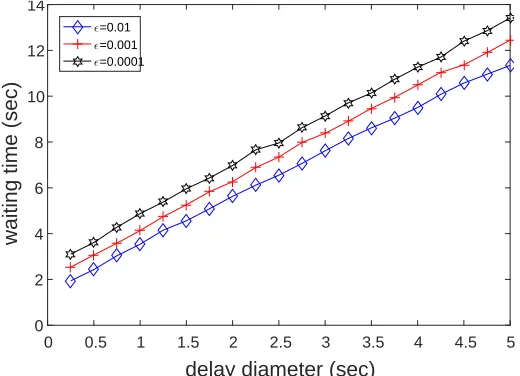
How does the delay diameter affect acceptance times?Given that block creation rate is high, most of the waiting time for acceptance is dominated by the block propagation delay. Fig. 5 depicts the transaction acceptance times of SPECTRE, for various values of the delay diameter
D, and for different security thresholds. Note that, unlike the Nakamoto Consensus, Daffects the acceptance time of transactions but not their security.
0 0.5 1 1.5 2 2.5 3 3.5 4 4.5 5 delay diameter (sec)
0 2 4 6 8 10 12 14
waiting time (sec)
ǫ=0.01
ǫ=0.001
ǫ=0.0001
Fig. 5: The average time for a transaction to enter RobustT xO, assuming there’s no visible double-spend, forλ= 10 blocks per second andα= 0.25.
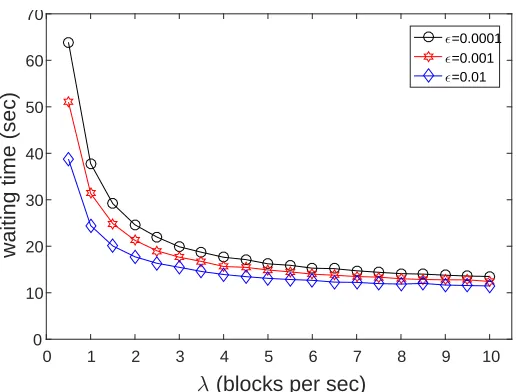
0 1 2 3 4 5 6 7 8 9 10
λ (blocks per sec)
0 10 20 30 40 50 60 70
waiting time (sec)
ǫ=0.0001 ǫ=0.001 ǫ=0.01
Fig. 6: The average time for a transaction to enter RobustT xO, assuming there’s no visible double-spend, ford= 5 seconds and α= 0.25.
Can an attacker delay acceptance? We now turn to demonstrate the effect of censorship attacks in which some dishonest nodes publish blocks that do not reference other miners’ blocks. Recall that the Weak Liveness property of SPECTRE (Proposition 3) guarantees fast acceptance of transactions that are not visibly double-spent, even in the presence of a censorship attack. However, such an attack still causes some delay in transaction acceptance, but this delay is minor for small attackers. In Fig. 7 we quantify this effect, by comparing the acceptance times in “peace days” to those under an active censorship attack. The parameters here are d = 5
0 0.05 0.1 0.15 0.2 0.25 0.3 0.35 0.4 0.45
α (fraction of hashrate)
0 5 10 15 20
acceptance time (sec)
under no attack under active attack
Fig. 7: The average time for a transaction to enter RobustT xO, assuming there’s no visible double-spend, ford= 5 seconds, λ= 10 blocks per second, and= 0.01, in the presence and in the absence of a censorship attack.
How does decrease for various sizes of the attacker? Once an honest node -accepts a transaction, there’s still a small risk () that it would eventually be rejected. We show that the probability of this event vanishes quickly, even for an extremely capable attacker (e.g., with
α = 0.4 of the hashrate). This is illustrated in Fig. 8, assuming d = 5 seconds and λ = 10
blocks per second (notice that the y-axis is in log scale).
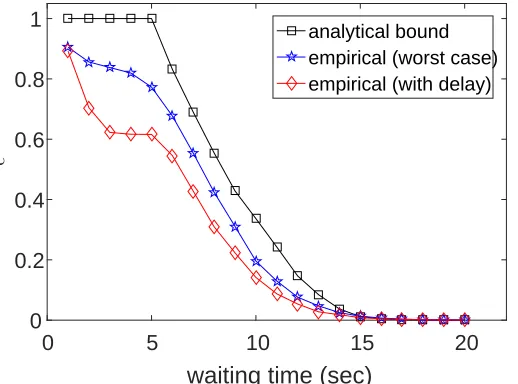
How tight is our security analysis? The analysis on which Alg. 3 relies makes several worst-case assumptions in order to bound the probability of a successful attack, e.g., that the attacker can broadcast blocks to and receive blocks from all nodes without any delay (see Appendix E, mainly Lemmas 14 and 20). Accordingly, the analysis is not tight, and in reality attacks are in fact less likely to succeed. In Fig. 9, we depict the comparison between the analytical bound and two different empirical simulations. In these simulations we explicitly generate blocks for the attacker and simulate the optimal double-spending attack. We repeat the experiment 10,000 times for each point in the graph, and measure the empirical success rate. The simulations assume two types of attackers: a worst-case attacker that is able to transmit and receive blocks with no delays, and a more realistic attacker that is connected to other nodes with typical delays. We compared the fraction of successful attacks under these setups to the analytical risk calculated by SPECTRE’s policy (Alg. 7).
0 5 10 15 20 25 30
waiting time (sec) 10-60
10-40 10-20 100
ǫ
α=0.1 α=0.25 α=0.4
Fig. 8: The probability of a successful double-spending attack, as a function of the waiting time before acceptance, under d= 5 seconds andλ= 10blocks per second, for α= 0.1, 0.25, and
0.4. The probability here is the result of the calculation performed by Alg.3.
0 5 10 15 20
waiting time (sec)
0 0.2 0.4 0.6 0.8 1
ǫ
analytical bound empirical (worst case) empirical (with delay)
Fig. 9: The analytical vs. empirical probabilities of a successful double-spending attack, as a function of the waiting time before acceptance, underd= 5 seconds,λ= 10, and α= 0.25.
APPENDIX C
ADDITIONALALGORITHMS
the second layer of SPECTRE, which allows users to measure the robustness of this order, and to translate this into the robustness of accepted transactions.
A. Robustness of the block pairwise ordering
Assume that in the order of the current observable DAG the block x precedesy. We need a method to measure how likely is it that this relation will persist forever. Algorithm 3 outputs an upper bound on the probability that an attacker will be able to reverse the relationx≺y. When the argument y is unspecified, the interpretation of the algorithm’s output is x’s robustness against an unseen block (withheld by an attacker or yet to be created). In the algorithm,
gap(b, G) denotes the size of the set {z∈anticone(b, G) : votez,b(virtual(G))≥0}. The notationhG, z, Ki will be explained in the paragraphs that follow.
In the algorithms below, we omit for the sake of brevity the following parameters which the user must set by himself:α – maximal size of attacker,d– upper bound on D(the recent delay diameter in the network),λ – the block creation rate
Algorithm 3 Risk (offline)
Input: G=Gvtime now – some node v’s current block DAG,x – a block in G, y (optional) – a block in anticone(x, G)
Output: risk – an upper bound on the probability that x will not recede y in some point in the future (Pr (∃u∈honest,∃s≥time now :votex,y(virtual(Gus))≥0))
1: iftime now < publication(x) + 2·d then
2: return 1
3: K← dp|f uture(x, G)|e 4: ifN U LL=y then 5: g←f uture(x, G)
6: M ←0
7: else
8: g←Pz0∈f uture(x,G)votey,x(z0, G)
9: M ←
n
z∈f uture(x, G) :votex,y(z, G) = +1∧gap(z,hG, z, Ki) = 0 o
10: nx ←
f uture(x, G) −M 11: j←gap(x, G) +K 12: l←K
13: risk←fpre mine(l) +fpre pub(K) +fpost pub(M) +fpost mine(nx, g, j, l, M) 14: return risk
In line 13 the algorithm uses several functions whose precise definitions we defer to later sections. An explicit formula forfpre pub is given in (54), forfpost pubis given in (50) and (52), and for fpost mine is given in (5). Preceding Lemma 24, we provide a method to calculate
Intuitively, the function fpre mine upper bounds the probability that the attacker has gained an advantage larger than l during the pre-mining phase (i.e., up until the creation of x). The function fpost mine upper bounds the probability that the attacker will ever be able to create enough blocks so as to reverse the relation x≺y. In essence, fpost mine is an adaptation of a formula from [17]. According to our version of the formula, if during the interval[time(x), tacc] (wheretaccrepresents the current time) honest nodes creatednblocks, then n−m1+m
·αm·(1−α)n is the probability that the attacker has created during this intervalm blocks. Ifg aggregates all the votes of blocks inf uture(x, G), then the probability that the attacker will be able to reverse the majority’s vote is roughly
α
1−α
max{g−m,0}
. The combined expressions produce an upper bound on the success-probability of an attack.6
The main challenge here is to correctly measure n. This is a difficult task, as Algorithm 3 uses only structural information (with the exception of making sure that x has been published for at least2·d seconds) and does not rely on measurements of blocks’ timings. Na¨ıvely one would use n≈ |f uture(x, G)| to upper bound blocks created after publication(x). However, there are two main difficulties:
• The blockxmight have been created by a dishonest node and withheld by it. In this case, there might have passed a long time between its creation and its publication, which implies that |f uture(x, G)| alone may be well below n. To avoid underestimating n, we upper bound the number of honest blocks inanticone(x, G), by the variablej, and add it to our count (the addition is done insidefpost mine(nx, g, j, l, M)).
The functionfpre pub upper bounds the probability that we have underestimated j.
• By publishing his attack blocks, the attacker can increase the size of f uture(x, G) and cause us to overestimaten. This would result in an upper bound on the success-probability of an attack that is not tight enough, which would allow an attacker with a large value of
α to delay acceptance indefinitely. Risk overcomes this problem, by recognizing attacker blocks and excluding them from the count ofn. This is done as follows.
Let G be a block DAG, b a block in G, and K a whole number. The DAG hG, b, Ki is obtained by creating a new chainz1, ..., zK ofK hypothetical blocks, connecting an edge from z1 to b and replacing every edge (z, b)∈G with (z, zK)∈G. Essentially, this adds to the DAG K artificial voters which vote strongly x ≺ y, against any y /∈ past(x, G). In line 9, the algorithm checks whether gap(z,hG, z, Ki) = 0, i.e., whether there exists a block in anticone(z) that precedes z in the modified DAG hG, z, Ki. In the case of a negative answer, z is counted into n(in line 10).
The following property explains why this procedure is useful:If we addK voters in favour of an honest block, for some smallK, then no other block will precede it in the pairwise ordering (apart from its past set). This is restated formally and proven in Lemma 29. 6The calculations we use are quite more involved, as will be detailed later on. The reason why we aggregate in
gvotes fromf uture(x, G) alone – rather than votes from the entire DAG – was discussed in Sec. 5. Essentially, observe that counting all votes – including votes of blocks inpast(x) – is not meaningful, as such voters might reverse their vote as future events unfold. Rather, it is useful to measure how robustly voters in past(x) support
The functionfpost pubupper bounds the probability that we have underestimated the number of honest blocks inf uture(x, G).
B. Robustness of transaction acceptance
The next step is to translate robustness of blocks (calculated by Risk) to robustness of transactions. This transition is implemented similarly to the transition from the (non-robust) ordering of blocks (Alg. 1) to the (non-robust) accepted set of transactions (Alg. 2).
TheRiskT xAcceptprocedure (Alg. 4) takes as input Gandtx(and an additional argument) and returns an upper bound on the probability that some honest node will not-accept tx. The main task of RiskT xAccept is to properly account and aggregate the error bounds that Risk
induces. As can be easily recognized,RiskT xAccept and RiskT xReject (Alg. 5) are mirror images of each other. WhileRiskT xAcceptupper bounds the probability that a given transaction will ever be removed from the accepted transaction subset, RiskT xReject upper bounds the probability that a given transaction will ever be included in this subset. This is particularly vital for the case where two conflicting transactions are related topologically, i.e., tx2 ∈y and tx1 ∈x∈f uture(y), but tx2 is not in the accepted set (due to some previous conflict). In this
case, although the block containing tx2 precedes that containing tx1, we accept tx1. It can be
further-accepted if the rejection-status of tx2 is robust, as calculated byRiskT xReject.
Algorithm 4 RiskT xAccept
Input: G=Gvtime now – a block DAG,
Output: risk – an upper bound on the probability that some honest node
in some future point in time will accept no transaction in [tx] ∩ subG
(Pr (∃u∈honest,∃s≥time now,[tx]∩subG∩RobustT xOGus =∅)) 1: minrisk←1
2: for all z1 ∈ZG([tx])∩subG do 3: risk←Risk(G, z1,∅)
4: for all tx2 ∈G∩conf lict(tx) do
5: for all z2 ∈ZG(tx2)∩anticone(z1, G) do
6: risk←risk+Risk(G, z1, z2)
7: risk←risk+RiskT xReject(G,[tx2], past(z1))
8: for all [tx3]∈inputs(tx)∩past(z1) do
9: risk←risk+RiskT xAccept(G,[tx3], past(z1))
10: minrisk ←min{minrisk, risk}
11: risk←minrisk 12: return risk
Building on these procedures, we now present theRobustT xO procedure of SPECTRE. The user should provide as input the entire DAG that he currently observesG, and the maximal error probability he is willing to tolerate . As mentioned above, the user should also set the α, d, λ
Algorithm 5 RiskT xReject
Input: G – a block DAG, subG – a subDAG of G which is the past of a (possibly virtual) block,tx – a copy of the transaction to defend
Output: risk– an upper bound on the probability that some honest node in some future point in time will accept a transaction in [tx]∩subG.
1: risk←0
2: for all z1 ∈ZG([tx])∩subG do 3: minrisk ←1
4: for all tx2 ∈G∩conf lict(tx) do
5: for all z2 ∈ZG(tx2)∩anticone(z, G) do
6: minrisk←min{minrisk, Risk(G, z2, z1)}
7: minrisk ←min{minrisk, RiskT xAccept(G,[tx2], past(z1))}
8: for all [tx3]∈inputs(tx) do
9: minrisk ←min{minrisk, RiskT xReject(G,[tx3], past(z1))}
10: risk←risk+minrisk
11: return risk
Algorithm 6 RobustT xO
Input: G = Gvtime now – a block DAG representing the current DAG observed by the node running the algorithm, – the maximum risk the user is willing to tolerate, α – maximal size of attacker,d – upper bound on network’s delay diameter,λ – the block creation rate
Output: a set of transactions that are guaranteed to remain accepted, as defined by Property 2 1: RobustT x← ∅
2: for all z∈Gdo
3: for all tx∈z do
4: if RiskT xAccept(G,[tx]∩G)< then
5: addtx to RobustT x
C. Online policy
We now present an alternative implementation ofRisk, which requires that the user be online at the time when his block gains confirmations. This assumption is highly reasonable for many practical scenarios, e.g., a cashier serving a continuous line of customers. The main benefit of the online version is that it relies on a tighter analysis, and therefore accepts transactions slightly faster. We now confine ourselves to the case where there is no visible double-spend (i.e.,y=N U LL).
The fact that the user is online can be utilized in two ways: First, any block that the user receives after receivedv(b) + 2·d and does not belong to f uture(x) can be marked by him as an attacker block.7 Second, the user can estimate the number of hidden attacker blocks by
7
measuring the time that passed since the creation ofx.
Below we describe the online version of Risk. The algorithm takes as input node v’s DAG and the block x to defend, and returns an upper bound on the probability that some block
y∈Gpub∞ \Gpubt will ever precede it.
Algorithm 7 Risk (online)
Input: Gvt – the block DAG thatv obesrves at time t, x – a block in Gvt
Output: risk – an upper bound on the probability of blockx not preceding y at any point in the future, for somey∈Gpub∞ \Gpubt
1: iftime now < publication(x) +dthen
2: return 1
3: T ←time now−receivedv(x)
4: Gx←Gvreceivedv(x)+2·d∪f uture(x, Gx) 5: g←minx0∈anticone(x,G
x)|f uture(x
0, G
x)| 6: risk←risk hidden(T, g)
7: ifrisk < then
8: return ACCEP T
9: else
10: return W AIT
The definition of risk hiddenappears in (45)-(46). In practice, as nodev may have a partial view ofGpub∞ \Gpubt , in order to use Alg. 7 the user must wait additional dseconds and verify thatconf lict(tx)∩Gv
t+d=∅, i.e., that the attacker did not publish a double-spend in the interval
[t−d, t]. The correctness of the online policy modification is proven in Corollary 27. APPENDIXD
IMPLEMENTATIONDETAILS
Minting. In SPECTRE, any block whose target meets the required value T ARGET – as will be defined below – receives the same minting reward. If its target is higher thanT ARGET (i.e., it is solved with an easier difficulty) by a factor of (1 +δ) at most, then its reward is reduced by the same factor. The parameterδ represents the protocol’s tolerance to blocks mined with an outdated difficulty. Thus, if for instance δ is chosen to equal 2, then blocks with a target value of2·T ARGET or3·T ARGET are valid, and their minting rewards are reduced by a factor of 2 or 3, respectively; blocks with a target higher than3·T ARGET are invalid and discarded. We now explain howT ARGET is defined and readjusted.
that elapsed since the previous reference block (using the timestamps written inside each block) and plugging it into the retargeting formula. The output of this formula is the new value of
T ARGET that the new reference block should be mined with.
We adapt this scheme to SPECTRE: Let xn−1 be the previous reference block. Every new
block xn that has the property that
past(xn)∩f uture(xn−1)
= 2016,8 is a candidate to become the new reference block. In case additional candidates exist, we choose the one with the minimal dist gap, with some arbitrary tie-breaking, where dist gap(b, G) := minK∈Ngap(b,hG, b, Ki) = 0. The variable dist gap(b, G) represents the minimal K such
that adding K votes in favour of b makes its gap equal zero. This guarantees that among a set of candidates to becomexn(satisfying the above property) one and only block would be chosen as the reference block succeedingxn−1. In particular, as explained in Appendix A, an attacker
block that was withheld for a while will have a large dist gap and will not be eligible as a reference block. Furthermore, an attacker block that was mined before xn−1 will not affect the
next retargeting, as it cannot belong tof uture(xn−1).
The new difficulty, with which the new reference block should be mined, is given again through the formula that uses the time that elapsed betweenxn−1 andxn to updateT ARGET.
The formula should aim for a predefinedλfor which nodes are believed to have sufficient bandwidth, e.g., 1 MB per second. This difficulty dictates the difficulty for every block in
antipast(xn)\anticone(xn+1), where xn+1 is the next reference block. Every block in this
set should be mined according to the same difficulty asxn.
If block b ∈ antipast(xn)\anticone(xn+1) was solved with an easier difficulty than that
dictated by the reference block xn, then b is still considered valid, provided that its outdated target is at most (1 +δ) of the target of xn (i.e., a difficulty easier by at most (1 +δ)). The parameter δ is the protocol’s tolerance threshold. The minting reward of b is reduced by the corresponding factor, as explained above. Blocks whose target exceeds the required one by a factor higher of (1 +δ) are ignored and discarded.
Block headers.In order to incorporate all blocks into the DAG, every block embeds in its header pointers to the hash of previous blocks. No redundancies are permitted, hence only leaf-blocks of past(b) should be pointed at by the header of b. The implication of this is that a block’s header is of size≈50 +d·λ·32 Byte. Therefore, there is a limit to the extent at which block size could be reduced and block creation rates increased – at extremely high rates, the overhead of the block header becomes significant relative to the number of included transactions. We note, additionally, that in case the current observable DAG has too many leaves (whether by a rare burst in block creations or by an attacker releasing many outdated blocks), the next block creator can cap the number of leaf-blocks it points at. Blocks left out by this block will later integrate into the DAG, as future blocks will have available space in their headers and will be able to point at these blocks and include them.
Efficient implementation. Our current implementation of SPECTRE uses na¨ıve calculations which are usually inefficient, specifically, cascading the votes all the way to the genesis
8Some new notation is used in these paragraphs:f uture(x) :=f uture(x)∪ {x}, and similarly forpast(x)and
block. Several efficient implementations are possible. Designing such an efficient implementation requires attention to CPU attacks, in which the attacker exposes peculiar structures of outdated blocks in order to cause other nodes to perform extensive computation. It can be shown that these attacks are highly costly to the attacker. We have an implementation of SPECTRE’s procedures that works in O(d·λ) in expectation, compared to the na¨ıve implementation with O(|G|3). We leave its full specification, and a proof of the cost of CPU attacks on it, to future work.
Transaction fees.The body of a transaction specifies the amount transferred from the payer to the payee. The transaction-fee specifies the payment from the payer to the miner whose block contains the transaction. We regard these two parts as separate transactions, in the following sense. Assume thattx∈x, and denote byf ee(tx, x)the transaction representing the fee-payment oftxto the creator of blockx. Assume now that two copies oftxappear in two different blocks
x, y. Then the body is considered simply as a copy of the same transaction (recall the notation
[tx]from Sec. 2), whereas the transactionsf ee(tx, x) and f ee(tx, y) are considered a conflict, i.e., a double-spend. Accordingly, as in the ordinary scheme of SPECTRE, the fee is granted to (the creator of) blockxifftx∈T xO(G) andxdefeats all other blocks that containtx as well. This rule can potentially harm miners, in the special case when the relation between x
and y does not become robust (SPECTRE does not guarantee robustness if these blocks were published in time proximity and an active attack is taking place). We address this problem by introducing settlement transactions. A settlement transaction is a voluntary transaction which both the creators of x and y sign after they observe that their blocks conflict. We denote it
settlement(x, y). The interpretation ofsettlement(x, y)is that the fees from all of (or part of, if the parties involved so choose) the transactions inx∩yshould be divided evenly between blocksx
andy.settlement(x, y)essentially overridesf ee(tx, x)andf ee(tx, y). Whensettlement(x, y)
appears in some block z in the DAGG, it is considered accepted (i.e., a member of T xO(G)) iff x, y ∈ past(z) and z precedes every block that contains a transaction spending f ee(tx, x)
or f ee(tx, y). Therefore, once one party has spent its fee before it belonged to it robustly, it won’t be able to settle later (w.h.p.). Miners are therefore advised to wait for their transaction-fee rewards to become robust, or to initiate a settlement, before spending these rewards.
Note that this scheme can be used to settle conflicts between blocks of multiple parties simultaneously. Furthermore, the settlement scheme need not be confined to conflicts regarding fees, and can be applied to any double-spend.
APPENDIXE
THECOMPLETEPROOF OFTHEOREM3
Theorem 3. For any D·λ, SPECTRE’s security threshold is 50%. A. Additional notation
• Goraclet :=∪v∈NGvt; this is the DAG as observed by a hypothetical oracle node. Similarly,
Gpubt :=∪v∈honestGvt; this is the DAG as observed by a hypothetical node that has 0 delay from and to honest nodes.
• node(b) ∈ N – the node that created block b, time(b) – the time of its creation,
publication(b) – the time at which node(b) begun the transmission of b to some other honest node,receivedv(b) – the time at which node v receivedb.
• f uture(x) :=f uture(x)∪ {x}, and similarly forpast(x) andanticone(x). In addition,
antipast(x) =f uture(x)∪anticone(x), and similarly forantif uture(x)
• Ebsu(x, y) := the event where votey,x(virtual(Gus)) = +1.
• Esu(x, y, ) := the event where Risk(Gus, x, y)< .
• Abus(tx) := the event where tx∈T xO(Gus).
• Aut(tx, ) := the event where T xO∈RobustT xO(Gut, ).
• Etall→∞(x, y, ) := the event ∩u∈honest∩s∈(t,∞)Esu(x, y, ), and similarly for Ebtall→∞(x, y),
Aall
t→∞(tx, ), and Aballt→∞(tx).
• pasth(z, G) :=past(z, G)∩honest, and similarly for the future and anticone sets.
• Vx≺y(G) := {z∈G|z is a strong voter w.r.t. (x, y) and votex,y(z) =−1} (Vx≺y(G) depends onx, y).
• Poiss(δ, j) :=e−δ·δj j!.
• IfE is a set or an event, its complement set or event is denotedE{.
• Ifx is a real number, x+ is defined by max{0, x}. B. Formal claims
We now take apart Theorem 3 and write a separate proposition for each of the security properties Safety, Progress, and Weak Liveness, and for Consistency. In order to prove Theorem 3, we need to prove the following propositions:
Proposition 4 (Consistency). The accepted set is consistent: For any history G, 1) iftx∈T xO(G) and tx2 ∈inputs(tx) then tx2 ∈T xO(G).
2) iftx∈T xO(G) and tx2 ∈conf lict(tx) then tx2 ∈/T xO(G).
Proposition 5 (Safety). For any v ∈ honest and time t, if tx ∈ RobustT xO(, Gvt, dv, α) then, with probability of at least 1−, there exists a τ ≥ t such that ∀u ∈honest,∀s≥ τ : RiskT xAccept(tx, Gus, du, α)< , and the expectation of τ −t is finite.
Proposition 6 (Weak Liveness). Let t be the current time, and assume that tx ∈ Gpubt . Let ψ≥t be the earliest time after t at which an honest node -accepts tx. Then, conditioned on the event whereconf lict(tx)∩Gpubψ =∅ and on the event where for alltx2 ∈inputs(tx),tx2 remains -accepted forever (by some honest node), the expectation of ψ−tis finite.