Secure Deduplication of Encrypted Data:
Refined Model and New Constructions
Jian Liu?1[0000−0001−6796−6828], Li Duan?2[0000−0002−8383−0776], Yong Li3[0000−0002−6920−0663], N. Asokan1[0000−0002−5093−9871]
1 Aalto University, Finland
[email protected], [email protected]
2 Paderborn University, Germany
3 Ruhr-University Bochum, Germany
Abstract
Cloud providers tend to save storage via cross-user deduplication, while users who care about privacy tend to encrypt their files on client-side. Secure dedupli-cation of encrypted data (SDoE) which aims to reconcile this apparent contra-diction is an active research topic. In this paper, we propose a formal security model for SDoE. We also propose two single-server SDoE protocols and prove their security in our model. We evaluate their deduplication effectiveness via simulations with realistic datasets.
1
Introduction
Cloud storage services are very popular. Providers of cloud storage services rou-tinely use cross-user deduplication to save costs: if two or more users upload the same file, the storage provider stores only a single copy of the file. Users concerned about privacy of their data may prefer encrypting their files on client-side before uploading them to cloud storage. This thwarts deduplication since identical files are uploaded as completely different ciphertexts. Reconciling dedu-plication and encryption has been a very active research topic [3,10,4,16,20,14]. One proposed solution isconvergent encryption(CE) [10] [4], which derives the file encryption key solely and deterministically from the file contents. As a result, identical files will always produce identical ciphertexts given identical public pa-rameters. Unfortunately, a server compromised by the adversary can perform an offline brute-force guessing attackover the ciphertexts, due to the determinstic property of CE.
More recent solutions allow clients to encrypt their files using stronger en-cryption schemes while allowing the server to perform deduplication. They usu-ally assume the presence of independent (trusted) third parties [3] [16] [20]. However, in a cloud storage setting, like in many other commercial client-server
?
contexts, assuming the presence of an independent third party is unjustified in practice [14] since it is unclear who can bear the costs of such third parties. Moreover, such schemescannotpreventonline brute-force guessing attacksfrom a compromised active server.
Liu et al. proposed a single-server scheme for secure deduplication without the need for any third party [14]. Their scheme uses a per-file rate limiting strategy to prevent online brute-force guessing attacks by a compromised active server. However, their security model and proof only cover one round of the protocol (Section 9 in [15]). Consequently, their scheme is vulnerable to additional attacks when considering the long-term operation of the system which involves multiple rounds of the protocol.
In this paper, we make the following contributions:
– We propose aformal security modelfor the single-server “secure dedupli-cation of encrypted data” (SDoE) (Section 2). We claim that a deduplidedupli-cation scheme proved secure in this model can guarantee that, for a certain file, (1) a compromised client cannot learn whether or not this file has already been uploaded by someone else (Section 2.1), and (2) the only way for a compro-mised server to uniquely determine this file is by doing an online brute-force attack (Section 2.2).
– We propose two newsingle-server SDoEschemes and prove their security in our model. (Section 4)
– We show that their deduplication effectiveness is reasonable viasimulations with realistic datasets. (Section 5)
2
Syntax and Security Model
2.1 Syntax
We consider the generic setting for a cloud storage system where a set of clients (Cs) store their files on a single storage server (S), andCs andSare always com-municating through secure channels. The deduplication happens at server-side, i.e., the client always uploads encrypted files and the server knows whether to discard the uploaded file or not after the protocol execution. All theses partici-pants are generalized asparties. Each party has a party identifier pid; a flag τ indicating whether it is corrupted or not. EachCmay have one or more sessions connecting to S, where each session has a session identifier sid. The internal stateΦC,pid of a C is a list of tuples {(fidi, ki)}, which stores the identifier and the encryption key of each file owned by it. The internal stateΦS ofS contains a listDB={(bi,fidi, %i,LOi)}and a list of current user identifiersPID, wherebi is a bit indicating whether the file has been uploaded or not,fidi is an identifier of an encrypted file%iandLOiis the list of owners of%i. Note thatDBcontains all possible files.
Definition 1. A single-server SDoE schemeΠdedup=(Init,Reg,Upload,Download) is composed of an initialization algorithmInitand three sub-protocolsReg,Upload
– Init(1λ,aux)→PP. The Initalgorithm takes the security parameter 1λ and
the auxiliary informationauxas input and outputs the public parameterPP, which includes the specification of the encryption schemeΠEnc chosen for the files.
– Reg(pid)→Φpid. The protocolRegregister a new clientCwith identifierpid
and returns a new client internal stateΦpid.
– Upload(PP, Φc,DBs,{Φj}, F)→Φ0c, DB
0
s. The protocolUploadinvolves the
uploaderC, the serverS and a group of possible file owners{Cj}. Taking as
inputΦc of C,DBs of S and {Φj} of {Cj}, this protocol produces updated
statesΦ0c andDB0sof C andS respectively. A file identifier fid is contained both inΦ0c andDB0sand a pair(fid, kf)is inΦ0c with encryption/decryption
keykf conformant withΠEnc.
– Download(Φc,DBs, f idi) → F. The protocol Download involves the
down-loaderCand the serverS. Besides the internal state ofCandS, this protocol takes as an extra input a file identifier fidi and outputs a fileF.
Definition 2. (Correctness)AΠdedup is correct if
∀(f id, kF)∈Φ0c←Upload(PP, Φc,DBs,{Φj}, F) :
Pr[Download(Φ0c,DBs, f id) =F] = 1
2.2 Game Setup
One way to model security in cryptography is by issuing security games played between an adversary (attacker) and a challenger. The challenger possesses some secret targeted by the adversary. As in the real world, the adversary can interact with the challenger by using different queries to the challenger. At the end of each game, the adversary outputs what it has learned about the secret and it wins if the output is correct. The restriction on queries are used to rule out the trivial cases of breaking the security of the scheme.
To initializeDB for the security game, the challenger first generates a list of file owners with the corresponding identifier listPID. After callingInitwith given security parameter and the auxiliary information to generates the public parameter PP, the challenger calls Reg(id) for each id in PID. Let PIDh be the identifier set of honest file owners. Note that before interacting with adver-saries,PID=PIDh, butA can add new malicious identities toPID by using
RegisterCorrupt(pid) queries described below. Then for each fidi, the challenger
choosesbi $
←− {0,1}. Ifbi= 0, the tuple would be (0,fidi,−,∅,−). Otherwise, it chooses a uniformly random Cj ∈ PID and calls Upload(PP, Φj,DB,{Φl}, Fi) to uploadFi. Note that the updated stateDB now contains the ciphertext%i ofFi generated andCj is added to LOi. We denote asDB0the content ofDB after initialization.
2.3 Security against a compromised client
model attacks from a compromised client. The intuition is that by interacting with the server, the client must not be able to learn whether a file already exists in the cloud storage. We allow the adversary A that has compromised one or more clients to make the following types of oracle queries in the security experiments:
RegisterCorrupt(pid) The adversary A can register a new corrupted client with
identifier pid. If pid ∈ PID, A gets the state ΦC,pid of pid, including all the file identifiers and the corresponding file key{(f idi, ki)} owned bypid. Otherwise A only gets an empty state. The challenger updates PID := PID∪ {pid} and marks pid as corrupted. In both cases, A can perfectly impersonatepidfrom this moment on.
Send(pid, sid, M) The corresponding oracle computes on the input message M following the SDoE protocol and returns the output message in the view of all corrupted parties toA. This oracle models that an adversary can tam-per with each single message in the SDoE protocol. For example, initiating
Downloadwith maliciously formed file identifier.
Test() A signals the end of the security game to the challenger, ceases all the interaction with oracles, and outputs a pair (F∗, b∗). The adversary can only query this oracle once. Note that this query is not an abstraction of any attack but serves as a measure of the adversarial success.
Letλbe the security parameter. Given the queries described above, we de-fine the security experimentExpSDoEC,Π (λ) for a SDoE protocol Π against com-promised clients as follows:ExpSDoEC,Π (λ) = 1 ifAreplies toTest() with (F∗, b∗) and either of the following cases happens:
– Ifb∗= 0 and6 ∃(f idj, kj)∈Spid∈P IDhΦC,pid, (bi, f idi, %i,LOi)∈DB0 s.t.,
E(kj, F∗) =%i. (i.e.,F∗ has not been uploaded before).
– Ifb∗= 1 and∃(f idj, kj)∈Spid∈P IDhΦC,pid, (bi, f idi, %i,LOi)∈DB0 s.t., E(kj, F∗) =%i. (i.e.,F∗ has been uploaded before).
Butnoneof the following events happens beforeAoutputs (F∗, b∗):
– Ahas issuedRegisterCorrupt(pid) with pid∈PIDh (i.e., Acannot directly read internal information of honest file owners.)
– A has issued Send(pid, sid, M) with pid ∈ PIDh. (i.e., A cannot force an honest owner to send/receive any messages. However,A can use the Send
queries to fully control the behavior of compromised clients.)
Definition 3. We define the advantage of an adversary A in the experiment
ExpSDoEC,Π (λ)as
AdvSDoEC,Π (λ) = Pr[ExpSDoEC,Π (λ) = 1]−1
2.4 Security against a compromised server
The intuition behind the security definition is that a SDoE scheme is secure against a compromised server cannot be uniquely determined by the compro-mised server. The queries (adversary’s ability) captures the essence of concrete attacks, such as registering malicious clients, uploading and tampering some messages. Those attacks may come from a malicious server colluding with some external clients. For simplicity, we now assume that all files have been uploaded into DB0. We allow the adversaryAthat has compromised the server to make the following types of queries in the security experiments:
RegisterCorrupt(pid) The same as that of compromised clients.
Send(pid, sid, M) The same as that of compromised clients.
AccessDB() The adversaryAgets all the%iand the owner list of each%i inΦS
withbi= 1. If this is theta-th query made byA, then for all thet-th queries witht > ta,Aalso gets the updatedΦs items withbi= 1 in addition to the response for other queries.
Execute(pid, P, F) As the initiator, A invokes a complete (sub-)protocol P ∈
{Upload,Download} with party pid on the input file F and obtains all the
messages exchanged, following the description ofP.
Test() Aoutputs two filesF0, F1with equal length. Upon receivingF0, F1, the
challenger choosesb←− {$ 0,1}and replies with a ciphertext%b =Enc(kfb, Fb). Aperforms the above queries and then outputs a bitb0.
We define the security experimentExpSDoES,Π (λ) for a SDoE protocolΠagainst partially compromised server as follows:ExpSDoES,Π (λ) = 1 ifA replies to Test() withb0 =b, butnone of the following events happens beforeAoutputs the bit b0:
– Ahas issuedRegisterCorrupt(pid) withpid∈PIDh.
– Ahas issued Execute(pid, P, F), F ∈ {F0, F1}. (A have not includedF0 or
F1 in its online brute-force attacks.)
– Ahas issuedSend(pid, sid, M) withpid∈PIDh.
Definition 4. We define the advantage of an adversary A in the experiment
ExpSDoES,Π (λ)as
AdvSDoES,Π (λ) = Pr[ExpSDoES,Π (λ) = 1]−1
2
Remark. We exclude trivial wins by preventing the adversary from corrupting honest clients, but this is not overly restrictive because the adversary can still steer honest clients by issuingExecutequeries.
3
PAKE based Deduplication
hold the same secret (“password”). Otherwise, neither party can learn anything about the key output by the other party.
Bellare et al. provided a game-based definition for the security of PAKE [5]. A random bitbis chosen at the beginning of the game. They assume that there is an adversary Athat has complete control over the environment (mainly, the network), and is allowed to query the following oracles:
Send(Ui, M) : causes message M to be sent to instance Ui, which computes following the protocol and gives the result toA. If this query causes Ui to accept or terminate, this will also be shown toA.
Execute(Ai, Bj) : causes the protocol to be executed to completion between Ai
andBj, and outputs the transcript of the execution.
Reveal(Ui) : outputkUi, which is the session key held byUi.
Test() : if b = 1, output the session keykUi; otherwise, output a string drawn uniformly from the space of session keys. Note thatTestis queried only once.
Corrupt(Ui) : outputUi’s password.
LetSuccPAKEA (λ) be the event that A outputs a bitb0 =b but none of the following events happens:
1. aReveal(Ui) query occurs;
2. aReveal(Uj) query occurs whereUj is the partner ofUi;
3. aCorrupt(Ui) query occurs beforeUi defined its keykUi and aSend(Ui, M)
query occurred.
The advantage ofAattacking a PAKE protocol is defined to be
AdvPAKEA (λ)def= 2Pr[SuccPAKEA (λ)]−1.
The PAKE protocol is considered secure if passwords are uniformly and in-dependently drawn from a dictionary of sizen:
AdvPAKEA (λ)≤ nse
n +negl(λ),
wherenseis the number ofSendqueries (to distinct instancesUi). The intuition behind this definition is that only online brute-force attacks are allowed in a secure PAKE protocol.
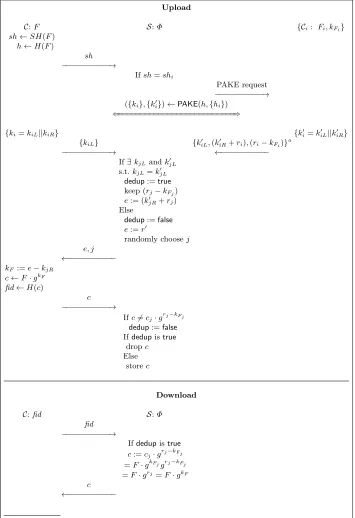
PAKE-based SDoE. Liu et al. presented a PAKE-based SDoE scheme that does not depend on any additional independent servers [14]. Their scheme al-lows an uploader to securely obtain the decryption key of another user who has previously uploaded the same file. Specifically, the uploaderCfirst sends a short hash of its file (10-20 bits long) to S. S finds other clients who may hold the same files based on the short hash, and lets them run a single round PAKE protocol (routed throughS) with the long hashes of their files as inputs. At the end of the protocol, the uploader gets the key of another C if and only if they indeed hold the same file. Otherwise, it gets a random key. The PAKE-based SDoE scheme ΠPAKE is shown in Figure 1. Notice that ΠPAKE uses additively
uploader sendsEnc(pk, kiR+r) to the server. The goal of using additively homo-morphic encryption Enc() is to: (1) guarantee the privacy ofkiR; and (2) allow the server to compute Enc(pk,(k0iR+kFj)−(kiR+r)), such that the uploader can get kFj iff k
0
iR =kiR. We noticed that the use of additively homomorphic encryption [15] is an overkill, since both of these two goals can be achieved more efficiently by using a one-time-padkiR⊕r: (1) the server cannot learn anything aboutkiRsinceris randomly chosen by the uploader; (2) the server can compute (kiR⊕r)⊕(kiR0 ⊕kFj), such that the uploader can also getkFj iffk
0
iR=kiR. If there is no match on the short hash,S lets the uploader run PAKE with dummy checkers to hide the fact that the file has not been uploaded before. In addition,Cs protect themselves against online brute-force attacks by limiting the number of PAKE instances they will participate in for each file.
Security against compromised clients.As pointed out by Liu et al. them-selves in [15], additional attacks are possible when considering the long-term operation of the system. For example, a malicious client can upload a file and then pretend to be offline. Later it uploads the same file using another identity. If it gets the the same key as the one it got before, it knows that the file has been uploaded be someone else. Another attack is also targeting the PAKE phase. The adversary uploads a file F with the identity of C1in the first protocol run. It then uses a different identityC2to upload F again. By observing whetherC1 is involved in the PAKE phase withC2 forF, the adversary knows if there are other owners ofF.
In the next section, we will introduce two protocols that are immune to those attacks and prove their security under our new model.
4
New SDoE Schemes
Recall that inΠPAKE, there are two possible cases when an uploader uploads a
file: it either gets the key of a previous uploader of the same file or gets a new random key. As described in the previous section, a maliciousC can distinguish between these two cases.
In this section, we address the issue inΠPAKEby havingCs always get random
keys when they upload their files. We propose two schemes. The first scheme (ΠPAKE,re-enc) borrows the idea from proxy re-encryption [1]. S only keeps a
single copy of duplicated files. WhenCwants to download its file,S re-encrypts the file so that C will download the same ciphertext as the one it uploaded. However, this scheme requires public-key operations on the entire file, which is not efficient for large files. So we propose a second scheme (ΠPAKE,popular) that
Upload
C:F S:Φ {Ci: Fi, kFi}
sh←SH(F) h←H(F)
sh
−−−−−−−−−−−→
Ifsh=shi
PAKE request
−−−−−−−−−−−→
({ki},{k0i})←PAKE(h,{hi})
⇐==========================⇒
{ki=kiL||kiR} {ki0=k0iL||k0iR}
{kiL, kiR⊕r}
−−−−−−−−−−−→
{k0iL, k
0
iR⊕kFi}
←−−−−−−−−−−−
If∃kjLin{kiL, kiR⊕r}and
∃kjL0 in{kiL0 , k0iR⊕kFi} s.t.kjL=k0jL
dedup:=true
e:=r⊕kFj Else
dedup:=false
e:=r0 e
←−−−−−−−−−−−
kF:=e⊕r c←E(kF, F) f id←H(c)
c
−−−−−−−−−−−→
Ifc6=cj
dedup:=false
Ifdedupistrue
dropc Else
storec
Download
C:f id S:Φ
f id
−−−−−−−−−−−→
Ifdedupistrue
c:=cj c
←−−−−−−−−−−−
4.1 PAKE-based Deduplication with Re-encryption
The first scheme ΠPAKE,re-enc is shown in Figure 2. It is similar to ΠPAKE. In
the following description, the details of client authentication and file ownership authentication are omitted. We assume that the owners of each file are stored in an ordered list with respect to the upload time points. In the case that there are more than one owner of a candidate file, the newest checker is chosen byS for the PAKE phase. After PAKE, instead of masking kFi withk
0
iR, Ci generates a random numberri, and masks bothkFi andk
0
iR withri.C only sendskiL to S. If there is an indexj s.t. kjL=k0jL, S knows thatC is uploading the same file withCj. Then, it keeps (rj−kFj) and sends (k
0
jR+rj) toC. Otherwise, it sends a random numberr0.Ccalculates its file key ask
F :=e−kjRand then encrypts its file as F·gkF. Notice that if F is detected to be duplicated, k
F is just the randomnessrj generated byCj.S can just drop this ciphertext if deduplication happens and stores the fid=H(C) as an alias of the file. Later, whenC wants to download F, C re-encryptscj to kF: c :=cj·grj−kFj =F ·gkFjgrj−kFj =
F ·grj =F ·gkF. Notice that c
j may be deduplicated already. In this case, S need to calculate (r0−kF0) + (r1−kF1)+, ...,+(rj −kFj) = (rj−kF0), and
then transfer c0 toC’s ciphertext. We follow the same dummy checker and rate limiting strategy asΠPAKE.The correctness ofΠPAKE,re-enc is trivial.
Security against compromised clients.Security of SDoE schemes cannot be directly reduced to the semantic security of PAKE schemes in [5]. This technical impossibility in the proof lies in the fact that the password (the hash of the file) is always known to the adversary in SDoE prior to any other interactions in the PAKE protocol. To overcome this difficulty, we expand the original definition of the model in [5] in the following way, which we call the constrained PAKE security game. Let sk = skL||skR be the session key computed in the Test() session, where|skL|=|skR|=12|sk|.
– The setup of this game is the same as in the original PAKE game except that each party now holds an additional secret su ∈ K. A public function
f :K × {0,1}∗→ {0,1}1
2|sk| can be queried by the adversary asf(pi,·).
– TheTest()-query now returns tk =tkL||tkR, where |tkL| = |tkR| = 12|sk|. The first half oftk is always the same as the the first half of the real session key, i.e., tkL = skL. If b = 1, tkR = skR ⊕f(si, Ti), where Ti,s is the transcript of this session. OtherwisetkR =skR⊕r, where r
$
←− {0,1}12|sk|.
The adversary wins if she outputsb0=b.
– Corrupt(u) only returns the passwordP Wubut not the additional secretsu.
– A session involvingπs
i andπtj is fresh if both the following condition holds
• noReveal(s, i) orReveal(t, j) is made beforeTest().
• nof(pi, Ti,s) is made beforeTest().
The winning condition and the advantage of an adversary in a constrained-PAKE game is defined in the same way as in the constrained-PAKE game.4
4 We also assume that the implicit authentication property is preserved in the PAKE
protocol as in the ideal functionalityFsame−input−pakein [15]. The extention of the
Upload
C:F S:Φ {Ci: Fi, kFi}
sh←SH(F)
h←H(F)
sh
−−−−−−−−−−−→
Ifsh=shi
PAKE request
−−−−−−−−−−−→
({ki},{k0i})←PAKE(h,{hi})
⇐==========================⇒
{ki=kiL||kiR} {k0i=k
0
iL||k
0
iR}
{kiL}
−−−−−−−−−−−→
{k0
iL,(k0iR+ri),(ri−kFi)} a
←−−−−−−−−−−−
If∃kjLandk0jL
s.t.kjL=k0jL
dedup:=true
keep (rj−kFj)
e:= (k0jR+rj)
Else
dedup:=false
e:=r0
randomly choosej
e, j
←−−−−−−−−−−−
kF :=e−kjR c←F·gkF
fid←H(c)
c
−−−−−−−−−−−→
Ifc6=cj·g
rj−kFj
dedup:=false
Ifdedupistrue
dropc
Else
storec
Download
C:fid S:Φ
fid −−−−−−−−−−−→
Ifdedupistrue
c:=cj·g rj−kFj
=F·gkFjgrj−kFj
=F·grj=F·gkF
c
←−−−−−−−−−−−
a r
i is chosen byCi at random in a finite field. All additions and subtractions are in
the same field.
Theorem 1 If there exists a ppt adversary C in ExpSDoEC,Π
PAKE,re-enc(λ) with
ad-vantage C, then there also exists a ppt adversary A with advantage A in the underlying constrained-PAKE game against Π in the random oracle model such that
C ≤ qH
2lh +qH·A
whereΠ is the PAKE oracle, lhthe length of the long hash andqHis the number
of distinct files C has queried for short hash, hash or uploaded.
Proof. We use the sequence of games technique introduced in [19]. We assume that the hash function is simulated by the challenger and all files are of equal length.
Game 0. This is the original gameExpSDoEC,Π
PAKE,re-enc(λ).
C =AdvGameC 0(λ) (1)
Game 1.LetF0 ={F10, F20,· · ·, Fq0
H}be the set of distinct files thatChas issued H-queries or used forSend()-queries beforeCqueriesTest(). Let (F∗, b∗) be the output ofC. If∃Fi0∈F0 :H(Fi0) =H(F∗)∧Fi0 6=F∗, abort the game. Then,
AdvGameC 0(λ)≤ qH
2lh +Adv Game1
C (λ) (2)
This rule makes sure that no hash collision happens.
Game 2. The challenger makes a guess of an index i ∈ {1,· · · , qH} and if
F∗6=Fi0, the challenger aborts the game5. Thus, we have
AdvGameC 1(λ)≤qH·AdvGameC 2(λ) (3)
Game 3.In this game, the random oracle inΠPAKE,re-encis replaced (implicitly)
by the random process for password generation. More specifically, we defineH :
{0,1}∗→P W, whereP W is the password space and all the public parameters ofΠ (for example, group order and generator as in EKE2 [6]) are included in the public parameters of ΠPAKE,re-enc. This replacement has no impact on C’s view
since all passwords and parameters inΠ are also sampled uniformly at random as required. Thus
AdvGameC 2(λ) =AdvGameC 3(λ) (4) We now construct an adversary A using C against the underlying PAKE schemeΠ. Letdbe the number of distinct passwords used by parties initialized by A’s PAKE challenger, where d ≥ |F|6. A maps all files in F to PAKE partiesP1,· · ·, P|F|with different passwords.7Athen sets up the listPIDhand PID as described in the model and binds the identifiers in PID to each file randomly. Each file identifier fidi and encryption key kFi are chosen according to the protocol definition and then used to build each ΦC,pid. Finally, Astores all the (bi,fidi, Fi, kFi,LOi) tuples asDB0. To answer the Hash queriesH(F
0 j), 5 The rational of this abort rule can be found in Game 3.
6
We assume a polynomial sized file space. 7
1. Asearches for (Fj0,{Pj0}) .
2. If found, AissuesCorrupt(Pj0) and let the output ofCorrupt(Pj0) beP WP0
j . 3. AreturnsP WP0
j toC.
To answerRegisterCorrupt(pid) forpid /∈PIDh,Asimply enrols thispidinPID. Ifpid∈PIDh,Cfails automatically. To answersend(pid, M), forpid /∈PIDh,A answers the send-queries exactly as in the SDoE protocol. The hash-value or the PAKE messages to be returned are obtained in the same way as when answering hash queries.
During every PAKE for uploadingFi, A usesSend to involve an oracle πsi run by partyPi. Afterwards, except for one session involvingF∗,AusesReveal on each accepted processPi,s of partyPi to get session key ki,s.
Denote asP∗ the PAKE party bound with F∗. Recall thatTest() can only be queried once in the constrained-PAKE game. Since the abort rule in Game 2 isnot triggered, now Acan successfully bind his unique test session T∗ into the answers to C when C uploads F∗. A uses the PAKE Test queries to get a challenge session key tk∗. ThenA queries for f(P∗, T∗) and computeskR∗ = tk∗
R⊕f(P∗, T∗). FinallyAchooses anr∗and usesk∗Ras defined in SDoE protocol
ΠPAKE,re-enc.
Let i be the original index of F∗ in DB0. A outputs 1 if b∗ = bi and 0 otherwise. Note that ifb= 0 in the constrained PAKE experiment, the right half oftk∗is random a bit-string and so isk∗R=tk∗R⊕f(P∗, T∗). As a consequence, eis also random. Therefore in this case,C also has no advantage. On the other hand, if b= 1, kR∗ is correctly distributed as in ΠPAKE,re-enc. The probabilityC
outputs the correctb∗ is the same asAoutputs the correctb. Thus we have
A=AdvGameC 3(λ) (5)
By combining (1) to (5), we have proved Theorem 1.
Security against compromised server.Next, we prove the security ofΠPAKE,re-enc
against a compromised server, which leads to the following theorem.
Theorem 2 If there exists a ppt adversary S inExpSDoES,ΠPAKE,re-enc(λ)with advan-tage S when sh(F0) = sh(F1), then there also exist a ppt adversary A with
advantageAin the underlying IND-KPA game against Πenc in the random
or-acle model and a ppt but passive adversaryBagainst the PAKE-protocolΠ with advantageB such that
S ≤
2C·Ne
|K| +Ne·T·B+
2lsh qH
2
2|F|2·A
whereC is the maximal number of owners of each file,K the key space ofΠenc,
Ne the number of Executequeries,T the maximal number of PAKE sessions in
each Execute query, F the file space, lsh the length of the short hash, qH the
number of distinct files that S has queried for its hash or short hash and Πenc
Proof. First we consider two different cases forS to win.
1. S has issued Execute(pid, P, F) and seen at least one file key collides into any of the file keys of the equivalent ciphertexts ofF0or F1.
2. S has not seen any colliding keys by issuingExecute(pid, P, F).
In the first case, eachExecute(pid, P, F) reveals at most one real file keyk∈K. There are at most C owners of each file, and each of whom has an equivalent file key. Thus, seeing one key increases the probability of S by at most |KC| to decrypt eachFb correctly.
Let the advantage ofS in the second case be0S. With the union bound we have
S ≤
2C·Ne
|F| +
0
S (6)
To further analyze0S, two types of adversaries are considered.
1. Adversaries recovered at least one complete session key generated by honest clients in the PAKE. We call these adversaries as type 1 adversaries. 2. Adversaries did not recover any complete session keys generated by honest
clients. We call these adversaries as type 2 adversaries.
With a simple probability argument, it can be deduced that
0S ≤1+2 (7)
where1 is the advantage of type 1 adversary and2 is the advantage of type 2 adversary. Furthermore, we assume that the hash function is simulated by the challenger and all files are of equal length.
Next, we prove Theorem 2 by proving the following 2 lemmas.
Lemma 1 (Bounding of the advantage of the type 1 adversary) If there exists any type 1 adversaryA1 with advantage1and running time t1, then there also
exists a constrained PAKE adversary B with advantage B and running time
tB≈t1 such that 1≤Ne·T·B.
Proof. (lemma 1, sketch) B can answer A1’s queries with the PAKE oracle, including transcripts of the Test-session and obtain at least one session keyskA1
recovered byA1. IfskA1 has the same session-id owned by the Test-session, B
then outputs (skA1 =kb), wherekbis the reply of PAKETest(). Since there are
at mostNe·T sessions, Bwins with advantageB≥ Ne1·T ·1.
Note that in our protocol, if the session key is leaked toA1, then the encryption keykF is also leaked toA1and vise versa. The confidentiality ofkF is the basis of the remaining proof.
Lemma 2 (Bounding of the advantage of the type 2 adversary) If there exists any type 2 adversaryA2 with advantage2and running time t2, then there also
exists a IND-KPA adversary A with advantage A and running time tA ≈ t2
such that 2≤
2lsh qH
2
2|F|2· A
Proof. (lemma 2)Game 0 . This is the original gameExpSDoES,Π
PAKE,re-enc(λ).
A2 =Adv
Game 0
S (λ) (8)
Game 1.If eitherF0orF1chosen byShas a unique short hash value, abort the
game. We add this rule since the short hash is also stored as part of the cipher-text. If anysh(Fj) is unique,Scan simply learnFj by computing and comparing the short hash values of all file candidates. FixFj and letCollSHbe the event that sh(Fj) does equal to any othersh(Fi), Fi ∈F. Then Pr[CollSH] = 2qlshH . Thus we have
P r[∃Fi, Fk∈F, Fi 6=F0∧Fk6=F1:
sh(Fi) =sh(F0)∧sh(Fk) =sh(F1)]≥
qH
2lsh
2
(9)
Therefore we have
AdvGameS 0(λ)≤
2lsh qH
2
AdvGameS 1(λ) (10)
Note thatlshis sub-polynomial in λso the loss factor is not exponential.
Game 2.The challenger guesses two files Fj and Fk. If{Fj, Fk} 6={F0, F1} ,
abort the game. Thus
AdvGameS 1(λ)≤(|F|)2AdvGameS 2(λ) (11) Now we show how to constructAagainstΠEncfromS.Acan guess{F0, F1} since Game 2 does not abort. In the setup phase, A includes the public pa-rameters of ΠEnc in the public parameters of ΠPAKE,re-enc, and queries for its
own challenge ciphertext%bwith{m0=F0, m1=F1} in its IND-KPA game.A fixes this %b as the ciphertext of F0 and use other random keys (conforming to security parameter) to encrypt all other files as described in the model and this protocol8.
The Send and RegisterCorrupt queries can be answered as in the proof for
security against compromised clients. For AccessDB, A simply gives S all the ciphertexts and owner lists at that time. Whenever a query from S results in an observable database change (i.e., new ciphertexts are added or new owners are added to files), Aupdates the server state and gives the ciphertext and/or the changed owner lists to S. For Execute with F /∈ {F0, F1}, A can use the homomorphic property ofΠEnc to correctly generate all the transcript. SinceA knows all other keys and ciphertexts,Acan answer all the queries fromS.
If S queries Test(), A replies with %b of her own and outputs whatever S outputs. Since the probability that Acorrectly simulates the SDoE-game forS
is exactly 12, we have
AdvGameS 2(λ)≤2A (12) By combining (8) and (12), we have proved Lemma 2.
8
By combining (6) and (7) and the two lemmas, we have proved Theorem 2.
4.2 PAKE-based deduplication on popular files
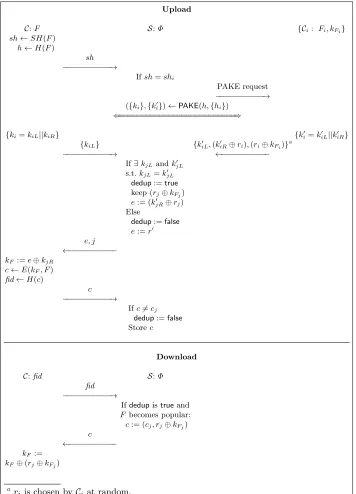
Our second scheme (ΠPAKE,popular) is shown in Figure 3. It tries to avoid using
public-key operations to encrypt the entire file. The penalty is that it only dedu-plicates popular files. The idea is the same asΠPAKE,re-enc, except that instead of
deleting the duplicated files directly,S keeps them until they become popular. Note that, for unpopular files, the views of bothSandCare similar to those inΠPAKE,re-enc, except that XOR is used to replace addition and subtraction and
a symmetric-key encryption schemeE() is used to replaceF·gkF. So the security argument forΠPAKE,re-encstill holds for unpopular files here.
Deduplication effectiveness will be negatively affected if only popular files are deduplicated. In the next section, we show that this affection is small via simulations with realistic datasets.
5
Simulation
The authors in [14] did a realistic simulation to measure the deduplication ef-fectiveness of ΠPAKE. They used a dataset comprising of Android application
popularity data to represent the predominance of media files. We follow their simulation but with two improvements.
First, we expanded the data set to a more reasonable size since their dataset is relatively small (7 396 235 “upload requests” in total, of which 178 396 are for distinct files). In order to measure how the system behaves as the number of unique files increases, a larger dataset is needed. Since such data was not available, we used the Synthetic Minority Over-sampling (SMOTE) Technique [8] to generate extra samples. Given a set of input samples and the amount of required over-samplings, SMOTE performs the following for each input sample:
1. Computexnearest neighbors for the input sample.
2. Randomly choose a neighbor and a point on the line segment joining the input sample to the selected neighbor. This point is a new, generated sample. 3. Repeat step 2 until the requested amount of over-sampling has been reached. For example, if the amount of needed over-sampling is 200%, it will be re-peated twice.
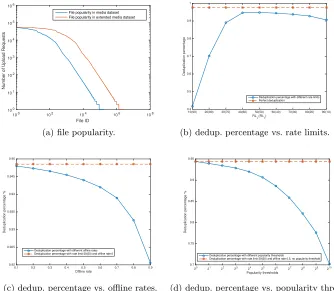
We used the (file size, popularity) pairs of the original dataset as the input samples in the SMOTE algorithm. The amount of over-sampling was 500% and for each input sample five nearest neighbors were considered when the new sam-ples were computed. The hashes for the synthetic samsam-ples were chosen randomly. These new samples were combined with the samples from the original dataset into a expanded dataset. The expanded dataset contains 110 942 571 files of which 2 675 917 are unique. See Figure 4a for the file popularities of the original dataset and the expanded dataset.
Upload
C:F S:Φ {Ci: Fi, kFi}
sh←SH(F)
h←H(F)
sh
−−−−−−−−−−−→
Ifsh=shi
PAKE request
−−−−−−−−−−−→
({ki},{k0i})←PAKE(h,{hi})
⇐==========================⇒
{ki=kiL||kiR} {k0i=k
0
iL||k
0
iR}
{kiL}
−−−−−−−−−−−→
{k0
iL,(k
0
iR⊕ri),(ri⊕kFi)} a
←−−−−−−−−−−−
If∃kjLandk0jL
s.t.kjL=k0jL
dedup:=true
keep (rj⊕kFj)
e:= (k0
jR⊕rj)
Else
dedup:=false
e:=r0 e, j
←−−−−−−−−−−−
kF :=e⊕kjR c←E(kF, F)
fid←H(c)
c
−−−−−−−−−−−→
Ifc6=cj
dedup:=false
Storec
Download
C:fid S:Φ
fid −−−−−−−−−−−→
Ifdedupistrueand
F becomes popular:
c:= (cj, rj⊕kFj)
c
←−−−−−−−−−−−
kF := kF⊕(rj⊕kFj)
a
ri is chosen byCi at random.
generating the request in random order, i.e., a file that hasxcopies generatesx upload requests that are uniformly distributed during the simulation. We argue that this cannot precisely capture the upload stream in real world: a file usually has less upload requests when it was generated, and becomes increasingly popular (more and more people hold it). To capture this case, we assume the upload requests of a single file follows normal distributionN(µ, σ2) whereµ andσare chosen randomly. Specifically, for a fileFi that has xi total copies, the number of copies ofFi uploaded at time pointtisyi= σ 1
i √
2πe −(t−µi)2
2σ2i x
i. Then the total number of files uploaded at time point t is Py
i and we assume that they are uploaded in random order. We do this for all time points and measure the final deduplication percentage.
Parameters. We follow [14], setting the number of possible files as 825 000, lsh = 13 and (nRL +n0RL) = 100 (i.e., a C will run PAKE at most 100 times
for a certain file as both uploader and checker). We use these parameters in our simulations and measure deduplication effectiveness using thededpulication percentageρ:
ρ= (1− N umber of all f iles in storage
T otal number of upload requests)·100% (13)
Rate limiting. We first assume that all Cs are online during the simulation and all files will be deduplicated (not limited to popular files). We run simula-tions with different combinasimula-tions of RLu and RLc that satisfiesRLu+RLc = 100, to see how selecting specific values for rate limits affects the deduplication effectiveness. Figure 4b shows that settingRLu=RLc = 50 maximisesρto be 94.85%, which is close to the perfect deduplication percentage of 97.59%. Offline rate. Note that Cs cannot participate in the deduplication protocol if they are offline, which may negatively affect deduplication effectiveness. To estimate this impact, we assign anoffline rate to eachC as its probability to be offline during one run of the deduplication protocol. We set rate limitsRLu= 50 andRLc = 50, and measuredρby varying the offline rate. Figure 4c shows that
ρis still reasonably high even for for relatively high offline rates of up to 70%, but drops quickly beyond that.
Popularity threshold.By far, all of the simulation results are forΠPAKE,re-enc.
Recall thatΠPAKE,popularonly deduplicates popular files which have a number of
copies that are larger than a threshold, calledpopularity threshold. To investigate how this strategy affects deduplication effectiveness, we set rate limits RLu = 50(RLc= 50), offline rate as 0.5, and run the simulation with different popularity thresholds. Figure 4d shows that ρdrops quickly if the popularity thresholds is larger than 32.
6
Related Work
100 102 104 106 108
File ID
100 101 102 103 104 105 106
Number of Upload Requests
File popularity in media dataset File popularity in extended media dataset
(a) file popularity.
RLu(RLc)
10(90) 20(80) 30(70) 40(60) 50(50) 60(40) 70(30) 80(20) 90(10)
Deduplication percentage
0.4 0.5 0.6 0.7 0.8 0.9 1
Deduplication percentage with different rate limits Perfect deduplication
(b) dedup. percentage vs. rate limits.
Offline rate
0.1 0.2 0.3 0.4 0.5 0.6 0.7 0.8 0.9
Deduplication percentage %
0.92 0.925 0.93 0.935 0.94 0.945 0.95
Deduplication percentage with different offline rates Deduplication percentage with rate limit 50(50) and offline rate 0
(c) dedup. percentage vs. offline rates.
Popularity thresholds
20 21 22 23 24 25 26 27 28 29 210
Deduplication percentage %
0.7 0.75 0.8 0.85 0.9 0.95
Deduplication percentage with different popularity thresholds
Deduplication percentage with rate limit 50(50) and offline rate 0.5, no popularity threshold
(d) dedup. percentage vs. popularity thresh-olds.
Fig. 4: Simulation results.
third party in DupLESS. Cloudedup is a SDoE scheme that introduces a third party for encryption and decryption [16]. Stanek et al. propose another SDoE scheme that only deduplicates popular files [20].
7
Conclusions
In this paper, we revisited the problem of secure deduplication of encrypted data (SDoE). We proposed a formal security model for this problem. We also proposed two single-server SDoE protocols and proved their security in our model. We showed that both of them can achieve reasonable deduplication effectiveness via simulations with realistic datasets.
Acknowledgments
This work was supported in part by TEKES - the Finnish Funding Agency for Innovation (CloSer project, 3881/31/2016) and by Intel (Intel Collaborative Research Institute for Secure Computing, ICRI-SC).
References
1. G. Ateniese, K. Fu, M. Green, and S. Hohenberger. Improved proxy re-encryption schemes with applications to secure distributed storage. ACM Trans. Inf. Syst. Secur., 9(1):1–30, Feb. 2006.
2. M. Bellare and S. Keelveedhi. Interactive message-locked encryption and secure deduplication. In IACR International Workshop on Public Key Cryptography, pages 516–538. Springer, 2015.
3. M. Bellare, S. Keelveedhi, and T. Ristenpart. DupLESS: Server-aided encryption for deduplicated storage. InUSENIX Security, pages 179–194. USENIX Associa-tion, 2013.
4. M. Bellare, S. Keelveedhi, and T. Ristenpart. Message-locked encryption and secure deduplication. In EUROCRYPT, volume 7881 of LNCS, pages 296–312. Springer, 2013.
5. M. Bellare, D. Pointcheval, and P. Rogaway. Authenticated key exchange secure against dictionary attacks. In B. Preneel, editor,Advances in Cryptology — EURO-CRYPT 2000: International Conference on the Theory and Application of Crypto-graphic Techniques Bruges, Belgium, May 14–18, 2000 Proceedings, pages 139–155, Berlin, Heidelberg, 2000. Springer Berlin Heidelberg.
6. M. Bellare, D. Pointcheval, and P. Rogaway. Authenticated key exchange secure against dictionary attacks. InEUROCRYPT, pages 139–155, 2000.
7. S. M. Bellovin and M. Merritt. Encrypted key exchange: password-based protocols secure against dictionary attacks. In Research in Security and Privacy, 1992. Proceedings., 1992 IEEE Computer Society Symposium on, pages 72–84, May 1992. 8. N. V. Chawla, K. W. Bowyer, L. O. Hall, and W. P. Kegelmeyer. Smote: Synthetic minority over-sampling technique. J. Artif. Int. Res., 16(1):321–357, June 2002. 9. H. Dang and E. C. Chang. Privacy-preserving data deduplication on trusted
10. J. Douceur, A. Adya, W. Bolosky, P. Simon, and M. Theimer. Reclaiming space from duplicate files in a serverless distributed file system. InDistributed Comput-ing Systems, 2002. ProceedComput-ings. 22nd International Conference on, pages 617–624, 2002.
11. Y. Duan. Distributed key generation for encrypted deduplication: Achieving the strongest privacy. InCCSW, pages 57–68. ACM, 2014.
12. D. Harnik, B. Pinkas, and A. Shulman-Peleg. Side channels in cloud services: Deduplication in cloud storage.IEEE Security and Privacy, 8(6):40–47, Nov. 2010. 13. L. Lei, Q. Cai, B. Chen, and J. Lin. Towards Efficient Re-encryption for Secure Client-Side Deduplication in Public Clouds, pages 71–84. Springer International Publishing, Cham, 2016.
14. J. Liu, N. Asokan, and B. Pinkas. Secure deduplication of encrypted data without additional independent servers. In Proceedings of the 22Nd ACM SIGSAC Con-ference on Computer and Communications Security, CCS ’15, pages 874–885, New York, NY, USA, 2015. ACM.
15. J. Liu, N.Asokan, and B. Pinkas. Secure deduplication of encrypted data without additional independent servers. Cryptology ePrint Archive, Report 2015/455, 2015.
http://eprint.iacr.org/2015/455.
16. P. Puzio, R. Molva, M. Onen, and S. Loureiro. Cloudedup: Secure deduplica-tion with encrypted data for cloud storage. In CloudCom, pages 363–370. IEEE Computer Society, 2013.
17. C. Qin, J. Li, and P. P. C. Lee. The design and implementation of a rekeying-aware encrypted deduplication storage system.Trans. Storage, 13(1):9:1–9:30, Feb. 2017. 18. Y. Shin, D. Koo, J. Yun, and J. Hur. Decentralized server-aided encryption for secure deduplication in cloud storage. IEEE Transactions on Services Computing, PP(99):1–1, 2017.
19. V. Shoup. Sequences of games: a tool for taming complexity in security proofs. IACR Cryptology ePrint Archive, 2004:332, 2004.
20. J. Stanek, A. Sorniotti, E. Androulaki, and L. Kencl. A secure data deduplication scheme for cloud storage. InFC, pages 99–118, 2014.
![Fig. 1: PAKE-based deduplication scheme [14].](https://thumb-us.123doks.com/thumbv2/123dok_us/7960015.1320518/8.612.131.485.127.636/fig-pake-based-deduplication-scheme.webp)