Solida: A Blockchain Protocol Based on
Reconfigurable Byzantine Consensus
Ittai Abraham
1, Dahlia Malkhi
2, Kartik Nayak
3, Ling Ren
4, and Alexander Spiegelman
51
VMware Research, Palo Alto, USA –
[email protected]
2VMware Research, Palo Alto, USA –
[email protected]
3University of Maryland, College Park, USA –
[email protected]
4Massachusetts Institute of Technology, Cambridge, USA –
[email protected]
5
Technion, Haifa, Israel –
[email protected]
Abstract
The decentralized cryptocurrency Bitcoin has experienced great success but also encountered many challenges. One of the challenges has been the long confirmation time. Another challenge is the lack of incentives at certain steps of the protocol, raising concerns for transaction withholding, selfish mining, etc. To address these challenges, we propose Solida, a decentralized blockchain protocol based on reconfigurable Byzantine consensus augmented by proof-of-work. Solida improves on Bitcoin in confirmation time, and provides safety and liveness assuming the adversary control less than (roughly) one-third of the total mining power.
1
Introduction
Bitcoin is the most successful decentralized cryptocurrency to date. Conceptually, what a decentralized cryptocurrency needs is consensus in apermissionless setting: Participants should agree on the history of transactions, and anyone on the network can join or leave at any time. Bitcoin achieves permissionless consensus using what’s now known as Nakamoto consensus. In Nakamoto consensus, participants accept the longest proof-of-work (PoW) chain as the history of transactions, and also contribute to the longest chain by trying to extend it. Thus, cryptocurrencies are also known as public ledgers or blockchains in the literature. While enjoying great success, Bitcoin does have several drawbacks. The most severe one is perhaps its limited throughput and long confirmation time of transactions. For instance, presently a block can be added every ten minutes on average and it is suggested that one waits for the transaction to be six blocks deep. This implies a confirmation time of about an hour. Furthermore, each block can contain about 1500 transactions [6] with the current 1MB block size limit. This yields a throughput of∼2.5 transactions per second.
A number of attempts were made to improve the throughput and confirmation time of Bitcoin. These fall into two broad categories. One category [32, 18, 8] tries to improve Nakamoto consensus. The other category [7, 14, 20, 26] hopes to replace Nakamoto consensus with classical Byzantine fault tolerant (BFT) consensus protocols. These proposals envision a rolling committee that approves transactions efficiently using a Byzantine Fault Tolerant (BFT) protocol such as PBFT [5].
This second category presents a new approach to blockchain designs and has potential for significant improvements in performance and scalability over Nakamoto consensus. This is especially true for transaction
∗Solidus was a gold coin used in the Byzantine Empire. Solida is our way of (mis-)spelling Solidus.
∗∗ An earlier version of this paper contains incentive designs (https://arxiv.org/abs/1612.02916v1). This version adds
confirmation time, since decisions in Byzantine consensus are final once committed. Pass and Shi [26] formalized the above intuition withresponsiveness notion for permissionless consensus protocols. A protocol isresponsive if it commits transactions (possibly probabilistically) at the speed of theactual network delay, without being bottlenecked by hard-coded system parameters (e.g., 10 minutes for Bitcoin). In the same paper, Pass and Shi proposed the hybrid consensus protocol, which uses a (slow) Nakamoto PoW chain to determine the identities of committee members, and let the committee to approve transactions responsively.
In this work, we present Solida, a decentralized blockchain protocol based on reconfigurable Byzantine consensus. We were indeed inspired by the work of Pass and Shi [26]. Yet, Solida is conceptually very different from Bitcoin or hybrid consensus as we do not rely on Nakamoto consensus for any part of our protocol. Committee election and transaction processing are both done by a Byzantine consensus protocol in Solida. PoW still plays a central role in Solida, but we remark that use of PoW does not equate Nakamoto consensus. The heart of Nakamoto consensus is the idea that “the longest PoW chain wins”. This creates possibility of temporary “chain forks”. A decision in Nakamoto consensus becomes committed only if it is “buried” sufficiently deep in the PoW chain, which leads to Bitcoin’s long confirmation time.
Looking from a different angle, we can think of PoW as a leader election oracle that is Sybil-proof in the permissionless setting. But this oracle is imperfect as leader contention can still occur when multiple miners find PoWs around the same time. Nakamoto consensus can be thought of as a probabilistic method to resolve leader contention in which miners “vote on” contending leaders using their mining power. A leader (or its block) “wins” the contention gradually and probabilistically, until an overwhelming majority of miners “adopt” it by mining on top of it. In Solida, we also use PoW as an imperfect Sybil-proof leader election oracle.
But instead of using Nakamoto consensus, we use a traditional Byzantine consensus protocol to resolve leader contention with certainty, rather than probabilistically.
Once we have a committee, electing new members using Byzantine consensus (as opposed to Nakamoto) just seems to be the natural design once we have a closer look at the details of the protocol. A central challenge of this framework is to reconcile thepermissioned nature of Byzantine consensus protocols and the
permissionless requirement of decentralized blockchains. Byzantine consensus protocols like PBFT assume a static group of committee members, but to be permissionless and decentralized, committee members must change over time — a step commonly referred to asreconfiguration. Note that the Nakamoto chain in hybrid consensus only provides agreement on the identities of the new members and when reconfigurationshould
happen. It does not dictate when and how reconfigurationactually happens. The standard reconfiguration technique requires a consensus decision from the old committee on theclosing state [16, 12, 30, 3, 24, 1]. It is then just natural to include in that consensus decision thenew configuration (i.e., the identity of the new member), at no extra cost, thereby eliminating the need for Nakamoto chains altogether.
Not relying on Nakamoto consensus gives Solida a few advantages over hybrid consensus. First, the identities of committee members are exposed for a shorter duration in Solida compared to hybrid consensus, because their identities no longer need to be buried in a Nakamoto chain. (Admittedly, members’ identities are still exposed during their service on the committee for both Solida and hybrid consensus.) Second, defending selfish mining [9, 23] is much easier with the help of a committee (cf. Section 4.4). In comparison, hybrid consensus requires quite a complex variant of Nakamoto consensus in FruitChain [27] to defend against selfish mining. Third, analysis of our protocol is much simpler. In contrast, although the Bitcoin protocol is simple and elegant, its formal modeling and analysis turn out to be highly complex [11, 25]. FruitChain [27] and the interaction between Nakamoto and Byzantine consensus [26] further complicate the analysis.
Contribution. The high-level idea of designing blockchains protocols using reconfigurable Byzantine consensus is by no means new. PeerCensus [7] and ByzCoin [14] are two other works in this framework and they predate hybrid consensus and Solida. Comparing to those two works is tricky since their protocols were described only at a high level. But no matter how one interprets their protocols, our paper makes the following new contributions:
– Rigorous proof. We rigorously prove that Solida achieves safety and liveness if the adversary’s ratio of mining power does not exceed (roughly) 1/3.
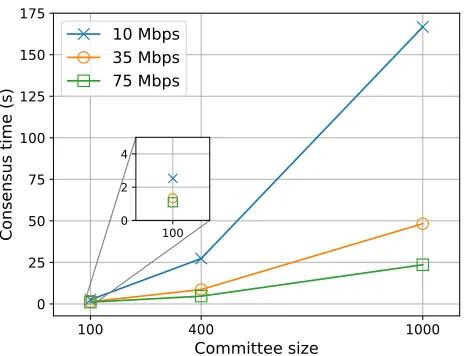
– Implementation and evaluation. We implement Solida and measure its performance. Our im-plementation is fully Byzantine fault tolerant. With a 0.1s network latency and 75 Mbps network bandwidth, Solida with committees of 1000 members can commit a consensus decision in 23.6 seconds.
1.1
Overview of the Solida Protocol
At a high level, Solida runs a Byzantine consensus protocol among a set of participants, called a committee, that dynamically change over time. The acting committee commits transactions into a linearizable log using a modified version of PBFT [5]. The log is comparable to the Bitcoin blockchain, also called a public ledger. We say each consensus decision fills aslot in the ledger. A consensus decision can be either (1) a batch of transactions, (2) a reconfiguration event. The first type of decision is analogous to a block in Bitcoin. The second type records the membership change in the committee.
We denote the i-th member in chronological order asMi, and the committee size isn= 3f+ 1. Then,
the i-th committeeCi = (Mi, Mi+1, Mi+2,· · ·, Mi+n−1). The first committeeC1 is known as the Genesis
committee, and itsnmembers are hard coded. After that, each new member is elected onto the committee one at a time, by the acting committee usingreconfiguration consensus decisions.
At any time, one committee member serves as the leader. It proposes a batch of transactions into the next empty slotsin the ledger. Other members validate proposed transactions (no double spend, etc.) and commit them in two phases. A Byzantine leader cannot violate safety but may prevent progress. If members detect lack of progress, they elect the next leader in the round robin order using standard techniques from PBFT view change. The next leader needs to stop previous leaders, learn the status from 2f+ 1 members and possibly redo consensus for previous slots, before continuing on to future empty slots.
The more interesting part of protocol is reconfiguration. To be elected onto the committee, a miner needs to present a PoW, i.e., a solution to a moderately hard computational puzzle. Upon seeing this PoW, the current committee tries to reach a specialreconfiguration consensus decision that commits (1) the identity of the new member, i.e., a public key associated with the PoW, and (2) the closing state before the reconfiguration. Once this reconfiguration consensus decision is committed, the system transitions into the new configurationCi+1. Starting from the next slot, PoW finder becomes the newest committee member
Mi+n, and the oldest committee memberMi loses its committee membership.
Here, a crucial design choice is: who should be the leader that drives reconfiguration? The first idea that comes to mind is to keep relying on the round robin leaders. But this approach presents a challenge on the analysis. The current leader may be Byzantine and refuse to reconfigure when it should. By doing so, it tries to buy time for other adversarial miners to find competing PoWs, so that it can nominate a Byzantine new member instead. Although we can conceive mechanisms to replace this leader, subsequent leaders may also be Byzantine. The probability of taking in an honest new member now depends on the pattern of consecutive Byzantine leaders on the current committee. This means we will not be able to apply the Chernoff inequality to bound the number of Byzantine members on a committee. It is unclear whether this is merely a mathematical hurdle or the adversary really has some way to increase its representation on the committee gradually and to go aboven/3 eventually.
Therefore, we will switch to external leadersfor reconfiguration. In particular, the successful miner would act as the leaderLfor reconfiguration and try to elect itself onto the committee. WhenL’s reconfiguration proposal is committed (becomes a consensus decision), reconfiguration is finished, and the system starts processing transactions under the new committee withLbeing the leader. Note that at this pointLbecomes a committee member, so the system has seamlessly transitioned back to internal leaders.
interrupt lower ranked ones. To ensure safety, the higher ranked leader may have to honor the proposals from lower ranked leaders by re-proposing them, if there exists one.
Now the key challenge is to figure out how leaders (internal or external) should be ranked in our protocol. One idea is to rank external leaders by the output hash of their PoW, and stipulate that external leaders are higher ranked than all internal leaders in that configuration. This approach, however, allows the adversary to prevent progress once in a while. If a Byzantine miner submits a “high ranked” PoW but does not drive reconfiguration, the system temporarily stalls until some honest miner finds an even higher ranked PoW. Note that no transactions can be approved in the meantime because internal leaders are all lower ranked than the Byzantine PoW finder. Our solution to this problem is to “expire” stalling external leaders, and give the leader role back to current committee members, so that the committee can resume processing transactions under internal leaders until the next external leader emerges. Crucially, during this process, we must enforce a total order among all leaders, internal or external, to ensure safety. The details are presented in Section 4.
1.2
Overview of the Model and Proof
We adopt the network model of Pass et al. [25]: a bounded message delay of ∆ that is known apriori to all participants. Note that this is the standard synchronous network model in distributed computing, though Pass et al. [25] call it “asynchronous networks”. What they really meant was thatBitcoin does not behave like a conventional synchronous protocol. In a conventional synchronous protocol, participants move forward in synchronized rounds of duration ∆, but Bitcoin does nothing of this sort and has no clear notion of rounds. Our adoption of a synchronous network model may raise a few immediate questions, which we discuss below.
Is the bounded message delay assumption realistic for the Internet? How realistic this assumption is depends a lot on the parameter ∆. With a conservative estimate, say ∆ = 5 seconds, and Byzantine fault tolerance, the assumption may be believable. Fault tolerance also helps here. Participants experiencing slow networks and unable to deliver messages within ∆ are considered Byzantine. So the assumption we require in Solida is that adversarial participants and “slow” participants collectively control no more than (roughly) 1/3 of the mining power.
More importantly, the bounded network delay assumption seems necessary for all PoW-based protocols. Otherwise, imagine that whenever an honest member finds a PoW, its messages are arbitrarily delayed due to asynchrony. Then, it is as if that the adversary controls 100% of the mining power. In this case, the adversary can create forks of arbitrary lengths in Bitcoin or completely take over the committee in BFT-based blockchains [7, 14, 26]. Pass et al. formalized the above intuition and showed that Bitcoin’s security fundamentally relies on the bounded message delay [25]. The larger ∆ is, the smaller percentage of Byzantine participants Bitcoin can tolerate; if ∆ is unbounded (an asynchronous network), then even an adversary with minuscule mining power can break Bitcoin.
Why do we use PBFT if the network is synchronous? It is well known that there exist protocols that can toleratef < n/2 Byzantine faults in a synchronous network [13, 19, 29]. By requiringf < n/3, PBFT preserves safety under asynchrony. But this seems unnecessary given that we assume synchrony. We adopt PBFT (with modifications) because it is an established protocol that provides responsiveness. Most protocols that toleratef < n/2 are synchronous and not responsive, because they advance in rounds of duration ∆. If the actual latency of the network is better than ∆ — either because the ∆ estimate is too pessimistic, the network is faster in the common case, or the network speed has improved as technology advances — a responsive protocol would offer better performance than a synchronous one. In other words, we opt to use an asynchronous protocol in a synchronous setting, essentially abandoning the strength of the bounded message delay guarantee, in order to run as fast as the network permits. But like all PoW-based blockchains, we rely on synchrony for safety in the worse case. We remark that a recent protocol called XFT [19] seems to be responsive in its steady state while toleratingf < n/2 Byzantine faults. An interesting future direction is to explore whether we can combine our reconfiguration techniques and XFT to get the best of both worlds.
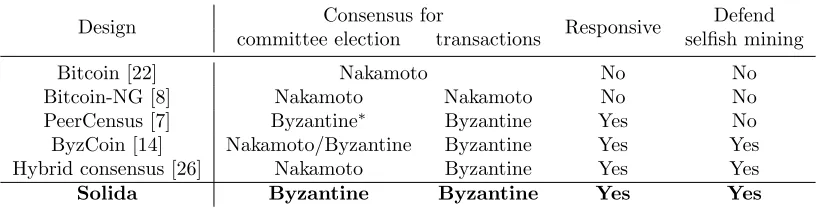
Table 1: Comparison of consensus protocols in Solida and related designs. Bitcoin and Solida combine committee election and transactions into a single step. Other protocols decouple the two, which we reflect with two separate columns in the table.
Design Consensus for Responsive Defend
committee election transactions selfish mining
Bitcoin [22] Nakamoto No No
Bitcoin-NG [8] Nakamoto Nakamoto No No
PeerCensus [7] Byzantine∗ Byzantine Yes No
ByzCoin [14] Nakamoto/Byzantine Byzantine Yes Yes
Hybrid consensus [26] Nakamoto Byzantine Yes Yes
Solida Byzantine Byzantine Yes Yes
mostly “fair”, i.e., the probability that a newly elected member is honest (Byzantine) is roughly proportional to the mining power of honest (Byzantine) miners. Additionally, with external leaders driving reconfiguration, we can show independence between reconfiguration events, and can then apply the Chernoff inequality to bound the probability of havingn/3 Byzantine members on a committee. Thus, the key step of the proof is to show that the Byzantine participants cannot distort their chance of joining the committee by too much. Here, the adversary’s main advantage is the network delay for honest participants, which essentially buys extra time for Byzantine miners to find PoWs. But since the network delay is bounded, the Byzantine miners’ advantage in finding PoWs can be also bounded.
2
Related Work
A comparison between Solida and related designs. Table 1 compares Solida and related designs. To start, we have Bitcoin that pioneered the direction of permissionless consensus (though not using the term). Bitcoin uses Nakamoto consensus, i.e., PoW and the longest-chain-win rule, and does not separate leader election and transaction processing. There have been numerous follow-up works in the Nakamoto framework. Some “altcoins” simply increases the block creation rate without other major changes to the Bitcoin protocol. A few proposals relax the “chain” design and instead utilize other graph structures to allow for faster block creation rate [32, 18, 31]. Some proposals [28] aim to improve throughput with off-chain transactions.
The key idea of Bitcoin-NG is to decouple transactions and leader election [8]. A miner is elected as a leader if it mines a (key) block in a PoW chain. This miner/leader is then responsible for signing transactions in small batches (microblocks) until a new leader emerges. Since (key) blocks in the PoW chain are small, Bitcoin-NG reduces the likelihood of forks. One can think of each leader in Bitcoin-NG to be a single-member committee. Since a single leader cannot be trusted, any transactions it approves still have to be buried in a Nakamoto PoW chain. Thus, Bitcoin-NG does not improve transaction confirmation time.
Blockchain analysis. While the Bitcoin protocol is quite simple and elegant, proving its security rigorously turns out to be highly nontrivial. The original Bitcoin paper [22] and a few early works [9, 32] considered specific attacks. Garay et al. [11] provided the first comprehensive security analysis for Bitcoin, by modeling Bitcoin as a synchronous protocol running in a synchronous network. Pass et al. [25] refined the analysis after observing that Bitcoin, while relying on a synchronous assumption, does not behave like a conventional synchronous protocol (cf. Section 1.1).
Byzantine Consensus. Consensus is a classic problem in distributed computing. There are a few variants of the consensus problem under Byzantine faults. A theoretical variant is Byzantine agreement [17] in which a fixed set of participants, each with an input value, try to agree on the same value. A more practical variant, which is also more suitable for blockchains, is BFT state machine replication (SMR). In this variant, a fixed set of participants try to agree on a sequence of values that may come from any participant or even external sources. Most BFT SMR protocols follow the PBFT [5] framework.
3
Model
Network. We consider apermissionless setting in which participants use their public keys as pseudonyms and can join or leave the system at any time. Participants are connected to each other in a peer-to-peer network with a small diameter. As mentioned, we adopt a synchronous network model: whenever a participant sends a message to another participant, the message is guaranteed to reach the recipient within ∆ time. For convenience, we define ∆ to be the end-to-end message delay bound. If there are multiple hops from the sender to the recipient, ∆ is the time upper bound for traveling all those hops. Our protocol uses computational puzzles, i.e., PoW. Similar to Bitcoin, the difficulty of the puzzle is periodically adjusted so that the expected time to find a PoW stays atD. D should be set significantly larger than ∆ according to our analysis in Section 4.5.
Types of participants. Participants in the system are eitherhonest orByzantine. Honest participants always follow the prescribed protocol, and are capable of delivering a message to other honest participants within ∆ time. Byzantine participants are controlled by a single adversary and can thus coordinate their actions. At any time, Byzantine participants collectively control no more than ρ fraction of the total computation power. We assume thenmembers in the Genesis committeeC1 are known to all participants,
and that the number of Byzantine participants onC1 is less thann/3.
Delayed adaptive adversary. We assume it takes time for the adversary to corrupt a honest participant. It captures the idea that it takes time to bribe a miner or infect a clean host. Most committee-based designs [7, 14, 26] require this assumption. Otherwise, an adversary can easily violate safety by corrupting the entire committee, which may be small compared to the whole miner population. This is formalized as a delayed adaptive adversary by Pass and Shi [26]. Specifically, we assume that even if the adversary starts corrupting a member as soon as it emerges with a PoW, by the time of corruption, the member would have already left the committee. Whether this assumption holds in practice remains to be examined. Algorand [21] introduced techniques to hide the identities of the committee members, and can thus tolerate instant corruption. Its core technique, however, seems to be tied to proof of stake, which has its own challenges such as the nothing-at-stake problem.
4
The Protocol
4.1
Overview
moving to future slots (liveness). To provide safety and liveness, the number of Byzantine members on each committee must be less thanf (n= 3f+ 1), which will be proved in Section 4.5.
We first describe the protocol outside reconfiguration, i.e., when no miner has found a PoW for the current puzzle. This part further consists of two sub-protocols: steady state under a stable leader (Section 4.2), andview change to replace the leader (Section 4.3). Members monitor the current leader, and if the leader does not make progress after some time, members support the next leader. The new leader has to learn what values have been proposed, and possibly re-propose those values. This part of the protocol is very similar to PBFT [5] except that the views in our protocol have more structures to support external leaders forreconfiguration (Section 4.4).
Each configuration can have multiple lifespans, and each lifespan can have many views. We use consecutive integers to number configurations, lifespans within a configuration, and views within a lifespan. The lifespan number is the number of PoWs (honest) committee members have seen so far in the current configuration. Intuitively, when a new PoW is found, the lifespan of the previous PoW ends. As explained in Section 1.1, our protocol can switch back and forth between internal and external leaders and we must enforce a total order among all leaders. To this end, we will associate each leader with a configuration-lifespan-view tuple (c, e, v), and rank leaders bycfirst, and then e, and thenv. Each (c, e, v) tuple also defines a steady state, in which the leader of that view, denoted asL(c, e, v), proposes values for members to commit. The view tuple and the leader role are managed as follows.
• Upon learning that a reconfiguration event is committed into the ledger, a memberM increases its configuration number c by 1, and resetse andv to 0. L(c,0,0) is the newly added member by the previous reconfiguration consensus decision.
• Upon receiving a new PoW for the current configuration, a memberM increases its lifespan numbere
by 1, and resetsv to 0. M now supports the finder of the new PoW asL(c, e,0) (e≥1).
• Upon detecting that the current leader is not making progress (timed out), a member M increases its view numberv by 1. L(c, e, v) (v≥1) is thel-th member on the current committee, by the order they join the committee, wherel=H(c, e) +v modn, andHis a random oracle (hash function).
To summarize, the 0-th leader of a lifespan is the newly added member (fore= 0) or the new PoW finder (e≥1). After that, leaders in that lifespan are selected in a round robin manner, with a pre-defined starting
point. We chose a pseudorandom starting point usingHbut other choices also work.
Now let us consider whether honest members agree on the identities of the leaders. For a view (c, e, v) withe= 0 orv≥1, the leader identity is derived from a deterministic function on the tuple and the current committee member identities (i.e., previous reconfiguration decisions). As long as the protocol ensures safety so far, members agree on the identities of these leaders. For views of the form (c, e,0) withe≥1, members may not agree on the leader’s identity if they receive multiple PoWs out of order. This is not a problem for safety because it is similar to having an equivocating leader and a BFT protocol can tolerate leader equivocation. However, contending leaders in a view may prevent progress. Luckily, members will time out and move on to views (c, e, v) withv≥1. Unique leaders in those views will ensure liveness.
Crucially, our protocol forbids pipelining to simplify reconfiguration: a memberM sends messages for slot
sonly if it has committed all slots up to s−1. LetM(c, e, v, s) be the set of members currently in view (c, e, v) working on slots. Each honest memberM can only belong to one such set at any point in time.
We use digital signatures even under a stable leader, i.e., we do not use PBFT’s MAC optimization [5]. The MAC optimization is not effective for a cryptocurrency since there are already hundreds of digital signatures to verify in each block/slot. We use hxiM to denote a messagexthat carries a signature from memberM. A message can be signed in layers, e.g.,hhxiMiM0. When the context is clear, we omit the signer
and simply writehxior hhxii.
4.2
Steady State
• (Propose) The leader L picks a batch of valid transactions {tx} and then broadcasts {tx} and hpropose, c, e, v, s, hiL wherehis the hash digest of{tx}.
After receiving{tx} andhpropose, c, e, v, s, hiL, a memberM ∈ M(c, e, v, s) checks
– L=L(c, e, v) andLhas not sent a different proposal,
– sis a fresh slot, i.e., no value could have been committed in slots(details in Section 4.4),
– {tx}is a set of valid transactions whose digest is h.
• (Prepare) If all the above checks pass,M broadcastshprepare, c, e, v, s, hi.
After receiving 2f+ 1 matchingprepare messages, a memberM ∈ M(c, e, v, s)accepts the proposal (represented by its digesth), and concatenates the 2f + 1 matchingprepare messages into anaccept certificate A.
• (Commit) Upon acceptingh,M broadcastshcommit, c, e, v, s, hi.
After receiving 2f+ 1 matchingcommitmessages, a memberM ∈ M(c, e, v, s) commits{tx} into slot
s, and concatenates the 2f+ 1 matchingcommitmessages into a commit certificate C.
The above is standard PBFT. We now add an extra propagation step to the steady state.
• (Notify) Upon committingh,M sendshhnotify, c, e, v, s, hi,CiM to all other members to notify them about the decision. M also starts propagating this decision on the peer-to-peer network to miners, users and merchants, etc. M then moves to slots+ 1.
Upon receiving anotifymessage like the above, a member commits h, sends and propagates its own notifymessage if it has not already done so, and then moves to slot s+ 1.
4.3
View Change
A Byzantine leader cannot violate safety, but it can prevent progress by simply not proposing. Thus, in PBFT, every honest memberM monitors the current leader, and if no new slot is committed after some time,
M abandons the current leader and supports the next leader. Since we have assumed a worst-case message delay of ∆, it is natural to set the timeout based on ∆. The concrete timeout values (4∆ and 8∆) will be justified in the proof of Theorem 1.
• (View-change) Whenever a memberM moves to a new slotsin a steady state, it starts a timerT. If
T reaches 4∆ andM still has not committed slots, thenM abandons the current leader and broadcasts hview-change, c, e, vi.
Upon receiving 2f+ 1 matching view-change messages for (c, e, v), if a member M is not in a view higher than (c, e, v), it forwards the 2f+ 1 view-changemessages to the new leaderL0=L(c, e, v+ 1). After that, ifM does not receive a new-view message from L0 within 2∆, thenM abandons L0 and broadcastshview-change, c, e, v+ 1i.
• (New-view) Upon receiving 2f + 1 matchingview-changemessages for (c, e, v), the new leaderL0=
L(c, e, v+ 1) concatenates them into a view-change certificateV, broadcastshnew-view, c, e, v+ 1,ViL0,
and enters view (c, e, v+ 1).
Upon receiving ahnew-view, c, e, v,ViL0 message, if a memberM is not in a view higher than (c, e, v),
it enters view (c, e, v) and starts a timerT. IfT reaches 8∆ and still no new slot is committed, thenM
• (Status) Upon entering a new view (c, e, v),M sendshhstatus, c, e, v, s−1, h, s, h0i,C,Aito the new leader L0 = L(c, e, v). In the above message, h is the value committed in slot s−1 and C is the corresponding commit certificate; h0 is the value accepted byM in slotsandAis the corresponding
accept certificate (h0 =A=⊥ifM has not accepted any value for slots). We call the inner part of the message (i.e., excludingC,A) itsheader.
Upon receiving 2f+ 1status,L0 concatenates the 2f + 1statusheaders to form astatuscertificate S.
L0 then picks astatusmessage that reports the highest last-committed slot s∗; if there is a tie,L0 picks the one that reports the highest ranked accepted value in slots∗+ 1 . Let the two certificates in this message beC∗ andA∗ (A∗ might be⊥).
• (Re-propose) The new leader L0 broadcasts hrepropose, c, e, v, s∗+ 1, h0,S,C∗,A∗i
L0. In the above
message, s∗ should be the highest last-committed slot reported inS. h0 should match the value inA∗
ifA∗6=⊥; IfA∗=⊥, thenL0 can chooseh0 freely. 1
Thereproposemessage serves two purposes. First, C∗ allows everyone to commit slots∗. Second, it
re-proposesh0 for slots∗+ 1, and carries a proof (S,A∗) thath0 is safe for slots∗+ 1. Therepropose
message is invalid if any of the aforementioned conditions is violated: s∗ is not the highest committed slot,C is not for slots∗,Ais not for the highest ranked accepted value fors∗+ 1, orh0 is not the value
certified byA.
Upon receiving a validreproposemessage, a memberM commits slots∗ if it has not already;M then executes the prepare/commit/notify steps as in the steady state for slot s∗+ 1, and marks all slots
> s∗+ 1 fresh for view (c, e, v). At this point, the system transitions into a new steady state.
A practical implementation of our protocol can piggybackstatusmessages on view-changemessages and repropose messages on new-view messages to save two steps. We choose to separate them in the above description because the reconfiguration sub-protocol can reuse thestatusstep.
4.4
Reconfiguration
PoW to prevent Sybil attacks. In order to join the committee, a new member must show a PoW, i.e., a solution to a computational puzzle based on a random oracleH. The details of the puzzle will be discussed later. For now, it is only important to know that each configuration defines a new puzzle. Let the puzzle for configurationcbepuzzle(c). Solutions to this puzzle are in the form of (pk,nonce). pkis a miner’s public key. A miner keeps trying different values ofnonce until it finds a valid solution such thatH(puzzle(c),pk,nonce) is smaller than some threshold. The threshold is also called thedifficulty and is periodically adjusted to keep the expected reconfiguration interval atD.
Upon finding a PoW, the miner tries to join the committee by driving a reconfiguration consensus as an external leader. To do so, it first broadcasts the PoW to committee members.
• (New-lifespan) Upon finding a PoW, the miner broadcasts it to the committee members.
Upon receiving a new valid PoW for the current configuration (that M has not seen before), M
forwards the PoW to other members, enters view (c, e+ 1,0), sets the PoW finder as its 0-th leader
L0=L(c, e+ 1,0) of the new lifespan, and starts a timerT. IfT reaches 8∆ and still no new slot is
committed, thenM abandonsL0 and broadcastshview-change, c, e+ 1,0i.
• (Status) Upon entering a new lifespan,M sendsL0hhstatus, c, e,0, s−1, h, s, h0i,C,Ai, wheres, h,C,A are defined the same way as in the view-change sub-protocol.
Upon receiving 2f+ 1 status,L0 constructss∗,S,C∗ andA∗ as in view-change.
1Strictly speaking, in this case,L0is proposing a new value rather than re-proposing. But we keep the message name as
• (Re-propose and Reconfigure) Leth∗ be the committed value in the highest committed slots∗
amongS. Leth0 be the highest ranked accepted value (could be⊥) into slots∗+ 1 amongS. Note thath∗ andh0 are certified byS,C∗ andA∗. Now depending on whetherh∗ andh0 are transactions or
reconfiguration events, the new external leaderL0 takes different actions.
– Ifh∗is a reconfiguration event to configurationc+ 1, thenL0 simply broadcastsC and terminates. Terminating meansL0 gives up its endeavor to join the committee (it is too late and some other leader has already finished reconfiguration) and starts working onpuzzle(c+ 1).
– Ifh∗ is a batch of transactions, andh0 is a reconfiguration event to configurationc+ 1, then L0
broadcastshrepropose, c, e,0, s∗+ 1, h0,S,C∗,A∗i
L0 and then terminates.
– Ifh∗ is a batch of transactions, andh0 =⊥, thenL0 tries to drive the reconfiguration consensus into slots∗+ 1 by broadcastinghrepropose, c, e,0, s∗+ 1, h,S,C∗,A∗i
L0 wherehis a reconfiguration
event that letsL0 join the committee. If this proposal becomes committed, then starting from slot
s∗+ 2, the system reconfigures to the next configuration and L0 joins the committee replacing the oldest member.
– If h∗ and h0 are both batches of transactions, then L’ first re-proposes h0 for slot s∗+ 1 by broadcastinghrepropose, c, e,0, s∗+ 1, h0,S,C∗,A∗i
L0. After that,L0tries to drive a reconfiguration
consensus into slots∗+ 2 by broadcastinghpropose, c, e,0, s∗+ 2, hiL0 wherehis a reconfiguration
event that letsL0 join the committee. If this proposal becomes committed, then starting from slot
s∗+ 3, the system reconfigures to the next configuration and L0 joins the committee replacing the oldest member.
In the latter three cases, members react to the reproposemessage in the same way as in view-change: check its validity and execute prepare/commit/notify. Note that the reconfiguration proposal in the last case is a steady stateproposemessage instead of areproposemessage, and it does not need to carry certificates as proofs. This is because after members commit the re-proposed value into slots∗+ 1, the system enters a special steady state under leaderL0. Slots∗+ 2 will be marked as afresh slot in this steady state. This steady state is special in the sense that, ifL0 is not faulty and is not interrupted by another PoW finder, members will experience a configuration change, but the leader remains unchanged as we have definedL(c+ 1,0,0) to be the newly added member. After reconfiguration, it becomes a normal steady state in view (c+ 1,0,0).
The puzzle and defense to selfish mining. We now discuss what exactly the puzzle is. A natural idea is to make the puzzle be the previous reconfiguration decision. However, this allowswithholding attacks similar to selfish mining [9]. To favor the adversary, we assume that if the adversary and an honest miner both find PoWs, the adversary wins the contention and joins the committee. Then, when the adversary finds a PoW first, its best strategy is to temporarily withhold it. At this point, the adversary already knows the next puzzle, which is its own reconfiguration proposal. Meanwhile, honest miners are wasting their mining power on the current puzzle, not knowing that they are doomed to lose to the adversary when they eventually find a PoW. This gives the adversary a head start on the next puzzle. Its chance of taking the next seat on the committee will hence be much higher than its fair share of mining power. The authors of ByzCoin suggested an idea to thwart the above attack: let the puzzle include 2f+ 1 committee member signatures. This way, a PoW finder cannot determine the puzzle on its own and thus gains nothing from withholding its PoW. For concreteness, we letpuzzle(c+ 1) beany set off+ 1 notifyheaders for the last reconfiguration decision hnotify, c, e, v, s, hi. This ensures the following:
Lemma 1. The adversary learns a puzzle at most2∆time earlier than honest miners.
4.5
Safety and Liveness
We first prove safety and livenessassuming each committee has no more thanf < n/3 Byzantine members. The proof of the following theorem (given in the appendix) mostly follows PBFT. Essentially, the biggest change we made to PBFT at an algorithmic level is from a round robin leader schedule to a potential interleaving between internal and external leaders. But crucially, we still have a total order among leaders to ensure safety and liveness.
Theorem 1. The protocol achieves safety and liveness if each committee has no more thanf < n/3Byzantine members.
Next, we showf < n/3 indeed holds. Letρbe the adversary’s ratio of mining power. Honest miners thus collective control 1−ρof the total network mining power. Ideally, we would hope that reconfiguration is a “fair game”, i.e., the adversary taking the next committee seat is with probabilityρ, and an honest miner takes the next seat with probability 1−ρ. This is indeed simply assumed to be the case in PeerCensus [7] and ByzCoin [14]. However, we show that due to network latency, it is as if that the adversary has aneffective mining power ρ0= 1−(1−ρ)e−(2ρ+8)∆/D> ρ. (Recall thatD is the expected time for the entire network to find a PoW.) We needD∆ so thatρ0 is not too much larger thanρ.
Theorem 2. Assuming f < n/3 holds forC1, thenf < n/3 holds for each subsequent committee except for
a probability exponentially small innif ρ0= 1−(1−ρ)e−(2ρ+8)∆/D<1/3.
Proof. The increase in the adversary’s effective mining power comes from three sources. First, as Lemma 1 shows, the adversary may learn a puzzle up to 2∆ earlier than honest miners. Second, if the adversary finds a PoW while an honest external leader is reconfiguring, which can take up to 8∆ time, the adversary can interrupt the honest leader and win the reconfiguration race. Lastly, two honest leaders may interrupt each other if they find PoWs within 8∆ time apart, while the adversary-controlled miners can coordinate their actions. Therefore, an honest miner wins a reconfiguration if all three events below happen:
• (event X) the adversary finds no PoW in its 2∆ head start,
• (event Y) some honest miner finds a PoW earlier than the adversary givenX, and
• (event Z) no miner, honest or adversarial, finds a PoW in the next 8∆ time givenY.
PoW mining is a memory-less process modeled by a Poisson distribution: the probability for a miner to findk PoWs in a period is p(k, λ) = λkke−!λ, where λ is the expected number of PoWs to be found in this period. Recall that the expected time for all miners combined to find a PoW is D. In the 2∆ head start, the adversary expects to find λX = 2∆ρ/D PoWs. Thus, Pr(X) =p(0, λX) =e−2∆ρ/D. Similarly,
Pr(Z) = e−8∆/D. Event Y is a “fair race” between the adversary and honest miners, so Pr(Y) = 1−ρ. The memory-less nature of PoW also means that the above eventsX, Y and Z are independent. Thus, the probability that an honest miner wins a reconfiguration is
Pr(X∩Y ∩Z) = Pr(X) Pr(Y) Pr(Z) = (1−ρ)e−(2ρ+8)∆/D:= 1−ρ0.
We define the above probability to be 1−ρ0, which can be thought of as the honest miners’ effective mining power once we take message delays into account. ρ0 is then the adversary’s effective mining power. This matches our intuition: as D → ∞, the adversary’s advantage from message delay decreases, and (1−ρ0)→(1−ρ).
Conditioned on all committees up toCi having no more thann/3 Byzantine members, the adversary
wins each reconfiguration race with probability at mostρ0, independent of the results of other reconfiguration races. We can then use the Chernoff inequality to bound the probability of Byzantine members exceeding
n/3 on any committee up to Ci+1. LetQdenote the number of Byzantine members on a committee. We
haveE(Q) :=µ=ρ0n. Pr(Q≥(1 +δ)µ)≤e−δµlog(1+2 δ) due to the Chernoff bound. Selectδ= 1
3ρ0 −1, we
have Pr(Q≥n/3)≤en(1−3ρ 0) log(3ρ0)
6 . Ifρ0 <1/3, then (1−3ρ0) log(3ρ0)<0, and the above probability is
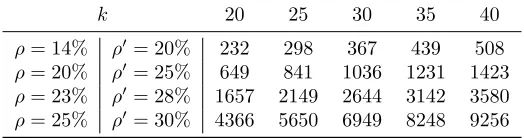
Table 2: The required committee size under different adversarial miner ratiosρand desired security levelsk, assuming ∆/D= 1/120.
k 20 25 30 35 40
ρ= 14% ρ0= 20% 232 298 367 439 508
ρ= 20% ρ0= 25% 649 841 1036 1231 1423
ρ= 23% ρ0= 28% 1657 2149 2644 3142 3580
ρ= 25% ρ0= 30% 4366 5650 6949 8248 9256
Concrete committee size. We calculate the required committee size under typical values. We can calculate
ρ0 from ρgiven the value of ∆/D. If ∆ is 5 seconds and D is 10 minutes, then ∆/D= 1/120. Then, for a desired security level, a simple calculation of binomial distribution yields the required committee sizen. The results are listed in Table 2. A security parameter k means there is a 2−k probability that, after a
reconfiguration, the adversary controls more thann/3 seats on the committee. k= 25 ork= 30 should be sufficient in practice. Assuming we reconfigure every 10 minutes, 225 reconfigurations take more than 600
years and 230reconfigurations take more than 20,000 years. With ρ0 = 25%, the required committee size is
around 1000.
It is worth noting that as ρ0 approaches 33%, the required committee size increases rapidly and the committee-based approach becomes impractical. This gap between theory and practice is expected. Similarly, Bitcoin, in theory, can tolerate an adversarial with up to 50% mining power. But the recommended “six confirmation” is calculated assuming a 10% adversary and a rather low security levelk≈10. If the adversary really controls close to 50% mining power, then thousands of confirmations would be required for each block.
4.6
Towards Pipelining
One limitation of the above Solida protocol is that it forbids pipelining, i.e., members are not allowed to work on multiple slots in parallel. The interaction between pipelining and reconfiguration is non-trivial, and to the best of our knowledge, has not been worked out in BFT protocols. In particular, when a slot is being worked on, the exact configuration (i.e., identities of committee members) for that slot would not be known if previous slots have not been committed. In this subsection, we briefly describe how we plan to support pipelining. We hope to present and implement a detailed pipelined protocol in a future version.
The key idea is to let each proposal carry a digest of its “predecessor proposal”. Since the predecessor proposal also carries the digest of its own predecessor proposal, each proposal is tied to its entire chain of “ancestor proposals”. A non-leader memberM sends messages for a proposal for slotsonly ifM has accepted its predecessor proposal in slots−1. When a member accepts a proposal, it also accepts all its ancestors proposals; likewise, when a member commits a proposal, it also commits all its ancestors proposals.
During a view-change or a reconfiguration, a member reports in its statusmessage the highest ranked proposal chain that it has accepted (with an accept certificate). The new leaderL0 then re-proposes the highest ranked proposal chain it hears from members. Note that in either step, we prioritize the highest ranked proposal chain, not the longest proposal chain. If the highest ranked proposal chain contains a reconfiguration event in its tail (highest numbered slot), thenL0 re-proposes this proposal chain and terminates. Otherwise,
100
400
1000
Committee size
0
25
50
75
100
125
150
175
Consensus time (s)
10 Mbps
35 Mbps
75 Mbps
100 0 2 4
Figure 1: Time to achieve reconfiguration consensus with different committee sizes and network bandwidth.
5
Implementation and Evaluation
Implementation details. We implement the non-pipelined version of the Solida consensus protocol in Python and measure its performance. We implement our 6-phase PBFT-style protocol in which committee members agree on a proposal digest from a successful miner. For digital signatures, we use ECDSA with the prime192v2 curve and the Charm crypto library [2]. We test Solida on 16 m4.16xlarge machines on Amazon EC2. The CPUs are Intel Xeon E5-2686 v4 @ 2.3 GHz. Each machine has 64 cores, giving a total of 1024 cores. We use 1 CPU core for each committee member, testing committee size up to 1000. To emulate Internet latency and bandwidth, we add a delay of 0.1 second (unless otherwise stated) to each message and throttle the bandwidth of each committee member to the values in Figure 1.
Experimental results. The main result we report is the time it takes for committee members to commit a reconfiguration consensus decision (committing a decision in the steady state takes strictly less time). We report the consensus time from the leader’s perspective, i.e., the time between when the leader sends its PoW and when the leader receives the firstNotifymessage, which is the earliest point at which the leader knows its proposal is committed. Figure 1 presents the time to reach a reconfiguration consensus decision (averaged over 10 experiments) under different committee sizesnand bandwidth limits. As shown in the zoomed-in part, with a small committee of 100 members, a decision takes 1 to 3 seconds depending on the throughput. The bottleneck here is network latency. Recall that there are 8 sequential messages from the leader’s perspective, each adding 0.1s latency. With larger committees of 400 and 1000 members, network bandwidth becomes the bottleneck. As expected, consensus time is roughly quadratic in committee size and inversely proportional to network bandwidth. With moderate network bandwidth, consensus time is manageable even with 1000 committee members: 48.3s for 35 Mbps and 23.6s for 75 Mbps. To study the effect of network latency, we rerun some experiments with a 0.5s latency (results not shown). In each experiment, the consensus time increases by about 3s, which is as expected given the 8 sequential messages and a 0.4s latency increase for each.
6
Conclusion and Future Work
bounded message delay model, and provided a prototype implementation and evaluation results. Besides the pipelined protocol, interesting future directions include designing and rigorously analyzing incentives for Solida, and extending Solida to tolerate an adversary with up to 50% mining power.
Acknowledgement
We thank Eleftherios Kokoris-Kogias for clarifying the ByzCoin protocol and other helpful discussions. We thank the anonymous reviewers for their valuable suggestions. This work is funded in part by NSF award #1518765, a Google Ph.D. Fellowship award, and an Azrieli Foundation scholarship.
References
[1] Ittai Abraham and Dahlia Malkhi. BVP: Byzantine vertical paxos, 2016.
[2] Joseph A Akinyele, Christina Garman, Ian Miers, Matthew W Pagano, Michael Rushanan, Matthew Green, and Aviel D Rubin. Charm: a framework for rapidly prototyping cryptosystems. Journal of Cryptographic Engineering, 3(2):111–128, 2013.
[3] Alysson Bessani, Jo˜ao Sousa, and Eduardo EP Alchieri. State machine replication for the masses with bft-smart. InDependable Systems and Networks (DSN), 2014 44th Annual IEEE/IFIP International Conference on, pages 355–362. IEEE, 2014.
[4] Dan Boneh, Ben Lynn, and Hovav Shacham. Short signatures from the weil pairing. pages 514–532. Springer, 2001.
[5] Miguel Castro and Barbara Liskov. Practical byzantine fault tolerance. InProceedings of the third symposium on Operating systems design and implementation, pages 173–186. USENIX Association, 1999.
[6] CoinDesk. Average number of transactions per block, accessed Aug, 2016. https://www.coindesk.com/data/bitcoin-number-transactions-per-block/.
[7] Christian Decker, Jochen Seidel, and Roger Wattenhofer. Bitcoin meets strong consistency. InProceedings of the 17th International Conference on Distributed Computing and Networking, page 13. ACM, 2016.
[8] Ittay Eyal, Adem Efe Gencer, Emin G¨un Sirer, and Robbert Van Renesse. Bitcoin-NG: A scalable blockchain protocol. In13th USENIX Symposium on Networked Systems Design and Implementation (NSDI 16), pages 45–59, 2016.
[9] Ittay Eyal and Emin G¨un Sirer. Majority is not enough: Bitcoin mining is vulnerable. InInternational Conference on Financial Cryptography and Data Security, pages 436–454. Springer, 2014.
[10] Bryan Ford. Untangling mining incentives in bitcoin and byzcoin, 2016. http://bford.github.io/2016/10/25/mining/.
[11] Juan Garay, Aggelos Kiayias, and Nikos Leonardos. The Bitcoin backbone protocol: Analysis and applications. InAnnual International Conference on the Theory and Applications of Cryptographic Techniques, pages 281–310. Springer, 2015.
[12] Flavio P Junqueira, Benjamin C Reed, and Marco Serafini. Zab: High-performance broadcast for primary-backup systems. InDependable Systems & Networks (DSN), 2011 IEEE/IFIP 41st International Conference on, pages 245–256. IEEE, 2011.
[13] Jonathan Katz and Chiu-Yuen Koo. On expected constant-round protocols for byzantine agreement. J. Comput. Syst. Sci., 75(2):91–112, 2009.
[14] Eleftherios Kokoris Kogias, Philipp Jovanovic, Nicolas Gailly, Ismail Khoffi, Linus Gasser, and Bryan Ford. Enhancing Bitcoin security and performance with strong consistency via collective signing. In25th USENIX Security Symposium, pages 279–296. USENIX Association, 2016.
[15] Leslie Lamport. The part-time parliament. ACM Transactions on Computer Systems (TOCS), 16(2):133–169, 1998.
[17] Leslie Lamport, Robert Shostak, and Marshall Pease. The byzantine generals problem. ACM Transactions on Programming Languages and Systems (TOPLAS), 4(3):382–401, 1982.
[18] Yoad Lewenberg, Yonatan Sompolinsky, and Aviv Zohar. Inclusive block chain protocols. InInternational Conference on Financial Cryptography and Data Security, pages 528–547. Springer, 2015.
[19] Shengyun Liu, Christian Cachin, Vivien Qu´ema, and Marko Vukolic. XFT: practical fault tolerance beyond crashes. In12th USENIX Symposium on Operating Systems Design and Implementation, pages 485–500. USENIX Association, 2016.
[20] Loi Luu, Viswesh Narayanan, Chaodong Zheng, Kunal Baweja, Seth Gilbert, and Prateek Saxena. A secure sharding protocol for open blockchains. InProceedings of the 2016 ACM SIGSAC Conference on Computer and Communications Security, pages 17–30. ACM, 2016.
[21] Silvio Micali. Algorand: The efficient and democratic ledger. arXiv:1607.01341, 2016.
[22] Satoshi Nakamoto. Bitcoin: A peer-to-peer electronic cash system, 2008.
[23] Kartik Nayak, Srijan Kumar, Andrew Miller, and Elaine Shi. Stubborn mining: Generalizing selfish mining and combining with an eclipse attack. In2016 IEEE European Symposium on Security and Privacy (EuroS&P), pages 305–320. IEEE, 2016.
[24] Diego Ongaro and John K Ousterhout. In search of an understandable consensus algorithm. InUSENIX Annual Technical Conference, pages 305–319, 2014.
[25] Rafael Pass, Lior Seeman, and Abhi Shelat. Analysis of the blockchain protocol in asynchronous networks. In
Advances in Cryptology – EUROCRYPT 2017, pages 643–673. Springer International Publishing, 2017.
[26] Rafael Pass and Elaine Shi. Hybrid consensus: Efficient consensus in the permissionless model. 2016. Cryptology ePrint Archive, Report 2016/917.
[27] Rafael Pass and Elaine Shi. Fruitchains: A fair blockchain. InProceedings of the ACM Symposium on Principles of Distributed Computing, pages 315–324. ACM, 2017.
[28] Joseph Poon and Thaddeus Dryja. The Bitcoin lightning network: Scalable off-chain instant payments. Technical Report. https://lightning.network, 2015.
[29] Ling Ren, Kartik Nayak, Ittai Abraham, and Srinivas Devadas. Practical synchronous byzantine consensus. Cryptology ePrint Archive, Report 2017/307, 2017. http://eprint.iacr.org/2017/307.
[30] Rodrigo Rodrigues, Barbara Liskov, Kathryn Chen, Moses Liskov, and David Schultz. Automatic reconfiguration for large-scale reliable storage systems. IEEE Transactions on Dependable and Secure Computing, 9(2):145–158, 2012.
[31] Yonatan Sompolinsky, Yoad Lewenberg, and Aviv Zohar. SPECTRE: A fast and scalable cryptocurrency protocol, 2016.
A
Proofs
Proof of Theorem 1. We first consider safety. LetM be the member to commit slotsin the lowest ranked view. SayM commits valuehand it does so in view (c, e, v). We need to show that no other valueh06=h
can be committed into slotsin that view and all future views. In fact, we will show by induction that there cannot exist an accept certificateA0 forh0 in that view and all future views, which means no honest member
would have acceptedh0, let alone committing it. SinceM committed in view (c, e, v), there must be 2f+ 1 members that have acceptedh in that view, and 2f+ 1 members that have sent hprepare, c, e, v, hi. For the base case, suppose for contradiction thatA0 exists forh0 in view (c, e, v). Then, 2f+ 1 members must
sendhprepare, c, e, v, h0i. This means at least one honest member has sentprepare messages for two different proposals in view (c, e, v), which is a contradiction. For the inductive step, suppose that no accept certificate exists forh0 from view (c, e, v) up to (excluding) view (c0, e0, v0). SinceM has committed slot s, then at least 2f + 1 members must have committed slot s−1 (they sendprepare for slot sonly after committing slot
s−1). So in the status certificate S of areproposemessage for view (c0, e0, v0), the largest last-committed slots∗≥s−1. Therefore, slotsis either already committed toh, or has to be re-proposed. If slotsneeds to
be re-proposed, which meanss∗=s−1, then S must contain at least one statusheader reporting thath
has been accepted into slotswith a rank no lower than (c, e, v). Due to the inductive hypothesis, no accept certificate can exist forh0 with a rank equal to or higher than (c, e, v). his, therefore, the unique highest ranked accepted value for slots, and it is the only value that can be legally re-proposed in view (c0, e0, v0). Hence, no accept certificate forh0 can exist in view (c0, e0, v0), completing the proof.
Next, we consider liveness. According to the protocol, if a Byzantine leader does not commit any slot for too long, it will be replaced shortly. But here is an another liveness attack that a Byzantine leader can perform in the cryptocurrency setting. The Byzantine leader can simply construct transactions that transfer funds between its own accounts and keep proposing/committing these transactions. It is impossible for honest members to detect such an attack. Fortunately, we have shown that honest miners win at least 2/3 of the reconfiguration races, and after a reconfiguration, the newly added member becomes the leader. So 2/3 of the time, an honest leader is in control to provide liveness. It remains to check that an honest leader will not be replaced until the next lifespan. It is sufficient to show that an honest leader will never be accused by an honest member. This is guaranteed by our timeout values. First, observe that thenotifystep ensures two honest members commit a slot at most ∆ time apart. In the steady state, each member gives the leader 4∆ time to commit each slot: one ∆ to account for the possibility that other members come to this slot (i.e., finish the previous slot) ∆ time later, and three ∆ for the three phases in the steady state. At the beginning of a new view or a new lifespan, each member gives the leader 8∆ time, because thestatus andrepropose steps take extra 4∆ time. The last case to consider is when a member abandons a future leader because it does not sendnew-view when it should. Before accusing a future leader, a member allows 2∆ time after forwarding it a view-change certificate, which is sufficient for an honest leader to broadcastnew-view.