IJEDR1403034
International Journal of Engineering Development and Research (www.ijedr.org)3106
Enhanced Implementation of Image Compression
using DWT, DPCM Architecture
1
Dr. Krupa Rasane,
2Vidya S V
1Professor, 2 P G StudentElectronics and Communication Engineering
K L E Dr. M. S. Sheshgiri College of Engineering and Technology, Belgaum, India
_______________________________________________________________________________________________________
Abstract - Image compression plays a vital role in many important and diverse applications, including video conferencing, remote sensing etc. To achieve the image compression, DWT is being used for decomposition and the decomposed sub- band is quantized and encoded. In most of the earlier work compression is obtained using multi-resolution DWT, quantization and encoding. It is observed that hardware implementation enhances speed and can be built as an Application Specific Integrated Circuits (ASIC) for many real time applications. This project performs image compression using DWT for multi-resolution decomposition. Further, in our work the lower frequency sub-band is quantized using DPCM and encoded.
Key words - Image Compression, DWT, DPCM
________________________________________________________________________________________________________
I.INTRODUCTION
During last decade there is an enormous increase in digital images which is the source of information in wide range of applications like various multi-media computer services and telecommunication applications such as video conferencing, interactive education and numerous other areas. This type of information gives rise to high transmission and storage cost. To store these images or make them available over networks, image compression techniques are needed. The image compression technique reduces the image storage space, provides a potential cost savings associated with sending less data over the transmission channel by reducing the bandwidth, as few bits are transmitted over the transmission channel, the probability of transmission errors is less, also provides a level of security against illicit monitoring.
Compression is achieved by removing one or more of the data redundancies [1]. There are three basic data redundancies are coding redundancy, Interpixel redundancy and Psychovisual redundancy. Coding redundancy is present when less than optimal code words are used in coding the information. Interpixel redundancy results from the correlation between the pixels of an image. Psychovisual redundancy is due to data that has relatively less importance than other information in the normal visual processing. The objective of Image compression techniques is to reduce the number of bits as much as possible to represent an image by taking advantage of these redundancies, while maintaining the resolution and the visual quality of the reconstructed image. An inverse process called decompression is applied to the compressed data to get the reconstructed image. At present, the main core of image compression technology consists of three important processing stages: pixel transforms, vector quantization and entropy coding. Hence there came a series of standard technique like JPEG, MPEG and H.261 for image and video compression.
II.DISCRETE WAVELET TRANSFORM
DWT can decompose the input samples in multi-resolution, where it decomposes a signal into its components in different frequency bands. The Inverse DWT reconstructs a signal from its different frequency band components. The applications of this transform are numerous, ranging from image and speech compression.
One-Dimensional Discrete Wavelet Transform Algorithm
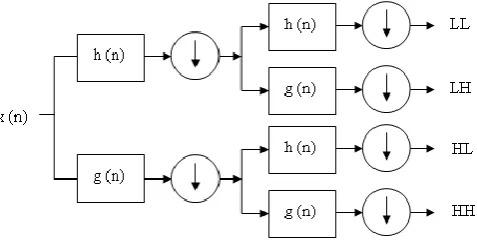
In the 1990s, the French scholar Mallat raised a fast discrete wavelet transform algorithm named the Mallat algorithm using of the concept of multi-resolution analysis [8]. The algorithm can be described as follows:
yh (n) = ∑k x(2n – k) h(k) (1) yg (n) = ∑k x(2n – k) g(k) (2)
Where x(n) are the input signals, yh(n) and yg(n) are the output sequence and h(k) and g(k) are low-pass and high-pass filters. The input sequence x(n) bypass the filter banks h(k) and g(k) and extracted by 2,and finally generate the low-frequency signal yh(n) and high frequency details signal yg(n).
Two-Dimensional Discrete Wavelet Transform Algorithm
IJEDR1403034
International Journal of Engineering Development and Research (www.ijedr.org)3107
Fig 1Two-dimensional Mallat algorithm structureTraditionally, DWT has been implemented by convolution or FIR filter bank structures which requires a large number of arithmetic computations and a large storage, features that are not desirable for either high speed or low power image/video processing applications. To overcome the disadvantage of convolution DWT, a new approach called the lifting-based wavelet transform or simply lifting is being used
.
III.LIFTINGBASEDDWT
The main feature of the lifting-based DWT scheme is to break up the high-pass and low-pass wavelet filters into a sequence of upper and lower triangular matrices, and convert the filter implementation into banded matrix multiplications. This scheme often requires far fewer computations compared to the convolution based DWT. It consists of a series of split, predict and update steps that modify or lift one set of samples to be used in the next step as shown in Fig 2.
Fig 2 Structure of Lifting scheme based DWT The steps involved in lifting based DWT are as follows [8]
• Split: The original image is split into odd and even samples.
Even samples: Xe = X2n (3)
Odd samples: Xo = X2n+1 (4)
• Predict: The prediction stage eliminates redundancy left and gives a more compact data representation. The Predict step uses the even subset X2n to predict the odd subset X2n+1 using a prediction function P. The difference between the predicted value of the subset and the original value is processed and replaces this latter
dn = Xo – P(Xe) (5)
• Update: The third stage of the lifting scheme introduces the update phase. In this stage the coefficient di is lifted with the help of the neighboring wavelet coefficients. This phase is referred as the primal lifting phase or update phase
an = Xe + U(dn) (6)
IV.DIFFERENTIALPULSECODEMODULATION
IJEDR1403034
International Journal of Engineering Development and Research (www.ijedr.org)3108
Fig 3DPCM ArchitectureThe fact that it is possible to predict future values of the samples, gives rise to the differential quantization scheme as shown in Fig.3. In this scheme the input to the quantizer is
e(n) = x(n) – x`(n)
Eq is the difference between the unquantized input sample x (n) and the prediction of it x` (n). The predicted value is produced by using a predictor whose input is the quantized input sample. The difference e(n) is called a prediction error, science it is the amount by which predictor fails to predict the input exactly. Encoding of quantizer output v(n) will reduce the number of bits as the difference between the original value and the predicted values will be significantly smaller in magnitude then the actual magnitude of pixel.
V.IMPLEMENTATION
Mathematical Equations for Lifting DWT
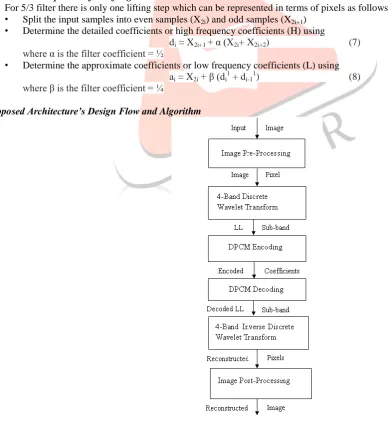
For 5/3 filter there is only one lifting step which can be represented in terms of pixels as follows
• Split the input samples into even samples (X2i) and odd samples (X2i+1)
• Determine the detailed coefficients or high frequency coefficients (H) using
di = X2i+1 + α (X2i+ X2i+2) (7)
where α is the filter coefficient = ½
• Determine the approximate coefficients or low frequency coefficients (L) using
ai = X2i + β (di1 + di-11) (8)
where β is the filter coefficient = ¼
Proposed Architecture’s Design Flow and Algorithm
IJEDR1403034
International Journal of Engineering Development and Research (www.ijedr.org)3109
• Determine L and H sub-band coefficients using 1D DWT equations of the lifting scheme.
• Store L and H sub-band coefficients into intermediate memory.
• 2D DWT is performed on L and H sub-bands of 1D DWT
• Read L from the intermediate memory and repeat the steps of 1D DWT to get LL and LH sub-band coefficients.
• Store LL and LH sub-band coefficients into the intermediate memory.
• Read H from the intermediate memory and repeat the steps of 1D DWT to get HL and HH sub-band coefficients.
• Store HL and HH sub-band coefficients into the intermediate memory. DPCM Encoding
• Read the LL sub-band coefficient and find the prediction of each coefficient.
• Determine the difference between the original coefficient and the predicted coefficient.
• Quantize the difference obtained in the previous step.
• Encode the output of the quantizer. DPCM Decoding
• Decode the encoded coefficients obtained from the encoder.
• Store the decoded coefficients of LL sub-band into memory. IDWT
• Read LL and LH band coefficients and perform 1D IDWT as per the inverse 1D IDWT equations to get L sub-band coefficients.
• Read HL and HH band coefficients and perform 1D IDWT as per the inverse 1D IDWT equations to get H sub-band coefficients.
• Read L and H sub-band coefficients and perform 1D IDWT as per the inverse 1D IDWT equations to get even and odd samples.
• Merge even and odd samples to get the reconstructed image samples.
• Write the reconstructed image samples into an output text. Post-Processing
• Read the reconstructed image samples from the output text.
• Calculate the compression ratio. VI.RESULT
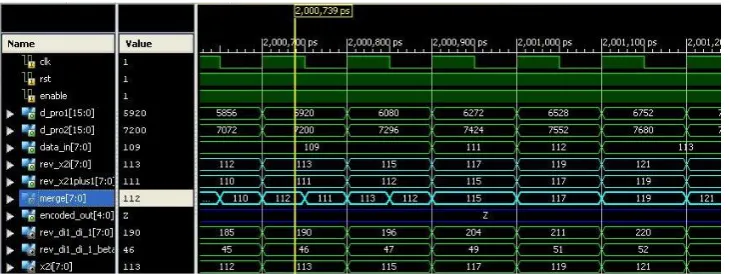
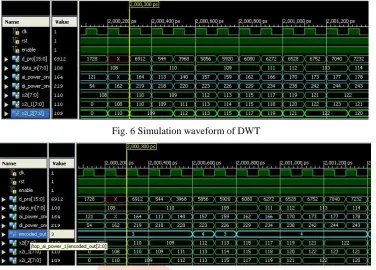
The image compression is implemented using DWT and DPCM encoding, decompression using DPCM decoding and IDWT. The functionality of all the modules are described using Verilog HDL and the simulation is carried out on FPGA Xilinx 14.2 platform to verify the result. The results of simulation are compared with MATLAB simulated output. The simulation results of all the modules are as listed.
IJEDR1403034
International Journal of Engineering Development and Research (www.ijedr.org)3110
Fig. 6Simulation waveform of DWTFig. 7Simulation waveform of DPCM Encoding
Fig. 8Simulation waveform of DPCM Decoding
Fig. 9Simulation waveform of IDWT VII.CONCLUSION
IJEDR1403034
International Journal of Engineering Development and Research (www.ijedr.org)3111
[3] Li, Juan, Binghua Su, Yongming Yan, and Caigao Jiang. "Discrete wavelet transform implementation based on FPGA."In Signal Processing (ICSP), 2012 IEEE 11th International Conference on, vol. 1, pp. 439-443. IEEE, 2012.
[4] Zhang, Wei, Zhe Jiang, Zhiyu Gao, and Yanyan Liu. "An efficient VLSI architecture for lifting-based discrete wavelet transform." Circuits and Systems II: Express Briefs, IEEE Transactions on 59, no. 3 (2012): 158-162.
[5] Wu, Zhigang, and Wei Wang. "Pipelined architecture for FPGA implementation of lifting-based DWT." In Electric Information and Control Engineering (ICEICE), 2011 International Conference on, pp. 1535-1538. IEEE, 2011.
[6] Darji, Anand D., Rajul Bansal, S. N. Merchant, and Arun N. Chandorkar. "High speed VLSI architecture for 2-D lifting Discrete Wavelet Transform." In Design and Architectures for Signal and Image Processing (DASIP), 2011 Conference on, pp. 1-6. IEEE, 2011.
[7] Lee, D-U., Lok-Won Kim, and John D. Villasenor. "Precision-aware self-quantizing hardware architectures for the discrete wavelet transform." Image Processing, IEEE Transactions on 21.2 (2012): 768-777.
[8] Shah, D. U., and C. H. Vithlani. "FPGA realization of DA-based 2D-Discrete Wavelet Transform for the proposed image compression approach." Engineering (NUiCONE), 2011 Nirma University International Conference on. IEEE, 2011. [9] Yu, Tao, et al. "A novel hybrid bi-orthogonal wavelets/ADPCM algorithm for very low bit rate satellite image
compression." Geoscience and Remote Sensing Symposium, 1999. IGARSS'99 Proceedings. IEEE 1999 International. Vol. 4. IEEE, 1999.
[10]Parvatham, N., and Seetharaman Gopalakrishnan. "A Novel Architecture for an Efficient Implementation of Image Compression Using 2D-DWT." Intelligent Systems, Modelling and Simulation (ISMS), 2012 Third International Conference on. IEEE, 2012.
[11]Gupta, Vidyadhar, and Krishna Raj. "An efficient modified lifting based 2-D discrete wavelet transform architecture." Recent Advances in Information Technology (RAIT), 2012 1st International Conference on. IEEE, 2012. [12]Zhang, Wei, et al. "An efficient VLSI architecture for lifting-based discrete wavelet transform." Circuits and Systems II:
Express Briefs, IEEE Transactions on 59.3 (2012): 158-162.
[13]Darji, Anand D., et al. "High speed VLSI architecture for 2-D lifting Discrete Wavelet Transform." Design and Architectures for Signal and Image Processing (DASIP), 2011 Conference on. IEEE, 2011.
[14]Mohanty, Basant K., and Pramod Kumar Meher. "Memory efficient modular VLSI architecture for high throughput and low-latency implementation of multilevel lifting 2-D DWT." Signal Processing, IEEE Transactions on 59.5 (2011): 2072-2084.
[15] M. Nagabushanam & S. Ramachandran. “Fast Implementation of Lifting Based DWT Architecture for Image Compression”. Global Journal of Computer Science and Technology Graphics & Vision: Volume 12 Issue 11 Version 1.0 Year 2012.
[16]Parhi, Keshab K., and Takao Nishitani. "VLSI architectures for discrete wavelet transforms." Very Large Scale Integration (VLSI) Systems, IEEE Transactions on 1.2 (1993): 191-202.