567
Volume 64 67 Number 2, 2016
http://dx.doi.org/10.11118/actaun201664020567
DESIGN AND TESTING OF LOW COST CHAIR
WITH ROUND MORTISE AND TENON JOINTS
Jaroslav Začal
1, Petr Dostál
1, Michal Šustr
1, Ioannis A. Barboutis
21 Department of Technology and Automobile Transport, Faculty of AgriSciences, Mendel University in Brno,
Zemědělská 1, 613 00 Brno, Czech Republic
2 Aristotle University of Thessaloniki Laboratory of Wood Products and Furniture Technology, 54124 - Thessaloniki
- Box 243
Abstract
ZAČAL JAROSLAV, DOSTÁL PETR, ŠUSTR MICHAL, BARBOUTIS IOANNIS A. 2016. Design and Testing of Low Cost Chair with Round Mortise and Tenon Joints. Acta Universitatis Agriculturae et Silviculturae Mendelianae Brunensis, 64(2): 567–572.
The present paper focuses on construction of school seats for developing countries from locally available resources using the local industry and low-end technology. Aim of the work is experimental assessment of mechanical properties of joints fl exion in angular plane. Furthermore work considers assessment of joint fi rmness and comparison between various joint types. Paper encloses the review of various joint manufacturing designs (tenon and mortise), which were proposed for its suitable mechanical properties and simplicity of manufacturing. Designated joint type is easiest form of joint construction and technologically feasible for chair manufacturing. The joints were constructed from fi r wood. Further the work introduces design of simple seat construction made from massive wood material manufactured by low-end technology with regards to achieving the due specifi cations. The task of this work is to design the viable manufacturing process of seats and chairs from raw wood and scrap material. Essential part of work is also manufacturing of seat prototype and simplifi ed model of proposed mortise and tenon drill.
Keywords: bending test, furniture construction, manufacturing technology, tenon, mortise, transversal plane
INTRODUCTION
School seat construction from locally available resources is a priority for developing countries (Haviarova et al., 2001) Leading advantages of this approach are shortening of supply chains, creating the maximal value of raw material and employing the local workforce in proximity of demand. Theoretical basis of this technology was proposed by (Alexander, 1994) who implies the possibilities of application without sophisticated technologies. Method was tested in practice by (Eckelman, 2003) Leading objective of this project was the design and practical construction of seats and chairs for schools in Zambia from locally available materials using the local industry and low-end technology. Design of simple wooden chair construction was performed using the “Greenwood chair” technology with use of manual woodworking tools commonly available in Czech Republic Eckelman introduces fi ve basic schemes for furniture design (Eckelman,
1997). He favours the approach solving the joint dimensioning to safely withstand the internal forces as well as external load that aff ects the furniture in course of use. For simplifi cation it is possible to claim that regardless of large scale of shapes each piece of furniture is basically designed using frame construction. One of fundamental perks for chair construction is the joint design. These joints have to be easily producible. Therefore furniture design has to adapt the simple construction scheme and has to be adapted for use of simple manufacturing technology (Crisan et al., 2001). Fixation system is supposed to facilitate the exchange of individual furniture components.
acquisition price of school furniture. That in certain levels aff ects both appearance and ergonomic characteristics and quality of school furniture (Haviarova, 2000).
It is expected that school furniture is designed for maximal lifespan, easy maintenance and repairs. It should also be easily composable from individual parts and designed as modular system with possibility to exchange the individual components in repair. Joints in the seating furniture could be manufactured as demountable without use of adhesives.
Another important factor for furniture construction are safety criteria, on whose basis the furniture has to achieve very high level of passive safety, considering both construction (stability, rounded edges, durability, joint sturdiness) and used material (Panero et al., 1979).
MATERIAL AND METHODS
Construction material could be obtained from conventional sources, e.g. lumber from sawmills. Many parts could be obtained from wooden scrap; other parts could be manufactured from reused profi les like pallets, crates, cabinets etc. Another option is purposive cultivation of fast-rotation coppice, whose thin trunk could be used as chair legs without subsequent turning.
Abies alba Mill. – This material, although not typical for designated country, was chosen for manufacturing of experimental samples for its mechanical properties. Namely for low fl exibility module and diff erent mechanical properties of earlywood and latewood. Mentioned properties helped adequately dimension the joint parameters to achieve the sturdy and durable connection of furniture components. Mechanical properties of fi r wood helped to stimulate the use of low-quality material from local sources in developing countries and occasional technological mistakes in processing by incompetent staff . Despite these adverse factors the suffi cient technical characteristics were achieved for proposed joints. Material available in target countries demonstrates the better mechanical properties, therefore is considered suitable for proposed use.
Manufactured testing samples represent the central joint used in seating furniture. For convenient manufacturing of tenon the plug cutter was used – it is a tool for cutting the plugs from transversal profi les for repairs of knot holes a er drilling out the knot. Mortise was manufactured with forstner drill Fig. 1 which is a peripheral drillbit with segmented head consisting of two main edges, centering spike and two separate pre-cutters, which are easy to sharpen. Large opening for splinters in the drillbit extracts the splinters from the manufactured piece. Both these drill bits are used for drilling of the compact wood and also to drill out the loose knots or construction of simple tenon joints.
Sample Description
Joint construction was performed in variants of round tenon/partial tenon and mortise as designated simplest and easy-to-manufacture type of chair component joint. The joints were manufactured from fi r wood. Samples are constituted of two parts, which were joined in T-shape. Samples were conditioned in air temperature 24 ± 2 °C and 50 ± 5% relative air humidity. Length of tenon should relate to counterpart thickness in the manner of slightly overreaching the edge of mortise. Too long tenon needs to be trimmed. Round tenon overreaching the counterpart doesn’t have suffi cient sturdiness, because a er hammering the wedge into the groove the wedge isn’t inserted in its full length.
Testing Method
Experimental testing of furniture joints in industry was performed by (Eckelman, 1997) and (Joščák, 1999) their research was focused on simple joints like pin, tenon and mortise for frame construction of massive wood. Experiment is designed to assess the joint behaviour in transversal plane, its sturdiness and shi under pressure
1: Joint production scheme: (left) forstner drill bit – mortise, (right) plug cutter bit – tenon
2: Through tenon (sample A)
with regard toparameters of designated material. Methodology of experiment was used according to (Kamperidou et al., 2012) for assessment of joint sturdiness in transversal plane. Despite the lack of valid technical standard the method is commonly used for mutual comparison of testing results. Method was further used by numerous authors e. g. (Vasilisou et al., 2006). Testing was performed on Universal Testing Machine SHIMADZU UH-300kNA. From previous experiments the optimal velocity of 10 mm/min was deduced to achieve the maximum load in 90 s ± 30 s. Method of experiment was used as described by (Joščák, 1999). Testing samples were divided into 8 groups. Groups No. 1 and 4 were manufactured with round tenon and groups No. 5 and 8 were constructed with partial tenon Tab. I. For comparison of measured values
the control samples were manufactured with use of adhesive and without the wedge, where fi nal sturdines correlates to D2 adhesive class. The joint was constructed as tenon and mortise, whose main feature is the time and cost effi ciency of fi rm joint construction. Use of wedge for fi xing the components appears as a rational alternative in conditions eliminating the possibility of the use of adhesives.
RESULTS
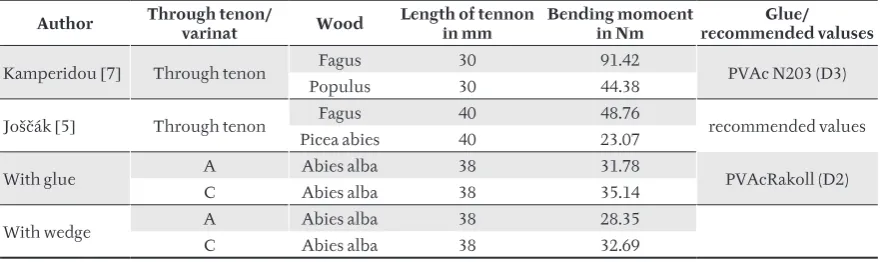
Table provides direct comparison of resulting fi rmness for individual sample types. Mentioned results and fi rmness division are described also by Angular coeffi cient 10–40%. In the experiment it is necessary to take into account the thickness of adhesive layer, material type, roughness of glued surface or component preparation previous to gluing. According to Tab. II there are obvious diff erences between glued and unglued samples. In second phase of the measurement the results indicated higher sturdiness for round tenon and round trestle.
For designing the optimal variant of joining the components the least favourable condition of stress should be taken into account, in our case the variant with least sturdiness and durability was achieved in impassable tenon. In my opinion it is best to discard these joint types for technical diffi culty in manufacturing, therefore these variants are not
I: Groups of tenon samples
Type of joint Dimension in mm Numbers of sample
With wedge
D 25×38 12 C 25×38 12 B 25×25 12 A 25×25 12
With glue
D 25×38 5 C 25×38 5 B 25×25 5 A 25×25 5
4: Scheme of fastening the samples in testing device
II: Measured values in angular plane according to various authors
Author Through tenon/varinat Wood Length of tennon in mm Bending momoent in Nm recommended valusesGlue/
Kamperidou [7] Through tenon Fagus 30 91.42 PVAc N203 (D3) Populus 30 44.38
Joščák [5] Through tenon Fagus 40 48.76 recommended values Picea abies 40 23.07
With glue A Abies alba 38 31.78 PVAcRakoll (D2) C Abies alba 38 35.14
further considered. For comparison data measured by (Joščák, 1999) and (Kamperidou, 2012) were used, who performed the same testing with application of adhesive and diff erent dimensional parametres of joint stressed in angular plane. Result comparison is interpreted in Tab. III.
When comparing results for carrying capacity in variants samples A glued/unglued – 31.78/28.35 N·m (diff erence 3.43 N·m) and samples C glued/unglued – 35.14/32.69 N·m (diff erence 2.45 N·m), the setup of joints is in this case very similar. In comparison with results published by (Joščák, 1999) for dependency between carrying capacity in angular plane and tenon width, it is obvious that tested samples have higher carrying capacity compared to spruce wood samples. This claim ensues that used non-glued (wedged) and glued samples achieve the suffi cient carrying capacity in angular plane and this setup is suitable for required parameters.
In comparison with results reviewed by (Kamperidou, 2012) it is not possible to compare the data in full scale. Estimated experiment assessed the mechanical properties in angular plane using the PVAc adhesive N203, where fi nal sturdiness values correspond to D3 class for populus and fagus wood.
The results also imply the necessity to take into account the eff ect of adjacent lever arm of sample when pressed against the counterpart Fig. 5. Previous experiments confi rmed the eff ect of lever arm, where round tenon samples C, D with dimension 25×38 mm shows higher values of carrying capacity. The results show that adjacent lever arms could substantially enhance the joint sturdiness. This confi rms the theory of “inner arm eff ect” in the sample on fi nal sturdiness value.
If the inserted piece has suffi cient area to lean against the counter piece in course of stress, the tension shows directly in the joints, resulting in deforming the mortise and breaking/pulling out the tenon.
Construction of joints aff ects not only the fi nal piece, but in construction and furniture manufacturing it is important to pay attention to manufacturability and most importantly the usability of fi nished piece. The sturdiness of joints depends on tenon diameter, inserting depth into the counter piece and also on material used. Infl uence of variable joint length correlated with its constant diameter is signifi cant for its sturdiness. In prevalent cases there is an eff ort to achieve the maximal length and diameter of tenon to ensure the best sturdiness characteristics.
Joints manufactured in this experiment were used to dimension the simple construction method to achieve the required sturdiness.
Chairs Construction
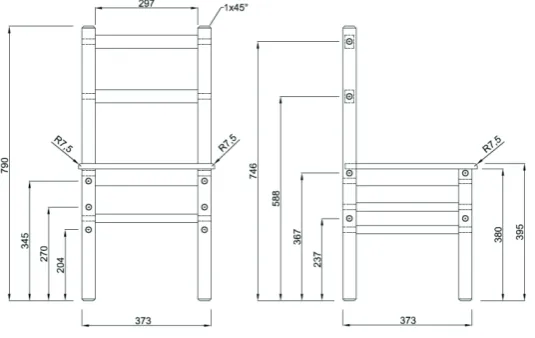
In real development of particular product it is necessary to fi rst manufacture the functional prototype Fig. 6. Then the individual details are considered and altered, including the exact dimensions and proportions of fi nal product, as well as its individual parts. Prototype is o en manufactured with some compromises like fi nancial budget. For these reasons it is necessary to consider the fi nal documentation with tolerance. It is possible, that the fi nal product will be further modifi ed.
III: Angular coeffi cient 10–40%
Type of joints Unglued (wedge) Glued
A y = 132.9x + 0.330 y = 242.5x + 0.446 B y = 131.5x + 0.526 y = 152.9x + 1.419 C y = 140.7x + 0.860 y = 166.8x + 0.859 D y = 153.9x + 0.306 y = 266.8x + 0.323
5: Representation clingy arm
CONCLUSION
Aim of this work was the design of constructing solution for school furniture in Zambia, manufactured by local industry from locally available resources and employing the low-end technology. The hypotheses are following:
• Is it possible to manufacture the school furniture from locally available materials?
• Is technologically possible to simplify the manufacturing processes in scale allowing the local production of the furniture in target developing countries?
First we were looking for a simple way to produce furniture in our history. With advancing my knowledge of given issue we found out a possibility to manufacture the seating furniture with use of simple „Greenwood chair“ construction using only the simple woodworking tools. Considering the material it is possible to produce the school furniture from wood scraps, old pallets or pickets from forest thinning. Parts required for construction could be cut from sawmill trimmings. In realization the main objective was to create the economically available and easy-to-produce seating furniture. Material and energy costs invested in furniture production should refl ect its durability and lifespan. Therefore it is necessary to maximize the lifespan and utility value in design and production.
Possibility of replacement of individual construction elements decreases the amount of material needed for chair repairs and in a certain manner facilitates the manufacturing process. These advantages allow to repair the construction in case of turning the joint loose.
In chair construction the broad spectrum of tenon joints is used. This type is regarded as one of the oldest ways of seating furniture joints solution and simultaneously it is regarded as the most effi cient due to its sturdiness characteristics. In spite of construction design diversity it is not possible to judge that one joint solution is inadequate or less sturdy than another, because the position of joint in construction is always a determining factor. Experiment was aimed on joint durability and carrying capacity measurement angular plane, as well as its resistance to turning. Length of tenon aff ects the joint durability. In performed tests better sturdiness characteristics in round tenon trestle, samples A, C were found, which show better sturdiness compared to partial tenon variant. Further the acquired data show that technological and temporal expenses of partial tenon construction variant are undesirable.
Use of these joints produced with low-end technology displays a great potential for developing countries; it is considered to be one of the easiest joints to produce, not requiring any qualifi cation to assemble.
Acknowledgement
The research has been supported by Internal Grant Agency, Mendel University in Brno, Faculty of Agronomy [No. IP21/2015]. “Monitoring of quality of composite materials in agricultural environment”.
REFERENCES
ALEXANDER, J. 1994. Making a Chair from a Tree:An Introduction to Working Green Wood. Mendham, NJ, USA: Astragal Press.
CRISAN, R., NICHOLLS, T. 2002. Study of the stress - state in corner joints and box-type furniture using fi nite element analysis (FEA). Holz als roh – und werkstoff , 60(1): 66–71.
ECKELMAN, C. A. 2003. Product Engineering and Strength Design of Furnitrure. West Lafayette, Indiana: Purdue University.
ECKELMAN, C. A. 1997. Engineering Design of Dowel Joints. Station Bulletin No. 745. West Lafayette, Indiana: Purdue University.
HAVIAROVA, E. 2000. Design and construction of wooden school furniture for children in developing countries. Ph.D. Thesis. Lafayette: Purdue University.
HAVIAROVA, E., ECKELMAN, C. A., ERDIL, Y. 2001. Design and Testing of Environmentally Friendly Wood School Chairs for Developing Countries. Forest Prod. J., 1(3): 58.
JOŠČÁK, P. 1999. Pevnostné navrovanie nábtyku. Zvolen: Technická Univerzita Zvolen.
PANERO, J., ZELNIK, M. 1979. Human dimension: a source book of design reference standards. New York: Whitney Library of Design.
VASSILIOU, V., BARBOUTIS, I. 2006. Tension Strength of Furniture Middle Joints Constructed With Biscuits. In: 10th anniversary Conference of
Enginerring Desingn, Interior and Furniture Design. Sofi a, Bulgaria: University of Forestry.
Contact information Jaroslav Začal: [email protected]