A new spacetime symmetry
Keith A. Fredericks
Restframe Labs, New York, NY, USA (Dated: April 4, 2020)
Based on detection of elliptic particle tracks, ' 1372n2 bigger than Bohr-Sommerfeld elec-tron orbits, indicating the possible detection of superluminal elecelec-trons masquerading as magnetic monopoles, a new structure emerges leading to: (i) a new set of seven elementary lengths; (ii) re-placement of the usual motion (Lorentz) transformations by scale transformations betweenv2< c2 and v2 > c2 frames; (iii) equivalence of charge betweenv2 < c2 andv2 > c2 frames based on the Dirac-Schwinger quantization condition; (iv) a relativistic foundation for the Dirac-Schwinger quan-tization condition; (v) a possible cause of charge quanquan-tization; and (vi) the prospect of symmetry in Maxwell’s equations. If the elliptic particle tracks are viewed as a magnification of electron or-bits, the effect is suggestive of a spacetime distortion such as those predicted in general relativistic theories.
I. INTRODUCTION
Recent experiments [1] may provide insight into the development of a theory of faster-than-light particles. Detected quantized elliptic particle tracks with sizes
' 1372n2 bigger than Bohr-Sommerfeld electron orbits, associated with the Dirac quantization condition, lead to elementary lengths, which are mapped to extended relativity and result in a new type of superluminal trans-formation.
Historically, two main approaches to a theory of faster-than-light particles, have been used [2], each focused on transformations to and from superluminal velocities:
1. Assuming that standard Lorentz transformations can be used for superluminal velocities [3, 4], γ = (1−β)−1/2, where β = v/c and β > 1 and rest mass, proper length and proper time become imaginary, but this may not be important since it is not possible to measure these with v2 < c2
ob-servers [3,4].
2. Assuming that equivalent v2 < c2 and v2 > c2
frames exist and that it is possible to perform stan-dard Lorentz transformations between them, the Lorentz factor becomes γ = (β −1)−1/2, where
β = v/cand β > 1 [5–7]. Here, inertial frames, moving at superluminal relative velocities, parti-tioned at the speed of light, co-exist in our universe. Within each frame physicists observe the very same laws. This approach allows observers in v2 > c2
frames, but, in four-dimensions, certain imaginary quantities enter the equations that cannot be mea-sured [8,9]. [10] [11]
We present a completely new approach based on the equivalence of frames, but in contrast to equivalent v2 < c2 and v2 > c2 frames, equivalent `2 < d2 and
`2 > d2 frames are proposed. A theory of
faster-than-light particles may be constructed using inertial frames withlengths greater than a certain length, drather than inertial frames with speeds greater thanc. This new ap-proach preserves important properties of earlier theories but improves important features. Scale transformations
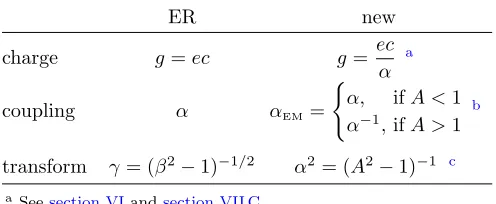
rather than motion transformations connect observations between equivalent frames. Extended relativity is modi-fied as follows (αis the fine structure constant,gis mag-netic charge,β =v/c,A=`/danddis a new elementary length described in the text):
ER new
charge g=ec g= ec
α a
coupling α αEM=
(
α, ifA <1 α−1,ifA >1
b
transform γ= (β2−1)−1/2 α2= (A2−1)−1 c
aSeesection VIandsection VII C. bSeeEquation 7.
cSeesection V.
Problems associated with faster-than-light particles, magnetic monopoles, charge quantization and electric-magnetic symmetry can be analyzed using this new model.
TABLE I. Symmetric Spacetime - Velocity and length mapped to v2 > c2 and v2 < c2 frames. The vertical in-terval between all values isα. Type III ) Tachyons withkmg2 and coupling constantα−1. Type II ) Luxons with velocity cand length d. Type I ) Bradyons with kee2 and coupling constant,α.
type velocity (m/s) length (m)
7.72×10¹⁴ cα−3 dα−3 r0m 1.86×10⁻² III. 5.63×10¹² cα−2 dα−2 ň
cm 1.36×10⁻⁴ 4.11×10¹⁰ v
0m cα−1 dα−1 a0m 9.93×10⁻⁷
II. 2.99×10⁸ c cα0 dα0 d 7.25×10⁻⁹
2.19×10⁶ v
0e cα1 dα1 a0e 5.29×10⁻¹¹ I. 1.60×10⁴ cα2 dα2 ňce 3.86×10⁻¹³
1.17×10² cα3 dα3 r
0e 2.82×10⁻¹⁵
II. EXPERIMENTS
In 1979, a technique was found using photographic emulsions that resulted in unusual particle tracks that had not been observed according to the scientific litera-ture. The technique consists of “supplementary” uniform photon exposures on photographic emulsions. In total darkness or with the appropriate safelight, a relatively uniform exposure of photons is created from white LEDs of about 1200 mcd at a distance of 6cm from the surface of a lith emulsion such as Arista Ortho Litho 3.0 for a time of about 250 ms. Any additional imagewise expo-sures, during exposure to the ambient environment, as in a cosmic ray study, will be amplified using this technique. [1,12,13].
In 2002, Russian researchers reported similar tracks during experiments with electric explosion of metal wires and foils in water [14] and low-energy discharges in water [15]. It is clear, by comparison, that the same tracks were recorded with both supplementary photon exposures and electric discharges in these and other experiments [12, 13].
Microscopic examination of these tracks reveals struc-ture consistent with particles traveling through emulsions (see elliptic track structure in Fig. 4 of Ref. [1]). A 1/r2
central force would be required to create elliptic particle tracks in any nuclear track detector. The elliptic tracks are excellent fits for ellipses [1]. Particle-like structure resulting from 1/r2 central force strongly indicates that
these detected tracks are caused by particles.
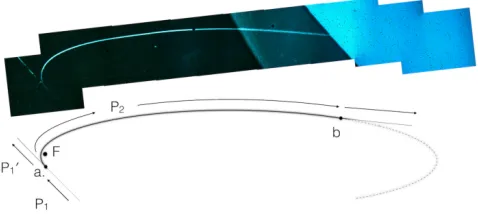
In 2014, experiments were undertaken to determine if these particles could be affected by electric or mag-netic fields [1]. Although no repeatable particle curva-ture resulted from applied electric or magnetic fields, el-liptic tracks were found, often in conjunction with de-cay events [1]. The elliptic tracks add to the known properties [12] of the detected particle tracks. The el-liptic tracks often occur at a point of decay of a primary track [1] (seeFigure 1andFigure 4) and differ from the predominant detected tracks [12]. Since it was shown that curvature, due to applied electric or magnetic fields, has not been observed for the predominant tracks, it was conjectured [1] that the predominant tracks are neutral and possibly comprised of oppositely charged particles and that these neutral composite particles may decay or split apart into separate charged particles. The separate charged particles may then become captured into elliptic orbits.
The track formation mechanism is unknown and para-doxical. In earlier work [1], we pointed out that
(i) particle tracks in photographic emulsions with smooth curvature are not known to occur for any known particle, yet these are commonly observed for the tracks under consideration.
(ii) although there is no high energy source for the tracks, estimates of deposited energy is quite large (up to∼250 GeV/cm or greater).
FIG. 1. Trackme, n = 7. Top.) Semi-major axis sizea= 2391.6±16.1µm. Ten tile photomosaic at 160x. Bottom.) Capture into and escape from an elliptic orbit. 1.) initial particle,P1, trajectory. 2.) at point a. particle decays into P10, continuing on initial trajectory andP2, which is captured into an elliptic orbit. 3.) at point b. particle escapes from the elliptic orbit.
(iii) for Bohr-Sommerfeld elliptic tracks, we should see no energy loss from an elliptic orbit. By defini-tion, these orbits have no dissipation and no en-ergy loss. Furthermore, there is no known way to directly record an orbiting particle on a material detector, that is, where the particle would actually traverse the material.
Evidently our normal understanding of track formation does not apply in this case. Against this backdrop, we have created an idealized model of the elliptic tracks based on the measured track geometry.
Out of a population of 750 exposures, 22 tracks with elliptic curvature were selected. The semi-major axis size of these tracks were measured to be'1372n2larger than
Bohr-Sommerfeld electron orbit semi-major axis sizes. In addition, the measured elliptic particle tracks were shown to be quantized (seeFigure 2.).
III. SYMMETRIC WORLDS
Dirac introduced the idea of electric charge quantiza-tion using the quantizaquantiza-tion condiquantiza-tion [16] whereg, mag-netic charge is
g= ecn
2α =ngD, n∈Z, (1)
where α = kee2/}c, ke ≡ (4πε0)−1 and e is electric
charge. This explanation of electric charge quantization due to magnetic monopoles (hereafter monopoles) con-tinues to be the best yet found. With n = 2, Eq. (1) becomes equivalent to then= 1 Schwinger quantization condition [17]
g= ec
α = 2gD, (2)
or, using shorthand,g= 2gD.
FIG. 2. Quantized ellipse semi-major axis sizes [1]. Ellipses between n = 8 and n = 3.5 are shown to be quantized as half integer values. Ellipses less thann = 3.5 are quantized by quarter integer values. Error bars represent the combined standard uncertainty of the semi-major axis size.
using Eq. (1) with n= 1, Datta [18] computed new ele-mentary monopole lengths,a0m,ňcmandr0m, which are
analogs of the Bohr radius, a0e, the reduced Compton
wavelength, ňce, (hereafter, Compton radius), and the classical electron radius, r0e, and showed that a hierar-chy,
a0m<ňcm< r0m (3)
exists as well as the usual hierarchy,
a0e>ňce> r0e. (4)
In this analysis, Datta
(i) used analogy with the electron for magnetic monopoles
(ii) reasoned that hierarchy (3) makes monopoles in-herently relativistic ,
(iii) expressed concern that the size of the classical monopole radius,r0m, is so large that it would
over-lap with the anti-monopole with an orbital radius ofa0m, and
(iv) found that a pair of north and south monopoles in anatom-like bound state would require superlumi-nal ground state orbital speeds as in Eq. (6).
Datta used the simple analogy of the bound monopole and the bound electron. For example, since the ground state velocity of the bound electron is
v0e=ke e2
}
=cα, (5)
the ground state velocity of the bound monopole should
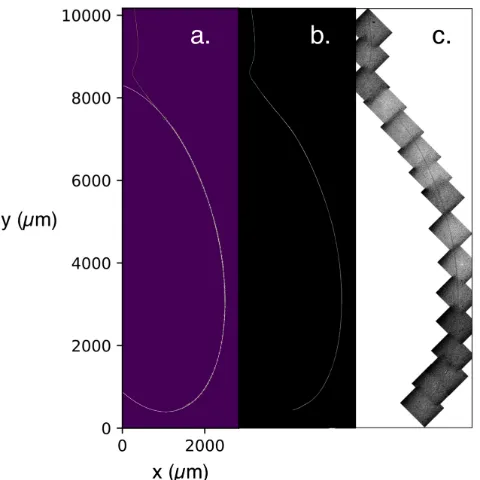
FIG. 3. Trackbe. The semi-major axis size ofam= 4078.6± 14.6µm is related to the semi-major axis size of an n = 8 electron in hydrogen, ae by am/1372n2 ' ae. a.) Least-squares fit of x, y track coordinates to ellipse overlayed on processed track image. b.) Track after image processing and background eradication. c.) Photo montage of track.
FIG. 4. Track rse2, n = 2.75 showing elliptic track decay event. Photo at 400x.
be
v0m=km g2
}
=c/α, (6)
where (km ≡ µ0/4π). Due to points (iii) and (iv) (i.e.
Eq. (6)), Datta rejected monopoles as unphysical, ending his investigation.
These specific points will be considered later (see sec-tion V A), but the mapping of hierarchy (3) to faster-than-light monopoles in extended relativity warrants fur-ther investigation.
Continuing along these lines, first it is noted that using g= 2gD,the coupling constant,α, simply inverts withβ. [19]
αEM=
(
α, if β <1
α−1, if β >1 . (7)
where α is the fine structure constant. Monopole mass can be found either by using the Compton radius of the monopole in terms of the Compton radius of the electron [19] or by using the analogy between the Bohr radius for the electon versus the Bohr radius for the monopole using the 1/α2relation derived from experiments [1]. Here the second approach is used. Usingg= 2gD, the ratio of the monopole Bohr radius to the electron Bohr radius is
a0m a0e
= 1
α2 . (8)
Using the formula for Bohr radius, a0e = }/mecα, the analogousa0m=}/mmcαmand Eq. (8), monopole mass can be written as
mm= meα3
αm
, (9)
and sinceαm=α−1
mm=meα4= 1.45×10⁻³eV/c
2
, (10)
which leads to the fine structure constant, α = (mm/me)1/4, as a mass ratio.
Using g = 2gD, analogy with the electron, and monopole mass, Table I. can be populated with values. The electron and monopole Bohr radii are equally offset from the length, d, corresponding to the speed of light, c, such that the monopole Bohr radius, is scale symmet-ric with the electron Bohr radius. A similar symmetric relation exists between the ground state orbital veloci-ties andc. Thusc and dform the axis of symmetry for both Bohr radii, the ground state orbital velocities and hierarchies (3) and (4) [19] (seeTable I.).
Hierarchy (4) comprises a set of three elementary lengths incremented by the fine structure constant, α. With the identification of d=ctand hierarchy (3), The entire right side ofTable I. represents a new set of seven elementary lengths, each incremented byα.
IV. EXTENDED RELATIVITY
Parker [5] notably forwarded the idea of extending rel-ativity to superluminal frames. He was also the first to suggest that when special relativity is extended to super-luminal velocities, charged tachyons should be detected as magnetic monopoles by subluminal observers.
Baldo, et.al [20], Recami and Mignani, [21] and Recami [22] developed Parker’s concepts [23–27]. Since faster-than-light electric charge, in this theory, brings into Maxwell’s equations exactly what mag-netic monopoles would (see section VIII), subluminal monopoles were rejected and, using a symmetry argu-ment, a magnetic charge of g = −ec was initially pro-posed in accordance with charge invariance (although later Schwinger quantization was favored). As a result,
the coupling constant,αtook a singular value both above and below the speed of light. According to Recami,et.al slower-than-light monopoles do not exist.
The structure of extended relativity follows Bilaniuk, et.al’s [3] original classification of particles. That is:
I. braydons (v2< c2), II. luxons (v=c) and III. tachyons (v2> c2).
The symmetric spacetime in Table I. maps one-to-one with the structure of extended relativity [5, 21, 22], i.e. symmetric v2 > c2 and v2 < c2 worlds partitioned at c, the speed of light, symmetric `2 > d2 and `2 < d2 worlds partitioned at d (see section VII) or, more gen-erally, type III and type I worlds partitioned by type II speed and length. Type I, type II, and type III will be used throughout in accordance withTable I.
The central feature of extended relativity is the super-luminal Lorentz transformation (SLT). The SLT shows what a type III object in a type III frame looks like to an observer in a type I frame and so connects observations of type I observers with observations of type III observers.
The collinear bi-dimensional (x, t) SLT works with-out problems, but, when extended to four dimensions, (x, y, z, t), it leads to imaginary quantities [8, 9] for cer-tain measurements ofv2> c2(type III) objects and prob-lems of how to interpret these physically. It is possible to use a six-dimensional spacetime for the SLT [28], but it may be difficult to physically interpret two additional time dimensions.
The standard collinear bi-dimensional SLT in its usual form will not transform the detected ellipse semi-major axis size into a Bohr-Sommerfeld ellipse semi-major axis size. That is
a(mn)(γ)6=ae(n), γ= (β2−1)−1/2. (11)
Using Recami’s multidimensional approach, the SLT inverts the quadratic form sign [29] of an object and a bound superluminal electron detected as a monopole el-lipse takes the form
0≥ − x 2
a(mn)2
+ y
2
b(mn)2
≥ −1, (12)
consisting of the area between an on-central-axis conic section,
y2
b(mn)2
= x
2
a(mn)2
, (13)
and a hyperbola,
y2
b(mn)2
= x
2
a(mn)2
−1, (14)
FIG. 5. Recami type SLT of a theoretical n= 8, l= 2 (ex-ample quantum numbers) monopole ellipse.
The elliptic particle tracks we observe do not share the same semi-major axis size as their (presumed) sublumi-nal counterparts, that is, the Bohr-Sommerfeld hydrogen semi-major axis sizes. They are larger by α−2 but not
distorted by stretching in one dimension.
The ratio of measured eccentricity, Eµ to Bohr-Sommerfeld eccentricity,Eτ
Eµ Eτ
= 1−b
2/a21/2
n−1(n2−`(`+ 1))1/2, (15)
as a ratio of averages over the 22 measured track values,
hEµi/hEτi = 0.99, so measured eccentricity corresponds well to Bohr-Sommerfeld electron orbit eccentricity. This implies that the (superluminal) transformation, for this restricted case of bound particles, should be a scale trans-formation.
Since measured eccentricity corresponds to pure Bohr-Sommerfeld eccentricity, then, due to the α−2 size
change, the transformation of ellipses in general needs to be an isotropicscale transformation instead of a transla-tion along one axis.
V. THE COULOMB FLIP
The force difference between magnetism and electricity using g= 2gD, re=a0e and rm=a0m is the difference between Coulomb’s law for magnetism and electricity
Fm(n)
Fe(n)
=kmg
2/a(n)2 0m
kee2/a(n)2 0e
=n2α2' n 2
1372. (16)
Since detected ellipses are the same shape but 1372n2 bigger than Bohr-Sommerfeld electron orbits, the most direct explanation would be that these are Bohr-Sommerfeld (type III) monopole orbits and the re-quired transformation is identical to the force ratio, from Eq. (16) between magnetic and electric force strengths, which is a scale ratio, dilation (α−2) or contraction (α2), which can be called theCoulomb flip.
The magnetic and electric Bohr-Sommerfeld Kepler el-lipses are completely analogous and scale symmetric with respect to the speed of light, c and the length,d. Using g = 2gD, the Kepler period for an electron in hydrogen
and the “monopole” in a magnetic hydrogen analog,
t(mn)= 2πa0mn
3
v0m
= 2πa0en
3
v0e
=t(en), (17)
are equal.
The one-dimensional basis Coulomb flip contractions from type III to type I are
coupling constant αEM: αm (α2) =αe, (18a)
Bohr radius a0: a0m (α2) =a0e, (18b)
ground statev v0: αmc (α2) =αec , (18c)
charge q20: kmg2(α2) =kee2. (18d)
Combining the basis transformations, Eqs. (18b), (18c), and (18d) and assuming } is Coulomb flip invariant, transformations between type III and type I frames for time, momentum, binding energy and mass are
tm=2πa0m αmc
(α2) −−−→
(α2)
2πa0e αec
=te (19a)
pm= } a0m
(1) −−−→
(α2)
} a0e
=pe (19b)
Em=− kmg2 2a0m
(α2) −−−→
(α2) −
kee2 2a0e
=Ee (19c)
Um= kmg2
2a0m
(α2) −−−→
(α2)
kee2
2a0e
=Ue (19d)
mm= }
a0mαmc
(1) −−−−→
(α2α2)
} a0eαec
=me (19e)
and the monopole and electron properties can be trans-formed into one another using Coulomb flips withg = 2gD. Time, in Eq. (19a) and energy in Eq. (19c) are invariant (in the ground state).
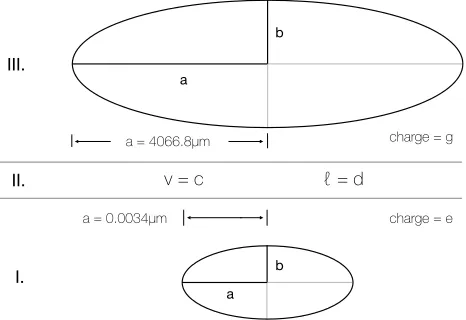
v = c
a = 4066.8µm charge = g
a = 0.0034µm
a b
charge = e
b
a
II. ! = d
III.
I.
The 2-dimensional Coulomb flip scales (contracts) the parametric equation of the monopole ellipse (upper el-lipse inFigure 6), by the factorα2/n2,
x y
= α
2
n2
"
a(mn)cosθ b(mn)sinθ #
= "
a(en)cosθ b(en)sinθ #
, (20)
where 0≤θ≤2π, to the electron ellipse (lower ellipse in Figure 6).
The parametric equation to contract a sphere of r = a0mtor=a0e using a scale factor ofα2is
x y z
=a0mα2
sinθ cosϕ sinθ sinϕ cosθ
=a0e
sinθ cosϕ sinθ sinϕ cosθ
, (21)
where 0≤θ≤2πand 0≤ϕ≤π.
A. Consequences
Returning to hierarchies (3) and (4), type III observers will see what we refer to as hierarchy (3) as their normal electric hierarchy (4). In their home frame, type I ob-servers and particles will recognize the type III electric charge as a magnetic charge. The mirror hierarchies map one-to-one with extended relativity, except that we are dealing with lengths (scale transformations) instead of velocities (Lorentz transformations).
Datta’s points(ii)and(iii)above are nullified if hierar-chy (3) is a type I to type III transformation of hierarhierar-chy (4) (that is, hierarchy (3) would just be the normal hi-erarchy (4) to type III observers). Datta’s point (iv) is therefore relevant and could indicate the unrealized dis-covery of type III lengths and symmetric spacetime.
VI. TRANSFORMATION OF CHARGE
Even though a type III particle’s observed (by a type I observer) charge state is magnetic, it should possess exactly the same amount of charge in its own rest frame where the charge state is electric. This is to say that type III electric charge is observed by normal type I observers to be magnetic charge and that type I magnetic charge does not exist [23,24].
As noted earlier, equivalence of charge along with considerations of special relativity motivated Recami, et.al. initially to proposeg =−ecand deviate from the Dirac-Schwinger quantization condition (although later Schwinger quantization was favored). In light ofg= 2gD it is possible to reconsider this issue.
The basis Coulomb flip for charge in Eq. (18d) shows that, after transformation, the magnetic charge is equiv-alent to the electric charge in a type III frame observed from a type I frame.
Solving for g in (18d) with km/ke = 1/c2 yields g = ec/α, which is the Schwinger quantization
condi-tion. So the Coulomb flip for charge is just the Schwinger quantization condition.
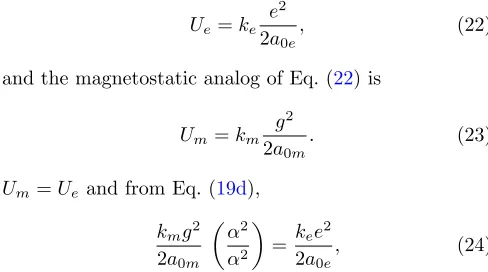
Consider a spherical condenser of size a0e. The elec-trostatic energy to charge the condenser to a total charge ofeis [31, (Eq. 8.11)]
Ue=ke e2
2a0e
, (22)
and the magnetostatic analog of Eq. (22) is
Um=km g
2
2a0m
. (23)
Um=Ue and from Eq. (19d),
kmg2 2a0m
α2
α2
=kee
2
2a0e
, (24)
is the Coulomb flip betweenUm andUe. All parameters of the magnetic condenser transform into the parameters of the electric condenser and vice versa. The amount of charge per capacity is equivalent.
This is a second application of the Coulomb flip, used for static spheres instead of bound states showing that the two spheres are equivalent and charge is invariant between subluminal and superluminal frames.
Transforming a spherical capacitor from a type III to a type I frame (or vice-versa) shows that magnetic charge is just electric charge in a type III frame as viewed from a type I frame. The equation for the transformation of the potential energy of the spheri-cal capacitor is the Schwinger quantization condition g=ec/α. This brings extended relativity into agreement with Dirac/Schwinger monopoles, but as Recami found, these monopoles are actually superluminal electrons and slower-than-light monopoles do not exist.
VII. RELATIVISTIC TRANSFORMATIONS
In Table I. on the length side, the Bohr, Compton and classical electron radii clearly represent the radii of spheres, i.e. the basis for a three-dimensional or spa-tial scale. This stands in contrast to the one-dimensional velocity scale on the left side of the table upon which spe-cial relativity is based. Hierarchies (3) and (4) are equally separated from a lengthd byα. In Table I, the length dcorresponds toc. Many computations can use d anal-ogously toc. There is a direct correspondence between the transformation of velocities and the transformation of lengths between type III and type I frames as in
v0m=c2/v0e, (25a)
a0m=d2/a0e. (25b)
A. Length transformations
With the new elementary lengthd, it becomes possible to represent relativistic transformations equivalently us-ing either length or velocity. Where v is velocity on the left side ofTable I. and ` is length on the right side of Table I., v/c=`/d and so we can write
β =A , (26)
where β = v/c and A = `/d. In addition, since the superluminal Lorentz factor is
γ= (β2−1)−1/2, (β >1), (27)
we can write the equivalent
α= (A2−1)−1/2, (A >1). (28)
SinceA=β, the length-based forms can be substituted for the velocity-based forms in relativistic computations.
Because the lengths are three-dimensional spatial radii as opposed to a one-dimensional velocity vector, this af-fords a convenient way to differentiate between motion-based velocity transformations and the length-motion-based scale transformations. Using this notation it is possible to show theα2 scale transformation (the Coulomb flip) as
a relativistic transformation
α2= (A2−1)−1. (29)
Eq. (29) can be seen as the relativistic factor between type I and type III worlds, replacing Eq. (27) of the SLT. That is,intra-frame transformations should use standard Lorentz transformations,i.e. γ= (1−β2)−1/2, and
inter-frame transformations could use Coulomb flips.
B. Relativistic expressions
The relation of the two symmetric Compton radii, from Table I., converted to masses using ň−m1(}c/e) and ň−e1(}c/e), are at once seen as the electron and “monopole” masses and, in terms of relativity, if the elec-tron mass me = m0, i.e. the rest mass in our type I
frame, then the “monopole” mass,mm=m0, is the “scale relativistic mass” as shown in Eq. (19e). The relativistic expression becomes
mm= me
(A2−1)2. (30)
The same thing can be done for each of the Eqs. (18) and (19), substituting (A2−1)−1 forα2.
C. The quantization condition
Insection VIit was shown that the Schwinger quanti-zation condition constitutes the transformation of charge between type I and type III frames. The Schwinger quan-tization conditiong = ec/α is also a Coulomb flip and can be represented as
g= ec
(A2−1)1/2 , (31)
adding a relativistic interpretation to this quantum rela-tion.
VIII. MAXWELL’S EQUATIONS
As has been mentioned previously [23], it is possible to recover symmetry in Maxwell’s equations since type III particles with electric charge constitute magnetic charge in the equations. In extended relativity, Maxwell’s equa-tions for type I and type III particles, take a form
∇ ·D=%e(I)
∇ ·B=−%m(III)
∇ ×E=jm(III)−∂B
∂t
∇ ×H =je(I) + ∂D
∂t
where I = type I frame and III = type III frame.
IX. THEα−2X LENS
If a type I observer peers into a type III frame, detects type III electrons and then transforms the detection us-ing a Coulomb flip, this is equivalent to an α−2x
mag-nification since type III electrons are by definition the same as type I electrons. This would mean that observ-ing type III objects could provide a portal of magnifi-cation, analogous to gravitational lensing, into our own world such thate.g. electron orbits could be examined at α−2x (∼1.88×10⁴x) magnification. This lens provides a
way to visualize equivalent frames at different scales and their relationship.
X. DISCUSSION
A symmetric world is defined inTable Iincluding both length and velocity-based values above and below a bor-der delineated by c and d and generalizes these three regions into type I, type II, and type III frames.
To get between type I and type III frames, extended relativity models use Lorentz velocity transformations, represented by the left (velocity) side ofTable I. Based on the right (length) side of this diagram, an alternative is considered to use scale transformations called Coulomb flips to transform between type I bound electron and type III bound “monopole” states. A number of Coulomb flips are shown in Eqs. (18) (19), (20) and (21).
This correspondence between the velocity-based and length-based transformations and the subsequent use of scale transformations brings into question the physical in-terpretation of the transformations. If the radius-based scale transformation is chosen, frames in extended rela-tivity can be separated by scale rather than superluminal velocitiesand yet support superluminal relative velocities. The structure of this dual space is not clear, but it ap-pears to have an analogy with the dual de Broglie wave. If electrons from a type III frame were detected as magnetic charges in a type I frame, then Dirac’s concept for the origin of charge quantization, defined as the in-teraction between magnetic charges and electronsshould automatically become evidence for electromagnetic in-teraction between type I and type III worlds. A further implication of detecting electrons from a type III frame is to resolve the asymmetry between electricity and mag-netism, thereby bringing symmetry to Maxwell’s equa-tions.
Charge in a type III frame can be transformed to charge in a type I. frame by means of a Coulomb flip. In addition, the transformation of charge from a type III to a type I frame can be represented as a relativistic transformation based on the Schwinger quantization con-dition. So the foundation for magnetic monopoles can be shown to be electric charge in a type III frame, which is connected with electric charge in a type I frame by a rela-tivistic transformation. Recami and Mignani had shown this earlier by SLTs ofE andHfields (see e.g.[21,22]) In four-dimensional extended relativity, imaginary quantities [8,9,32] occur in measurements between type I and type III frames due to the superluminal relative velocity. In the four-dimensional scale relativistic model, measurements occur between type I and type III frames
at relative scales and are therefore limited to real quan-tities, so no imaginary quantities are possible. The scale relativistic model trivially solves the imaginary quanti-ties problem.
XI. CONCLUSION
Experimental results are discussed where quantized el-liptic particle tracks 1372n2larger than Bohr-Sommerfeld
electron orbits were detected [1]. Analysis indicated con-sistency between these particles and the properties ex-pected of tachyon monopoles in extended relativity the-ories.
This led to the reexamination of a key discovery by Datta of superluminality resulting from the Dirac quan-tization condition, originally excluded [18], but now re-covered [19]. This, in turn led to a symmetric spacetime structure in Table I forming a basis for theories of ex-tended relativity.
An analysis of the experimental results using the sym-metric spacetime structure leads to a new alternative isotropic scale transformation between type I and type III frames called the Coulomb flip.
The results presented here lead to possible solutions for problems of magnetic monopoles, charge quantiza-tion, equivalence of charge between type I and type III frames, imaginary quantities in four-dimensional SLTs and electric-magnetic symmetry in Maxwell’s equations. Since transformations of observations of type III par-ticles constitutes the observation of a scale change, it is possible that simply observing type III particles is anal-ogous to a gravitational lens.
Further experiments are required to study the elliptic tracks in greater detail using thicker (10 - 100µm) nu-clear track emulsions with higher (>80%) AgBr/gelatin ratios.
ACKNOWLEDGMENTS
The author gratefully acknowledges stimulating discus-sions and review of Erasmo Recami without whose exten-sive body of work this would not have been possible.
[1] K. A. Fredericks,“Elliptical tracks: Evidence for super-luminal electrons?” (2019), preprints, 2019070181. [2] H. C. Corben,Int, J. Theor. Phys.15, 703 (1976). [3] O. M. P. Bilaniuk, V. K. Deshpande, and E. C. G.
Su-darshan, Am. J. Phys.30, 718 (1962). [4] G. Feinberg,Phys. Rev.159, 1089 (1967). [5] L. Parker,Phys. Rev.188, 2287 (1969).
[6] E. Recami and R. Mignani, Lett. Nuovo Cim. 4, 144 (1972).
[7] R. Goldoni, Lett. Nuovo Cim. 5S2, 495 (1972), [Lett. Nuovo Cim.5,495(1972)].
[8] E. Recami and G. D. Maccarrone, Lett. Nuovo Cim. (1971-1985)28, 151 (1980).
[9] H. C. Corben, Lett. Nuovo Cim. (1971-1985) 11, 533 (1974).
the property of the superluminal Lorentz transformation (SLT) to invert the quadratic form sign. (seesection IV). [11] We agree with Corben on superluminal worlds [2] and imaginary quantities [9] but disagree (see section VI) that, except for speed, superluminal electric charge would be equivalent to subluminal electric charge [9? ]. [12] K. A. Fredericks,Eng. Phys.6, 15 (2013).
[13] K. A. Fredericks, J. Condens. Mat. Nucl. Sci. 15, 203 (2015).
[14] L. I. Urutskoev, V. I. Liksonov, and V. G. Tsi-noev, Ann. Fond. L. de Broglie 27, 701 (2002),
arXiv:physics/0101089.
[15] N. G. Ivoilov,Ann. Fond. L. de Broglie31, 115 (2006). [16] P. A. M. Dirac,Proc. Royal Soc. A133, 60 (1931). [17] J. Schwinger,Phys. Rev.144, 1087 (1966). [18] T. Datta,Lett. Nuovo Cim.37, 51 (1983). [19] K. A. Fredericks,Phys. Essays30, 269 (2017).
[20] M. Baldo, G. Fonte, and E. Recami,Lett. Nuovo Cim. (1969-1970)4, 241 (1970).
[21] E. Recami and R. Mignani, Riv. Nuovo Cim. 4, 209 (1974).
[22] E. Recami,Riv. Nuovo Cim.9, 1 (1986).
[23] R. Mignani and E. Recami, Lett. Nuovo Cim. 9, 367 (1974).
[24] E. Recami and R. Mignani, Lett. Nuovo Cim. 9, 479 (1974).
[25] R. Mignani and E. Recami,Lett. Nuovo Cim. 11, 417 (1974).
[26] E. Recami and R. Mignani,Phys. Lett. B62, 41 (1976). [27] E. Recami and R. Mignani, inThe Uncertainty Princi-ple and Foundations Of Quantum Mechanics, edited by W. C. Price and S. S. Chissick (Wiley, London, 1977) pp. 321–324.
[28] E. A. B. Cole, Il Nuovo Cim. A (1965-1970) 40, 171 (1977).
[29] A. Barut, G. Maccarrone, and E. Recami,Nuovo Cim. A71, 509 (1982).
[30] Objects such as these have been calledX-shaped waves. An entire field of study and useful applications such as ultrasound scanning have resulted from the study of these X-shaped waves. Localized X-shaped waves have been shown to be superluminal [? ].
[31] R. Feynman, R. Leighton, and M. Sands,The Feynman Lectures on Physics - HTML Edition, The Feynman Lec-tures on Physics No. v. 2 (California Institute of Tech-nology, 2013).