International Journal in Management and Social Science (Impact Factor- 5.276)
Effectiveness of Individual Teaching Programme on
Exclusive Breastfeeding in terms of Knowledge and
Practices of Primi Mothers
White Rose, White Rose, MSN, RnRm (Community Health Nursing) Assistant Professor
Amity College of Nursing
Amity University, Gurgaon, Haryana (India)
Abstract: The quasi experimental research approach adopted for the study with non equivalent Comparison group, Post test only design. The present study was carried out on the primi mothers of MMIMS & R Tertiary Hospital of Mullana, District Ambala, Haryana, to assess their knowledge and practice regarding exclusive breastfeeding. The purposive sampling technique was used to gather data by using structured knowledge questionnaire and observational checklist for 60 primi mothers (30 in experimental and 30 in comparison group) . The study finding revealed that the mean knowledge score in the experimental group (20.30) was significantly higher than the mean knowledge score in the comparison group (12.03). The mean practice score in the experimental group (16.05) was significantly higher than the mean practice score in the comparison group (12.03). Result of the follow up showed that in experimental group, breastfeeding was given to all the babies and in the comparison group 30% of the babies were given top feeding starting the reason of non sucking behaviour of the baby and reduced lactation. The basis of the finding of this study showed that individual teaching programme was an effective method for enhancing the knowledge and improving the practices of primi mothers regarding exclusive breastfeeding.
Key Words: Effectiveness, Individual teaching programme, Exclusive breastfeeding, Primi mother, Knowledge, Practice
1.
Introduction
Motherhood is a beautiful and joyful experience to a woman.1Exclusive breastfeeding for the first six month of an infant’s life is a cost effective intervention in saving children’s lives and it is recommended by the World Health Organization.2 Studies have shown there are many benefits of breast feeding to the infant, mother, and society. These include health, nutrition, immunological developmental, psychological, social, economical and environment benefits. Benefits of breastfeeding to the child include a decreases in the incidence and severity of infectious disease such as diarrhea, respiratory tract infection, otitis media and urinary tract infection, decrease incident of type 1 and type 2 diabetes mellitus, overweight, obesity and asthma.3
World Health Organization estimates that around 2, 20,000 children could be saved every year with exclusive breastfeeding. Breastfeeding with in the first hour of birth can prevent 22% of neonatal death. 4
Exclusive breastfeeding can save the lives of more than one million children under- five and improve the quality of their life. It was found out that an estimated 1.3-1.45 million child deaths can be prevented annually through improved breastfeeding practices in low-income countries. 5
2.
Need of the study
International guidelines recommended exclusive breastfeeding for the first six months based on scientific
development.Breast milk is the nature’s complete food for infant which is hygienic, convenient, economical and protective and it is best suited for baby’s requirement.6 Breastfeeding provide frequent interaction between mother and infant, fostering emotional bonds, a sense of security, and stimulus to the baby’s developing brain. Exclusive breastfeeding eliminates dependence on costly breast milk substitutes, feeding equipment, and fuel for preparation. Breastfeeding is also integral part of the reproductive process with important implication for the health of the mother. It is documented that Breastfeeding increases level of Oxitocin, resulting in less post partum bleeding and more rapid uterine involution of ovulation with increased child spacing, improved bone Demineralization and post partum with reduction in hip circumference. It reduces risk of breast and ovarian cancer.7
Katiyar (2012) conducted an observational study assessed the knowledge regarding breastfeeding of 60 mothers in Hyderabad. The result of the study showed that 50 % mothers had adequate knowledge but majority was ignorant about hygienic practices.8
International Journal in Management and Social Science (Impact Factor- 5.276)
Malnutrition remains a global problem affecting development, Particularly that of the underprivileged and poor UNICEF has coined malnutrition is silent emergency that endangers children, women, society and the future mankind.10
Thus investigator felt the necessity of creating awareness among primi mothers as mothers for the first time need more support, education and awareness regarding Exclusive breastfeeding and there is huge gap in knowledge and practice of mothers.
3.
Objective
To assess and evaluate the effectiveness of Individual teaching programme on Exclusive Breastfeeding in terms of knowledge and practices of primi mothers.
4.
Methodology
A Quasi experimental research approach (non equivalent comparison group, post test only design) was used with 60 primi mothers selected in conveniently selected MMIMS & R Tertiary Hospital by using purposive sampling technique out of which 30 in experimental groups and 30 in comparison group, who met the inclusion criteria. The reliability of the structured questionnaire was found to be 0.65 with KR20 and 0.96 with inter- rater reliability for observational checklist . In experimental group before delivery teaching programme I regarding exclusive breast feeding in latent phase of labour was administered and after delivery on 1st day teaching programme II (demonstration) was given when mother is able to understand and taking one correct return demonstration from the Primi mother after administration of teaching programme till mother gain proficiency . Post test was taken on second day after delivery, in this the knowledge of Primi mother regarding breastfeeding were assessed and On the third day of delivery 3 subsequent breastfeeding practices were assessed. On 6th week follow up was conducted to assess the expressed practices through telephonic interview method in both the experimental and comparison group.
Ethical approval to conduct study was obtained from institutional ethical committee of M.M University,
Mullana .Consent form was prepared in Hindi and the consent was taken from the primi mothers regarding
their willingness to participate in the research project. The purpose for carrying out research project was explained to the subjects and assurance of confidentiality was given.
5.
Results
SECTION- I
Analysis of Sample Characteristic and Clinical Data Record Sheet of Primi Mothers
Part: A Table 1
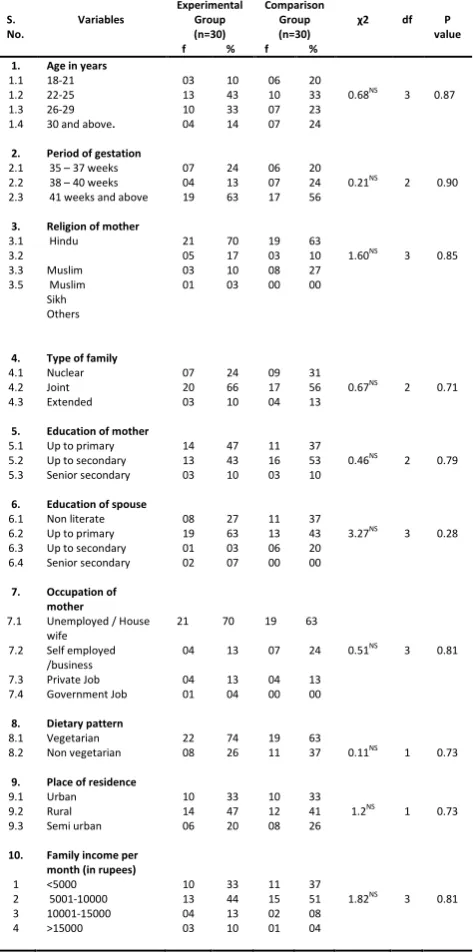
Frequency and Percentage Distribution of Primi Mothers According to Sample Characteristics in Experimental and Comparison Group
N=60 S. No. Variables Experimental Group (n=30) f %
Comparison Group (n=30) f %
χ2 df P value 1. 1.1 1.2 1.3 1.4
Age in years 18-21 22-25 26-29 30 and above.
03 13 10 04 10 43 33 14 06 10 07 07 20 33 23 24
0.68NS 3 0.87
2. 2.1 2.2 2.3
Period of gestation 35 – 37 weeks 38 – 40 weeks 41 weeks and above
07 04 19 24 13 63 06 07 17 20 24 56
0.21NS 2 0.90
3. 3.1 3.2 3.3 3.5
Religion of mother Hindu Muslim Muslim Sikh Others 21 05 03 01 70 17 10 03 19 03 08 00 63 10 27 00
1.60NS 3 0.85
4. 4.1 4.2 4.3
Type of family Nuclear Joint Extended 07 20 03 24 66 10 09 17 04 31 56 13
0.67NS 2 0.71
5. 5.1 5.2 5.3
Education of mother Up to primary
Up to secondary Senior secondary 14 13 03 47 43 10 11 16 03 37 53 10
0.46NS 2 0.79
6. 6.1 6.2 6.3 6.4
Education of spouse
Non literate Up to primary
Up to secondary Senior secondary 08 19 01 02 27 63 03 07 11 13 06 00 37 43 20 00
3.27NS 3 0.28
7. 7.1 7.2 7.3 7.4 Occupation of mother Unemployed / House
wife Self employed /business Private Job Government Job 21 04 04 01 70 13 13 04 19 07 04 00 63 24 13 00
0.51NS 3 0.81
8. 8.1 8.2 Dietary pattern Vegetarian Non vegetarian 22 08 74 26 19 11 63
37 0.11NS 1 0.73
9. 9.1 9.2 9.3
Place of residence Urban Rural Semi urban 10 14 06 33 47 20 10 12 08 33 41 26
1.2NS 1 0.73
10.
1 2 3 4
Family income per
month (in rupees) <5000 5001-10000 10001-15000 >15000 10 13 04 03 33 44 13 10 11 15 02 01 37 51 08 04
International Journal in Management and Social Science (Impact Factor- 5.276)
11. 1 2 3 4 5 Any information gained regarding breastfeeding during antenatal perioda) Yes b) No
If yes then source of
information Family member Friends Mass media Teacher Internet 17 13 10 02 02 01 02 57 43 33 07 07 03 07 20 10 12 03 02 03 00 67 33 40 10 07 10 00 0.43NS 4.11NS 1 4 0.739 0.57
χ 2 (1) =3.84, χ2 (2) = 5.99, χ2 (3) =7.8 , χ2 (4) = 9.488 at 0.05 level of
significance NS- Not significant (P> 0.05)
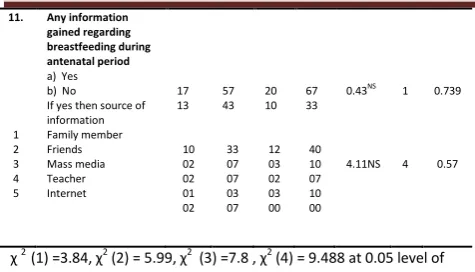
Finding in the table 1 revealed that primi mother in both the groups were similar in characteristics as the χ2 values for these variables were not found to be significant at 0.05 level of significance indicating that there was no significant difference between primi mothers of two groups before initiating the intervention.
Part: B Table 2
Frequency and percentage Distribution of Clinical Data Record Sheet of Primi Mothers in Experimental and Comparison group. N=60 S. No. Variables Experimenta l Group (n=30) f % Comparison Group (n=30) f %
χ2 P
valu e 12. 1 2 Type to delivery Normal Cesarean section 23 07 77 23 26 04 87 13
0.82 NS 0.36
13. 1 2 Montgomer y tubercle Present Absent 28 02 93 07 29 01 97 03
0.35NS 0.28
14.
1
Secondary
areola Present 30 100 30 100 0.01NS 1.00
15. 1 2 Soreness of nipples Present Absent 3 27 10 90 2 28 07 93 0.01N S 1.00 16. 1 2 Inversion of nipples Present Absent 2 28 07 93 1 29 03 97
0.01NS 1.00
17. 1 2 Cracked nipples Present Absent 2 28 07 93 3 27 10 90
0.01 NS 1.00
18. 1 Readiness of mother to feed the baby
Positive 30 100 30 100 0.01NS 1.00
19. 1
HIV status of mother Negative 30 100 30 100 0.01NS 1.00 20. 1 2 Sucking reflex of baby Present Absent 24 6 80 20 26 4 87 13 0.84NS 0.62
χ2 (1) =3.84 at 0.05 level of significance, NS- not significant (P >0.05)
Finding in the Table 2 revealed that primi mothers in both the groups were similar in clinical variables as the χ2 values for these variables were not found to be significant at 0.05 levels indicating that there was no significantly different in clinical variables among primi mothers of experimental and comparison group.
SECTION-II
Evaluation of Effectiveness of Individual Teaching Programme in Terms of Knowledge Regarding Exclusive
Breastfeeding Among Primi Mothers in the
Experimental Group and Comparison group
Table 3
Mean, Mean Difference, Standard Deviation of Difference, Standard Error of Mean Difference and ‘t’ Value of Post- Test Knowledge Score of primi mothers Regarding Exclusive breastfeeding in Experimental Group and Comparison group
N=60
Group Mean MD SDD SEMD ‘t’
value
Experimental
group (n=30)
20.30
8.267 4.989 1.031 8.01 * Comparison
group (n=30)
12.03
‘t’ (58) = 2.00 at 0.05 level of significance, * significant (p≤ 0.05)
International Journal in Management and Social Science (Impact Factor- 5.276)
difference in knowledge score was a true difference and not by chance.
SECTION-III
Evaluation of Effectiveness of Individual Teaching Programme in Terms of Practice Regarding Exclusive Breastfeeding Among Primi mothers in Experimental Group and Comparison group
Table 4
Mean, Mean Difference, Standard Deviation of Difference, Standard Error of Mean Difference and ‘t’ Value of post test practice score of primi mothers regarding Exclusive breastfeeding in Experimental Group and Comparison group
N=60
Group Mean MD SDD SEMD ‘t’
value
Experimental
group (n=30)
17.60
5.767 4.293 0.875 6.59 * Comparison
group (n=30)
11.64
‘t’ (58)=2.00 at 0.05 level of significance, *Significant (p≤ 0.05)
Data presented in table 4 revealed that the mean post test practice score of primi mother sin the experimental group (17.60) was higher them the mean post test practice score of primi mother in the comparison group (11.64) with the mean difference of 5.767 . The obtained mean difference was found to be significantly significant as evident from the ‘t’ value of 6.594 at 0.05 level of significance. This showed that mean difference obtained in post test practice score was not by chance but was a true difference.
SECTION-IV
Correlation between Knowledge and Practices of primi mothers Regarding Exclusive breastfeeding in the Experimental Group and Comparison group
Table 5
Correlation between Knowledge Score, Practice Score of Primi mothers in the Experimental Group and Comparison group
N=60
Groups Knowledge Practice
Knowledge Experimental
group (n=30) Comparison group (n=30)
-
-
0.24NS
0.15NS
Practice Experimental
group (n=30) Comparison group (n=30)
0.17
0.11
-
-
‘t’ (28) = 0.03, at 0.05 level of significance, NS - non significant (p≤ 0.05)
Finding in the table 5 indicated that in the experimental group, the coefficient of co- relation between knowledge score in experimental group was 0.24 and in comparison group 0.15 and between practice score and knowledge score in experimental group 0.17 and in comparison group 0.11.
There for it suggested that there was very low positive correlation between knowledge sores and practices score obtained by primi mothers regarding exclusive breastfeeding, which was not found to be significant at 0.05 level of significance. It indicates that there was no significant co- relation between knowledge and practice in the experimental group.
SECTION-V
Association of Knowledge Score and Practice Score of primi mothers with Selected Variables in the Experimental Group
The obtained ANOVA and t test of primi mothers computed with knowledge and practice of exclusive breastfeeding the finding revealed that age, period of gestation, religion, education of mother education of spouse, occupation, dietary pattern, type of family, place of resistance, family income, information gained were found statistically not significant at 0.05 level of significant at 0.05 level of significant.
Thus can conclude that the knowledge and practice of exclusive breastfeeding of primi mothers was independent of other variables.
SECTION-VI
Description of Expressed Practices in the Experimental Group and Comparison group
International Journal in Management and Social Science (Impact Factor- 5.276)
complications like inversion of nipple, less milk production and breast engorgement . Both in the experimental group (87%) and comparison group (82%) , majority of the babies did not had any complication. 13% of the babies in the experimental group and 18% of the babies in the comparison group had diarrhoea, vomiting, indigestion and chest infection.
6.
Discussion
Primi mother in both the groups were similar in characteristics, there was no significant difference between primi mothers of two groups before initiating the intervention. The similar variables were studied by Richa Gupta, in a study on effectiveness of Individual Teaching Programme on breastfeeding among primi mothers for improving their knowledge attitude and practice.11
The mean post test knowledge score of primi mothers in the experimental group was higher than mean knowledge score of primi mothers and there was no significant association between sample characteristic. Similar finding were also reported by MD Santhi, Kokilavani.12
The mean practice score of primi mothers in the experimental group was higher than mean practice score of primi mother in comparison group and according to the present study, telephonic interview finding at 6th week showed that breastfeeding was given to all the babies in the experimental group and in the comparison group 30% of babies were given top feeding because of non sucking behaviour of the babies.These findings were found to be similar with a study conducted by Kang JS, Choi SY Ryu EJ on effects of a breast feeding empowerment programme on breastfeeding mothers.13
7.
Conclusion
Individual Teaching Programme was an effective teaching method it enhanced the knowledge and improved the practices of primi mothers regarding exclusive breastfeeding in the experimental group. There was no significant association of post test practice scores with selected variables in the experimental group. There was low positive relationship between knowledge and practice scores in the experimental group.
Thus the individual teaching programme regarding exclusive breastfeeding among primi mothers was effective in bringing about a change in knowledge and practices of primi mothers
8.
Acknowledgement
We express our appreciations to the respected officials of the institutes of M.M. University Mullana, who cooperated with us for executing this research. The author would like to thank Mrs. Uma J Deave and Ms. Rashmi Panchal for her constant encouragement, detailed and constructive comments. The authors thanks all the participated in this study.
9. References
.1. Singh M. Care of Newborn. 6th edition. New Delhi . Sagar publications; 2009; pg 120-135.
2. Kallischnigg G. Plagemann. The Scientific Benefits of Breast feeding[online ] 2009 [cited
may 14, Available from
URLhttp://www.phdinparenting.com/2009/05/1 4/the-scientific-benefits-of-breastfeeding.
3. Frances Jones. “Baby Friendly Care”. 4th edition. The Canadian Nurse. 2012;pg 36-37
4. WHO. UNICEF. Academy for Educational Development. USAID. Learning from large scale community based programmes to improve breastfeeding practices. Geneva: WHO; 2010 5. WHO. Health a. Samervel publication.
Breastfeeding guidelines.2011;6(2)23-21
6. Katharyn A, Laura R. Comprihensive maternity
Nursing. 2nd ed. J.B. Lippincott
Company.2013;17(12):78-90
7. Valerie Hull, ShyamThapa and Had Pratomo. Breastfeeding in the modern health sector in Indinesia: The mother’s Perspective. Social Science & Medicine. 2013;34(7):17-23
8. Katiyar . Breastfeeding Practices Of Post Natal Mothers . Nursing Journal of India. 2012 (36): 22-25 9. S K Wadhwa. J S Deshmukh. S N Wahab. N D
Vasudeo. Awareness and practices regarding breastfeeding .Indain Journal of maternal and child health . 2009 January; 9:41-45
10. S K Rasania. SK Singh S Pathi. S Bhalla. TR Sachdev. Breastfeeding Practices In A Maternal And Child Health Centre . Indian Journal Of Pediatrics 2011;26 (3) :110-115
11. Gupta Richa. Effectiveness of educational package. Nursing Research. June 2013.
12. Santhi MD Kokilavani. International Journal of Nursing Care.2013;(1): 77-82