Startup Modelling Through Strategy Frame for Long Term Sustainability Author:
Rahatullah, M, K,. ORCID: M-2737-2013 Business Innovation and
Entrepreneurship Research Center Effat University – Jeddah
Saudi Arabia
Email: [email protected] Website: www.effatuniversity.edu.sa
www.strategizestartup.com Phone: +966 548098960
Abstract
The long term sustainability and longevity of the business life cycle depends on correct understanding of the contextual constituents, identification of market triggers and dynamics, pre-startup planning, strategy and financial forecasting. Therefore, business plans are developed to understand and forecast project viability, pitch ideas and secure funding. At the same time there is a lack of one page startup business model.
Identifying this need, a ‘startup business strategy frame’ has been developed through learnings and encompassing design thinking, the business canvas and other strategy models and approaches. It provides a logical sequential flow and connects value drivers on environmental, strategic including operational and financial levels of proposed startup in a sequential format.
To arrive at the frame as a logical conclusion a website www.strategizestartup.com is developed to build startup business model and plans in a time and cost effective process. The website assists the startups at each stage through a work and guidebook. The
website takes the user from creative ideation by charting the context to build the strategy and measuring the financial impact.
This startup strategy model will alleviate the problems for the first and second stage entrepreneurs to ideate creatively and strategizing. It eradicates issues related to reading and understanding long plans which could be an exhaustive and cumbersome process.
Key words:
Startups, Startup Strategy Frame, Startup Business Model, Business Canvas
Important Note:
This paper is further development of the paper, Rahatullah, M, K., (2018); Constructing Startup Strategy frame; CBU Internatioonal Conference proceedings, Innovations in Science and Education, March 21 to 23, 2018, Prague, Czech Republic.
Introduction
McLeod (2000) demonstrated a statistically significant relationship between the Startup Success Index and the level of the planning for Startup. During the pre-startup phase the startup business model is constructed, a business plan and a financial feasibility finalized. Models depict a simplified image of reality. Models are constructed to explain aspect(s) of a system. These can be used for ease of comprehension, know quickly and simply in a visual format. A business model pronounces the rationale that how a firm will create, capture and deliver value, customer benefits and trigger revenue generation. The business plans and feasibility studies are large documents and at times could become cumbersome to read and relate to the information in a clearer manner.
Historically, the entrepreneurs in first stage develop a business plan to pitch their ideas and lure the investors. However, planning process is not easy and requires business skills. The experience with the boot-camp participants and students in ‘launching entrepreneurial ventures’ course represented a problem of sketching the business strategy on one page. A significant portion of the startups also not necessarily have the business background. The frame is designed in a manner to trigger the creativity and design thinking by asking questions. The frame then helps the entrepreneur and other stakeholders have a strategic view of the proposed startup on one page and easily relate to other planning aspects.
Business Models
The business boom of 1990s provided impetus to the concept of the ‘business model’ (Wirtz 2010) which was otherwise a little known term despite its importance and significance (Morris et al. 2005).
Following is a summary of the business model definitions.
Table 1 – Selected Business Model Definitions Table 1 – Selected Business Model Definitions Author-Study -
Year Definition
Werani (2012) Looking at the value-based marketing approach the ‘value’ is defined as the difference between benefits and costs and it is valid for both the customer and the supplier side.
Magretta, 2002
Business models are “stories that explain how enterprises work. A good business model answers Peter Drucker’s age old questions: Who is the customers? And what does the customer value? It also answers the fundamental questions every manager must ask: How do we make money in this business? What is the underlying economic logic that explain how we can deliver value to customers at an appropriate cost?” (p. 4).
Morris et al., 2005
fundamental components: Value proposition, Customer, Internal process/
Competencies, External positioning, Economic model, and Personal/investor factors.
Teece 2010 ‘Logic’ of the way businesses function. A business model opines of a logic of how a company may create value and shift its benefits to customers through right mechanisms
Shafer et al., 2005 A business model is “a representation of underlining core logic and strategic choices for creating and capturing value within a value network” (p. 202).
Johnson et al., 2008
Business models “consist of four interlocking elements that, taken together, create and deliver value” (p. 52). These are: Customer value proposition, profit formula, Key resources, and Key processes.
Bieger and Reinhold (2011)
Taking value based business approach identify the holistic and integrated operations of a company. They suggested that the primary purpose of the business is the creation of value for stakeholders and itself. This involves six dimensions, including, value
proposition, value creation, value transfer and communication, value capture, value dissemination and value development.
Bjo¨rkdahl (2009)
Examined the way companies may benefit from new technologies. He was among scholars labelling a ‘business model’ as the logic and set of interconnected activities creating value for a business. The dimensions he included were value proposition and creation, customer segments, channels and value capture mechanisms.
Chesbrough (2010)
Illustrated that a business model determines how businesses create and capture value, market segments served, the positioning and triggers of competitive advantage. The dimensions of this approach included, value proposition, market segments, value chain, revenue mechanisms, cost structure and profit potential, value network and competitive strategy.
The above table identifies the variety in defining the business models. We also witness a disagreement on a ‘model’ dimension or its components. Nonetheless, , these definitions have some common elements and features, i.e. the answer on what, how, who is sought and provided.
Some of the key terms found are:
• Summary of the business.
• Value, Capturing and delivering value
• Choices available for strategizing.
• Value proposition.
• How to make profit in proposed business.
• Fundamental resources, and processes.
• Three level of the business, i.e. Economic then Operational and last is the Strategic Level.
• How to generate income.
• Strategic focus.
• How to achieve the competitive advantage.
If there were any more definitions to come after 2011’s introduction of business canvas, that would also definitely become part of the set of the terms identified above.
Building a Business Model
Keeping various definitions in mind, Osterwalder and Pigneur (2010, 2011) proposed noteworthy comprehensive business model approaches. They assert that as an
organization revolves around a business model, it is fundamental in generating value for both the customers and the company. They developed 9 building blocks as opposed to the 3-5 components offered by their counterparts. These blocks include: Management of customer benefits; Management of customer relationships; Segmentation of the markets and customer; Communication management; Sales management; Management of key partners; Management of key activities; Cost management and Price management. The scholars provide descriptions of these elements and their relationships with each other. Furthermore, in their ‘Business Model Canvas’, they use the respective designs of individual dimensions and employ a meta-model approach that elaborates and connects different business models. The canvas, fits a single page, classifies the starting point dimensions for business model innovation and the ways in which they will function, thereby presenting the pertinent parts of the business plan.
Teece (2010), takes a customer-centric approach and ties-up to the creation and transfer of value by contending that a business model focus on the ways a company creates value and transfers it to the customers through revenues and costs. The author therefore
deduces that without suitable adjustments in the business model, simply relying on product or process innovation is not sufficient to achieve success. Things like the value proposition, market segments, cost structure, revenue streams and value capture mechanisms can be identified as possible components.
Like Teece (2010), Zott and Amit (2010) did not provide clear cut business model
components of an activity system, i.e. context, the content and the governance which dictates the responsibilities of the people and the departments for the implementation of appointed activities. This explanation stays true to their upheld belief that a business model consists of a ‘system of interrelated activities within a particular company and beyond its borders’.
From the discussion above one can conclude that although the definitions are similar in many ways, they are also very different with regards to dimensions and therefore, disagreements among scholars continue to exist. Beiger and Reinhold and Osterwalder and Pigneur all utilize similar approaches to describe dimensions but the descriptions appear to be broad and vague. Moreover, the discussion between Gassman et.al. (2013) and Joseph-Maria Segarra-Blasco (2005) indicates that the careful formulation and execution of business models is key to success; especially as competition is on the rise and the world is quickly advancing to newer, better technology which facilitates easier ways to break barriers and globalization.
DaSilva and Trkman (2014) assert that these factors fuel the design and redesign of business models. Swiftly grasping onto this opportunity, consultants like McKinsey & Company, Bain & Company, and the Boston Consulting Group applied their professional and strategic business skills to propound the companies to innovate and effectively implement their business models. FasteRolfe et.al. (1993) further developed the work of Mckim from the 1980s and 1990s when design thinking approach began being taught as a creative thinking method. Similarly, Lockwood (2010) articulates that changes in
technology and social circumstances drive redesign. Design and analytical thinking differ because the former consists of ‘building up’ of ideas during the brainstorming phase to reduce the fear of failure (Brown, 20008). It alternates between divergent and convergent thinking and thus requires creative thought processes and discussion in order to attain disruptive and unique thinking (Jeanne, 2011; Nigel 2011; and Idriss 2013).
Despite acknowledging the fact that generalized statements are the basis of these
business models, Werani et.al. (2016) emphasize the opportunities to bring in diversity in order to successfully implement business models that continually evolve and change. This aforementioned discussion indicates that new models appear where the diversity is obligated to each business’s unique discerned weaknesses, strengths, opportunities, value systems etc.
Constructing a Startup Business Strategy Frame
The majority of focus of Entrepreneurs lies in creating value, building new businesses and visualizing a successful future. Wallin and Still (2016) and Veselovsky et.al. (2017) have postulated that the lack of information on business model development is conspicuous. Startups in their pre-startup level go through several stages before settling their business plan and financial feasibility. Once this is done, it is common for a 25+ page document containing all the information and strategies to be the outcome of this intense task.
processes, income generation and cash flow and how values can be developed to achieve economic, operation and strategic advantage.
By compiling all the existing knowledge, design thinking aspects and ideation approaches in a clear cut and straightforward manner; not only does the pre-startup stage that all entrepreneurs go through gets shortened but values are added and investors get a one page illustration of the proposed economic, operational and strategic business.
Thus, this paper aims to further the Osterwalder and Pigneur business canvas and
propose a “Startup Strategy Business Frame”, which is a generic industry level model that will facilitate the operations of startups and firms in the industry, according to Schallmo and Brecht (2010). The Osterwalder and Pigneur business model configuration approach is critically scrutinized and the supplementary areas in business strategy development and its implementation are identified. This frame intends to provide tailored approaches to business modelling by establishing all necessary startup information on a single page.
Methodology
The following methodology states the way in which the process of development of the ‘startup strategy frame’ came to be. Passing through the ideation phase accelerated the notion before it was executed.
Three boot-camps that were held for the undergraduate course, ‘Launching
Entrepreneurial Ventures’ during the Spring and Fall semesters of 2017 at the university, structured and built the frame work. A large number of entrepreneurs, coaches and mentors guided the contestants through the startup process and were later provided with a feedback survey to recognize the shortcomings in the drafted frame in order to be rectified for the final draft.
The participants were selected on the basis of a purposive sample which is a
non-representative subset of the larger population. It is developed for a very specific purpose, and thus, specifying the population is cumbersome (Marshall, 1996). The participants were called for via social networking platforms, emails to the university and the
researchers’ network. Anyone with a business idea who would like to partake was welcomed. However the undergraduate students were assigned by the university.
Each boot-camp had its set of challenges and the participants were randomly divided into teams of two.
addition and utility of design thinking methods was realized in order to present a more comprehensive yet concise image of a proposed startup.
Therefore, adding onto the abovementioned approaches, a ‘startup frame’ was drafted, providing a one page summary of the 9 dimensions suggested by Osterwalder and Pigneur (2010&2011) laying more emphasis on management of segmentation, customer relationships and design thinking element such as creativity and revenue triggers. By doing this, it was aiming at providing a proposed business narrative in a short time span. Further additions were also made to the canvas.
In the next boot-camp organized in the spring semester of April 2017, 137 people
participated and a number of flaws were spotted by these participants, coaches, mentors and students. The main issues were related to value triggers, long term strategy and goals, imaginative picture of the future and revenue drivers.
Images of a number of initial Startup Strategy Business Frames are presented below that show the participating teams’ work in identifying the areas for further improvement.
Figure 1 – The initial frame design
It can be observed that the amount of courses of action is more than the business canvas but less than the final versions placed in figure 2 below.
Adapted from Rahatullah 2018
Utilizing the Porter’s value chain that was developed in the 1980s, the business areas where a startup can add value were recognized. This differentiates Osterwalder and
D a te No Pa rt n e rs In d iv id u a ls O rg a n iz a ti o n s F in a n ci a l In s ti tu ti o n s S ta ke h o ild e rs Im p a c t b y y o uI m p a c t o n y o u N o Im p a c t C u s to m e rs G e n d e r T e ch n o lo g y G o vt . Po li cy A g e g ro u p In fra s tru ct u re Su p p li e rs T a x R e b a te s D is tri b u to rs L o w I n te re s t R a te In co m e l e ve l St a rt u p L a w s Ed u ca ti o n Loans O th e rs M a ri ta l St a tu s St a rt u p s o lu ti o n p ro vi d e rs O th e rs O th e rs Ex h ib it io n El e ct ro n ic D ire ct O u ts id e Pri n t O th e r Pro d / Srv U n it s So ld U n it Pri c e T o ta l Sa le s Y e a r 1 Y e a r 2 In d ic a to rs Y e a r1 Y e a r 2 L a n d + B u ild in g Pro d /Srv 1 0 N e t Pro fi t F u rn itu re Pro d /Srv 2 0 T . In vs tm n t M a rk e tin g + M e d ia Pro d /Srv 3 0 0 0 G ro s s Pro fi t S ig n a g e + P ri n tin g Y e a r 1 T o ta ls 0 N e t Sa le s M a c h in e + E q p t Pro d /Srv 1 0 R e n t+ U til ity 1 y r Pro d /Srv 2 0 N e t P rf t M rg n # D IV /0 ! # D IV /0 ! L e g a l+ In s u ra n c e Pro d /Srv 3 0 G r. P . M a rg in # D IV /0 ! # D IV /0 ! A ll O th e rs 0 0 R O I # D IV /0 ! # D IV /0 ! T o ta l 0 0 0 0 © M u h a m m a d R a h a tu lla h K h a n , E ff a t U n iv e rs ity J e d d a h , S a u d i A ra b ia . D e s ig n R e g is te re d in t h e U K . T o ta ls a re a u to m a tic Y o u n e e d S ta rt u p c o s t, s a le s s ta te m e n t, F ix e d a n d V a ri a b le C o s ts t o c re a te t h e P & L a c c o u n t R e v e n u e D ri v e rs s u c h a s p ro fi t & lo s s a c c o u n t, c a s h fl o w , B a la n c e s h e e t a n d R a tio A n a ly s is b e a tt a c h e d . In n u m b e rs a n d y o u r c u rr e n c y W h o a re y o u r cu s to m e rs ? Kn o w y o u r m a rke t G e o g ra p h ic lo ca ti o n (s ) U n iq u e V a lu e Pro p o s it io n W h a t is t h e cu s to m e r fe e d b a ck if y o u h a ve te s te d y o u r p ro to ty p e ? I f fe e d b a ck n o t ta ke n , p le a s e t a ke a n d a tt a ch a d ra w in g o f yo u r p ro d u ct / s e rv ice a s w e ll . In w h ich b u s in e s s fu n ct io n V a lu e w il l b e
added? (M
Pigneurs business canvas from the proposed frame. It also identifies the relationship between seminal areas of the startup development and offers business model dimensions and courses of action.
Brown (2008) maintains that, “thinking like a designer can transform the way you develop products, services, processes – and even strategy” (p. 85). The difference in traditional and designs way of thinking, says Brown, is either taking a tactical or a strategic
approach. The proposed frame is aimed to facilitate the shift from tactical to strategic design approach. While the Osterwalder and Pigneur canvas requires three value drives including customer benefits, price and costs of value creation (Werani, 2016), the
proposed framework takes susceptibility of a startup, attempts to add more value drivers such as financial returns and strategic direction through goals identification into account. It also further divides the business canvas drivers into sub-categories thereby simplifying its use for the startups. Hence the frame is holistic in nature as it gives an alignment of the value drivers startup strategy, proving it to be concise, efficient and comprehensive for startups.
Table 2 – The Proposed Frame Mix
Levels Frame Elements Courses of Actions Economic Indicators
• The cost of starting a business
• The pricing model
• The return on investment achieved
Operational Building Value
• The major resources applied by the startup
• The social and economic categories, the customers belong to.
• The plan to communicate with the stakeholders.
• Channels of distribution
• The suppliers of the firm.
• The agreed and implement design of the product or service.
• The market and functionality test of the product / service
• Competitors
• Partners and alliances
Strategic Design Elements and Strategic Thrust
• Identification of the problem
• Solution identified for key activities facing difficulties
• The market insight for the product/service
• The proposed and implemented value proposition
• Detailed SWOT Analysis and based on that the strategy development
• Startup goals
• The pricing strategy of the startup
• The strategy to achieve competitive and comparative advantage
• The startup’s customer relationships strategy
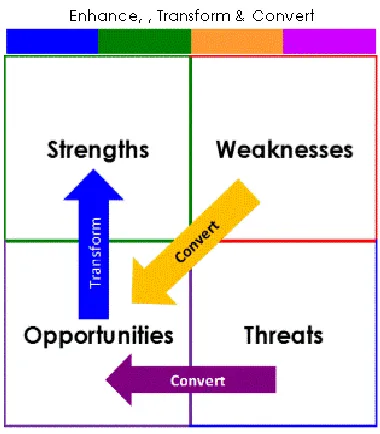
From April to September 2017, the identified elements were studied and integrated in the ‘startup frame’. SWOT analysis was then deployed in order to convert weaknesses and threats into opportunities and opportunities to strengths. Customer feedback on ideation, long term goals, strategy to achieve competitive advantage and possible returns on investment were also incorporated. The fall semester witnessed the utilization of the proposed frame and by the third boot-camp in November the participants had completely adopted it.
The feedback from the participants of the third boot-camp was positive and encouraging. With a few more changes in the ideation and customer feedback questions, the final ‘startup frame’ is propounded.
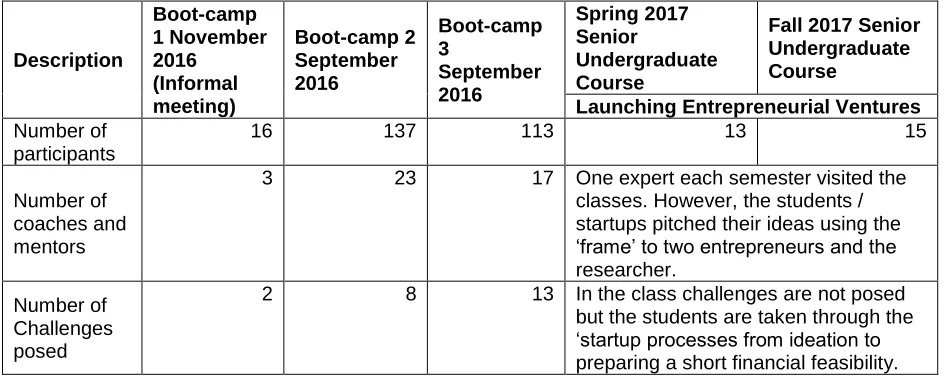
The table 3 below provides details of the events that help shape and structure the frame
Table 3 – Events where the ‘startup frame’ evolution took place
Description
Boot-camp 1 November 2016
(Informal meeting)
Boot-camp 2 September 2016
Boot-camp 3
September 2016
Spring 2017 Senior
Undergraduate Course
Fall 2017 Senior Undergraduate Course
Launching Entrepreneurial Ventures Number of
participants
16 137 113 13 15
Number of coaches and mentors
3 23 17 One expert each semester visited the classes. However, the students / startups pitched their ideas using the ‘frame’ to two entrepreneurs and the researcher.
Number of Challenges posed
2 8 13 In the class challenges are not posed but the students are taken through the ‘startup processes from ideation to preparing a short financial feasibility.
Achieving Credibility, Validity and Dependability
The participants’ feedback, including, recorded, verbal in the discussions and written as response to the feedback survey provided credibility of the data and validity to the fame structure.
These discussions were mostly in Arabic and parts in English. In order to increase the dependability and further validate the frame structure and content the responses were also discussed with a number of mentors and coaches who had attended the bootcamps. In an effort to keep the credibility the researcher himself spoke to 27 participants over the period of research to seek verbal feedback. Each individual was requested to provide feedback on the frame structure and content and the feedback was sought. This feedback was recorded in order to keep the evidence for each stage and of the changes made to the frame.
Courses of Actions Compared - Startup Frame and Business Canvas
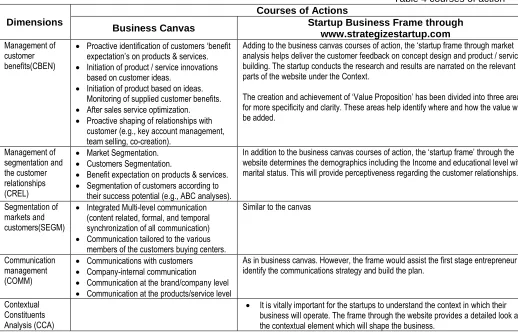
The table 4 below pinpoints, relates and reveals divergences and differences in courses of actions triggered through the revised Business Model Canvas and proposed startup frame.
The Frame through questions builds the startup business perspective and makes it easier to develop strategies targeting the future. The frame also helps infer and draw these strategies for a number of dimensions.
Table 4 courses of action
Dimensions
Courses of Actions
Business Canvas Startup Business Frame through www.strategizestartup.com Management of
customer benefits(CBEN)
• Proactive identification of customers ‘benefit
expectation’s on products & services.
• Initiation of product / service innovations based on customer ideas.
• Initiation of product based on ideas. Monitoring of supplied customer benefits.
• After sales service optimization.
• Proactive shaping of relationships with customer (e.g., key account management, team selling, co-creation).
Adding to the business canvas courses of action, the ‘startup frame through market analysis helps deliver the customer feedback on concept design and product / service building. The startup conducts the research and results are narrated on the relevant parts of the website under the Context.
The creation and achievement of ‘Value Proposition’ has been divided into three areas
for more specificity and clarity. These areas help identify where and how the value will be added.
Management of segmentation and the customer relationships (CREL)
• Market Segmentation.
• Customers Segmentation.
• Benefit expectation on products & services.
• Segmentation of customers according to their success potential (e.g., ABC analyses).
In addition to the business canvas courses of action, the ‘startup frame’ through the
website determines the demographics including the Income and educational level with marital status. This will provide perceptiveness regarding the customer relationships.
Segmentation of markets and customers(SEGM)
• Integrated Multi-level communication (content related, formal, and temporal synchronization of all communication)
• Communication tailored to the various members of the customers buying centers.
Similar to the canvas
Communication management (COMM)
• Communications with customers
• Company-internal communication
• Communication at the brand/company level
• Communication at the products/service level
As in business canvas. However, the frame would assist the first stage entrepreneur to identify the communications strategy and build the plan.
Contextual Constituents Analysis (CCA)
Strategy
Development (SD) •• The frame through website provides a detailed view of the strategy of the startup. The SWOT analysis will help the development of the strategy.
Financial Impact • Every strategy built on context has a financial impact. The frame through the
website provides important data on financial projections for the next two years. Strategic Goal
Setting and Management (SGM)
• Provides effective goal setting and helps build strategy to achieve the goals.
• The frame assists to build competitive advantage strategy on:
o Communications with stakeholders
o Pricing
o Key resources
o SWOT based strategy to convert weaknesses and threats into opportunities and opportunities to strengths.
o Competitors
o Value Chain Competitor
Analysis (CA) The competitor analysis is carried out through benchmarking. This is one of the core elements for a startup to understand their competitor. Designing the
Business (DB) • The frame assist the startup to identify the problem in the environment and justify that the ‘issue’ exists through guiding questions.
• Startup proposes a solution to the problem, identifies the product/service to be launched and solution includes by + - * of any features in existing product/service or is a totally new product/service.
• The design thinking process is implicitly operationalized by asking specific questions on product and service design and or prototype details. It also ensures that when required the product / service is tested before launch. Some Pugh analysis elements are also inserted.
Design Elements
(DE) The startup frame provides and adds the business design concepts including the design thinking process. It enhances the ideation phase by seeking answers to specific questions posed to initiate creativity and foment innovative means to bridge a market gap and serve customers.
Adapted from Rahatullah 2018
The ‘frame’ divulges the structural differences between the business canvas and the frame by identifying business areas where a startup can add value with the help of Porter’s value chain. The frame delivers further value as it assists the startup through various other business models. Recognizing the relationships among important business areas of the startups and putting forth the business model dimensions and courses of action to be taken is another key feature of the frame. Brown (2008) suggests that
“thinking like a designer can transform the way you develop products, services, processes – and even strategy” (p. 85). The variance in traditional and design thinking, says Brown, is either taking a tactical or a strategic approach. The frame puts in place various
elements that generates design thinking and assist the startups build their business by providing a shift from tactical to strategic design approach.
The difference in “Value Drivers” of Business Canvas and the “Frame” is also significant as the canvas requires three value drivers, i.e. customer benefits, price and costs of value creation (werani 2016). On the other hand the “frame” taking into account the
susceptibility of a startup, attempts to add more value drivers such as financial returns, strategic direction through goals identification and many more as identified in the contrast below. The “frame” also provides a holistic alignment of the value drivers to startup
strategy. Hence, the results would be a robust, adaptable and efficient startup.
The Frame Development through Website
The website assists the user to build a startup plan with detailed strategy. It has a work and guide book that guides and assists the development of the frame. The frame is developed into three parts, i.e. knowing the context, building strategy based on the context and then knowing the financial impact of the strategy and the plans.
In each part the user is asked to answer questions and each question has help available to guide the startup what is required. The work book alongside provides more detailed look.
The website then has the frame summary, which is the output same as figure 2.
The website also provides details on copyright, disclaimer statement, user agreement and privacy policy.
Innovative SWOT (Strategy) in the Frame
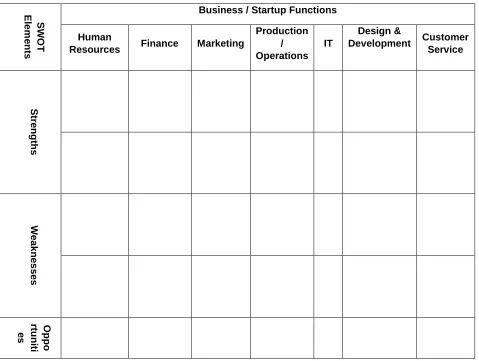
The SWOT is traditionally used to analyse the strengths, weaknesses, opportunities and threats. However, the frame through work and guide book, assists the users to develop a value based strategy through SWOT; see table 5 and 6 and figure 3 below.
Table 5 - The basic strategy building tool in analyzing ‘personal’ and ‘proposed business’s’ SWOT.
S
W
O
T
E
lem
ent
s
Business / Startup Functions
Human
Resources Finance Marketing
Production / Operations
IT
Design &
Development Customer Service
S
tr
eng
th
s
W
ea
knes
se
s
O
p
p
o
rt
u
n
it
i
T
h
rea
Table 6 – Buidling Strategy on SWOT
Now develop your strategy-How will you convert your:
Figure 3 – SWOT to Strategy
The above SWOT tool shows that the analysis alone is not enough and a tool in the shape of the tables and the figure helps the startup develop a strategy to by convert their Weaknesses into
Opportunities:
Threats into Opportunities:
Opportunities into Strengths:
weaknesses and threats to opportunities and opportunities to strengths and retaining strengths.
This strategy would greatly complement the overall strategy of the startup and add value to the offerings and startups’ own understanding of the business.
Conclusions and Recommendations
The startups utilizing this ideation and planning tool would be better able to model their startup. Though the business canvas is hugely important and visible business modelling tool and widely utilized. However, the startup frame is different than the canvas in many ways and builds by bringing in learnings from the design thinking as well. The startup frame was tested in three boot-camps by use of more than 265 participants. The areas of development were identified with the help of participants and then errors and omissions rectified.
The entrepreneurs going through the process of the startups would be greatly benefitted. They will be able to model their business operational and long term strategy on one page. It will provide them an opportunity to plan each subsequent plan in the frame on the basis of previous conclusions and responses. Since the frame poses questions it would trigger the creativity and innovation in devising the business strategy.
Financial investment decisions by the investors is crucial and holds key to the success of a financial outlay program. The startup frame can be utilized by the individual startups, banks, accelerators and incubators to help their startups to model their plans and present to investors and other stakeholders.
The importance of time Effectiveness at pre-startup stage is of essence for the
entrepreneurs and the frame facilitates that through its step by step approach to planning a startup from ideation to identifying the ROI.
The frame would be put on a blog to download in excel sheet or word format. It is
recommended that it is used on the computer to input the data and then printed. A4, A3, Arabic and English versions are being put up.
It will become an effective analysis tool for the investors to make their finance investment decisions hence adding value to such a choice. Pitching process for the startups would become elaborate, precise and ease the tasks of the judges.
The educational institutions teaching startup related courses and tools would be able to take advantage from the diversity of the information released on the frame.
The frame could be utilized by startups in any field.
Limitations
• Some information might require more space and extra blank sheets might have to be used by the user.
• For some of the start-ups the whole frame may not be filled and some courses of actions may not be implemented.
• Some start-ups may not have access to A3 papers for printing the frame.
References
• Bieger T, Reinhold S (2011); Comparative Analysis (QCA) and related techniques. Sage, Los Angeles, pp 1–18 Das wertbasierte Gescha¨ftsmodell: Ein aktualisierter Strukturierungsansatz. In: Bieger T, zu Knyphausen-Aufseß D, Krys C (eds)
Innovative Gescha¨ftsmodelle. Springer, Berlin, pp 14–70
• Bjo¨rkdahl J (2009) Technology cross-fertilization and the business model: the case of integrating ICTs in mechanical engineering products. Res Policy 38:1468– 1477. doi:10.1016/j.respol.2009.07.006
• Breiby, E., and Wanberg, M. (2011). Successful business model innovation. Norwegian University of Science and Technology. Retraído 20 de Junio 2014, de http://www.divaportal.org/smash/record.jsf?pid=diva2:473574
• Brown, T. (2008). Design Thinking. Harvard Business Review, 86, (6), 84-92.
• Chesbrough H (2010) Business model innovation: opportunities and barriers. Long Range Plan 43:354–363. doi:10.1016/j.lrp.2009.07.010
• DaSilva CM, Trkman P (2014) Business model: what it is and what it is not. Long Range Plan 47:379–389. doi:10.1016/j.lrp.2013.08.004.
• Faste, Rolf; Bernard Roth and Douglass J. Wilde (2013) "Integrating Creativity into the Mechanical Engineering Curriculum", Cary A. Fisher, Ed., ASME Resource
Guide to Innovation in Engineering Design, American Society of Mechanical
Engineers, New York, 1993.
• Gassmann O, Frankenberger K, Csik M (2013) Gescha¨ftsmodelle entwickeln: 55 innovative Konzepte mitdem St. Galler Business Model Navigator. Carl Hanser, Mu¨nchen.
• Idris, Mootee (2013). Design Thinking for Strategic Innovation. Wiley.
• Jeanne, Liedtka (2011) Designing for Growth: A Design Thinking Tool Kit for
Managers. Columbia University Press, 2011, ISBN 0-231-15838-6
• Juan AM., Manuela, PV. & Salvador, RD., (2016); the influence of institutions development in venture creation decision: A cognitive view; Journal of Business Research; Volume 69, Issue 11
• Josep-Maria Arauzo-Carod, & Segarra-Blasco, A. (2005). The determinants of entry are not independent of start-up size: Some evidence from spanish
manufacturing. Review of Industrial Organization, 27(2), 147-165. doi:http://dx.doi.org/10.1007/s11151-005-8321-z
• Kohlhammer, Stuttgart Wirtz B (2010) Business Model Management: Design— Instrumente—Erfolgsfaktoren von Gescha¨ftsmodellen. Springer, Wiesbaden
• Marshall, Martin N. (1996). "Sampling for Qualitative Research." Family
Practice 13: 522–526. doi:10.1093/fampra/13.6.522
• McLeod, J. S. (2000). Planning for startup: An evaluation of factors affecting the
startup of process industry facilities (Order No. 3004338). Available from ProQuest
• Morris M, Schindehutte M, Allen J (2005) the entrepreneur’s business model: toward a unified perspective. J Bus Res 58:726–735.
Doi:10.1016/j.jbusres.2003.11.001
• Nigel, Cross (2011); Design Thinking: Understanding How Designers Think and
Work. Oxford UK and New York: Berg.
• Osterwalder A, Pigneur Y (2010); Business Model Generation: A handbook for visionaries, game changers and challenges, Wiley, ISBN: 978-0-470-87641-1
• Osterwalder A, Pigneur Y (2011) Business Model Generation: Ein Handbuch fu¨ r Visiona¨re, Spielvera¨nderer und Herausforderer. Campus, Frankfurt am Main
• Rahatullah, M, K., (2018); Constructing Startup Strategy frame; CBU Internatioonal Conference proceedings, Innovations in Science and Education, March 21 to 23, 2018, Prague, Czech Republic
• Teece D (2010) Business models, business strategy and innovation. Long Range Plan 43:172–194. doi:10.1016/j.lrp.2009.07.003 608 T. Werani et al. 123
• Thomas, Lockwood (2010). Design Thinking: Integrating Innovation, Customer
Experience and Brand Value. New York, NY: Allworth.
• Veselovsky, M. Y., Nikonorova, A. V., Stepanov, A. A., Krasyukova, N. L., & Bitkina, I. V. (2017). THE DEVELOPMENT OF INNOVATIVE STARTUPS IN RUSSIA: THE REGIONAL ASPECT. Academy of Strategic Management
Journal, 16, 197A, 198-208.
• Wallin, A., Still, K., & Henttonen, K. (2016). Entrepreneurial growth ambitions: The case of Finnish technology startups. Technology Innovation Management
Review, 6(10), 5-16. Retrieved from
https://search.proquest.com/docview/1963139658?accountid=130572
• Wallin, A., Still, K., & Henttonen, K. (2016). Entrepreneurial growth ambitions: The case of Finnish technology startups. Technology Innovation Management Review, 6(10), 5-16. Retrieved from
• Werani T (2012) Business-to-Business-Marketing: Ein wertbasierter Ansatz.
• https://search.proquest.com/docview/1963139658?accountid=130572
• Werani, T., Freiseisen, B., Martinek-kuchinka, P., & Schauberger, A. (2016). How should successful business models be configured? Results from an empirical study in business-to-business markets and implications for the change of business
models. Zeitschrift Für Betriebswirtschaft, 86(6), 579-609. doi:http://dx.doi.org/10.1007/s11573-015-0795-z