Article
1
Blockchain-Based ICOs: Pure Hype or the Dawn of a
2
New Era of Startup Financing?
3
Lennart Ante 1,*, Philipp Sandner 2, Ingo Fiedler 3, Andranik Tumasjan 4 and Isabell Welpe 5
4
1 University of Hamburg, Von-Melle-Park 5, 20146 Hamburg, Germany; Blockchain Research Lab gGmbH,
5
20354 Hamburg Germany; [email protected]
6
2 Frankfurt School of Finance & Management, Adickesallee 32-34, 60322 Frankfurt am Main, Germany;
7
8
3 University of Hamburg, Von-Melle-Park 5, 20146 Hamburg, Germany; Blockchain Research Lab gGmbH,
9
20354 Hamburg Germi
10
any; [email protected]
11
4 Johannes Gutenberg University Mainz, Saarstraße 21, 55122 Mainz, Germany; [email protected]
12
5 Isabell M. Welpe, Technical University Munich, Arcisstraße 21, 80333 München, Germany; [email protected]
13
14
* Correspondence: [email protected]; Tel.: +49-40-42838-6454
15
16
Abstract: This study explores the determinants of ICO success, where success is defined as the
17
amount of capital a project was able to raise. ICOs are a tool for startups in the blockchain
18
ecosystem to raise early capital with relative ease. The market for ICOs has grown at a rapid pace
19
since its start in 2013. We analyze a unique dataset of 278 projects that finished their ICOs by
20
August 2017 to assess determinants of funding success that we derive from the crowdfunding and
21
venture capital literature. Our results show that ICOs exhibit similarities to classical crowdfunding
22
and venture capital markets. Specifically, we identify resemblances in determinants of funding
23
success regarding human capital characteristics, business model quality, project elaboration and
24
social media activity.
25
Keywords: initial coin offering; blockchain; venture capital; crowdfunding
26
27
1. Introduction
28
Understanding the role of blockchain-based Initial Coin Offerings (ICOs), which are claimed to
29
provide startups with a new form of financing, is of increasing importance both from a practical
30
(Clayton, 2017) and a scholarly perspective (Conley, 2017). Raising funds via ICOs is a very recent
31
phenomenon, with the first such offering having taken place in 2013. Especially over the last two
32
years, the number of ICO projects and the amount of funding raised have grown at a rapid pace and
33
attracted a lot of investors, with over $15 billion raised so far.
34
The ICO market has so far been characterized by very high yields for investors and, at the same
35
time, a lack of proper regulation. It could be argued that the ICO market has developed into a bubble
36
that could burst like the dot com bubble (Wheale & Amin, 2003) or that the exponential growth of
37
ICOs can solely be explained by the dawn of a new era of corporate financing. While certain return
38
rates for investors are at an abnormal level that is unlikely to be sustained in the future, there are also
39
good arguments why the current hype about ICOs is at least somewhat justified. One major reason is
40
that via the use of the underlying blockchain technology, ICOs enable startups to raise funds from
41
investors around the globe without the need for minimal contribution levels. Another reason is that
42
the tokens sold can usually be transferred immediately and traded on global cryptocurrency
43
exchanges that provide liquid secondary markets and operate 24 hours a day and 7 days a week.
44
There are three ways of looking at ICO financing: From the perspective of (1) startups, (2)
45
individual investors1, and (3) social welfare. When approaching the topic from the perspective of
46
startups, the main questions are how ICOs can help finance business ventures and how they are best
47
applied. Individual investors focus on success rates and on the return on their invested capital. From
48
the social welfare perspective, the angle of analysis is on the benefits and costs that ICOs entail for
49
society, how much market value they help create, and how they could be regulated.
50
Adhami et al. (2018) analyze success determinants of 253 ICO campaigns and find that code
51
availability, presales and specific services (like profit sharing) increase the probability of campaign
52
success. Fisch (2018) uses a sample of 238 ICOs campaigns between 2016 and 2017 and finds that the
53
underlying technology of a project determines the amount of funding, while venture characteristics
54
are less relevant. Amsden & Schweizer (2018) show in their sample of 1009 projects between 2015
55
and 2017 that venture uncertainty is negatively correlated and venture quality is positively
56
correlated to ICO success. The term “success” is somewhat misleading, as it can be applied to
57
funding success, venture success, secondary market access or return on investment. From the
58
perspective of a startup, the initial funding has the highest relevance, which is why we define
59
success as the amount of funding that a project is able to gather.
60
In this paper, we tackle the question of whether ICOs are pure hype or whether they represent
61
the dawn of a new era of financing from the perspective of startups and investors by analyzing
62
whether investors in ICOs behave similarly to investors in traditional crowdfunding. Signaling
63
theory (Spence, 1973) can be used to explain the relevance of specific information for investments
64
into companies (Ahlstrom & Bruton, 2006; Coleman & Robb, 2014; Robb & Robinson, 2014; Ahlers et
65
al., 2015). Ahlers et al. (2015) point to a research gap regarding the signaling of start-ups towards
66
smaller in the context of equity crowdfunding. As ICOs are a very new phenomenon, the same
67
research gap can be found for this specific kind of crowdfunding. For this purpose, we examine the
68
determinants of ICO funding using a unique dataset that includes data on the amount of funds
69
raised in 278 ICO projects through August 3rd, 2017, and a variety of additional variables for each
70
project. We hypothesize that if ICO participants invest their money based on expected fundamental
71
value, this constitutes evidence of ICOs being a new form of startup financing; otherwise the current
72
success of ICOs is perhaps more appropriately described as a hype. We argue that we may speak of
73
rational (i.e. fundamentals-based) investment if the amount of funds raised per project is driven by
74
similar variables as in traditional startup financing, such as team size, project quality in terms of the
75
business model and project elaboration, or social media activity.
76
Analyzing investor behavior in ICOs allows us to further add to the current stream of literature
77
on venture capital in two ways: We provide both a descriptive overview of the phenomenon of ICOs
78
and an insight into the variables that startups looking for ICO investments should focus on by
79
analyzing how ICO success depends on a range of factors.
80
2. Literature and hypotheses
81
2.1. Startup financing
82
When starting a venture, the entrepreneur will eventually face the question of how to fund the
83
business. Sources of external finance will often have to be tapped. While debt funding is not always
84
available, there are several options of equity funding. An angel investor, or business angel (BA), is
85
one such source of capital for early-stage startups. Deakins and Freel (2003) describe BAs as wealthy
86
individuals without any family connection to the entrepreneur who invest their money and
87
experience in the venture. Macht and Robinson (2008) find that BAs help the investees to close
88
funding and knowledge gaps, provide them with business contacts and facilitate future funding.
89
Harrison and Mason (1996) suggest that most BAs do not participate in follow-up funding, which
90
has however been disputed in the literature.
91
1 Legally, the term ‘investor’ may not be universally applicable, as ICO contributions strictly speaking often constitute
Another form of equity financing is venture capital (VC). Venture capitalists collect funding
92
from larger investors and allocate it to startups based on a sophisticated screening process. VC
93
traditionally covers the larger and more developed stages of startup funding and does not play a
94
role in deals below three or four million dollars (Kim & Wagman, 2016). However, to support young
95
ventures for later deals, many VC funds have started to also engage in seed stage financing, i.e. the
96
early-stage funding typically covered by BAs. According to Kim and Wagman (2016), entrepreneurs
97
will typically lose more of their ownership in the startup if they accept VC as compared to angel
98
capital.
99
The attraction of outside capital constitutes an inherent problem for startups, as the desired
100
amount of collateral or cash flows simply do not exist and there is a significant amount of
101
information asymmetry (Cosh et al., 2009; Schwienbacher & Larralde, 2010; Busenitz, Fiet & Moesel,
102
2005) or information cascades (Vismara, 2016) with investors. Startups face the problem of signaling
103
their quality at an early stage of development. Baum & Silverman (2004) list three major factors that
104
investors may use to assess the quality of a project: human capital, social (alliance) capital and
105
intellectual capital. Crowdfunding offers a way for members of the general public to pool their
106
resources to fund a particular project via the internet (Ahlers et al., 2015) and has become a
107
commonplace way for early stage companies to attract financing in recent years (Hornuf &
108
Schwienbacher, 2017). As Griffin (2012) states, the existing forms of crowdfunding can be
109
distinguished by the type of rewards that contributors get in return: Crowdfunding campaigns can
110
be (1) donation-based, without any actual rewards, (2) rewards-based, with non-financial rewards in
111
the form of promotion or services, (3) lending-based, with a financial return like interest payments,
112
or (4) equity-based with financial return in the form of equity or dividends. Crowdfunding
113
campaigns offer a signal regarding the market potential of a product (Schwienbacher & Larralde,
114
2010; Cholakova & Claryssee, 2015). In comparison to investments from angels or VC, crowdfunding
115
must attract investors who are small both in terms of their financial contributions and in terms of
116
their stake in the target company (Malmendier & Shanthikumar, 2007). Smaller investors are less
117
experienced than VCs and face higher information costs – a relatively small investment does not
118
warrant weeks of researching the target project (Ahlers et al. 2015).
119
In the following, we will deduce the group of characteristics that will be used to compare
120
blockchain-based ICOs to the traditional markets of VC and crowdfunding. We build upon results
121
obtained in previous studies for these markets, which are most similar to ICOs in terms of the
122
existing literature and procedures.
123
Human Capital. In line with existing research on VC (e.g. Hsu, 2007; Gimmon & Levie, 2010),
124
we posit that the human capital of ICO teams will act as a signal for potential investors, assuming
125
that investors gauge the future success of new ventures on the basis of the team’s human capital,
126
which is an important resource for organizational success (Becker, 1993; Lee et al., 2001). While
127
larger teams have more human capital as argued above, team size is also a future cost factor, as the
128
team will be paid from the proceeds of the crowdfunding. Previous research has found that venture
129
capitalists’ value human capital criteria such as previous startup experience, education and
130
managerial leadership experience (Hall & Hofer, 1993; Muzyka et al., 1996; Zacharakis & Shepherd,
131
2005). Such criteria serve venture capitalists as team quality indicators in the face of uncertain
132
prospects (Gimmon & Levie, 2010). In a similar vein, research has shown that investors also value
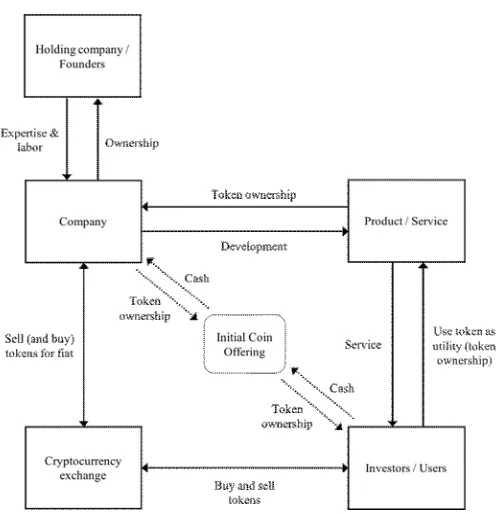
133
the founders’ social capital (Florin et al., 2003; Stuart et al., 1999). Hsu (2007) shows that the effect of
134
human capital on VC valuations positively depends on the novelty of an industry. This result is
135
particularly relevant to our context, blockchain technology, which is also an emerging technology at
136
the moment, much like the internet was in the 1990s and 2000s (Iansiti & Lakhani, 2017). Ahlers et al.
137
(2015) show that human capital is an important factor for the investment decision of small investors
138
in crowdfunding campaigns. Overall, in line with existing research, we posit that a team’s human
139
capital endowment will be positively related to the funds raised during an ICO.
140
Quality of the business model. A business model connects an idea or technology with its
141
potential revenue stream. As methods to define a business model, Chesbrough (2010) suggests the
142
profit potential, value network and competitive strategy. Zott et al. (2011) show that the literature
144
provides no general and consistent definition of a business model and thus also of its quality.
145
Various determinants of the quality of business models can be identified across the literature, such
146
as the presence of information and communication technologies in the e-commerce literature
147
(Timmers, 1989; Dubosson-Torbay et al., 2002), value drivers (Amit & Zott, 2001), actual choices by
148
the project (Shafer et al., 2005; Casadeus-Masanell & Ricard, 2010), regulatory pressure (Tankhiwale,
149
2009) and discovery-driven experimentation in the strategic literature (McGrath, 2010). Technology
150
itself (Chestbrough & Rosenbloom, 2002) and technological development and innovation (Calia et
151
al., 2007; Björkdahl, 2009) are identified as determinants of quality in the technology and innovation
152
management literature (Zott et al., 2011). Hellmann and Puri (2000) suggest that companies with
153
innovative marketing strategies are more likely to be funded by VC as their products will penetrate
154
the market more quickly. As a successful business model unlocks the realization of economic value
155
from a technical basis (Chesbrough & Rosenbloom, 2002), we expect that its quality will be positively
156
related to the funds raised during an ICO.
157
Project elaboration (whitepaper). We suggest that the availability and quality of a whitepaper,
158
which elaborates on the business project for the information of potential investors, will have a
159
positive impact on the amount of funds that a project is able to raise. A whitepaper for ICOs, which
160
52% of the companies in our sample provide, can be compared to the business plan or pitch of
161
traditional projects, as it usually contains all the information that may be relevant for investors.
162
Barrow et al. (2001) describe the business plan as the potentially most relevant aspect for the
163
successful creation of a business. Business plans, or the whitepaper of an ICO, represent the first
164
detailed information that a funding team shares with its investors (Shepherd and Douglas, 1999).
165
Cumming et al. (2017) show that fraudulent crowdfunding projects, a recurring phenomenon, are
166
often characterized by badly drafted pitches. Findings by Ahlers et al. (2015) suggest that the
167
provision of detailed information about risks can increase the likelihood of a successful
168
crowdfunding campaign. Du et al. (2015) show that crowdfunding success can be explained by the
169
amount of information that is disclosed in project descriptions. Chen, Yao & Kotha (2009) investigate
170
to what extent entrepreneurial passion influences VC investment decisions. The authors find that
171
funding success is driven not by the founders’ passion but by their level of preparedness. This
172
suggests that ICO project with very detailed whitepapers will be more successful. We therefore posit
173
a positive relationship between project elaboration and funds raised.
174
Social media. Based on existing research in crowdfunding and venture capital, we posit that
175
social media activity as proxied by the number of followers and the number of postings will
176
positively influence funds raised at ICOs. At least two transmission mechanisms for this expected
177
effect come to mind (Jin et al., 2017; Yang & Berger, 2017): First, social media activity may serve as a
178
marketing channel for announcing ICOs and distributing information about the underlying new
179
tokens. Thus, in line with the “salience view” (Solomon et al., 2012), increased social media activity
180
will lead to increased salience of an ICO, directing potential investors to the upcoming investment
181
opportunity (Sprenger et al., 2014). Second, social media activity may also serve as a positive signal
182
of endorsement from others and act as a mechanism to grow a (social) network and future user base
183
(Lechner et al., 2004; Witt, 2004). According to this view, ICO projects with more followers on social
184
media will raise more funds because the positive signal to investors indicates higher levels of social
185
network resources. Indeed, recent research has shown that the amount of funds raised by startups is
186
associated both with the number of social messages and with the number of followers. For instance,
187
Jin et al. (2017) show that Twitter influence (a composite score consisting of the number of followers,
188
mentions, impressions and sentiment on Twitter) is positively related to the funds raised by
189
early-stage startups. Moreover, they find a quadratic relationship between the number of Twitter
190
posts and funds raised, such that more posts initially increase funding while too many posts harm
191
the outcome. In a similar vein, Yang and Berger (2017) have recently shown a positive relationship
192
between the number of followers and the amount of startup funding. Likewise, Nevin et al. (2017)
193
show that the number of social media posts has a positive effect on funds raised through
194
less likely to use social media channels. Colombo et al. (2015) suggest that communication between a
196
project and its potential backers has a positive influence on the success of the campaign. Overall,
197
based on this evidence in the context of startup funding, we expect a positive relationship between
198
social media activity and funds raised at ICOs.
199
2.2. Hypotheses
200
Our general hypothesis is that ICO participants invest rationally based on fundamental value
201
expectations. We break this general hypothesis down into four hypotheses that can be tested
202
empirically. Each hypothesis is based on findings from the traditional VC funding and
203
crowdfunding literature, which we discussed above, and which we expect to confirm with respect to
204
ICO funding if investor decisions are driven by fundamental value expectations.
205
Hypothesis 1: There is a positive relationship between the amount of funds raised and the
206
company’s human capital characteristics, which we operationalize as (a) team size, (b) team network
207
size, and (c) the number of advisors.
208
Hypothesis 2: There is a positive relationship between the amount of funds raised and business
209
model quality, which we operationalize as a score variable determined by an industry expert for
210
each project for the respective form of the projects token-based business model (infrastructure,
211
financial, or utility model).
212
Hypothesis 3: There is a positive relationship between the amount of funds raised and project
213
elaboration, which we operationalize as (a) whitepaper availability and (b) a whitepaper score based
214
on a whitepaper’s number of pages and citations.
215
Hypothesis 4: There is a positive relationship between the amount of funds raised and social
216
media presence, which we operationalize as a score based on the number of Twitter messages and
217
the number of Twitter followers, as Twitter is the most widely used social media channel across the
218
projects covered by our sample. Activity levels on Facebook, Reddit and Bitcointalk are used as
219
control variables.
220
2.3. Blockchain Technology
221
Blockchain represents an emerging technology that is among the most promising and
222
potentially most disruptive technologies in the future. It was first introduced in October 2008 by an
223
unknown person or entity using the name Satoshi Nakamoto, who presented it as part of the
224
proposal for Bitcoin, its first suggested application (Nakamoto, 2008).
225
A blockchain is a distributed register to store static records and/or dynamic transaction data
226
without central coordination by using a consensus-based mechanism to check the validity of
227
transactions. In simple words, it is a database in which transactions are recorded and which is
228
simultaneously shared among all parties in a participating network. Data is stored in fixed
229
structures, “blocks”, which are always linked to the latest block that has been added to the database.
230
As all blocks are linked together in a chain, the entire history of transactions can be accessed and
231
retraced. The verification of each transaction results from the consensus of the majority of
232
participants in the network, without the involvement of any intermediary. In the Bitcoin world for
233
example, transactions are validated by so-called miners, which are network members with
234
high-level computing power. In order to validate transaction blocks, complex coded problems must
235
be solved. The miners’ efforts are then rewarded with Bitcoins (Nakamoto, 2008).
236
The main goal of the technology is to create a decentralized environment where no third party
237
is in control of the transactions and data. Simultaneously, it allows for transaction platforms that are
238
highly secure, cheap, fast, and less prone to error. This innovation will change not only the
239
interaction between individuals and organizations but also B2B collaboration, raising the overall
240
productivity of the economy. The potential benefits of blockchain are not restricted to economic
241
matters but extend to offering solutions to social, political, legal and health issues (Lin & Koo, 2016;
242
Scott, 2016; Osgood, 2016; De Philippi & Hassan, 2017).
243
While blockchain is much acclaimed for its potential to deliver solutions to a wide range of
244
One of the most significant risks arises from future government regulation, a factor that is crucial to
246
the success of the blockchain industry. We may expect the new technology to be much more heavily
247
monitored and regulated in the future, and these new regulations may either facilitate or slow down
248
the adoption process. Furthermore, several technical challenges and limitations have been identified
249
and must eventually be addressed (Puthal et al., 2018; Joshi et al., 2018). Among them are the limited
250
throughput, the time required to complete a transaction and high data volumes. Moreover, users
251
worry about a number of security threats. Especially in financial contexts there is concern about
252
hackers, identity theft and money laundering (Ante, 2018). All in all, the technology is still evolving
253
and maturing. As ever more individuals and organizations are investigating and experimenting
254
with it, new recommendations on how to solve the current issues are made each day.
255
2.3. Blockchain-based startup financing
256
An increasing number of startups in the blockchain ecosystem use ICOs to raise early-stage
257
financing. Instead of going for initial public offerings (IPOs), which are expensive and highly
258
regulated, startups often issue a blockchain-based token and distribute it across investors in
259
proportion to their respective investment. So far, ICOs are regulated only very lightly, if at all. This
260
allows for fast processes and low operational cost.
261
262
263
Figure 1. Token-based economy and initial coin offering (ICO)
264
In order to conduct an ICO, a token-based economy must be generated in which the blockchain
265
token has some form of value for investors. Figure 1 provides an example of a token-based economy
266
and the initial distribution of tokens. A company builds a product or a service around a token. The
267
token is used as a project-specific currency, some form of utility (utility token) or a security (security
268
token) that can provide some form of profit participation to investors. Utility tokens are the most
269
widely used token structure for ICOs. They possess some form of utility to token holders, like a
270
software license, which enables startups to bypass security regulations for their token sale. Security
271
token sales are less common, as they entail much higher legal costs and preparation and most
272
cryptocurrency exchanges do not hold the relevant licenses to trade securities, while regulated stock
273
exchanges cannot accommodate tokens yet. This paper focuses on utility tokens, as our sample
274
mainly consists of utility tokens. In order to access the product or service of the ICO project, users
275
will need to possess the specific token. The project simply generates the tokens and offers them to
276
allow startups to obtain finance while retaining full ownership of the company. ICOs are usually
278
carried out at a very early stage of the development process. Investors expect the tokens to increase
279
in value as they speculate that demand for the tokens will increase given the fixed or limited supply.
280
With the introduction of Ethereum and smart contracts, decentralized computer protocol can
281
automatically be executed upon predefined terms. This enables crowdsale-specific smart contracts
282
that are deployed on the blockchain and contain all crowdfunding details in the form of computer
283
protocol. Newly created tokens on the Ethereum blockchain are automatically distributed to
284
investors upon the successful deposit of funds (in the form of cryptocurrency), and once the
285
crowdfunding goal is reached, all additional payments are automatically returned. Blockchain
286
technology enables various technological innovations in the field of crowdfunding, as the
287
decentralized architecture in combination with low transaction fees permits individuals from
288
anywhere to participate in an ICO with as small an amount as they desire.
289
3. Data and methodology
290
3.1. Data sources
291
To identify blockchain-based crowdfunding projects, an explorative analysis of the ecosystem
292
was conducted. The online forum Bitcointalk2 serves as a platform to announce new projects and to
293
communicate with potential investors. Project details like crowdfunding date, team information,
294
amount of funding or token distribution were sourced from Bitcointalk, where available, or the
295
official web presence of each project. To this day, there is no comprehensive knowledge base that
296
lists information on all ICOs, so most information had to be retrieved manually. Social media
297
statistics such as likes, followers or subscribers for the platforms Twitter, Facebook and Reddit were
298
imported directly from the application programming interfaces (APIs) of each social media website.
299
Our dataset consists of 278 projects that finished their ICO between July 2013 and August 2017.
300
The sample comprises all ICOs during that period for which we were able to collect information on
301
all the variables. Due to a lack of transparency and public data, a number of ICOs had to be omitted
302
from the sample.
303
3.2. Operationalization of the variables
304
Dependent variable. This paper relies on the amount of funds raised (in USD) as the dependent
305
variable, i.e. as our measure of ICO success. Since the variable is highly skewed, in the regressions
306
we use the natural logarithm, in line with existing research (Alexy et al., 2012; Sandner & Block,
307
2011). As projects that finance themselves via an ICO are usually funded in the form of
308
cryptocurrency, the actual fiat value of the funding depends on the exact point in time at which the
309
prices of the cryptocurrencies, which fluctuate strongly (Yermack, 2013), are determined. For
310
comparability, we calculate the fiat equivalent that applied at the time when the crowdfunding
311
process closed.3
312
Independent variables. Team size signifies the number of team members listed on the official
313
website of each project. Team network represents the adjusted LinkedIn network reach of the team.
314
We calculate the average LinkedIn network of all team members in relation to the number of team
315
members who actually have a LinkedIn account. Advisors means the number of project advisors who
316
are listed on the project website.
317
We use three different score variables (business model: infrastructure, business model: financial and
318
business model: utility) to assess the quality of the business model of each project. For this purpose, we
319
2 https://bitcointalk.org
3 The example of the project Digix Global illustrates the effects of cryptocurrency price fluctuations. The project raised
had an expert evaluate each project. The expert assigned a score of zero, one or two for the three
320
business model categories for each project. More specifically, the expert was asked to rate the quality
321
of the projects’ tokenized business model with regard to the (1) creation of infrastructure, like
322
protocols that other projects can build on or networks where users can interact with each other, (2)
323
the financial value that a tokenized business model unlocks, like a payment token or
324
cryptocurrency-backed debit card system, and (3) the utility of the underlying token model. Utility
325
represents the overall value that a token brings to a service, an ecosystem or a network.
326
Whitepaper: exists is a dummy variable that indicates the availability of a whitepaper for each
327
project. There is no business standard for the actual contents of a whitepaper, which is why the
328
overall quality can vary greatly. The use of whitepapers in the ICO ecosystem is based on the fact
329
that Bitcoin was introduced in a whitepaper and very successful ICO projects, like Ethereum, also
330
issued whitepapers (Nakamoto, 2008; Buterin, 2014, Wood, 2014). The variable Whitepaper: score, our
331
proxy of whitepaper quality, equals the sum of the number of pages and citations in the document.
332
Twitter score summarizes the level of activity of a project’s Twitter account as the sum of the
333
number of tweets and the number of followers of the project divided by 1000.
334
Control variables. The variable ICO duration represents the number of days between the start
335
and the end of the ICO. Mollick (2013) shows that the duration of a crowdfunding campaign can
336
have a negative effect, as longer duration could be due to a lack of market confidence.
337
We assigned each project to one of six industry dummy variables: Financial (financial sector),
338
Blocknet (blockchain network / infrastructure project), Media (media and communications sector),
339
Gambling (gambling and casino projects), Gaming (gaming projects) and Cloud computing (cloud
340
computing and cloud storage projects).
341
Team dispersion captures the number of different home countries represented among the team.
342
This way, we can access the effects of centralized processes in project decisions (Mollick, 2013) and
343
the decentralized collaboration approach favored by open-source software projects (Belleflamme et
344
al., 2013).
345
The Facebook score is calculated as the number of likes of the project’s Facebook page divided by
346
1000. Reddit is an online forum where projects can start sub forums to discuss and rate articles and
347
posts. ICO projects usually have their own Reddit page to interact with their community. The
348
variable Reddit score consists of the number of subscribers to a project’s subpage divided by 1000.
349
Bitcointalk is a forum for projects related to cryptocurrencies where most ICO projects have an
350
announcement thread. The Bitcointalk score is calculated as the number of total reads and the average
351
number of posts per day of the full project’s sub forum divided by 1000.
352
4. Results
353
4.1. Descriptive statistics
354
To show the evolution of ICOs and ICO funding, the projects were classified in quarters based
355
on the end date of their ICO (see figure 2). As the last ICO recorded ended on August 3rd, 2017, the
356
numbers for the third quarter of that year were extrapolated linearly from the first 33 days of the
357
quarter. The data exhibit a strong upward trend, driven especially by the 2017 ICOs. This trend
358
holds both for the number of ICOs and the average amount raised. Before 2017, the funding amount
359
was dominated by a few large projects, especially The DAO in Q2/2016. We thus see evidence of
360
skewness, as also indicated by the large discrepancy between the average ($6.5 million) and median
361
($0.4 million) amount raised per ICO and the large standard deviation of $23.6 million. A GINI
362
coefficient of 86.7% also suggests that the distribution is strongly concentrated. We respond to this
363
skewness by using the log of funds as our dependent variable (Manning & Mullahy, 2001).
364
366
Figure 2. Number of ICOs and ICO funding in million US-dollars over time. Q3* 2017 has been
367
interpolated for the remaining part of the quarter.
368
In terms of industries, most of the projects in our dataset can be assigned to the financial sector
369
(43.5%), followed by blockchain network and infrastructure projects (13.6%), media and
370
communications (12.5%), gambling (5%) and gaming (4.3%). The classification by industries was
371
conducted manually and is clearly open to debate as many projects could be allocated to multiple
372
sectors. For example, gaming and gambling often overlap, and the sector of cloud computing and
373
storage (2.9%) is not much different from blockchain network or infrastructure projects.
374
Table 1 provides an overview of the descriptive statistics. The mean amount of funds raised was
375
$6.5 million, with a minimum of $25 and a maximum of about $228 million. The biggest project team
376
had 46 members, while the average across all projects was 3.91. Team members possessed just below
377
100 LinkedIn contacts on average, while keeping in mind that 500 contacts is the maximal publicly
378
shown amount. The average ICO duration was 26 days and the longest ICO took 906 days to
379
complete. We were able to obtain whitepapers for 52 percent of all projects.
380
Table 1. Descriptive statistics
382
Variables Obs. Mean Std. Dev. Median Min. Max.
Funds raised 278 6,515,099 2.32e+07 436,316 25 2.28e+08
Log(Funds raised) 278 5.471 1.315 5.64 1.4 8.36
Team size 278 3.910 6.141 0 0 46
Team network 278 97.477 147.021 0 0 500
Advisors 278 1.162 2.804 0 0 17
Business model: infrastructure
278 0.662 0.779 0 0 2
Business model: financial 278 0.644 0.69 1 0 2
Business model: utility
278 0.651 0.72 1 0 2
ICO duration 276 26.070 62.817 15 0 906
Log(ICO duration) 1 276 0.996 0.647 0 2.957
Whitepaper: score 278 13.230 17.601 2.5 0 131
Whitepaper: exists 277 0.520 0.501 1 0 1
Twitter score 278 4.750 9.714 2.025 0 115.21
Facebook score 278 3.332 13.755 0 0 143.213
Reddit Score 278 1.211 8.062 0.002 0 98.033
Bitcointalk Score 278 117.681 266.287 25.85 0 2379.9
Financial 278 0.414 0.493 0 0 1
Blocknet 278 0.133 0.340 0 0 1
Media 278 0.112 0.315 0 0 1
Gambling 278 0.054 0.226 0 0 1
Gaming 278 0.054 0.226 0 0 1
Cloud Computing 278 0.216 0.146 0 0 1
Team dispersion 278 1.040 1.628 0 0 9
1 If ICO duration > 0, then log(ICO duration), else 0.
383
4.2. Multivariate results
384
The multivariate results are based on four models, which we estimate by OLS. The results are
385
reported in Table 2. In models 1 and 2 we added the variable ICO duration as control variable to all
386
independent variables to observe any effects of the length of the campaigns, while in model 2 we
387
additionally added the six industry dummies to control for any influence of business sectors. In
388
model 3, we add the variable log(ICO duration) to account for any heteroscedasticity, as there is
389
substantial variation in ICO duration. The social media control variables are introduced in model 4,
390
as is team dispersion to check for any effects of the degree of business centralization. Models 1 and 3
391
have F values of 39.48 and 39.01 and adjusted R² values of 0.5857 and 0.5831, respectively, suggesting
392
a reasonable fit. The fourth model has a lesser fit, at F = 30.79 and adjusted R² = 0.5854. The second
393
model has the highest adjusted R² (0.6021) and, being based on the largest number of different
394
variables, the lowest F value (26.8).
395
In models 1, 3 and 4 we find a significant but small positive influence of team size, while all four
396
models predict a highly significant but small positive influence of the team network and a highly
397
significant positive influence of the number of advisors on the funds raised. The existence of the
398
whitepaper has a highly significant positive impact across all models, while for whitepaper: score we
399
find a positive but insignificant coefficient.
400
Regarding the quality of the business idea we find highly significant positive results for
401
Business model: financial in all fours models. For Business model: utility we find positive results that
402
also find a marginally significant positive effect of ICO duration in model 1. Interestingly, the social
404
media have no significant impact, with the coefficient signs being variously positive (Twitter and
405
Facebook) and negative (Bitcointalk and Reddit). We find a negative impact of Team dispersion in
406
model 4. Regarding the industry dummies in model 4, the only significant result is a strongly
407
negative one for financial projects.
408
409
Table 2. Results of OLS regression models
410
Variables Model 1 Model 2 Model 3 Model 4
Team size 0.019*
(0.075)
0.016
(0.123)
0.018*
(0.089)
0.032***
(0.009)
Team network 0.009**
(0.047)
0.001***
(0.008)
0.001*
(0.045)
0.001**
(0.014)
Advisors 0.061***
(0.007)
0.061***
(0.008)
0.063***
(0.006)
0.055**
(0.016)
Business model: infrastructure 0.043 (0.614)
-0.034
(0.696)
0.048
(0.573)
0.093
(0.288)
Business model:
financial
0.358***
(0.000)
0.395***
(0.000)
0.364***
(0.000)
0.391***
(0.000)
Business model:
utility
0.265***
(0.005)
0.178*
(0.065)
0.252***
(0.008)
0.266***
(0.005)
Whitepaper: score 0.005
(0.291)
0.004
(0.321)
0.005
(0.279)
0.004
(0.367)
Whitepaper: exists 0.806***
(0.000)
0.811***
(0.000)
0.783***
(0.000)
0.829***
(0.000)
Twitter score 0.008
(0.169)
0.005
(0.410)
0.008
(0.200)
0.011
(0.148)
Bitcointalk score -0.000
(0.446)
Facebook score 0.001
(0.776)
Reddit score -0.001
(0.850)
ICO duration 0.001*
(0.083)
0.001
(0.208)
Log(ICO duration) 0.093
(0.274)
Team dispersion -0.105**
(0.039)
Blocknet 0.046
(0.801)
Financial -0.462***
(0.000)
Media -0.275
Gambling -0.097 (0.696)
Gaming 0.041
(0.869)
Cloud computing 0.455
(0.227)
F 39.48 26.8 39.01 30.79
Adj. R² 0.5857 0.6021 0.5831 0.5854
1 If ICO duration > 0, then log(ICO duration), else 0.
411
5. Discussion
412
5.1. Implications for theory
413
The exponential growth in ICO funding may be due to the “free money effect” or “house
414
money effect” (Thaler & Johnson, 1990). Early investors in Bitcoin or Ethereum reaped very large
415
gains of many thousand percent (depending on their entry, of course) that allowed them to invest
416
large sums into ICOs. According to Zelizer’s (1994) Social Meaning of Money theory, money is
417
treated differently depending on its context. This would imply that money won by investing in
418
cryptocurrencies is not seen as neutral but as tied to the same market. Compared to money gained in
419
other markets, early cryptocurrency winners are more likely to invest large sums in ICOs. Another
420
reason might reinforce this house money effect: Compared to gambling, early cryptocurrency
421
investors might not perceive their gains as pure luck but rather as the fruits of investing in a
422
technological breakthrough. As early supporters, they are likely to reuse their funds to foster this
423
technology. The analysis has shown that most funds are raised in a few very large ICOs that appear
424
to attract most investor interest.
425
The results of the multivariate analysis support some of our hypotheses. Especially H1, the
426
conjectured positive relationship between human capital and funds raised, is supported by all four
427
models in the form of significant positive effects of team size, team network size and the number of
428
advisors. This confirms our hypothesis that a larger network and thus greater human capital
429
supports ICO success, in line with the corresponding literature on venture capital (Florin et al., 2003;
430
Stuart et al., 1999), crowdfunding (Ahlers et al., 2015) and ICOs (Fisch, 2018).
431
We also found support for H2 regarding the quality of a project in all four models, as there are
432
significant correlations between funds raised on the business model in regards to financial and
433
utility aspects. This finding suggests that investors at least to some extent rationally pick those ICOs
434
which signal strong quality, rather than blindly distributing their funds across the available ICOs.
435
This finding is in line with existing research on ICOs (Fisch, 2018; Amsden & Schweizer, 2018).
436
Interestingly, we did not find significant results for the third variable, infrastructure. We suggest
437
that investors may possess some form of knowledge to evaluate the quality of a business model.
438
Furthermore, we found a strong influence of whitepaper existence and thus some support for
439
H3 of a positive relationship between project elaboration and funds raised. Yet, no significant effect
440
was found for the whitepaper score. This suggests that what ICO investors value is not so much a
441
convincing (technical) whitepaper but rather the quality of the business model in general. This could
442
be a sign that investors expect a whitepaper to be available but do not actually read it. Our research
443
confirms that the actual level of preparedness in form of a well-structured business plan promotes
444
ICO success, as shown by Chen, Yao & Kotha (2009) for VC investment decisions.
445
Our hypothesis H4, a positive relationship between social media presence and funds raised,
446
failed to find any significant support across all social media variables. Twitter has a very small
447
positive impact in all four models, as does Facebook when included in model 4. Both Bitcointalk and
448
Reddit yield insignificant and negative results. There are two reasons why a negative sign on these
449
illegitimacy or fraud, a lot of additional posts are generated, resulting in a high score; (2) projects
451
that occurred towards the start of our sample period tend to raise less capital (by virtue of the
452
growth trend we found) but have had more time to accumulate posts and thus have a higher score.4
453
If for these reasons we disregard Bitcointalk and Reddit and thus only interpret as a proxy for social
454
media attention the Twitter score, as it only comprises followers and project tweets but not
455
community posts, our result confirms the finding from the venture capital and crowdfunding
456
literature that social media presence has a positive impact on financing campaigns. The finding
457
furthermore suggests that entrepreneurs looking for funding via an ICO should devote attention to
458
the social media (Solomon et al., 2012; Sprenger et al., 2014).
459
In general, we show that investor behavior in ICOs shows similarities to the VC and
460
crowdfunding markets. This suggests that ICOs may need to be integrated into the research on
461
corporate finance. Our research adds to the literature of signaling theory by showing that ICO
462
startups use certain types of information, like human capital characteristics, business model quality
463
and project elaboration, to signal their quality to campaign contributors.
464
5.2. Implications for practice
465
The blockchain technology is said to hold massive disruptive power for various industries and
466
to entail groundbreaking changes to numerous aspects of our lives. Startup funding is clearly among
467
the affected fields. If the relevant players including VC funds, startups and business angels are
468
aware of the technology’s disruptive potential and learn to harness it to improve current processes
469
or to develop new business models, it can be a highly valuable tool for raising funds.
470
Furthermore, blockchain can potentially change the way in which businesses are managed and
471
organized. Yet, before concrete action can be taken companies need to familiarize themselves with
472
the challenges and risks of the technology. In the financial industry, a broad utilization of blockchain
473
is expected in no more than three to five years, so other industries need to start preparing for it.
474
The fact that companies are able to raise money without the need to offer any form of equity,
475
voting rights or profit participation in return could herald a new era of corporate financing. If ICO
476
funding keeps growing, traditional methods of corporate finance may have to adapt in some form.
477
Several aspects of the ICO market suggest that a bubble is emerging. Blockchain-based ICOs
478
and their underlying decentralized approach represent an innovative technology, and innovation
479
lay at the root of the financial bubbles in new economy stocks (Pastor & Veronesi, 2009), the
480
Mississippi Bubble, the South Sea Bubble and the Dutch Windhandel (Frehen et al., 2013). Pastor and
481
Veronesi (2006) show that stock prices in innovative industries grow irrationally high and predict
482
that their price falls once the uncertainty about the technology is resolved. The market for ICOs does
483
fit clientele models as it features both arbitrageurs (informed investors) and noise traders
484
(uninformed investors) (Frehen et al., 2013). Very high returns and rapid market growth constitute
485
additional evidence of a price bubble emerging, which asset managers need to account for in their
486
risk analysis (Lee & Phillips, 2016).
487
5.3. Limitations
488
Regardless of the strengths of our study (e.g. the comprehensive data set of a wide range of
489
ICOs starting from the very beginning in 2013), the following limitations should be mentioned. First,
490
the ICO tokens issued by various projects represent very different things (Conley, 2017). For
491
instance, there are donation tokens, utility tokens (for different sorts of services and products),
492
dividend tokens, and equity tokens. Moreover, a token can also provide two sorts of benefits at the
493
same time. This variation may have unobserved effects on the amount of funds raised. We therefore
494
encourage future studies to explicitly control for token characteristics and to compare the
495
investment consequences of different kinds of tokens.
496
4
Instead, the number of posts until the end of the ICO phase should have been used to determine the social media scores. Yet
Second, the regulatory situation and legal status of the ICOs in our sample varied across
497
countries and across time, potentially leading to uncontrolled effects on our observations. ICOs are
498
such a novel phenomenon that there was and still is great regulatory uncertainty in many countries,
499
allowing projects to sell tokens for large sums to investors without conducting
500
Know-Your-Customer (KYC) procedures (Ante, 2018). In 2017, the U.S. Securities and Exchange
501
Commission (SEC) stated that the tokens sold in an ICO by the project The DAO (Jentzsch, 2016)
502
were indeed securities whose issuance in a crowdfunding campaign would have required a
503
prospectus (SEC, 2017a). The SEC additionally issued an investor bulletin that provides potential
504
ICO investors with numerous warnings of investment fraud and a list of challenges that law
505
enforcement face when investigating ICOs, including difficulties in tracing money flows, the
506
international scope, the lack of central authority and the risks and obstacles of freezing or securing
507
virtual currency (SEC, 2017b). On December 11th, 2017, the SEC issued a cease-and-desist order to
508
the Delaware-based company Munchee Inc. that offered securities in their token sale, forcing the
509
company to refund all investments and to abort its campaign. Munchee promised that the value of
510
the MUN token would increase because of the company’s work and that tokens would be traded on
511
secondary markets. The token did not involve any profit participation mechanisms such as buybacks
512
or dividends (SEC, 2017c). In other countries, ICO tokens may also represent securities or can
513
alternatively also be considered currencies with or without securities characteristics (e.g. Germany).
514
This unclear status may also have had an unobserved effect on our results. However, there is no
515
reason to assume a systematic effect, so the results are unlikely to be biased.
516
As a mostly unregulated ecosystem, the ICO market is only beginning to mature. The first ICOs
517
were carried out without incorporation or legal protection, which is why only limited information
518
on these projects is available. Our dataset is likely missing a number of failed and abandoned ICO
519
projects, so there is some selection bias in favor of successful projects. It is unclear whether and to
520
what extent our results are influenced by this fact. As the market continues to grow rapidly, the
521
relevant information is becoming much more accessible, so future research along these lines should
522
not face the same problem.
523
Presales of tokens are a standard process used by many projects. Various different approaches
524
such as multi-stage presales and undisclosed presales are used, which further reduces transparency
525
in the market. More and more funds and venture capitalists are entering the ICO market and try to
526
gain access to presale deals. Up until 2017, ICOs usually employed time-based bonus systems to
527
incentivize investors to invest early, a practice that has now been replaced by presales. Our variable
528
funds raised equals the sum of presale and main sale funding. Yet, we may not have captured all
529
presale funding for some projects. As a limitation, we cannot observe whether presale success had
530
any effect on the amount of funding raised in the ICO.
531
Some projects set minimum and maximum funding caps, while others try to raise as much
532
capital as possible. Our study defined ICO success as the amount of capital that a project was able to
533
raise, yet numerous projects met their funding targets in less than a day, so very likely they could
534
have raised more capital. In these cases, our dependent variable may not adequately capture the true
535
funding potential of a project or, in other words, the cap prevented our explanatory variables from
536
taking full effect. For our dataset, we were unable to identify enough funding caps across all projects
537
due to a lack of transparent data for historic campaigns. By implementing funding caps, the actual
538
success of a project could potentially be defined clearer. Still, most projects implement funding goals
539
today, so their effects can be tested in future studies.
540
We have identified a small positive impact of the variable whitepaper score on funding success,
541
while the existence of a whitepaper had a strong effect. Agrawal et al. (2015) show that
542
crowdfunding campaigns tend to be more successful if a unique product or service can be easily
543
explained. Therefore, whitepaper complexity could also impede funding success. Future research
544
should therefore additionally control for the availability of a less complex version of the whitepaper,
545
like a pitch deck.
546
Our model 4 yielded a negative connection between the funds raised and the geographical
547
the ICO ecosystem. Yet, the effect we found may really be driven by the existence of a collocated or
549
virtual team (Powell at al., 2006) or by cultural differences (Burtch et al., 2013). To check for the
550
second possibility, we conducted alternative calculations using geographical data, such as
551
classifying projects according to cultural dimensions theory (Hofstede, 1984) or evaluating whether
552
the presence of a team member from China or eastern countries, like Russia, had any impact on ICO
553
success. No significant results were found. We therefore encourage future research to look into this
554
issue as the data quality continues to improve rapidly.
555
6. Conclusion
556
This study of the ICO phenomenon adds to existing research by evaluating how this new
557
ecosystem compares to existing processes in VC and crowdfunding financing. We investigate this
558
question from the perspective of the startups that are looking to raise money for their venture. Our
559
findings suggest that the ICO market indeed exhibits close similarities to the classical markets of VC
560
and crowdfunding: ICO success as measured by the amount of capital raised is positively related to
561
human capital characteristics, business model quality, project elaboration, and social media
562
presence. ICO contributors seem to invest rationally based on publicly available data. Yet, our
563
findings regarding the relevance that investors assign to project elaboration and social media
564
presence are to some extent inconclusive and require further research. The market for ICO is still
565
underregulated and intransparent, with large information asymmetries between startups,
566
contributors and society. ICO success is subject to the same causalities and signals as classic VC and
567
crowdfunding financing. We thus conclude that though ICOs are a new way of financing startups,
568
they do constitute a new form of crowdfunding financing that will technically and legally move
569
closer to traditional mechanisms as markets mature and regulators step in. It still remains to be seen
570
to what extent the other markets will adapt towards the ICO market. By 2018, over $15 billion has
571
been raised in ICOs, so unless regulation puts a stop to it, the phenomenon is here to stay.
572
Our study adds to research in the field of ICOs as a novel form of fundraising for startups and
573
paves the way for future research in this growing but as yet under-researched area. Several
574
questions warrant further research. First, longitudinal research is needed to examine ICOs over time
575
and track their long-term development. A panel data set could yield more fine-grained insights into
576
how the predictors influence ICO success and into the mechanisms behind each of the variables.
577
Such research could also reveal the dynamics for certain variables, such as the influence of social
578
media, advisors or team composition. For instance, it can be assumed that social media may create a
579
hype around certain ICOs. Longitudinal analyses of social media sentiment and funds raised over
580
time could uncover the dynamics underlying the influence of social media. Future research should
581
comprise time-series data on the social media channels of ICO projects to detect information
582
cascades, under- or overpricing and announcement effects.
583
Second, while our study has been conducted from a startup’s perspective, looking at the
584
determinants of the amount of funds raised, future research may investigate ICOs from an investor’s
585
perspective and focus on variables such as returns, dividends, and market capitalization. For
586
instance, our knowledge of investor strategies and the associated outcomes is very limited. In this
587
regard, it would be interesting to investigate how investors allocate their funds in terms of, for
588
example, industries, geography, and diversification, and what returns these strategies yield.
589
Third, we see a need to examine ICOs from a regulator’s and a legal perspective, and the status
590
of ICOs in society more generally. For instance, since tokens have different characteristics in
591
different countries (being treated for example as securities, as a currency etc.), comparative research
592
on the impact of such differential treatment is needed.
593
Fourth, given the amount of money at stake, we need to know how this form of funding can be
594
institutionalized in a way that benefits society as a whole. We hope that our study will spark interest
595
in these and related questions and trust that future research will address many of the as yet
596
unresolved puzzles in the emerging token economy.