©
DOI: 10.1534/genetics.104.037473
Mitochondrial Translation: Elongation Factor Tu Is Essential in Fission
Yeast and Depends on an Exchange Factor Conserved in Humans
but Not in Budding Yeast
Ste´phane Chiron, Audrey Suleau
1and Nathalie Bonnefoy
2Centre de Ge´ne´tique Mole´culaire du CNRS, 91198 Gif-sur-Yvette, France
Manuscript received October 20, 2004 Accepted for publication January 4, 2005
ABSTRACT
The translation elongation factor EF-Tu is a GTPase that delivers amino-acylated tRNAs to the ribosome during the elongation step of translation. EF-Tu/GDP is recycled by the guanine nucleotide exchange factor EF-Ts. Whereas EF-Ts is lacking in S. cerevisiae, both translation factors are found in S. pombe
andH. sapiensmitochondria, consistent with the known similarity between fission yeast and human cell mitochondrial physiology. We constructed yeast mutants lacking these elongation factors. We show that mitochondrial translation is vital forS. pombe, as it is for human cells. In a genetic background allowing the loss of mitochondrial functions, a block in mitochondrial translation inS. pombe leads to a major depletion of mtDNA. The relationships between EF-Ts and EF-Tu from both yeasts and humans were investigated through functional complementation and coexpression experiments and by a search for suppressors of the absence of theS. pombeEF-Ts. We find thatS. cerevisiaeEF-Tu is functionally equivalent to theS. pombeEF-Tu/EF-Ts couple. Point mutations in theS. pombeEF-Tu can render it independent of its exchange factor, thereby mimicking the situation inS. cerevisiae.
M
ITOCHONDRIA are organelles specialized in the translocation step after peptide bond formation and the production of energy via the respiratory is also involved in ribosome recycling, but is indepen-chain, which is a series of enzymatic complexes of dual dent of an exchange factor. The budding yeast Saccharo-origin. Several of these complexes contain, in addition myces cerevisiaehas EF-Tu and EF-G orthologs (Nagata to nuclear-encoded subunits, a few subunits encoded et al. 1983; Vambutas et al. 1991), but an equivalent by the mitochondrial genome (mtDNA). The mtDNA of EF-Ts does not appear to be present, either as a also encodes all the RNAs (rRNAs and tRNAs), but at biochemical activity (RosenthalandBodley1987) or most only one protein component of the mitochondrial as a homologous gene product. In Schizosaccharomyces translation machinery. Consequently, most of the ribo- pombe, the genome sequence predicts that all three fac-somal proteins, factors involved in ribosome assembly, tors are present.tRNA synthetases, and general or specific translation The fission yeast S. pombeis strikingly different from factors mediating the initiation, elongation, and termi- the budding yeast S. cerevisiae, and in many respects nation steps of mitochondrial translation are encoded mimics human cells more closely thanS. cerevisiaedoes in the nucleus, synthesized in the cytoplasm, and im- (Zhao and Lieberman 1995; Forsburg 1999). This ported into mitochondria. seems to be the case for various aspects of mitochondrial The elongation step of mitochondrial translation, physiology. Mitochondrial distribution depends on mi-best documented in mammals, closely mimics the pro- crotubules in S. pombe, as in animal cells (Weir and karyotic system (see Spremulli et al. 2004). Like its Yaffe2004). Also,S. pombeis highly dependent on respi-prokaryotic homolog, the mammalian EF-Tu GTPase ration and cannot survive the loss of mtDNA (rho⬚ mu-hydrolyzes a molecule of GTP each time an amino- tants), unless specific nuclear mutations are present acylated tRNA is accommodated on the A site of the (HaffterandFox1992); in a similar way human cells ribosome, and its recycling depends on the exchange cannot lose their mtDNA except in cell cultures con-factor EF-Ts. Another conserved GTPase, EF-G, catalyzes taining specific supplements (KingandAttardi1989). TheS. pombemtDNA closely resembles that of humans: it is very compact (19 instead of 75 kb forS. cerevisiae) and has a similar organization, with low intron content,
1Present address:Laboratoire de Microbiologie et Ge´ne´tique
Mole´cu-laire, Institut National de la Recherche Agronomique, INA-PG, BP01 limited transcriptional origins, and tRNA punctuation
78850 Thiverval-Grignon, France.
(Scha¨fer2003). This suggests that transcription, RNA
2Corresponding author:Centre de Ge´ne´tique Mole´culaire, CNRS
Baˆti-maturation, and translation could be similar in human
ment 26, 1 Ave. de la Terrasse, 91198 Gif-sur-Yvette Cedex, France.
E-mail: [email protected] and S. pombe mitochondria. This similarity is seen in
1892 S. Chiron, A. Suleau and N. Bonnefoy
withAvaI andMscI, with a PCR-amplified V146Ituf1Sp
frag-general translation factors, as we were able to identify
ment. TheS. cerevisiae TUF1gene (TUF1Sc), encoding EF-TuSc, the complete human set inS. pombeby homology searches.
was PCR amplified from genomic DNA and cloned in pFL61.
Messenger-specific factors required for initiation of The genes encoding both human elongation factors were am-translation inS. cerevisiaeseem to be absent from both plified from a cDNA library (Minetet al.1992) and subcloned
into plasmids carrying the yeast factors to fuse the yeast
tar-the human and fission yeast nuclear genomes (
Cos-geting sequences to the human proteins. All constructs were tanzoet al.2000). All these considerations have led us
verified by sequencing.
to useS. pombeas both a model and a tool for the study
Suppressors of thetsf1Spdeletion:Since theura4mutation
of mitochondrial translation. decreases growth under nonfermentable conditions (our un-Starting from a respiratory-deficient mutant, we found published observations), the⌬tsf1Sp::KanRstrain NB222 was
transformed with aura4empty vector before plating cells from
thatS. pombemitochondria, like human mitochondria,
10 independent subclones on galactose medium to look for
do have a nucleotide exchange factor EF-Ts that recycles
spontaneous reversion events. Such revertants appearing
be-EF-Tu. Using this couple of elongation factors, we have
tween 8 and 13 days were subcloned before testing the
galac-determined the consequences of defects in mitochon- tose and ethanol/glycerol growth at different temperatures drial translation inS. pombe. to constitute phenotypic classes. At least one member from
each class was crossed with a ⌬tsf1Sp::ade6 strain. All tested mutations segregated 2:2, some showing a linkage with the mating-type locus 293 kb away fromtuf1Spon chromosome MATERIALS AND METHODS
2. Thetuf1Spgene from these revertants and from others that had not been analyzed genetically was PCR amplified and fully Genetic techniques and strains:All strains are described in
sequenced. Revertants with a wild-type tuf1Sp gene repre-Table 1 and were grown at 28⬚. Media and genetic methods
sented at least two other complementation groups, but were for S. cerevisiaeand S. pombe were as reported (Bonnefoyet
not studied further.
al.1996, 2000).S. pombeasci were microdissected directly from
S35-labeling and cytochrome spectra:Mitochondrial proteins
the mixture of haploid, diploid, and sporulating cells.S. pombe
were labeled by a 3-hr incubation of whole cells with [35 S]meth-transformation (Okazaki et al. 1990) was improved by (1)
ionine in the presence of 6 mg/ml cycloheximide, which spe-using single-strand salmon sperm DNA as a carrier, (2)
regen-cifically blocks cytoplasmic translation. Samples were run on erating cells in complete liquid medium overnight, and (3)
a 16% acrylamide-0.5% bisacrylamide SDS gel, and the dried plating the cells onto 5% glucose selective medium. Yeast
gel was exposed for 2 months up to 1 year at ⫺70⬚. Low-genomic DNA was extracted as described (Hoffmanand
Win-temperature cytochrome spectra fromS. pombecell paste were
ston1987).
recorded using a Cary 400 spectrophotometer after addition Genomic library screening:The ASD5 [Gly⫺] [Gal⫺] mutant
of sodium dithionite to fully reduce the cytochromes (Claisse
was isolated in our lab by UV mutagenesis of the S. pombe
et al.1970). The absorption maxima were 603, 560, 554, and strain Eg555 (a gift from R. Egel). Ahis3derivative of ASD5
548 nm for cytochromesaa3,b,c1, andc, respectively. TheS.
(NB23-5B) was transformed with a pBG2-based genomic
li-pombecytochromecpeak always shows a 544-nm shoulder that brary (Ohi et al. 1996) kindly provided by C. S. Hoffman.
disappears in a cytochromecmutant (N.Bonnefoy, unpub-Among [His⫹] clones, a single cosegregating [Gal⫹] colony
lished results). was obtained and its plasmid analyzed. The 0.9-kb
comple-Protein analysis and antibodies:Mitochondria were purified menting ORF was PCR amplified from Eg555 and ASD5
geno-fromS. pombecells (Bonnefoyet al.2000) grown in complete mic DNA and the PCR products were sequenced.
or minimal glucose medium. Total yeast proteins were ex-Gene disruptions: For deletion of the S. pombe tsf1 gene
tracted from exponential cultures (Yaffe1991). Samples were (tsf1Sp), the BglII HincII 734-bp internal fragment was
re-run on 10 or 12% SDS-PAGE before Western blotting. Primary placed by either the 1.9-kbDraIade6gene (Bonnefoyet al.
antibodies were anti-tetraHis: 1/1500, QIAGEN (Chatsworth, 2000; Figure 1B, line 5) or the 1.4-kbKanRgene that confers
CA); anti-Arg8p: 1/4000, a gift from T. D. Fox (Steele et
resistance to G418 (a gift from M. S. Longtine). TheS. pombe
al. 1996); anti-S. pombe Cox2p: 1/5000 (M. Gaisne and N. predictedtuf1gene (ORF SPBC9B6.04c, calledtuf1Sp), which
Bonnefoy, unpublished results). The 6-His-tagged EF-TuSp contains one intron, was amplified as a 2.6-kb HindIII
frag-produced inE. coliwas insoluble under all conditions tested ment and cloned into theS. pombeplasmid pON163 (
Weil-and sedimented as the main pellet component, which was
gunyet al.1991) or pKS⫺, whereKanRwas cloned into the
directly used to immunize rabbits. The serum obtained after
EcoRI sites, creating a 1435-bp deletion. Flanking regions for
three injections was diluted 5000-fold and specifically recog-recombination of the different constructs into strains
NB205-nized one major 50-kD band present in purified mitochondrial 6A and NB34-21A were 245 and 1329 bp fortsf1Spand 812
or total proteins from wild-type yeast but not from⌬tuf1Sp
and 283 bp fortuf1Sp at the 5⬘and 3⬘ends, respectively. A
cells. ⌬tuf1Sc deletion was generated using a KanRPCR product
with 50 bp of homology toTUF1Scon each side. For all disrup-tions the integration was verified on both sides by PCR analysis.
RESULTS Gene cloning and tagging:Thetuf1SpcDNA was amplified
from anS. pombecDNA library (Lollieret al.1995) and cloned
S. pombe cells lacking the mitochondrial translation in theS. cerevisiaeexpression vector pFL61. The very end of the
elongation factor EF-TsSp are respiratory deficient but
reading frame, fused to a two-glycine codon linker followed by
the 6His-tag, was subcloned in theEscherichia colipET3 vector viable:Previously we showed thatS. pombemutants
defec-and in theS. pombeexpression vector pTG1754 (Bonnefoyet tive in respiratory chain biogenesis are unable to use al.1996) and fully complemented the⌬tuf1Spmutant. ALEU2 either glycerol or galactose supplemented with 0.1%
derivative of pTG1754 was constructed using a gap repair
glucose as the sole carbon source (Bonnefoyet al.1996,
strategy (Kelly and Hoffman 2002) and used to express
2000). We isolated a collection of [Gly⫺Gal⫺] mutants tuf1Sp. An intron-free V146Ituf1Spplasmid was obtained in
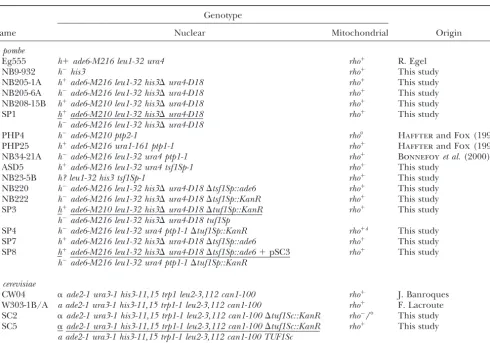
TABLE 1
S. pombeandS. cerevisiaestrains used in this study
Genotype
Name Nuclear Mitochondrial Origin
S. pombe
Eg555 h⫹ade6-M216 leu1-32 ura4 rho⫹ R. Egel
NB9-932 h⫺his3 rho⫹ This study
NB205-1A h⫹ade6-M216 leu1-32 his3⌬ura4-D18 rho⫹ This study
NB205-6A h⫺ade6-M216 leu1-32 his3⌬ura4-D18 rho⫹ This study
NB208-15B h⫹ade6-M210 leu1-32 his3⌬ura4-D18 rho⫹ This study
SP1 h⫹ade6-M210 leu1-32 his3⌬ura4-D18 rho⫹ This study
h⫺ade6-M216 leu1-32 his3⌬ura4-D18
PHP4 h⫺ade6-M210 ptp2-1 rho⬚ HaffterandFox(1992)
PHP25 h⫹ade6-M216 ura1-161 ptp1-1 rho⫹ HaffterandFox(1992)
NB34-21A h⫺ade6-M216 leu1-32 ura4 ptp1-1 rho⫹ Bonnefoyet al.(2000)
ASD5 h⫹ade6-M216 leu1-32 ura4 tsf1Sp-1 rho⫹ This study
NB23-5B h? leu1-32 his3 tsf1Sp-1 rho⫹ This study
NB220 h⫺ade6-M216 leu1-32 his3⌬ura4-D18⌬tsf1Sp::ade6 rho⫹ This study
NB222 h⫺ade6-M216 leu1-32 his3⌬ura4-D18⌬tsf1Sp::KanR rho⫹ This study
SP3 h⫹ade6-M210 leu1-32 his3⌬ura4-D18⌬tuf1Sp::KanR rho⫹ This study
h⫺ade6-M216 leu1-32 his3⌬ura4-D18 tuf1Sp
SP4 h⫺ade6-M216 leu1-32 ura4 ptp1-1⌬tuf1Sp::KanR rho⫹d This study
SP7 h⫹ade6-M216 leu1-32 his3⌬ura4-D18⌬tsf1Sp::ade6 rho⫹ This study SP8 h⫹ade6-M216 leu1-32 his3⌬ura4-D18⌬tsf1Sp::ade6⫹pSC3 rho⫹ This study
h⫺ade6-M216 leu1-32 ura4 ptp1-1⌬tuf1Sp::KanR
S. cerevisiae
CW04 ␣ade2-1 ura3-1 his3-11,15 trp1 leu2-3,112 can1-100 rho⫹ J. Banroques
W303-1B/A a ade2-1 ura3-1 his3-11,15 trp1-1 leu2-3,112 can1-100 rho⫹ F. Lacroute
SC2 ␣ade2-1 ura3-1 his3-11,15 trp1-1 leu2-3,112 can1-100⌬tuf1Sc::KanR rho⫺/⬚ This study SC5 ␣ade2-1 ura3-1 his3-11,15 trp1-1 leu2-3,112 can1-100⌬tuf1Sc::KanR rho⫹ This study
a ade2-1 ura3-1 his3-11,15 trp1-1 leu2-3,112 can1-100 TUF1Sc
TheS. pombestrains NB9-932, NB205-6A, NB205-1A, and NB208-15B were generated through a series of crosses of our lab strains followed by tetrad dissection. The nature of thehis3allele from NB9-932 is unknown, whereas thehis3⌬allele in the three other strains was described (Ohi et al.1996) and is derived from strain CHP731 (a gift of C. S. Hoffman). SP1 is the diploid resulting from the cross of NB208-15B and NB205-6A. ASD5 is a UV-inducedtsf1Sp-1point mutant derived from Eg555, and NB23-5B is a spore from the cross between ASD5 and NB9-932. NB220 and NB222 were generated by replacement oftsf1Sp
by different markers genes in NB205-6A. SP3 and SP4 are derived from SP1 and NB34-21A, respectively, by disruption oftuf1Sp. SP4 contains low amounts of wild-type mtDNA (rho⫹d). SP7 is a spore from the cross of NB220 with NB205-1A, whereas SP8 is the transient diploid from the cross of SP4 to SP7 transformed with pSC3, which carries theTUF1Scgene. TheS. cerevisiaestrains are all from the W303 background. SC2 comes from the disruption ofTUF1Scinto CW04, and SC5 was generated by crossing SC2 with W303-1B/A.
spectral defect of the cytochromesbanda⫹a3, belong- drial translation elongation factor EF-Ts (23% identity, 55% similarity, and 27% identity, and 61% similarity, ing to the complexes III and IV of the respiratory chain
(Figure 1A). All tetrads from an ASD5-derived heterozy- respectively). Like the human protein, the predictedS. pombeprotein contained an N-terminal extension typical gote showed a 2:2 cosegregation of the [Gal⫺] and
spec-tral phenotype (Figure 1A). of mitochondrial targeting sequences (Figure 2A). Strik-ingly, no homolog of EF-Ts could be identified in the The [His⫺ Gal⫺] spore, NB23-5B, was transformed
with a library ofS. pombegenomic DNA (Ohiet al.1996). S. cerevisiaegenome by BLAST homology searches. Con-sistently,RosenthalandBodley(1987) could not find A plasmid carrying a 2.3-kb insert containing two entire
open reading frames (ORFs) from chromosome 2 re- any biochemical evidence for the presence of an ex-change factor for the S. cerevisiae EF-TuSc, which was stored the growth of NB23-5B on galactose medium.
Subcloning or disruption of the plasmid insert showed isolated almost 20 years ago (Myerset al.1985). To demonstrate that we had cloned the wild-type gene that the complementing gene was SPBC800.07c (Figure
1B). We have called this genetsf1Sp, since its predicted mutated in the strain ASD5 and not a high-copy suppres-sor, we sequenced thetsf1Spgene from ASD5 and the product is the onlyS. pombeprotein showing substantial
1894 S. Chiron, A. Suleau and N. Bonnefoy
Figure2.—Complementation of the ⌬tsf1Spmutation by its human homolog. (A) The human (box with dark shading,
Figure 1.—Analysis of the ASD5 mutant phenotype and
Ts Hs) and S. pombe (box with light shading, Ts Sp) EF-Ts identification of the corresponding wild-type gene and
muta-proteins present an N-terminal extension (marked with a dot-tion. (A) Sister spores from the cross of ASD5 with a wild-type
ted line) that is lacking in theE. colifactor (open box, TsEc). strain were grown on glucose before recording cytochrome
The solid boxes depict two regions of high homology that are spectra. Cytochromec,c1,b, andaa3 peaks are indicated. (B)
known as the EF-Ts signature sequence. TheS. pombeandH.
The original complementing fragment (line 1), as well as
sapienssequences were fused at the very beginning of these deletion (lines 2–4) or disruption (line 5) derivatives were
signature sequences (arrows) to yield a chimera Ts Sp/Hs. introduced into NB23-5B. Transformants were patched on
(B)⌬tsf1Sp::KanRcells transformed with high-copy plasmids glucose medium and replica plated onto galactose plates. The
producing TsSpor TsSp/Hscompared to an empty vector generic S. pombe ORF names are given at the top. Shaded
were streaked onto complete ethanol glycerol medium. (C) boxes indicate ORFs, arrows show the gene orientations, and
The transformants from B were grown on either ethanol glyc-letters indicate restriction sites (S,SacI; H,HincII; B,BglII).
erol medium (Ts Sp, Ts Sp/Hs) or glucose (vector) before (C) The tsf1Spgene nucleotide and deduced amino acid
se-recording cytochrome spectra. Peaks as in Figure 1A. quences in the wild-type (Eg555) and mutant (ASD5) strains are
given in the vicinity of the mutation. Numbering refers to the start codon. (D) Mitochondrial translation products from a wild
type (lane 1, Eg555) and two mutants (lane 2,tsf1Sp-1and ASD5; had two additional adenine nucleotides inserted in the
lane 3, Resp⫺, a respiratory mutant from our collection affected same stretch, restoring the reading frame by creating at a post-translational level) were radioactively labeled and sepa- an additional lysine codon. We constructed disrupted rated by SDS-PAGE before phosphorimaging.
versions of thetsf1Spgene that were phenotypically iden-tical to ASD5 and yielded diploid cells unable to use galactose when crossed to ASD5. This confirmed that additional adenine in a stretch of nine A’s (Figure 1C),
resulting in a frameshift leading to a truncated 79-resi- the gene mutated in strain ASD5 is indeed SPBC800.07c, encoding EF-TsSp, a homolog of the prokaryotic EF-Ts due product instead of the wild-type 299-amino-acid
protein. [Gal⫹] intragenic revertants of this mutation translation elongation factor, which would function in S. pombemitochondria.
fell into two classes. Strong revertants had recovered the
mutant and wild-type strains with [S35]methionine in the since one or the other of these complexes is required to generate the mitochondrial membrane potential es-presence of cycloheximide, which blocks cytoplasmic
translation. Mutation of tsf1Sp dramatically decreased sential for life. Thus, a stringent translational arrest in mitochondria is expected to have similar consequences the labeling of all mitochondrial translation products,
whereas another respiratory mutant generated substan- to the complete loss of mitochondrial DNA. Because mutations in two as-yet-uncharacterized genes,ptp1and tial amounts of labeled proteins (Figure 1D). However,
after a very long exposure, faint bands corresponding ptp2, allow S. pombe to tolerate the loss of its mtDNA (HaffterandFox1992;ChenandClark-Walker2000), to the expected size for mitochondrial translation
prod-ucts were observed in thetsf1Spmutant, suggesting that we reasoned that such mutants might also tolerate a complete block of mitochondrial translation. We used a low residual level of translation can still occur in
mito-chondria whentsf1Spis mutated. These results support a haploidptp1-1strain as recipient for thetuf1Sp disrup-tion and could indeed isolate ⌬tuf1Sp::KanR clones. the idea that the cloned gene indeed encodes a
transla-tion factor. However, these cells not only were [Gal⫺], but also grew very poorly on complete glucose plates and floculated
The tsf1Sp gene encodes a functional homolog of
human EF-Ts:To determine whether the sequence ho- upon growth in liquid glucose medium (Figure 3A and data not shown). These phenotypes were reminiscent of mology between EF-TsSpand its human counterpart
re-flected a functional conservation, we tested whether the rho⬚derivatives of theptpmutants. There was a dramatic decrease in all cytochromes, as observed forrho⬚ cells human gene could complement the ⌬tsf1Sp mutant.
Since human mitochondrial targeting sequences are not (Figure 3B). Thus, the consequences of a complete block of mitochondrial translation are similar to the always efficiently recognized by the yeast import
machin-ery, we directly fused the first 42 residues of the fission effect of the loss of mtDNA, raising the question of the state of the mtDNA in the⌬tuf1Spmutants.
yeast protein, specifying the targeting sequence, to
resi-due 56 of the human protein (Figure 2A). This chimeric Mitochondrial DNA is drastically depleted when EF-TuSp is absent:For unknown reasons, S. cerevisiae cells human gene, controlled by the endogenoustsf1Sp
pro-moter, was introduced into the⌬tsf1Spmutant and con- defective in general mitochondrial translation, such as strains lacking EF-TuSc, rapidly accumulate deleted mol-ferred strong growth on ethanol/glycerol, like thebona
fide S. pombe tsf1Spgene (Figure 2B). Similarly, both the ecules of mtDNA or even completely lose their mtDNA (Myers et al. 1985; Chen and Clark-Walker 2000; S. pombeand human gene restored wild-type cytochrome
spectra (Figure 2C). ContamineandPicard2000).
To determine the fate of mtDNA in the absence of Thus, under our expression conditions, the human
EF-Ts exchange factor is able to replace its S. pombe EF-TuSp, we first stained DNA molecules with DAPI in several independentptp1-1⌬tuf1Sptransformants, but counterpart to give wild-type growth and cytochrome
spectra, suggesting that it can interact efficiently with could detect only punctate structures characteristic of mtDNA in control strains (not shown). However, several the fission yeast EF-TuSpGTPase. In contrast, we found
that a human EF-Tu protein fused to theS. pombeorS. mtDNA fragments could be amplified by PCR from whole genomic DNA of the⌬tuf1Spclones, suggesting cerevisiae EF-Tu targeting sequence and coproduced
with its exchange factor could replace neither the S. that at least some regions of mtDNA were still present. Southern blot analysis of genomic DNAs with the entire pombenor theS. cerevisiaehomolog, suggesting that the
human EF-Tu factor might not be able to interact with S. pombemtDNA as a probe showed that in the⌬tuf1Sp clones, a dramatic mtDNA loss had occurred (lanes 3–6, the required partners to deliver amino-acylated tRNAs
to yeast mitochondrial ribosomes. Figure 3C), compared to the wild-type samples (lanes 2 and 7), which can eventually lead to a complete loss
Absence of the EF-TuSpGTPase is lethal inS. pombe:
Unlike the exchange factor EF-Ts, the GTPase EF-Tu is (lane 3), without producing detectable levels of re-arranged mtDNA molecules. The depletion reflected a central player in translation, which seems ubiquitous
in mitochondria. A deleted version of thetuf1Spgene the state of a homogenous cell population since sub-clones obtained after streaking the⌬tuf1Spcells all con-was constructed on a plasmid using the G418 resistance
marker and was tentatively integrated into both haploid tained low amounts of mtDNA. This 1–2% of residual mtDNA present in the⌬tuf1Spclones showed a strictly and diploid S. pombestrains. Homologous [G418R]
re-combinants could be isolated only in a diploid strain wild-type profile.
To test whether this residual amount of mtDNA could and yielded only [G418S] spores. Thus, the loss of
EF-TuSpis lethal inS. pombe whereas the lack of EF-TsSpis still be functional upon recovery of thetuf1Spgene, a series ofptp1-1clones deleted for tuf1Spwere crossed viable.
S. pombeis a petite-negative yeast, so the loss of mtDNA to a rho⬚ ptp2-1 strain. Diploids were [Gal⫹], showing that the remaining low level of mtDNA present in the is lethal. Chen and Clark-Walker (2000) had
pro-posed that wild-typeS. pombecells cannot simultaneously ⌬tuf1Spmutant was intact and could be reamplified to sustain respiration when EF-TuSpwas present. We found lose the mitochondrially encoded subunits of the
1896 S. Chiron, A. Suleau and N. Bonnefoy
Figure4.—Overexpression of thetuf1Spgene suppresses the⌬tsf1Spdeletion. (A) Total protein extracts from a wild-type (Eg555),⌬tuf1Spcells (SP4), or cells (NB34-21A) over-expressing tuf1Sp were analyzed by Western blotting using antibodies recognizing the EF-TuSp and Cox2Sp proteins. A cross-reacting band revealed in all lanes by the anti-EF-TuSp antiserum (X) is used as loading control. (B) The⌬tsf1Sp:: KanRstrain (NB222) was transformed with a plasmid overex-pressing a tagged version oftuf1Sp. Total (T, lane 1), postmito-chondrial (S, lane 2), and mitopostmito-chondrial (M, lane 3) protein fractions of this galactose-grown transformant were analyzed by Western blotting, using antibodies raised against the His-tag to detect EF-TuSp-6His or against theS. cerevisiaemitochondrial matrix enzyme Arg8p (Steeleet al.1996). The bottom of the
Figure 3.—Effects of EF-TuSp absence on growth,
cyto-two bands revealed by the anti-Arg8p antibody in lane 1 is chrome spectra, and mtDNA. (A) Serial dilutions of the
mu-absent in a⌬arg8strain and corresponds to the 47-kDS. pombe
tant SP4 (bottom,ptp1-1 ⌬tuf1Sp) and its isogenic wild type
Arg8 protein (N. Bonnefoy, unpublished results). The top NB34-21A (top,ptp1-1) were spotted onto media containing
cross-reacting protein (Y) is absent in purified mitochondria, 5% glucose, 2% glucose supplemented with G418, or 2%
galac-contrary to Arg8Sp. (C) In addition to plasmids used in Figure tose and 0.1% glucose. (B) Cells were grown on glucose before
2A, the⌬tsf1Sp::KanRstrain NB222 was transformed by a plas-recording cytochrome absorption spectra. The ptp2-1 rho0
mid producing EF-TuSp (Tu Sp). The transformants were strain is PHP4 (HaffterandFox1992), other strains as in
streaked on minimal glucose (left) or complete ethanol glyc-A, and peaks as in Figure 1A. (C) Caesium-chloride-purified
erol (right) media. wild-type mtDNA (lane 1; a gift of G. D. Clark-Walker) and total
genomic DNA extracted from a heterozygous⌬tuf1Sp::KanR/ tuf1Sp ura4-D1.8/ura4-D1.8diploid stain (lane 2, SP3), several
independent ptp1-1 ⌬tsf1Sp::KanR ura4 strains (lanes 3–6, (not shown), showing that even very weak residual trans-SP4), and the isogenicptp1-1 ura4strain (lane 7, NB34-21A)
lation is sufficient for mtDNA maintenance inS. pombe.
were digested withHindIII and analyzed by Southern blotting
Overproduction of EF-TuSpcan compensate for the
under standard conditions. Probes were either (top) pDG3
[a pBR322-based plasmid that contains the whole S. pombe absence of its exchange factor:One explanation for the
mtDNA (Del Giudiceet al.1983)] or (bottom) the 1.8-kb viability of⌬tsf1Spand the lethality of⌬tuf1Spmutants
HindIIIura4fragment (Grimmet al.1988). The blot hybrid- could be that the GTPase EF-Tu
Sp can still function ized to the complete mtDNA was exposed for either a few
at a low level without its exchange factor. To test this
days (right) or several weeks (left).HindIII digestion of
wild-hypothesis, we overproduced EF-TuSp. Overexpression type mtDNA gives 10 fragments of 4318, 4081, 3407, 2459,
2118, 1655, 1160, 134, 90, and 9 bp. Band sizes for the Raoul oftuf1SpinS. pombeindeed leads to increased
accumula-DNA marker (Appligene) are given in base pairs. Signals were tion of the protein (Figure 4A, compare lanes 3 and 1), quantified using a STORM phosphor imager (Molecular Dy- which is fully imported into mitochondria (Figure 4B). namics, Sunnyvale, CA).
with aLEU2plasmid overexpressingtuf1Spand theura4 TUF1Sc plasmid was cured using 5-fluoroorotic acid. The resulting strain clearly showed weaker growth on galactose medium. Coproduction of theS. pombeor hu-man exchange factors improved growth, up to the level of the transformant producing EF-TuSc alone (Figure 5). These data are consistent with the idea that theS. cerevisiae GTPase functions independently of an ex-change factor.
To do the equivalent experiment inS. cerevisiae, we
Figure 5.—Heterologous complementation analysis. S. transformed a⌬tuf1Sc heterozygote with plasmids ex-pombe ptp1-1⌬tuf1Sp::KanR⌬tsf1Sp::ade6cells containing plas- pressing the EF-Ts and/or EF-Tu factors from either mids producing the indicated S. cerevisiae, S. pombe, or H. yeast or humans and recovered spores carrying the dif-sapiensEF-Tu or EF-Ts proteins were patched onto minimal
ferent plasmids. This strategy was used because the
glucose medium. Plates were replicated on galactose or
glyc-⌬tuf1Sc allele would readily convert any haploid strain
erol medium (left). A heterozygousS. cerevisiae⌬tuf1Sc::KanR
diploid was transformed with various plasmids producing the into a mixture of rho⬚/rho⫺ cells. The absence of
EF-indicated proteins and sporulated. Mutant⌬tuf1Scspores car- TuScinS. cerevisiaewas complemented by production of rying the different plasmids producing the indicated EF-Tu EF-Tu
Sp. This complementation was improved when the or EF-Ts proteins from S. cerevisiae and/or S. pombe were
S. pombeor theH. sapiensexchange factors were
copro-patched onto minimal glucose medium and replica plated on
duced (Figure 5). Thus theS. pombe GTPase can only
nonfermentable glycerol medium (right). Tu, Tu; Ts,
EF-Ts;Sc,S. cerevisiae;Sp,S. pombe;Hs,H. sapiens. partially replace its S. cerevisiae counterpart and func-tions more efficiently with its cognate exchange factor.
Variants of EF-TuSp can become independent of an tuf1Sp compensates for the deletion of tsf1Sp (Figure exchange factor: To explain how closely related and 4C). Elevated levels of EF-TuSpprobably sustain respira- functionally homologous GTPases like the S. cerevisiae tory growth in the absence of EF-TsSpby increasing the andS. pombeEF-Tu factors could differ in their require-availability of GTP-bound EF-TuSp. Thus EF-TuSp can ment for an exchange factor, we isolated suppressors function, although at a reduced level, in the absence able to compensate for the lack ofS. pombeEF-Ts. Among of its exchange factor. By extension, the remaining low 34 suppressors analyzed, 27 contained a 1-bp substitu-EF-TuSpactivity due to the endogenous copy of thetuf1Sp tion in the tuf1Sp reading frame, creating a single-gene probably ensures sufficient residual translation to amino-acid replacement. A total of 16 differenttuf1Sp maintain viability of the⌬tsf1Spmutant but not growth suppressor mutations were recovered (Figure 6A). Four-on nFour-onfermentable substrate. teen of the mutations mapped into domain I of the
EF-TuScfunctions independently of an exchange fac- EF-TuSp factor, often in the vicinity of the
nucleotide-tor: The fact that tsf1Sp was partly dispensable when binding site; two mutations mapped into domain III in tuf1Spwas overexpressed may provide a key to under- a region of close contact with domain I (Figure 6B). standing whyS. cerevisiaeis missing an EF-Ts exchange Since overexpression oftuf1Sppartially compensates factor. TheTUF1Scgene could be naturally more highly for the ⌬tsf1Sp mutation, we determined the level of expressed than its S. pombe counterpart. Alternatively, EF-TuSpin the suppressor strains. In the⌬tsf1Spmutant, theS. pombeandS. cerevisiaeGTPases could have differ- which is the parental strain of the suppressors, EF-TuSp ent affinities for guanine nucleotides. It has been shown was nearly undetectable (Figure 6C, lane 2). This sug-that EF-TuSchas a higher affinity for GTP than for GDP, gested that EF-TsSpmight act as a chaperone of EF-TuSp, whereas theE. coliandHomo sapiens homologs, which as inE. coli(Krabet al.2001). In the three suppressor depend on an exchange factor, have a higher affinity strains, nearly wild-type (L354F and G168C) or even for GDP (Miller and Weissbach 1970; Rosenthal slightly higher than wild-type (V146I) levels of EF-TuSp and Bodley 1987; Cai et al. 2000). The biochemical were restored (Figure 6C; compare lanes 3, 5, and 6 approach appeared difficult inS. pombebecause EF-TuSp with lane 1), suggesting that the EF-TuSpvariants carry aggregates, so we decided to use genetic strategies to a mutation that can stabilize them. However, EF-TuSp study the relationships between both factors. levels were dramatically higher in thetuf1Sp overexpres-The heterologous complementation experiment inS. sion control (Figure 6C, lane 4) whereas the Cox2Sp/ pombewas conducted by crossing aptp1-1⌬tuf1Sp::KanR EF-TuSpratio was at least 10-fold lower than that in the strain (SP4) to a⌬tsf1Sp::ade6mutant (SP7) transformed suppressors. This suggests that the EF-TuSpvariants are with aura4plasmid expressingTUF1Sc. Fully respiring more active than the wild-type EF-TuSpin a strain lacking [Ura⫹G418RAde⫹] segregants were obtained, showing the exchange factor.
that theS. cerevisiaegene could efficiently replacetsf1Sp The V146I variant gene was cloned in anS. cerevisiae andtuf1Spat the same time (Figure 5). One of these expression plasmid and expressed in the S. cerevisiae
1898 S. Chiron, A. Suleau and N. Bonnefoy
Figure6.—Nature and localization of the EF-TuSpmutations able to compensate for the absence of an exchange factor. (A) Serial 10-fold dilutions of⌬tsf1Sp::KanR(⌬, NB222), wild-type (NB205-6A), and revertant strains were spotted onto 2% galactose 0.1% glucose plates. In addition to the⌬tsf1Sp::KanRallele, each revertant carries a mutation in thetuf1Spgene, given in the one-letter code with its position. (B) The EF-TuSpvariants from A are depicted with shaded circles on the crystal structure of the bovine EF-Tu (Andersenet al.2000) bound to GDP (indicated by a thick solid line) on the basis of sequence homologies with theS. pombeprotein. The numbering in the shaded circles corresponds to the residue position inS. pombe. (C) Total protein extracts from a wild-type (NB205-6A, lane 1),⌬tsf1Sp(NB222) cells overexpressing (lane 4) or not (lane 2) the wild-typetuf1Sp
gene, as well as cells from three suppressors from A (lanes 3, 5, 6) were analyzed by Western blotting as in Figure 4A. Signals were quantified using the ImageJ program. (D) The mutant gene encoding the V146I EF-TuSpprotein variant was subcloned in aS. cerevisiaeexpression vector and tested for complementation of the⌬tuf1Scmutant as in Figure 5.
obtained clearly showed that the V146I EF-TuSpvariant does not appear to be the case for EF-TuSc, as sequence had become independent of its exchange factor, even comparison of the EF-Tu factors from a number of or-in a heterologous system. ganisms including S. cerevisiae and S. pombe could not highlight any obvious feature that could explain the autonomous recycling of EF-TuSc.
DISCUSSION We determined that the
S. pombe EF-TuSp is highly dependent upon its exchange factor, and thus this sys-The GTPase superfamily includes three types of
tem offered a good opportunity to design a genetic GTPases: the small Rho-type G proteins, the
heterotri-strategy to understand the basis of EF-Ts factor loss in meric G proteins, and the translational GTPases. Apart
S. cerevisiae. We found that various single-amino-acid from some of the translational GTPases, such as the
substitutions could confer independence toward its ex-initiation factor IF2, which delivers the initiator tRNA,
change factor on EF-TuSp. Two nonexclusive hypotheses and the elongation factor EF-G, all depend on
nucleo-can be proposed for the mechanism of suppression: tide exchange factors. Unlike its E. coli, S. pombe, and
the mutations could modify the activity of EF-TuSp or higher eukaryote homologs, theS. cerevisiaeEF-TuScalso
increase its stability. We have shown that overproduction seems to lack an exchange factor (Rosenthaland
Bod-of EF-TuSp can compensate for the absence of its ex-ley 1987). Both IF2 and EF-G contain additional
do-change factor, and suppressor effects of the overproduc-mains that could play a role as an intrinsic exchange
inS. cerevisiae either in the cytoplasmic system (Carr- the rest of the hemi-ascomycete branch.E. coliIF3 is a modulator of the initiation step of translation, which Schmid et al. 1999b) or in the mitochondrial tRNA
discriminates between different types of messenger mutants (Rinaldiet al.1997;Feuermannet al.2003).
RNAs, and its homolog might have a similar regulatory However, the suppressor mutations do not augment the
role in human and fission yeast mitochondria. However, steady-state level of EF-TuSpenough to account for the
in S. cerevisiae mitochondrial translation initiation is significantly increased Cox2Spsynthesis. Thus we
hypoth-controlled by messenger-specific activators, conserved esize that the main reason for the suppression is that
mainly in closely related yeasts (Costanzoet al.2000); the EF-TuSpvariants have acquired or extended a new
these messenger-specific activators may compensate for ability of self-exchange,e.g., decreased affinity for GDP
the absence of IF3. Thus, the translation-factor losses and/or increased affinity for GTP.
in hemi-ascomycetes might reflect profound differences The nature and/or location of the suppressor
muta-in the way mitochondrial translation is regulated com-tions indeed points toward a crucial role of nucleotide
pared to other eukaryotes. binding in the suppression. Of 16 mutations, 14 are
In addition, our study has clearly shown that a com-located in the GDP-binding domain I, mostly in close
plete block of mitochondrial translation is lethal in wild-proximity of the G-nucleotide-binding sites. Position 94
typeS. pombeand leads to a major depletion of mtDNA (52 in E. coli) is located in one of the switch regions
under conditions where viability can be maintained de-(Spremulliet al.2004), alanine 215 (174 inE. coli) is
spite the translational block. AlthoughS. cerevisiaestrains directly part of the nucleotide-binding site (Songet al.
with mitochondrial translational defects are viable, mul-1999), and aspartate 151 (155 in bovine) corresponds to
tiple deletions accumulate readily when mitochondrial a position connected to GDP through water molecules
translation is affected, and in general the extent of (Andersenet al.2000). Position 227 (G232 in bovine)
mtDNA deletion production depends on the stringency has been proposed as a candidate to explain the weaker
of the mutation (Myerset al.1985). The results we have nucleotide binding of mammalian compared to
pro-obtained inS. pombeare reminiscent of results obtained karyotic EF-Tu (Andersenet al.2000). In addition,
mu-with human cells. When human cells in culture were tations in the nucleotide-binding site of the cytoplasmic
treated with thiamphenicol, a drug that inhibits mito-eEF1A close to our mutant position 182 abolish the
chondrial translation, their mtDNA remained intact exchange factor requirement (Carr-Schmid et al.
(Selwoodet al. 2001). In cells from patients showing 1999a), and position 168 corresponds to a conserved
a mitochondrial translation defect of nuclear origin, no glycine whose mutation decreases the preference for
evidence of any large-scale rearrangement or mtDNA GDP over GTP inE. coli(Knudsenet al.1995). Finally,
depletion was found (Sasarman et al. 2002). Finally, the two last suppressor mutations in EF-TuSpdomain III
mutant hamster cells affected in mitochondrial transla-are very close to domain I, according to bothE. coliand
tion showed intact mtDNA but with a 50% decrease bovine crystal structures (Songet al.1999;Andersenet
in the quantity of mtDNA (Au and Scheffler1997). al. 2000), suggesting that they could alter domain I
However, in all three cases, mitochondrial translation conformation to modulate nucleotide binding.
was probably not completely blocked. The physiological The subtle changes found in the EF-TuSp variants state of these cell cultures was thus probably more simi-could make them functionally more similar to the
EF-lar to that of a⌬tsf1Spmutant, which does contain wild-TuScor to other self-recycling GTPases like EF-G or IF2,
type amount of intact mtDNA, than to that of a⌬tuf1Sp which display greater affinity toward GTP than do
bacte-mutant. This suggests that mitochondrial translation rial or human EF-Tu factors (RosenthalandBodley
defects stringent enough to cause mtDNA depletion are 1987). This could explain why EF-TuSc does not seem probably unlikely to be found in humans, because they to require a separate exchange activity, despite the
ab-might correspond to drastic mutational events, not com-sence of additional domains, and illustrates how the
EF-patible with viability.
TuSc gene could have evolved to allow the loss of the The fact that the mtDNA is intact in both sequence exchange factor EF-Ts without a drastic alteration in and quantity in the⌬tsf1Spmutant shows thatS. pombe mitochondrial metabolism. Sequence searches revealed mtDNA maintenance needs only a very limited level (Gaillardinet al.2000) that EF-Ts loss actually seems to of mitochondrial translation. The⌬
tsf1Spmutant now extend to the whole branch of hemi-ascomycete yeasts. provides the opportunity not only to analyze the rela-Since G nucleotide exchange factors are known to per- tionships between mtDNA metabolism and mitochon-form an essential regulatory function in the GTPase drial translation, but also to study whether a dramatic cycle, hemi-ascomycetes might have developed another mitochondrial translation decrease affects steps of mtDNA regulatory mechanism to compensate for the absence expression such as mRNA transcription and stability. of EF-Ts. Another mitochondrial translation protein,
We are indebted to C. S. Hoffmann for the kind gifts of ahis3⌬
the initiation factor IF3, also appears to be conserved strain and theS. pombegene bank constructed in the laboratory of inE. coli,S. pombe, and mammals (KocandSpremulli K. L. Gould. We are grateful to T. D. Fox for the gift of strains and
antibodies and for providing a plasmid constructed by L. Del Giudice
1900 S. Chiron, A. Suleau and N. Bonnefoy
Haffter, P., andT. D. Fox, 1992 Nuclear mutations in the petite-and coworkers. We thank A. Goffeau for useful advice concerning
negative yeastSchizosaccharomyces pombeallow growth of cells lack-S35-labeling inS. pombe, G. D. Clark-Walker and M. S. Longtine for
ing mitochondrial DNA. Genetics131:255–260. the gift of DNAs, and R. Egel for a yeast strain. We also thank G.
Hoffman, C. S., andF. Winston, 1987 A ten-minute DNA prepara-Dujardin and C. J. Herbert for excellent critical reading of the
manu-tion from yeast efficiently releases autonomous plasmids for trans-script and helpful discussions, and C. J. Herbert for looking over the formation ofEscherichia coli.Gene57:267–272.
English. S.C. was a Ph.D. fellow of the Ministe`re de la Recherche et Kelly, D. A., and C. S.Hoffman, 2002 Gap repair transformation de la Technologie. This work was supported by a research grant from in fission yeast to exchange plasmid-selectable markers. BioTech-the Association Franc¸aise contre les Myopathies to N.B. niques33:978, 980, 982.
King, M. P., andG. Attardi, 1989 Human cells lacking mtDNA: repopulation with exogenous mitochondria by complementa-tion. Science246:500–503.
Knudsen, C. R., I. V. Kjaersgard, O. WiborgandB. F. Clark, 1995 LITERATURE CITED
Mutation of the conserved Gly94 and Gly126 in elongation factor
Aevarsson, A., E. Brazhnikov, M. Garber, J. Zheltonosova, Y. Tu fromEscherichia coli. Elucidation of their structural and
func-Chirgadzeet al., 1994 Three-dimensional structure of the ribo- tional roles. Eur. J. Biochem.228:176–183.
somal translocase: elongation factor G fromThermus thermophilus. Koc, E. C., andL. L. Spremulli, 2002 Identification of mammalian
EMBO J.13:3669–3677. mitochondrial translational initiation factor 3 and examination
Andersen, G. R., S. Thirup, L. L. SpremulliandJ. Nyborg, 2000 of its role in initiation complex formation with natural mRNAs. High resolution crystal structure of bovine mitochondrial EF-Tu J. Biol. Chem.277:35541–35549.
in complex with GDP. J. Mol. Biol.297:421–436. Krab, I. M., R. te Biesebeke, A. BernardiandA. Parmeggiani, 2001
Au, H. C., andI. E. Scheffler, 1997 A respiration-deficient Chinese Elongation factor Ts can act as a steric chaperone by increasing hamster cell line with a defect in mitochondrial protein synthesis: the solubility of nucleotide binding-impaired elongation factor-rapid turnover of some mitochondrial transcripts. Somat. Cell Tu. Biochemistry40:8531–8535.
Mol. Genet.23:27–35. Lollier, M., L. Jaquet, T. Nedeva, F. Lacroute, S. Potieret al.,
Bonnefoy, N., M. Kermorgant, P. Brivet-Chevillotte and G. 1995 As inSaccharomyces cerevisiae, aspartate transcarbamoylase
Dujardin, 1996 Cloning by functional complementation, and is assembled on a multifunctional protein including a dihydrooro-inactivation, of theSchizosaccharomyces pombehomologue of the tase-like cryptic domain inSchizosaccharomyces pombe.Curr. Genet. Saccharomyces cerevisiaegeneABC1.Mol. Gen. Genet.251:204–210. 28:138–149.
Bonnefoy, N., M. Kermorgant, O. GroudinskyandG. Dujardin, Luchin, S., H. Putzer, J. W. Hershey, Y. Cenatiempo, M. Grunberg -2000 The respiratory geneOXA1has two fission yeast ortho- Managoet al., 1999 In vitro study of two dominant inhibitory logues which together encode a function essential for cellular GTPase mutants ofEscherichia coli translation initiation factor viability. Mol. Microbiol.35:1135–1145. IF2. Direct evidence that GTP hydrolysis is necessary for factor
Cai, Y. C., J. M. Bullard, N. L. Thompson andL. L. Spremulli, recycling. J. Biol. Chem.274:6074–6079.
2000 Interaction of mammalian mitochondrial elongation fac- Miller, D. L., andH. Weissbach, 1970 Studies on the purification tor EF-Tu with guanine nucleotides. Protein Sci.9:1791–1800. and properties of factor Tu fromE. coli.Arch. Biochem. Biophys.
Carr-Schmid, A., N. Durko, J. Cavallius, W. C. MerrickandT. G. 141:26–37.
Kinzy, 1999a Mutations in a GTP-binding motif of eukaryotic Minet, M., M.-E. DufourandF. Lacroute, 1992 Complementation elongation factor 1A reduce both translational fidelity and the ofSaccharomyces cerevisiaeauxotrophic mutants byArabidopsis thali-requirement for nucleotide exchange. J. Biol. Chem.274:30297– anacDNAs. Plant J.2:417–422.
30302. Myers, A. M., L. K. PapeandA. Tzagoloff, 1985 Mitochondrial
Carr-Schmid, A., L. Valente, V. I. Loik, T. Williams, L. M. Starita protein synthesis is required for maintenance of intact mitochon-et al., 1999b Mutations in elongation factor 1beta, a guanine drial genomes inSaccharomyces cerevisiae.EMBO J.4:2087–2092. nucleotide exchange factor, enhance translational fidelity. Mol. Nagata, S., Y. Tsunetsugu-Yokota, A. NaitoandY. Kaziro, 1983
Cell. Biol.19:5257–5266. Molecular cloning and sequence determination of the nuclear
Chen, X. J., andG. D. Clark-Walker, 2000 Thepetitemutation in gene coding for mitochondrial elongation factor Tu of Saccharo-yeasts: 50 years on. Int. Rev. Cytol.194:197–238. myces cerevisiae.Proc. Natl. Acad. Sci .USA80:6192–6196.
Claisse, M. L., G. A. Pere-Aubert, L. P. ClavilierandP. P. Slonim- Ohi, R., A. FeoktistovaandK. L. Gould, 1996 Construction of
ski, 1970 Method for the determination of cytochrome concen- vectors and a genomic library for use withhis3-deficient strains trations in whole yeast cells. Eur. J. Biochem.16:430–438. ofSchizosaccharomyces pombe.Gene174:315–318.
Contamine, V., andM. Picard, 2000 Maintenance and integrity of Okazaki, K., N. Okazaki, K. Kume, S. Jinno, K. Tanakaet al., 1990 the mitochondrial genome: a plethora of nuclear genes in the High-frequency transformation method and library transducing budding yeast. Microbiol. Mol. Biol. Rev.64:281–315. vectors for cloning mammalian cDNAs by trans-complementation
Costanzo, M. C., N. Bonnefoy, E. H. Williams, G. D. Clark-Walker ofSchizosaccharomyces pombe. Nucleic Acids Res.18:6485–6489. andT. D. Fox, 2000 Highly diverged homologs ofSaccharomyces Rinaldi, T., R. Lande, M. Bolotin-FukuharaandL. Frontali, 1997 cerevisiae mitochondrial mRNA-specific translational activators Additional copies of the mitochondrial Ef-Tu and aspartyl-tRNA have orthologous functions in other budding yeasts. Genetics synthetase genes can compensate for a mutation affecting the
154:999–1012. maturation of the mitochondrial tRNAAsp. Curr. Genet.31:494–
Del Giudice, L., K. Wolf, F. Mannaand D. R. Massardo, 1983 496.
Expression of cloned mitochondrial DNA from the petite nega- Rosenthal, L. P., andJ. W. Bodley, 1987 Purification and charac-tive yeastSchizosaccharomyces pombeinE. coliminicells. Mol. Gen. terization ofSaccharomyces cerevisiaemitochondrial elongation
fac-Genet.191:91–98. tor Tu. J. Biol. Chem.262:10955–10959.
Feuermann, M., S. Francisci, T. Rinaldi, C. De Luca, H. Rohou Sasarman, F., G. Karpati andE. A. Shoubridge, 2002 Nuclear et al., 2003 The yeast counterparts of human ‘MELAS’ mutations genetic control of mitochondrial translation in skeletal muscle cause mitochondrial dysfunction that can be rescued by overex- revealed in patients with mitochondrial myopathy. Hum. Mol. pression of the mitochondrial translation factor EF-Tu. EMBO Genet.11:1669–1681.
Rep.4:53–58. Scha¨fer, B., 2003 Genetic conservation versus variability in
mito-Forsburg, S. L., 1999 The best yeast? Trends Genet.15:340–344. chondria: the architecture of the mitochondrial genome in the
Gaillardin, C., G. Duchateau-Nguyen, F. Tekaia, B. Llorente, S. petite-negative yeastSchizosaccharomyces pombe.Curr. Genet.43:
Casaregolaet al., 2000 Genomic exploration of the hemiasco- 311–326.
mycetous yeasts: 21. Comparative functional classification of Selwood, S. P., A. McGregor, R. N. LightowlersandZ. M.
Chrza-genes. FEBS Lett.487:134–149. nowska-Lightowlers, 2001 Inhibition of mitochondrial
pro-Grimm, C., J. Kohli, J. MurrayandK. Maundrell, 1988 Genetic tein synthesis promotes autonomous regulation of mtDNA ex-engineering ofSchizosaccharomyces pombe: a system for gene disrup- pression and generation of a new mitochondrial RNA species. tion and replacement using theura4gene as a selectable marker. FEBS Lett.494:186–191.
1999 Crystal structure of intact elongation factor EF-Tu from Weilguny, D., M. Praetorius, A. Carr, R. EgelandO. Nielsen, 1991 New vectors in fission yeast: application for cloning the Escherichia coliin GDP conformation at 2.05 A resolution. J. Mol.
Biol.285:1245–1256. his2gene. Gene99:47–54.
Spremulli, L. L., A. Coursey, T. NavratilandS. E. Hunter, 2004 Weir, B. A., andM. P. Yaffe, 2004 Mmd1p, a novel, conserved Initiation and elongation factors in mammalian mitochondrial protein essential for normal mitochondrial morphology and dis-protein biosynthesis. Prog. Nucleic Acid Res. Mol. Biol.77:211– tribution in the fission yeastSchizosaccharomyces pombe.Mol. Biol.
261. Cell15:1656–1665.
Steele, D. F., C. A. ButlerandT. D. Fox, 1996 Expression of a Yaffe, M. P., 1991 Analysis of mitochondrial function and assembly. recoded nuclear gene inserted into yeast mitochondrial DNA is Methods Enzymol.194:627–643.
limited by mRNA-specific translational activation. Proc. Natl. Zhao, Y., andH. B. Lieberman, 1995 Schizosaccharomyces pombe: a
Acad. Sci. USA93:5253–5257. model for molecular studies of eukaryotic genes. DNA Cell Biol.
Vambutas, A., S. H. AckermanandA. Tzagoloff, 1991 Mitochon- 14:359–371. drial translational-initiation and elongation factors in