Some Aspect of Information Processing in
Human Brain and Studies on its Simulation
Anupam Srivastava1, Atul Shukla2,Shriniketan Acharya3,Priyanka Pandey4
Associate. Professor, Dept. of Physics and Electronics, Dr.RMLAU, Faizabad, India1
Asst. Professor, Dept. of Physics, SRMGPC, Lucknow, India2
M Sc, Dept. of Physics and Electronics Dr. RMLAU, Faizabad, India3
Research Scholar, Dept. of Physics and Electronics Dr.RMLAU, Faizabad, India4
ABSTRACT: Much of brain’s microstructure is known i.e. how the neurons are organized into systems and their interconnections, how sensory nerves come in from the sense organs and how motor nerves go to the muscles. Yet it has not been possible to simulate the brain exactly as it works which has been discussed in some detail in this paper.
KEYWORDS: Neuron, Neuroscience, Artificial Intelligence (AI), Artificial neuron, Neural, PDP(Parallel Distributed Processing)
I. INTRODUCTION
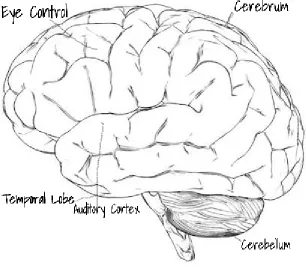
Much work has been done by many scientist in modelling of brain functions [1,2].Brain is most complex organ in the human. It controls all the body parts and generates signals which make human different from other living things. Brain consists of neurons which form functional units or modules of the nervous system. Groups of neurons serving a single function are organised at different hierarchical levels. The nervous system is divided into spinal cord, Medulla or midbrain, Cerebral cortex and the like, best described by biologists (see fig. 1). Then there are neurons which are functional units of nervous system. These neurons are connected either serially or in parallel. Sensation received from the body and from the outside world is need to be stored for future reference and necessary action. Temporal lobes of the cerebral cortex is memory area [3,4]. The left side lobe stores the past experiences and the right sides stores the recent ones. When a person sees an object and tries to recall it, the brain waves move to-and-fro between left and right temporal lobes. From the temporal lobe, past experiences are retrieved to integrate with recent ones to understand the implications and formulate future action.the development of an understanding how the human brain function and its simulation by electronic techniques is one of the most important and challenging task faced by modern science.
II. LITERATURE SURVEY
The first proposal to use neural networks as a basis for computation is made in 1943 by McCulloch and Pitt. Formerlyneurocomputing is concerned with non programmed adaptive information processing systems.Neural networks –that autonomously developoperational capabilities in adaptive response to an information environment. Instead of been given a step-by-step procedure for carrying out the desired transformation, the neural network itself generates its own internal rules governing the association and refinesthose rules by mapping or association of objects or representation in one set (such as written words) with objects are representation in another set(such as spoken sounds) through trial and error, the network literally teaches itself how to do task[5,6,7]
III. PROPOSED METHODOLOGY
The cognitive science or the science of the mind is an effort to simulate the mental phenomenon like perception, thoughts, learning, understanding and remembering. Cognitive science is interdisciplinary including the fields of psychology, philosophy, linguistics, artificial intelligence and neuroscience.
In the contemporary practice of cognitive science, models of human nervous system are defined at one of two different levels: (1) connectionist and (2) symbolic.
(1)The elements of the connectionist systems are conceptualized as highly simplified and schematized neurons interconnected in a network. The operators modify the network and, in particular, modify the strengths of the connections between elements.
Fig. 1. Some functional parts of brain
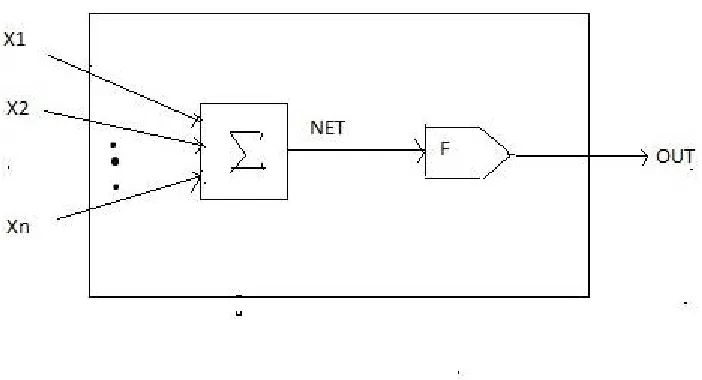
In the neuronal model, the input vector components are related to the dendrite inputs, the weights attached to the inputs are analogous to synapses. The quantized output is analogous to the axonal output. The output decision is determined by a weighted sum of the inputs, in much the same way real neurons are believed to behave (figs. 2 & 3).
Fig.2. Motor Neuron of brain
(2) The elements of symbolic systems may be conceptualized as symbols held in one or more memories. The memories may be organized as lists or networks but elements of these are interpreted as symbols rather than as neurons or perceptual features. The symbolic network architecture describes the system at a higher , or more abstract level than does the connectionist architecture.
Figure 3. Artificial Neuron (F is mathematical function)
Also, both computers and humans can compare symbols and can make choices according to the results of the comparison. With the right computer program, we hope to mimic the adaptability and the fluidity of human thought processes.
IV. RESULT AND DISCOSSION
Cognitive Science views the human mind as a highly complex-information processing system i.e. a system which receives, stores, retrieves, transforms and transmits information. Artificial neural network is an important paradigm in this direction.
In evaluating the plausibility of different architectures as responsible models of the human nervous system, it is good to keep in mind some of the parameters a system must fit if it is to claim that it describes human cognition.
The simple model of the artificial neuron ignores many of the characteristics of its biological counterpart. For example, it does not take into account time delays that affect the dynamics of the system; inputs produce an immediate output. It takes about one millisecond for a signal to cross the synapse between two neurons and longer, of course, for a sequence of such transmissions. A simple act of recognition takes roughly a second. Hence, all of the activities between simple neural events and overt behaviours emanating from a few elementary processes must be squeezed into a time range of only three orders of magnitude. Or in other words, an act of recognition cannot require more than a thousand successive synaptic crossings. We may look forward towards quantum computing (if it materializes) for making these delays negligible. As is predicted that quantum computers will be able to perform only specific tasks, it will not be possible to replace classical computers by quantum computers.
V. CONCLUSION
While modelling the human brain, these parameters put important constraints on the architecture of a serial system. But they also put severe constraints on the parallel systems as well because the equilibration processes used by the connectionist systems require numerous rounds of successive approximation. It is not evident whether their time requirements are greater or less than that of a serial recognition system. More important, neural network does not include the effects of synchronism or the frequency-modulation function of the biological neuron, characteristic that seems to be critical[12].
As second approach is concerned, there is clear cut difference between pure AI and computer simulation. Pure AI is an approach that seeks to accomplish a task as efficiently as possible. For example, the computer program for chess evaluates as many moves as possible in as little time as possible. A program that considers a large number of moves is more likely to win the game. In contrast, computer simulation attempts to take human limitations into account. For example, most human chess players do not have the ability to evaluate several dozen potential moves at the same time. Moreover, when we centre our attention on the contents of our consciousness, we do not think of neural network pulsing with electrochemical activity. We apprehend a flux of thoughts, sensations, desires and emotions.
A variety of mental phenomenon, like seeing the colour or smelling the fragrance of a flower cannot be accounted by purely physical explanation. We may know everything about the taxonomy and the molecular structure of the flower and of the human brain, but this knowledge does not enable us to predict the human experience like smelling the flower. So called parapsychological phenomena such as telepathy and telekinesis are beyond purely physical explanation[13]. Acknowledgement: Our warmest thanks are due to MasterArpitSrivastava for his affectionate help in preparation of figures.
REFERENCES
1. Amit D.J. Modelling Brain Functions, Cambridge University Press,Cambridge,1989
2. Hopfield, JJ, Proc ,National Academic Science USA ,79,2554,1982
3. BrodalA.Neurological Anatomy, Oxford University Press, Oxford 1981
4. Baddeley, A. D.,’Cognitive Psychology and human Memory’, Trends in Neurosciences, No. 11, p176-1811988
5. Robert J Smith, et.al. Mathematical modelling of biological systems, volume II, Birkhauser Basel 2008
7. AlfredoWeilzenfeld,Michael A. Arbib,Amanda Alexander ,The Neural Simulation Language “A System for Brain Modelling” The MIT Press ,2002
8. Computational Neuroscience (ed. Schwarz, E.L.), MIT Press, Cambridge, Massachusetts, 1990
9. Kleinfeld D. And sompolonsky H., Methods in Neural Modelling (eds. Koch, C. And Segev, I.), MIT Press, Cambidge, Massachusetts, 1989
10. Rumelhart, D.E. and McClelland, J.L. (eds.), Parallel Distributed Processing, MIT Press, Cambridge, Massachusetts, 1986
11. Ashok Kumar Gupta &AnupamSrivatava, LISP for Beginners, Shree Publishers & Distributers, New Delhi, India,2013
12. Trends in Neuroscience, No. 12, p15, 1992