Study of Distributed Spatial Modulation in
Cognitive Relay Network based
MIMO-OFDM System
Aparna Singh Kushwah
1, Alok Kumar Shukla
2Assistant Professor, Department of Electronics and Communication, UIT, RGPV, Bhopal, India1
M. Tech. Scholar, Department of Electronics and Communication, UIT, RGPV, Bhopal, India 2
ABSTRACT: Distributed Spatial modulation (DSM) is a recently developed multiple-input-multiple-output (MIMO)
techniquethat uses multiple transmit antennas in a innovative fashion. In SM, a group of information bits ismapped into two constellations: a signal constellation based on modulation scheme, and a spatial constellationto encode the index of a transmit antenna.DSM, multiple relays form a virtual antenna array and assist a source to transmit its informationto a destination by applying SM in a distributed manner. The source broadcasts its signal, which is independently demodulated by all the relays. Each of the relays then divides the received data in two parts: the first part is used to decide which one of the relays will be active, and the other part decides what data it will transmit to the destination. An analytical expression for symbol error probability is derived for DSM in independent and identically distributed Rayleigh fading channels.
KEYWORDS: MIMO-OFDM System, Cognitive Relay Network, Distributed Spatial Modulation
I. INTRODUCTION
With rapid growth in mobile multimedia applications, the demand for higher throughput is exponentially increasing in wireless cellular networks. However, available bandwidth below 10 GHz cannot be scaled at the same rate, which leads to the problem of spectrum scarcity. Multiple Input Multiple Output (MIMO) transmission has shown the promises to meet the demand for higher throughput. The MIMO technique is an effective way to increase system capacity and reliability by taking advantages of spatial multiplexing gain and/or diversity gain, without increasing the use of spectrum. For example, conventional Bell Labs layered space-time (BLAST) schemes transmit independent data streams simultaneously over multiple antennas to achieve high multiplexing gain [1]. On the other hand, in space-time block codes (STBC) technique, multiple copies of a data stream are transmitted over antennas and different versions of the data stream received through multiple antennas are then exploited to achieve maximum diversity gains [2]. Vertical-BLAST (V-Vertical-BLAST) is the most popular Vertical-BLAST schemes, which has the simplest detection scheme [3]; whereas Alamouti STBC is the simplest of all STBC schemes designed for two transmit antennas achieving full diversity gain [4]. The data rate of a MIMO system increases linearly by increasing the number of transmit and receive antennas. However, several problems are encountered in the development of multiple antenna transmission schemes [5]. These problems arise from several factors, among which are the following.
BLAST transmission systems suffer from high inter-channel interference (ICI) at the receiver due to simultaneous transmissions on the same frequency from multiple antennas.
The high ICI requires a complex receiver algorithm such as Maximum Likelihood (ML), which increases the overall system complexity.
With full-diversity STBC scheme, the above limitations can be overcome. In addition, due to their orthogonal design, they can easily be decoded at the receiver. However, the maximum spectral efficiency of full diversity STC systems is one symbol per symbol duration for any number of transmits antennas. Therefore, higher order modulation is required for full-diversity STBC to achieve spectral efficiency same as that of BLAST techniques.
II. MODULATION
Spatial modulation
Spatial modulation (SM) is a recently developed transmission technique, which uses multiple transmit antennas [6], [7]. In SM, an index of transmit antenna is used as an additional source of information to improve the overall spectral efficiency. A group of any number of information bits is mapped into two constellations: a signal constellation based on modulation scheme and a spatial constellation to encode the index of the transmit antenna. At any time instant, only one transmits antenna is active; whereas other transmit antennas radiate zero power. This completely avoids inter channel interference at the receiver and relaxes the stringent requirement of synchronization among the transmit antennas. In addition, unlike conventional MIMO system, SM system does not require multiple RF chains at the transmitter. At the receiver, a low complexity decoder such as maximum receive ratio combining (MRRC) is used to estimate the index of active transmit antenna, and after which transmitted symbol is estimated. Using these two estimates, a spatial demodulator retrieves the group of information bits.
Distributed Spatial Modulation
Spatial modulation (SM) is a new transmission technique for low-complexity implementation ofMIMO systems. In SM, the index of the active transmit antenna is employed as an additional meansof conveying information. Since, only one transmit antenna is active at any time instant, inter-channel interference (ICI) and inter-antenna synchronization (IAS) are efficiently avoided. Recent studies [4]-[5] have shown that SM can outperform other state-of-the-art MIMO schemes in terms of computational complexity if many antennas are available at the transmitter. Unfortunately, this makes SM useful only in the downlink of the cellular network, where a base station can be equipped with a large number of antennas. On the other hand, use of multiple antennas in mobile terminals has practical limitations.
Besides constraints on complexity and cost, decreasing terminal size restricts the application of SM in the uplink of cellular network.
To overcome these problems, distributed spatial modulation (DSM) presents a promising solution, where a set of neighboring mobile terminals assist the source in conveying its information to the destination [6]. The key idea behind DSM is that multiple cooperative relays share their antennas to form a virtual antenna array (VAA) and apply SM principle in a distributed manner. The DSM system overcomes the limitations of heavy shadowing effects while expanding network coverage. Moreover, only one relay is selected to forward the source’s information to the destination, thus saving overall transmit power of the system. Over the recent years, several attempts have been made to extend the concept of SM/SSK to a distributed scenario, both for the amplify-forward (AF) and decode-forward (DF) protocols. The authors of [7] have studied the performance analysis of a SSK-based AF relay network. In
[8], using the idea of SSK, a cooperative transmission scheme is considered both for the AF and DF protocols. In [9], the application of distributed SSK to the uplink cellular network is studied. In [10], a distributed SM scheme, where the relays have their own data, has been studied.
III. COOPERATIVE RELAY NETWORK
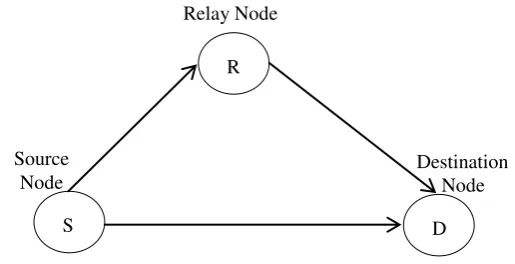
in fade decreases. This feature provides the ability to overcome the detrimental effects of severe fading in the wireless channel. In addition, cooperative relay systems reduce the end-to-end path loss between the source and destination. Since, intermediate relay nodes are placed in between the source and destination, the total resultant path loss of source-relay and source-relay-destination is less than the path loss of the source-destination. It is known theoretically that the SNR is inversely proportional to the signal propagation distance, d, as given below:
𝑁 ∝ 1
𝐷𝑛
Where d is the distance between the source and destination nodes and n is the path loss exponent who typically fluctuates between 2 and 6 based on the type of the propagation environment.
The potential advantages offered by cooperative relay systems are mentioned below:
High system reliability: A cooperative relay system can be extremely effective to combat the effects of channel fading by cooperative diversity. Also, it can effectively enhance the transmission robustness by guaranteeing the transmission between the source and destination even if the direct link is in deep fade.
High system coverage: The cooperative relay system can effectively expand the network coverage through the relaying capability. So, the transmitted signal can travel longer as compared to point to-point systems. Also, it can expand the network coverage by covering dead holes or spots in the network such as shadowed terminals.
Increasing data rate: The cooperative system can effectively increase the system data rate through exploiting its multiplexing capability or by exploiting the power gains due to diversity and path loss gains in increasing the cardinality of the signal constellation.
Figure 1: A single-relay with direct-link transmission model
IV. PROPOSED METHODOLOGY
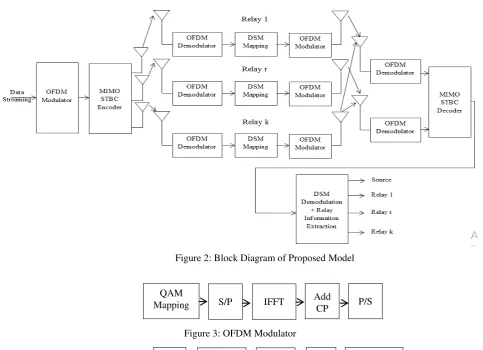
Consider Nt×NrDSM-MIMO system for point-to-point communications. The basic concept of SM is to map the information bits into two constellations: the spatial constellationand the signal constellation. The bit stream is divided into blocks of ns bits, where ns are the number of bits per symbol. Each block is then split into two parts of log2Ntand log2 M bits, where M denotes the size of the signal constellation diagram. The first part activates one of the Nttransmit antennas, and we denote the currently active antenna as l. The second part selects one symbol from the signal constellation diagram, and the active antenna conveys this symbol, which is denoted by s.
Relay Node
Destination Node Source
Node
R
Figure 3: OFDM Modulator
Figure 4: OFDM Demodulator
OFDM is a special form of multicarrier modulation (MCM) with densely spaced subcarriers with overlapping spectra, thus allowing multiple-access. MCM works on the principle of transmitting data by dividing the stream into several bit streams, each of which has a much lower bit rate, and by using these sub-streams to modulate several carriers. This technique is being investigated as the next generation transmission scheme for mobile wireless communications networks.
OFDM structure basically relies on three principles:
The IFFT and FFT are used for modulating and demodulating individual OFDM sub carriers to transform the signal spectrum to the time domain for transmission over the channel and then by employing FFT on the receiving end to recover data symbols in serial order.
QAM
Mapping S/P IFFT Add CP P/S
S/P Remove
CP FFT P/S
Interleaving is the third most important concept applied. The radio channel may affect the data symbols transmitted on one or several sub carriers which lead to bit errors. To encounter this issue we use efficient coding schemes [8].
V. CONCLUSION
Dynamic frequency allocation scheme is proposed forthe source and relays separately to improve the performance of DSM in this scenario. The frequency allocation for the source is formulated as unconstrained optimization problem with an objective to maximize the probability of correct estimation of transmitted symbols at all the relays. On the other hand, the frequency allocation for the relays is model through a weighted bipartite graph with end-to-endSER of source-destination links via relay as a weight function. The optimal frequency allocation for the relays is formulated as minimum weight perfect matching problem, in which frequencies are assigned to relays with an objective to minimize the sum total of end-to-end SER.
REFERENCES
[1] Shan Jin and Xi Zhang, “Compressive Spectrum Ali Afana, Telex M. N. Ngatched, Octavia A. Dobre, and SalamaIkki, “Cooperative DF Cognitive Radio Networks with Spatial Modulation with Channel Estimation Errors” 978-1-5090-4183-1/17/$31.00 ©2017 IEEE.
[2] KunalSankhe, SachinChaudhari, and Garimella Ramamurthy, “Distributed Spatial Modulation in Cognitive Relay Network”, submitted in IEEE Transactions on Cognitive Communications and Networking, May 2016.
[3] Aparna Singh Kushwahand NileshLonare, “Performance Analysis of Spectrum Sensing MIMO-OFDM based Cognitive Radio”,
International Journal of Innovative Research in Computer and Communication Engineering, Vol. 5, Issue 09, September 2017.
[4] KunalSankhe, and Garimella Ramamurthy, “Distributed Spatial Modulation-OFDM in Uplink Relay-assisted Cellular Network,” accepted in Wireless Personal Multimedia Communications (WPMC) 2015.
[5] KunalSankhe, Chandan Pradhan, Sumit Kumar, and Garimella Ramamurthy, “Machine Learning Based Cooperative Relay Selection in Virtual MIMO”, in Wireless Telecommunications Symposium (WTS) 2015, New York, USA, Jun. 2015.
[6] Chandan Pradhan, KunalSankhe, Sumit Kumar, and Garimella Ramamurthy, “Full-Duplex eNodeB and UE Design for 5G Networks”, in Wireless Telecommunications Symposium (WTS) 2015, New York, USA, Jun. 2015.
[7] Chandan Pradhan, KunalSankhe, Sumit Kumar, and Garimella Ramamurthy, “Revamp of eNodeB for 5G Networks: Detracting Spectrum Scarcity”, in Consumer Communications and Networking Conference (CCNC) 2015, 12th Annual IEEE, pp. 862-868, Jan. 2015.
[8] DeeptiSinghal, Chandan Pradhan, KunalSankhe, Garimella Ramamurthy, “Cognitive Radio Networks: Issues and Solutions,” in Handbook of Research on Self-Organized Mobile Communication Technologies, IGI Global 2015.
[9] KunalSankhe, Chandan Pradhan, Sumit Kumar, and Garimella Ramamurthy, “Cost effective restoration of wireless connectivity in disaster hit areas using Open BTS,” in India Conference (INDICON), 2014 Annual IEEE, pp. 1-6, Dec. 2014.
[10] Chandan Pradhan, KunalSankhe, Sumit Kumar, and Garimella Ramamurthy, “Cognitive base station design for efficient spectrum utilization in cellular network,” in Wireless and Optical Communications Networks (WOCN) 2014, pp. 1-7, Sep. 2014.
[11] Q. Wu, W. Chen and M. Tao, “Resource allocation for joint transmitter and receiver energy efficiency maximization in downlink OFDMA systems,” IEEE Trans. Communication, vol. 63, no. 2, pp. 416-430, Feb. 2015.
[12] J. B. Rao and A. O. Fapojuwo, “Analysis of spectrum efficiency and energy efficiency of heterogeneous wireless networks with intra-/inter- RAT offloading”, IEEE Trans. Veh. Technol., vol.64, no. 7, pp. 3120- 3139, Jul. 2015.