ISSN(Online): 2319-8753 ISSN (Print): 2347-6710
I
nternational
J
ournal of
I
nnovative
R
esearch in
S
cience,
E
ngineering and
T
echnology
(An ISO 3297: 2007 Certified Organization)
Website: www.ijirset.com Vol. 6, Issue 6, June 2017
Design and Parametric Weight Optimization
of Four Wheeler Lower Control Arm
M. Balaji Rao1, J.A. Sandeep Kumar2, A.V. Hari Babu3
M.Tech., (PG Scholar), Dept. of ME, SVR Engineering College, Nandyal, India1
Assistant Professor, Dept. of ME, SVR Engineering College, Nandyal, India 2
Associate Professor, Dept. of ME, SVR Engineering College, Nandyal, India 3
ABSTRACT: Suspension system of an automobile plays an important role in ensuring the stability of the automobile. Another major aspect of suspension system in passenger cars is luxury. A lot of research is going on in this direction, to further the development of independent suspension systems for automobiles. In the independent suspension system the control arm plays a major role. It is generally made of forged steel but this material is found to be excessively heavy in the current context of the quest for reducing the weight of the automobiles without any significant changes to design. In this task of designing the control arms with alternative materials,Computer Aided Engineering (CAE) software being extensively used to perform the topology optimization. The main objective of this study is to reduce the weight of the lower control arm of independent suspension by using topology optimization and material optimization. Static loads were taken into consideration and analysis is done for two different models viz. the existing model and an optimized model developed by topology optimization. Static structural analysis s& modal analysis of lower control arm is carried out by using HYPERWORKS. The obtained results of existing model are compared with the optimized model and their weights are calculated for two different materials. The best model from this study is proposed based on the topology and material optimization.
I.INTRODUCTION
In automobiles, a double wishbone suspension is an independent suspension design using two wishbone-shaped arms to support the wheel as shown in Fig 1.1.Double wishbones provide more stability to wheel movements at high speeds which reduces camber angle as the wheel moves up and down over uneven surfaces. Wishbones can be very easily adjusted as every joint can be removed for optimal wheel movement. During the actual working conditions, the maximum load is transferred from upper wishbone arm to the lower arm which may cause failure and bending of lower wishbone arm either at the ball joint location or at control arm because of high impact loads that are could be producedby road conditions.Such failure should be avoided to ensure the reliability of the suspension system and the automobile.
Fig1.1: suspension system
ISSN(Online): 2319-8753 ISSN (Print): 2347-6710
I
nternational
J
ournal of
I
nnovative
R
esearch in
S
cience,
E
ngineering and
T
echnology
(An ISO 3297: 2007 Certified Organization)
Website: www.ijirset.com Vol. 6, Issue 6, June 2017
A-arm. Control arms can be used in an all-wheel independent suspension system. During running condition lower control arm is subjected to loads due to variation in gross weight and impact loads due to fluctuation of road surface and additional forces such as braking and cornering. Because of this complex nature of loads, the chances of bending and hence failing of lower control arm at ball joint are very high which is undesirable. The lower control arm is one of the major parts of the front suspension system which controls the wheel trace and transmits the load on the wheel by the road to other parts of the car. It is assembled between the wheel hub and the automobile chassis as shown in Fig 1.2. When the car runs on the road, the lower control arm is subjected to complex loads that constantly change with time. Thus, the mechanical performance, usually relating to strength and stiffness are critical to the safety and reliability of the car.
Fig1.2: Assembly of suspension system The main functions of control arm are:
To form a rigid connection between the chassis and wheel hub, to which wheel is attached.
To allow the wheel, the required degrees of freedom for proper steering and suspension abilities.
To support the spring and dampers, which form the major components for shock absorbing.
To do these functions properly the control arm needs to be sufficiently strong. Depending upon the position of
the control arm, there are mainly two types of control arms Upper and lower control arm. The springs and shock absorbers are supported between these arms.
II.RELATED WORK
In automotive industry simulation-based improvementof models has been used for a variety of applications. In the study of XueGuanSong et al.(2010), based on the FEM analysis, both the response surface model(RSM)and Kriging model are used to optimize an ADI upper control arm, where the weight of the upper control arm is considered as the design objective, and the maximum allowable vonmises stress is the constraint objective. The initial FEM analysis shows the stress distribution and maximum stress on the upper control arm under a very severe loading condition. And, by virtue of the result of FEM analyses, fifty simulations with six design variables are performed for RSM and Kriging model to construct the approximation of the weight and maximum stress to obtain the optimum result. The optimized results obtained by using RSM and KRG are confirmed by a verified FEM analysis. In addition, a fatigue analysis is carried out to verify the durability of the final design.
ISSN(Online): 2319-8753 ISSN (Print): 2347-6710
I
nternational
J
ournal of
I
nnovative
R
esearch in
S
cience,
E
ngineering and
T
echnology
(An ISO 3297: 2007 Certified Organization)
Website: www.ijirset.com Vol. 6, Issue 6, June 2017
using Pro-Engineer. Vonmises stress –strain is carried out in order to find out maximum induced stress and strain, while modal analysis is done for finding out natural frequencies and mode shapes of component are analyzed in the study. These analyses were carried using Altair Hyper works and solver used is Radioss. From the analyzed results, design parameters were compared for two different materials and best one was identified. From result obtained it was found that existing design was safe and was somewhat overdesign. So in order to save material and reduce weight of component, Topology optimization analysis is carried out in Hyper works which yielded in optimized shape. The study of A.S. Todkar et al. (2013), was focused on stress strain analysis of lower control arm. The wishbone control arm is a type of independent suspension used in motor vehicles. The general function of control arms is to keep the wheels of a motor vehicle from uncontrollably changing the direction when the road conditions are not smooth. The control arm suspension normally consists of upper and lower arms. The upper and lower control arms have different structures based on the model and purpose of the vehicle. By many accounts, the lower control arm is the better shock absorber than the upper arm because of its position and load bearing capacities. It has an “A” shape on the bottom known as wishbone shape which carries most of the load from the shock received. The lower control arm takes most of the impact that the road has on the wheels of the motor vehicle. It either stores that impact or sends it to the coils of the suspension depending on its shape. During the actual working condition, the maximum load is transferred from upper wishbone arm to the lower arm which creates possibility of failure in the arm. Similarly, impact loading produces the bending which is not desirable. Hence it is essential to focus on the stress strain analysis study of lower wishbone arm to improve and modify the existing design. The present study will contribute in this problem by using finite element analysis approach.
III. MODELING
The full form of CATIA is computer aided three dimensional interactive applications and it was developed by Dassault system, in France
The CATIA is a powerful CAD/CAE/CAM tool for product life cycle management. It is easy to because of its flexibility and its versatility enables designing of complex geometries as well as quick re-designing of available geometries. And it is also improves the innovative design concepts and gives the best design strategy, better productivity and creativity. It helps in creating the product from concept generation to the final product with in the given span of time with best design. In CATIA, we have different types of workbenches. A workbench means definite environment which involves the set of tools and these tools are utilized to perform the best design within a particular area
Sketcher:
CATIA sketcher tools primarily draft a rough sketch following the shape of the profile. The objects created are converted into a proper
sketch by applying geometric constraints and dimensional constraints. These constraints refine the sketch according to a rule. Adding parametric dimensions further control the shape and size of the feature. Line, rectangle, palette, constrain, dimension modification, and text etc., are used as one of the feature creation tools to convert the sketcher entity into a part feature.
Design of lower control arm
ISSN(Online): 2319-8753 ISSN (Print): 2347-6710
I
nternational
J
ournal of
I
nnovative
R
esearch in
S
cience,
E
ngineering and
T
echnology
(An ISO 3297: 2007 Certified Organization)
Website: www.ijirset.com Vol. 6, Issue 6, June 2017
Fig 3.1: draft design of control arm
Before starting the geometric modelling of the lower control arm, the origin is assumed. Based on the origin we can develop 2D sketches of each of the parts of the model in the sketcheras shown in fig 3.1 and with the use of suitable commands convert 2D sketchers into 3D solid components using “EXIT WORKBENCH”.
IV. MESHING
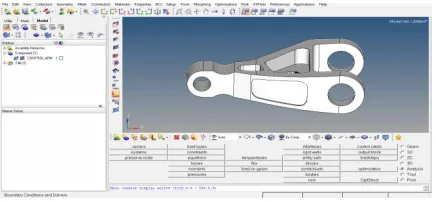
The details of the geometry are taken from an existing component and the 3D model is developed by the commercial tool “CATIA” as described above and the file is saved in step file. After developing the CATIA model, it is exported to HYPERMESH. The figure 4.1 shows the imported file from CATIA. Import the CAD model into Hypermesh V13. File → Import → Geometry → Browse .IGS file → import
Fig 4.1:Imported geometry in Hypermesh.
4.2Meshing
Steps involved in meshing of the geometry using Hypermesh are selection of mesh type, meshing method and type of elements used in the mesh as shown in figure4.2.
Mesh Type: 3D mesh
Mesh Method: Volume Tetra Mesher Mesh Element: Tetrahedral
ISSN(Online): 2319-8753 ISSN (Print): 2347-6710
I
nternational
J
ournal of
I
nnovative
R
esearch in
S
cience,
E
ngineering and
T
echnology
(An ISO 3297: 2007 Certified Organization)
Website: www.ijirset.com Vol. 6, Issue 6, June 2017
Fig 4.2: Meshing component
Finding Free Edges
In addition to the node connectivity problems, there could also be free edges in the generated mesh. The presence of free edges and T edges between the nodes and elements should thus be checked after meshing. If there are any free edges and T edges on the component, remeshing may be required to eliminate the free edges. The free edges in hypermesh could be found using Shift+F3 option. Free edges are shown in figure 4.3. Tool→ edges→ elements→ displayed→ find edges
Figure 4.3: Free edges of elements
Removing Edges:
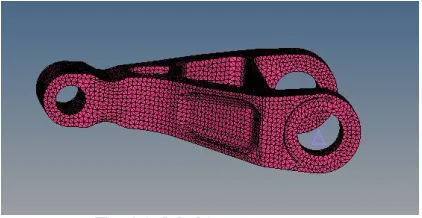
If there are any spurious edges that are created these edges are saved into temp file. From the temp file elements related to free edges can be found using shiftF3 and they can be removed. The final component, the control arm with the mesh is shown in figure 4.4.
Figure 4.4: Final meshed model
ISSN(Online): 2319-8753 ISSN (Print): 2347-6710
I
nternational
J
ournal of
I
nnovative
R
esearch in
S
cience,
E
ngineering and
T
echnology
(An ISO 3297: 2007 Certified Organization)
Website: www.ijirset.com Vol. 6, Issue 6, June 2017
Figure 4.5: Elements checking in hyper mesh
Calculate the Number of Nodes and Elements
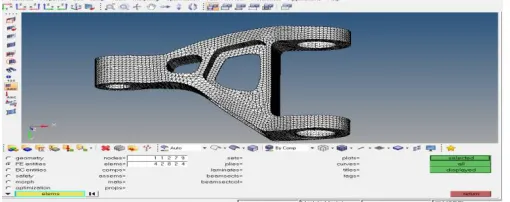
If there are no free edges and no failure elements on the component then the meshing is ready to do analysis. Before that the number of nodes and elements present on the existing model is calculated using tool option.The total number of nodes are shown in figure 4.6
Figure 4.6: No of nodes and elements displayed option in Hypermesh
Number of nodes in the model used here is 11279 and elements are 42824. The quality of total number of elements created is ensured by monitoring the parameters like jacobian, warpage, skew, aspect ratio and connectivity and verifying that they are within acceptable limits.
Dynamic axle loads:
ISSN(Online): 2319-8753 ISSN (Print): 2347-6710
I
nternational
J
ournal of
I
nnovative
R
esearch in
S
cience,
E
ngineering and
T
echnology
(An ISO 3297: 2007 Certified Organization)
Website: www.ijirset.com Vol. 6, Issue 6, June 2017
CASE :-1.The vehicle braking on level ground :
Figure 4.14: Forces acting on a vehicle during braking
The car is under negative acceleration as show in figure 4.13, an inertial reaction force denoted by (G/g.a) acting at the centre of gravity opposite to the direction of the acceleration . During the vehicle decelerates, load is transferred from the rear axle to the front axle.
By considering the equilibrium of moments about the front and rear tire-ground contact points, the normal loads on the front and rear axle are,
GFAdyn = ∗ . . , ( . × ) ( × . × ) = 13176.3172 N.
GFAdyn = ∗ . . , ( . × ) ( × . × ) = 16744.182 N
The transferred load to the front axle is found from the following equation GT = GFAdyn - GFA, 13176.3172-13165.02 = 11.2972 N.
Case2: The vehicle at the instant of Cornering: (Lateral Load Transfer on the Banking)
ISSN(Online): 2319-8753 ISSN (Print): 2347-6710
I
nternational
J
ournal of
I
nnovative
R
esearch in
S
cience,
E
ngineering and
T
echnology
(An ISO 3297: 2007 Certified Organization)
Website: www.ijirset.com Vol. 6, Issue 6, June 2017
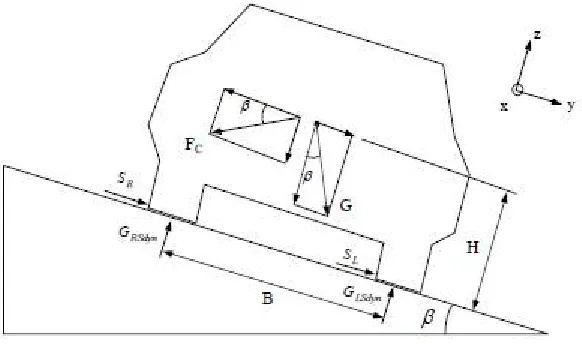
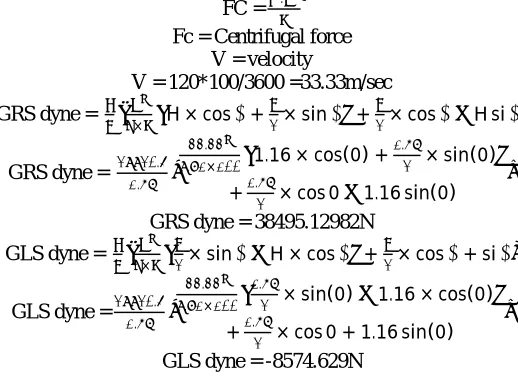
The centrifugal force which results from the speed V , the radius of the bend R and the total weight of the vehicle is;
FC = .
Fc = Centrifugal force V = velocity
V = 120*100/3600 =33.33m/sec
GRS dyne =
× H × cosβ+ × sinβ + × cosβ −H siβ
GRS dyne = .
.
.
. × 1.16 × cos(0) +
.
× sin(0)
+ . × cos 0−1.16 sin(0)
GRS dyne = 38495.12982N
GLS dyne =
× × sinβ −H × cosβ + × cosβ+ siβ
GLS dyne = .
.
.
. ×
.
× sin(0)−1.16 × cos(0)
+ . × cos 0 + 1.16 sin(0)
GLS dyne = -8574.629N
Transferred load from the left side to the right side of the vehicle while cornering GC = GRS dyne -
GC =38495.12982− .
GC =23534.879N.
Case: 3 The vehicle on a Downhill grade
Figure 4.16: Forces acting on a vehicle on a downhill grade
A negative grade causes load to be transferred from the rear to the front axle. On roads, the grade angle occasionally reaches 10 to 12 per cent,
The major external direction, the aerodynamic resistance Ra, rolling resistance of the front and rear tires Rrf and Rrr are neglected for this case,
The dynamic loads on the front and rear axle are determined by summing moments equilibriums
GFA dyne = (H. sin∝+ L . cosα)
ISSN(Online): 2319-8753 ISSN (Print): 2347-6710
I
nternational
J
ournal of
I
nnovative
R
esearch in
S
cience,
E
ngineering and
T
echnology
(An ISO 3297: 2007 Certified Organization)
Website: www.ijirset.com Vol. 6, Issue 6, June 2017
GFA dyne = . . (1.16. sin(11) + 1.27. cos(11)) =15146.0146N
GRA dyne = .
. (1.27. cos(11)−1.16. sin(11)) = 14163.99442N
Transferred load from rear axle to front axle is GT = GFA dyne - GFA
GT = 15146.0146-13165.02 GT = 1980.9946N.
Case:4 The vehicle at the instant of braking on a downhill grade
Figure 4.17: Forces acting on a vehicle braking on a downhill grade
The dynamic loads on the front and rear axle are determined by the summing moments equilibriums
GFA dyne = [G. (H × sinα+ L × cosβ) + F × H−F × H ]
GFA dyne = .
.
29920.5 × (1.16 × sin(11) + 1.276 × cos(11))
+28.24 × 1.16−797.30 × 1.11
GFA dyne = 71290.258N
GRA dyne = [G. (L × cosα −H × sinα) + F × H −F × H]
GRA dyne = .
.
29920.5 × (1.624 × cos(11)−1.16 × sin(11))
+797.14117 × 1.11−28.243 × 1.16
GRA dyne = 69397.4878N.
GFAw = , = . =35645.1291N.
The braking inertia force is: FA = m .a
The aero dynamic forces produced on a vehicle arise from two sources,from (or pressure) drag and rolling resistance of the tires. Drag is the largest and most important aerodynamic force. The aerodynamic drag is
FD = CD.A * *V2 FD = 0.32*3.482*1.288/2*33.332
FD =797.14117
The drag coefficient, CD is determined empirically for the car. The frontal area, A is the scale factor taking into account the size of the car. The frontal area of the vehicle in range of 79-84% of a car calculated from the overall vehicle width and height. The frontal area %80 of area is
A = 0.80.b.h, A = 0.80*1.961*2.22 A = 3.482m
ISSN(Online): 2319-8753 ISSN (Print): 2347-6710
I
nternational
J
ournal of
I
nnovative
R
esearch in
S
cience,
E
ngineering and
T
echnology
(An ISO 3297: 2007 Certified Organization)
Website: www.ijirset.com Vol. 6, Issue 6, June 2017
Hh =
Hh = .
Hh = 1.11m
The other major vehicle resistance force on level ground is the rolling resistance of the tires by the equation FR = G.fR. Cosα
FR = 29920.5*0.015*cos (11) FR = 440.561N.
Where and are the braking force of the front and rear axles, respectively. The magnitude of the transmission resistance is small and can be neglected in the braking calculations
V. EXPERMENTIAL RESULTS
Static Structural Analysis Mild steel
Lower control arms are generally made of mild steel due to their high compressive strength, wear resistance, excellent machinability, low cost, etc. First simulation is performed by taking the material of the control arm to be mild steel. The lower control arm behaves like a cantilever beam at the one hole side is fixed and two holes side is free. From the fig6.1 it is clear that maximum displacement occurs at the free end.
Figure 5.1: Displacement for mild steel reference design
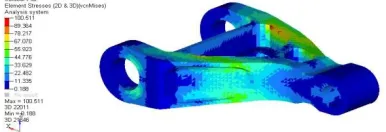
Based on the given loading conditions the model behaves like a cantilever beam. For cantilever beam the maximum bending stresses is developed at fixed support. The von Mises stress distribution of mild steel of lower control arm is shown in the figure6.2
Figure 5.2: Vonmises stress for mild steel reference design. Aluminium T6 Alloy
ISSN(Online): 2319-8753 ISSN (Print): 2347-6710
I
nternational
J
ournal of
I
nnovative
R
esearch in
S
cience,
E
ngineering and
T
echnology
(An ISO 3297: 2007 Certified Organization)
Website: www.ijirset.com Vol. 6, Issue 6, June 2017
Figure 5.3: Displacement for aluminium-T6design.
Figure 5.4: Vonmises stress for aluminium-T6design
OPTIMIZED MODEL MILD STEEL
After completion of topology optimization First simulation is performed by taking the material of the control arm to be mild steel. From the fig6.5 it is clear that maximum displacement occurs at the free end. The maximum displacement of mild steel material is 0.609mm
Figure 5.5: Displacements for mild steel optimize model design.
The optimized design is having the less stress when compare with the existing design as shown in Figure6.6. The vonmises stress of the optimized model is 63.527mm.
Figure 5.6: Vonmises stresses for mild steel optimize model design. Aluminium T6 Alloy
ISSN(Online): 2319-8753 ISSN (Print): 2347-6710
I
nternational
J
ournal of
I
nnovative
R
esearch in
S
cience,
E
ngineering and
T
echnology
(An ISO 3297: 2007 Certified Organization)
Website: www.ijirset.com Vol. 6, Issue 6, June 2017
Figure 5.7: Displacement for aluminium-T6 optimize model design
For cantilever beam the maximum bending stresses is developed at fixed support. The von Mises stress distribution of lower control arm is shown in the figure6.8. The maximum displacement of lower control arm is 62.940mm.
Figure 5.8: Vonmises stresses for aluminium-T6 optimize model design.
Discussion of Structural Analysis
The results of the structural analyses conducted for four different cases are summarized here. The maximum von Mises stresses and maximum displacements for each of two materials are as shown in the table 6.1, and they are also graphically presented in graph6.1 and6.2 respectively.
Final results
Materials
Base design Optimized design
Displacement (mm)
Vonmises Stress (MPa)
Displacement (mm)
Vonmises Stress (MPa)
Mild steel 0.618 100.51 0.609 63.527
Al-T6 1.813 99.717 1.026 62.94
Table: Results obtained from the static structural analysis Comparison of Stress
ISSN(Online): 2319-8753 ISSN (Print): 2347-6710
I
nternational
J
ournal of
I
nnovative
R
esearch in
S
cience,
E
ngineering and
T
echnology
(An ISO 3297: 2007 Certified Organization)
Website: www.ijirset.com Vol. 6, Issue 6, June 2017
Graph 5.1:Von mises stress for base model and optimize model
Comparison of Displacement
A comparison of maximum deflection in all the cases considered here shows that AluminiumT6 alloy before optimization gives largest deflection. Also, Mild steel is having the less displacement because of its density.
Graph 5.2: Displacement for base model and optimize model
MODAL ANALYSIS
In this analysis, we determine the vibration characteristics and it is also used to calculate the natural frequencies at corresponding mode shapes. Various mode extraction methods are available. The required boundary conditions are, two holes was fixed in all degrees of freedom and the material properties was given for extracting the first three mode shapes of control arm are shown below.
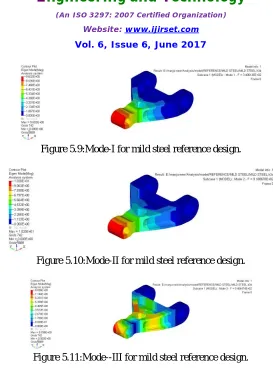
Mode Shapes of existing model – Mild steelMode1
The different mode shapes and its natural frequencies of the base model with mild steel are shown in Figures 6.9 – 6.11.
MILD STEEL ALT6
BASE MODEL 100.51 99.717
OPTIMIZE MODEL 63.527 62.94
100.51 99.717
63.527 62.94
0 20 40 60 80 100 120
STRESS(MPa)
BASE MODEL
OPTIMIZE MODEL
mild
steel Al t6
Base model 0.618 1.813
optimize model 0.609 1.026 0.618
1.813
0.609
1.026
0 0.5 1 1.5 2
Base model
ISSN(Online): 2319-8753 ISSN (Print): 2347-6710
I
nternational
J
ournal of
I
nnovative
R
esearch in
S
cience,
E
ngineering and
T
echnology
(An ISO 3297: 2007 Certified Organization)
Website: www.ijirset.com Vol. 6, Issue 6, June 2017
Figure 5.9:Mode-I for mild steel reference design.
Figure 5.10:Mode-II for mild steel reference design.
Figure 5.11:Mode--III for mild steel reference design.
Mode Shapes of existing model – aluminium-T6
The different mode shapes and its natural frequencies of the base model with aluminium –T6 are shown in Figures 6.12 – 6.14.
Figure 5.12: Mode-I for aluminium-T6design
ISSN(Online): 2319-8753 ISSN (Print): 2347-6710
I
nternational
J
ournal of
I
nnovative
R
esearch in
S
cience,
E
ngineering and
T
echnology
(An ISO 3297: 2007 Certified Organization)
Website: www.ijirset.com Vol. 6, Issue 6, June 2017
Figure 5.14: Mode--III for aluminium-T6design
Mode shapes of optimized model – Mild steel
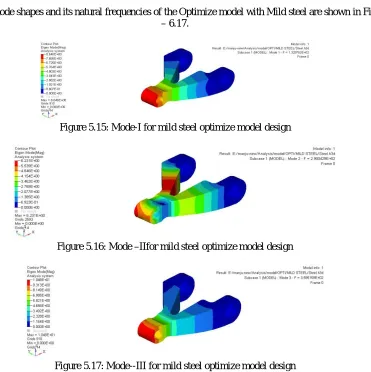
The different mode shapes and its natural frequencies of the Optimize model with Mild steel are shown in Figures 6.15 – 6.17.
Figure 5.15: Mode-I for mild steel optimize model design
Figure 5.16: Mode –IIfor mild steel optimize model design
Figure 5.17: Mode--III for mild steel optimize model design
Mode shapes of optimized model-aluminium-T6
ISSN(Online): 2319-8753 ISSN (Print): 2347-6710
I
nternational
J
ournal of
I
nnovative
R
esearch in
S
cience,
E
ngineering and
T
echnology
(An ISO 3297: 2007 Certified Organization)
Website: www.ijirset.com Vol. 6, Issue 6, June 2017
Figure : Mode-I for aluminium-T6 optimize model design.
Figure: Mode-II for aluminium-T6 optimize model design.
Figure: Mode--III for aluminium-T6 optimize model design.
Modal analysis results
Materials Base design Optimized design
Mode-1 Mode-2 Mode-3 Mode-1 Mode-2 Mode-3
Mild steel 3.406 9.188 9.464 1.329 2.900 3.595
Al-T6 3.258 8.810 9.124 4.027 8.839 9.123
Table : Results obtained from modal analysis Graph:
ISSN(Online): 2319-8753 ISSN (Print): 2347-6710
I
nternational
J
ournal of
I
nnovative
R
esearch in
S
cience,
E
ngineering and
T
echnology
(An ISO 3297: 2007 Certified Organization)
Website: www.ijirset.com Vol. 6, Issue 6, June 2017
Graph: : Frequency modes for base model
Graph:
Based on the above results we draw the graph between mild steel alt6 model by comparing for optimize model frequencies as shown in below.
Graph: Frequency modes for optimize model
Calculation of weight
The main objective of this study is to reduce the weight of the lower control arm using topology optimization and material optimization. In material optimization, it is necessary to introduce the materials having good mechanical properties like high strength to weight ratio. Mild steel and Aluminium alloy 7050T6 are used for this study to reduce the weight of the component. To calculate the weight of the model, use tool option displayed in Hyperworks. In tool option, click on the mass calculation option and select the all displayed elements to calculate the weight of the model as shown in Table
MODE-1 MODE-2 MODE-3
MILD STEEL 3.406 9.188 9.464
ALT6 3.258 8.81 9.124
3.406 9.188 9.464 3.258 8.81 9.124 0 2 4 6 8 10
BASE MODEL
MILD STEEL ALT6MODE-1 MODE-2 MODE-3
MILD STEEL 1.329 2.9 3.595
ALT6 4.027 8.839 9.123
ISSN(Online): 2319-8753 ISSN (Print): 2347-6710
I
nternational
J
ournal of
I
nnovative
R
esearch in
S
cience,
E
ngineering and
T
echnology
(An ISO 3297: 2007 Certified Organization)
Website: www.ijirset.com Vol. 6, Issue 6, June 2017
Materials Base design weight in(kg) Optimized design weight in(kg)
Mild steel 77.49 73.9
Al-T6 28.83 27.3
Table : Weight of the models with three different materials
Total weight reduction
Initial Weight of the component = 77.49 Kg
Weight of the optimized model after material optimization = 27.3 kg
Totalweightreduction = Initialweight−Finalweight
Initialweight
= . .
.
Percentage of total weight Reduction = 64.76%
Graph: Weight optimization for base model and optimize model
From the Graph, it is found the weight of the optimized model with aluminium-T6 is very less compared to mild steel. Hence the optimized model with aluminium-T6 is well suited for automobile applications.
MILD STEEL AL T6
BASE MODEL 77.49 28.83
OPTIMIZE MODEL 73.9 27.3 77.49
28.83 73.9
27.3
0 20 40 60 80 100
W E
I G H T
(
k g
) BASE MODEL
ISSN(Online): 2319-8753 ISSN (Print): 2347-6710
I
nternational
J
ournal of
I
nnovative
R
esearch in
S
cience,
E
ngineering and
T
echnology
(An ISO 3297: 2007 Certified Organization)
Website: www.ijirset.com Vol. 6, Issue 6, June 2017
V.CONCLUSION AND FUTURE WORK
In this study, topology optimization approach is presented to create a new design of a lower control arm. Comparison between the existing model and optimized model is done in terms of stress, weight and the performance of the component. In this study, weight reduction of lower control arm is taken into consideration without varying the performance of the component. Firstly the process of the topology optimization involves the material distribution, which resulted that the weight of the existing industrial component is reduced to % of its total weight. The lower control arm has further undergone weight reduction using the different materials through the usage of ALTAIR OPTISTRUCT SOFTWARE. The obtained results states that % of weight reduction is done to the component. In this paper we have seen that the weight of the component is reduced to 64% by using optimized Aluminium Alloy 7075 T6 material made component. The future scope of this work focuses on the cost reduction of the material without varying the weight of the component. After the careful analysis of the better material the product is further undergone to topology optimization using Hyperworks software. The manufacturability of the component is been analyzed using the ALTAIR OPTISTRUCT and Optistruct analysis. Based on the results in this study, we proposed that the optimized model with Aluminium alloy 7075 T6 is best suited for the lower control arm.
REFERENCES
1. “Structural Design Method of a Control Arm with Consideration of Strength” By Jong-Kyu Kim 9th WSEAS Int. Conference on Applied Computer and Applied Computational Science Issue ISSN: 1790-5117.
2. “Met model-based optimization of a control arm considering strength and durability performance” by Xue Guan Song 2010 ELSEVIER journals Issue ISSN 976-980.
3. “Design and Optimization of Sheet Metal Control Arm for Independent Suspension System” by Nagarjuna.P October 2012 IJERA journal ISSN: 2248-9622.
4. “Design Analysis and Simulation of Double Wishbone Suspension System” by Vivekananda June 2014 IIJME journal Volume 2 Issue 6 5. “Design of Electro-Hydraulic Active Suspension System for Four Wheel Vehicles” by Hemanth.D April 2014 IJETAE journal Volume 4 Issue
4 ISSN 2250-2459, ISO 9001
6. “Finite Element Analysis and Topology Optimization of Lower Arm of Double Wishbone Suspension using RADIOSS and Optistruct” by Vinayak Kulakarni May 2014 IJSR journal Volume 3 Issue 5 ISSN: 2319-7064
7. “Modelling and Finite Element Analysis of Double Wishbone Suspension” by Amol Patil April 2014 IJIRSET journal Volume 3 Issue 4 ISSN: 2319-8753
8. “Finite Element Analysis and Topography Optimization of Lower Arm of Double Wishbone Suspension Using Abacus and Optistruct” by Sagar Darge July 2014 IJERA journal volume 4 Issue 7 ISSN: 2248-9622