Static and Dynamic Analysis of Impeller of
Centrifugal Blower
Dinesh Tare1, Vaibhav Bhagat2, Basavaraj Talikoti3
P.G. Student, Department of Mechanical Engineering, PHCET, Raigad, Maharashtra, India1 Assistance Professor, Department of Mechanical Engineering, PHCET, Raigad, Maharashtra, India2
Associate Professor, Department of Mechanical Engineering, PHCET, Raigad, Maharashtra, India3
ABSTRACT:A blower is mechanical gadget give air to ventilation and modern procedure prerequisites. Blower creates dynamic vitality to move air and gasses against a resistance brought on by pipes, dampers and channel or different parts in a framework. The blower rotor gets vitality from pivoting shaft and transmits it to the air. Blowers are generally utilized as a part of modern and business applications from shop ventilation, material taking care of and heater applications to a portion of the vehicle cooling frameworks.
This project deals with the study of impeller design of centrifugal blower manufacturing company. In this study operating mechanism of impeller and analyse the static and dynamic design. The organization is confronting numerous issues with respect to diffusive blower. They are utilizing outward blower utilized for ventilation reason, likewise they are utilizing blower to keep up the temperature of sustenance stockpiles .The present divergent blower is comprised of from M.S. material here erosion is a noteworthy issue. Because of the erosion life of blower is less. The destructive elements of the same are blending with organic product pulps, which are hurtful, additionally weight of the present blower is high and vibrations created by the given radiating blower is more.
The above problem solve by using changing the blower material. The present divergent blower is framed from M.S. material here erosion could be a noteworthy issue; this will be lessened by changing blower material i.e. during the project work SS316L material is used to control the erosion problem of the blower. Weight of the diffusive blower is lessened by and beside increases its strength, by optimization of static analysis and dynamic analysis by using FEA for the MS, SS, and SS316L (Food Grade Steel). During this project work modal analysis is finished for the MS, SS, SS316L that could be a food grade material and natural frequency of the blower is compared with frequency of external excitation so as to cut back vibrations and failure of the centrifugal blower fan.
KEYWORDS: Impeller of blower, CATIA V5 R20, ANSYS 14.5
I. INTRODUCTION
Most assembling plants utilize fans and blowers for heat ventilation and air conditioning, need a wind stream for pharmaceutical and air process industry. Fan frameworks is key to continue producing forms working, and comprise of a fan, an electric engine, a drive framework, conduits, funneling, stream control gadgets, and aerating and cooling hardware (channels, pipe, cooling loops, condenser, evaporator , and so forth.
higher temperatures and medium edge tip speeds. Forward-bended fans are utilized as a part of clean situations and work at lower temperatures. They are appropriate for lower tip rate and high-wind current work - they are most appropriate for moving vast volumes of air against moderately low weight. In reverse slanted fans are more productive than forward-bended fans. In reverse slanted fans achieve their crest power utilization and force request drops off well inside their useable wind stream range. In reverse slanted fan are known as "non-over-burdening" on the grounds that adjustments in static weight don't over-burden the engine.
II. PROBLEMSTATEMENT
Rotating blower is comprised of from M.S material. When blower works under wet environment it may corrode and formation of scale on it. This corrosion and scale formation may lead to affect life & performance of blower. In this project corrosion is a problematic undesired chemical ingredients cumulatively to add pollute ingredients in the food and pharmaceutical Industries process. Due to the corrosion life of the bower is reduced. The corrosive ingredients are mix with an equivalent with food that is harmful for human life; conjointly heaviness of ms material blower is more and also considerable measure of vibration
III.OBJECTIVESOFTHEPROJECT
To study operations of blower under mechanical conditions.
To reduce the weight of the impeller of centrifugal blower by selecting various materials like MS, SS, SS316L. To Observe experimentally the reading torque of shaft, load, various frequencies of vibration of impeller, and
temperature
To develop solid model of impeller with static part CATIA To analyse static and dynamic stability of impeller by ANSYS To validate the simulated results with experimental results.
IV.SOLUTIONPROCEDURE
1) To Reduce Corrosion Problem of Centrifugal Blower and increase life of blower:
The M.S material rotating blower is a corrode and scale formation problem and its noteworthy downside. This corrosion and scale formation may lead to affect life & performance of blower. The corrosive ingredients are mix with an equivalent with food that is harmful for human life; conjointly heaviness of MS material blower is more and also considerable measure of vibration.In this project work to avoid corrosion downside of centrifugal blower SS316L (Food Grade Steel) material is employed rather than MS material because of its corrosion resistance properties and this material is food grade steel. Stainless-steel offers extraordinary imperviousness to consumption.
2) Static Analysis of Centrifugal Blower to Optimize the Weight and enhance the strength
(a) (b)
Fig.01 Modelling of blower (a) Blower Model (b) Meshing
3) MESH GENERATION
In order to hold out a finite part analysis, the model we tend to area unit victimisation should be divided into variety of little items called finite parts. Since the model is split into variety of separate components, FEA will be delineated as a discretization technique. In straightforward terms, a mathematical web or “mesh” is needed to hold out a finite part analysis. If the system beneath investigation is 1D in nature, we tend to might use line parts to represent our pure mathematics and to hold out our analysis. If the matter will be delineated in 2 dimensions, then a 2nd mesh is needed. Correspondingly, if the matter is complicated and a 3D illustration of the time is needed, then we tend to use a 3D mesh refer fig 01 (b).
5.4) ANSYS 14.5:
ANSYS Work bench may be thought of as a computer code platform or framework wherever you perform your analysis (Finite component Analysis) activities. In different words, bench permits you to arrange all of your connected analysis files and databases underneath same frame work. Among different things, this implies that you simply will use an equivalent material properties set for all of your simulation.
(c) (d)
(e)(f)
(g)(h)
Fig 02 (a) Defomation of MS blower (b) Stress of MS blower (c) Defomation of SS blower (d) Stress of SS blower (e) Defomation of SS316L blower (f) stress of SS316L blower (g) Defomation of SS316L blower(opti)
Fromthe static analysis of impeller of centifugal blower, by using simulation software determine deformation of different material like MS, SS, SS316L and SS316L (opti) and also determine stress of material like MS, SS, SS316L and SS316L (opti). From the above figure shows stress and defromation of impeller.
Table No:- 1 Results & Discussions
Sr. No. Material Stress (MPa) Deformation(mm) Weight (Kg)
1 MS 7.0313 0.042438 36.394
2 SS 6.3616 0.047647 35.93
3 SS316L 6.2856 0.032549 35.93
4 SS316L (Optimized) 7.7023 0.038594 32.93
The most extreme deformation incited in SS316L material is 0.038594 mm, breaking points safe for this value of deformation. Thus taking into account inflexibility the configuration is protected. The stress induced for the SS316L material is 7.7023 Mpa and this will be in safe limit. Hence is the allowable and safe stress as design criteria. If we compare corresponding deformation of the material MS, SS on above results SS316L material having minimum deformation therefore there are less chances of failure of the blower fan as compare to other two materials. Hence the strength of blower gets increased because of the SS316L material. From the above result table it is clear that weight of the SS316L blower fan material is minimum as compared to other material, hence weight of the blower fan optimized.
V. MODAL ANALYSIS OF CENTRIFUGAL BLOWER FAN
MS blower
SS blower
(c)(d)
SS316 L blower(opti)
(e)(f)
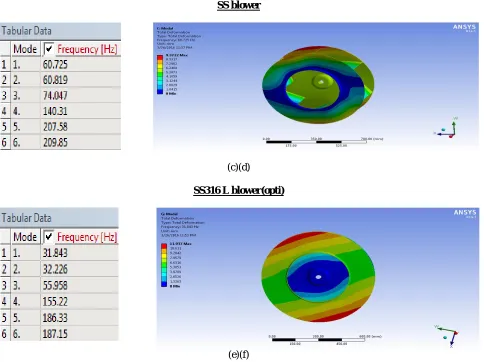
Fig 03 (a) MS blower mode shape table (b)MS blower first mode shape and its deformation(c)SS blower mode shape table (d) SS blower first mode shape and its deformation (e) SS316L(OPTI) blower mode shape table (f) SS316L blower first mode shape and its deformation
Results analysis of Eigen system gives the main basic rate of MS blower is 64.209 Hz and that of SS316L blower is 31.843 Hz. The vibration frequency is decreased in the SS316L material blower because of more firmness. This result shows that SS316L material blower is as per problem statement because of experimental result compare with the simulation result.
F1=
Table2. Comparison of first five natural frequencies of MS and SS316L
Sr. No. of Modes
Vibration frequencies of impeller made from MS
material(Hz)
Vibration frequencies of impeller made from SS
material(Hz)
vibration frequencies of impeller made from SS316L material with1mm reduced thickness(Hz)
1 64.209 60.725 31.843
2 64.296 60.819 32.226
3 78.011 74.047 55.958
4 148.21 140.31 155.22
5 222.6 207.58 186.33
6 224.7 209.85 187.15
Table3. Comparison of Deformations of MS and SS316L blower
From above table it is clear that SS316L with 1mm reduced thickness have less deformation for different modes. Therefore there are less chances of failure the material, also from table 2 it is clear that the natural frequency of SS316L with 1mm less thickness blower is reduced because of more firmness.
VI. CONCLUSION
1. Corrosion issue of the radiating blower is decreased (93.7%) by utilizing material SS316L (Food Grade Steel), which is very erosion safe. Thus there won't be any blending of elements of erosion in natural product pulps as talked about in issue definition. Weight of the Centrifugal blower is optimized by using SS316L material (i.e.33.073 Kg which is less as compared to MS material i.e. 35.93 Kg)
2. SS316L material having least deformation subsequently, there are less chance of failure of the blower fan as contrast with other two materials. Consequently the quality of blower increase.
3. From above result we reason that SS316L steel is the best material for blower fabricating according to modern prerequisite.
4. Vibration issue of divergent blower decreased by utilizing SS316L material as a result of its high firmness and layup succession in fan.
REFERENCES
1. Atre Pranav C, Thundil Karuppa Raj R. Numerical design and parametric optimization of centrifugal fans with airfoil blade impeller. [Journal]. - Vellore : Research Journal of Recent Sciences, 2012. - Vol. 1. - pp. 7-11.
2. Y.Devender Goud,K Deepak.Design and analysis of centrifugal blower using composite marteial. [Journal]. - Telangana : International Journal Mode MS Deformation SS Deformation SS316L-1mm reduced thickness
Deformation
1 9.3067 9.3732 11.937
2 9.1647 9.2205 11.937
3 9.8699 9.9189 8.8338
4 10.403 10.464 11.878
5 62.19 64.36 18.074
3. Karthik Matta, Kode Srividya Static and dynamic response of a centrifugal blower impeller using FEA [Journal]. - Vijayawada : International Journal of Applied Sciences, Engineering and Management, September 2013. - 5 : Vol. 2. - pp. 101-105.
4. L.Durga Prasad , D.Dev Singh, B.Sridhar Babu Static and dynamic analysis of centrifugal blower using composite material [Journal]. - Hydrabad : International Journal of Latest Trends in Engineering, Science and Technology, 2012. - 3 : Vol. 2.
5. M.Sampathkumar, Dsvsra Varaprasad, Vijaykumar. Static analysis of centrifugal blower using composite material [Journal]. - Hyderabad : The International Journal Of Engineering And Science (IJES), 2014. - 9 : Vol. 3. - pp. 25-31.
6. Mohd Zubair Nizami ,Ramavath Suman,M.Guru Bramhanada Evalution of static and dynamic analysis of a centrifugal blower [Journal]. - Hydrabad : International Journal of Advanced Trends in Computer Science and Engineering., 2013. - Vol. 2. - pp. 316-321.
7. Veeranjaneyulu Itha ,T.B.S.Rao Static and dynamic analysis of a centrifugal blower using FEA [Journal]. - Vijayawada : International Journal of Engineering Research & Technology (IJERT), 2013. - 8 : Vol. 1. - pp. 1-11.