ANALYSIS OF A MUTATOR
KLAUS MAMPELL
Wm. G . Kerckhoff Laboratories of the Biological Sciences, California Institute of Technology, Pasadena
Received May 18, 1945 INTRODUCTION
PONTANEOUS mutation is a well known phenomenon. A mutation is
S
considered spontaneous when it cannot be traced back to some agent which is known to influence mutability. The causes of “spontaneous” mutation can be investigated when strains are found which differ noticeably in their inherent mutability.Recently, high mutation frequency in a strain of
D.
pseudoobscura, race B, was found to be due to a dopinant mutator (MAMPELL 1943). During the work on that strain a culture appeared which was characterized by a high number of Minutes and Minute mosaics. This led to the present investigation on a re- cessive mutator.The analysis of abnormal mutability offers some difficulties. The phenotype in this case is the mutability found in an individual’s offspring, and this phenotype can be safely identified only when the numbers are large; for the frequency of mutant individuals may overlap that characteristic of wild type. The fact that an individual produces no mutation does not necessarily mean that it is wild type with respect to mutation frequency. When an individual does produce a mutation, it may merely be a “normal spontaneous’’ one. A certain number of mutations in this investigation are probably not induced by the recessive mutator, but no means are available for excluding them. These various factors introduce some inaccuracies which cannot be avoided.
These disadvantages are probably not serious in the present investigation. Hundres of thousands of flies were examined; the individual tests were usually carried out on a large scale and a t different times. Furthermore, the mutability induced by this recessive mutator is usually so high, and qualitatively so dis- tinct, that a confusion with normal mutability is hardly possible.
All cultures are the results of pair matings. To avoid confusion with other mutation processes, only Minutes are taken as indicators of the presence of the mutator, since they are typical of the effect produced by this gene.
THE APPEARANCE OF THE PHENOMENON
MUTATION INDUCING FACTOR 497 for a certain number of Minute individuals; if they cannot be told apart by appearance, ten mutants may be the result of one or of ten mutations. But in the case of mosaics, it is known that each mosaic individual is the result of a t least one mutation.
There is no doubt that the mosaics represent real mutations, since in some cases they affect the germ line and are then inherited as single factors. About 32 percent of the mosaics are sterile, about 54 percent are fertile b u t do not have the germ line ;affected by the mutation; about 14 percent are fertile and transmit the mutant gene for which they are mosaic.
Most notable among other phenotypes which make an occasional appearance TABLE I
Distribution of mutations. .-
X-CHROMOSOME I1 CHROMOSOME
Minute 4 ;$5.5 Sm9ky 0.0 (so)*
Ngtch ( 2 6 ) * Minute 8
Minute 17
.
Minute 14Minute 19 Minute 16
Minute 18
Minute 2 2
Minute 23
III CHROMOSOME
Minute 5 Minute 6
Minute f
Minute IO Minute 1 2
Minute 15
Minute 2 0
I V CHROMOSOME
Minute 3 0.0
Minute I Minute 2
Minute 9
Minute I I Minute 13
Minute 2 1
*
Numbers in parenthesis refer to number of occurrences.in the cultures are Smoky and Notch. Both, like the Minutes, may be mosaics a s well as whole mutants.
The mutability affects the male and the female offspring equally. The rela- tive numbers of male and female mosaics are so nearly alike that no difference can be assumed.
THE RECESSIVE MUTATOR GENE
From outcrossing flies of the mutating cultures t o those of normal cultures (Reedsport) the results summarized in table 2 were obtained. Only the males
produce mosaics in their offspring. The number of mosaics produced by the females is negligible when compared to that of the males. I n Fz only a small number appear in either outcross, but in F1 an appreciable number are obtained from each outcross. Judging by the mosaics, an autosomal recessive gene is
498 KLAUS MAMPELL
TABLE 2
Result of crossingjies f r o m mutating line to flies from normd line.
d outcross 9 outcross
P
+
9 0 from + d d from cultures with X cultures with 0.00% mosaics 7,65% mosaics(0 in 9935) (1004in 13121)
’%of %of mo- Min- No. of mos. Min. saics utes flies
Fz 0 . 0 2 0.77 2 85 11100
F8 0.60 0.70 34 40 5683
+
0 0 from cultures with 8.83% mosaics(678 in 7680)
mos. Min. %of % o f
0.07 0.53
0.16 0 . 0 0
0.81 0.88
X d d from X cultures with
0.00% mosaics
(0 in 7597)
mo- Min- No. of saics utes .+lies
6 41 7779
7 0 4300
37 40 4573
they transmit the gene. The appearance of the whble Minutes will be discussed later.
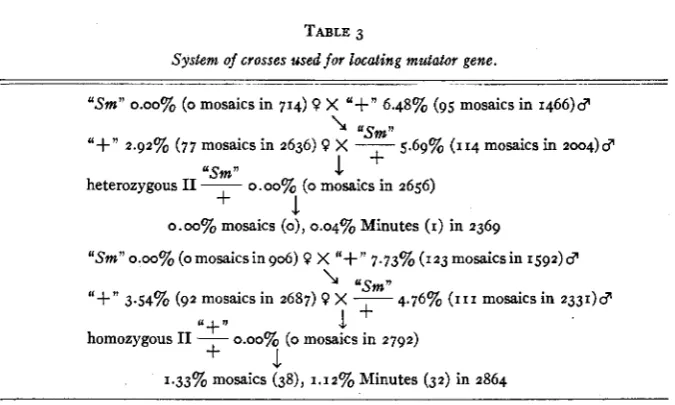
I n order to assign the recessive mutator to its chromosome a system of
crosses was used as shown in table 3. Only those males produce mosaics which
TABLE 3
System of crosses used for locating mutator gene.
‘Sm” 0.00% (0 mosaics in 714) 9
x
‘+’
6.48% (95 mosaics in 1466)d___ - -
I
USm”‘+’
2.92% (77 mosaics in 2636) 0 5.69% (114 mosaics in 2004)d0.00% mosaics (o), 0.0470 Minutes (I) in 2369
‘Sm”o.oo% (omosaicsin906) 0 X ‘I+” 7.73% (123 mosaicsin 15gz)d
L USm”
‘I-!-’’ 3.54% (92 mosaics in 2687) 0 X - 4.76% (111 mosaics in 2331)d
, I
It+.
1 ‘
+
1
homozygous I1 - 0.00% (0 mosaics in 2792)
1.33% mosaics (38), 1.12% Minutes (32) in 2864
Flies were taken from cultures with the average mutability indicated in percentage; total num- bers are given in parentheses.
499
Several reasons can be given for the predominance of mosaics. The indi- viduals which h a w some wild type tissue may survive more often. Most of the gross mutations are lethal to the individual, and they may be detected only when they occur late enough to affect only part of the fly. Thus, dominant lethals are sometimes detected when they happen to be linked to a dominant marker gene and when they arise early in the development of the germ line. On outcrossing such an individual to an unrelated fly the ratio of the dominant to wild type would be upset; such a case has been observed a t least once. A
male heterozygous for Stubble was outcrossed to a wild type female. There were seven Stubble flies and 358 wild type flies in the offspring; the Stubble flies had tumors and were weak. Sometimes flies emerge with various parts missing. This could be interpreted as the result of the action of dominant lethals arising in somatic tissue and accounting for the missiag parts (usually of the thorax, such as legs, wings, and halteres). Obviously, if the dominant lethal occurred somewhat earlier the whole fly would be missing, and the mutation would not be discovered.
Another reason is the greater probability of detection of slight mutants in mosaics. Slight variations in bristle length, are easily overlooked when the entire fly is of mutant phenotype, because these slight mutant types overlap the effects produced by normal variation; when the two kinds of tissue occur in the same fly, however, there is no doubt that a mutation accounts for the difference.
Neither of the above reasons could completely account for the unusually high number of mosaics. There is undoubtedly a more basic cause for their abundance. It is important to know the time a t which the mutation responsible for the mosaic has arisen. The mosaic could be the result of mutation in the sperm head after t'he chromosome has split, or it could be the result of somatic mutation in the zygote or any later stage.
If the mutation leading to the production of the mosaic has arisen in the gamete, the flies would be expected to be approximately bilateral mosaics in the great majority of cases. Although bilateral mosaics are actually observed to be the most frequent ones, it is clear that they are also the easiest to detect. On the scale a t which this work was carried on, involving the examination of hundreds of thousands of flies, it was obviously not feasible to look for mutated patches no larger than one cell. However, there is on record a consid- erable number of individuals which were mutated for only half the thorax, half the head, or half the abdoKen, or for the sterncpleural bristles only, or a combination of those or certain other patterns. It is perhaps an adequate approximation to consider the bilateral mosaics the most frequent, the one- quarter mosaics the next most frequent and so forth. On the basis of pattern it
is not safe to come to a conclusion about the above alternatives of gamete and somatic mutation, respectively.
I n the mutating cultures mosaics for sex linked recessives have been ob- served. If those are induced by the mutator gene, the mutation cannot have
500 KLAUS MAMPELL
arisen in the sperm head, but a t the earliest in the zygote, since the chromo- some concerned is of maternal origin. This, then, is evidence in favor of somatic mutation. Some interesting mosaics will now be described.
Certain Minute mosaics serve as an indication that “deficiencies” of varying extent are produced. When a wild type male was outcrossed to a SJubble fe- male, in two instances, a mosaic occurred in the offspring which was Minute for half the thorax without indication of Stubble, whereas the unmutated half was Stubble. This is interpreted as a deficiency including the Stubble locus, and by removing the gene, it would also remove its phenotypical effect. I n a similar case, when a wild type male was outcrossed to a Stubble HairlessE fe- male, a mosaic female in the offspring was Stubble HairlessE on the right side, whereas the mutated left had an abnormal eye and wing, but was wild type for bristles. This probably means that a deficiency arose long enough to include both the Stubble and HairlessE loci, thus removing their phenotypic effects. Similarly, in two instances of an outcross to a Stubble female, there occurred a female one half of which was Stubble, while the other half was wild type for bristles, but had a smaller eye and w b g . The latter three cases may also be explained on the same basis as the two following ones-namely haploidy for part of the tissue.
There are two examples for this kind of mosaic. I n one case a wild type male was mated to a female homozygous for seven sex-linked mutant genes: bdCt sct d y rs st se s. I n the progeny, one mosaic was wild type female on one side and bdct sct d y rs st se s female on the other side. Similarly, a bdCt sct d y rs st se s
male was mated to a female heterozygous for wild type and bdCt sct d y I S st se s. I n the progeny a mosaic occurred which was wild type female on the right half and bdCt sct d y rs st se s female on the left half. Since the side showing the sex- linked recessives was female in both cases, it could not have arisen merely by elimination of an X chromosome, for then, that part would have been male. Although in both cases other explanations are possible, it could both times be a matter of an entire chromosome set being eliminated. Then the part re- vealing the sex-linked recessives would be completely haploid and, therefore, normal female. I n the first case the male set, in the second case the female set could have been the victim. Haploid-diploid mosaics have been described also in
D.
melanogaster where they were first observed (BRIDGES 1925), inD.
mi- randa-D. pseudoobscura hybrids (MACKNIGHT 1937)) and inD.
pseudoobscura(CREW and LAMY 1938).
Gynandromorphism also has occurred repeatedly. It could likewise be ex- plained on the basis of an entire chromosome being eliminated. One reason for this a i g h t be a mutation of the centromere, its deficiency or inactivation. This would account for both types of observed aneuploidy. Elimination of other chroaoson es or chromosome combinations by the same mechanism would probably result in lethality.
the zygote; the same is true for the gynandromorphs. If these have been in- duced by the mutator, it seems likely that the majority of the mosaics is due to somatic mutation. Further evidence for s o a a t i c a u t a t i o n is given in the next section.
hNALYSIS O F MALE AND F E M A L E OUTCROSSES
As can be seen in table 2 , the F1 of the male outcross has mosaics and whole
Minutes; the Fz has practically only whole Minutes. If the mutations occur in the FI giving rise to the mosaics in that generation, we should expect the germ line to be affected and should obtain whole a u t a n t s in Fz. If the F1 shows no mosaics, as is nearly so in the case of the ferrale outcross, we should expect no whole mutants in Fz. None are observed in that case. I t n ust be emphasized that the whole Minutes in the Fz of the male outcross do not represent the off-
spring of FI Minute mosaics, but of F1 wild tyFe flies. This is strong evidence in favor of the mutations responsible for the mosaics arising in the mosaics themselves, and not in the father’s gaaetes.
We have seen that, on outcrossing, a male Kust be homozygous for the mutator to give mosaics in its offspring. The mutations occur in the F1 in- dividuals, both matle and female, although they are heterozygous. Thus arise the mosaics in F1 and the whole mutants in Fz. This is the cause of the whole mutants in the F1 of the female outcross; they represent the residue of the mutation-inducing capacity of the maternal grandfather.
This forces u s to a curious conclusion. On the basis of the available evidence we must assume that the mutator gene, when homozygous, is responsible for the production of a factor or factors transmitted through the cytoplasm of the sperm. The F1 individual, being heterozygous for the mutator, produces the normal wild type counterpart of this cytoplasmic con-ponent. And, unless the component should be self-reproducing to s o a e extent, the abnornial component in the F1 should decrease a t least by a factor of two with each cell generation. The bilateral mosaics should be twice as frequent as the one-fourth, the one- fourth twice as frequent as the one-eighth and so forth. The least frequent should be the mutations affecting only one son atic or germ cell, for, by that time, the abnormal component would be too dilute to be very effective.
Now, we must grant the wild type sperm the same right as the mutator sperm; it would transmit the normal component. Therefore, a fly which is homozygous for the mutator, as one-fourth of the FZ would be, ought not to be- gin mutating until the normal component is too dilute to be effective. Or, we should here find the reverse of the former case-that is, the bilateral mosaics should be the least frequent and the single cell mutations the most frequent. We notice the lack of an appreciable number of mosaics in Fz. However, the result of germ cell mutations should show and does show in the FB of either outcross, even though the mosaics in Fz were very scarce.
5 0 2 KLAUS MAMPELL
components as the centriole which are usually transmitted through the sperm, and not through the egg. Furthermore, such components as mitochondria and Golgi bodies may be contributed by the sperm to a larger extent than by the egg. They may also be of quite different appearance or function in sperm and egg, respectively. It is not new to find that an individual’s characteristic de- pends on the genic make up of the female parent; this is known as a maternal effect. As concerns the observable effect on mutability, in this case, the roles are reversed. An individual’s mutability depends in fact on the genic make up of the male parent; therefore, this should be called a “paternal effect.”
The alternative reason for the lack of mutation in the F1 of female outcrosses does not contradict the paternal effect which in fact exists. It does contradict the supposition that the sperm contributes a component which is necessarily absent in the egg.
It must first be ascertained whether homozygous females are produced a t all and, if so, whether they are fertile. It was found that the mutator is not lethal to the females nor does it sterilize them. There remains one reason for the lack of mutability from the female aside from purely physiological ones. Perhaps the mutator gene can produce its effect only in the presence of a Y chromo- some. This would not have to be a specific Y chromosome as is obvious from the fact that the mutability reappears in the FI of a female outcross. If the supposition were true, the mutator might show its effect in an XXY female. This has not yet been tested. I n this argument it is assumed that the egg is potentially capable of transmitting the cytoplasmic component.
THE MUTATION RATES
There is a general correlation between the mutation rate of the parent cul- tures and the rate of the offspring cultures. The offspring cultures show an increasing number of mutations with an increasing number in the parent cul- tures, as can be seen in table 4. The parent cultures in the 6.st row are those with between 4.5 and 7.5 percent mosaics, in the second row with between 7.5 and 10.5 percent mosaics, in the third with more than 10.5 percent mosics. Only
cultures with a t least three previous generations of inbreeding were included. All the pair matings established from these are summarized under “offspring cultures.” The average number of flies per culture depends to some extent on the mutability. The higher the mutability the lower is the number of flies in a culture.
With a greater mutability as judged by mosaics we should expect the whole Minutes to rise proportionally. There should be a correlation between the per- centage of mosaics of a certain culture and the percentage of Minute flies in the offspring of the individuals from that culture. Table 4 shows this to be the case.
tribution. The extremes of the distribution would tend to go back to the center.
Only wild type individuals are used for breeding. Thereby, the more muta- ble ones are const(ant1y selected against. Furthermore, a gene that has mu- tated, cannot mutate again (where we are dealing with deficiencies or some- thing corresponding to them). I n the absence of selection for it, the phenom- enon, in time, would mutate itself out of existence.
The mutation ra.te may also be influenced by the kind of mating. When a homozygous mutator male is outcrossed to a homozygous wild type female, we should not expect ais many mosaics in the offspring as when we cross this male to a heterozygous or homozygous mutator female. I n the former case the mosaics would be only the residue of the mutation-inducing capacity of the father. I n the latter two crosses mosaics would occur because of that mecha-
TABLE 4
Different leoels of mzdability.
____ __-__
Parent cultures Offspring cultures
-
No. of %of %of mosaics Minutes
% of No. of No. of
mosaics mosaics flies flies mosaics Minutes
6.14 2151 35014 1128 565 30547 3.69 1.88
8.63 2027 23490 667 367 15882 4.20 2.31
13.88 2027 14596 725 281 10642 6.81 2.64
nism as well as froin the mutation-inducing capacity of the individuals them- selves, for here half the individuals or all the individuals respectively are homozygous for the mutator; they could begin mutating in the zygote, because no wild type component is contributed by the sperm. I n the cross of two hetero- zygotes we supposed that the resulting homozygotes would not mutate a t this early stage since the wild type component would prevent this.
Homozygous females may on occasion produce mosaics and thus provide an additional factor for influencing the mutation rate.
But, as can be seen in table 4, the level of mutability tends to be maintained in a certain line. This suggests a further influence on mutability.
504 KLAUS MAMPELL
practically IOO percent mutations. This could be accomplished by selecting for
or against the genes which are readily influenced by the mutator. There must be many such mutators controlling or influencing the over-all mutation rate of a particular strain, and a certain gene may be susceptible to one but not to another of these mutators. I n the various cases of rises in mutation frequency described in the literature the phenomenon soon disappeared. This could be explained by the rapid “acclimatization” of the genic complex. The sudden rise of mutation frequency itself can be explained on the same grounds- namely, when genes are taken out of their normal mutator environment and subjected to a new one by crossing or hybridization, they would undergo a temporary high mutability (STURTEVANT 1939, and others). This suggestion of susceptibility receives support from the following observation.
MUTATION FASHIONS
On the basis of the individual susceptibility of the genes to the mutator, another phenomenon can be explained which has been observed repeatedly in the mutating cultures: mutation fashions. The mutability in different lines may be distinguished qualitatively in some cases. The two main characters which occur in fashions are Smoky and Notch. The predominant phenotype is Min- ute, and it is the Minute mutations for which the lines were constantly selected. Minute is the commonest mutant phenotype in Drosophila; many loci in dif- ferent chromosomes are known to produce this effect. But in certain lines there has been a high proportion of Notch or Smoky or certain other mutations. These fashions may persist for some time, and evidently they can be selected for. This is not surprising; in those cases we would select for a susceptible wild type allele of Smoky or of Notch or of a certain other region in preference to the Minute regions. The different kipds of mutability on the basis of our ex- planation would of necessity have to be qualitative as well as quantitative.
THE IRREGULARITIES
There are several stocks of Drosophila pseudoobscura as well as other species which have persistently shown an unexpected number of mutations of the type described here. Although mutability in these strains is nowhere near as high as in the mutator strain, it warrants careful analysis. This is now in prog- ress. The research with these strains has not advanced far enough to allow discussion a t this time. But the existence of the phenomenon should be men- tioned here, because it would introduce irregularities into the mutator strain. The degree of the irregularities cannot be measured as long as we do not know more about the new phenomenon. The wild type to which the mutator has been usually outcrossed is the Reedsport strain. It has a negligible mutability.
CONCLUSION
MUTATION INDUCING FACTOR 505
must be a carrier between the mutator gene and the genes to be mutated. It is the carrier which arouses our interest in connection with this recessive muta- tor. Although we cannot exclude any of the cytologically distinct structures, there is no reason to assume that we are dealing with more than a general cytoplasmic component of molecular size. I n a study such a s this, already full of uncertainty and hypothesis, it is not profitable to extend the discussion.
SUMMARY
A recessive mutator gene in Drosophila pseudoobscura is the object of the in- Minutes and Minute mosaics are characteristic mutations in the cultures The mutator is in chromosome 11, in the vicinity of cinnabar.
The mosaics represent somatic mutations; when those mutations affect the germ line, they are inherited as single genes.
On outcrossing, only males produce mosaics in their off spring. Possible rea- sons for the failure (of the females to produce the mutations are presented. It is assumed that the mutator when homozygous produces a cytoplasmic compo- nent which induces the mutation. The component is transmitted through the cytoplasm of the sperm. This represents a “paternal effect.”
The mutation rates resulting from the various possible crosses are discussed. Differential susceptibility of the genes to the mutator may account for the different levels of mutability.
“Mutation fashions” can be explained on the basis of this susceptibility. It is suggested that the carrier of mutability is evenly distributed through vestigation.
showing the high mutability.
the cytoplasm.
ACKNOWLEDGMENT
For stimulating discussions and for valuable criticism I am indebted to Prof. A. H. STURTEVANT and to DR. R. H. MACKNIGHT.
LITERATURE CITED
BRIDGES, C. B., 1925 Haploidy in Drosophila melanogaster. Proc. Nat. Acad. Sci. 11: 706-710. CREW, F. A. E., and R. .LAMY, 1938 Mosaicism in Drosophila psedoobscura. J. Genet. 37: 211-
228.
MACKNIGHT, R. H., 1937 Haploid ovarian tissue in Drosophila. Proc. Nat. Acad. Sci. 23: 440- 443.
MAMPELL, K., 1943 HLgh mutation frequency in Drosophila pseudoobscure, Race B. Proc. Nat. Acad. Sci. 29: 137-:[44.