ISSN(Online) : 2319-8753 ISSN (Print) : 2347-6710
I
nternational
J
ournal of
I
nnovative
R
esearch in
S
cience,
E
ngineering and
T
echnology
(An ISO 3297: 2007 Certified Organization)
Vol. 5, Issue 3, March 2016
Problem of Ageing: Problem of Elderly
Women and Their Consumption Pattern with
Special Reference to Perumbavoor
Municipality in Central Kerala
Jaheer Mukthar KP1,Shabana fathima KA2
Assistant Professor, Holycross Institute of Management and Technology, Calicut, Kerala, India1
PG Student, Cochin University of Science and Technology, Cochin, Kerala, India2
ABSTRCT: Kerala is demographically one of the most advanced states in India. Post-independence, State witnessed
significant progress in human development; it boasts highest literacy rates and has one of the best health care systems in the country. Alongside growth, there are two parallel trends, a growing graying population and the increasing outward migration of the younger working generation. The study examines the socio economic and health profile of the aged women in the study area and also analyses the consumption pattern of aged women in the study area. The study throws direct attention to the need for income security, reforms of social security measures for the aged and the increased role of government and the society in taking care of the aged women.
KEEYWORDS: Ageing, Feminization of ageing, Health Status, Morbidity
I.INTRODUCTION
Ageing is the process of becoming older. It represents the accumulation of changes in a person over time. In humans, ageing refers to a multidimensional process of physical, psychological, and social change. Reaction time, for example, may slow with age, while knowledge of world events and wisdom may expand. Ageing is an important part of all human societies reflecting the biological changes that occur, but also reflecting cultural and societal conventions. Ageing is among the largest known risk factors for most human diseases Roughly 100,000 people worldwide die each day of age-related causes. The problem of ageing and its consequences often are more serious in respect of the developing and third-world countries because of their utter scarcity of resources for effective remedial strategies. Population ageing is the increase in the number and proportion of older people in society. Population ageing has three possible causes: migration, longer life expectancy (decreased death rate) and decreased birth rate. Ageing has a significant impact on society. Young people tend to have fewer legal privileges (if they are below the age of majority); they are more likely to push for political and social change, to develop and adopt new technologies, and to need education. Older people have different requirements from society and government, and frequently have differing values as well, such as for property and pension rights.
II.AGEING- GLOBAL SCENARIO
ISSN(Online) : 2319-8753 ISSN (Print) : 2347-6710
I
nternational
J
ournal of
I
nnovative
R
esearch in
S
cience,
E
ngineering and
T
echnology
(An ISO 3297: 2007 Certified Organization)
Vol. 5, Issue 3, March 2016
social and economic challenges to the work which can be overcome with “the right set of policies to equip individuals, families and societies to address these challenges and to reap its benefits.
Recent scientific successes in rejuvenating and extending the lifespan of model animals (mice 2.5 times, yeast and nematodes 10 times) and the discovery of a variety of species (including humans of advanced ages) having little senescence, give hope of achieving negligible senescence for younger humans, reversing the progression of ageing or significantly delaying it. Regenerative medicine is a branch of medicine associated with the treatment of age-related diseases. Ageing is the major cause of mortality in the developed world.
The issue of the senior citizens is the emerging global challenge of the 21st century. The global population ageing is 690 million people today, as per the United Nation’s Population Division figures of 2006, there are 690 million people over the age of sixty years. This means that 11 per cent of the total world populations are senior citizens. The United Nations defines senior citizens as those above the age of 60 years. This population will grow to 2 billion people by 2050 that is 22 per cent of the total world population.
III.AGEING- AN INDIAN SCENARIO
Across the world, countries are experiencing population ageing. The growth rate ofthe elderly population is more rapid in developing countries like India than developed countries. Apart from demographic transitions, socio-economic andpolitical changes together with increased individualism have altered living conditions of the elderly. Today, the elderly demand that society should not only ensure independence andparticipation, but also provide care, fulfillment and dignity. Limited understanding of factors influencing their quality of life is largely responsible for the elderly beingdenied a dignified existence. After all, the last stage of life holds as much potential for growth and development as earlier stages. The diversity among the elderly and varied inter-related influencing aspects from their environment need significant consideration of researchers and policy planners.
In India, population ageing, as per 2011 Census of India, is 8 per cent of the total Indian population. The gradual rise in the elderly population in India from 5.4 percent in 1951, the proportion of 60+people grew to 6.4 per cent in 1981 and is projected to be close to 8.1 percent in 2001 and to 8 percent in 2011. By 2030, this figure will reach nearly 20 crore.Compared to developing countries, India can be considered ‘Young’, with a vast majority of working age population, and so the dependency ratio is not very unfavorable. But this ‘Population Dividend’ will gradually disappear within the next four to five decades, and the country will face the same type of situation that the developed countries are witnessing today, of a rapidly ageing society. This advantage gives us the time to plan and introduce policy initiatives and programmes to address these issues and prepare the society for this demographic transition. India’s old-age share is expected to rise close to 14 per cent by 2050. In this context, one major concern in Asia is that some low income countries may grow old before they grow rich. Even though, India is expected to become an aging society in 2024, the focal would be its preparedness towards meeting the aging crisis from the present unstructured system. With the decline in fertility and mortality rates accompanied by an improvement in child survival and increased life expectancy, a significant feature of demographic change is the progressive increase in the number of elderly persons. Increasing life span and poor health care add to the degree of disability among the elderly and compound the problems of care giving an important dimension of the ageing process in India is the rising share women in the older age groups
IV. FEMINIZATION OF AGEING
ISSN(Online) : 2319-8753 ISSN (Print) : 2347-6710
I
nternational
J
ournal of
I
nnovative
R
esearch in
S
cience,
E
ngineering and
T
echnology
(An ISO 3297: 2007 Certified Organization)
Vol. 5, Issue 3, March 2016
An increasing proportion of elderly population, combined with a dramatic abundance of elderly women in comparison to elderly men, illiteracy, discrimination in beholding of property, disparity in socio-economic status and added with their health seeking behavior will be greatest challenges in coming decades. Both, aging and feminization strongly affects the overall socio -economic condition of both developed and developing countries. By 2050, women over 60 years would exceed the number of elderly men by 18.4 million, which would result in a unique characteristic of ‘feminization’ of the elderly population in India.
In a country likeIndia, with huge gender bias, breakdown of joint family system of living, increased life expectancy among adults have posed criticality of supporting these elderly female populations in terms of physiological and psychological means by Government or Non-Governments organizations with their focused programs
V. SIGNIFICANCE OF THE STUDY
Among all the states in India, Kerala achieved a tremendous demographic transition well recognized all over the world. Kerala continues to be the state where the females outnumber males per thousand males. This particularly aggravates the plight of the elderly women. Women above the age of sixty, the marginalized group have life expectancy, low income, no assets and no pension which needs greater attention, concern a and care. Ageing in Kerala is disproportionately a female phenomenon and this gender dimension of ageing is a significant aspect. Population ageing could have profound implications for the economies as well as the societies. With raising demand for medical facilities in the old age, high medical cost could impose pressure on government and family budget, as ageing of population could lead to drastic shift in consumption and saving behavior not only of the elderly but also of all those whom they depend for their consumption. Most of the studies on ageing in Kerala were centered on the health aspects, old age homes and socio economic problem of the elderly. But studies on the consumption pattern of the elderly women have not been undertaken till date. The present study is an attempt in this regard. The focal point of this study is to analyze the socio-economic and health profile of the elderly women and also their consumption of food and non-food items. An overview of the available studies shows that majority of the studies concentrated either on ageing or on the consumption pattern. No such studies conducted on the topic ageing and consumption pattern of the elderly women. So this study seeks to analyses the aging problem of elderly women and their consumption pattern with special reference to Perumbavoor Municipality in Ernakulum District of central Kerala.
VI. OBJECTIVES OF THE STUDY
To analyze the socio economic and health profile of the aged women in the study area
To analyze the consumption pattern of aged women in the study area
VII. PROFILE OF THE SUDY AREA
Perumbavoor is a municipality in Ernakulam in the Indian state of Kerala. It lies in the North Eastern tip of the Greater Cochin area and is also the headquarters of KunnathunadTaluk.Perumbavoor is famed in the state for wood industries and small-scale industries. Ernakulam lies 33 km southwest of Perumbavoor.. Perumbavoor lies in the banks of rivers Periyar and Muvattupuzha.Perumbavoor has many immigrants from other parts of India. Most work in the plywood or other industries. Tamils and Bengalese have special colonies of their own.Perumbavoor Panchayat was formed in 1936. The Perumbavoor city is divided into 24 wards for which elections are held every 5 years. The Perumbavoor Municipality has population of 28,110 of which 13,775 are males while 14,335 are females as per report released by Census India 2011. Population of Children with age of 0-6 is 2808 which is 9.99 per cent of total population of Perumbavoor (M). In Perumbavoor Municipality, Female Sex Ratio is of 1041 against state average of 1084. Moreover Child Sex Ratio in Perumbavoor is around 1004 compared to Kerala state average of 964. Literacy rate of Perumbavoor city is 96.01 per cent higher than state average of 94.00 per cent. In Perumbavoor, Male literacy is
around 97.50 per cent while female literacy rate is 94.58 per cent.
ISSN(Online) : 2319-8753 ISSN (Print) : 2347-6710
I
nternational
J
ournal of
I
nnovative
R
esearch in
S
cience,
E
ngineering and
T
echnology
(An ISO 3297: 2007 Certified Organization)
Vol. 5, Issue 3, March 2016
and sewerage. It is also authorize to build roads within Municipality limits and impose taxes on properties coming under its jurisdiction.
Perumbavoor is a predominantly agricultural town and Asia's largest plywood industries. Commodities like rubber, pepper, ginger, turmeric, plantain, vegetables, coconut, nutmeg, cocoa, rice, areca nut, cloves, etc. are traded every day in the local market. Most of these commodities are supplied to mainstream exporters in Kochi or to local retailers. Rest of the economy is shared by government and private sectors and small industries. Perumbavoor is an important city for timber trade in Kerala.
VIII. DEMOGRAPHIC PROFILE
For the sake of present study, 50 elderly women are taken from different wards of Perumbavoor Municipality on a simple random basis. The sample is divided those above the age of 60, but less than 70, those above 70 years of age but less than 80, and those above 80 years of age. Because of the fact that the number of elderly women being more in the age group of 60-69, more weight is assigned to this group. Diagram 4.1 shows the idea clearly.
Figure No. 1
Source: Primary Data
The above diagram shows that out of 50 elderly women in the sample population, 56 percentage belongs to the age group of 60-69, 34 percentage is belongs to the age group of 70-79 and 10 percentage is belongs to the age group of 80 and above.
IX. MARITIAL STATUS
Marriage and family life are still considered to be a social and cultural requirement. The family sees it to as women are married off before a particular age. Presence of any unmarried women in the family as considered being disadvantage to the next kin to the marriage market. Hence the number of unmarried won in the present study is relatively very small compared to the total number. Yet the presence of unmarried women is a fact. This may be because of physical disorders and diseases, timely marriage could not be taken place for some women. Since the cultural and social taboo makes it imperative that man is older to women at the time of marriage makes it all the more difficult to find a suitable match once the so called marriageable age has been surpassed. Taking a cumulative consideration for the sample as a whole, 6 percentage of the sample is unmarried. Though the institution of marriage is very much strong in Kerala, still
56% 34%
10%
Agewise Distribution of Elderly Women
ISSN(Online) : 2319-8753 ISSN (Print) : 2347-6710
I
nternational
J
ournal of
I
nnovative
R
esearch in
S
cience,
E
ngineering and
T
echnology
(An ISO 3297: 2007 Certified Organization)
Vol. 5, Issue 3, March 2016
cases of separation are prevalent. Reasons ranging from nonpayment of dowry to infidelity have led to separation of women from the present sample from their husbands. Religion background too has some ramification in this aspect as some religion allows man to marry more than one woman and to get divorced from their earlier partner easily.
Out of 50 elderly women in the sample population, 54 percent are widows, 38 percent are married, and 2 percent are separated and 6 percent are unmarried. One of the important features of sample is that 54 percent are widows. This is more explicit in the 80 plus age group. One of the reasons for this phenomenon is the fact that women live longer than men. Coupled with this in Kerala, men are older than women at the time of marriage. All these have led to the presence of more widowed women. Growing number of widowed women, and also, though in a small proportion, the presence of separated and unmarried women in the sample has repercussion on their consumption pattern. They have to depend on their children or relatives as the case may be. Most often this adds to their economic plights they are considered, though not in all cases, as economic parasites. Living with spouse gives women a sense of security, both economic and emotional, to the extent that it surely affects their consumption pattern, because this has tangible effects on degree of dependency on children, relatives or others.
X. RELIGION
Just as religion as irrevocable place in the everyday life of the majority of the people in India, elderly women too, consider religion to have indomitable place in their life. It is observed that most of the elderly women more intensively religious in their later lives. Many of them spent their sizable portion of their time in religion related activities, both personally and collectively. It is found that elderly women more religious to their male counterparts. Involvement in the religious life affects the consumption pattern in two ways. One is that religious observation and practices demand monetary expenses which become a part of their consumption expenditure. On the other hand, individual religious faith can have a bearing on the consumption pattern of the individual. Performance of poojas, undertaking special offering to pilgrim centers, pilgrimage to the centers of religious importance etc affect the total expenditure of the elderly women considerably. Moreover religious faith certain restriction on consumption pattern of the individuals. Thus religious belief or lack of it affects both consumption pattern and consumption expenditure of the elderly.On the aggregate, out of 50 sample population, 48 percent is belongs to Muslim community while 40 percent is Hindus and remaining 6 percent belongs to Christian religion.
XI. EDUCATION
The sample presents varied picture with reference to their educational qualification. Illiterate women comprise two percent of the total sample. It is to be noted to be that they belong to the 70-79 and 80 above age group while none of the women in the 60-69 age groups in the sample are illiterate. It can be ascribed to the phenomenal advancement that Kerala society has succeeded in making literacy universal to all sections of people and also for both sexes. 40 percent of the people have only primary education while 38 percent have secondary education, 16 percent have degree and 2 percent have above degree qualification. This has precise bearing on the consumption pattern of the elderly because this is the foundation on which they build their economic independence by reaching out to employment opportunities.
Figure No. 2
Source: Primary Data
1
20 19
8
2
0 5 10 15 20 25
illiterate Primary Secondary Degree Above
ISSN(Online) : 2319-8753 ISSN (Print) : 2347-6710
I
nternational
J
ournal of
I
nnovative
R
esearch in
S
cience,
E
ngineering and
T
echnology
(An ISO 3297: 2007 Certified Organization)
Vol. 5, Issue 3, March 2016
XII. ECONOMIC PROFILE
This section deals with economic profile of the elderly women regarding income, pension etc.
I. MONTHLY INCOME OF THE ELDERLY
Occupational structure of the sample has significance with regard to the monthly income pattern of it. Since most of the members of the samples are housewives without any tangible income stream, the monthly income pattern of them also does not have any tangible bearing on the consumption pattern.
Diagram3
Source: Primary Data
The above diagram shows that 22 percent of the sample does not have any tangible income. 22 percent of sample population has got income less than 1000 which may in the form of old age pensions and 44 percent people has got income between 1000 and 5000 and 12 percent of people has got income above 5000.
II. SOURCE OF INCOME OF ELDERLY
Those elderly women who have income of their own derive from variety of sources. For the sake of study, the researcher has chosen agricultural income, business, animal, poultry, rent, interest, and pensions as the probable source of income of the elderly.
Table 1
Source of Income of Elderly
Source No
Agriculture 2
Business 0
Animal 2
Poultry 3
Rent 3
Interest 5
Pension 24
Source: Primary Data
11 11
22
6
0 5 10 15 20 25
Nil <1000 1000-5000 >5000
ISSN(Online) : 2319-8753 ISSN (Print) : 2347-6710
I
nternational
J
ournal of
I
nnovative
R
esearch in
S
cience,
E
ngineering and
T
echnology
(An ISO 3297: 2007 Certified Organization)
Vol. 5, Issue 3, March 2016
It has been found that out of 50 sample population, 4 percent has considers agriculture as the main source of income while none of them considers business as the source of income. Rearing of animals and poultry are the another source of income for the sample population. 4 percent of the population considers rearing of animal as main source of income while 6 percent considers poultry percent as the main source of income. The table also shows that 6 percent of the income accrues from rent and 10 percent from interest. Rents accrue to those who have some property and building still in their name. 48 percent of the people have got some sort of pensions from the government. Though this number forms considerable amount of the sample, the amount that they receive in form of pension is insufficient to sustain economically. 22 percent of the sample does not have any income source whatsoever.
III. PENSION BENEFITS
Government sponsored social nets can be substitutes for the lack of economic resources for the elderly. Old age pensions, service pensions, widow pensions, and other pensions can augment the income stream of elderly women. It is all more relevant in the light of the fact that the some of them do not have any personal income sources.
Diagram 4
Source: Primary Data
Of the total sample taken, 14 percent have some sort of service pensions which meet their consumption needs. 10 percent of the surveyed elderly get benefit out of the widow pensions. Considering the total number of widows in the sample and comparing this with total number of elderly women who get pensions reveals the ineffectiveness of government policies in respect of not reaching the target population. Out of 50 sample population, 14 percent of elderly women got family pensions while 8 percent of the people got old age pension and only 2 percent of the sample population getting agricultural pension. The above diagram reveals that 52 percent of total samples are without any government initiated monetary assistance in the sunset years of their life when they need assistance most, both monetary based and policy based is very much disproportional with respect to the needs.
IV. MONTHLY INCOME OF THE FAMILY
Many of the women do not have income of theirown to support their consumption requirements. On the other hand, they depend on the income of the family members for their consumption. In this context, income level of family has an influence on consumption of the elderly; monthly income of the family determines the economic status of elderlywomen also.
7
5 7 4
1
26
0 5 10 15 20 25 30
Service Widow Family Old age Agriculture Nil
Pension Benefits
ISSN(Online) : 2319-8753 ISSN (Print) : 2347-6710
I
nternational
J
ournal of
I
nnovative
R
esearch in
S
cience,
E
ngineering and
T
echnology
(An ISO 3297: 2007 Certified Organization)
Vol. 5, Issue 3, March 2016
Those families which have income below 5000 are considered to be poor in this study and those having income between 5000-15000 considered as lower middle class and those with income between 15000 -25000 considered as upper middle class and those having income above 25000 considered as rich. Out of 50 elderly women in the sample, 8 percent are poor, 44 percent of the sample household belongs to the category of lower middle class and 32 percent of the samples belong to the category of upper middle class and 16 percent belongs to the category of rich people. Though the family income of the elderly women reflects their socio economic status, many report that actual picture is even grimmer. All through their life, many of these women had been living without any recorded income. Though they are active in third household activities, they are not considered to have contributed anything to the family income pool because their activities are not treated as remunerative. Hence, in their old age, they have limited access to the income. It has all more aggravated problem the problem by the fact that gender discrimination against women in handling family’s income with their male counterparts has been a social and cultural reality.
Diagram 5
Source: Primary Data
XIII. HEALTH PROFILE
This section shows the health profile of the elderly women including type of diseases, treatment, and functional status etc.
I. DISEASES
An attempt was made to asses different ailments of elderly women in the study area. Most of them are suffering from more than one disease like diabetics, BP, Cholesterol etc.
4
22
16
8
0 5 10 15 20 25
< 5 0 0 0 5 0 0 0 - 1 5 0 0 0 1 5 0 0 0 - 2 5 0 0 0 > 2 5 0 0 0
ISSN(Online) : 2319-8753 ISSN (Print) : 2347-6710
I
nternational
J
ournal of
I
nnovative
R
esearch in
S
cience,
E
ngineering and
T
echnology
(An ISO 3297: 2007 Certified Organization)
Vol. 5, Issue 3, March 2016
Table 2 Types of diseases
Disease No
Diabetics 22
Cholesterol 19
Arthritis 16
Blood pressure 33
Varicose vein 3
Asthma 2
Cancer 6
Others 14
Source: Primary Data
The above table shows that 66 percent of the sample population have the problem of blood pressure followed by 44 percent of the sample population have been suffering from diabetics and 38 percent of the samples have the problem of cholesterol. 32 percent of the samples have the issue of arthritis while 12 percent of the samples have the major issue of cancer.
II. TYPES OF TREATMENT
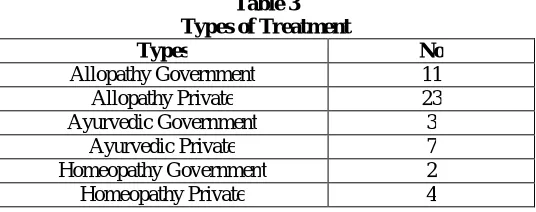
The sample has internal variation regarding the preferences for the type of treatment that they opt for diseases. All the important streams of treatment such as alopathy, ayurveda, and homeopathy are opted for, though at varying degrees, by the elderly. Medical expenses occupy an important place in the overall consumption expenses of elderly. It is observed that facilities for treatment of the elderly are yet to be developed in the sense that they are treated along with normal patience and on an individual disease basis. Geriatric Hospitals or departments are yet to be developed even on a minimum scale. With an ageing population, and a medical system, that is disarray, the outlook for proper medical treatment of the elderly looks dimmer and dimmer. Their economic resources being weak, and with many of them having little or no medical insurances, present even a dimmer picture.
Table 3 Types of Treatment
Types No
Allopathy Government 11
Allopathy Private 23
Ayurvedic Government 3
Ayurvedic Private 7
Homeopathy Government 2
Homeopathy Private 4
Source: Primary Data
ISSN(Online) : 2319-8753 ISSN (Print) : 2347-6710
I
nternational
J
ournal of
I
nnovative
R
esearch in
S
cience,
E
ngineering and
T
echnology
(An ISO 3297: 2007 Certified Organization)
Vol. 5, Issue 3, March 2016
III. FUNCTIONAL STATUS
The below diagram shows that 18 percentage are not dependent in the study area, others need help for an activity of daily living. 46 percentages are partially dependent while 36 percentages are fully dependent. Occasionally individual lose their complete sense of competence when they become dependent on others. This dependence on the elderly poses problems not only for themselves, but also for those whom they depend.
Diagram 8
` Source: Primary Data
IV.HEALTH INSURANCE
The study shows that only 22 percent of total sample population is insured while 78 percent of the sample populations are not insured. This adds ups to the extra economic burden that caring for the elderly presents to those on whom they are dependent.
IVX. CONSUMPTION PATTERN OF ELDERLY WOMEN
In the next decade, significant demographic changes will create new issues for the Kerala economy. It should be surprised to find that average consumer will be older. The number of elderly (Persons aged 60 and over) is projected to grow by over 45 percentages between 2010 and 2020. In 2030, when the surviving baby boomers become elderly, about 20 percentage of the whole population will be over the age of 60. Not only that, the number of elderly women is growing all the more. In contrast, total population growth is projected to be below the growth in the number of the elderly.
A striking feature of this dramatic change is that the most rapidly growing age group will be 60 and above. Since women in Kerala in general outlive their male counterparts is going to be a problem of the society women. Public and private policy makers need to be informed about the consumption patterns of this large and growing segment of the Kerala population. Information on food consumption pattern and differences in consumption within the elderly women population will be beneficial to the planners and policy makers.
I.CONSUMPTION OF FOOD ITEMS
An analysis of food intake pattern can provide insight regarding the impact of food consumption on the total consumption pattern of the elderly. The present study shows that all the elderly women irrespective of their age have included different kinds of cereals in their food intake. Data shows that all the respondents spend a part of their income on different types of cereals. Rice being the staple food item does enter the food system of the elderly in a prominent
Not dependent
18%
fully dependent
36% Partially
dependent 46%
ISSN(Online) : 2319-8753 ISSN (Print) : 2347-6710
I
nternational
J
ournal of
I
nnovative
R
esearch in
S
cience,
E
ngineering and
T
echnology
(An ISO 3297: 2007 Certified Organization)
Vol. 5, Issue 3, March 2016
way. Another significant cereal item is wheat. More than preference, it is the prescription by the medical people that prompt the elderly women to include wheat in food routine. Cereal substitute are also consumed by the elderly women in the sample area. Edible oils. Fruits and nuts and vegetables too are included in the food consumption of the elderly women. Coconut oil is still the favorite edible oil consumed by most of the elderly women.
Table4
Food consumption pattern of the elderly women in the study area (Age wise in percentages)
Item 60+ 70+ 80+
Cereals 100 100 100
Pulses 65 62 70
Vegetables 100 100 100
Milk 94 100 92
Meat 78 62 42
Egg 68 54 48
Edible oil 100 100 100
Fruits and Nuts 100 100 100
Sugar 64 58 54
Processed foods 92 82 72
Soft drinks 72 30 24
Coffee and Tea 96 88 84
Others 26 34 42
Source: primary data
The study cannot show a clear trend in the use of pulses. It does not play a prominent role in the total food consumption pattern of the elderly. Milk and milk products are consumed in an increasing ratio but some of the elderly especially the 80 plus avoid it as part of dietary restrictions. There are elderly women households who do not consume milk or milk products because they cannot afford it. Egg, meat, soft drinks, processed food, coffee and sugar too present a declining trend as the elderly women progress in age. This is because of the facts that as the elderly becomes progressively old, much of the old food habit are changed or forced to change and they adopt some sort of frugality and caution so as not to aggravate certain diseases associated with old age.
II. CONSUMPTION OF NON FOOD ITEMS
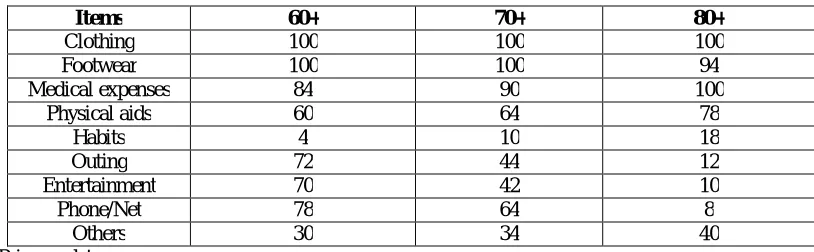
The survey consumption pattern of the elderly women, attempts to examine the differences in the consumption pattern of non-food items among the different group of the elderly women. Significant in consumption pattern between younger and older elderly are found in the consumption of different items such as food at home, food away from home, utility, clothing, health care, phone/net etc. However the relationship between socio demographic factors and consumption pattern among the age group are varying.
ISSN(Online) : 2319-8753 ISSN (Print) : 2347-6710
I
nternational
J
ournal of
I
nnovative
R
esearch in
S
cience,
E
ngineering and
T
echnology
(An ISO 3297: 2007 Certified Organization)
Vol. 5, Issue 3, March 2016
Table 5
Age Wise Consumption of Non Food Items in the Study Area in Percentages
Items 60+ 70+ 80+
Clothing 100 100 100
Footwear 100 100 94
Medical expenses 84 90 100
Physical aids 60 64 78
Habits 4 10 18
Outing 72 44 12
Entertainment 70 42 10
Phone/Net 78 64 8
Others 30 34 40
Source: Primary data
Non-food consumption form an integral part of the consumption expenditure of the elderly women. Clothing and footwear appear to be a universal item of consumption for all age group. Other non-food items are outing, medical, phone/net, entertainment, habits, and others shows wide disparities in the different age group of the elderly women. Travel expenses decreases as the elderly progress in age. The same trend is visible except in the case of medical expenses and in use of physical aids. It is all account of the fact that as women progress in age, they tend to fall ill quite often and the medical expenses are common. The medical expenses for physical aids too grow with the age as infirmities of different kinds grow with age.
Socio economic and demographic variables like age, family income, and marital status etc are the major factors influencing the consumption pattern of elderly women in Kerala. The other factors such as education, occupation etc also influences their consumption pattern. It can be seen that consumption of non -food items is high in rich and upper middle classes
XV. MAJOR FINDINGS OF THE STUDY
Age wise distribution of the elderly women in the sample reveals that 56 percentage belongs to the age group
of 60-69, 34 per cent belongs to the age group of 70-79 and 10 percent is belongs to the age group of 80 plus
Religion wise distribution of respondents shows that 48 per cent is belongs to the Muslim community, 40 per
cent Hindus and 12 per cent Christian.
Regarding education, 40 percent elderly women in the sample have primary education, 38 percent have
secondary education, 16 percent have degree, 4 percent have above degree qualification and 2 percentage of sample population is illiterate.
Marital status of the respondents shows that 54 percent of the sample population are widows, 38 percent are
married, 6 percent are unmarried and 2 percent is separated. Widows are more found in the 80 plus age group.
The present study shows that regarding monthly income of the elderly women, 22 percent have no such
income, while 22 percent have income below 1000 rupees, 44 percent have income below 5000 and 12 percentage have income more than 5000
Regarding source of income, 44 percent have pension benefits while 10 percent have income from interest
and 6 percent have income from rent , 6 percent have income from poultry and 4 percent have earning from animal rearing and 2 percent have income from agriculture and 22 percent have any income sources whatsoever
ISSN(Online) : 2319-8753 ISSN (Print) : 2347-6710
I
nternational
J
ournal of
I
nnovative
R
esearch in
S
cience,
E
ngineering and
T
echnology
(An ISO 3297: 2007 Certified Organization)
Vol. 5, Issue 3, March 2016
Regarding the family income of the sample population, 8 percentage of sample population having income less
than 5000 rupees per month, 44 percent samples having income between 5000 to 15000, 32 percentage having income in the range of 15000 to 25000 and 16 percentage having income above 25000. Though the family income of the elderly women reflects their socio economic status, many report that actual picture is even grimmer. All through their life, many of these women had been living without any recorded income.
With regard to the diseases, they were prone the diabetics, cholesterol, Blood Pressure, Arthritis, varicose vein
etc. The study shows that that 66 percent of the sample population have the problem of blood pressure followed by 44 percent of the sample population have been suffering from diabetics and 38 percent of the samples have the problem of cholesterol. 32 percent of the samples have the issue of arthritis while 12 percent of the samples have the major issue of cancer.
For the medical treatment, 22 percentages of the elderly women opt for allopathy hospitals under the
government hospitals, while 46 percentages opt for private allopathy treatment. Though the private allopathy treatment is costlier than that of public sector hospitals, yet many prefer them because of the lack of facilities both in terms of quantity and quality in the government sector and rest depends upon ayurvedha and Homeopathy
The study also reveals that only 22 percent of the samples have medical insurance and remaining 78 percent
have not yet medically insured.
The study shows that 18 percentages are not dependent in the study area; others need help for an activity of
daily living. 46 percentages are partially dependent while 36 percentages are fully dependent
Age poses one of the important factors determines the consumption level of the elderly women.
The study highlights that as they progress in age, food consumption is reduced and digestive process becomes
difficult.
The study also shows that there is significant difference in the consumption of food and non-food item in the
different age group in the study area.
XVI. SUGGESTIONS
The age structure of the population shows that elderly population has been increasing on a constant pace so as
to turn the age of age pyramid in favor of the elderly and more specifically in terms of elderly women, while comparatively reducing the proportion of the 0-14 group. So it will be worthwhile to direct some of the resources from the department of family planning and primary education to the department of geriatrics. It will be in the welfare of the elderly women that the government, through panchayat bodies, should be able to identify the needy elderly and divert resources to the social, material and medical needs of elderly. Public sector programmes providing primary healthcare and services for women are restricted to maternal and child health (MCH) and family planning. As the elderly suffers from chronic ailments, the type of care they require is different from primary healthcare. Operations research o different models of geriatric service delivery in the public sector are required to provide information on various aspects such as programme implementation, training and management requirements, resource needs, financing and reliability.
A multi pillar social security for the aged women should be formulated.
Current health systems, both public and private, are geared more to serving the adults and children than the
elderly. This has been partly due to the thrust of public policy towards the younger age group. There is clear need for discussion on how to best address the health needs of the elderly given the existing health programmes.
Since elderly women outnumber their male counterparts in Kerala, ‘women especially’ welfare schemes can
generate more welfare to the people.
The increasing public health expenditure would make health insurance an effective mechanism for financing
the healthcare needs of older persons
XVII. CONCLUSION
ISSN(Online) : 2319-8753 ISSN (Print) : 2347-6710
I
nternational
J
ournal of
I
nnovative
R
esearch in
S
cience,
E
ngineering and
T
echnology
(An ISO 3297: 2007 Certified Organization)
Vol. 5, Issue 3, March 2016
women. The present study illustrates the need to formulate a complete health care programme for the aged women. Action should be taken to alleviate financial dependence, poor health and impaired functional status of the women. The public response to these issues should be created.
BIOGRAPHY
1. Bhende, Asha, A., and Tara Kanitkar. (2001): “Principles of Population Studies”, Himalaya Publishing House,Delhi, pp 156-161.
2. Bordia, Anand and Bhardwaj, Gautam. (Ed) (2003): “Rethinking Pension Provision for India”, Tata McGraw Hill Publishing Company Limited, New Delhi.
3. Bose, Ashish and Mala KapurShankardass. (2004): “Growing Old in India: Voices Reveal and Statistics Speak”, B R Publishing Corporation, New Delhi.
4. Chakraborthi, Dhar. Rajagopal. (2004): “The Greying of India”, Sage Publications, New Delhi.
5. Chen, Martha, Alter. (1998): “Widows in India”, Sage Publications New Delhi.
6. Citro, Constance, F., and Robert, T., Micheal (1995): “Measuring Poverty A New Approach”, National Academy Press, Washington, DC. 7. D’Souza. V.S. (1989): “Changing Social Scene and Its Implications for the Aged” in K G Desai (ed), Aging India. Ashish Publishing House,
New Delhi.
8. Rajan, Irudaya, S. (2004): “Fertility Change in South India”, in C.Z Guilmoto and S. IrudayaRajan (ed.). Fertility Transition in South India, Sage Publications, New Delhi.
9. Rajan, Irudaya, S., Perera,Myrtle and Begum, Sharifa.(2005): “The Economics of Pensions and SocialSecurity in South Asia”, in pp 196-257, Mohsin Khan (ed.) Economic development in South Asia, Tata McGraw- Hill Publishing Company Limited, New Delhi.
10. Rajan,Irudaya , S., Mishra , U.S., and Sarma, P.S. (1999): “India’s Elderly: Burden or Challenge”? Sage Publications, New Delhi. 11. Schafer, R. (1999): “Determinants of Living Arrangements of the Elderly”, Joint Centre for Housing Studies, Harvard University W 99-6. 12. Shah, V.P. (1993): “The elderly in Gujarat”, Department of Sociology, Gujarat Univerity, Ahmedabad (Mimeographed).
13. Subrahmanya, R., and Jhabavala,Renana (Ed.) (2000): “The Unorganized Sector: Work Security andSocial Protection”, Sage Publication, New Delhi.
14. World Bank. (1994): “Averting the Old Age Crisis: Policies to Protect the Old and Promote Growth” Oxford University Press. 15. Navaneetham et al (2009), “Morbidity Patterns in Kerala: Levels and Determinants”, Working Papers with number id: 2176.
16. Gupta, Punam, and Adarsh, K., Vohra. (1987): “Pattern of Psychiatric Morbidity in the Aged”. In M.L Sharma and T.M. Dak (Eds.) Aging in India, Ajanta Publications, New Delhi,pp 214-21.
17. Economic review (2012, 2013, 2014), Kerala Planning Board, Trivandrum.
OFFICIAL WEBSITES
18. www.censusindia.com
19. www.mospi.nic.in
20. NSSO official website
21. Ministry of health, Government of Kerala
22. www.inflibnet.com