Phenotypic Plasticity in Bacterial Plasmids
Paul E. Turner
1Department of Ecology and Evolutionary Biology, Yale University, New Haven, Connecticut 06520 Manuscript received December 5, 2003
Accepted for publication January 27, 2004
ABSTRACT
Plasmid pB15 was previously shown to evolve increased horizontal (infectious) transfer at the expense of reduced vertical (intergenerational) transfer and vice versa, a key trade-off assumed in theories of parasite virulence. Whereas the models predict that susceptible host abundance should determine which mode of transfer is selectively favored, host density failed to mediate the trade-off in pB15. One possibility is that the plasmid’s transfer deviates from the assumption that horizontal spread (conjugation) occurs in direct proportion to cell density. I tested this hypothesis usingEscherichia coli/pB15 associations in laboratory serial culture. Contrary to most models of plasmid transfer kinetics, my data show that pB15 invades static (nonshaking) bacterial cultures only at intermediate densities. The results can be explained by phenotypic plasticity in traits governing plasmid transfer. As cells become more numerous, the plasmid’s conjugative transfer unexpectedly declines, while the trade-off between transmission routes causes vertical transfer to increase. Thus, at intermediate densities the plasmid’s horizontal transfer can offset selection against plasmid-bearing cells, but at high densities pB15 conjugates so poorly that it cannot invade. I discuss adaptivevs.nonadaptive causes for the phenotypic plasticity, as well as potential mechanisms that may lead to complex transfer dynamics of plasmids in liquid environments.
A
LTHOUGH plasmids can provide beneficial traits recipient concentrations the rate of change of plasmid-bearing cells issuch as antibiotic resistance, in the absence of positive selection a plasmid typically reduces the growth
dP/dt⫽ PP ⫹ ␥PR, of its bacterial host in vitro (Levin 1980; Zund and
Lebek 1980; Lenski and Bouma 1987; Nguyen et al. where Pis the combined densities (cells per milliliter) 1989) andin situ (Devanas et al. 1986; Sundin et al. of donors and transconjugants, Ris recipient density, 1994;Bjorklofet al.1995;Moenne-LoccozandWeaver Pis exponential growth rate of plasmid-bearing cells, 1995). Plasmids are vertically transferred to daughter and␥is the rate of conjugative transmission. The per-cells during binary fission and can be horizontally trans- capita rate,
ferred from infected cells (donors) to uninfected cells
r⫽dP/Pdt⫽ P⫹ ␥R, (recipients) through conjugation (Lederberg and
Tatum 1946; Clewell 1993; Thomas2000). Plasmid reveals that vertical spread (P) is independent of host activities that promote horizontal transmission (such as density, whereas horizontal spread (␥R) should be pro-producing more conjugative pili) should further im- portional to recipient density.
pede host growth, thereby reducing the plasmid’s po- For parasites that feature both horizontal and vertical tential for vertical transmission. We previously demon- modes of transmission, susceptible host density (R) should determine which mode is selectively favored (Mayand strated this trade-off when plasmids evolved increased
Anderson1983;Herre1993;Bull1994;Ewald1994), horizontal transfer at the expense of decreased vertical
provided there is a genetic trade-off between transfer transfer and vice versa (Turneret al.1998).
modes. Consider three hypothetical plasmids:x,y, and Spread of conjugative plasmids in liquid culture is
z. Plasmid xconjugates faster than plasmid y, but the often approximated through simple mass-action models
trade-off causes slower growth ofx-infected hosts. Plas-(Stewart and Levin 1977; Levin et al. 1979;
Berg-midztransfers only vertically, thereby causing the least stromet al.2000;GanusovandBrilkov2002;
Pauls-host burden. The model predicts that x andyshould son2002). Matings between donors and recipients are
spread through the host population faster asRincreases assumed to be governed by random encounters, which
(Levin et al. 1979; Simonsen et al. 1990; Figure 1A). result in the creation of plasmid-bearing
transconju-In this way, a costly plasmid can theoretically invade a gants. If matings occur in proportion to donor and
population if its rate of horizontal transfer is rapid enough to offset its poor vertical transmission (Stewart andLevin1977). At high densitiesxis most favored to
1Address for correspondence:Department of Ecology and Evolutionary
invade, whereas the advantage progressively shifts to Biology, Science Area Receiving, 266 Whitney Ave., Yale University,
New Haven, CT 06511. E-mail: [email protected] plasmidsyandzasRdecreases. However, any plasmid
point) because the greater cell-to-cell contact affords more opportunities for horizontal transfer. The im-provement is generallynot due to changes in the rate constant of conjugative transfer (␥) or in the cost of plasmid carriage (c), which can be estimated as the difference between recipient and donor growth rates:
c⫽ R⫺ P.
[Cost of carriage can be more broadly defined in terms of the fitness difference between plasmid-free and plas-mid-bearing hosts (Bouma and Lenski1988; Turner et al.1998), whereby growth rate is only one of several fitness components.] Thus, both␥andcare assumed to remain constant as host density varies (Figure 1B). But in the absence of genetic constraints, selection should favor parasites that are phenotypically plastic and able to switch between transmission strategies in direct response to environmental conditions (Bradshaw1965;Scheiner 1993). Therefore, a phenotypically plastic plasmid might be expected to maximize the conjugation rate at high densities to facilitate horizontal spread and to minimize conjugation at low densities to promote vertical spread (Figure 1C).
In a previous study (Turneret al.1998) we predicted that high host densities should favor evolution of in-creased plasmid conjugation at the expense of reduced vertical transmission, whereas low densities should favor
Figure1.—Theorized effect of susceptible host density on
the reverse. Plasmid pB15 (LundquistandLevin1986) plasmid transmission and phenotypic plasticity of plasmid
traits. (A) Hypothetical net rates of increase (solid lines) for was allowed to evolve for 500 generations in replicated plasmid genotypesx, y, andz, as a function of available host batch-culture environments containing different avail-density. The rapidly conjugating plasmidxis favored at high abilities of uninfected Escherichia coli hosts. Bacterial densities, but a trade-off between transmission modes causes
concentrations (governed by sugar concentration in the the advantage to shift in favor of plasmidsyandzas densities
liquid medium) were high (ⵑ109cells/ml) to facilitate decline. For any plasmid to spread, the net rate must exceed
the per-capita growth rate of plasmid-free recipients in the contact between donors and recipients, but differences population (dashed line). (B) Reaction norms for two hypo- inavailablehost density were achieved by manipulating thetical plasmids featuring traits unaffected by host density. the immigration of recipients into treatment popula-The solid line designates a plasmid that conjugates slowly
tions. To prevent disruption of mating pairs the experi-but imposes a low cost of carriage, whereas the dashed line
mental populations were grown in static culture, where indicates a faster-conjugating plasmid that imposes a higher
cost. (C) Reaction norms for two hypothetical plasmids featur- matings can also occur between a minority subpopula-ing phenotypically plastic traits. The solid line shows a plasmid tion of cells at the bottom surface of the culture tube. whose conjugation rate and cost of carriage decline with in- Results showed that plasmids evolved greater conjuga-creasing host density, whereas the dashed line symbolizes a
tion at the expense of reduced vertical transfer (and plasmid featuring the opposite response. Most models predict
vice versa), confirming the implicit trade-off described that rapid conjugation can be selectively favored at high
densi-ties; thus, a correspondingly “optimal” plasmid should feature in many models for the evolution of parasite virulence the latter form of plasticity. (damage to host fitness;MayandAnderson1983;Bull 1994;Ewald1994). However, available host density did not mediate the trade-off because plasmids featuring can fail to invade if its net rate of spread is negative increased (and reduced) conjugation evolved in all (r⬍ R⫺ ␥P), whereRis the growth rate of recipients treatments (Turneret al.1998).
(Figure 1A). Failure of susceptible host density to mediate the
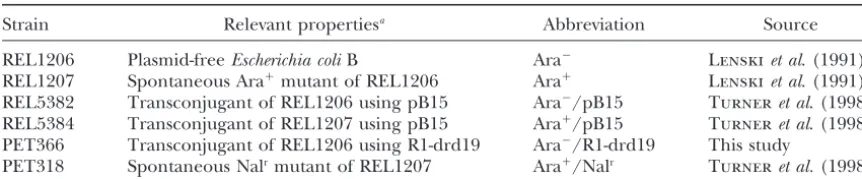
TABLE 1
Key bacterial strains used in this study
Strain Relevant propertiesa Abbreviation Source
REL1206 Plasmid-freeEscherichia coliB Ara⫺ Lenskiet al. (1991) REL1207 Spontaneous Ara⫹mutant of REL1206 Ara⫹ Lenskiet al. (1991) REL5382 Transconjugant of REL1206 using pB15 Ara⫺/pB15 Turneret al. (1998) REL5384 Transconjugant of REL1207 using pB15 Ara⫹/pB15 Turneret al. (1998) PET366 Transconjugant of REL1206 using R1-drd19 Ara⫺/R1-drd19 This study
PET318 Spontaneous Nalrmutant of REL1207 Ara⫹/Nalr Turneret al.(1998)
aAra⫹indicates the ability to grow onl-arabinose. Nalrindicates resistance to nalidixic acid; all strains are Nalsunless otherwise indicated.
are fairly rare; for strains REL5382 and REL5384 (Table 1), rizontal transfer of the plasmid. At low cell densities
ⵑ1 in 4000 colonies formed on TA is a segregant on the basis pB15 maximizes horizontal transmission at the expense
of tooth-picking assays onto TA⫹Km (Turneret al.1998). of vertical transfer, but at high cell densities it features Thus, both pB15 and R1-drd19 can be considered relatively
the reverse. stable under the current culture conditions.
Culture conditions:Bacteria were grown at 37⬚in batch culture using Davis minimal (DM) broth (CarltonandBrown1981) MATERIALS AND METHODS supplemented with 2g/ml thiamine hydrochloride and glu-cose (glu) at a specific concentration;e.g., DM25 indicates
Strains:Table 1 lists strains used in this study. Hosts (kindly DM broth with 25g/ml glu, which yieldsⵑ5⫻107cells/ml provided by R. Lenski, Michigan State University, East Lan- at stationary phase. Culture volume was 10 ml, in nonshaking sing, MI) were derived from a single clone ofE. coliB (REL1206), 18⫻150-mm glass tubes or shaking 50-ml Erlenmeyer flasks. which evolved previously for 2000 generations in a glucose- Daily propagation occurred by vortexing a culture, followed limited environment (Lenskiet al.1991); this strain cannot grow by 100-fold dilution into fresh medium (serial transfer). Dur-onl-arabinose and is denoted Ara⫺. Ara⫹and Ara⫺strains form ing this 24-hr cycle, bacteria attained stationary-phase densi-white and red colonies, respectively, on tetrazolium-arabinose ties, at which point they had depleted the available resource. (TA) indicator plates (Levinet al.1977). The Ara marker is The resulting 100-fold growth of the population represents selectively neutral under the shaking and static culture condi- ⵑ6.64 (⫽
log2100) generations of binary fission per day. tions used here (Travisano1997;Turneret al.1998).
Invasion-when-rare experiments:To examine plasmid spread, Plasmids were obtained from the laboratory of B. Levin
donors and recipients were mixedⵑ1:200 in DM broth con-(Emory University, Atlanta, GA). R1 is a large (ⵑ100 kb) well- taining 10, 12.5, 25, 50, 100, 200, 400, 800, or 1000g/ml described plasmid of the IncFII group, featuring a copy
num-glu. Mixtures were serially transferred for up to 20 days, in the ber of four to five copies per cell (Nordstromet al. 1980).
presence or absence of shaking. Every day, after serial transfer R1 (and many other plasmids) normally repress conjugative
had taken place, glycerol was added to each population, which pilus synthesis, but upon transfer to a new cell the plasmid’s
was then stored in a freezer at⫺80⬚ for future study. Daily transfer operon is transitorily derepressed for a short time to
samples were plated on TA to track recipient densities and facilitate further transmission (Willetts 1974; Lundquist
on TA with 25g/ml Km to measure densities of donors and andLevin1986). In contrast, plasmid R1-drd19 used in this
transconjugants. (Transconjugants were also tested on TA with study is a mutant of R1 that is permanently derepressed for
1g/ml Tc and no dissociation between resistance markers conjugation. R1-drd19 confers clinical resistance to kanamycin
was observed, indicating that plasmids did not lose the Km (Km) and several other antibiotics (Lundquist and Levin
marker over time as they were transferred between cells.) In 1986). Plasmid pB15 is also large (ⵑ50 kb), but its copy
num-some experiments, populations were sampled on minimal-ber per cell is unknown. Although pB15 is not fully
character-arabinose (MA) plates containing Km, to screen for Ara⫹ ized, preliminary sequence data suggest it is related to R64,
transconjugants that were very rare relative to Ara⫺donors. an IncI1 plasmid of Salmonella (D.Guttmanand P.Turner,
Km is an aminoglycoside that is bactericidal to sensitive cells, unpublished results). Plasmid pB15 conjugates at high rates
as confirmed by spreading plasmid-free recipients onto TA⫹ in chemostats containingⵑ108cells/ml in 50g/ml glucose
Km. Therefore, transconjugant estimates were not confounded medium (Lundquist and Levin 1986). It confers clinical
by matings between recipients and plasmid-bearing cells on resistance to Km and subclinical resistance to tetracycline (Tc;
TA⫹Km plates. To further dismiss plate matings as a potential
Lundquist and Levin 1986), confirmed by growth on TA
confounding factor, diluted samples from frozen populations with 25g/ml Km and 1g/ml Tc, respectively. To move a
were spread on both TA⫹Km and MA⫹Km plates; colony plasmid into REL1206, this recipient was mixed with
plasmid-counts yielded identical estimates of transconjugant densities bearing donors, and transconjugants were obtained through
per milliliter. overnight matings. No differences in plating efficiency on
Conjugation rate assay:To assay conjugation rate (␥), Ara⫺/ selective and nonselective media were observed for any of the
pB15 donors and Ara⫹Nalr(nalidixic acid resistant) recipients plasmid-bearing cells in this study.
were mixedⵑ1:100 and allowed to grow and mate during a Plasmid segregation is incomplete transfer to one of the
standard 24-hr growth cycle in static culture. The Nalrmarker daughter cells during binary fission. R1-drd19 features at least
facilitated visualization of rare transconjugants on selective plates one mechanism to ensure its stability in the absence of
selec-containing 25g/ml Km and 15g/ml Nal. After 24 hr, the tion for plasmid carriage (Gerdeset al.1986). It is unknown
final densities of donors (D), recipients (R), and transconju-whether pB15 features a stability mechanism such as
and nonselective plates. Growth rate per hour in exponential pB15 was costly in all treatments (Figure 2). In some phase () of mating cultures was estimated by regressing the cases, donors decreased to low densities where (presum-natural logarithm of total cell density vs. time during the
ably) their loss due to selection was balanced by their period of exponential-phase growth. The rate of conjugative
increase through reinfection of rare segregants. transfer (milliliters per cell hour) for matings in batch culture
may be estimated using the formula Invasion success was gauged by tracking transconju-gant densities. Results (Figure 2) showed that the rate ␥ ⫽ ⫻ln[1⫹(T/R)(N/D)]/(N⫺N0)
of transconjugant formation per day was not sufficient to outpace selection against plasmid carriage at 12.5 glu (Simonsenet al.1990), whereN⫽T⫹R⫹DandN0is initial
population size. Unlike other transfer measures (e.g.,Watanabe (linear regression with slope ⫽ ⫺0.1408, t ⫽ 1.886,
1963;Baleet al.1987), the end-point method is largely unaf- d.f.⫽4,P⫽ 0.132) and 25 glu (slope⫽ ⫺0.0789,t⫽ fected by factors such as donor-to-recipient ratio because it
esti-3.452, d.f.⫽7,P⫽0.011). (Assay at 12.5 glu was halted mates the actual rate constant of transfer rather than simply the
at 11 days due to contamination, but by this time trans-resulting frequency of transconjugants (Simonsenet al.1990).
conjugants were already below the limit of detection The equation is simplified by usingfor the total population,
thereby ignoring predictably slower growth of plasmid-bearing on TA ⫹Km.) Consistent with the predicted effect of cells. However, even reasonably large costs of carriage do not increased cell density, pB15 invasion improved at inter-strongly affect estimation of␥(Simonsenet al.1990).
mediate glucose concentrations: 50 glu (slope⫽0.0979,
Relative fitness and cost of plasmid carriage:To estimate
rela-t⫽13.629, d.f.⫽14,P⬍0.0001) and 100 glu (slope⫽ tive fitness, two strains (distinguished by the Ara marker) were
0.0944,t⫽14.139, d.f.⫽14,P⬍0.0001). But at high competed under the culture regimes described above. Strains
were grown separately (preconditioned) for 1 day in the exper- concentrations, the plasmid invaded poorly: 200 glu imental medium to ensure comparable physiological states. (slope⫽ ⫺0.0173, t ⫽ 5.405, d.f.⫽ 15, P ⬍ 0.0001), They were then mixed 1:1, diluted 1:100 into fresh medium, 400 glu (slope ⫽ ⫺0.1287,t ⫽ 7.555, d.f. ⫽ 15, P ⬍ and allowed to grow and compete for 24 hr. Initial and final
0.0001), and 800 glu (slope⫽ ⫺0.0888,t⫽3.523, d.f.⫽ densities of each competitor were estimated on TA plates.
14, P ⫽ 0.003). Transconjugants disappeared faster Let the initial densities of the two competitors beN1(0) and
N2(0), respectively, and letN1(1) andN2(1) be their densities than donors in the latter two environments. This result after 1 day. The time-average rate of increase, mi, for each could occur if the cost of carriage is higher in Ara⫺
competitor was then calculated as cells, but this idea seems unlikely given marker
neutral-ity under the current conditions (Travisano 1997; mi⫽ln[Ni(1)/Ni(0)]/(24 hr).
Turner et al. 1998). A plausible explanation is that The fitness of one strain relative to the other is expressed the Ara⫹ donors are more numerous than the Ara⫺
simply as the dimensionless ratio of their rates of increase:
transconjugants, causing the Ara⫹ background to pro-vide a larger segregant pool for reinfection. There was Wij⫽mi/mj
also a sharp drop in donor and transconjugant densities (Lenskiet al.1991). Cost of plasmid carriage was measured
on day 12 in 400 glu. This decline could easily result by competing a plasmid-bearing strain against its plasmid-free
from a pipette error causing⬎100-fold dilution during counterpart that differed by the neutral Ara marker. Fitness
serial passage; the plasmid-bearing cells were in the mi-of the plasmid-bearing strain relative to the plasmid-free strain
was calculated as above. Cost of carriage (c) is the difference nority and sampling error could cause them to be under-between 1.0 and the estimated fitness; thus,c⬎0 indicates represented in the propagated cells.
that a plasmid reduces host fitness. Fitness estimates are com- Figure 3A shows the data for rates of transconjugant plicated, in principle, by segregants and transconjugants that
formation (log10transconjugants/ml/day)vs.mean log10 arise during competitions between plasmid-bearing and
plas-R(stationary-phase recipient density). Clearly, the invasion mid-free cells. To ensure accurate estimates, I sampled a subset
of cells to track plasmid losses and gains due to segregation and rate of pB15 is positive (and maximal) only at the inter-conjugation that occurred during competitions. As previously mediate resource concentrations. My results demonstrate observed (Turneret al.1998), segregants and transconjugants that spread of pB15 in static culture does not increase in were small minorities, and their inclusion or exclusion from
direct proportion to cell density, as governed by glucose the calculations had no significant effect on fitness estimates.
concentration.
Invasion by pB15 is unaffected by chromosomal mark-ers: The above results could be due to an unexpected RESULTS
interaction between pB15 and the Ara⫺ marker on the
Invasion by pB15 is maximal at intermediate densities recipient chromosome. To examine this possibility, two
in static culture:Invasion-when-rare experiments in static experiments were conducted. First, Ara⫺/pB15 donors
Figure 2.—Invasion by plasmid pB15 occurs only at intermediate host densities in static cul-ture. Log10colony-forming units (CFU) per millili-ter of Ara⫺recipients (circles), Ara⫹/pB15 do-nors (squares), and Ara⫺/pB15 transconjugants (diamonds) during serial transfer in seven envi-ronments are shown: (A) 12.5, (B) 25, (C) 50, (D) 100, (E) 200, (F) 400, and (G) 800 g/ml glucose.
marker combination for donors and recipients: 25 glu Invasion by R1-drd19 is maximal at high densities in
static culture:Failure of pB15 to invade fastest at high cell
(slope⫽ ⫺0.1258, d.f.⫽7,P⫽0.009), 100 glu (slope⫽
0.1461, d.f.⫽7,P⫽0.001), and 800 glu (slope⫽ ⫺0.1301, densities could be due to particulars of the culture regime. To examine this potential bias, I conducted invasion ex-d.f.⫽ 7,P⫽ 0.002).
Second, invasion experiments were repeated at seven periments using a different plasmid. Ara⫺/R1-drd19 do-nors invaded Ara⫹recipients for 5 days at three glucose glucose concentrations for 10 days, but donors and
recipi-ents featured the identical Ara marker. These assays are concentrations, with threefold replication. Results (Fig-ure 4) showed that the recipients remained approxi-less accurate because donors cannot be distinguished from
transconjugants, but they can determine whether pB15 mately constant, whereas the donors declined due to plas-mid carriage. As cell density increased, the mean rate of transfer between differently marked cells accounts for
poor invasion at high cell densities. Consistency between change in transconjugants also increased: 10 glu (slope⫽ ⫺0.9283, d.f.⫽ 1,P⫽0.181), 100 glu (slope ⫽0.1742, these and the above assays would be maximal plasmid
spread at intermediate glucose concentrations. However, d.f.⫽3,P⫽0.001), and 1000 glu (slope⫽0.6299, d.f.⫽ 3,P⫽0.0018). These data showed that the static culture the maximum rate can be net negative because majority
donors can decline as minority transconjugants increase. regime did not bias against increased plasmid spread at higher glucose concentrations.
Once again, results showed that the rate of plasmid spread
was most rapid at intermediate glucose concentrations, Mass action governs invasion by R1-drd19 and pB15 in
shaking environments:To examine whether mass action
regardless of the Ara marker shared by donors and
con-Figure3.—Invasion by plasmid pB15 is maximal at interme-diate host densities in static culture. (A) Solid circles summa-rize the experiments shown in Figure 2. Solid triangles are from a second set of invasion assays in fewer environments (25, 100, and 800g/ml glucose), using Ara⫹recipients and
Ara⫺/pB15 donors. The solid line is a quadratic fit to the Figure4.—Invasion by plasmid R1-drd19 occurs in propor-data. (B) Seven independent invasion assays (12.5, 25, 50, 100, tion to host density in static culture. Each point represents 200, 400, and 800g/ml glu), using Ara⫺-marked donor and the mean of independent assays (n⫽ 3). Log10CFU/ml of recipient cells (solid squares, dashed line) and using Ara⫹- Ara⫹ recipients (circles), Ara⫺/R1-drd19 donors (squares),
marked donors and recipients (solid diamonds, solid line). and Ara⫹/R1-drd19 transconjugants (diamonds) during serial
See text for details. transfer in three environments are shown: (A) 10, (B) 100, and (C) 1000g/ml glucose.
Conjugation rate of pB15 declines at high densities in
ducted invasions using R1-drd19 and pB15 in shaking
culture. Ara⫺/R1-drd19 donors invaded Ara⫹recipients, static environments: The horizontal component of plas-mid spread (␥R, see Introduction) is assumed to be pro-whereas Ara⫹/pB15 donors invaded Ara⫺recipients. Both
mating combinations were replicated threefold, at 100 portional to the density of potential recipients (R). Be-cause this prediction for pB15 breaks down in static culture and 1000 glu. Results (Figure 5) showed that for R1-drd19
the mean rate of change in transconjugants per day was (Figure 3), it suggests that conjugation rate (␥) or host density (R) (or both) deviates from expectations. faster at high glucose concentration, similar to the
out-come in static culture: 100 glu (slope⫽0.5578, d.f.⫽3, I first tested whether glucose concentration predictably governs R in static culture. To do so, I calculated mean P⫽0.024) and 1000 glu (slope⫽0.6179, d.f.⫽3,P⫽
0.017). More importantly, the data revealed that pB15 can log10 R at each glucose concentration using the data from pB15 invasions in static environments (Figure 2): successfully invade at intermediateandhigh densities in
shaking environments: 100 glu (slope⫽0.7921, d.f.⫽2, 12.5 glu, 3.24⫻ 107cells/ml; 25 glu, 5.88 ⫻107 cells/ ml; 50 glu, 8.95 ⫻ 107 cells/ml; 100 glu, 1.67 ⫻ 108 P⫽0.031) and 1000 glu (slope⫽0.8264, d.f.⫽3,P⫽
0.0048). These results indicated that mass action is a rea- cells/ml; 200 glu, 3.45⫻108cells/ml; 400 glu, 6.30⫻ 108 cells/ml; and 800 glu, 9.90 ⫻ 108 cells/ml. This sonable descriptor of pB15 spread in well-agitated liquid
Figure 5.—Invasions by plasmids R1-drd19 and pB15 occur in proportion to host density in shaking culture. Each point represents the mean (⫾SE) of indepen-dent assays (n ⫽ 3); error bars too small to be visual-ized are omitted. (A and B) Log10 CFU/ml of Ara⫹ re-cipients (circles), Ara⫺ /R1-drd19 donors (squares), and Ara⫹/R1-drd19 trans-conjugants (diamonds) dur-ing serial transfer in two en-vironments: (A) 100 and (B) 1000g/ml glucose. (C and D) Identical experiments us-ing Ara⫺recipients (circles), Ara⫹/pB15 donors (squares), and Ara⫺/pB15 transconju-gants (diamonds): (C) 100 and (D) 1000g/ml glucose.
as the glucose concentration similarly increased, and a ␥is not constant, but declines by approximately an order of magnitude asRincreases by the same amount. linear regression of mean log10Ron glucose
concentra-tion was statistically significant (slope is 0.0017, d.f.⫽ Trade-off between vertical and horizontal transfer of
pB15 holds across cell densities:Because vertical and
5,t⫽ 4.046,P ⫽0.0099).
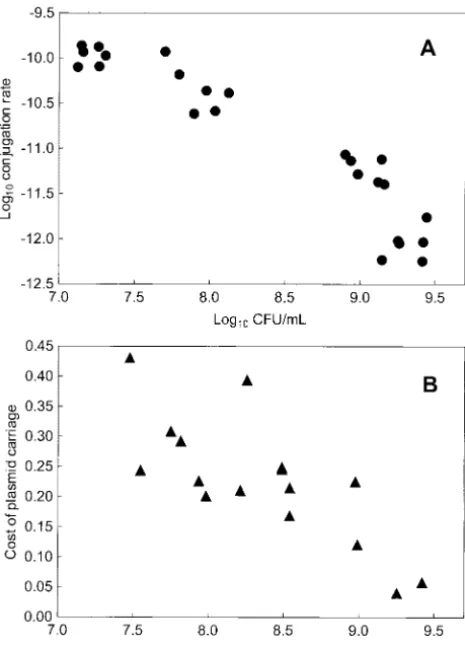
To examine whether pB15 conjugation is constant horizontal transfer routes in pB15 show a trade-off (Turneret al.1998), the cost of plasmid carriage should across cell densities, I measured␥at 5, 50, 500, and 1000
glu in static culture; six blocks of assays were performed. vary along with␥across glucose concentrations. To test this hypothesis, I measured the fitness of Ara⫹/pB15 Results showed that␥was highly sensitive to cell density
governed by glucose concentration (Figure 6A). A cells relative to Ara⫺ cells in seven glucose concentra-tions (12.5, 25, 50, 100, 200, 400, 800, and 1000 glu) in two-way ANOVA showed a highly significant effect of
glu on␥, but no block effect (Table 2). Mean ␥(n⫽ static culture, with replication (n ⫽ 2). I then calcu-lated the cost of plasmid carriage,c(seematerials and 6) for pB15 at 5 glu was 1.092⫻10⫺10ml/cell hour; that
is, during 1 hr, each plasmid-bearing cell can effectively methods). Results (Figure 6B) indicated that plasmid-bearing cells were generally disadvantaged, as all values “search” a volume ofⵑ10⫺10ml and infect any
plasmid-free cell therein. (Because cell densities are Ⰶ1/␥, a ofcexceeded zero. More importantly, these data showed thatcdecreased at higher glucose concentrations, and donor is unlikely to encounter two recipients in close
temporal proximity, or vice versa; hence, the system is this outcome was statistically significant (linear regres-sion with slope⫽ ⫺0.1341, d.f.⫽ 14, t ⫽ 4.487, P ⫽ unsaturated.) In contrast, mean␥progressively
dimin-ished at 50 glu (5.315⫻ 10⫺11ml/cell hour), 500 glu 0.0005). These data demonstrate that the genetic trade-off between transmission modes in pB15 holds across a (6.185 ⫻ 10⫺12ml/cell hour), and 1000 glu (9.483⫻
10⫺13ml/cell hour). To further examine this phenome- wide range of cell densities and that both ␥ and c are phenotypically plastic in static culture containing glucose. non, I estimated meanR(n⫽6) at each glucose
concen-tration: 5 glu, 1.65⫻ 107 cells/ml; 50 glu, 8.81 ⫻ 107 cells/ml; 500 glu, 8.76 ⫻ 108 cells/ml; and 1000 glu,
DISCUSSION 2.16⫻109cells/ml. Using mean values of␥andR, it is
revealed that␥Rin pB15 does not increase with glucose Many parasites can transfer vertically between parent and offspring, as well as horizontally between infected concentration. Rather, ␥R is approximately constant
between low and intermediate cell densities (5 glu, and uninfected individuals. Activities that augment hori-zontal transmission (such as greater within-host repro-0.00542; 50 glu, 0.00533) and even declines slightly at
sengeret al. 1999). Although the models predict that susceptible host abundance should determine which transfer mode is selectively favored, host density failed to mediate the trade-off in pB15 because plasmids evolved increased (and reduced) conjugation in all treatments (Turneret al.1998).
Theory generally predicts that plasmid spread should improve with increasing cell density due to greater con-tact between donor and recipient cells (e.g.,Stewart and Levin 1977; Levin et al. 1979; Simonsen 1990; Lagidoet al.2003). Here I demonstrated that host den-sity failed to mediate the trade-off in pB15 because the plasmid’s rate of horizontal spread is not proportional to cell density in static culture. Rather, invasion by pB15 is maximal at intermediate cell densities determined by glucose concentration. This result explains why manipu-lation of available host density at elevated glucose con-centrations (i.e., ⵑ109 cells/ml, 1000 g/ml glu) did not predictably select for the evolution of conjugation rates in pB15-derived plasmids (Turneret al.1998; see further discussion below).
Spread of pB15 occurs disproportionately to cell den-sity in static culture because traits governing its transfer are phenotypically plastic. The rate of conjugative trans-fer (␥) is expected to be a constant, which is relatively insensitive to cell density, donor-to-recipient ratio, and other environmental factors (Simonsen et al. 1990). Thus, horizontal spread should be determined by the
Figure 6.—Plasmid pB15 features phenotypically plastic product of␥and susceptible host density (R, a variable traits in static culture environments. Each point represents determined by resource concentration), causing␥Rto an independent measurement. (A) Conjugation rate (solid increase in direct proportion to R. In contrast, ␥Rin circles) of pB15 decreases with increasing cell concentration
pB15 is relatively unchanged asRincreases, because␥ (Log10CFU/ml). See Table 2 for statistics. (B) Cost of plasmid
declines by approximately an order of magnitude asRis carriage (solid triangles) similarly declines, due to the
trade-off between horizontal and vertical modes of transmission. similarly increased in static culture containing glucose. See text for statistical analyses. Although it is clear that increased cell densities nega-tively impact spread of pB15 in static culture, it is ques-tionable whether the mass-action measurement ␥ 1983; Herre 1993; Bull 1994; Ewald 1994; but see
should be used to describe the phenomenon.Simonsen Ebert and Bull 2003). We previously observed that
(1990) showed that measurements of ␥ are strikingly plasmid pB15 evolves greater conjugation at the
ex-similar for plasmid R1-drd19 when bacteria are mated pense of reduced intergenerational transfer (and vice
on surfaces and in shaking liquid culture, even when versa) in static culture (Turneret al.1998),
demonstra-cells are grown at densities below those used in my ting the trade-off between transmission modes
com-experiments (i.e., where donors very rarely encounter monly assumed in theories for the evolution of parasite
recipients). Therefore, the data by Simonsen (1990) virulence (see alsoDiffleyet al.1987;Dearsleyet al.
suggest that␥may be usefully applied in static culture 1990;Bullet al.1991;EbertandMangin1997;
Mes-environments where matings occur both in liquid and between cells that settle out in culture. However, non-mass-action models should more accurately describe
TABLE 2
conjugal transfer in complex environments such as on
ANOVA of the effect of glucose concentration
surfaces (e.g.,Lagidoet al.2003).
on conjugation rate (␥) of plasmid pB15
At intermediate densities horizontal transfer in pB15 is sufficient to overcome the growth disadvantage
suf-Source SS d.f. MS F P
fered by plasmid-bearing cells, but at high densities its Glucose concentration 15.673 3 5.224 193.011 ⬍0.0001 poor conjugation prevents the plasmid from invading. Block 0.233 5 0.047 1.724 0.1897 My data allow a crude estimate of the cell densities
Error 0.406 15 0.027
appar-ently a nonlinear function of log10R(Figure 3A), and that plasticity of a trait can change in response to selec-a quselec-adrselec-atic function provides selec-a stselec-atisticselec-ally significselec-ant tion (see Scheiner 1993 for review). This idea could fit to the data (F[2,7]⫽7.0428,P⫽0.0211). This function be studied by evolving E. coli B/pB15 associations for is described bydT/dt⫽ ⫺29.957⫹7.268⫻R⫺0.439⫻ prolonged periods in static culture at a single glucose R2, which can be solved for the two values ofRwhere concentration. In fact, this experiment has already been the curvilinear fit crosses a value of zero. This solution completed in the control populations from Turner yieldsR⫽7.244⫻107cells/ml and 4.571⫻108cells/ml
et al. (1998), where replicated bacteria/plasmid asso-as the lower and upper boundaries, respectively, for ciations were allowed to evolve for 500 generations in successful invasion by pB15 in static culture. Although 1000g/ml glu. Thus, evolved plasmids from the prior the estimate indicates a relatively narrow range of exis- study could be examined for changes in plasticity. tence conditions for pB15, more thorough examination A second possibility is that the phenotypic plasticity of invasion conditions can be explored using the param- is a consequence of differing physiology of theE. colihost
eters described in this study. at varying glucose (and hence host density) levels. The
The cost of plasmid carriage in pB15 is also phenotypi- 2000 generations of evolution experienced by the bacte-cally plastic in static culture, because the fitness disad- rium at 25g/ml glu in shaking culture (Lenskiet al. vantage suffered by plasmid-bearing cells declines as 1991) are sufficient for profound adaptive changes, which hosts become more numerous. Thus, the previously de- can cause very different performance in other environ-scribed trade-off between transmission modes (Turner ments (e.g.,Travisano1997). Therefore, it is possible et al.1998) is now revealed to hold across a broad range that the host’s physiology could be greatly affected by of cell concentrations in static culture. However, the growth in elevated glucose concentrations and/or static plasticity observed in pB15 seems nonintuitive because culture. In turn, because plasmids are obligate intracel-it indicates that the plasmid relies more heavily upon lular elements, expression of plasmid genes (such as vertical transfer as cell densities are increased. conjugative ability) can be strongly affected by the host’s
Adaptive vs. nonadaptive phenotypic plasticity:Phe- physiological state (Levinet al.1979). This idea is
sup-notypic plasticity may or may not be the result of adapta- ported by the phenomenon of transitory derepression. tion (seeScheiner1993 for review). If plasmid transfer Immediately after conjugation has occurred, the mecha-is proportional to cell density, it seems logical that “opti- nism allows a plasmid to temporarily derepress its conju-mal” phenotypic plasticity should allow increased
plas-gation to maximize the rate of further horizontal trans-mid virulence (more rapid conjugation) at high host
fer, suggesting transitory derepression occurs in response densities and decreased virulence (reduced
conjuga-to host physiology. tion) at low host densities. Precisely the opposite was
At this juncture, it appears that pB15’s conjugation observed in pB15, suggesting the plasticity is
nonadap-rate is strongly influenced by levels of cell density in static tive. However, the theorized importance of cell density
culture. Preliminary sequence data for pB15 (D. Gutt-for plasmid spread is a reasonably good predictor Gutt-for
manand P.Turner, unpublished data) suggest that the invasiveness of plasmid R1-drd19 in static and shaking
plasmid may be related to R64, a large (ⵑ120 kb) IncI1 environments and of pB15 in shaking culture. These
plasmid ofSalmonella typhimurium(HedgesandDatta combined results strongly suggest that an interaction
1973). IncI1 plasmids form two types of sex pili, a thin between pB15 and the static culture environment
gov-flexible pilus and a thick rigid pilus (Bradley 1983, erns the plasticity observed.
1984). The thick pilus is essential for mating in general, One possibility is that the plasticity is a coincidence of
whereas the thin pilus is required only for liquid mating. the novel association between plasmid pB15 andE. coli
R64 features an elaborate 54-kb transfer mechanism, the B bacteria. The experimental host was evolvedin vitro
R64 shufflon, which is prone to stochastic DNA re-for 2000 generations (Lenskiet al.1991), whereas pB15
arrangements that strongly influence mating efficiency, was isolated from an unknownE. colihost taken from
especially recipient specificity in liquid culture (Komano a human undergoing antibiotic treatment (Lundquist
et al.1995;Komano1999). Although pB15 appears ge-andLevin1986). It may be that an epistatic interaction
netically similar to R64, its transfer mechanism is proba-between plasmid and chromosomal genes is responsible
bly much less complex because the entire pB15 genome in part (or wholly) for the observed plasticity. To
exam-(ⵑ50 kb) is smaller than the R64 shufflon (D.Guttman ine this hypothesis, one could look for phenotypic
plas-and P. Turner, unpublished data). However, pB15 ticity when the plasmid is moved to a different host
might also feature two (or more) types of sex pili, and background, such asE. coliK-12 or unevolvedE. coliB.
the influence of cell density and/or glucose concentra-Equally intriguing would be to examine the “cost of
plas-tion on the expression of genes related to pilus forma-ticity” in pB15, by predicting that evolution of plasmid/
tion in pB15 is unknown. For instance, these factors host associations in a constant environment would
se-might cause pB15 to differentially express one or more lect against maintenance of phenotypic plasticity,
assum-of its pilus genes, thereby influencing invasiveness. Be-ing there is a cost of maintainBe-ing the associated
I discuss several other possibilities below. In addition, cells in my static-culture experiments, thus reducing the potential for transfer to occur at high cell densities. I relate my data to previous studies in plasmid biology.
Potential mechanisms for density-dependent conjuga- This idea could explain the pB15 results, but seems
unlikely given that transfer of R1-drd19 was not similarly
tion: A simple explanation for the density-dependent
effect is that the conjugation process in pB15 somehow hampered by elevated densities in static culture.
Relevance to previous work:Most models of plasmid
becomes “saturated” at higher cell densities in static
culture, much as bacterial growth reaches a maximum transfer depend on simple mass-action kinetics, but it is now widely recognized that the majority of bacteria rate that cannot be raised by increasing the
concentra-tion of a limiting resource (Monod 1949). However, found in natural, clinical, and industrial settings persist in association with surfaces (DaveyandO’Toole2000). saturation kinetics cannot explain the apparent
maxi-mum rate of plasmid increase at intermediate densities, Therefore, plasmid conjugation is likely to be a com-plex process that extends beyond simple models (e.g., as observed here. A similar possibility is that conjugation
rate in pB15 is not a function of cell densityper sebut Lagidoet al.2003). Further complexities may arise be-cause conjugation can be sensitive to both abiotic and instead responds to the concentration of glucose, which
was varied to manipulate cell density. That is, higher biotic conditions (Fernandez-Astorgaet al.1992), such as temperature (Fernandez-Tresguerreset al. 1995) concentrations of glucose may somehow inhibit the
con-jugal transfer of pB15. and dissimilarities between donor and recipient strains
(e.g.,Dionisioet al.2002).PappasandWinans(2003) I examined this possibility by looking closely at the
population dynamics occurring in the 24-hr mating ex- showed that conjugation of the Ti plasmid is activated by quorum sensing in the phyto-pathogenAgro-bacterium periments used to estimate conjugation rate. There was
some evidence that the number of transconjugants in- tumefaciens, demonstrating density-dependent changes in plasmid transfer ability. Thus, earlier findings indicate that creases unexpectedly during the transition from
expo-nential growth to stationary phase, irrespective of cell phenotypic plasticity can occur in plasmids, but to my knowledge the data were never described in light of this density, suggesting that conjugation in pB15 is somehow
stimulated by the depletion of glucose (data not shown). important biological phenomenon.
Virulence models predict that virulent parasites can In particular, the number of transconjugants
measur-ably increased between 8 and 10 hr of the growth cycle, evolve at increased host densities, because available host abundance favors selection for highly infectious geno-whereas by this time the donors and recipients had
evidently made the transition from exponential growth types. The underlying assumption is that increased viru-lence leads to reduced host fitness, thereby preventing to stationary phase as the medium was being depleted
of glucose. Simple models assume that the rates of bacte- a parasite from simultaneously maximizing verticaland horizontal transfer. We chose plasmid pB15 to examine rial growth and plasmid transfer are Monod functions
(Monod1949) of resource concentration, so that when this hypothesis (Turneret al.1998), on the basis of its ability to successfully invade E. coli K-12 populations resources are exhausted growth and conjugation cease
(StewartandLevin1977;Simonsenet al.1990). Thus, growing at ⵑ108 cells/ml in chemostat culture (
Lund-quistandLevin1986). To do so, we used static serial-the conjugation rate of a plasmid is expected to be
proportional to the growth rate of the mating popula- culture environments containing 1000g/ml glu (ⵑ109 cells/ml). Our previous experiment was correctly de-tion. However, in IncP plasmids the expression of
trans-fer proteins can be highest when host cells are growing signed to test the theoretical prediction, in principle. Preliminary experiments with pB15 showed that the slowly and thus when vertical transfer of plasmids is
minimized (Pansegrau et al. 1994). Further experi- plasmid can invade when rare at moderate cell densities (ⵑ108cells/ml; 50g/ml glu) in static culture (Turner ments could examine the dynamics of 24-hr matings
with pB15 and the possibility of unexpectedly high trans- 1995), as confirmed here. However, my current data also reveal that the combination of plasmid pB15 and fer of the plasmid during the transition to stationary
phase in static culture. a glucose-rich static culture regime was an unfortunate
choice, because this environment negatively impacts the High cell densities (or high glucose concentrations)
might strongly impact other plasmid or bacterial traits plasmid’s conjugation ability (i.e., R1-drd19 would have been an okay choice because its spread improves with in my experiments. For instance, the average number
of pB15 copies per cell might somehow decline at high increasing cell density in the presence and absence of shaking). Hence, we may have created weak ability for densities in static environments, due to changes in the
host (e.g., replication control during cell division) or in host density to select for conjugation in our prior study, resulting in the apparently stochastic evolution of in-plasmid regulation of copy number. But this
explana-tion works only if changes in plasmid copy number affect creased (and reduced) conjugation in all of our treat-ments. We can be criticized for conducting our study at infectiousness (e.g., if increased copy number increases
conjugative pilus formation), and to my knowledge this 1000g/ml glu, without first examining the associated invasion dynamics of pB15 (Turneret al.1998); other-link has not been documented. Similarly, the level of
of plasmid size and nutrients on survival of hosts and maintenance suitable choices. But the negative effect of cell density
of plasmids. Curr. Microbiol.13:269–277.
on conjugation rate of pB15 in static culture is both Diffley, P., J. O. Scott, K. MamaandT. N.-R. Tsen, 1987 The rate of proliferation among African trypanosomes is a stable trait that unusual and unexpected. Therefore, we had noa priori
is directly related to virulence. J. Trop. Med. Hyg.36:533–540. reason to believe that a 20-fold increase in cell density
Dionisio, F., I. Matic, M. Radman, O. RodriguesandF. Taddei, would inhibit the invasiveness of pB15 seen in our pre- 2002 Plasmids spread very fast in heterogeneous bacterial
com-munities. Genetics162:1525–1532. liminary assays (Turner1995).
Ebert, D., andJ. J. Bull, 2003 Challenging the trade-off model for Whatever the precise mechanistic explanation for the
the evolution of virulence: Is virulence management feasible? observed phenomena, they may explain the failure of a Trends Microbiol.11:15–20.
Ebert, D., andK. L. Mangin, 1997 The influence of host demogra-simple model to predict the evolutionary response of
phy on the evolution of virulence of a microsporidian gut parasite. pB15 to experimental manipulations of susceptible host
Evolution51:1828–1837.
density. Although thegeneticassumption of a trade-off Ewald, P. W., 1994 Evolution of Infectious Disease. Oxford University Press, New York.
between rates of horizontal and vertical transmission
Fernandez-Astorga, A., A. Muela, R. Cisterna, J. Iriberri and was fulfilled (Turneret al.1998), theecological
assump-I. Barcina, 1992 Biotic and abiotic factors affecting plasmid tion that the rate of horizontal transmission is simply transfer in Escherichia coli strains. Appl. Environ. Microbiol.58:
392–398. proportional to susceptible host density was evidently
Fernandez-Tresguerres, M. E., M. Martin, D. Garcia de Viedma, not satisfied (current findings). More generally, models
R. GiraldoandR. Diaz-Orejas, 1995 Host growth temperature of phenotypic evolution depend on both genetic and and a conservative amino acid substitution in the replication protein of pPS10 influence plasmid host range. J. Bacteriol.177:
ecological assumptions, and the predictions of these
4377–4384. models may fail as a consequence of violating either
Ganusov, V. V., andA. V. Brilkov, 2002 Estimating the instability
type of assumption. parameters of plasmid-bearing cells. I. Chemostat culture. J. Theor.
Biol.219:193–205. I thank M. Girgenti and R. Montville for technical assistance and
Gerdes, K., P. B. RasmussenandS. Molin, 1986 Unique type of the members of my laboratory group for enlightening discussion.
plasmid maintenance: postsegregational killing of plasmid-free R. Lenski, B. Levin, and J. Smith kindly provided strains. T. Cooper, cells. Proc. Natl. Acad. Sci. USA83:3116–3120.
V. Cooper, S. Duffy, R. Lenski, J. Wertz, and two anonymous reviewers Hedges, R. W., and N. Datta, 1973 Plasmids determining I pili gave helpful advice and valuable comments on the manuscript. This constitute a compatibility group. J. Gen. Microbiol.77:19–25. work was supported by grants from the National Science Foundation Helinski, D. R., A. E. ToukdarianandR. P. Novick, 1996
Replica-tion control and other stable maintenance mechanisms of plas-(DEB-02-01860 and DEB-01-29089).
mids, pp. 2295–2324 inEscherichia coli and Salmonella: Cellular and Molecular Biology, Ed. 2, edited by F. C.Neidhardt. American Society for Microbiology, Washington, DC.
Herre, E. A., 1993 Population structure and the evolution of viru-LITERATURE CITED
lence in nematode parasites of fig wasps. Science259:1442–1445. Komano, T., 1999 Shufflons: multiple inversion systems and inte-Bale, M. J., J. C. FryandM. J. Day, 1987 Plasmid transfer between
strains ofPseudomonas aeruginosaon membrane filters attached grons. Annu. Rev. Genet.33:171–191.
Komano, T., S.-R. KimandT. Yoshida, 1995 Mating variation by to river stones. J. Gen. Microbiol.133:3099–3107.
Bergstrom, C. T., M. LipsitchandB. R. Levin, 2000 Natural selec- DNA inversions of shufflon in plasmid R64. Adv. Biophys. 31:
181–193. tion, infectious transfer and the existence conditions for bacterial
plasmids. Genetics155:1505–1519. Lagido, C., I. J. Wilson, L. A. GloverandJ. I. Prosser, 2003 A model for bacterial conjugal transfer on solid surfaces. FEMS Bjorklof, K., A. Suoniemi, K. HaahtelaandM. Romantschuk,
1995 High-frequency of conjugation versus plasmid segregation Microbiol. Ecol.44:67–78.
Lederberg, J., andE. L. Tatum, 1946 Gene recombination in Esche-of RP1 in epiphyticPseudomonas syringaepopulations.
Microbiol-ogy141:2719–2727. richia coli. Nature158:558.
Lenski, R. E, andJ. E. Bouma, 1987 Effects of segregation and Bouma, J. E., andR. E. Lenski, 1988 Evolution of a bacteria/plasmid
association. Nature335:351–352. selection on instability of plasmid pACYC184 inEscherichia coliB. J. Bacteriol.169:5314–5316.
Bradley, D. E., 1983 Derepressed plasmids of incompatibility group
I1 determine two different morphological forms of pilus. Plasmid Lenski, R. E., M. R. Rose, S. C. SimpsonandS. C. Tadler, 1991 Long-term experimental evolution inEscherichia coli. I. Adaptation
9:331–334.
Bradley, D. E., 1984 Characteristics and function of thick and thin and divergence during 2,000 generations. Am. Nat.138:1315– 1341.
conjugative pili determined by transfer-derepressed plasmids of
incompatibility groups I1, I2, I5, B, K, and Z. J. Gen. Microbiol. Levin, B. R., 1980 Conditions for the existence of R-plasmids in
bacterial populations, pp. 197–202 inAntibiotic Resistance:
Transpo-130:1489–1502.
Bradshaw, A. D., 1965 Evolutionary significance of phenotypic plas- sition and Other Mechanisms, edited by S.Mitsuhashi, L.Rosival and V.Krcmery. Springer-Verlag, Berlin.
ticity in plants. Adv. Genet.13:115–155.
Bull, J. J., 1994 Perspective: virulence. Evolution48:1423–1437. Levin, B. R., F. M. StewartandL. Chao, 1977 Resource-limited growth, competition, and predation: a model and experimental Bull, J. J., I. J. MolineuxandW. R. Rice, 1991 Selection of
benevo-lence in a host-parasite system. Evolution45:875–882. studies with bacteria and bacteriophage. Am. Nat.111:3–24. Levin, B. R., F. M. StewartandV. A. Rice, 1979 The kinetics of Carlton, B. C., andB. J. Brown, 1981 Gene mutation, pp. 222–242
inManual of Methods for General Bacteriology, edited by P. Ger- conjugative plasmid transmission: fit of a simple mass action model. Plasmid2:247–260.
hardt. American Society for Microbiology, Washington, DC.
Clewell, D. B., 1993 Bacterial Conjugation. Plenum Press, New York. Licht, T. R., B. B. Christensen, K. A. Krogfeltand S. Molin, 1999 Plasmid transfer in the animal intestine and other dynamic Davey, M. E., andG. A. O’Toole, 2000 Microbial biofilms: from
ecology to molecular genetics. Microbiol. Mol. Biol. Rev. 64: bacterial populations: the role of community structure and envi-ronment. Microbiology145:2615–2622.
847–867.
Dearsley, A. L., R. E. SindenandI. A. Self, 1990 Sexual develop- Lundquist, P. E., andB. R. Levin, 1986 Transitory derepression and the maintenance of conjugative plasmids. Genetics113:483–497. ment in malarial parasites, gametocyte production, fertility and
infectivity to the mosquito vector. Parasitology100:359–368. May, R. M., andR. M. Anderson, 1983 Epidemiology and genetics in the coevolution of parasites and hosts. Proc. R. Soc. Lond. Devanas, M. A., D. RafaelieshkolandG. Stotzky, 1986 Survival
Messenger, S. L., I. J. Molineux andJ. J. Bull, 1999 Virulence Estimating the rate of plasmid transfer: an end-point method. J. Gen. Microbiol.136:2319–2325.
evolution in a virus obeys a trade-off. Proc. R. Soc. Lond. Ser. B
Stewart, F. M., andB. R. Levin, 1977 The population biology
266:397–404.
of bacterial plasmids: a priori conditions for the existence of Moenne-Loccoz,Y., andR. W. Weaver, 1995 Plasmids and
sapro-conjugationally transmitted factors. Genetics87:209–228. phytic growth ofRhizobium-leguminosarumbv.trifoliiW14-2 in soil.
Sundin, G. W., D. H. Demezas andC. L. Bender, 1994 Genetic FEMS Microbiol. Evol.18:139–144.
and plasmid diversity within natural populations ofPseudomonas
Monod, J., 1949 The growth of bacterial cultures. Annu. Rev.
Micro-syringaewith various exposures to copper and streptomycin bacte-biol.3:371–394.
ricides. Appl. Environ. Microbiol.60:4421–4431. Nguyen, T. N. M., Q. G. Phan, L. P. Duong, K. P. Bertrandand
Thomas, C. M., 2000 The Horizontal Gene Pool: Bacterial Plasmids and
R. E. Lenski, 1989 Effects of carriage and expression of the
Gene Spread. Harwood Academic Publishers, Amsterdam. Tn10 tetracycline-resistance operon on the fitness ofEscherichia
Travisano, M., 1997 Long-term experimental evolution in Esche-coliK12. Mol. Biol. Evol.6:213–225.
richia coli. VI. Environmental constraints on adaptation and diver-Nordstrom, K., S. Molin andH. Aagaard-Hansen, 1980
Parti-gence. Genetics146:471–479. tioning of plasmid R1 in Escherichia coli. I. Kinetics of loss of
Turner, P. E., 1995 Bacteria and conjugative plasmids: model sys-plasmid derivatives deleted of theparregion. Plasmid4:215–227.
tems for testing evolutionary theory. Doctoral Thesis, Michigan Pansegrau, W., E. Lanka, P. T. Barth, D. H. Figurski, D. G. Guiney
State University, East Lansing, MI.
et al., 1994 Complete nucleotide sequence of Birmingham
Turner, P. E., V. S. CooperandR. E. Lenski, 1998 Tradeoff between IncP␣plasmids: compilation and comparative analysis. J. Mol. horizontal and vertical modes of transmission in bacterial plas-Biol.239:623–663. mids. Evolution
52:315–329.
Pappas, K. M., andS. C. Winans, 2003 A LuxR-type regulator from Watanabe, T., 1963 Infective heredity of multiple drug resistance
Agrobacterium tumefacienselevates Ti plasmid copy number by acti- in bacteria. Bacteriol. Rev.27:87–115.
vating transcription of plasmid replication genes. Mol. Microbiol. Willetts, N. S., 1974 The kinetics of inhibition of Flac transfer by
48:1059–1073. R100 inE. coli.Mol. Gen. Genet.129:123–130.
Paulsson, J., 2002 Multileveled selection on plasmid replication. Zund, P., andG. Lebek, 1980 Generation time-prolonging R plas-Genetics161:1373–1384. mids: correlation between increases in the generation time of Scheiner, S. M., 1993 The genetics and evolution of phenotypic Escherichia colicaused by R plasmids and their molecular size.
plasticity. Annu. Rev. Ecol. Syst.24:35–68. Plasmid3:65–69. Simonsen, L., 1990 Dynamics of plasmid transfer on surfaces. J. Gen.
Microbiol.136:1001–1007.