Energy Efficient Data Aggregation Cluster
Head Election Using Fuzzy Logic in Sensor
Network
Rasneet Kaur , Manjot Kaur
Assistant Professor, Department of Computer Science and Engineering, SUSCET, Tangori, India
M.Tech Student, Department of IT, SUSCET, Tangori, India
ABSTRACT: All nodes in a network can be organized in hierarchical structures called clusters. Each cluster consists of a cluster head and several member nodes. The member nodes collect data and send it to their cluster heads. The cluster head aggregates and transmits the data to the Base Station. The energy consumption of cluster heads is higher than that for member nodes. Clustering algorithms are required which can efficiently utilize the energy of nodes so that life of network can be increased.
Each non-Cluster Heads selects the best Cluster Head by considering residual energy of Cluster Head and a distance from non- Cluster Heads to Base Station (Sink).These two member functions i.e. residual energy of Cluster Head and a distance from non- Cluster Head to Base Station (Sink) are used in Fuzzy System to give the best probability results for a cluster head to be elected.
KEYWORDS: Wireless sensor network, Cluster, Fuzzy Logic, Non-CH
I. INTRODUCTION
A wireless sensor network (WSN) consists of a large number of miniaturized sensor nodes which collect data form environment and send them to the base station via radio transmitter [1]. To keep the cost and size of these sensors small, they are equipped with small batteries, which restrict them to have limited power and computational capacity. This puts significant constraints on the power available for communications, and affects the data rate as well as transmission range [2]. However, against such limitations, WSNs can be used in various applications such as military, biomedical, and environmental applications [3].
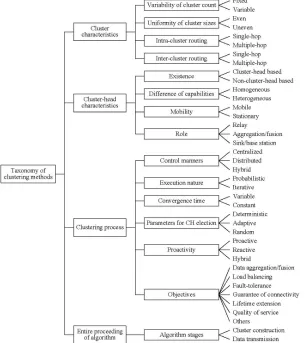
Clustering provides an efficient way to save energy inside WSNs and enables efficient resource allocation and it also improves the WSN’s scalability. Generally, clustering in WSNs is defined as the process of dividing the network nodes into groups, where each group agrees on a central node, called the cluster head [4]. The cluster head or CH acts as a bridge between other sensor nodes and base station and sometimes between one cluster head and other cluster head in multi-hop cases [5]. Cluster heads have responsibility of locality preserving, adding or leaving of nodes, scheduling time slots for each node, data aggregation and management of messages between nodes and base station [4, 6, 7].
II. LITERATURE REVIEW
In the literature,
LEACH (low-energy adaptive clustering hierarchy), was one of the pioneering clustering routing approaches for WSNs. It divides the protocol operation into rounds, and each round was subdivided into two phases: setup and steady-state phase. In the setup phase, the nodes create clusters and elect CH.
election, HEED does not select nodes as CHs arbitrarily. In HEED, CHs were periodically elected based on two important parameters: residual energy and intra-cluster communication cost of the candidate nodes.
Two-Level Hierarchy LEACH (TL-LEACH),was an addition to the algorithm of LEACH. TL-LEACH uses the following two techniques to achieve energy and latency efficiency: randomized, adaptive, self-configuring cluster formation and localized control for data transfers
Energy Efficient Clustering Scheme (EECS), was a clustering algorithm which better suits the periodical data gathering applications. EECS was a LEACH-like scheme, where the network was partitioned into several clusters and single-hop communication between the CH and the BS was performed. In EECS, CH candidates compete for the ability to elevate to CH for a given round.
Energy-Efficient Uneven Clustering (EEUC) algorithm, proposed by.], was a distributed competitive and clustering algorithm, where CHs are elected by confined competition, which was not like LEACH. Each node has a pre-assigned viable range, which was smaller as it gets close to the BS.
2Problem Statement
LEACH or Low Energy Adaptive Clustering Hierarchy is proposed by Heinzelman et al. in [8]. In this protocol, time is divided into consecutive rounds and each round is consisting of set-up phase and steady state phase.
In set-up phase, cluster heads are elected and clusters are formed. In steady state phase, environmental data are sensed and transmitted to the cluster head. After a cluster head receives its members’ data, it aggregates them and sends it to the sink. At the start of each set-up phase, each sensor node generates a random number between 0 and 1
to determine it will become a cluster-head or not, then compares this number with the threshold value T(n) which is computed by the following equation:
Where P is the desired percentage of cluster heads, r = current round, and G is the set of nodes that have not been cluster-heads in the last 1/P rounds. If the number chosen by each node is less than the threshold value T(n), the node becomes a CH for that current round[11].
Although, LEACH is a reliable clustering and routing protocol in WSNs, it applies a probabilistic cluster head selection method which as indicated in Figure 2, it may cause the following problem:
Because each node independently selects itself as cluster heads, the cluster heads may be positioned near to each other.
Some nodes which have fewer neighboring nodes may be elected as cluster heads and network may not be utilized form advantages of data aggregation.
Random selection of cluster heads does not create symmetric clusters and this may increase the total distance of nodes to cluster heads communications. As the distance of communications is increased more energy should be consumed to transfer the sensed data to cluster heads which this finally reduces the network lifetime.
III. PROPOSED WORK
4.1 Objectives
In this research we study few of clustering Routing techniques in WSN. The summarized of goal of work for the dissertation as follows.
To study the existing techniques of clustering in Wireless Sensor Networks.
To propose and implement energy efficient based method for clustering.
To compare the existing technique with the proposed technique using the parameter Energy Consumption per Round.
4.2. Research Methodology
In hierarchical architectures, the nodes are divided into clusters and a set of nodes is periodically elected as a CH. cluster heads (CHs) are used for more complex tasks, such as: the management of each cluster, collecting data from non-CHs, data aggregation, and sending the collected data to the BS. In this context, it is important to use multiple metrics for cluster head (CH) election to provide an energy-efficient and load balance model. Furthermore, the cluster formation process can lead to poor energy use, if the cluster heads (CHs) that are elected are only based on a single metric. In this context, CLENER [19] proposes an equation, which is used by nodes to enable them to become a CH.
4.2.1 Cluster head (CH) election
During the initialization of the network, base station broadcasts a startup message, which enables the node to compute the distance to BS. Following this, the nodes are able to adjust the transmission power according to distance, which reduces the energy consumption since higher transmission power consumes more energy.
After adjusting the transmission power, each node generates a random number (μ), which ranges from 0 to 1. Then, the node decides to become a cluster head (CH) by comparing μ with the T(n), which is computed by means of Equation 1. If μ is less than T(n), the node becomes a cluster head (CH) for the current round.
T(n)=
( )+ (1−
)……… (1)
Where η and α are weights to give importance, the sum is exactly 1. The Residual Energy is denoted as RE, and σre means the energy variance, which is used to produce better cluster head (CH) candidates.
Now, the node that becomes cluster head (CH) broadcasts a cluster head (CH) message, which contains the value of its remaining energy. Then, cluster head (CH) waits for a join message from the non-CH nodes. However, if the cluster heads (CHs) do not receive a join message, this cluster head (CH) should not become CH.
4.2.2 Cluster Formation
In present work author had used three linguistic input variables of the system are the remaining energy which can be expressed in percentages, the distance between non-CH and cluster head (CH) (expressed in meters) and the distance between cluster head (CH) and Base Station (expressed in meters). The specifications related for the input and output functions of the system and their respective Linguistic Values (LV) are as follows:
Residual energy: u= [0,100]: LV = low, average, high; Distance: u= [0,100]: LV = small, average, big;
Probability: u= (0,1]: LV = very high, Medium high, high, moderately medium, fairly medium, medium, moderately low, low, very low.
For the representation of the linguistic states (low, high, small and large) of the input variables, the degrees of membership to these sets must remain constant for certain values of the universe of discourse.
3.3 Design & Implementation
For the representation of the linguistic states (low, high, small and large) of the input variables, the degrees of membership to these sets must remain constant for certain values of the universe of discourse.
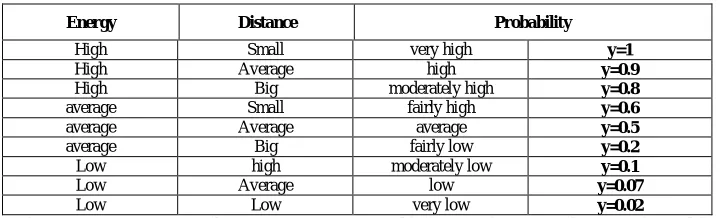
The rules are determined on the basis of an analysis of the whole network behavior through extensive simulations over time. They result in a class of higher probability, ensure an excellent chance these nodes will be elected, and differentiate depending on their distance from each CH. Table 4.1 shows the fuzzy inference rules used in the system.
Table 4.1: Fuzzy Inference Rules
Energy Distance Probability
High Small very high y=1
High Average high y=0.9
High Big moderately high y=0.8
average Small fairly high y=0.6
average Average average y=0.5
average Big fairly low y=0.2
Low high moderately low y=0.1
Low Average low y=0.07
Low Low very low y=0.02
The use of fuzzy logic is appropriate, whenever it is not possible to employ a mathematical model for the system. Additionally, fuzzy can reduce the complexity of the model, computational effort and memory TS receive context information from nodes as input and converts into fuzzy linguistic variable input.
Figure 4.2: Cluster-based algorithm for energy-efficiency
IV. RESULTS
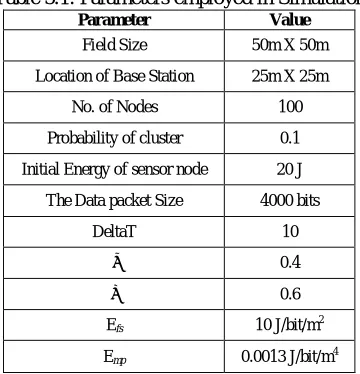
The basic parameters used for simulations are listed in table 5.1.
Table 5.1: Parameters employed in Simulation
Parameter Value
Field Size 50m X 50m
Location of Base Station 25m X 25m
No. of Nodes 100
Probability of cluster 0.1
Initial Energy of sensor node 20 J
The Data packet Size 4000 bits
DeltaT 10
ᶯ 0.4
α 0.6
Efs 10 J/bit/m2
Emp 0.0013 J/bit/m4
Based on these parameters author will carry out the simulations. These parameters are taken after studying different research papers used in Wireless sensor network.
Figure 5.1: Comparison of Energy Consumption
Table 5.1 is showing the average energy Consumption of old and proposed scheme which gives the results that proposed scheme is consuming almost 50% (Approx.) less energy as compared to old scheme. Also the standard deviation for energy consumption of proposed scheme is 30 % (approx.) less.
Table 5.1: Comparison of Energy Consumption & Standard Deviation
Scheme Round no. Energy
(%)
Energy
consumption (%)
Difference in Energy consumption (%)
Standard Deviation
Old 1 99.96 0.34
188.89
0.10
10 99.62
Proposed 1 99.95 0.18 0.074
10 99.77
V. CONCLUSION & FUTURE SCOPE
5.1 Conclusion
In New scheme fuzzy logic is used in which non-CHs select the best cluster head (CH) by considering residual energy of cluster head (CH) and a distance from non-CH to Base Station (Sink).
The use of fuzzy logic is suitable, whenever it is not possible to use a mathematical model for the system. Additionally, fuzzy can reduce the complexity of the model, computational effort and memory. Energy consumption is affected by message communication between nodes, so our technique is efficient than traditional old scheme.
5.2 Future Work
A further direction of this study can be that the chosen cluster head should be given an extra amount of energy at the time when it will get selected as cluster head. It is for long life of cluster head and Network.
REFERENCES
1. Geetha, P.V. Kallapur, and S. Tellajeera. Clustering in wireless sensor networks: Performance comparison of leach & leach-c protocols using {NS2}. Procedia Technology, 4(0):163 – 170, 2012.
2. Akyildiz, I.F.; Su, W.; Sankarasubramaniam, Y.; Cayirci, E. Wireless sensor networks: A survey. Comput. Netw. 2002, 38, 393–422. 3. Al-Karaki, J.N.; Kamal, A.E. Routing techniques in wireless sensor networks: A survey. IEEE Wirel. Commun. 2004, 11, 6–28.
4. Intanagonwiwat, C.; Govindan, R.; Estrin, D.; Heidemann, J. Directed diffusion for wireless sensor networking. IEEE/ACM Trans. Netw. 2003, 11, 2–16.
6. Karp, B.; Kung, H. GPSR: Greedy Perimeter Stateless Routing for Wireless Networks. In Proceedings of the Sixth Annual International Conference on Mobile Computing and Networking (MOBICOM), Boston, MA, USA, 6–11 August 2000; pp. 243−254.
7. Niculescu, D.; Nath, B. Trajectory Based Forwarding and Its Applications. In Proceedings of the Ninth Annual International Conference on Mobile Computing and Networking (MOBICOM), San Diego, CA, USA, 14–19 September 2003; pp. 260–272.
8. Shah, R.C.; Rabaey, J.M. Energy Aware Routing for Low Energy Ad Hoc Sensor Networks. In Proceedings of the Wireless Communications and Networking Conference (WCNC), Orlando, FL, USA, 17–21 March 2002; pp. 350–355.
9. Murugunathan, S.D.; Ma, D.C.F.; Bhasin, R.I.; Fapajuwo, A.O. A Centralized Energy-Efficient Routing Protocol for Wireless Sensor Networks. IEEE Radio Commun. 2005, 43, S8–S13.
10. Lindsey, S.; Raghavendra, C.; Sivalingam, K.M. Data gathering algorithms in sensor networks using energy metrics. IEEE Trans. Parallel Distrib. Syst. 2002, 13, 924–935.
11. Manjeshwar, E.; Agrawal, D.P. TEEN: A Routing Protocol for Enhanced Efficiency in Wireless Sensor Networks. In Proceedings of the 15th International Parallel and Distributed Processing Symposium (IPDPS), San Francisco, CA, USA, 23–27 April 2001; pp. 2009–2015.
12. Manjeshwar, A.; Agrawal, D. P. APTEEN: A Hybrid Protocol for Efficient Routing and Comprehensive Information Retrieval in Wireless Sensor Networks. In Proceedings of the 2nd International Workshop on Parallel and Distributed Computing Issues in Wireless Networks and Mobile computing, Lauderdale, FL, USA, 15–19 April 2002; pp. 195–202.
13. Luo, H.; Ye, F.; Cheng, J.; Lu, S.; Zhang, L. TTDD: Two-tier data dissemination in large-scale wireless sensor networks. Wirel. Netw. 2005, doi:10.1007/s11276-004-4753-x.
14. Claudio Silva, Rodrigo Costa, AdoniasPires, Denis Rosário, Eduardo Cerqueira, Kássio Machado, Augusto Neto and JóUeyama, “A Cluster-based Approach to provide Energy-Efficient in WSN”, International Journal of Computer Science and Network Security, VOL.13 No.1, pp. 55-62, January 2013.