ISSN(Online): 2319-8753 ISSN (Print) : 2347-6710
I
nternational
J
ournal of
I
nnovative
R
esearch in
S
cience,
E
ngineering and
T
echnology
(An ISO 3297: 2007 Certified Organization)
Vol. 5, Issue 6, June 2016
Design and implementation of Controlling
Vehicle Direction Using Brain Rhythms
Sweta VM 1, Manisha D Mali 2, Sunita P sagat 3
P.G. Student, Department of Electronics and Telecommunication Engineering, N.B Navale Sinhgad College of
Engineering, Solapur University, Maharastra, India1
Assistant Professor, Department of Electronics and Telecommunication Engineering, N.B Navale Sinhgad College of
Engineering, Solapur University, Maharastra, India 2
Assistant Professor, Department of Electronics and Telecommunication Engineering, N.B Navale Sinhgad College of Engineering, Solapur University, Maharastra, India 3
ABSTRACT: In recent years, lot many research activities have taken place in the field of EEG based BCI. Recent experiments have shown that this application finds good potential for disabled people where driving becomes an impossible task. This paper discusses potential of BCI application for controlling vehicle direction, its effectiveness and probable issues. This system works on EEG signals on MATLAB platform. This is implemented by signal acquisition, filtering, feature extraction and their classification on the basis of command given.These commands are executed on Arduino microcontroller board.
KEYWORDS:BCI-Brain Computer Interface, EEG Electroencephalography, DWT-Discrete Wavelet Transform, SVM–support vector Machine, ZPF-Zero phase filtering.
I. INTRODUCTION
BCI is the natural way to augment human capabilities by providing a new interaction link with outside world and is particularly relevant as an aid for paralysed humans, although it also opens up new possibilities in human robot interaction for able bodied people. One of these new fields of application is use of BCI in automatic way where driving becomes an impossible task for disabled people. In past couple of years BCI technology has expanded in leaps and bounds. This technology allows disabled person to move the wheel chair without touching wheels or pedals. Instead EEG sensor is programmed to pick up conscious thoughts like left or forward and wirelessly beamed them to custom built automated control system that pushes pedals and turns steering wheel. BCI monitors and acquires brain activity of user, analyses it to determine the intent of subject on the basis of frequency and cortical areas activated and finally transmits signals as executable commands.
Through this project a software platform is set up to support BCI applications whose performance could be implemented by signal acquisition, filtering, feature extraction and classification.
Only EEG has the advantages of easy preparation, inexpensive equipment cost, and high temporal resolution in implementing BCIs. An EEG-based BCI system requires an elaborately designed task for generating reliable neural responses, a credible signal processing method for extracting particular signal features, and an efficient translation algorithm to produce output signals [2].
ISSN(Online): 2319-8753 ISSN (Print) : 2347-6710
I
nternational
J
ournal of
I
nnovative
R
esearch in
S
cience,
E
ngineering and
T
echnology
(An ISO 3297: 2007 Certified Organization)
Vol. 5, Issue 6, June 2016
II. PROBLEM STATEMENT
The main problem of disabled people is to move from one place to another place. The proposed system will control vehicle direction using EEG signals (brain rhythms) .The vehicle can be moved forward, backward, right and left using this system.
III. METHODOLOGY
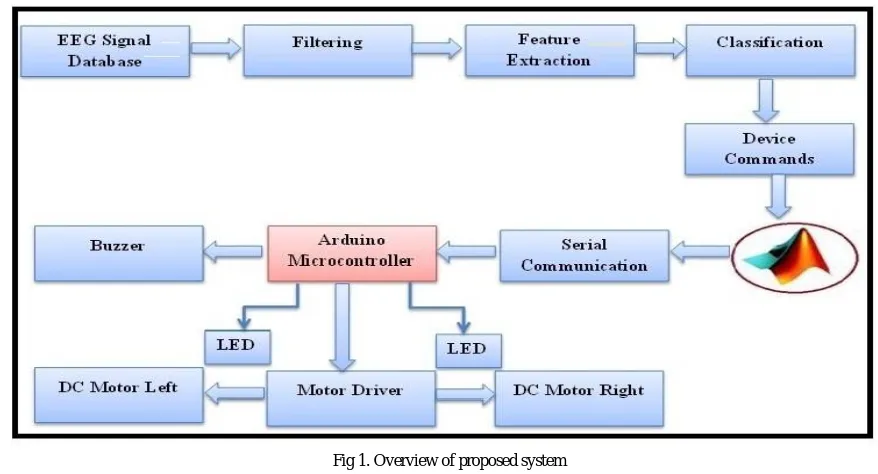
The architecture of the system mainly consists of five components. Steps or the overview of proposed system is as shown in following figure
.
Fig 1. Overview of proposed system
1 EEG signal database:
Electrical activity of the brain is measured by electrodes over the scalp. Electrodes establish connections between the scalp and EEG recording device by converting ionic current into electrical current. Electrolytic gel is applied between the scalp and the electrodes to prevent attenuation of the signal. An electrode placement system accepted as International standard called 10-20 System and is used to compare the measurements [4]. EEG measurement can be done in one of the two ways:
a) Bipolar Recording:
C3-F3 and C4-F4 bipolar electrode pairs according to the 10-20 System are used as two channels in this study in order to detect rhythms [9]
b) Referential Recording:
For SSVEP data acquisition, the positions of the electrodes are placed according to the International standard 10-20 system. The International 10-20 system is an internationally recognized method to describe and apply the location of scalp electrodes in the context of an EEG test or experiment. The first electrode, SSVEPPOS, is placed at the occipital region that is OZ (based on the International EEG 10-20 system); the second electrode, SSVEPNEG, is placed at the right mastoid; and the bipolar signal (SSVEPPOS to SSVEPNEG) with respect to the ground electrode (third electrode, SSVEPGND) is placed at the forehead position as shown in Figure 2.
ISSN(Online): 2319-8753 ISSN (Print) : 2347-6710
I
nternational
J
ournal of
I
nnovative
R
esearch in
S
cience,
E
ngineering and
T
echnology
(An ISO 3297: 2007 Certified Organization)
Vol. 5, Issue 6, June 2016
Fig. 2 SSVEP data Acquisition
2 Filtering or signal preprocessing:
One of the main problems in the automated EEG analysis is the detection of the different kinds of interference waveforms (artifacts) added to the EEG signal during the recording sessions. These interference waveforms, the artifacts, are any recorded electrical potentials not originated in brain. There are four main sources of artifacts emission:
1. EEG equipment.
2. Electrical interference external to the subject and recording system. 3. The leads and the electrodes.
4. The subject her/himself: normal electrical activity from the heart, eye blinking, eyes movement, and muscles in general.
In case of visual inspections, the artifacts can be quite easily detected by EEG experts. However, during the automated analysis these signal patterns often cause serious misclassifications thus reducing the clinical usability of the automated analysing systems. Recognition and elimination of the artifacts in real – time EEG recordings is a complex task, but essential to the development of practical systems.
Acquired signals are usually contaminated with noises as we have seen above. The filtering method depends on the type of noises in signal. Various types of interferences in biomedical signals are from different origin. High frequency noise in EEG is due to instrumentation amplifier, recording system and EM signals by cables. Motion artifact in EEG may be caused in by coughing and breathing. Poor contact and polarization of electrodes may also cause low frequency artifacts. Due to harmonics distortion in fundamental frequency power line interference could appear in EEG which may be difficult to visualize.
First step in designing of filter is to remove the baseline noise. The baseline noise means the signal causes shifting due to movement. This shift has to be removed to get the original EEG signal. For removing the shift in EEG signal zero phase low pass filter is used.
a) Zero phase low pass filter:
Zero phase low pass filter is a bidirectional filter. To avoid this distortion bidirectional filters are used in which the signal is filtered in a forward direction over a selected window and then same window is filtered in a reverse direction .A short window was preferably selected so that the filter could be used for real time purposes.
The delay of each frequency components is applied forwards and backwards in time and is therefore cancelled. Then the result has the following characteristics.
Zero phase distortion.
A filter transfer function which equals the squared magnitude of the original filter transfer function.
A filter order that is double the order of the filter specified by numerator and denominator.
Zero phase filtering minimizes start up and ending transient by matching initial conditions. It helps in preserving the features in the filtered time wave form exactly where those features occur in the unfiltered waveform.
b) Notch filter:
ISSN(Online): 2319-8753 ISSN (Print) : 2347-6710
I
nternational
J
ournal of
I
nnovative
R
esearch in
S
cience,
E
ngineering and
T
echnology
(An ISO 3297: 2007 Certified Organization)
Vol. 5, Issue 6, June 2016
3 Feature Extraction:
There are different feature extraction methods like principal component analysis, discrete derivatives, Wavelet Transform and FFT transform.
Wavelet transform is an effective way to extract features from non-stationary EEG signals. Through wavelet transform EEG signals are decomposed into frequency sub bands using discrete wavelet transform and a set for statistical features was extracted from the sub-bands to represent the distribution of wavelet coefficients according to the characteristics of signals.
dt
t
t
x
b
a
W
(
,
)
(
)
(a,b)(
)
b a,
(t)=a
b
R
a
b
t
a
,
0
),
)
(
(
)
1
(
where a and b are scale and translation parameters, respectively, Ψ is the mother wavelet, * is the complex conjugate operator and W(a,b) is the continuous wavelet transform of x(t).
Scaled and translated versions of the basic functions are obtained from one prototype function, the mother wavelet. In principle, the CWT produces an infinite number of coefficients, thus it provides a redundant representation of the signal. The DWT provides a highly efficient wavelet representation that can be implemented with a simple recursive filter scheme and the original signal reconstruction can be obtained by an inverse filter [4]. The number of levels of decomposition is chosen on the basis of the dominant frequency components of the signal. According to the motor imagery EEG signals itself, level 4 and the wavelet of Daubechies order 10 was selected to extract m and b rhythms as features [4]. As a result, the EEG signal is decomposed into the details D1-D3 and approximation A3. The ranges of different frequency bands for a 128 Hz sampled signal are shown in table1.
Table 1: Frequencies correspond to different levels of decomposition for Daubechies order 10 wavelet with a sample rate 128 Hz
Decomposed Signal
Frequency
range Hz Level
D1 32-64 1
D2 16-32 2
D3 8-16 3
A3 0-8 3
4 Classification:
Extracted features of Wavelet coefficients for each trial can be classified depending upon the values obtained. A variety of classifiers have been used to translate these extracted features from EEG signals into an output command, from simple classifiers such as nearest neighbour, linear discriminant analysis (LDA), nonlinear neural networks (NN), support vector machines (SVM), and statistical classifiers.
In the proposed system SVM classification method will be used.
Support vector machine
:
Machine learning methods are helpful for interpreting high dimensional feature sets and analyse the characteristics of brain patterns. Support Vector Machine is one of the popular Machine Learning methods for classifying EEG signals. SVM aims to maximize the margin in order to avoid the risk of over fitting data and minimize the misclassification error. SVM is applied in many applications like EEG signal classification, cancer identification, bioinformatics, seizure prediction, and face recognition and speech disorder.5 Hardware Interface:
ISSN(Online): 2319-8753 ISSN (Print) : 2347-6710
I
nternational
J
ournal of
I
nnovative
R
esearch in
S
cience,
E
ngineering and
T
echnology
(An ISO 3297: 2007 Certified Organization)
Vol. 5, Issue 6, June 2016
while moving the buzzer will be ON to give the warning for the person to make vehicle speed slow so that no accident should happen.
IV. EXPERIMENTAL RESULTS
The main objective of this proposed system is to extract the feature of EEG signal and classify it according to the values obtained. This is done by the algorithm. The algorithm steps are summarized as follows.
Step 1: First take the EEG signal for testing.
Step 2: Remove the noises like baseline and power line noise by using zero phase low pass filter and notch filter. Step 3: Extract the features of filtered EEG signal, which will give the different wavelet coefficient like mean, standard deviation, kurtosis, wave energy, skewness, range of EEG signal etc.
Step 4: Depending on the values of wavelet coefficient EEG signal can be classified as forward, backward, left tun and right turn.
Step 5: From step 1 to step 4 is repeated for different number of EEG signals.
Below figures shows the results of EEG signal as followed in the algorithm.
Figs. 3 (A) shows the original EEG signal (B) shows the EEG signal obtained by applying first ZPLF.(c) shows the signal obtained by applying Notch filter (D) Shows the feature extracted signal and the value is given for range of EEG signal.
(A) (B)
(C)
(D)
ISSN(Online): 2319-8753 ISSN (Print) : 2347-6710
I
nternational
J
ournal of
I
nnovative
R
esearch in
S
cience,
E
ngineering and
T
echnology
(An ISO 3297: 2007 Certified Organization)
Vol. 5, Issue 6, June 2016
(E)
(F)
V. CONCLUSION
The system has been designed and implemented using MATLAB and Arduino microcontroller environment .It is observed to be more users friendly and compatible with real time environment. The algorithm is the more efficient, accurate and easy method for processing of EEG signals
REFERENCES
[1] Mill´an et al. in 2004, proposed first “Noninvasive brain-actuated control of a mobile robot by human EEG,” IEEE TRANSACTIONS ON BIOMEDICAL ENGINEERING, VOL.51, NO. 6, JUNE 2004
[2] In 2013 Luzheng Bi ,published the paper on “EEG based brain-controlled mobile robot: survey. IEEE TRANSACTIONS ON HUMAN-MACHINE SYSTEMS, VOL. 43, NO. 2, MARCH 2013.
[3] In 2013Priyanka Khatwani1, Archana Tiwari published paper on “A survey on different noise removal techniques of EEG signals” International Journal of Advanced Research in Computer and Communication Engineering Vol. 2, Issue 2, February 2013.
[4] M. Rajya Lakshmi* Dr. T. V. Prasad and Dr. V. Chandra Prakash published paper “ Survey on EEG Signal Processing Methods” International Journal of Advanced Research in Computer Science and Software 4, Issue 1, January 2014
[5] Sławomir Kocoń, Jacek Piskorowski published paper on “Digital Finite Impulse response Notch Filter with Non-Zero Initial Conditions, Based On An Infinite Impulse Response Prototype Filter” METROLOGY AND MEASUREMENT SYSTEMS Index 330930, ISSN 0860-8229.
[6] A book on “EEG Signal Classification for Brain Computer Interface Applications” ECOLE POLYTECHNIQUE FEDERALE DE LAUSANNE Jorge Baztarrica Ochoa Responsible Assistant : Gary Garcia Molina. Professor : Touradj Ebrahimi ,March 28th, 2002. [7] P Bhuvaneswari “Support Vector Machine Technique for EEG Signals “published paper in International Journal of Computer
Applications (0975 – 8887) Volume 63– No.13, February 2013.
[8] B.W.Jervis, E.C.Ifeachor, and E.M.Allen. “The removal of ocular artifacts from the electroencephalogram :a review”. Medical &Biological Engineering &Computing , 26: 2-12, 1988.
[9] “A Tutorial on EEG Signal Processing Techniques for Mental State Recognition in Brain-Computer Interfaces” by Fabien Lotte
https://hal.inria.fr/hal-01055103 Submitted on 11 Aug 2014
BIOGRAPHY
Ms Sweta VM received the B.E (Electronics and Telecommunication) from Visvesvarayya Technological university ,Belagum. and M.E. degrees in Electronics and Tele communication Engineering from Sinhgad Institute of Technology in 2009 and 2016, respectively. During 2009-2012, she worked as hardware design engineer in iWave system Technologies PVT Ltd,Banglore.
ISSN(Online): 2319-8753 ISSN (Print) : 2347-6710
I
nternational
J
ournal of
I
nnovative
R
esearch in
S
cience,
E
ngineering and
T
echnology
(An ISO 3297: 2007 Certified Organization)
Vol. 5, Issue 6, June 2016
Sinhgad College of Engineering, Solapur. She has published 5 articles in professional journals and conferences Her current research interests include embedded system, VLSI, and communication.