An Efficient Haze Removal Algorithm for
Surveillance Video
D.Shabna 1, C.S.Manikandababu 2
P.G. Student, Department of Electronics and Communication Engineering (P.G), Sri Ramakrishna Engineering College, Coimbatore, India1
Assistant Professor, Department of Electronics and Communication Engineering (P.G), Sri Ramakrishna Engineering College, Coimbatore, India2
ABSTRACT: The reliable method for dehazing in video was proposed by using haze removal algorithm. The simple but effective prior is change of detail prior (CoD) algorithm to remove haze from video. By using Change of detail prior algorithm we can estimate the thickness of Haze from every frame and also effectively recover a high quality video. In this approach first extract the background image by using frames differential method and then estimate the atmospheric light and transmission map from the background image and finally renders the haze-free video according to the haze image model. The performance analysis of proposed method demonstrates that a good haze-free video can be produced effectively and efficiently.
KEYWORDS: Video haze removal, Transmission map, Image haze model, Atmospheric light. I. INTRODUCTION
1.2 HAZE REMOVAL PROCESS FOR VIDEO
Figure 1 Haze removal process for video.
II. PROPOSED APPROACH
2.1 CHANGE OF DETAIL PRIOR ALGORITHM
In a given video that has a haze, fog or mist, the first step is to extract the background image and then estimate the atmospheric light using the dark channel prior proposed by He et al[1].In this algorithm the universal Transmission map is estimated based on the intensity component through Bilateral Filter, MSR and total variation (TV) denoising filter. Finally haze free video can be obtained by haze imaging model.
2.2 HAZE IMAGING MODEL
In computer vision and computer graphics, most widely used to describe the formation of a haze image model is it can be defined as follows
I = LO. T + LA. (1−T) (1)
Where I is the Haze image, 0 represents haze free representation at the same pixel, T represents the Transmission map, which represents the atmospheric light estimation. This method is to enhance the visibility of the entire video not only the single image for surveillance camera systems, traffic monitoring. For this purpose, the haze removal approaches for video adopt a different strategy to deal with video defogging problem. So in this method adopt a universal strategy to restore the video based on haze imaging model.
2.3 ATMOSPHERIC LIGHT ESTIMATION
Among these pixels, the pixels with highest intensity in the input image I are selected as the atmospheric luminance. The Dark channel is defined as
(2)
where min represents the minimum operation to find the minimum value among three colour channels, is a color
channel of input image, and Ω(x) is a minimum local patch cantered at x. Each colour channel of input image is filter by NxN minimum filter with a moving window. The maximum value from each colour channel is selected as atmospheric luminance. This method produces similar results but performs more efficiently.
2.4 BACKGROUND EXTRACTION
Our research considers an outdoor surveillance video camera capturing a scene (with moving objects) over an extended period of time. We would like to process it in real-time to obtain a haze-free video. Transmission map is only calculated for the background part of the video, in order to apply the universal transmission map to more frames with
))
(
(
)
(
min
min
} , , {
y
x
i
i
cb g r c y dark
III. TRANSMISSION MAP EXTRACTION
Transmission map is calculated based on the assumption that the intensity of an image reflects the amounts of photons received by every position of the image. The farer distance between the scene points and camera, the fewer photons are received by the sensor, which leads to darker intensity in the image. Thus, the depth information reflected by the transmission map can be measured by intensity, in other words, the transmission map can be obtained by the intensity component of an image. So our objective is to obtain the transmission information from the intensity component of an image. For this purpose, MSR, bilateral filter are used on the intensity component of the background image.
3.1 PSEUDO-TRANSMISSION MAP ESTIMATION
For surveillance camera system, the camera is fixed and often positioned high in the air, so the background of each frame is unchangeable and the difference in transmission between a foreground object and the background behind it is usually small. Although the haze removal result obtained by using bilateral filter to obtain transmission map is good for a single image, using the filter to calculate trans-mission map for each frame is surely time-consuming. In order to make the pseudo-transmission map calculated once and used for all, the map should only contain scene outlier. Therefore, the moving foreground object and image details can be regarded as noise. As the total variation based on Rudin-Osher-Fatemi (ROF) model proved to be quite efficient for denoising and regularizing images without smoothing the boundaries of the objects [11], we use the total variation algorithm to calculate the pseudo-transmission map obtained by bilateral filter. This pseudo-transmission map is applied to all video frames without creating significant errors in the enhanced video.
.
3.2 BILATERAL FILTER
Bilateral filter is a non linear technique, edge preserving, and noise reducing for images. In bilateral filter each pixels is replaced by weighted average of its neighbours, in a manner very similar to Gaussian convolution. This filter preserves edges while smoothing and for each pixel is to influence another pixel, it should not occupy nearby pixel location but also have a similar value. The bilateral filter, denoted by BF
(3)
Where, I is the input image, p and q are the pixel co ordinates, Gσs - is a spatial domain Gaussian weighting for distant
pixels, Gσr is a range Gaussian that decreases the influence of pixels q. An important characteristic of bilateral filter is that the weights are multiplied, but if the weights are close to zero no smoothing will occurs.
3.3 TV DENOISING
Total variation Denoising is often used for image filtering and restoration, noise reduction so as to preserve sharp edges in the underlying signal. The total variation based on model proved to be quite efficient for denoising and smoothing the boundaries of the objects. So we use the total variation algorithm to calculate the pseudo-transmission map obtained by bilateral filter.
IV. SCENE RADIANCE RESTORATION
According to the haze image model we can recover the scene radiance of each frame with the same transmission map obtained by the algorithm presented above. Because the direct attenuation term I(x)t(x) can be very close to zero, so the transmission map t(x) is restricted to a lower bound t0, which means that a small amount of haze are preserved in very dense haze regions. A typical value of t0 is 0.1. The final scene radiance I(x) is then recovered by:
=
( )( ( ), )
+
(4)
s q p Pw
I
BF
s(||
p
-
q
||)
G
r(|
Ip
-
Iq
|)
Iq
G
Since from the first frame, the transmission map t(x) and the atmospheric light A can be estimated, so we can apply this equation to each frame of the original video in order to obtain the final haze-free result.
V. RESULTS AND DISSCUSION
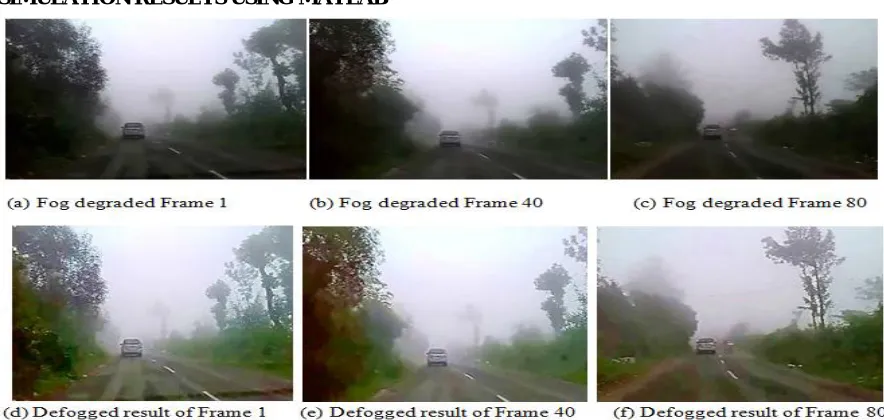
In this section the change of detail prior algorithm results are discussed. The execution is carried out in MATLAB 2013a tool. The PSNR value of output image is found to be better than the input image.
5.1 SIMULATION RESULTS USING MATLAB
5.2 ANALYSIS REPORT FOR VIDEO FRAMES
Table I analysis report
Table 1 shows the analysis report of PSNR value and MSE value is compared with the existing technique and proposed technique. Input hazy image contain more error by using visibility approach the error has been minimized.
VI. CONCLUSION AND FUTURE WORK
This paper proposes a fast video defogging approach using haze image model with the same atmospheric light
S.NO
Parameters
Existing
method
Proposed
method
1
PSNR
67.9435
69.3837
with universal estimated atmospheric light and trans-mission map. The experiment results show that our method is effective and efficient.
REFERENCES
[1] He K, Sun J, Tang X (2009) Single image haze removal using dark channel prior [C]. In: Proceedings of the IEEE computer society conference on computer vision and pattern recognition (CVPR), Piscataway, U S A, pp 1956–1963.
[2] Tan R (2008) Visibility in bad weather from a single image [C]. In: Proceedings of the IEEE computer society conference on computer vision and pattern recognition (CVPR), Piscataway, U S A, pp 1–8
[3] Fattal R (2008) Single image dehazing [J]. ACM Trans Graph 27(3):72–79
[4] John J, Wilscy M (2008) Enhancement of weather degraded video sequences using wavelet fusion [C]. Cybernetic intelligent system, 2008. CIS 2008 In: 7th IEEE international conference on London, Sept 2008, pp 1–6
[5] Xu Z, Liu X, Chen X (2009) Fog removal from video sequences using contrast limited adaptive histogram equalization [C]. Computational intelligence and software engineering, international conference on 2009, pp 1–4
[6] Narasimhan SG, Nayar SK (2003) Contrast restoration of weather degraded images [J]. IEEE Trans Pattern Anal Mach Intell 25(6):713–724 [7] Chen G, Zhou H, Yan J (2007) A novel method for moving object detection in foggy day [C]. In: 8th ACIS international conference on software engineering. Artificial intelligence, networking, and parallel/distributed computing, pp 53–58
[8]. McCartney EJ (1976) Optics of atmosphere: scattering by molecules and particles [M]. Wiley, New York, pp 23–32
[9]. Xie B, Guo F, Cai Z (2010) Improved single image dehazing using dark channel prior and multi-scale retinex [C]. In: International conference on intelligent system design and engineering application.
[10] Haritaoglu I, Harwood D, Davis LS (2000) W4: Real-time surveillance of people and their activities [J]. IEEE Trans Pattern Anal Mach Intell 22(8):809–830.
[11] Schechner Y. Y., Narasimhan S. G., and Nayar(2010), “Polarization based vision through haze,” Appl. Opt., vol. 42, no. 3, pp. 511–525. [12] M. Aleksic, M. Smirnov, and S. Goma (2006), “Novel bilateral filter approach: Image noise reduction with sharpening,” in Proceedings of the Digital Photography II Conference, volume 6069, SPIE.