(Under the direction of Dr. Douglas J. Gillan.)
The purpose of this study was to decompose the navigation performance differences between males and females to address the lack of consistency in navigation research gender differences. Previous research on such gender differences is inconclusive and shows that some measures can be gender biased. This research utilized a collection of spatial ability and navigation measures to facilitate the decomposition of gender differences. Sixty six college students (31 males, 35 females) participated in this study. The independent variables were gender, feedback presence, and type of object used as a landmark. The dependent variables were map distance estimates, map angle estimates, navigation distance estimates, navigation angle estimates, and navigation time.
Participants completed two spatial ability tests (MRT and PTSOT), an anxiety measure (SAS), and a video game experience questionnaire as pre-tests. A virtual
environment was used for the navigation tasks and on-screen maps were used for the map tasks. Results were as inconsistent as previous research. Two-way ANOVAs and
Hierarchical multiple regression analyses showed that differences and interactions varied by dependent variable showing instances where males outperformed females, females
by
Michaela Rose Case
A thesis submitted to the Graduate Faculty of North Carolina State University
in partial fulfillment of the requirements for the degree of
Master of Science
Psychology
Raleigh, North Carolina 2012
APPROVED BY:
_______________________________ ______________________________ Jason C. Allaire Anne C. McLaughlin
________________________________ Douglas J. Gillan
Dedication
Biography
Acknowledgements
I would like to thank my advisor Dr. Douglas Gillan for supporting my research and
providing invaluable guidance and insight throughout my graduate career. He is an admirable advisor. My gratitude extends to Dr. Anne McLaughlin and Dr. Jason Allaire for their
Table of Contents
List of Tables vi
List of Figures vii
Introduction 1
Evolution 1
Gender Differences in Cognition 2
Navigation 16
Measures of Spatial Ability 33
Virtual Environments 35
Feedback and Motivation 39
Training for the Test 42
Aims of this Research 44
Method 45
Participants 45
Materials 45
Design 50
Procedure 50
Results 54
Pre-tests 54
Navigation Performance Measures 55
Test of Hypothesis 55
Discussion 58
Pre-tests 58
Navigation Performance Measures 60
Conclusion and Limitations 62
References 65
Appendices 98
List of Tables
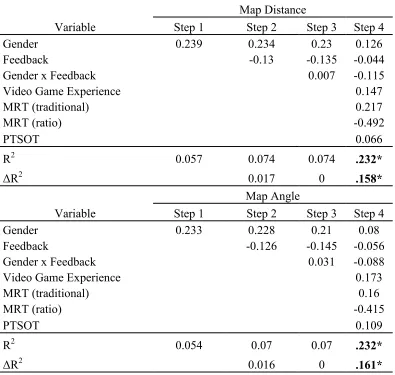
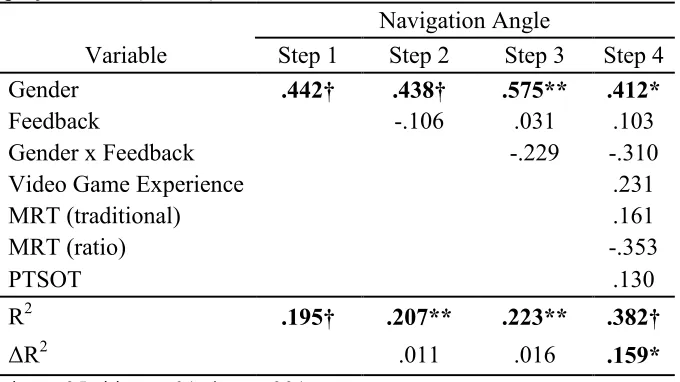
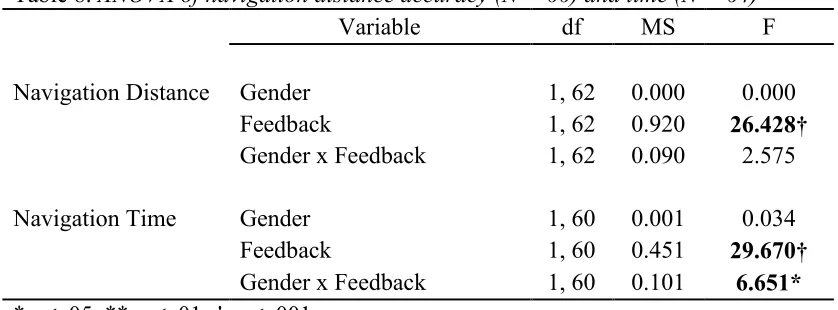
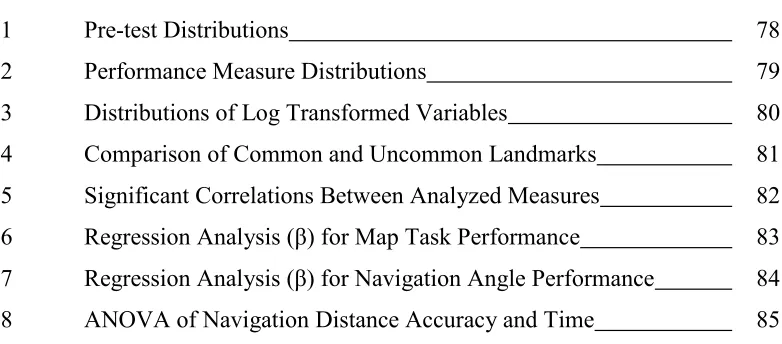
Table 1 Pre-test Distributions 78
Table 2 Performance Measure Distributions 79
List of Figures
Figure 1 Experiment Design 86
Figure 2 MRT (traditional) Score Distribution 87 Figure 3 Log MRT (traditional) Score Distribution 87
Figure 4 MRT (ratio) Score Distribution 88
Figure 5 PTSOT Score Distribution 89
Figure 6 Log PTSOT Score Distribution 89
Figure 7 SAS Score Distribution 90
Figure 8 Video Game Experience Distribution 90 Figure 9 Map Distance Estimate Error Distribution 91 Figure 10 Log Map Distance Estimate Error Distribution 91 Figure 11 Map Angle Estimate Error Distribution 92 Figure 12 Log Map Angle Estimate Error Distribution 92 Figure 13 Navigation Distance Estimate Error Distribution 93 Figure 14 Log Navigation Distance Estimate Error Distribution 93 Figure 15 Navigation Angle Estimate Error Distribution 94 Figure 16 Log Navigation Angle Estimate Error Distribution 94
Figure 17 Navigation Time Distribution 95
Figure 18 Log Navigation Time Distribution 95
Introduction
Gender differences in spatial abilities have been researched for decades. Males tend to exhibit better spatial abilities than females (e.g., Halpern, 2000) and females exhibit stronger verbal skills than males (e.g., Halpern, 2000; Naglieri & Rojahn, 2001). Given that navigation is based on spatial abilities, males might be expected to have stronger navigation skills. However, research shows mixed results as to which gender is actually better at navigation tasks. Some studies show males are better (Tlauka, Brolese, Pomerov, & Hobbs, 2005), some show females are better (Barkely & Gabriel, 2007; Chai & Jacobs, 2009), and others show there are no gender differences (Gillner & Mallot, 1998).
Evolution
Evolutionists have developed two explanations for why gender differences exist in spatial abilities and navigation performance. Most widely accepted are the hunter-gatherer roles that males and females followed throughout history (Dabbs, Chang, Strong, & Milun, 1998; Silverman & Eals, 1992). In this model, males are typically the hunters which required them to travel into unknown areas to find game. The males would not take direct routes to search for the game but would use a direct route to return home (Dabbs et al., 1998). As the gatherers, females would maintain the home and forage in the area nearby. In doing so, females would use the same routes since they did not have to track game but rather returned to the same set of locations.
would have maintained a larger territory to maximize his potential to find mates (Gaulin & FitzGerald, 1986). Males who were able to maintain a large territory were able to find more mates and produce more offspring. Maintaining a larger territory requires strong spatial and navigation skills so these genes were passed on to the next generation. Because males did the traveling, females were likely to have stayed in substantially smaller areas. These differences in travel exposure caused males to develop stronger spatial abilities and navigation skills. According to evolutionary theory, males should be better at navigating in general; however, research has found this is not always the case. Deeper analyses of cognitive differences, navigation, and spatial ability measures could help explain why gender differences exist in navigation research.
Gender Differences in Cognition
Many cognitive gender differences do not become consistently apparent until puberty, especially those in spatial abilities (Halpern, 1997; Hyde, Fennema, & Lamon, 1990; Roberts & Bell, 2002; Voyer, Voyer, & Bryden, 1995). Spatial abilities are measured in many
different ways which is problematic since gender differences are not generalized to all types of spatial abilities (Catteneo, Postma, & Vecchi, 2006). Rather, these gender differences only occur in the specific group of spatial ability tasks that involve mental manipulation of
Attention to detail. Attention to detail is important in many measures of navigation ability such as landmark identification, direction estimates, and distance estimates. Many studies examining gender differences in attention to detail show females are more competent than males. One example, facial recognition tests, requires attention to detail because faces are similar with subtle differences. In face recognition tests, females outperform males in accuracy with more hits and fewer false alarms when indicating which faces they have and have not seen before (Guillem & Mograss, 2005). Since recognizing the correct faces takes high attention to detail, it supports that females make more detailed memories than males (Guillem & Mograss, 2005). The less detailed memories are easily influenced by familiarity (Schacter, Norman, & Koustaal, 1998) and interference (Kramer, Delis, Kaplan, O’Donnel, & Prifitera, 1997; Palmer & Folds-Bennett, 1998; Guillem & Mograss, 2005). This suggests that for detailed memory tasks such as face recognition, males’ memories are more
influenced by familiarity and interference than females.
Various other studies show females tend to have more detailed memories than males. In research by Naglieri and Rojahn (2001), females exhibited better letter-word
memories. When emotion was low, there were no gender differences which shows only females’ memories are improved by emotions. In a false memory production study of themed word lists, Bauste and Ferraro (2004) did not find any gender differences. This supports significant gender differences in accurate recall, not false memory production. These examples all support attention to detail as an influence of performance on recall and recognition tasks. As such, females should be more attentive to details during navigation.
by familiarity and interference. In terms of navigation, this should give females the advantage.
Although this supports that females have more attention to detail than males, it raises another point. In the female-dominated tasks of attention to detail, they have realistic
applications: remembering faces, reading for comprehension, emotional memories, and facts about a TV show. Another aspect of these differences was the type of information required for the responses. Simply identifying faces, memories, and facts that were provided is different from asking the participants to use expected previous knowledge in response to the current task. For example, when tasks require participants to estimate distances with metric information, males are more accurate than females (Iachini, Sergi, Ruggiero, & Gnisci, 2005). This metric information was not provided during the experiment so participants have to use their previous knowledge to manipulate the conceptualized distances into the
appropriate metric units.
study object icons, tested with object icons; study object words, tested with object words; study object icons, tested with object words; study object words, tested with object icons. When there was no change from object study form to test form, overall performance was better. There were no significant gender differences in any of the conditions (Catteneo et al., 2006).
In the next experiment, two more conditions were added: study object icons, tested with half object icons and half object words; study object words, tested with half object icons and half object words. When half of the objects changed from words to icons and vice versa, males were more accurate than females (Catteneo et al., 2006). When all of the icons were changed to words and vice versa, there were no gender differences (Catteneo et al., 2006). Introducing distracters into the study phase decreased overall performance of both genders. When there was any transformation of object form, distracters caused the females to perform significantly worse than males (Catteneo et al., 2006). According to the authors, this shows that when cognitive load was increased by a distracter and mentally manipulating spatial information, males significantly outperform females in object replacement tasks (Catteneo et al., 2006). Unlike the attention to detail studies, the task was not typical and there was no relationship between the objects (except that they all had short names). This means the task did not have a direct realistic application.
van Honk, 1999; Voyer et al., 2007). However, when correctly replacing objects to a set of indicated possible locations, gender differences are absent or even reversed (Postma et al., 1998; Postma et al., 1999). When there are cues to show the participant where the item might belong, females outperform males in accuracy. In an object replacement task that used themed rooms with appropriate objects, females outperformed males in replacing the objects in their respective rooms (Goede & Postma, 2008). Each room showed three possible places for the item and participants indicated which location was the correct one. There were no gender differences in object identity, only object location (Goede & Postma, 2008). This is another example of an experiment with realistic application where females outperform males. Since males outperform females when there is no indication of possible locations, it seems counterintuitive that they would perform worse than females when possible locations are indicated. The reason why females outperformed males in the Goede and Postma (2008) experiment was because it had realistic application of possible places.
how performance is measured, different genders may have the advantage. For example, this experiment shows that both genders placed the objects in the correct orientation but females were less successful at placing the objects the correct distance apart. If angles were used as a performance measure, there would be no gender differences but if distances were the
measure then males would be better.
Realistic application has been slightly investigated in terms of types of objects. For objects that have gender associations, males and females perform differently in replacement tasks. In a meta-analysis conducted by Voyer and colleagues (2007), object replacement tasks favored females when the objects were common or geometric. For feminine, gender-neutral, and uncommon objects, there were no significant gender differences (Voyer et al., 2007). The only time males consistently outperform females is when the objects are masculine (Voyer et al., 2007). Also, females were better than males in object relocation tasks when time and accuracy were the dependent variables (Voyer et al., 2007). This brings about the issue of performance measures in object recognition and replacement tasks.
2008). This causes the gender gap to substantially narrow from pretest to posttest (Cherney, 2008; Feng, Spence, & Pratt, 2007). The type of mental rotation has also been shown to influence the amount of gender difference in performance.
Roberts and Bell (2002) examined gender differences in mental rotation of three different types of figures: two-dimensional (2D) alphanumeric characters, a 2D gingerbread man, and a 3D basketball player. Performance on all three of the mental rotation tasks showed no gender differences. Unlike the commonly used Mental Rotation Test (MRT) (Shepard & Metzer, 1971) which uses arrangements of cubes, these mental rotation tasks used alphanumeric characters, a gingerbread man, and a basketball player which are all considered common objects. Similar to the idea that females are better at relocating common objects, in this case it could have eliminated the gender difference in mental rotation ability. However, the female advantage in relocating geometric objects does not appear to translate for performance on the MRT.
instead of open-ended. Like the open-ended object relocation tasks, the MRT relies more on previous knowledge and familiarity to be successful.
In Cherney’s (2008) study to examine the mental rotation differences, participants were divided into three training conditions: 3D video game, 2D video game, or paper and pencil puzzles. The MRT and the CRT were given as pretests and posttests. Cherney’s (2008) results showed that both genders improve similarly on the CRT but only females improved on the MRT. Participants in both video game conditions, not the paper and pencil puzzle condition, improved on the MRT; however, participants in all conditions improved on the CRT (Cherney, 2008). This shows how video game experience can influence performance on the MRT and moderate the male advantage in mental rotation skill (Cherney, 2008; Terlecki & Newcombe, 2005).
Context and gender associations. Typically, navigation studies with realistic environments, such as buildings, do not have significant gender differences (Rossano & Moak, 1998; Wilson, Foreman, & Tlauka, 1997). This brings about the importance of context in navigation tasks. In an experiment examining the influence of context on gender
differences in memory, Herrmann, Crawford, and Holdsworth (1992) used themed lists. Their results showed that given the same lists of items, genders perform differently
“Workbench”. When the directions were labeled “Shirt”, the females remembered more of the directions but when the same directions were labeled “Workbench”, the males had better memory. This research is a prime example of how context and gender associations can influence gender differences in cognitive skills performance. More interesting is that although both genders performed better on their respective lists and directions, males were more influenced by the context than the females.
A context biased study found that males outperformed females in recall of the layout and operation of an electron microscope, an internal-combustion engine, and a refrigeration unit (Geiger & Litwiller, 2005). Participants were given a passage accompanied by a diagram, each contained exclusive information about the function and structure of each object. Although females would be expected to learn more from passages than males (Halpern, 2000), results showed that males acquire more information from diagrams and passages than females when learning about these devices. Even though there were gender differences, it is important to note that electron microscopes, internal-combustion engines, and refrigeration units are considered masculine devices. As shown by Crawford and Holdsworth (1992), this gender preference could have caused the males to perform better than if the diagrams and passages pertained to feminine or neutral devices.
more attentional resources than people who do not play video games regularly (Green & Bavelier, 2003). Action-adventure video games focus on time constraints and accuracy which parallels the measures of most navigation studies. Video game experience is not only
experience with virtual environments but also experience with the input devices. These advantages translate to navigation studies that use virtual environments.
From playing video games, spatial abilities can be significantly improved, including performance on the MRT as described earlier (Subrahmanyam & Greenfield, 1994; Terlecki & Newcombe, 2005). Specifically, Terlecki and Newcombe (2005) showed that both males and females can continue improving spatial abilities through videogame training even after the duration of a semester; however, females tend to show significantly more improvement than males. Since most video game players are male (Cherney & London, 2006; Terlecki & Newcombe, 2005), this could be due to a ceiling effect with males since females tend to have less prior video game experience.
The majority of virtual environment navigation research that show significant male advantages use unrealistic environments such as mazes (Astur, Oritz, & Sutherland, 1998; Moffat, Hampson, & Hatzipantelis, 1998; Sandstrom, Kaufman, & Huettel, 1998). Using a virtual Morris Water Maze (MWM), Astur and colleagues (1998) measured gender
males traveled more distance in both conditions and it was considered better than the females who traveled less distance. Traveling more distance could be negative because the males could have been traveling aimlessly until they came across a familiar viewpoint. In the invisible condition, males crossed the platform significantly more times than females before finding it. Although the males were faster at finding the invisible platform than the females, they traveled more distance. It is possible that traveling less distance is a characteristic of females in unfamiliar places or females were not as comfortable with the controls in the virtual environment as males. Females could have spent the extra time looking for the
platform before actually moving towards it whereas males could have moved more until they found the specific orientation.
environments could have impeded female performance and caused them to focus on the landmarks instead of the walls which were farther away.
One study used a realistic virtual environment, a shopping center, to compare spatial knowledge of males and females (Tlauka, Brolese, Pomeroy, & Hobbs, 2005). Since it is contextually relevant, it would be assumed that females would do better at the task; however, the results showed otherwise. During pre-training to orienting themselves with the controls in the virtual environment, the females took significantly longer than the males. Overall,
females had significantly longer orientation and navigation times. Since longer orientation time was significantly correlated with longer navigation times, it seems logical that the gender difference in navigation time was due to the orientation time; however, the
researchers did not test this potential mediation. Their results showed that overall, females made more incorrect decisions than males but again, the researchers do not address how this could relate to the gender differences in orientation time. Lacking familiarity with the controls could have caused the females to have more difficulty when navigating the virtual shopping center which in turn would increase their navigation times. The context, a shopping center, could have influenced the males’ motivation to complete the task quickly since it was a feminine setting and males are influenced by context.
no significant gender differences in the accuracy of directional and distance estimates. Although this study claims males outperformed females in a realistic environment, the measures failed to examine the male-dominated skills with the controls in the virtual
environment as well as those needed for post-tests. The advantage seems to have been due to the familiarity with the input devices.
Non-gamers can improve. Training non-gamers with action-video games
significantly improves useful field of view, visual processing, task-switching, and increase attentional resources (Green & Bavelier, 2006). Testing the effects that video game
experience can have, research was done to test a virtual environment of a submarine to supplement training for student submariners in the military (Stone, Caird-Daley, & Bessel, 2009). Results showed that when an interactive virtual submarine environment supplemented instruction, student submariners performed better on their submarine safety and performance exams (Stone et al., 2009). This research shows that not only can non-gamers improve but video games can enhance skills beyond typical training techniques.
action-video game, gender differences in UFOV ability was not significant whereas pretest showed significant gender differences in favor of males (Feng et al., 2007). As for the MRT, males continued to be significantly better than females although the difference was greatly reduced from pretest to post-test. This shows females improved significantly more than males on the MRT which supports video game experience as a mediator for the gender difference in performance measures.
Navigation
Arguably the most important application of spatial abilities, navigation is essential for people to perform most of their everyday tasks. Strong navigation skills are essential for any persons controlling a ship, aircraft, or any other vehicle. Anyone who moves through their environment needs navigation skills. As mentioned above, gender differences in spatial abilities appear to translate to navigation. Although some of the research is mixed, results most consistently favor males in virtual environments (Chai & Jacobs, 2009; Gillner & Mallot, 1998). Typically, the measures to assess navigation ability, such as metric
information and mental rotation skills, also tend to favor males (Iachini et al., 2005; Cherney, 2008). In order to understand why these gender differences are more prominent in virtual navigation than physical navigation, it is important to take a closer look at what is being measured and how it’s being measured.
of a space has been studied. The concept of a cognitive map is expansive and encompasses all of the different types of information people use when navigating (Kitchin & Blades, 2002). Determining the environmental cues that make the cognitive map would show how males and females use different information to navigate the same space.
The ‘cognitive map’ is not necessarily like “a cartographic or any other type of map”, the term ‘map’ is used as a descriptor of the arrangement of information used to
conceptualize the space (Kitchin & Blades, 2002, pp. 2). This conceptualization includes the set of descriptions representing a given space (such as landmarks) and the spatial
relationships between the descriptors, hence a form of ‘map’ (Kitchin & Blades, 2002). Previous research performed by psychologists and geographers show that a cognitive map is the result of acquiring and applying spatial knowledge to a mental model of a space (Bell & Saucier, 2004). A cognitive map is malleable, facilitating changes and different perspectives to be imagined of the same space (Bell & Saucier, 2004). However, gender differences may be in how the cognitive map is constructed and mentally manipulated.
Experience in a space plays a significant role in an individual’s ability to navigate that space more efficiently (Walter et al., 1998). It can be assumed that individuals with greater familiarity have a better cognitive map of the space. This exposure may be more useful for conceptualizing some constructs than others. So depending on what constructs each gender use to form a cognitive map, they may need different levels of exposure to form a useful cognitive map. Utilizing and manipulating a cognitive map is required in order to conduct typical navigating tasks such as wayfinding, discovering short cuts, and maintaining
orientation (Bell & Saucier, 2004; Morganti, Carassa, & Geminani, 2006). Previous research ties a person’s ability to utilize and manipulate a cognitive map to his/her other spatial abilities (Asselen, Fritschy, & Postma, 2006; Bell & Saucier, 2004; Morganti et al., 2006; Voicu & Schmajuk, 2000; Walter, Hunter, & Knapp, 1998).
In order to navigate successfully, people use landmark, metric, and sensorimotor information to compile their cognitive map (Asselen et al., 2006). Landmark information refers to any visual characteristic of the space such as colors and objects. Metric information refers to geometric descriptions of a space such as distances. Sensorimotor information refers to what the person physically feels as they navigate the space such as vibrations and
temperature. A compilation of this information and spatial relationship between them is used to form the cognitive map which facilitates the process of storing the information in memory (Asselen et al., 2006; Kitchin & Blades, 2002). It is assumed that cognitive maps contain this combination of spatial and non-spatial information which can be difficult to quantify.
a cognitive map. Research has not determined which types of information are more essential for a more useful cognitive map and these could differ by gender (Bell & Saucier, 2004).
Measuring cognitive maps in previous research has been performed by asking people to draw a map of the desired space, use an orientation to indicate the location of objects in the space, navigate through the space, and/or make judgments on the distance between two objects in that space (Kitchin & Blades, 2002; Gillan, 1994). These methods are chosen because they can be validated with geographically correct maps and distances; however, they are not necessarily measures of actual navigation ability and the types of knowledge that may be necessary for a useful cognitive map (Bell & Saucier, 2004). According to Goldin and Thorndyke (1982), acquiring accurate geometric knowledge of a space is mostly the result of using a map as a training device. Measuring more than what can be compared to
geographically correct information would guide research to a better understanding of how people translate spatial knowledge into a cognitive map (Bell & Saucier, 2004). This is beyond the scope of this research so this will only focus on the gender differences in typical measures of an accurate cognitive map.
landmarks has not been determined. Since landmarks in research tend to be objects, the way they are conceptualized can be related to the previously discussed cognitive gender
differences in object recognition and relocation. Some landmarks may be more appealing and useful to one gender than the other.
Research by Asselen and colleagues (2006) showed that there is no difference in landmark recognition and landmark ordering tasks between people who intentionally and incidentally learn landmarks. Asselen and colleagues (2006) claim these results support the idea that route knowledge acquisition is mostly an automatic process so people may not realize they are doing it. In order to develop a more complete cognitive map of a given space, it is necessary for people to integrate the configurational information of the landmarks (Bell & Saucier, 2004).
Since research shows that females use landmarks to navigate and males use metric information when navigating (Galea & Kimura, 1993; Sandstrom et al., 1998), an experiment controlled for the cues used when navigating a physical school campus (Saucier et al., 2002). Participants were given directions and escorted by a researcher as they followed the
directions through the campus. Performance was measured in time and number of errors. Females following the metric directions made significantly more errors and took significantly longer than females following landmark directions and males following either set of
having more anxiety than males. Unexpectedly, landmark familiarity performance did not correlate with the landmark directions performance. Meaning even though males were able to identify more landmarks, females were still able to indicate the direction of landmarks. In this experiment, returning to the last successful point accompanying the feedback could have been discouraging to the females.
To further examine these differences, the researchers performed a second study using a 2D grid with images of objects in each grid-square to emulate navigation. Once again, females in the metric-based directions made significantly more errors than males in the metric-based directions. Males in the landmark-based directions made significantly more errors than males in the metric-based directions. Males in the metric condition had faster times than males in the landmark condition and females in the metric condition. Females in the landmark condition outperformed females in the metric condition and males in the landmark condition. Here, there was no difference in landmark recognition. Overall, Males tend to be better with metric information and females tend to be better with landmark information (Coluccia & Louse, 2004; Saucier et al., 2002).
Genders tend to utilize landmarks differently and so integrate the configural
advantage in object recognition and replacement tasks helps explain the gender differences in landmark usage.
Mapping. One way to measure an individual’s configurational spatial knowledge, 2D data related to creating a standard map, like Cartesian maps, are collected (Chadwick et al., 2004). Previous research claims that map drawing and navigation abilities are related since people who have poor navigation performance tend to draw inaccurate maps (Chadwick et al., 2004). Not only does this contradict research discussed earlier claiming a cognitive map is not like a Cartesian map, other research shows that geographic knowledge tends to be the result of map experience (Goldin & Thorndyke, 1982). Since males have been shown to use geographic information more so than females, it is appropriate that males tend to perform better on mapping tasks (Dabbs et al., 1998). Since measuring map-drawing ability can be difficult and different methods of measurement produce different results, it could be confounding the relationship with navigation performance.
The most common method of measuring a cognitive map is asking people to draw a map of a particular space. There are three different types of map-drawing tasks: basic sketch map, normal sketch map, and cued sketch map. For the basic sketch map, a participant is given a blank piece of paper and asked to sketch an area but not told which features to
participants to use when drawing a map which causes each map to be different for each individual (Morganti et al., 2007). This brings about the difficulty of how to “quantitatively evaluate the drawings” (Marganti et al., 2007, pp. 1984). In order to quantitatively measure the map-drawing results, a researcher must first make a distinction between the lack of drawing ability and the lack of geometric knowledge (Marganti et al., 2007).
For the third map-drawing task, cued sketch map, a participant is given enough information about the space to know the scale and orientation but asked to fill in specific components of the environment (Kitchin & Blades, 2002). This can eliminate the scaling problem and, depending on the detail required for the requested features, it can also minimize the distortions caused by a lack of drawing ability. Controlling these parts of the task makes quantitative evaluation of the map easier but reduces the amount of recall and distortion that can be derived from the participant’s cognitive map or memory of the space. All map-drawing tasks are metric-based which has been shown to favor males (Iachini et al., 2005). However, females dominate or are equal in angle measurements between landmarks which shows orientation is more important than distances for females to navigate successfully (Iachini et al., 2005).
Pointing. Orientation skills are necessary for a person to maintain spatial awareness as their position changes and as such, are a key element of navigation ability (Bell & Saucier, 2004). In order for a person to remain oriented in a space, the individual uses external
mapping research (Waller, Hunt, & Knapp, 1998a; Kitchin & Blades, 2002). Conceptually, a pointing task consists of giving a person an orientation and asking him/her to indicate the direction of a location (Kitchin & Blades, 2002). This orientation can be physical or imagined before indicating the direction of the desired location (Kitchin & Blades, 2002).
Previous research has shown that this task is applicable for people with normal and impaired vision (Anooshian & Young, 1981; Kirasic, Allen, & Siegel, 1984; Herman, Rother, Miranda, & Getz, 1985; Begelow, 1991; Espinosa, Ungar, Ochiata, Blades, & Spencer, 1998; Kitchin & Blades, 2002) which supports pointing tasks as a strong direction task to use in testing. Differences in results emerge with the various ways to conduct a pointing task. Some researchers use protractors, others use specialized dials, and virtual environments typically have participants change the camera angle to face the target. There are three different types of pointing methods commonly used to determine the configuration of locations in a cognitive map (Bell & Saucier, 2004).
reach the desired location (Bell & Saucier, 2004). Path integration may be a useful method in basic navigation tasks; however, this does not explain how people find and utilize shortcuts (Bell & Saucier, 2004).
The third type, complex path integration, supports the idea of simultaneous
maintenance of multiple starting points (Bell & Saucier, 2004). This method involves more mental manipulation of the space than either path integration or dead reckoning (Bell & Saucier, 2004). With complex path integration, each environmental feature is stored with its relation to other environmental features (Bell & Saucier, 2004). These environmental
features can be arranged in “pairs, strings, and more complex arrays” which can then be used by individuals to navigate a space or find a shortcut (Bell & Saucier, 2004, pp. 255). The flexibility of complex path integration facilitates the incorporation of new experiences to modify the stored environmental features to develop short-cuts and new pathways (Bell & Saucier, 2004). Due to the necessary mental manipulation, skills associated with a complex path integration network should be the same as those used to manipulate a cognitive map (Bell & Saucier, 2004).
Since females tend to be better with angles when drawing maps or space arranging, the male advantage could be due to the devices used for pointing tasks.
Distance estimates. The most common mental models of relative distances are derived from geometric properties (Cooke, 1992). The predominantly used property, magnitude of distance, can be estimated in many different ways (Kitchin & Blades, 2002). One method, scaling estimation, is performed by asking participants to estimate distances on a known scale (feet, inches, etc.) (Kitchin & Blades, 2002). Another is ratio estimation which has participants use a line that represents the length of the space, then mark on the line the ratio of the distance between landmarks (Kitchin & Blades, 2002). These estimation techniques are highly dependent on the participant’s understanding of scales and distances (Kitchin & Blades, 2002). Studies that do not take the participants’ previous knowledge of scales and metric information into consideration miss key individual differences in
performance.
Other methods are based on comparisons and as such do not require a participant to have accurate geometric knowledge. The simplest of which is paired comparison which has a participant compare distances in pairs to determine which is longer (Kitchin & Blades, 2002). Slightly more complicated is ranked comparisons which ask participants to rank distances between locations (Kitchin & Blades, 2002). Another method, rating distances, asks
categorize distances between landmarks in groups of similar distances (Kitchin & Blades, 2002).
Depending on an individual’s orientation when making relative distance estimates, some of the estimates could be inaccurate. When the individual uses his/her cognitive map to determine how far one location is from another, they are using a ‘goal-activation’ method (Voicu & Schmajuk, 2000). The goal-activation method causes the cognitive map to be activated successively, with locations closer to the goal activated first and more prominently than places farther from the goal (Voicu & Schmajuk, 2000). This method is the explanation for why people learn sequences of stimuli when navigating (Deutsch, 1960; Voicu &
Schmajuk, 2000). Due to this goal-activation method, asking participants to compare landmarks that are unrelated or non-sequential could yield inaccurate responses. This could be especially true for females in non-realistic environments with objects or landmarks that lack associations. Also, whether the distance is the path from one point to the next or if it is the dead reckoning distance makes a difference in accuracy. For straight line distance estimations, there are no gender differences (Coluccia & Louse, 2004).
& Mallot, 1998; Foo, Warren, Duchon, & Tarr, 2005; Wang & Spelke, 2000; Zetzshe, Wolter, & Schill, 2008).
For example, a study performed by Zetzshe, Gallibraith, Wolter, and Schill (2007) showed that when geometric laws were violated in a virtual environment, participants’ navigation capabilities were not influenced and the participants did not even notice the violations. Zetzshe and colleagues (2007) claim that their results show there is not an allocentric cognitive map but rather a more abstract, non-planar arrangement of locations with pathways between them from the egocentric perspective. Contrastingly, a research experiment performed by Bell and Saucier (2004) showed that people using a map as a training device are able to acquire configural knowledge more rapidly than people who train by exploring the environment because the map produces an allocentric cognitive map. With such conflicting conclusions, the actual cognitive representation of navigation knowledge may be conceptualized in a sense of both egocentric and allocentric frame of references.
In a military experiment on perspective and awareness of surroundings, Thomas and Wickens (1999) compared a third person point of view (allocentric) to the first person point of view (egocentric). Although participants in both conditions felt equally confident, the third person point of view was significantly more accurate in describing their surroundings. This shows that the allocentric frame of reference is more accurate than the egocentric. This shows how gender differences could be explained by the frame of reference usage.
Another frame of reference study in a virtual environment using random objects for landmarks had three exploration conditions: free-roam, map, and static (Arthur & Hancock, 2001). The free-roam condition allowed participants to explore the virtual environment to learn the landmark locations. This facilitated the formation of an allocentric frame of
able to develop an allocentric cognitive map. These results serve as support for an allocentric cognitive map surpassing an egocentric cognitive map
Gender differences. Physiological psychology research has attempted to decompose gender differences in navigation. Since gender differences in navigation are inconsistent (Barkley & Gabriel, 2007; Chai & Jacobs, 2009; Gillner & Mallot, 1998; Waller, Hunt, & Knapp, 1998b), gender-related hormones may be mediated by other factors in navigation. Biological differences between genders show that low levels of testosterone results in better navigation skills in males whereas the opposite is true for females (Bell & Saucier, 2004). This supports the idea of an optimal testosterone level for navigation tasks. Since research shows that females use landmarks to navigate and males use metric information when
navigating (Galea & Kimura, 1993; Sandstrom et al., 1998) it is possible that the measures of navigation are biased in favor of males.
Most of the research that supports males as having stronger navigation skills uses virtual environments (Chai & Jacobs, 2009; Gillner & Mallot, 1998). Only the study
performed by Waller and colleagues (1998b) made comparisons between the same group of males and females on virtual and physical navigation tasks. The results from the study by Waller and colleagues (1998b) showed that it was only in the virtual environments that males outperformed females. This could be due to males having more experience with virtual environments (i.e., video games) or the virtual environments may be missing the
virtual environments in navigation experiments may not be as accurate for females as it is for males.
Stereotype Threat. One aspect of navigation research that lacks control is the
phenomena known as ‘stereotype threat’. As defined by Goff, Steele, and Davies “stereotype threat is the sense of threat that can arise when one knows that he or she can possibly be judged or treated negatively on the basis of negative stereotype about one’s group” (2008, pp. 92). Only the group associated with the negative stereotype is affected by stereotype threat (Schmader, 2010). Research has shown that alleviating stereotype threat increases the performance of the targeted populations without changing the performance of the other populations (Kiefer & Sekaquaptewa, 2007; Schmader, 2010). Since the stereotype is that males are better at spatial and navigation tasks, females may be experiencing ‘stereotype threat’ which could lower their performance. This may be especially true when using virtual environments because males are stereotypically better at video games (Atkinson-Bonasio, 2010; Bulik, 2006).
differences in the nullified condition. More interestingly, male performance was not significantly different in any of the conditions. Only female performance in the nullified condition was significantly different from performance in the present and absent conditions. This implies that females are the targeted stereotype in visuospatial tasks which are related to spatial abilities. Essentially, stereotype threat causes target populations to feel anxious, doubtful, and uncomfortable (Vick, Seery, Blascovich, & Weisbuch, 2008). Instead of measuring stereotype threat directly, navigation studies examine fear and anxiety.
Fear and anxiety. Research supports that females are intimidated by tasks that require masculine abilities such as spatial tasks (Meyer & Koehler, 1990). In all navigation tasks, physical and virtual, females report higher anxiety and fear of getting lost (Bryant, 1982; Coluccia & Louse, 2004; Lawton, 1996; Maguire, Burgess, & O’Keefe, 1999;
Schmitz, 1997). Participants who have higher anxiety and fear move more slowly through the environment which helps explain why males tend to be faster than females (Schmitz, 1997). This difference in fear and anxiety ratings show males are more confident in navigation skills than females (Coluccia & Louse, 2004). Spatial abilities used in navigation are lowest for individuals with high fear and anxiety, feminine traits as measured by the Mf MMPI-2 scale form (Pancheri & Sirigatti, 1995), and are female (Nori, Mercuri, Giusberti, Bensi, &
stereotype threat be nullified, female performance should improve and become comparable to male performance.
Measures of Spatial Ability
Measures of spatial ability have been divided into two groups: Orientation and object manipulation (Kozhevnikov & Hegarty, 2001). Commonly used measures that are considered object manipulation are the MRT (Shepard & Metzer, 1971), Guilford-Zimmerman Spatial Orientation Test (Guilford & Zimmerman, 1948), Cube Comparison Test (Ekstrom, French, & Harman, 1976), Card Rotation Test, and Paper Folding Test (Kozhevnikov & Hegarty, 2001). Common measures for orientation are the Santa Barbara Sense of Direction (Hegarty, Richardson, Montello, Lovelace, & Subbiah, 2001), Object Perspective Test (Hegarty & Waller, 2004), and Map Perspective Test (Kozhevnikov & Hegarty, 2001).
Relationships between spatial ability measures and navigation ability have been researched by using an unmanned aerial vehicle (UAV) simulator (Rodes, Gugerty, Brooks, & Cantalupo, 2009). Measures of navigation ability were cardinal direction estimate, route following, and map-drawing (Rodes et al., 2009). Spatial ability measures were the CRT for mental rotation, Paper Folding for spatial visualization, and Building Memory (Ekstrom, French, & Harman, 1976) for spatial memory. The CRT was a significant predictor of accuracy and speed of cardinal direction estimates. The Building Memory test was
test can contribute to different measures of navigation ability. With such subtle differences, spatial ability measures could be favoring male performance in such tasks.
Aoki, Oman, Buckland, and Natapoff (2007) conducted a navigation experiment comparing how the Cube Comparison and Perspective Taking tests measure spatial ability. The scores on the Cube Comparison and Perspective Taking tests were correlated with each other showing they measure similar abilities. Surprisingly, they were also negatively
correlated with computer usage (more computer use meant lower scores). These measures could be more predictive of actual navigation ability instead of virtual proficiency and have less bias in favor of video game players.
Measures of object manipulation show the most consistent gender differences in favor of males whereas orientation measures are not consistent (Voyer et al., 1995). The Paper Folding Test does not show significant gender differences (Voyer et al., 1995); however, it does not predict navigation as well as other measures (Rodes et al., 2009). Research shows gender differences in spatial abilities are decreasing over time, except for the MRT, and deserve to be re-analyzed (Voyer et al., 1995). The way the tests of spatial ability are tested and scored could affect the gender differences (Voyer et al., 1995). New, less biased
measures have been developed but the MRT continues to be the most common measure for mental rotation ability.
constraints and scoring procedure influence gender differences on MRT performance (Voyer, 1997). Since each item on the MRT has two possible answers, participants must have both answers correct for the item to be scored as correct. When partial credit is given to each correct answer, gender differences greatly narrow (Voyer, 1997). Other research shows that the male advantage is expressed regardless of how the MRT is scored (Masters, 1998).
In a comparison of the MRT and the Perspective-Taking/Orientation Test (PTSOT), Kozhevnikov, Motes, Rasch, and Blajenkova (2006) showed that the PTSOT was more predictive of performance on several navigation tasks than the MRT. The PTSOT was significantly correlated with route-retracing accuracy, finding short-cuts, and pointing accuracy whereas the MRT was only significantly correlated with retracing a route
(Kozhevnikov et al., 2006). When PTSOT and MRT scores were in a model to predict route-retracing accuracy, PTSOT was the only significant factor (Kozhevnikov et al., 2006). These results show that when testing navigation ability, the PTSOT is more predictive than the commonly used MRT (Kozhevnikov et al., 2006). Therefore, the PTSOT is more useful than the MRT when measuring mental rotation ability related to navigation. Due to these
differences, research should use measures other than the MRT to determine other
contributors to spatial ability in navigation and the PTSOT is an option (Kozhevnikov et al., 2006).
Virtual Environments
interface proficiency account for most of the gender differences in virtual environment navigation experiments that have gender differences (Waller, 2000). In a study of knowledge transfer from a virtual to physical maze, there were no significant gender differences (Ross, Skelton, & Mueller, 2006). Although females made slightly more mistakes in the virtual maze than the physical maze, it was not significant (Ross et al., 2006). Research where males and females have similar video game experience do not express gender differences in
navigation performance measures (Levy, Astur, & Frick, 2005). These support the idea that gender differences in virtual environment navigation ability can be mediated by other abilities (Waller, 2000). Namely, training spatial abilities or increasing video game experience could reduce these gender differences (Waller, 2000; Kass, Ahlers, & Dugger, 1998).
Available cues. Landmarks, number of turns, and field of view are all important cues during navigation. By manipulating the cues available in an environment, researchers modify gender differences. In one such research experiment, performance was measured by the number of moves and time to complete a virtual maze (Cutmore et al., 2000). When the participant found the exit of the maze or five minutes elapse, whichever came first, the trial would end (Cutmore et al., 2000). Having a time limit also served as a cue to the participants the rate at which they should be attempting to complete the trials. There were no gender differences and the number of moves was correlated with navigation time for both genders. Once again, longer time was associated with more spatial anxiety and lower spatial ability.
In a second experiment with three maze conditions, the researchers showed that males required fewer moves to reach the maze exit in all conditions (Cutmore et al., 2000). For estimates of the total distance from origin to maze exit, there were no gender differences in accuracy. Further analyses showed that only in the landmark condition (each room in the maze had a different picture) it took longer for the females to become more efficient than it did for the males (Cutmore et al., 2000). In the compass condition (a compass heading was provided) and the no-cue condition, the genders did not differ in improvement (Cutmore et al., 2000). This shows that males and females use landmark knowledge differently in mazes.
by virtual environments. Similarly, participants using the night vision goggles made
significantly more mistakes and took longer to complete the navigation tasks than the group without the goggles. However, the night vision goggles group improved more than the control group similar to how females show more improvement in virtual environments than males. This could be exposing a ceiling effect of the control group similar to males in virtual environments. Interestingly, the night vision goggle group was better at orientation and distance estimates when the landmarks were not in the same room (Gauthier et al., 2008). This could be due to the restricted field of view which might be limiting the cues that participants are able to remember in each room. This idea has not been tested in virtual environments where there are not typically multiple objects near each other.
distance estimates (Foo et al., 2005). This was another example of how females are more dependent on available cues in virtual environments than males.
When screen size was manipulated, the larger screens significantly narrow the gender gap virtual environment navigation ability (Tan, Czerwinski, & Robertson, 2006). Like the night vision goggles, the smaller screen eliminated perceived peripherals and produces similar errors in navigation. Overall results showed that larger screens improved both genders but improved females more, enough so that their performance was comparable to males.
Rendering quality. Another experiment by Cutmore and colleagues (2000) showed that the fidelity of a virtual maze mediated gender differences in performance. In this experiment, performance was measured by travel distance and task times. Female performance was significantly better in the high fidelity condition than the low fidelity condition. Male performance was not significantly different between the high and low fidelity conditions. In the low fidelity condition, males outperformed females on both performance measures. In the high fidelity condition, there were no significant gender differences. This shows how fidelity can influence female performance in virtual environments with high fidelity potentially mediating gender differences.
Feedback and Motivation
researcher, instruction manual, and no practice. Participants were tested in a periscope simulator to determine orientation of a simulated submarine. Viewing time through the periscope was limited. When determining orientation, participants were encouraged to work quickly but given unlimited time to respond. A second test was given three weeks later to determine retention of skills. Overall, males were more accurate in orientation estimates than females. The training conditions produced significantly different results for females but not for males. Females performed best in the feedback training condition showing how female performance can be modified by feedback. In the feedback condition, there were no
significant gender differences. It was only the instruction manual and no practice conditions that males outperformed females. This shows that females benefit more from feedback than males. Since previous navigation research neglects these aspects, it is possible that the results are biased for male performance. Also, the positive feedback may be inadvertently nullifying the stereotype threat.
males and females conceptualized the space similarly when they were not motivated to learn the layout for navigation tasks.
Using a virtual maze, Schmitzer-Torbert (2007) compared performance in response learning. This means that participants were placed in different places in the maze and had to find the same target. If they went to where it was previously located, they were using place strategy but if they used the same directions, they were using response strategy (Schmitzer-Torbert, 2007). In order to be successful at the task, response learning was required. Initially, males outperformed females but after 18 trials there were no longer significant gender
differences (Schmitzer-Torbert, 2007). A second experiment was done to test the influence of feedback in performance. When the participants were reinforced for using the correct
strategy, females outperformed males for the first 30 trials. By simply adding the feedback, gender differences were reversed. Overall, males used more consistent routes than females which indicated males are more likely to engage in route strategy but females are more likely to engage in place strategy (Schmitzer-Torbert, 2007). With feedback, gender differences were moderated even though the task required route strategy and females are more likely to use place strategy.
were the same as the test phase except feedback was only provided in training. The lack of gender differences could have been caused by the implementation of feedback and training that was equivocal to the testing.
Another virtual environment navigation experiment motivated participants to find hidden targets in a maze (Levy, Astur, & Frick, 2005). Motivation to complete the task was to find all of the “rewards” in the maze. Upon finding each target, a brief session of virtual fireworks accompanied by colorful bold text of “Reward” appeared on the monitor. It may seem trivial, but these “rewards” are different from previous navigation research and serve as motivational feedback. There were no time differences in navigation between males and females. A combination of the available landmarks and motivation could have affected the lack of gender differences.
Training for the Test
Many navigation studies do not train participants before testing. This is forcing participants to use expected previous knowledge. Using the Spatial Visualization Test (Middle Grade Mathematical Project, 1983), research compared benefits in training with three different models of structures made with blocks: interactive, animated, and standard paper-drawn models (Rafi, Samsudin, & Said, 2008). In pretests, there were no significant gender differences. With the interactive training, males outperformed females. With
differently from different types of training. Males benefit more from manipulating viewing angles and females benefit more from being presented with multiple viewing angles.
In the experiment by Sturz, McKelly, and Brown (2010), participants were tested in the same condition in which they were trained. The goal of the research was to compare object location performance in a virtual environment and a physical environment. The environment consisted of a room of bins arranged in a 5x5 grid. The objects to be located were hidden in the bins. The bins that contained objects made a basic pattern and the pattern was the same in all three conditions but did not necessarily contain the same bins. All conditions exhibited significant performance improvements. Performance between the physical bins and the virtual bins was not significantly different. This overall improvement could have been due to the training being exactly like the testing.
maze worst. There were not significant gender differences in bearing and distance estimates in the physical maze, but there were in the virtual maze. Since female performance in the virtual maze was worse, it could help explain the training difference. Training was only in the physical environment which did not have significant gender differences, unlike the virtual environment.
The virtual navigation research conducted by Foo and colleagues (2005) is another experiment where participants practice the measures that are tested. Specifically, participant navigation performance was measured by distance estimates between landmarks. By having participants practice the distance estimates, males and females did not differ significantly. Another experiment that showed no significant gender differences in virtual environment navigation ability had participants practice map-drawing and distance estimates until they felt comfortable before beginning testing (Jansen-Osmann & Berendt, 2002). Studies such as these support gender differences in effects of training, with females more affected than males.
Aims of this Research
differences. In addition to this decomposition, a fear and anxiety measure will be used to determine the presence of stereotype threat. The results of this research will help to illuminate some of the pitfalls of previous navigation research as well as provide some direction for future navigation research of gender differences.
Hypothesis. The hypothesis that motivated the present study is that gender differences in five navigation performance measures (map distance estimates, map angle estimates, navigation distance estimates, navigation angle estimates, and navigation time) will be moderated by landmark type and feedback presence. Pre-test measures of spatial ability, anxiety, and video game experience were also examined as covariates of navigation ability.
Method Participants
Thirty-two male and 37 female students (Mage = 20.45, sdage = 5.39) were recruited from a large, southeastern university for the experiment. All participants had normal or corrected to normal vision. Two females did not finish the experiment due to nausea in the virtual environment and one male did not understand the tasks in the virtual environment. Their data were removed from the study, so the sample consisted of 31 males and 35 females. Materials
(Hegarty & Waller, 2004; Kozhevnikov et al., 2006) to measure object manipulation and orientation abilities. To measure fear and anxiety, the Spatial Anxiety Scale (SAS),
developed by Lawton (1994), was used. The SAS served as the measure of stereotype threat. The administration of the demographics questionnaire was always first, followed by the MRT, PTSOT, and SAS in an order that was counterbalanced between participants.
For the MRT, participants were asked to match a 3D figure to two possible rotations. For each figure, there were two targets and two distracters. All participants were given a practice session before beginning the actual MRT. The test was divided into two parts, each containing 10 items. Participants were allowed three minutes to complete each part. Because the present research is focused on gender differences, the MRT was scored using the
The PTSOT provided an image of an arrangement of objects on the top of a piece of paper and then asked participants to perform a pointing task using a circle on the bottom of the paper. Participants were provided with the name of an object in the center of the circle and the name of a second object at the top of the circle. With this orientation, participants indicated the direction of a third object by drawing a line from the center object’s name to the edge of the circle. This test required participants to complete 12 of these scenarios within five minutes. Each individual’s PTSOT score was computed by the average difference between the indicated direction and the actual direction of the each third object. The possible scores for the PTSOT ranged from 0 to 180, where lower scores indicated better performance. Previous studies do not show gender differences in this task (Hegarty & Waller, 2004; Kozhevnikov & Hegarty, 2001).
The SAS is a short survey consisting of eight questions to determine an individual’s spatial anxiety. Each question proposes a common scenario and participants rated how anxious s/he would feel if s/he was in that situation on a five point Likert scale (1 = not at all, 5 = very much). There was no time limit for this survey. Scores were computed by the sum of the responses and ranged from eight to 40. Lower scores on this survey indicated lower levels of spatial anxiety. Females tend to have higher spatial anxiety than males (Bryant, 1982; Coluccia & Louse, 2004; Lawton, 1996; Maguire, Burgess, & O’Keefe, 1999; Schmitz, 1997).
1998; Moffat, Hampson, & Hatzipantelis, 1998; Sandstrom, Kaufman, & Huettel, 1998; Waller et al., 1998b), a virtual maze environment was used to accentuate a possibility of gender differences. Platinum Arts LLC granted permission via e-mail for Sandbox Free 3D Game Maker (Platinum Arts LLC, 2010) to be used in this experiment. Based on the Cube 2 engine, Sandbox is a high fidelity, open source program used to create 3D virtual
environments. A ZT desktop computer (AMD Phenom II Quad-Core 3.2 GHz processor, 8.00 GB DDR2 RAM, Radeon HD 5570 graphics card, running on a 64-bit Windows 7 operating system) was used to run the program for the experiment. The desktop was
connected to a 22” monitor (1280x720 resolution and 16:9 aspect ratio) via an HDMI cable. Input devices were a trackball mouse and standard keyboard. The mouse was used to move the camera angle and only the arrow keys on the keyboard (up, down, left, and right) were used to move through the environment (forward, backward, left, and right respectively).
one of each maze layout and one of each set of landmarks, the measures could be compared across maze layouts and landmark types.
If the distance from the participant’s point of view to the floor was two units, then the training environment was 35 x 100 units, maze layout A was 76 x 92 units, and maze layout B was 76 x 100 units. In all of the environments, the walls were nine units high without a ceiling and visibility was unlimited.
Navigation performance data. Of the five navigation performance measures used in this experiment, two were from the map tasks conducted in Microsoft PowerPoint (2010) and three were from the navigation tasks conducted in Sandbox (Platinum Arts LLC, 2010). Both the map and navigation task contained distance and angle estimates as performance
measures. The average distance estimate error for both tasks was calculated using the following formula: distances ark interlandm of Number distance actual -distance estimated error estimate
Distance
Angle estimate error for both tasks was calculated similarly:
angles ark interlandm of Number angle actual -angle estimated error estimate
Angle
Design
All participants experienced the same pretests and training procedures. During the training of the virtual environment, all participants received feedback on their performance. While being tested, half of the males and half of the females received feedback. All
participants experienced both maze types and both sets of landmarks in the testing phase. The order of the maze layouts was counterbalanced across participants. Therefore, there were four groups for the two between-participants variables (gender and feedback) and all participants were measured with the within-participants variable (landmark set) (see Figure 1).
Procedure
Consent form and pre-tests. Researchers were provided with a script and one participant was tested at a time. Before starting the experiment, participants read a consent form and were informed that during the virtual environment tasks, their actions on the computer screen would be recorded. Participants were told that the recorder only records the monitor and not them, physically. All participants choose to participate and signed two copies of the consent form: one for the participant and one to keep on record. Once the consent form was signed, participants were told that they were part of a research project on video game design and given the demographics questionnaire. Next, the pretests (MRT, PTSOT, and SAS) were administered to participants one at a time. As stated previously, the order of the pre-tests were counterbalanced.
through the environment using the mouse and keyboard. Then participants were instructed to practice moving about in a large, open space until they felt comfortable with the controls. When the participant verbally expressed they felt comfortable, the researcher began the second phase. If participants did not provide a verbal expression and were visibly using the controls well, the researcher prompted the participant with the offer to continue to the next phase. Once participants confirmed they were comfortable with the controls, as determined by a verbal response, the researcher asked participants to move into the area of the second phase.
the distance estimates, participants were allowed to move from tile to tile freely to gain familiarity with the distances. Once participants expressed they were ready to continue, they were then guided into phase three.
In phase three, there was a wooden box and a wooden barrel on opposite sides of a wall. Participants were asked to walk about the box, wall, and barrel to provide a dead reckoning distance estimate from the box to the barrel (18 feet). While standing at the box, participants were informed that all of the walls were four feet thick and then asked what they thought the distance was from the box to the barrel (18 feet). Just like phase two, participants were provided with correct distance estimates after guessing. Then, participants moved into the fourth phase.
Phase four was most like the testing phases. Here, there were three objects: A wooden box, a wooden barrel, and a wooden barrel lying on its side. The wooden box and the
choice of the training phases before continuing to the testing phase. Once training was completed, the researcher then moved participants into the appropriate testing maze.
Testing navigation. Two layouts of virtual environments were used for testing in this experiment (see Appendix A). Both layouts were been adapted from the mazes in the
experiment conducted by Schmitzer-Torbert (2007). Each maze contained a set of seven objects to serve as landmarks. There were two sets of landmarks: common and uncommon. The common landmarks consisted of a couch, mug, toilet, bench, television, potted plant, and chair. The uncommon landmarks were a cannon, a spike covered ball, a fish, a cluster of mushrooms, a large metal wok, a water dispenser, and a sword.
All participants were given a five minute time limit to find the objects and learn their arrangements. Once the five minutes had passed, participants were asked to move to a specified object. From this object, participants were asked to point to and give a distance estimate for each of the other objects. If participants were in the “feedback” condition, they received feedback like the training. If participants were in the “no feedback” condition, they did not receive any feedback during the testing phase.. Once participants finished the
![Table 1. Pre-test Distributions (N = 66; NMales = 31 [29 for PTSOT, 30 for Video Game Experience], NFemales =35 [33 for Video Game Experience])](https://thumb-us.123doks.com/thumbv2/123dok_us/1598888.1197457/87.612.106.531.193.452/table-distributions-nmales-ptsot-video-experience-nfemales-experience.webp)
![Table 2. Performance Measure Distributions (N = 66; NMales = 31, NFemales =35 [33 for Navigation Time])](https://thumb-us.123doks.com/thumbv2/123dok_us/1598888.1197457/88.612.127.507.156.415/table-performance-measure-distributions-nmales-nfemales-navigation-time.webp)
![Table 3. Distributions of log transformed variables (N = 66; NMales = 31 [29 for PTSOT], NFemales =35 [33 for Navigation Time])](https://thumb-us.123doks.com/thumbv2/123dok_us/1598888.1197457/89.612.115.525.152.507/table-distributions-transformed-variables-nmales-ptsot-nfemales-navigation.webp)
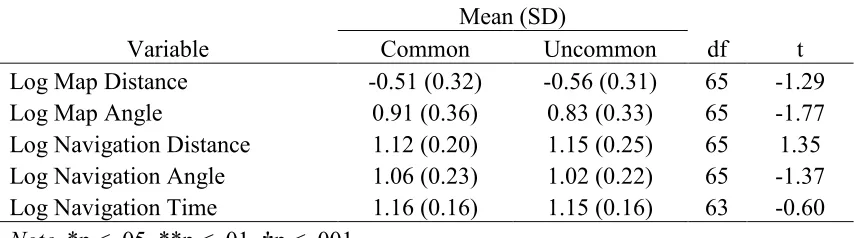
![Table 5. Significant correlations between analyzed measures (N = 66; NMales = 31 [30 for Video Game Experience, 29 for PTSOT], NFemales = 35 [33 for Navigation Time and Video Game Experience])](https://thumb-us.123doks.com/thumbv2/123dok_us/1598888.1197457/91.612.98.534.170.542/significant-correlations-analyzed-measures-experience-nfemales-navigation-experience.webp)