DOI: 10.1534/genetics.106.056150
Evolution of DNA Double-Strand Break Repair by Gene Conversion:
Coevolution Between a Phage and a Restriction-Modification System
Koji Yahara,* Ryota Horie,
†Ichizo Kobayashi*
,‡,1and Akira Sasaki
§,**
*Laboratory of Social Genome Sciences, Department of Medical Genome Sciences, Graduate School of Frontier Science and Institute of Medical Science and‡Graduate Program of Biophysics and Biochemistry, Graduate School of Science, University of Tokyo,
Tokyo 108-8639, Japan,†Laboratory for Language Development, RIKEN Brain Science Institute, Saitama 351-0198, Japan,§Department of Biology, Faculty of Sciences, Kyushu University, Fukuoka 812-8581, Japan and
**Evolution and Ecology Program, International Institute for Applied Systems Analysis, A-2361 Laxenburg, Austria
Manuscript received February 7, 2006 Accepted for publication February 27, 2007
ABSTRACT
The necessity to repair genome damage has been considered to be an immediate factor responsible for the origin of sex. Indeed, attack by a cellular restriction enzyme of invading DNA from several bacteriophages initiates recombinational repair by gene conversion if there is homologous DNA. In this work, we modeled the interaction between a bacteriophage and a bacterium carrying a restriction enzyme as antagonistic coevolution. We assume a locus on the bacteriophage genome has either a restriction-sensitive or a restriction-resistant allele, and another locus determines whether it is recombination/repair proficient or defective. A restriction break can be repaired by a co-infecting phage genome if one of them is recombination/ repair proficient. We define the fitness of phage (resistant/sensitive and repair-positive/-negative) genotypes and bacterial (restriction-positive/-negative) genotypes by assuming random encounter of the genotypes, with given probabilities of single and double infections, and the costs of resistance, repair, and restriction. Our results show the evolution of the repair allele depends onb1=b0, the ratio of the burst sizeb1
under damage to host cell physiology induced by an unrepaired double-strand break to the default burst size
b0. It was not until this effect was taken into account that the evolutionary advantage of DNA repair became apparent.
S
EX can be defined as the homology-based transferof genetic information between DNAs (Michod
and Levin1988; Turnerand Chao1998; Santoset al.
2003). More specifically, it can be defined as homolo-gous recombination involving outcrossing and crossing over. In this sense, sex is widely found from prokaryotes to eukaryotes. Its prokaryotic examples include incor-poration of incoming DNAs in natural transformation in several bacteria and homologous recombination of bacteriophage genomes by bacteriophage function.
The necessity to repair damage on the genome using undamaged genetic material as a template has been con-sidered to be an immediate factor responsible for the origin of sex (Bernsteinet al.1984; Longand Michod
1995; Michod and Long 1995; Michod 1998).
Re-combination genes may have arisen in the first instance because of their role in repair, and this may have remained their major function until today. Indeed, many experiments have demonstrated that homologous recombination is stimulated by damage to DNA.
Trans-formation frequencies inBacillus subtilisincreased with increasing levels of DNA damage when the cultures are
given homologous DNA (Michodand Wojciechowski
1994). A DNA double-strand break is repaired by copying homologous DNA, with and without associated crossing over, inEscherichia coliby lambdoid bacterioph-ages (Kobayashiand Takahashi1988; Takahashiand
Kobayashi1990).
However, the repair hypothesis does not readily explain the origin and maintenance of sex in eukaryotes, which is defined as meiotic crossing over built in the haploid–diploid cycle (MaynardSmith1988; Barton
and Charlesworth 1998). Previous studies of the
evolution of the haploid–diploid cycle showed that the origin and maintenance of this cycle could be solely explained by faster removal of recurrent deleterious mutations in haploids and greater resistance to genetic
damage in diploids (Kondrashov and Crow 1991;
Maynard Smith and Szathmary 1995; Cavalier
-Smith2002; Santoset al.2003). The necessity of repair
was not revealed. Furthermore, it is obvious that double-strand repair does not require meiosis and syngamy of sexual reproduction in eukaryotes at all. Indeed, the most popular hypotheses for the evolution of sex in eu-karyotes ascribe the advantage of sex to accelerated adaptation to ever-changing environments, which likely
1Corresponding author: Laboratory of Social Genome Sciences,
De-partment of Medical Genome Sciences, Graduate School of Frontier Science and Institute of Medical Science, University of Tokyo, 4-6-1 Shirokanedai, Minato-ku, Tokyo 108-8639, Japan.
E-mail: [email protected]
result from antagonistic interactions with other organ-isms, or to efficient elimination of deleterious mutations. A thorough review of this subject has been carried out by Kondrashov(1993).
The molecular mechanisms underlying meiotic re-combination may provide some clue as to this issue. Meiotic recombination in yeast is initiated by the for-mation of a double-strand break in one of the numerous
sites along the chromosome (Kroghand Symington
2004). It is repaired by copying a sister chromatid or a homologous chromosome, which may result in gene conversion. This break repair (gene conversion) is often accompanied by crossing over of the flanking sequences. This led to the hypothesis that the advantage of meiotic recombination is in the elimination of ‘‘nonself’’ sequences from the genome (Takahashiet al. 1997;
Kobayashi 1998). Similarly, the advantage of sex is
hypothesized to be defense against selfish genetic elements (Welchand Meselson2000). The repair
hy-pothesis is strongly related to these hypotheses. It can be imagined that the costs of sex in the pro-karyotes that lack the haploid–diploid cycle are much smaller than those in the eukaryotes, although the ma-chinery for natural transformation appears to be some-what costly. Therefore, the repair hypothesis can more adequately explain the evolution of sex in the prokar-yotes (often called the origin of sex) than in the eu-karyotes, although it is not obvious why DNA double-strand break repair has to be often accompanied by crossing over of the flanking sequences (Kusanoet al.
1994) because crossing over has still a potential to break apart favorable combinations of genes (Shields1988).
However, there are also observations and arguments that question experimental evidence of the repair hy-pothesis for prokaryotes. One of the observations is that transformation with a small part of the Haemophilus influenzae chromosome was as effective in increasing survival as with the whole chromosomal DNA (Mongold
1992). This result was not predicted by the repair hypoth-esis because the DNA fragment supplied would be able to patch ,1% of the possible sites of damage in the H. influenzae genome. The above-mentioned experiments with B. subtilis may not have been sufficiently sensitive to detect such modest differences in bacterial survival (Redfield2001).
In this work, to examine the validity of the repair hy-pothesis, we focus on sex in bacteriophages in the form of DNA double-strand break repair by gene conversion. A major role of the homologous recombination machin-ery carried by DNA bacteriophages is suggested to be repair of DNA double-strand breaks made by restriction-modification systems through the double-strand break repair mechanism (Takahashiet al. 1997; Kobayashi
1998). Attack by a cellular restriction enzyme on invading DNA of several bacteriophages initiates recombinational repair by gene conversion if there is homologous DNA. Because several restriction-modification systems behave
as selfish mobile elements, such as transposons and bac-teriophages (Naitoet al.1995; Kobayashi1998, 2004),
there is an aspect of biological interaction in this mode of homologous recombination. We model the interaction between a bacteriophage and a restriction-modification system in a bacterium as antagonistic coevolution and explore conditions for sexual (recombination/repair-proficient) phages to evolve by numerical simulations.
As is already suggested by the repair hypothesis, sex in DNA bacteriophages has a cooperative (altruistic) aspect. A repair enzyme of a sexual (recombination/repair-proficient) phage is able to repair not only a sexual but also an asexual bacteriophage genome if there is a homol-ogous template chromosome for repair. Namely, the DNA repair enzyme can equally act incisand intrans, providing an equal opportunity of repair to asexual (re-combination/repair-defective) phages. In this case, it can be imagined that evolution of sexual (recombination/ repair-proficient) phages is not easy even if the cost of sex is small. Competition between sexual (recombination/ repair-proficient) and asexual (recombination/repair-defective) phages in the phage population will become apparent and the former can be viewed as altruistic while the latter can be viewed as selfish.
Our simulation revealed that the sexual (recombina-tion repair) allele is able to evolve only under specific conditions of induced damage to the host cell physiol-ogy due to an unrepaired double-strand break. It was not until this effect was taken into account that the evo-lutionary advantage of DNA repair became apparent.
MODELS
We construct a model of the interaction between bac-teriophage genomes and a restriction-modification system of a bacterium, in which the survival of an in-dividual with a certain genotype depends on the geno-typic frequencies of the interacting species. This is a gene-for-gene system for a bacteriophage genome and a restriction-modification system.
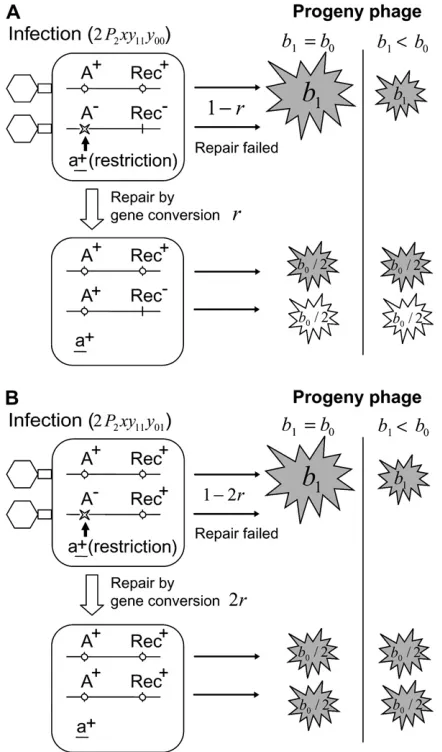
Our model is illustrated in Figure 1, and all the symbols used are explained in Table 1. A bacterial cell either carries a restriction enzyme that can attack a sen-sitive bacteriophage genome (a1) or does not carry it
(a). Each bacteriophage genome has two loci. The first
locus (A) harbors either a restriction-sensitive site (A)
or a restriction-resistant site (A1). The second locus
(Rec) of the bacteriophage harbors either a sexual (recombination/repair-proficient) allele (Rec1
) or an asexual (recombination/repair-defective) allele (Rec).
We assume that a bacterial cell may experience no infection at all, may be infected with one phage particle, or may be infected with two phage particles, with pre-determined probabilities (P0; P1; P2). The relative
be given by the product of their frequencies (x, 1x, andyij’s).
Inevitable attack of the restriction enzyme on the restriction site of an invading bacteriophage genome
can initiate recombinational repair of the restriction break by gene conversion if there is a co-infecting phage genome and if at least one of them is recombination/ repair proficient. The probability of successful repair is denoted byr(r,1) when one of the two co-infecting phages is ‘‘Rec1
’’ and the other is ‘‘Rec’’ (Figure 1A).
When the co-infecting phages are both Rec1
, the probability of repair increases to 2rbecause the amount of Rec enzyme in the host cell is doubled (Figure 1B). If repair succeeds, the ‘‘A’’ allele of the restricted phage
genome is changed to ‘‘A1
’’ by gene conversion. Our model assumes that a template chromosome for re-combinational repair is supplied only by a co-infecting phage. This assumption of frequent multiple infection is based on the abundance of bacteriophage particles in natural environments (Berghet al.1989; Waldoret al.
2005). We assume that repair cannot occur in single
Figure1.—Model. (A) Co-infection of a restriction-positive bacterial cell with an ‘‘A1(restriction-resistant) Rec1
(repair-positive)’’ phage and an ‘‘A(restriction-sensitive) Rec
(repair-negative)’’ phage. Co-infection occurs with predetermined probabilityP2multiplied by frequencies of bacteriaxand that of phageyij(see Table 1 for the symbols). The ARecphage genome is cut at the Asite by the restriction enzyme. The Rec1
enzyme can repair the double-strand break by copying the A1
allele with a probability ofr. The Alocus is converted to A1
by gene conversion. If repair is successful, the undamaged A1
Rec1
phage and the repaired A1
Recphage give the same
number of progeny. If repair fails with a probability of 1r, only the A1
Rec1
phage gives the progeny. The default burst size common to a single infection and a multiple infection isb0. When a double-strand break of one of the co-infecting phage genomes remains unrepaired, the burst size would be reduced tob1by induction of damage to the host cell physiology. The above explanation and those for the other infection patterns are summarized in Table 2. (B) Co-infection of a restriction-positive bacterial cell with an A1Rec1phage and an ARec1
phage. When co-infecting phages are both Rec1, the
probabil-ity of repair increases to 2rbecause the amount of Rec enzyme in the host cell is doubled.
TABLE 1
Definitions and parameter values
Parameter Symbol Value
Restriction site of phage (A1
is resistant, Ais sensitive)
A
Locus of restriction enzyme of bacteria a
Maximal multiplicity of infection (MOI) 2
Probability that MOI is 2 P2 0.4
Probability that MOI is 1 P1 0.4
Probability that MOI is 0 P0 0.2
Frequency of a1
bacteria x
Frequency of AiRecjphage yij
Probability of restriction of restriction-sensitive site
1.0
Probability of repair by gene conversion by Rec enzyme from one phage in a cell
r 0.1
Burst size of ARecphage
b0 100 Burst size of ARecphage when
lethality of host cell is induced by a remaining double-strand break of one of the co-infecting phage genomes
b1 #100
No. of progeny of surviving bacterial cell f 1
Metabolic cost of restriction enzyme c1 0.3
Metabolic cost of restriction-insensitive site
c2 0.3
Metabolic cost of repair/recombination enzyme (Rec)
c3 0.001
Relative fecundity of a1
bacterium to that of abacterium
S1 ec1
Relative fecundity of A1
bacteriophage to that of Abacteriophage
S2 ec2
Relative fecundity of Rec1
bacterio-phage to that of Recbacteriophage
S3 ec3
Initial frequency of Rec1
phages (ARec1plus A1Rec1)
1 or 99%
Mutation rate of a restriction site 63106
Aimeans that A0is Aand A1is A1. Recjmeans that Rec0is
Recand Rec
infection because there is no template chromosome for repair in the bacterial cell.
Undamaged or repaired phage genomes survive and give rise to progeny. We designate the number of prog-eny as burst size, which is defined as the number of virus particles released per cell (Weinbauer2004). As
illustrated in Figure 1, we assume that the burst size decreases when a double-strand break of one of the co-infecting phages remains unrepaired. This assumption is based on the experimental evidence that a single unrepaired double-strand break on a plasmid molecule or a yeast artificial chromosome induces lethality to a cell (Bennett et al. 1993, 1996). We thus introduce
another parameter of burst size under induction of damage to the host cell physiologyb1, which is less than
or equal to default burst size b0. Two examples of
b1=b0¼1:0 andb1=b0¼0:5 are illustrated in Figure 1.
The influence of this parameter is apparent only when co-infection results in survival of one of the infecting phages and death of the other phage with an unrepaired double-strand break. When single infection occurs or co-infection leads to the survival of both phages, any damage is not induced and, therefore, the distinction betweenb1 andb0 is unnecessary. Note that ifb1=b0 ¼
1.0, the total burst size is equal to the default burst size b0whether the repair succeeds and leads to the survival
of both restriction-sensitive and -resistant phages or it fails and leaves only resistant phage. In the case of successful repair, the two resulting phage genotypes are assumed to give the same number of progeny because there is an upper limit of intracellular resources avail-able in a host cell and they equally share the resources.
There are four genotypes (A1
Rec1
, A1
Rec, ARec1
,
and A Rec) in the phage population and two
ge-notypes [restriction positive (a1
) and negative (a)] in
the bacterial population. Phages are sampled randomly from the phage population, with the multiplicity of infection (MOI) from 0 to 2, and allowed to infect one of the two genotypes of bacteria. When no infection oc-curs in a bacterial cell (MOI¼0), or when the restriction-positive bacterial cell is infected by sensitive phage(s), the bacterial cell multiplies.
After single infection either by a Rec1
or by a Rec
bacteriophage, the phage will kill a restriction-negative bacterial cell and produce progeny. On the other hand, a restriction-positive cell will always prevent the growth of a restriction-sensitive phage, but will always yield to a restriction-resistant phage.
Co-infecting phage pairs can be classified into three cases (Rec1
and Rec1
infection, Rec1
and Recinfection,
and Recand Recinfection), each of which is further
divided into their allelic states at the restriction locus (A1
or A). For each combination, the phages experience
three possible events (restriction, repair, and burst). We assume that there is a cost of carriage of a restriction-modification system on a1
bacterium, c1,
which is realized as a reduced growth rate. The relative
fecundity of a1 bacterium to that of a bacterium
de-pends on the cost of restriction modification asS1 ¼ec1.
Also assumed are the metabolic cost c2 for restriction
resistance on A1
phage and thatc3 for recombination/
repair capacity on Rec1
phage, both represented by a reduced burst size (the relative fecundity, see Table 1). The relative fecundity of A1
phage is expressed as S2 ¼ec2 and that of Rec1phage asS3¼ec3. If a phage
carries both a restriction-resistant site and a Rec allele in its genome, the relative fecundity is given byS2S3.
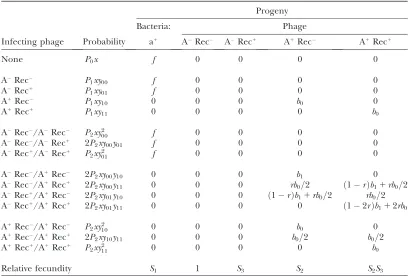
We compile a mating table that contains all the infec-tion patterns, their probability of occurrence, and the number of progeny from each pattern. Part of the mat-ing table is shown in Table 2. Note that all the patterns in Table 2 are those for restriction-positive (a1) bacteria.
Other patterns for restriction-negative (a) bacteria are
not included because they are trivial, in the sense that all the infecting phages survive and thus the genotype of their progeny always remains the same as that of their parents. The number of phage progeny from an infected bacterium depends on the relative burst size, which isb0
when both of the co-infecting phages (or the singly in-fecting phage) survive(s) and b1 when one of the
co-infecting phages survives in the presence of an unrepaired double-strand break of another phage’s chromosome. The expected number of phage progeny is assumed to be given by the product of the relative burst size, the relative fecundity depending on the metabolic costs of restriction-resistance and recombination/repair-proficient alleles, and probabilities of each infection and repair. The number of progeny of the host bacterial genotype in the next generation is represented similarly.
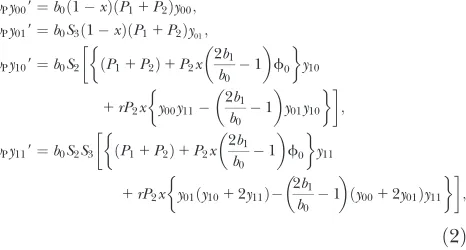
From the mating table, we can write down the fol-lowing equations. The frequencyxof bacteria that have restriction-modification genes changes between gener-ations as
x9¼ S1 P01P1f01P2f
2 0
x ð1xÞP01xS1 P01P1f01P2f20
; ð1Þ
where f0¼y001y01 is the frequency of
restriction-sensitive phages (with f1¼y101y11, the frequency of
restriction-resistant phages). The phage genotype fre-quencies in the next generation are expressed as
wPy009¼b0ð1xÞðP11P2Þy00;
wPy019¼b0S3ð1xÞðP11P2Þy01;
wPy109¼b0S2 ðP11P2Þ1P2x 2b1
b0 1 f0 y10
1rP2x y00y11 2b1
b0
1
y01y10
;
wPy119¼b0S2S3 ðP11P2Þ1P2x 2b1
b0 1 f0 y11
1rP2x y01ðy1012y11Þ 2b1
b0
1
ðy0012y01Þy11
;
ð2Þ wherewPis the mean fitness of phage, which is given by
Strongly antagonistic interaction between bacteria and phage genotypes represented by frequency-dependent genotypic fitness easily destabilizes an equilibrium of the coupled genotypic dynamics (1)–(2), which, unless the costs of restriction modification in bacteria and re-striction resistance in phage are too large, show com-plex limit cycles of large amplitudes. Even when the phage population is monomorphic with respect to its recombination/repair locus, the coupled dynamics of negative and -positive bacteria and restriction-sensitive and -resistant phages exhibit limit cycles. With periodic oscillation in genotypic frequencies of bacteria and phage populations, obtaining the analytical ‘‘inva-sion criteria,’’ the sign of the long-term marginal loga-rithmic growth rate of Rec1carrying phage introduced
into the resident Recpopulation, becomes difficult.
We therefore numerically explore conditions that allow the sexual (recombination/repair-proficient) al-lele to evolve. The procedure is summarized in Figure 2, which is equivalent to the iteration of the recursion (1)–(2) except for the process of mutation described below. After all the combinations are computed on the basis of the mating table, the progeny of each phage/ bacterial genotype is summed up to yield the fitness (i.e., expected number of progeny) for all genotypes in each generation. Selection and mutation then operates, re-sulting in frequency change for each genotype. Muta-tion is assumed to occur only at the restricMuta-tion locus
of the bacteriophages, which enables us to eliminate the persistence of the repair/recombination allele by mutation–selection balance, because we are interested in the adaptive evolution of the repair/recombination allele. This evolutionary process for one generation is repeated for thousands of generations.
The basic parameter values used in our simulation are listed in Table 1. The simulations are extensively carried out by changing the values ofb1,c3,r, andP2(andP1).
We then summarize how the condition for the evolution of a sexual allele depends on these parameters.
RESULTS
Our simulation gave completely different results for the spread of the sex allele depending on the values of b1=b0, although it always gave sustained cycles of
geno-types for our choices of parameters. The dependence of the advantage of the sex allele onb1=b0 is summarized
in Figure 3. Apparently, evolution of the repair allele be-comes possible whenb1=b0 is small and its cost is small.
Whenb1=b0is large, the evolutionary dynamics show
victory of Recphages over Rec1
phages (Figure 4A). Rec1
phages continue to decrease in frequency and become extinct even when the initial frequency is very high (99%). The recombination/repair-proficient allele can-not evolve under this condition. The intuitive reason for the failure of the sex allele is clear: the damaged TABLE 2
Mating table (contribution from a1bacteria)
Infecting phage Probability
Progeny
Bacteria: Phage
a1
ARec ARec1
A1
Rec A1
Rec1
None P0x f 0 0 0 0
ARec
P1xy00 f 0 0 0 0
ARec1
P1xy01 f 0 0 0 0
A1
Rec P1xy10 0 0 0 b0 0
A1Rec1
P1xy11 0 0 0 0 b0
ARec/ARec P2xy2
00 f 0 0 0 0
ARec/ARec1
2P2xy00y01 f 0 0 0 0
ARec1/ARec1 P2xy2
01 f 0 0 0 0
ARec/A1
Rec 2P2xy00y10 0 0 0 b1 0
ARec/A1Rec1 2
P2xy00y11 0 0 0 rb0=2 ð1rÞb11rb0=2 ARec1
/A1
Rec 2P2xy01y10 0 0 0 ð1rÞb11rb0=2 rb0=2
ARec1
/A1
Rec1
2P2xy01y11 0 0 0 0 ð12rÞb112rb0
A1
Rec/A1
Rec P2xy2
10 0 0 0 b0 0
A1
Rec/A1
Rec1
2P2xy10y11 0 0 0 b0=2 b0=2
A1Rec1/A1Rec1 P2xy2
11 0 0 0 0 b0
Relative fecundity S1 1 S3 S2 S2S3
Contributions to the phage genotypeijfrom abacteria are simply given byð
sensitive genomes of Recphage can be repaired by
co-infecting Rec1
’s enzymes and templates. This implies that Rec phage can enjoy the advantage of ‘‘free
re-pairs’’ equally efficiently as altruistic Rec1
phage does, yet without paying any cost.
Figure 4B shows the relationship between the fre-quencies of the repair/recombination allele in phages, the restriction-resistant allele in phages, and the restriction-positive strain in bacteria observed in the sim-ulation. More specifically, the intergenerational increase in the frequency of Rec1phages, a fitness measure of
the recombination/repair modifier allele, is plotted against the frequency of a1(restriction-positive)
bacte-ria and that of A1
(restriction-resistant) phages of each generation. The dynamics show a cycle in which the frequency of a1
bacteria and that of A1
phages period-ically fluctuates. Apparently, the number of Rec1
phages consistently decreases, showing no correlated change with the abundance of restriction-resistant phage or restriction-positive bacterium, indicating that no evolu-tionary advantage of DNA double-strand break repair has been generated under this condition. This makes a sharp contrast with strikingly correlated changes be-tween Rec1, a1, and A1, giving rise to an evolutionary
advantage of Rec1, which we found in the case of
b0/b1,1
and is discussed later.
Detailed dynamical interaction between bacteria restriction-positive genotypes and bacteriophage restric-tion-resistance genotypes is presented in Figure 4C. Among Recphages, the relative frequency of each allele
at the restriction-site locus [A(restriction sensitive) or
A1
(restriction resistant)] shows sustained oscillation. This is also true of Rec1
phages (data not shown). In the bacteria, the relative frequency of each allele [a
(re-striction negative) or a1
(restriction positive)] alter-nates in conjunction with the cycles of phage genotypes. These results represent a continuous coevolutionary force acting both on the phage genome and on the restriction-modification system in bacteria. When a prev-alent genotype of bacteria is a1(restriction positive), A1
(restriction-resistant) phages survive and spread. Once A1 (restriction-resistant) phages become prevalent,
however, any restriction enzyme of bacteria is no longer effective while its cost still exists. Then a
(restriction-negative) bacteria increase their frequency in the bac-terial population. Once a(restriction-negative) bacteria
become prevalent, however, A (restriction-sensitive)
phages in turn have an advantage because resistance of the phage genome is no longer useful and becomes costly. The prevalence of A (restriction-sensitive)
phages makes a1
(restriction-positive) bacteria advanta-geous and the dynamics return to the former state. Sustained cycles of phage and bacteria genotypes are thus produced. The Rec1modifier allele in phage,
how-ever, consistently decreases as its ability to repair the
Figure2.—Simulation. There are four genotypes (A1/A, Rec1
/) in the phage population, while the bacterial
popula-tion has two genotypes (restricpopula-tion positive and negative) as listed in Table 2. From the phage population, phages are sam-pled with MOI from 0 through 2 and allowed to infect one of the two types of bacteria. For each combination, the phages experience three events (restriction, repair, burst). After all combinations are computed, progeny of each phage/bacte-rial genotype are summed to yield fitness (i.e., expected num-ber of progeny). Selection and mutation then operates, resulting in a frequency change for each genotype. This evo-lutionary process for one generation continues for thousands of generations.
Figure3.—Conditions for evolution of repair/recombina-tion allele: phase diagram of the metabolic cost of repair/ recombination enzymec3 and the ratio of burst size under induced damage to the host cell physiologyb1to default burst size b0. Other parameter values are listed in Table 1. Solid circles represent victory of Rec1
over Rec phage. Shaded
squares represent victory of Recover Rec1
phage. The open triangle represents an unsettled case after 30,000 generations: neither Rec1
cleaved restriction-sensitive site benefits co-infecting Recphages equally as well as themselves when
b1=b0is
large (equal to or only slightly,1).
From these results we were unable to find a definitive evolutionary advantage of the double-strand break repair. However, the results change dramatically as b1
decreases relative tob0, as summarized in Figure 5.
The evolutionary dynamics show victory of Rec1
phages over Recphages, as shown in Figure 5A. Rec1
phages continue to increase in frequency, even when the initial frequency is very low (1%). This indicates that the double-strand break repair has an evolutionary ad-vantage, enabling Rec1phages and the recombination/
repair-proficient allele to evolve.
The evolutionary trajectory reveals the Rec1allele can
remarkably increase in frequency by its building up of positive linkage disequilibrium to restriction-resistant sites, as shown in Figure 5B. The sustained cycles of bacteria and phage genotypes then drive the frequency of Rec1
alleles to fixation. The increase of the Rec1
allele occurs in the phase of cycle in which both a1
(restriction-positive) bacteria and A1
(restriction-resistant) phages are prevalent. This indicates that the double-strand break repair between Rec1
phages has a definitive evolution-ary advantage when a1
bacteria predominate. For suf-ficiently small b1=b0, the mutually altruistic repair in
Rec1
/Rec1
infections produces an advantage for Rec1
by their larger contribution of progeny to the next generation than that in Rec/Rec infections, which
can overcome the Rec’s advantage of free repairs in
Rec/Rec1heterologous co-infections. This at the same
time generates a positive correlation between the Rec1
allele and the restriction-resistant allele. The larger con-tribution of Rec1
/Rec1
homologous infection is due to its prevention of induced damage to the host cell phys-iology by the unrepaired double-strand break in the Rec1
/Rec1
infections, as parameterized in the model as (b1=b0,1).
The sustained cycle of each genotype [A(restriction
sensitive) or A1
(restriction positive)] among Rec1
phages is similar (Figure 5C) to the case when Rec1
de-creases (Figure 4C). Thus apparently same coevolution-ary cycles of bacteria restriction-modification genotypes and phage restriction-resistance genotype have quite different effects on the fate of the sexual allele in phage—they can drive the costly sexual allele to fixation ifb1=b0is sufficiently,1, but fail to do so ifb1=b0is large.
The conditions for the evolution of the recombina-tion/repair-proficient allele also critically depend on
Figure4.—Results for largeb1=b0. Results forb1¼b0¼1:0 andc3¼0:001 are shown. Other parameter values are listed in Table 1. (A) Evolutionary dynamics indicating victory of Recphages over Rec1phages. Recphages increase in
fre-quency. The initial frequency of Rec phages is 1% (0.5%
ARecand 0.5% A1
Rec). (B) Evolutionary trajectory
indi-cating continuous decrease of Rec1
phages. Thex-axis indi-cates the frequency of a1
(restriction-positive) bacteria of each generation, and they-axis indicates that of A1
(restriction-positive) phages. The z-axis indicates the intergenerational increase in the frequency of Rec1
phages. These values are plotted until 20,000 generations by black dots and the trajec-tories of about one cycle from 5000, 7500, and 19,000 gener-ations are illustrated by a black, a green, and a blue line, respectively. The frequency of Rec1
phages continues to de-crease from the initial frequency (99% as in Figure 4A) while the frequency of a1bacteria and that of A1phages
periodi-cally oscillate. The trajectory is counterclockwise. (C) Periodic oscillation of restriction-sensitive and -resistant genotypes of Recphages in the interaction with bacterial dynamics. The
vertical axis indicates the frequency of A Recand that of
A1
Recphages along with the frequency of aand that of
a1
bacteria in the total population. The frequency of each genotype of Recphages [A(restriction sensitive) or A1
(re-striction positive)] oscillates in the interaction with bacterial genotypic dynamics [a(restriction negative) or a1
the probabilityP2 of co-infection and the probability r
of successful repair in the presence of Rec1phage. The
results of extensive simulations shown in Figure 6 demonstrate that the higher the values of these two pa-rameters, the more likely the evolution of the repair allele. These results indicate that considerable co-infection and repair are necessary for evolution of the double-strand break repair, even whenb1=b0is small.
DISCUSSION
Our simulation gave completely different results depending onb1=b0, the ratio of the burst sizeb1under
induced damage to the host cell physiology to the default burst sizeb0. It was only when this effect of the
induced damage was taken into account that the evo-lutionary advantage of the double-strand break repair
Figure 6.—Parameter dependence for evolution of a re-combination allele whenb1=b0is low: phase diagram with re-spect to co-infection probability and repair probability when
P0 is fixed, b1=b0¼0:5, and c3¼0:001. (A) Wide view; (B) close-up view. Other parameter values are listed in Table 1. The symbols used are the same as in Figure 3.
Figure 5.—Results for small b1=b0. Results obtained for b1=b0¼0:5 andc3¼0:001 are shown. Other parameter values are listed in Table 1. The composition is the same as that in Figure 4. (A) Evolutionary dynamics indicating victory of Rec1phages
over Recphages. Rec1phages increase in frequency. The initial
frequency of Rec1is 1% (0.5% ARec1and 0.5% A1Rec1). (B)
Evolutionary trajectory in which the Rec1allele can remarkably
increase. Thex-axis indicates the frequency of a1
(restriction--positive) bacteria of each generation, and they-axis indicates that of A1(restriction-positive) phages. Thez-axis indicates the
inter-generational increase in the frequency of Rec1
phages. The initial frequency of Rec1
phages is 1% and a typical trajectory is illustrated from 5546 to 5606 generations by a black line, while the other parts are the same as those in Figure 4B. Rec1
phages remarkably in-creaseinfrequencyonlywhenanincreaseofa1
(restriction-positive) bacteria and an ensuing increase of A1
(restriction-positive) phages occur. (C) Periodic oscillation of restriction-sensitive and -resistant genotypesofRec1
phagesintheinteractionwithbacterialdynamics. Sustained cycles of genotypic dynamics appear as shown in Figure 4C, except that the frequency of Rec1
became apparent. The validity of the repair hypothesis for the origin of sex is, therefore, confirmed under a limited condition.
Under the condition whereb1=b0 is high, the repair
allele did not increase at all. Namely, double-strand break repair did not show any evolutionary advantage under this condition. This seems counterintuitive, be-cause progeny of the Rec1
phage indeed increase by re-pair of its genome in ARec1
/A1
Recinfection and the
cost of repair is assumed to be not very large (Figure 3). In our model, however, the DNA repair enzyme acts equally incisand intrans, providing an equal opportu-nity of repair to Rec phages. In A Rec/A1 Rec1
infection (Figure 1A), once-restricted Rec phage is
repaired by an enzyme from Rec1phage, resulting in a
decrease in Rec1 progeny. Therefore, the benefit of
repair for the Rec1 phages is completely
counterbal-anced by that of the Recphages. In addition, even in
A Rec1
/A1
Rec1
infection, where both infecting phages are Rec1
(Figure 1B), double-strand break re-pair confers no advantage for Rec1
because repairing the genome does not change the total burst size. For ex-ample, in Figure 1B, 100 progeny of Rec1
result from re-pair failure, while 50 plus 50 progeny of Rec1
result from repair success. This number is the same as that for progeny of Rec phage in A Rec/A1
Rec infection
without any repair. This is why double-strand break repair confers no selective advantage under the condition b1 ¼b0.
In contrast, the repair allele did increase from a very low initial frequency whenb1=b0,1. As in the case of
b1=b0close to 1, the benefit of repair of Rec1in ARec1/
A1
Rec infection is counterbalanced by that of Rec
phages. However, the fitness difference between Rec1
and Recphages is generated when ARec1
/A1
Rec1
and ARec/A1
Recinfections are compared. In
A1
Rec1
/A Rec1
infection, where both the infecting phages are Rec1
, the total progeny of Rec1
increases by repair success. For example, 50 progeny of Rec1
result from repair failure, while 50 plus 50 progeny of Rec1
result from repair success (see Figure 1B). In contrast, in A
Rec
/A1
Rec
infection where no repair occurs, the number of progeny of surviving Rec
phage decreases to b1(50) because a remaining double-strand break of one
of the co-infecting phage genomes induces damage to the host cell physiology. This represents the definitive advantage of repair for Rec1phages under this condition
(see theappendixfor further analytical explanations).
The disadvantage of A Rec/A1
Rec infection
means Rec is recessive deleterious. Therefore, Rec
phages decreased slowly as they became rare in the pop-ulation because the probability of Rec/Recco-infection
became lower. After the initial 10,000 generations, Rec
phages decreased in frequency from 99 to17%. After the next 10,000 generations, however, Recphages did
not become extinct and decreased more and more slowly (,0.1%).
In our model, there is no fitness difference between Rec1and Recphages when single infection or infection
to abacteria occurs. This is also true of co-infection in
which both phages are Aor A1
. We therefore examined our results in the above explanations by focusing on A1
/ Aco-infection.
The evolutionary dynamics of Rec1
and Rec were
smooth compared to those of A1
and A alleles as in
Figures 4 and 5. In contrast, if a genetic correlation between the modifer (Rec) and the selected (A) locus is close to 100% and the recombination rate between them is close to 0%, frequencies of modifier alleles (Rec1 or Rec) strongly depend on those of selected
alleles (A1or A). This corresponds to a situation where
a modifier (Rec) locus sits very close to a selected (A) locus and recombination between them does not occur. Although the situation is possible if there are some striction sites in a genome, our model assumed one re-striction site (A) for simplicity. Therefore, the modifier (Rec) locus did not gain an association with a selected (A) locus and frequencies of modifier alleles (Rec1
or Rec) changed more slowly than those of selected alleles
(A1
or A). The selection coefficient of the modifier
locus is the squared order of that of selected locus (Ishii et al.1989).
The predominance of Rec phages under a large
b1=b0 condition is caused by complementation.
Co-infection of a virus supplying a gene product leads to a defective virus gene that is then represented in the prog-eny, which instead decreases the progeny of the former functional virus (Dennehyand Turner2004; Froissart et al. 2004; Novella et al. 2004). This is apparently
disadvantageous for the functional viruses (Rec1
phages in our model), which can be viewed as altruists, while the defective (Rec) phages can be viewed as free riders
or cheaters (Maynard Smith and Szathmary 1995;
Keller 1999; Foster et al. 2004). Meanwhile, the
condition of smallb1=b0selectively benefits Rec1
prog-eny on Rec1
/Rec1
infection, as shown in Figure 5B. The repair process under competition between co-infecting phages is considered to act as a mechanism that con-strains cheaters (Travisano and Velicer 2004). Our
model represents one of the mechanisms for constrain-ing cheaters in microbes (Fosteret al.2004). Although
cheating, cooperation, and sociality in microbes have not been the focus of attention until recently, these are now being pointed out as fundamental issues in evo-lutionary theory and in pathogenicity control (Smith
2001; Froissart et al. 2004; Griffin et al. 2004;
Travisanoand Velicer2004).
We assume that repair-defective (Rec) phages can
produce progeny in the absence of a bacterial recombi-nation system (RecBCD). In lambdoid bacteriophages, packaging of the phage genome into a viable phage par-ticle needs a concatemer form, in which phage DNA units are joined together in a head-to-tail manner (Fujisawa
blocked by the RecBCD DNase of the hostE. coli, which degrades nonself DNA but repairs self DNA marked by an ID sequence (Handaet al.1997, 2000). Lambda and
other bacteriophages produce an inhibitor of RecBCD
DNase (Smith 1983). Therefore, our model
corre-sponds to the RecBCD-negative states.
In reality, even a single infecting phage genome might encounter homologous prophage genomes in the host cell that can serve as a template for repair. Pro-phages are abundant in the sequenced bacterial ge-nomes. For example, a natural isolate ofE. colicarries 18 prophages and phage remnants, among which 13 are related to bacteriophage lambda (Hayashiet al.2001).
In addition, an infecting bacteriophage may start rep-lication before attack by a certain type of restriction enzyme, which seems to produce a template for repair of a sister chromosome (Handaand Kobayashi2005).
These effects might provide an additional advantage of double-strand break repair in that a single infecting ‘‘ARec1
’’ bacteriophage is able to revive to some extent after attack by a restriction enzyme, which would se-lectively benefit Rec1
phages while eliminating cheaters. The burst size of a once-restricted and repaired bacteriophage could be lower than that of an undam-aged phage on the assumption that an infecting bacte-riophage would start replication before attack by certain types of restriction enzyme, as explained above. Accord-ingly, the restriction and repair process would delay replication of the bacteriophage, which could in turn increase progeny of the undamaged coexisting phage. Our simulation does not explicitly include this effect. However, we already confirmed that the effect could not change the result because Rec1
and Recphages had
equal opportunities to increase their progeny by this effect.
Our model was constructed in the framework of evolutionary game theory: a powerful tool in both social science and evolutionary biology to analyze social prob-lems involving interdependence among several agents (MaynardSmith1982; Nowakand Sigmund2004). It
is now recognized as being applicable to social inter-actions such as cheating and cooperation in microbes as well (Turnerand Chao1999; Kerret al.2002; Nowak
and Sigmund2002; Wolf and Arkin 2003; Pfeiffer
and Schuster2005; Turner2005; Wolfet al.2005). It
has been claimed that one of the most important chal-lenges lying ahead is to model the interaction of strategies
encoded in genomic sequences (Nowakand Sigmund
2004). Our model represents one of the first examples of such attempts (see also Mochizukiet al.2006).
Our one-locus model has been simplified from the gene-for-gene model used by Sasaki(2000), which
as-sumed multilocus and asymmetric gene-for-gene inter-action. This simplification enabled us to write down all the interactions between bacteriophages and host bac-teria into a simple mating table, even if we also consider a modifier locus (Rec) and co-infection. Multilocus models
yield a much greater number of genotypes and of interactions between them, which makes analysis and interpretation difficult. Despite the simplification, our model similarly showed protected genetic polymor-phism in the genotype of the host (phage genome in our model) and the parasite (restriction-modification system in bacteria in our model) and produced a sustained cycle of genotype frequencies. This is a robust tendency in many gene-for-gene models, which has been considered to give an advantage to recombination and sexual reproduction, although the cycle itself has not been experimentally proven (see, for example, Koronaand Levin1993). To the best of our knowledge,
this work represents the first study examining whether these characteristics of the dynamics enable sex (re-combination repair) in bacteriophages to evolve. Be-cause our one-locus models cannot distinguish between gene conversion not associated with flanking crossing over and gene conversion associated with flanking cross-ing over, whether the dynamics yield a short-term advan-tage for crossing over remains an unexplored question. The repair process of our model is assumed to begin only after a double-strand break by a restriction enzyme, which is similar to the ‘‘damage-induced sex’’ proposed
by Michod and colleagues (Long and Michod 1995;
Michodand Long1995; Michod1998). However, they
assumed different molecular mechanisms, in that gene damage was repaired by cell or protocell fusion with damaged or undamaged partners. These differences lead to different results, especially in a situation in which sexual cells mate with asexual (cheater in our model) cells (Michodand Long1995).
In this work, we assumed that gene conversion initiated by a restriction break is limited to the broken locus. It would be interesting to consider the case where the gene conversion continues across the Rec site. The biological plausibility of such coconversion between linked loci is well established in meiotic recombination in Ascomycetes (Stahl 1979; Petes et al. 1991). The
underlying mechanism could be expansion of the double-strand breakage into a double-double-strand gap (6:2 segrega-tion of alleles) (Szostaket al.1983), repair synthesis (5:3
segregation of alleles) (Sunet al.1991), or mismatch
cor-rection on heteroduplex DNA formed from the break site (6:2, 5:3) (Nag et al. 1989; Allers and Lichten
2001). In the DNA double-strand break repair mediated by bacteriophage lambda recombination machinery, there is evidence for DNA double-strand gap repair (Takahashi and Kobayashi 1990). Clustering of
exchanges (called high negative interference), which can be explained by mismatch repair on heteroduplex DNA, is observed in the presence of DNA replication (Stahl1979). A long heteroduplex DNA formed from
the cos site (for the molecular ends) was shown to serve as a substrate for mismatch repair (White and Fox
1974; Stahlet al.1985; Leach1996), leading to high
replication. Such coconversion from ARec1/A1Rec
may lead to A1Rec/A1Rec. Here the very action of the
Rec1
allele leads to its disappearance from the progeny. This cost should be dependent on linkage with the cut locus and the allelic state of the interacting genomes. Therefore, it may be regarded as more similar to the cost of sex that has been analyzed in terms of population genetics (Michod and Levin 1988) than the simple
metabolic type of cost of sex assumed in this work. Under-standing its effects would represent another goal in the study of DNA double-strand break repair by gene conversion.
It is conceivable that the repair mechanism used in our model represents one form of bacteriophage adaptation to attack by restriction enzymes (Kobayashi
1998), that is, an example of anti-restriction strategies (Tockand Dryden2005). An advantage of the
mech-anism, however, becomes obvious only when a remain-ing double-strand break of one of the co-infectremain-ing phage genomes induces damage to the host cell physiology, resulting in a decrease in the burst size, although some additional advantages might exist as well.
We thank Kenji Takahashi (Riken) for very helpful comments. The computer simulation was run on a UNIX workstation of the Human Genome Center at the Institute of Medical Science, the University of Tokyo. This work was supported by a grant from the Foundation for the Fusion of Science and Technology to K. Y., by the 21st century Center of Excellence project ‘‘Elucidation of Language Structure and Semantics Behind Genome and Life System,’’ and by the ‘‘Grants-in-Aid for Scientific Research’’ (13141201, 15370099, and 17310113) from the Japan Society for the Promotion of Science to Ichizo Kobayashi.
LITERATURE CITED
Allers, T., and M. Lichten, 2001 Intermediates of yeast meiotic
re-combination contain heteroduplex DNA. Mol. Cell8:225–231. Barton, N. H., and B. Charlesworth, 1998 Why sex and
recom-bination? Science281:1986–1990.
Bennett, C. B., A. L. Lewis, K. K. Baldwinand M. A. Resnick,
1993 Lethality induced by a single site-specific double-strand break in a dispensable yeast plasmid. Proc. Natl. Acad. Sci. USA
90:5613–5617.
Bennett, C. B., T. J. Westmoreland, J. R. Snipeand M. A. Resnick,
1996 A double-strand break within a yeast artificial chromo-some (YAC) containing human DNA can result in YAC loss, de-letion or cell lethality. Mol. Cell. Biol.16:4414–4425.
Bergh, O., K. Y. Borsheim, G. Bratbakand M. Heldal, 1989 High
abundance of viruses found in aquatic environments. Nature
340:467–468.
Bernstein, H., H. C. Byerly, F. A. Hopf and R. E. Michod,
1984 Origin of sex. J. Theor. Biol.110:323–351.
Cavalier-Smith, T., 2002 Origins of the machinery of
recombina-tion and sex. Heredity88:125–141.
Dennehy, J. J., and P. E. Turner, 2004 Reduced fecundity is the cost
of cheating in RNA virus phi 6. Proc. R. Soc. Lond. Ser. B Biol. Sci.271:2275–2282.
Foster, K. R., G. Shaulsky, J. E. Strassmann, D. C. Quellerand C.
R. Thompson, 2004 Pleiotropy as a mechanism to stabilize
co-operation. Nature431:693–696.
Froissart, R., C. O. Wilke, R. Montville, S. K. Remold, L. Chao
et al., 2004 Co-infection weakens selection against epistatic mu-tations in RNA viruses. Genetics168:9–19.
Fujisawa, H., and M. Morita, 1997 Phage DNA packaging. Genes
Cells2:537–545.
Griffin, A. S., S. A. Westand A. Buckling, 2004 Cooperation and
competition in pathogenic bacteria. Nature430:1024–1027. Handa, N., and I. Kobayashi, 2005 Type III restriction is alleviated
by bacteriophage (RecE) homologous recombination function but enhanced by bacterial (RecBCD) function. J. Bacteriol.
187:7362–7373.
Handa, N., S. Ohashi, K. Kusanoand I. Kobayashi, 1997 Chi-star,
a chi-related 11-mer sequence partially active in anE. colirecC1004 strain. Genes Cells2:525–536.
Handa, N., A. Ichige, K. Kusanoand I. Kobayashi, 2000 Cellular
responses to postsegregational killing by restriction-modification genes. J. Bacteriol.182:2218–2229.
Hayashi, T., K. Makino, M. Ohnishi, K. Kurokawa, K. Ishiiet al.,
2001 Complete genome sequence of enterohemorrhagic Escher-ichia coli O157:H7 and genomic comparison with a laboratory strain K-12. DNA Res.8:11–22.
Keller, L., 1999 Levels of Selection in Evolution.Princeton University
Press, Princeton, NJ.
Kerr, B., M. A. Riley, M. W. Feldman and B. J. Bohannan,
2002 Local dispersal promotes biodiversity in a real-life game of rock-paper-scissors. Nature418:171–174.
Kobayashi, I., 1998 Selfishness and death: raison d’eˆtre of
restric-tion, recombination and mitochondria. Trends Genet.14:368– 374.
Kobayashi, I., 2004 Restriction-modification systems as minimal
forms of life, pp. 19–62 in Restriction Endonucleases, edited by A. Pingoud. Springer-Verlag, Berlin.
Kobayashi, I., and N. Takahashi, 1988 Double-stranded gap repair
of DNA by gene conversion inEscherichia coli.Genetics119:751– 757.
Kondrashov, A. S., 1993 Classification of hypotheses on the
advan-tage of amphimixis. J. Hered.84:372–387.
Kondrashov, A. S., and J. F. Crow, 1991 Haploidy or diploidy:
Which is better? Nature351:314–315.
Korona, R., and B. R. Levin, 1993 Phage-mediated selection and the
evolution and maintenance of restriction-modification. Evolution
47:556–575.
Krogh, B. O., and L. S. Symington, 2004 Recombination proteins
in yeast. Annu. Rev. Genet.38:233–271.
Kusano, K., Y. Sunohara, N. Takahashi, H. Yoshikura and I.
Kobayashi, 1994 DNA double-strand break repair: genetic
de-terminants of flanking crossing-over. Proc. Natl. Acad. Sci. USA
91:1173–1177.
Ishii, K., H. Matsuda, Y. Iwasaand A. Sasaki, 1989 Evolutionarily
stable mutation rate in a periodically changing environment. Genetics121:163–174.
Leach, D. R. F., 1996 Genetic Recombination. Blackwell Science,
Oxford.
Long, A., and R. E. Michod, 1995 Origin of sex for error repair. I.
Sex, diploidy, and haploidy. Theor. Popul. Biol.47:18–55. MaynardSmith, J., 1982 Evolution and the Theory of Games.Cambridge
University Press, Cambridge, UK.
MaynardSmith, J., 1988 The evolution of recombination, pp. 106–
125 inThe Evolution of Sex: An Examination of Current Ideas, edited by R. E. Michodand B. R. Levin. Sinauer Associates,
Sunder-land, MA.
MaynardSmith, J., and E. Szathmary, 1995 The Major Transitions
in Evolution.Freeman/Spektrum, Oxford.
Michod, R. E., 1998 Origin of sex for error repair. III. Selfish sex.
Theor. Popul. Biol.53:60–74.
Michod, R. E., and B. R. Levin, 1988 The Evolution of Sex: An
Exam-ination of Current Ideas.Sinauer, Sunderland, MA.
Michod, R. E., and A. Long, 1995 Origin of sex for error repair. II.
Rarity and extreme environments. Theor. Popul. Biol.47:56–81. Michod, R. E., and M. F. Wojciechowski, 1994 DNA repair and the
evolution of transformation IV. DNA damage increases transfor-mation. J. Evol. Biol.7:147–175.
Mochizuki, A., K. Yahara, I. Kobayashiand Y. Iwasa, 2006 Genetic
addiction: selfish gene’s strategy for symbiosis in the genome. Genetics172:1309–1323.
Mongold, J. A., 1992 DNA repair and the evolution of
transforma-tion inHaemophilus influenzae.Genetics132:893–898.
Nag, D. K., M. A. Whiteand T. D. Petes, 1989 Palindromic sequences
in heteroduplex DNA inhibit mismatch repair in yeast. Nature
Naito, T., K. Kusanoand I. Kobayashi, 1995 Selfish behavior of
restriction-modification systems. Science267:897–899. Novella, I. S., D. D. Reissigand C. O. Wilke, 2004
Density-depen-dent selection in vesicular stomatitis virus. J. Virol.78:5799–5804. Nowak, M. A., and K. Sigmund, 2002 Bacterial game dynamics.
Nature418:138–139.
Nowak, M. A., and K. Sigmund, 2004 Evolutionary dynamics of
biological games. Science303:793–799.
Petes, T. D., R. E. Maloneand L. S. Symington, 1991 Recombination
in yeast inThe Molecular and Cellular Biology of the Yeast Saccharomyces: Genome Dynamics, Protein Synthesis, and Energetics, edited by J. Broach, E. Jonesand J. Pringle. Cold Spring Harbor
Labora-tory Press, Cold Spring Harbor, NY.
Pfeiffer, T., and S. Schuster, 2005 Game-theoretical approaches
to studying the evolution of biochemical systems. Trends Bio-chem. Sci.30:20–25.
Redfield, R. J., 2001 Do bacteria have sex? Nat. Rev. Genet.2:634–
639.
Santos, M., E. Zintzarasand E. Szathmary, 2003 Origin of sex
revisited. Origins Life Evol. Biosphere33:405–432.
Sasaki, A., 2000 Host-parasite coevolution in a multilocus
gene-for-gene system. Proc. R. Soc. Lond. Ser. B267:2183–2188. Shields, W. M., 1988 Sex and adaptation, pp. 253–269 inThe
Evo-lution of Sex: An Examination of Current Ideas, edited by R. E. Michodand B. R. Levin. Sinauer Associates, Sunderland, MA.
Smith, G. R., 1983 General recombination, pp. 175–209 inLambda
II, edited by R. W. Hendrix, J. W. Roberts, F. W. Stahland R. A.
Weisberg. Cold Spring Harbor Laboratory Press, Cold Spring
Harbor, NY.
Smith, J., 2001 The social evolution of bacterial pathogenesis. Proc.
Biol. Sci.268:61–69.
Stahl, F. W., 1979 Genetic Recombination: Thinking About It in Phage
and Fungi.Freeman, San Francisco.
Stahl, F. W., I. Kobayashi and M. M. Stahl, 1985 In phage
lambda, cos is a recombinator in the red pathway. J. Mol. Biol.
181:199–209.
Sun, H., D. Trecoand J. W. Szostak, 1991 Extensive 39-overhanging,
single-stranded DNA associated with the meiosis-specific double-strand breaks at the ARG4 recombination initiation site. Cell 64:1155–1161.
Szostak, J. W., T. L. Orr-Weaver, R. J. Rothsteinand F. W. Stahl,
1983 The double-strand-break repair model for recombination. Cell33:25–35.
Takahashi, N., and I. Kobayashi, 1990 Evidence for the
double-strand break repair model of bacteriophage lambda recombina-tion. Proc. Natl. Acad. Sci. USA87:2790–2794.
Takahashi, N. K., K. Sakagami, K. Kusano, K. Yamamoto, H. Yoshikura
et al., 1997 Genetic recombination through double-strand break repair: shift from two-progeny mode to one-progeny mode by heterologous inserts. Genetics146:9–26.
Tock, M. R., and D. T. Dryden, 2005 The biology of restriction and
anti-restriction. Curr. Opin. Microbiol.8:466–472.
Travisano, M., and G. J. Velicer, 2004 Strategies of microbial
cheater control. Trends Microbiol.12:72–78.
Turner, P. E., 2005 Cheating viruses and game theory. Am. Sci.93:
428–435.
Turner, P. E., and L. Chao, 1998 Sex and the evolution of intrahost
competition in RNA virus phi6. Genetics150:523–532. Turner, P. E., and L. Chao, 1999 Prisoner’s dilemma in an RNA
virus. Nature398:441–443.
Waldor, M. K., D. I. Friedmanand S. L. Adhya, 2005 Phages: Their Role
in Bacterial Pathogenesis and Biotechnology.ASM Press, Washington, DC.
Weinbauer, M. G., 2004 Ecology of prokaryotic viruses. FEMS
Mi-crobiol. Rev.28:127–181.
Welch, D. M., and M. Meselson, 2000 Evidence for the evolution of
bdelloid rotifers without sexual reproduction or genetic ex-change. Science288:1211–1215.
White, R. L., and M. S. Fox, 1974 On the molecular basis of high
negative interference. Proc. Natl. Acad. Sci. USA71:1544–1548. Wolf, D. M., and A. P. Arkin, 2003 Motifs, modules and games in
bacteria. Curr. Opin. Microbiol.6:125–134.
Wolf, D. M., V. V. Vaziraniand A. P. Arkin, 2005 A microbial
mod-ified prisoner’s dilemma game: how frequency-dependent selec-tion can lead to random phase variaselec-tion. J. Theor. Biol. 234:
255–262.
Communicating editor: M. K. Uyenoyama
APPENDIX
Here we show that (i) if there is no cost of unrepaired double-strand break, the recombination-efficient allele can never invade the phage population and that (ii) if the cost of unrepaired double-strand breakdis sufficiently larger than the cost of recombinationc, a positive linkage disequilibrium between the restriction-resistance locus and the recombination locus can be built up. The latter fact indicates that the recombination allele increases both by its direct benefit by restoring the loss due to unrepaired break and by the hitchhiking effect on the linkage disequilibrium driven by strong selection for restriction-resistant phage.
LetwPdenote the mean fitness of phage, which is given by the sum of the right-hand sides of (2) in the text. If the
cost of recombinationcis ignored, the mean fitness is given by
ðwPÞc¼0¼ ð1xÞð1pÞ1sp1msxfð12dÞpð1pÞ12drðð12pÞD12pð1pÞqÞg; ðA1Þ
wherep¼y101y11is the frequency of the restriction-resistant allele in the first locus,q¼y011y11is the frequency of
the recombination-efficient allele in the second locus, andD¼y00y11y01y10is the linkage disequilibrium between
the loci. We denote byd¼ ðb0b1Þ=b0 the reduction of phage production when unrepaired double-strand breaks
remain in the bacteria cell and bym¼P2=ðP11P2Þthe fraction of multiple infection. We also denote, for notational
convenience, by s the relative fecundity of restriction-positive phage and by 1c the relative fecundity of the recombination-efficient allele.
We can see that in the last term of (A1),
mxðð12pÞD12pð1pÞqÞ ¼mxðpy011ð1pÞy11Þ
represents the probability that phage genotype with recombination-efficient allele Rec1
recombination-efficient allele is not a neutral modifier but is directly subject to selection, and the intensity of the direct selection for the recombination allele is proportional tod,r,m, andx. In other words, the direct selection for the recombination-efficient allele exists only when there is multiple infection (m.0), restriction-positive bacteria (x.0), nonzero recombination (r.0), and the reduction in phage production in the presence of the unrepaired double-strand break (d.0).
The second to last term of (A1), on the other hand, represents the contribution, not through recombination, to phage fitness from the sensitive/resistant heterologous infection to the restriction-positive bacterium. This includes the reduction 2dof phage particles due to the unrepaired double-strand break. The first two terms of (A1) simply represent the facts that restriction-sensitive phages can multiply only in restriction minus bacterium and restriction-resistant phages can multiply in any bacterium but pay a cost of reduced fecundity (s,1).
If we assume that the cost c of recombination is sufficiently small, the changes in the frequency of restriction-resistant allelepand that of recombination modifier alleleqin one generation are given by
Dp¼p9p¼ 1
wP
½ðx ð1sÞÞpð1pÞ
1msxfð12dÞpð1pÞ212drð1pÞðð12pÞD12pð1pÞqÞg1OðcÞ ðA2Þ
Dq¼q9q¼1cð1qÞ
wP
½ðx ð1sÞÞD
1msxfð12dÞð1prÞD12drðDðp1DÞ1pð1pÞqð1qÞÞg
cqð1qÞðwPÞc¼0
wP
: ðA3Þ
Note that change by recurrent mutation in the restriction-resistance locus is not explicitly included in (A2). The frequency after mutation p$ can be expressed as p$¼ ð1mÞp9 1mp9, where m is the mutation rate between
restriction-sensitive and -resistant alleles. Formal neglect of the explicit mutation term, however, does not affect the qualitative results we derive in the following, because we need only the protected polymorphism in the restriction-resistance locus (i.e.,0,p,1) to establish the results. The expression for the change in the linkage disequilibriumD is complicated, but its derivation is straightforward from (2) in the text. With combined dynamics ofx,p,q, andD defined here, we establish the following results:
Ifd¼0,i.e., if there is no reduction in phage production in the presence of the unrepaired double-strand break, the surfaceq¼D¼0 is locally attracting, indicating that the recombination-efficient allele can never invade the phage population.
If, however, the costdof the unrepaired double-strand break is sufficiently larger than the costcof recombination, a positive linkage disequilibrium between the restriction-resistance locus and the recombination locus can be built up.
We first show that if there is no cost of unrepaired double-strand break (d¼0), the surfaceq¼D¼0, the state with no Rec1
allele and no linkage disequilibrium, is locally attracting. Because bacteria restriction genotypes and phage restriction-resistance genotypes show sustained cycles, the local stability ofq¼D¼0 is determined by examining a linearized system with respect toqandDwith time-dependent coefficients [i.e., those depend on the frequency of restriction-positive bacteria,xðtÞ, and the frequency of restriction-resistant phage,pðtÞ]. The Jacobian matrix at the surfaceq¼0 andD¼0 is given, by linearizing (A3) andD9¼y00y11y01y10defined in (2) in the text with respect toq
andD, as
JðtÞ ¼
@q9
@q
@q9
@D
@D9
@q
@D9
@D 0
B B @
1 C C A¼
1c BðtÞ
0 ð1cÞwp0ðtÞfwp1ðtÞ rmsxð1pðtÞÞg
wPðtÞ2
0 @
1
A; ðA4Þ
whereBðtÞis a function of time whose explicit form does not affect the stability, and
wp0ðtÞ ¼1xðtÞ; wp1ðtÞ ¼sf11mxðtÞð1pðtÞÞg
are the fitnesses of restriction-sensitive and -resistant alleles of phage. The eigenvalues of this time-dependent triangular matrix can be obtained, by noting that the diagonal elements of the products of triangular matrices are equal to the products of the diagonal elements, as
and
0,l2¼ ð1cÞlim T/‘
Y
T1
t¼0
wp0ðtÞfwp1ðtÞ rmsxð1pðtÞÞg
wPðtÞ2
!1=T
,ð1cÞlim
T/‘ Y
T1
t¼0
wp0ðtÞ
wPðtÞ
wp1ðtÞ
wPðtÞ
!1=T
¼1c; ðA6Þ
where we used the fact that
lim
T/‘ Y
T1
t¼0
wp0ðtÞ
wPðtÞ
!1=T
¼ lim
T/‘ Y
T1
t¼0
wp1ðtÞ
wPðtÞ
!1=T
¼1; ðA7Þ
which follows as restriction-sensitive and -resistant alleles are stably maintained in the population, and hence their geometric mean fitness must equal 1. Therefore, the surfaceq¼D¼0 is locally attracting ifd¼0, implying that the Rec1
allele can never invade the population if there is no cost, in terms of phage production, of unrepaired double-strand break in the infected cell.
Second, we show that, ifd.0,i.e., if there is nonzero cost of unrepaired double-strand break, a positive linkage disequilibrium can be built up from locally repelling surface of equilibriaq¼D¼0. The change in the linkage disequilibrium is complicated, but it always increases atD¼0,
ðDDÞD¼0 ¼
2dð1cÞrmspð1pÞ2qð1qÞxð1xÞ
ðwPÞ2D¼0
.0; ðA8Þ
ifd.0 and 0,x; p; q,1. Thus as long as both host and parasite are polymorphic in each locus, and there is a cost of unrepaired double-strand break (d.0), a positive linkage disequilibrium is generated. We need to guarantee that nonzeroqis maintained to show the buildup of positive linkage disequilibrium near the surface (polymorphisms in the phage restriction-resistance locus and in bacteria are certain). The finite rate of increase of the frequency of recombination-efficient allele Rec1at
q¼D¼0 is
q9
q
D¼0;q¼0
¼ ð1cÞ 11 2drmsxpð1pÞ
ð1xÞð1pÞ1sp1msxð12dÞpð1pÞ
: ðA9Þ