NORTH CAROLINA COMMUNITY CHILD PROTECTION TEAMS
2013 End of Year Report
Community Child Protection Teams End-of-Year Report, 2013 Page i of ix
Forward
This report is submitted by the North Carolina Community Child Protection Team (CCPT) Advisory Board. This body was established in response to a recommendation set forth in the 2011 CCPT End of Year Report. The Advisory Board held its first meeting on August 28, 2012 and since then, has met quarterly. Since its formation, the Board has experienced changes in its NC Division of Social Services coordinator and in its membership, which was expanded to support system of care.
The report this year is based upon local team responses to an on-line survey,
completed by almost 80% of local teams. In the spring of 2014, the CCPT Advisory Board met twice to review the 2013 survey findings and develop recommendations. This report was compiled with the assistance of Dr. Joan Pennell at NC State University, Center for Family and Community Engagement.
We are proud of what the CCPTs have accomplished over the years and the leadership that the teams provide to their local communities and to the development of state policy.
Respectfully submitted,
Liz Mandel CCPT Advisory Board Chair 2013 Freddie Harris Warren County
Executive Summary
The North Carolina CCPT Advisory Board presents this end-of-year report on behalf of the Community Child Protection Teams (CCPTs) and their communities. The Board is
responsible for conducting an annual survey of local CCPTs, synthesizing the data, and presenting recommendations to the North Carolina Division of Social Services (NCDSS). NCDSS then prepares a written response to the CCPT report. Both the CCPT report and NCDSS response are included in the state’s Annual Progress and Services Report to the US Department of Health and Human Services, Administration for Children and Families.
The survey was completed by the local CCPTs in 79 of the 100 North Carolina counties. Based on the data, this report summarizes the work accomplished over the year and highlights issues cutting across counties. In response to these statewide concerns, the
Advisory Board developed a series of recommendations. The goal of the recommendations is to increase the meaningful engagement of CCPTs in improving child welfare.
Strategies for accomplishing this goal are more closely aligning CCPTs with two major approaches to system reform in North Carolina. The first is system of care, that is, a unified approach wrapping agency services and community supports around children and their
families. The second is Social Services’ system of continuous quality improvement system, in particular, its emphasis on use of data.
Closer Alignment of CCPT with System of Care (SOC)
CCPTs made recommendations to address situations of concern in their counties. Many of these recommendations related to enhancing their system of care. These included building awareness across agencies about the needs of children and families through joint training and information sharing. CCPTs also urged advocating for increased services and developing improved processes for referral, assessment, discharge planning, and reimbursement.
Cross-System Partnerships. Their capacity to effect such recommendations was limited by the extent to which different systems were represented on their teams. Overall, the CCPTs had solid representation from Social Services, Schools, Public Health, and Guardians ad Litem with lower participation by Local Law Enforcement, Local Community Action Agency, and District Attorney’s Office.
Community, Family, and Youth Engagement. CCPTS identified the valuable role that parent partners can play such as raising public awareness of threat to child safety. Only 37% (28) of the 76 responding CCPTs said that they engaged parents while the remaining 63% (48) said that they did not. Appointments by boards of county commissioners can facilitate family, youth, and community participation on CCPTs. Strategies for sustaining these partnerships include shared leadership, cultural relevance, peer networking, and supports for participation, such as training, child care, honoraria, cost reimbursement, and flexible scheduling.
Action Step Taken
Community Child Protection Teams End-of-Year Report, 2013 Page iii of ix Recommendations
CCPTs involve family and youth partners on their teams.
CCPTs seek external funding to provide stipends to support the participation of family and youth partners.
Realignment of CCPTs with Continuous Quality Improvement
Case Reviews and Self-Ratings. In 2013, there were a combined total of 738 cases reviewed by 87% (69/79) of the reporting CCPTs, of which 4% (31/738) were intensive Fatality CCPT Review cases. CCPTs were asked to evaluate the extent to which their case reviews achieved specific outcomes. They gave positive self-ratings especially to their identifying service gaps, utilizing the CCPTs’ collective knowledge to benefit families and their children, and
identifying issues affecting the entire community. Their lowest self-ratings concerned involving parents and publically commenting on the impact of child protective services.
Peer Support. The CCPTs identified some of their own best practices that they thought could benefit other teams. Practices that CCPTs considered especially beneficial included multi-disciplinary teams on investigation of sexual maltreatment, community drug task forces, and education on electronic usage (e.g., sexting). In addition, 12 CCPTs indicated that they were willing to offer peer support to other CCPTs on the practice.
Action Step Taken
This year, NCDSS included CCPT coordination within the role of its CQI – Child Welfare Outcomes Coordinator.
Recommendations
NCDSS facilitate local DSSs in involving their CCPTs in assessing community needs and creating Child Welfare Achievement Plans.
NCDSS ensure training and technical assistance to CCPT members on participating in CQI case reviews.
Local Social Services agencies include CCPT members in the development of their CQI case review system.
Recurring Family Issues
Types of Cases Reviewed. The counties reported reviewing cases primarily involving neglect only or serious neglect only, making a total of 358 cases. Second in prominence were cases involving abuse, totaling 265. Cases of dependency were lowest at 13.
Risk Factors. As in previous years, the CCPTs were deeply concerned about the impact on children and their families of the lack of mental health services, substance abuse, and family violence. Citations came to 633 for the lack of mental health services, 500 for substance abuse (including new substance abuse by adolescents or parents), 279 for domestic violence (including the lack of mandated services for perpetrators), and 186 for child sexual abuse (including abuse committed by children against children). All these factors may relate to the inappropriate supervision or discipline of children, together cited 395 times.
child development and healthy families and help to build productive relationships between families and their system of care.
Recommendations
Each year, the CCPT Advisory Board select one issue for greater study. NCDSS ensure training to CCPTs on the issue and use of relevant data. The CCPTs request that the local DSS select cases for review that are
experiencing this issue where families are especially struggling and where families have made progress. CCPTs can use this comparative approach to identify protective factors.
Meeting Statutory Requirements
The majority of counties were complying with state legislative requirements. Most CCPTs met at least four times per year and included a number of key mandated agencies.
Self-Assessment. In assessing their functioning as a team, the CCPTs gave the most positive ratings to their reporting to their Board of Commissioners and to NCDSS, their chairperson’s responsiveness to the team and external constituencies, their conduct of case reviews, and their meeting logistics. Their lowest self-rating concerned their communication with citizens. For the most part, CCPTs saw themselves as important in advancing the welfare of all
children in their communities.
Supports for CCPTs. The CCPTs identified a number of areas in which they wanted further assistance from NCDSS. They sought training beyond case reviews so that they could become more active in their communities, support meaningful parent involvement, and use the media effectively to highlight their work. In keeping with CQI, they wanted to use information to identify gaps in local services. Networking was important to them, and they were looking for means of connecting with other CCPTs and sharing resources. An updated CCPT manual was also seen as beneficial.
Action Step Taken
Community Child Protection Teams End-of-Year Report, 2013 Page v of ix Recommendations
NCDSS ensure training to CCPTs on their role and functioning.
CCPTs develop a consistent plan to share themes and recommendations from the annual report with their local communities.
Strategic Planning
When the accomplishments of the CCPTs are taken as a whole, North Carolina far exceeds federal expectations for citizen review panels (CRPs). Federal legislation stipulates three CRPs while North Carolina has 100 CCPTs with extensive community involvement. The CCPTs recognized that to fulfill their responsibilities and to have a beneficial impact on their communities, they needed to better engage their communities, support family and youth leadership, and use the media effectively. They wanted to share their expertise with other CCPTs and learn from the experience of others, and they wanted more state-level strategic planning and resources to support their efforts.
Action Step Taken
The CCPT Advisory Board identified the need and resources for strategic planning.
Recommendation
Table of Contents
Introduction ... 1
Background ... 2
Mission and Strategy... 2
Legislative Mandate ... 2
Continuous Quality Improvement... 3
Annual Reporting ... 3
Issues and Recommendations ... 3
Closer Alignment of CCPTs with System of Care (SOC) ... 4
Cross-System Partnerships... 4
Community, Family, and Youth Engagement ... 5
Action Step Taken... 6
Recommendations ... 6
Realignment of CCPTs with Continuous Quality Improvement ... 6
Case Reviews and Achieving Outcomes ... 6
Peer Support ... 9
Action Step Taken... 10
Recommendations ... 11
Recurring Family Issues ... 11
Types of Cases Reviewed ... 11
Risk Factors ... 12
Protective Factors... 12
Recommendations ... 12
Meeting Statutory Requirements ... 13
Self-Assessment ... 13
Supports for CCPTs ... 15
Action Step Taken... 16
Recommendations ... 17
Strategic Planning ... 17
Action Step Taken... 17
Recommendation ... 17
References ... 18
Appendices ... 20
Appendix A: Local CCPT Teams Submitting Survey ... 20
Appendix B: Number of Reviewed Cases for Which a Child Protection Factor Was Significant ... 21
Table of Tables
Table 1: Case Review Achieving CCPT Outcomes ... 8
Table 2: CCPT Fulfilling Responsibilities ... 9
Table 3: Best Practices that Could Benefit Other Teams ... 10
Table 4: CCPT Self-Assessment of Team Functioning ... 14
Community Child Protection Teams End-of-Year Report, 2013 Page ix of ix
Table of Figures
North Carolina Community Child
Protection Teams (CCPT)
End-of-Year Report – 2013
North Carolina CCPT Advisory Board
Submitted to the North Carolina Division of Social Services
Introduction
The North Carolina CCPT Advisory Board presents this end-of-year report on behalf of the Community Child Protection Teams (CCPTs) and their communities. The 2011 CCPT report recommended the establishment of the Advisory Board. The Board was first convened in the fall of 2012 and since its establishment, has met four times per year. The Board is responsible for conducting an annual survey of local CCPTs, synthesizing the data, and presenting
recommendations to the North Carolina Division of Social Services (NCDSS).
Based on the surveys completed by local CCPTs, the 2013 report summarizes the work accomplished over the year and highlights issues that cut across counties. In response to these statewide concerns, the Advisory Board developed a series of recommendations. These recommendations, incorporated into a discussion paper, were reviewed, modified, and given preliminary approval by the Advisory Board at its February 20th, 2014 meeting. Participating in the meeting were county CCPTs, NCDSS, NC Division of Mental Health/Developmental Disabilities/Substance Abuse Services, Public Health, NC Families United, and NC State University. At the meeting, the NCDSS Director and the Child Welfare Section Chief voiced strong support for CCPTs.
The recommendations were then included in a drafted end-of-year report. The Advisory Board met again on April 10th, 2014 and amended and approved the recommendations and laid the foundation for strategic planning on CCPTs. Participants were county CCPTs, NCDSS, NC Division of Mental Health/Developmental Disabilities/Substance Abuse Services, NC Families United, and NC State University.
The recommendations presented in this report are intended to strengthen the contributions of CCPTs to protecting children and supporting their families. The overall goal is to increase the meaningful engagement of CCPTs in improving child welfare. Strategies for accomplishing this goal are more closely aligning CCPTs with two major approaches to system reform in North Carolina.
The first is system of care, that is, a unified approach wrapping agency services and
Community Child Protection Teams End-of-Year Report, 2013 Page 2 of 25 is Social Services’ system of continuous quality improvement system, in particular, its emphasis on use of data.
The report begins by presenting background information on CCPTs and then delineates statewide issues. Below each issue are action steps already taken and recommendations for response by NCDSS. This year, NCDSS is combining its response to the 2012 and 2013 end-of-year CCPT reports. Combining the response to the two reports was with the agreement of the CCPT Advisory Board and in recognition of the major leadership and direction changes underway.
Background
Mission and Strategy
Community Child Protection Teams (CCPTs) are dedicated to strengthening child protection, promoting safe and caring homes, and supporting positive child development. Their chief strategy for achieving these aims is a system-of-care collaboration that fosters community-wide and evidence-informed solutions. CCPTs view child and youth well-being as a shared responsibility of families, communities, and government. CCPTs are interdisciplinary teams with representation from key public agencies, non-profit organizations, and concerned community members.
Legislative Mandate
As set forth in the administrative rule 10A NCAC 70A.0201, each CCPT team is expected: (1) to identify gaps and deficiencies in community resources which have impact
on the incidence of abuse, neglect, or dependency;
(2) to advocate for system improvements and needed resources where gaps and deficiencies exist in the child protection system;
(3) to promote collaboration between agencies in the creation or improvement of resources for children as a result of their review of selected cases; and
(4) to inform the county commissioners about actions needed to prevent or ameliorate child abuse, neglect, or dependency.
The legislative authority for CCPTs comes from the North Carolina General Statute 7-1406 through1413, which became effective in 1993. This statute mandates the establishment of CCPTs in each county, specifies their interdisciplinary composition, and defines their role in improving child welfare practice and policy. The NC Division of Social Services’ policy manual further clarifies the operations of the CCPTs.
Continuous Quality Improvement
As specified in state legislation, the expectation is that CCPTs review selected active cases of child abuse, neglect, and dependency. In partnership with the NCDSS’s fatality reviewers, each CCPT shall review fatalities, which are suspected to have resulted from child abuse, neglect, or dependency and the child or the child’s family had received child welfare services within 12 months of the child’s death. These reviews make it possible to identify the impact of family situations and local contexts and to assess the strengths and limitations of service interventions and community responses.
The findings from the case reviews provide a foundation from which the CCPTs can make recommendations, mount public education, and advocate for system changes. These efforts promote dialog between CCPTs and Social Services and encourage continuous quality improvement (CQI) on behalf of children.
Annual Reporting
Each CCPT is expected to submit its annual report to the board of county commissioners, thus, offering an opportunity for education on local policy and resource allocations. Each CCPT is expected to submit an online survey to the CCPT Advisory Board, who synthesizes major findings, issues, and recommendations for the final consolidated report to the North Carolina Division of Social Services (NCDSS). The Division then prepares a written
response to the CCPT report. Both the CCPT report and NCDSS response are included in the state’s Annual Progress and Services Report to the US Department of Health and Human Services, Administration for Children and Families.
Issues and Recommendations
The NC CCPT Advisory Board developed the survey format and opened the online response to 100 NC local teams in December 2013 with a return due date of January 31, 2014. After two weather-related delays, the survey closed February 28th with 79 counties reporting. Many teams met collectively to consider their responses, while some were completed by the team leadership, and still others utilized both strategies to formulate their report.
In all, the surveys were received from 9 (90%) of the 10 large counties, 34 (87%) of the 39 medium-size counties, and 36 (71%) of the 51 small counties. The reporting rates point to the need to support especially the smaller counties in carrying out their CCPT functions. Note: NCDSS designates the size category of each county in its Management Assistance for Child Welfare, Work First, and Food & Nutrition Services in North Carolina (Duncan et al, 2014).
Community Child Protection Teams End-of-Year Report, 2013 Page 4 of 25 Closer Alignment of CCPTs with System of Care (SOC)
Cross-System Partnerships
CCPTs were asked to make recommendations to address situations of concern in their counties. Many of these recommendations related to enhancing their system of care. These included building awareness across agencies about the needs of children and their families through joint training and information sharing. CCPTs also urged advocating for increased services and developing improved processes for referrals, assessments, discharge planning, and reimbursement. Their capacity to effect such recommendations was limited by the extent to which different systems were represented on their teams.
The CCPTs were asked to rate the level of participation of mandated members or their designees from never (0) to very frequently (4). As shown in the figure below, CCPTs in general had solid representation by Social Services staff who participated very frequently. On average, Schools, Public Health, and Guardians ad Litem (GAL) took part frequently. The level of participation decreased for Local Law Enforcement and Local Community Action Agency, averaging between occasionally and frequently; and the participation of the District Attorney’s Office was the lowest, averaging between rarely and occasionally.
Figure 1: Frequency of Participation of Mandated CCPT Members
reporting counties indicated a combined CCPT and CFPT team with 23% (18/79) operating separately, although half (9) reported discussion of combining the teams. Thus, the trend appears to be toward integrating the two teams.
Community, Family, and Youth Engagement
Involving parent partners is mandated by CAPTA Community-Based Grants for the
Prevention of Child Abuse and Neglect, Sec. 201(b)(1)(G), which stipulates that public child welfare “demonstrate a commitment to meaningful parent leadership.” Nevertheless, only 37% (28) of the 76 responding CCPTs said that they engaged parents while the remaining 63% (48) said that they did not. In regards to promoting and supporting parent leadership, 22% (17) of the responding teams agreed that they did with the other 78% (59) indicating that they did not.
The CCPTS identified the valuable role that parent partners could play such as raising public awareness of threat to child safety. The teams gave examples of ways in which they involved parents. These included encouraging parent participation at CCPT meetings, hosting family events, partnering with organizations that provide services to parents, involving family and youth in conference organizing, and supporting parents as mentors and as trainers.
Appointments by boards of county commissioners can encourage family and community participation on CCPTs. The boards may appoint a maximum of five additional members to represent various county agencies or the community at large to serve on any local teams. Team members appointed by the board of county commissioners should represent the diversity of the community. This is an opportunity for teams to involve all entities of the community that impact children or have the potential to impact children. The appointment of additional members leaves room for including family, youth, and community partners. Out of the 79 counties, 59 identified that they had 1 to 5 additional members. The total number of additional members was 226, of which 25% (56) were private citizens and 75% (170) were agency representatives.
Family partners are individuals who have received child welfare services and may include parents and other adult family members. Youth partners are current or former foster youth. In order to encourage family partners, the FRIENDS National Resource Center (2010) has stressed shared leadership, cultural relevance, peer networking, and supports for participation, such as training, child care, honoraria, cost reimbursement, and flexible scheduling. Foster youth partners especially need coaching, skills building, and emotional and practical supports; nevertheless, as a national study reported (Clay, Amodeo, & Collins, 2010), the process can promote positive youth development and greater understanding among workers.
Within North Carolina, a collaborative called the “Family Agency Collaborative Training Team” (FACTT) offers professional development to family and youth partners so that they can serve as trainers. In addition to preparation for training, this collaborative emphasizes that family and youth partners require support, stipends, and travel funding to sustain and expand their contributions.
Community Child Protection Teams End-of-Year Report, 2013 Page 6 of 25 provide valuable information on how other states overcome barriers to involving family and youth partners and assist CCPTs in developing specific action steps for engaging family and youth partners.
Action Step Taken
The CCPT State Advisory Board expanded its representation in order to more closely mirror the local CCPT organizations.
Recommendations
CCPTs involve family and youth partners on their teams.
CCPTs seek external funding to provide stipends to support the participation of family and youth partners.
Realignment of CCPTs with Continuous Quality Improvement
NCDSS and local Social Services seek to promote continuous quality improvement (CQI) by setting objectives and measuring their achievement. The U.S. Children’s Bureau supports this focus in its Child and Family Services Reviews (CFSRs) by emphasizing outcomes and the use of data to drive practice improvements and system reforms. NCDSS ensures that local DSSs and their community partners receive training and technical assistance on using data to examine and improve service delivery.
A vehicle for CQI is the Reaching for Excellence in Accountability and Practice (REAP) initiative. The REAP initiative is now piloted in 17 counties and supports local Departments of Social Services (DSS) and their community partners in creating Child Welfare
Achievement Plans and reviewing progress on meeting these plans. The 2013 CCPT survey was completed by all 17 REAP counties. The CCPT Advisory Board included representatives from REAP counties, and the Board included their CQI strategies in recommendations.
The CQI emphasis on data use intersects with the CCPT case review process. The informed use of data is supported by research findings that citizen review panels experience a greater sense of effectiveness when child welfare provides them with the necessary information flows for carrying out their work (Bryan et al., 2011).
Case Reviews and Achieving Outcomes
The CCPTs’ responsibility is to conduct case reviews in order to identify gaps and deficiencies in the county’s response to protecting children, report findings to the county board of commissioners and the state, and to develop strategies to address the need with consideration given to the availability of resources.
running from 1 to 112 cases (SD = 18.93). The number of cases reviewed was not a function of the size of the counties but did relate to whether the county combined its CCPT and Child Fatality Prevention Teams.
The counties that separated the two teams reviewed an average of 17.11 cases (n = 18, SD = 33.78); in contrast, the counties that combined the two teams reviewed an average of 8.43 cases (n = 51, SD = 8.92). In order to avoid duplicate numbers, the Combined CCPT/CFPT counties (18) were asked not to report “Non Intensive” child fatality reviews for the survey as they would be covered in the Child Fatality Prevention Team annual report. Nevertheless, as a whole, CCPTs have extensive experience with case reviews, and their expertise can benefit Social Services’ emphasis on continuous quality improvement (CQI).
Community Child Protection Teams End-of-Year Report, 2013 Page 8 of 25
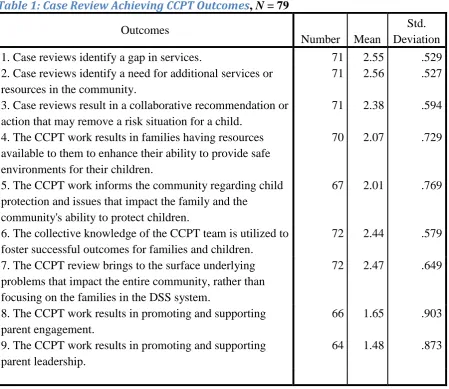
Table 1: Case Review Achieving CCPT Outcomes, N = 79
Outcomes
Number Mean
Std. Deviation
1. Case reviews identify a gap in services. 71 2.55 .529 2. Case reviews identify a need for additional services or
resources in the community.
71 2.56 .527
3. Case reviews result in a collaborative recommendation or action that may remove a risk situation for a child.
71 2.38 .594
4. The CCPT work results in families having resources available to them to enhance their ability to provide safe environments for their children.
70 2.07 .729
5. The CCPT work informs the community regarding child protection and issues that impact the family and the
community's ability to protect children.
67 2.01 .769
6. The collective knowledge of the CCPT team is utilized to foster successful outcomes for families and children.
72 2.44 .579
7. The CCPT review brings to the surface underlying problems that impact the entire community, rather than focusing on the families in the DSS system.
72 2.47 .649
8. The CCPT work results in promoting and supporting parent engagement.
66 1.65 .903
9. The CCPT work results in promoting and supporting parent leadership.
64 1.48 .873
Note. Very Good = 3, Good = 2, Poor = 1, Very Poor =0
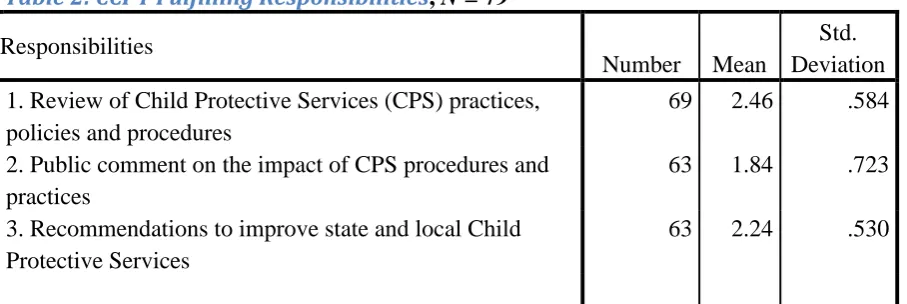
Table 2: CCPT Fulfilling Responsibilities, N = 79
Responsibilities
Number Mean
Std. Deviation
1. Review of Child Protective Services (CPS) practices, policies and procedures
69 2.46 .584
2. Public comment on the impact of CPS procedures and practices
63 1.84 .723
3. Recommendations to improve state and local Child Protective Services
63 2.24 .530
Note. Very Good = 3, Good = 2, Poor = 1, Very Poor =0
Peer Support
Community Child Protection Teams End-of-Year Report, 2013 Page 10 of 25
Table 3: Best Practices that Could Benefit Other Teams, N = 79
Best Practice
Number Mean
Willing to Coach 1. Multi-Disciplinary teams to improve service
delivery & address gaps in the investigation of sexual maltreatment.
31 1.77 11
2. Participation in a community drug task force 23 1.74 5 3. Education on electronic usage (sexting, etc.) and
its impact on our children
20 1.70 4
4. Collaboration w/ Law Enforcement & DSS for training on Joint Response in child injury cases
34 1.68 12
5. Initiative to educate the community re the Protective Factors
33 1.67 3
6. Joint DSS/Law Enforcement training on Child Fatality investigations
21 1.62 7
7. Developed proactive, meaningful partnerships with Communities of Faith
23 1.61 5
8. Materials in local schools on issues such as dangers of prescription drug abuse
22 1.59 4
9. Developed proactive, meaningful partnerships with community businesses
24 1.58 5
10.Collaboration for basic safety programs (i.e. swimming classes for Kindergarten children)
20 1.55 3
11.Invited CCPT member from another county to gain a broader perspective
17 1.53 2
12.Introduced Protective Factors to the language and work of the CCPT and its partners
18 1.44 1
13.Community collaborative Newsletter 17 1.42 5 14.Creation of a CPS Diversion Court without
removing the child from the home
14 1.36 2
15.Collaboration w/pharmacies to provide information re proper medicating of children
17 1.29 3
Note. Great Benefit = 2, Above Average Benefit = 1
Action Step Taken
Recommendations
NCDSS facilitate local DSSs in involving their CCPTs in assessing community needs and creating Child Welfare Achievement Plans.
NCDSS ensure training and technical assistance to CCPT members on participating in CQI case reviews.
Local Social Services agencies include CCPT members in the development of their CQI case review system.
Recurring Family Issues
Types of Cases Reviewed
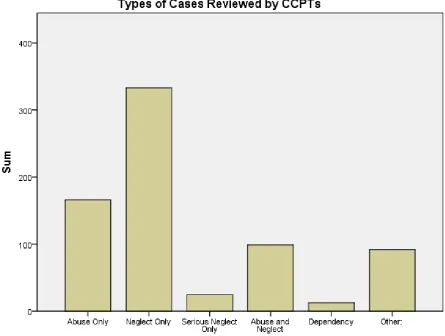
The counties reported reviewing cases primarily involving neglect only or serious neglect only, making a total of 358 cases. Second in prominence were cases involving abuse, totaling 265. Cases of dependency (parent unable or unavailable to provide care) were lowest at 13. The category of other had 92 cases and covered a wide gamut of areas such as concerns about the neighborhood environment to witnessing a murder-suicide in the home.
Community Child Protection Teams End-of-Year Report, 2013 Page 12 of 25
Risk Factors
The CCPTs were asked to “enter the number of cases for the applicable significant CPS [child protective services] factor or factors below for the total cases reviewed in 2013.” Because more than one factor could apply to a case, the CCPTs responses were often greater than the actual number of cases reviewed. For their responses on all factors, see Appendix B.
As in previous years, the CCPTs were deeply concerned about the impact on children and their families of the lack of mental health services, substance abuse, and family violence. Citations came to 633 for the lack of mental health services, 500 for substance abuse (including new substance abuse by adolescents or parents), 279 for domestic violence (including the lack of mandated services for perpetrators), and 186 for child sexual abuse (including abuse committed by children against children). All these factors may relate to the inappropriate supervision or discipline of children, together cited 395 times.
The families also experienced instability in child welfare services because of the involvement of multiple local DSS agencies or multiple out-of-home placements of children. This
instability was exacerbated by delays in reporting or addressing child maltreatment
committed by parents as well as by non-caretakers. The families’ struggles were compounded by economic hardship stemming from problems with employment, housing, transportation, child care, and health insurance.
Protective Factors
Given the recurrence of deep-seated problems in the case reviews, CCPTs may benefit from comparing cases with different trajectories. Reviewing cases where families appear stuck and ones where families make substantial gains can assist with developing strategies for resolving issues that set children at risk. This solution focus can help to identify protective factors supporting positive child development and healthy families and help to build productive relationships between families and their system of care. Public child welfare casework that is solution based is predictive of the Child and Family Service Reviews’ outcomes of child safety, permanency, and wellbeing (Antle, Christensen, van Zyl, & Barbee, 2012).
Recommendations
Each year, the CCPT Advisory Board select one issue for greater study. NCDSS ensure training to CCPTs on the issue and use of relevant data. The CCPTs request that the local DSS select cases for review that are
Meeting Statutory Requirements
Self-Assessment
The survey checked on whether CCPTs were meeting their statutory requirements in regards to their participation, frequency of meeting, and annual reporting. The majority of counties were complying with state legislative requirements.
As discussed previously, CCPTs meetings frequently included a number of key mandated agencies but struggled to involve other mandated agencies on a consistent basis. CCPTs also varied in whether they convened at least four times per year.Out of the 79 reporting CCPTs, the large majority met at least four times per year: 81% (64) met at least 4 times per year and 19% (15) met less than 4 times in the year. Overall the CCPTs met on average 6 times per year with the range from 2 to 12 times (SD = 3.05). In addition, some CCPTs had
subcommittees meeting over the year.
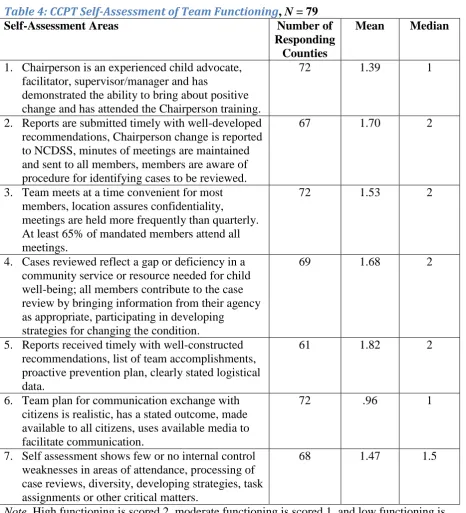
CCPTs assessed their own functioning as a team. The self-assessment items are from the NCDSS’s (2013) Strengths and Needs Evaluation Tool – Community Child Protection Team. The instrument is intended to engage CCPTs in discussion of their performance as a team. As seen in the table below, the CCPTs gave the most positive ratings to their reporting to their Board of Commissioners and to NCDSS, their chairperson’s responsiveness to the team and external constituencies, their conduct of case reviews, and their meeting logistics. Their lowest self-rating concerned their communication with citizens.
Community Child Protection Teams End-of-Year Report, 2013 Page 14 of 25
Table 4: CCPT Self-Assessment of Team Functioning, N = 79
Self-Assessment Areas Number of
Responding Counties
Mean Median
1. Chairperson is an experienced child advocate, facilitator, supervisor/manager and has
demonstrated the ability to bring about positive change and has attended the Chairperson training.
72 1.39 1
2. Reports are submitted timely with well-developed recommendations, Chairperson change is reported to NCDSS, minutes of meetings are maintained and sent to all members, members are aware of procedure for identifying cases to be reviewed.
67 1.70 2
3. Team meets at a time convenient for most members, location assures confidentiality,
meetings are held more frequently than quarterly. At least 65% of mandated members attend all meetings.
72 1.53 2
4. Cases reviewed reflect a gap or deficiency in a community service or resource needed for child well-being; all members contribute to the case review by bringing information from their agency as appropriate, participating in developing
strategies for changing the condition.
69 1.68 2
5. Reports received timely with well-constructed recommendations, list of team accomplishments, proactive prevention plan, clearly stated logistical data.
61 1.82 2
6. Team plan for communication exchange with citizens is realistic, has a stated outcome, made available to all citizens, uses available media to facilitate communication.
72 .96 1
7. Self assessment shows few or no internal control weaknesses in areas of attendance, processing of case reviews, diversity, developing strategies, task assignments or other critical matters.
68 1.47 1.5
Note. High functioning is scored 2, moderate functioning is scored 1, and low functioning is scored 0.
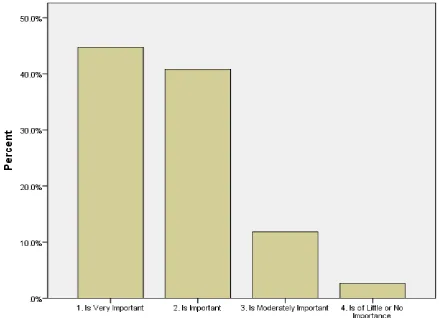
In addition, CCPTs were asked to “select the rating that best reflects your team's perception of the CCPT importance to the community and to the welfare of all children.” As seen in the figure below, 85.5% (65) of the 76 responding counties rated the importance as very
Note. Data are missing from 3 of the 79 CCPTs.
Figure 3: CCPTs’ Importance to Community and Children
In their reasons for the lower self-ratings on importance, the CCPT respondents wrote of the need for “rejuvenation” of their team, changeover in the chairperson, irregular participation from agencies such as schools and mental health, and the same individuals serving on multiple local committees that might better be combined into one. Another issue identified was that unlike the Child Fatality Prevention Teams, CCPTs lacked funding, with the result that they found it difficult to make the team “more visible in the community and engage members and the community on a larger scale.” Another survey reporter pointed to problems with the term CCPT itself: “If Citizen Review Panels are what we are suppose[d] to have, that is what we should call it - it is confusing to have to disclose that we are ccpt and we serve as the crp/ none of which the public understands.”
Supports for CCPTs
Community Child Protection Teams End-of-Year Report, 2013 Page 16 of 25 services. Networking was important to them, and they were looking for means of connecting with other CCPTs and sharing resources. An updated CCPT manual was also seen as
beneficial.
Table 5: Supports Requested from NCDSS, N = 79
Supports Number Mean
1. Training on how teams can become more active in the community and not just meet to review cases
71 1.51
2. Updated CCPT Manual 73 1.48
3. Information on how local gaps in services can be addressed beyond what the local team has already done
69 1.45
4. Training on promoting and supporting meaningful parent engagement and leadership
70 1.43
5. Media releases that can be personalized by local teams that speak to the importance and work of community panels, success stories, statistic-specific visual aids and other associated materials.
69 1.42
6. CCPT ListServ where members can seek the advice of others for training, engagement & motivation, fatality reviews, etc.
68 1.42
7. Assistance to develop resources in rural counties 69 1.38 8. Training on state policy changes 70 1.36 9. Webinars re information updates, training, child wellness reports,
etc.
69 1.33
10.Hold annual NC CCPT meeting with planning and sharing sessions, a refresher training on CCPT policy and purpose, and legislative issues.
69 1.29
11.Reduced time lines for the scheduling of Fatality Reviews and receipt of the post-review State report
67 1.18
12.Addressing the length of time it takes to complete out-of-state placements (ICPC cases)
69 1.04
13.Training on crime scene investigations 68 .93 14.Training on how to read / understand autopsy reports 66 .91 15.Hold regional CCPT meetings (quarterly) 69 .83
Note. Very Important = 2, Important = 1, Not Important = 0
Action Step Taken
Recommendations
NCDSS ensure training to CCPTs on their role and functioning.
CCPTs develop a consistent plan to share themes and recommendations from the annual report with their local communities.
Strategic Planning
When the accomplishments of the CCPTs are taken as a whole, North Carolina far exceeds federal expectations for citizen review panels (CRPs). Federal legislation stipulates three CRPs while North Carolina has 100 CCPTs with extensive community involvement. In addition to case reviews, the CCPTs hold events to raise public awareness of the need for preventing child maltreatment. This year, 60 of the 79 counties hosted child abuse prevention April activities. Other common events were community forums and presentations, healthy parenting education, joint training across the child welfare disciplines, and school curriculum, programs, and presentations. For a listing of the primary prevention activities and the CCPT ratings of their importance, see Appendix D.
The CCPTs recognized that to fulfill their responsibilities and to have a beneficial impact on their communities, they needed to better engage their communities, support family and youth leadership, and use the media effectively. The online surveys also point to the desire of CCPTs to connect more closely with other teams. In particular, they wanted to share their expertise with other CCPTs and learn from the experience of others, and they wanted more state-level strategic planning and resources to support their efforts.
Action Step Taken
The CCPT Advisory Board identified the need and resources for strategic planning.
Recommendation
Community Child Protection Teams End-of-Year Report, 2013 Page 18 of 25
References
Antle, B. F., Christensen, D. N., Van Zyl, M. A., & Barbee, A. P. (2012). The impact of the Solution Based Casework (SBC) practice model on federal outcomes in public child welfare. Child Abuse &Neglect, 36, 342– 353. doi:10.1016/j.chiabu.2011.10.009
Bryan, V., Jones, B., & Lawson, E. (2010). Key features of effective citizen-state child welfare partnerships: Findings from a national study of citizen review panels. Child and Youth Services Review, 32, 595-603. doi:10.1016/j.childyouth.2009.12.006
Clay, C., Amodeo, M., & Collins, M. E. (2010). Youth as partners in curriculum development and training delivery: Roles, challenges, benefits, and recommendations. Families in Society, 91(2), 135-141. doi:10.1606/1044-3894.3971
Duncan, D. F., Kum, H. C., Flair, K. A., Stewart, C. J., Vaughn, J., Bauer, R., & Reese, J. (2014). Management Assistance for Child Welfare, Work First, and Food & Nutrition Services in North Carolina (vol. 3.1). Retrieved from University of North Carolina at Chapel Hill, Jordan Institute for Families website, http://ssw.unc.edu/ma/
FRIENDS National Resource Center for Community-Based Child Abuse Prevention. (2010). Meaningful parent leadership: A guide for success. Chapel Hill, NC: Author.
North Carolina Division of Social Services. (2013). Strengths and Needs Evaluation Tool – Community Child Protection Teams. Retrieved from
Community Child Protection Teams End-of-Year Report, 2013 Page 20 of 25
Appendices
Appendix A: Local CCPT Teams Submitting Survey Alamance County Iredell County Alexander County Jackson County Alleghany County Johnston County
Anson County Lenoir County Ashe County Lincoln County Avery County Macon County Beaufort County Madison County Brunswick County Martin County Buncombe County Mecklenburg County
Burke County Mitchell County Caldwell County Moore County
Camden County Nash County Caswell County New Hanover County Catawba County Northampton County Chatham County Onslow County Cherokee County Orange County
Chowan County Pasquotank County Clay County Pender County Cleveland County Pitt County Columbus County Polk County
Craven County Randolph County Cumberland County Richmond County
Currituck County Robeson County Dare County Rockingham County Davidson County Rowan County
Davie County Rutherford County Duplin County Sampson County Durham County Scotland County Edgecombe County Stanly County
Franklin County Stokes County Gaston County Surry County
Gates County Vance County Granville County Wake County Guilford County Warren County
Appendix B: Number of Reviewed Cases for Which a Child Protection Factor Was Significant
Significant Child Protection Factor # of Cases
1. Substance Abuse-Involved Families 349
2. Domestic Violence in Families 261
3. No mandated services for domestic violence perpetrators 18
4. Improper discipline of children 47
5. inappropriate supervision of children 348 6. Lack of consistent, accessible, effective mental health services to
diagnose & treat needs
345
7. Child sexual abuse 142
8. Child-on-child sexual abuse 44
9. Multiple out-of-home placements 103
10.Multiple DSS agencies involved over the course of the child's lifetime
204
11.Insufficient services in rural areas 60 12."New" substance abuse usage by Teens (i.e. Bath Salts,
Prescription Drugs, etc.)
13
13."New" substance abuse usage by Parents (i.e. Bath Salts, Prescription Drugs, etc.)
138
14.Lack of psychological testing/mental health services for the family 288
15.Limited family support 232
16.Limited private insurance coverage for non-Medicaid cases 31
17.Immigration status 17
18.Parent(s) employment status (un- or under-employed) 210
19.Reliable transportation (own) 127
20.Appropriate public transportation (time, routes, cost, etc.) 43
21.Safe / stable housing 77
22.Multiple placements in group homes 17 23.Lack of out-of-home placement options 22 24.Lack of or delayed reporting/addressing of CAN 12 25.Lack of or delayed reorting/addressing of CAN for non-caretaker
abuse issues
3
26.Lack of quality, affordable, child care 48 27.Lack of consistent, effective law enforcement investigation of child
fatalities
4
28.Lack of consistent, stronger communication/training between ME and Law Enforcement
4
29.Children ordered into DSS custody when there are no abuse/neglect issues
9
Community Child Protection Teams End-of-Year Report, 2013 Page 22 of 25 31.Extreme child custody issues impacting children and their safety
(mental and physical)
19
32.Human trafficking 2
33.Internet Safety / Cyber-bullying 9
34.Teen suicide/ suicide threats and or attempts 17 35.Child support issues and enforcement 8 36."Invisible children" (i.e. Transiency, Home-Schooling, Isolation,
etc.)
4
37.Bullying 7
38.Military-connected 12
39.Gang-related issues 8
Appendix C: Self-Assessments by CCPTs
1. Does your Team conduct self-assessments on a regular basis?
Frequency Percent
Valid Percent
Cumulative Percent
Valid Yes 20 25.3 26.7 26.7
No 50 63.3 66.7 93.3
Uncertain 5 6.3 6.7 100.0
Total 75 94.9 100.0
Missing System 4 5.1
Total 79 100.0
3. Did you use the recently released form “DSS Strengths and Needs Evaluation Tool – CCPT? To score your work?
Frequency Percent
Valid Percent
Cumulative Percent
Valid Yes 12 15.2 15.8 15.8
No 61 77.2 80.3 96.1
Uncertain 3 3.8 3.9 100.0
Total 76 96.2 100.0
Missing System 3 3.8
Total 79 100.0
Note: Tool available at www.ncdhhs.gov/dss/ccpt/
3. Were you aware of the CCPT Website?
Frequency Percent
Valid Percent
Cumulative Percent
Valid Yes 41 51.9 53.9 53.9
No 33 41.8 43.4 97.4
Uncertain 2 2.5 2.6 100.0
Total 76 96.2 100.0
Missing System 3 3.8
Community Child Protection Teams End-of-Year Report, 2013 Page 24 of 25
4. Does your team use any other type of evaluation tool?
Frequency Percent
Valid Percent
Cumulative Percent
Valid Yes 7 8.9 9.2 9.2
No 64 81.0 84.2 93.4
Uncertain 5 6.3 6.6 100.0
Total 76 96.2 100.0
Missing System 3 3.8
Total 79 100.0
5. Does your team have a Mission Statement?
Frequency Percent
Valid Percent
Cumulative Percent
Valid Yes 19 24.1 25.3 25.3
No 47 59.5 62.7 88.0
Uncertain 9 11.4 12.0 100.0
Total 75 94.9 100.0
Missing System 4 5.1
Appendix D: CCPT Primary Prevention Efforts
CCPT PRIMARY PREVENTION EFFORTS, N = 79
Primary Prevention Efforts Number of Counties
Mean Importance
Std. Deviation
1. Child abuse prevention April activities in the community
60 2.60 .785
2. Community forums and presentations 53 2.34 .876 3. Healthy parenting education 50 2.32 .999 4. Joint training across the child welfare
disciplines
51 2.2 1.02
5. School curriculum, programs, presentations
51 2.1 1.17
6. Traditional media 48 1.73 1.026
7. Programs such as Darkness2Light, StopItNow, WaitToText, etc.
46 1.59 1.185
8. Communities of Faith involvement events 40 1.58 1.13
9. Family workshops 40 1.50 1.198
10.Websites, social media 45 1.40 1.136
11.Legislative education (tours/programs to build awareness of unmet needs)
38 1.11 1.20
12.Candlelight vigils 43 1.09 1.13
13.Billboards 41 .76 1.044
14.Community Cafe or Parent Cafe 34 .56 .991
Note. Very Important = 3, Important = 2, Moderately Important = 1,