Formel-Kapitel 1 Abschnitt 1
4-D visualization study of a vortex ring life cycle using modal analyses
Benjamin Ponitz1,*, Mark Sastuba1 and Christoph Brücker2
1: Institute of Mechanics and Fluid Dynamics, University of Freiberg, Germany 2 Dept. Mechanical Engineering and Aeronautics, City University London, UK
* correspondent author: [email protected]
Formelabschnitt (nächster)
Keywords: 4-D PIV, vortex ring, scanning back-projection, modal analysis, POD, DMD,secondary instabili-ties
Abstract In this study, the life cycle of a vortex ring is visualized and simultaneously investigated in a three-dimensional domain and time resolved for an observer in a reference frame moving with the ring. By traversing the system, the object of interest is captured within the measurement volume during the entire cycle. The 4-D (time-resolved 3-D) data gained from the experiment is post-processed by using modal analyses such as Proper Orthogonal Decomposition (POD) and Dynamic Mode Decomposition (DMD). The latter is used to reconstruct the vortex dynamics by means of the Q-values, based on the most dominant modes in the DMD. These modal analyses allow reconstructing the dominant dynamics of the behavior of the secondary structures and their interaction with the vortex core. The visualization for the vortex ring at ReΓ = 5500 shows the well-known azimuthal instability and its growth at n = 6 in our experiments. As the
process of transition further develops, we found a zig-zag-like mesh of tilted secondary structure and finally helical coil-type vortex ribbons wrapped around the core that emerge in the late-stage process. It is hypothesized that the initial state of this process is the emergence of a pair of standing helical waves both counter-balancing each other at the beginning and forming the zig-zag pattern. Azimuthal core flow is only weak in this phase. Later in the transition, one of the helical waves starts to take over the other and finally dominates. This results in the helical coil-type vortex structure seen in the reconstructed results, which goes with increase in axial flow along the core. The hypothesis of co-existing helical waves is drawn from similarities in the transition of attached vortex rings in axisymmetric wakes.
1 2
3
4
5 6
7 8 9
10 11
12 13 14
15 16
17 18
19 20
21 22 23
Content
1. Introduction...3
2. Methods...4
2.1 Time-resolved flying PIV system...4
2.2 Vortex ring parameters...5
2.3 Volumetric measurements via scanning back-projection (SBP)...7
2.4 Computational procedures...8
2.5 Feature visualization via POD and DMD analyses...9
3. Results...10
3.2 Visualization via 3-D POD Analysis based on velocity and vorticity...11
3.3 Visualization via 2-D POD Analysis of the cylindrical projection layer...13
3.4 Visualization via 3-D DMD Analysis based on Q-criterion...14
4. Conclusions...16
5. Appendix...19
Part A - Proper Orthogonal Decomposition Analysis (POD)...19
Part B - Dynamic Mode Decomposition Analysis (DMD)...20
Part C – Additional POD results...Error! Bookmark not defined. 6. References...24
7. Figure/ESM Legends...26 25
26
27
28
29
30
31
32
33
34
35
36
37
38
39
40
41
42
43
44
1
. Introduction
In recent years, 3-D time-resolved PIV measurement methods (such as 3-D Scanning-PIV or Tomo-PIV) have experienced a big step towards practicable use in fluid mechanics. This is due to the availability of state-of-the-art digital high-speed cameras and computational processing power to obtain the velocity fields from 3-D cross correlation or 3-D Least Squares Matching; a recent review is given in Kitzhofer et al. (2013). This allows to use the full 3-D velocity field information and to determine quantities derived thereof, such as the velocity gradient tensor, the Lamb vector etc. In addition, post processing methods such as Proper Orthogonal Decomposition (Berkooz et al. 1993; Andrianne et al. 2011) or Dynamic Mode Decomposition (Schmid 2010; Rowley et al. 2009) as well as the finite time Lyapunov exponent method (Haller & Sapsis 2011) provide a clearer picture of the data fields to enlighten the complex vortex dynamics in 3-D space and in time. An example of such a complex flow field is the life cycle of a vortex ring from its initial birth to its turbulent breakdown at higher Reynolds-numbers. Such a full 3-D quantitative investigation has so far not been performed experimentally. On the other hand, 3-D direct numerical simulations (DNS) recently provided a clearer picture of the secondary vortex strcutures and their arrangement around the core (Archer et al. 2008; Bergdorf et al. 2007). Here, we focus on the behavior of such a single ring during its breakdown process, as it transfers from a laminar state over several instability stages into the fully turbulent breakdown. The method used herein is a 4-D technique developed in Ponitz et al. (2012) that captures the flow in a reference frame that moves with the travelling ring. The visualization outcome is realized by using POD and DMD analyses. Several figures and animations give an insight into significant vortex structures.
46 47
48
49
50
51
52
53
54
55
56
57
58
59
60
61
62
63
64
65
66
2. Methods
2.1 Time-resolved flying PIV system
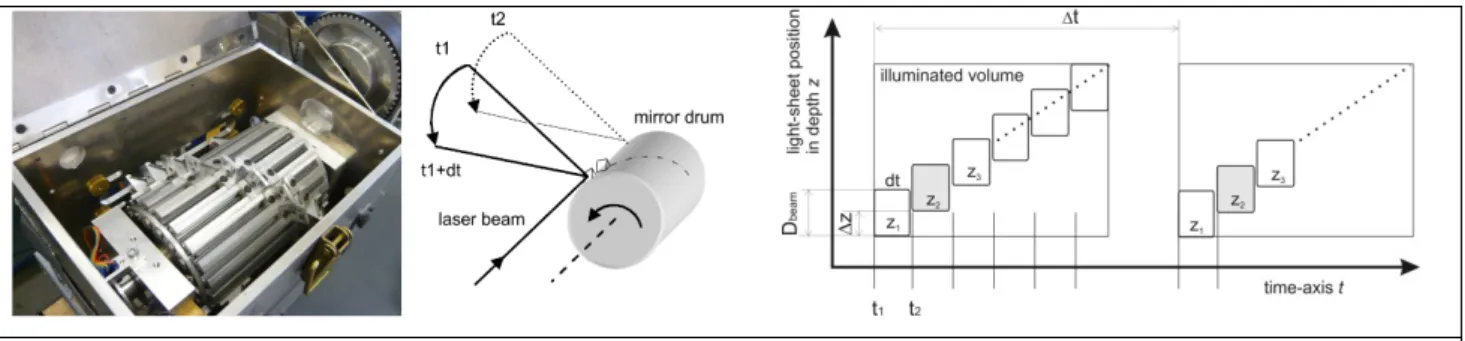
The combined method of scanning light-sheet and tomographic reconstruction is applied herein to resolve the 3-D velocity field within the volume of interest. For details the reader is referred to Ponitz et al. (2012). The experimental set-up is shown in Fig. 1a: The laser beam of a continuous Argon-Ion laser Coherent Innova 70 (3 W) passes through an optical lens system to adjust the beam diameter to Dbeam 10mm. A 3-D scanning laser beam system using a rotating drum with helical
arrangement of mirrors on the circumference as previously used in Brücker (1997) is applied herein, see Fig. 1b. This scanning illumination slices the flow in 10 parallel thick light sheets (light-sheet thickness Dbeam, shift of the light-sheet z=8mm) leading to a quasi-volumetric illumination. The
particle images are captured separately for each scan position z using the trigger timing shown in Fig. 1b with a synchronized three-camera high-speed imaging system (Phantom V12.1, Vision Research, 1280 x 800 pixel resolution, pixel size 20 microns, internal memory of 8 Gigabyte RAM) with an angular displacement of roughly 45°, 90° and 135°. The cameras are equipped with telecentric lenses (Sill Optics, M = 0.2). Thus, the aperture is closed to f/16 to obtain a depth of focus of approximately 10 cm. The mirror drum and the timing control of the camera image capturing the repetition of the light sheet scan is given in Fig 1b. It shows a chart illustrating the temporal relation between the scan position z1-zn and the camera shutter trigger t1-tn. A typical
sampling frequency of 1/dt = 1250Hz is reached with the current drum device that triggers the frame capturing at 1250Hz. Note that the cameras are run in free trigger mode, so there is no first and second exposures for PIV processing but the successive images are used for reconstruction of the scanned volume and processing of particle image displacement is done between consecutive volumes. The sampling rate of the individual scan-volumes is therefore calculated to 125 Hz. The mean particle displacement in the volume from scan to scan is of order of 8 pixels.
Fig. 1b Rotating mirror drum and camera timing
69
70 71
72
73
74
75
76
77
78
79
80
81
82
83
84
85
86
87
88
89
90
91
92
93
The observed flow is a vortex ring travelling in an octagonal fluid basin filled with water (water temperature: 20°C). The vortex is generated at the exit of a piston tube (exit diameter De = 30 mm).
The neutrally buoyant seeding particles (diameter: 90 microns) are injected into the center of the piston tube and the surrounding fluid in the basin. To compensate for the travelling speed of the vortex in the system of a co-moving reference frame and to ensure that the vortex ring stays in the measurement volume of the cameras while capturing, we moved the whole basin with a traverse at the same speed as the vortex but in opposite direction with a velocity of Utrav ≈ 50 mm/s. Note that
the fluid basin was first accelerated to the final rise velocity and thereafter at constant speed the piston was pushed to generate the vortex ring, so there is no effect of an accelerating environment on the vortex dynamics.
The total acquisition time of a measurement sequence, from the piston stroke to the complete breakdown of the vortex ring, is 6.4 seconds, which corresponds to 800 scans. The recorded volume is defined by the captured image format and the thickness of the light sheets. This leads to a reconstructed volume extension of approx. 70 x 50 x 52 mm³. The scale in depth is reduced relative to the theoretical maximum scanning width because of blurred particle images in the lateral corners of the sensors for camera #2 and #3. In these regions particle images get blurred because the cameras are tilted against the normal camera orientation about an angle of 45°. This reduces the box volume in depth to 52mm.
2.2 Vortex ring parameters
Before discussing the results we herein define the characteristic parameters of the flow. The necessary values are taken from the results of the measurements presented in section 3 further below. The geometry of a vortex ring is characterized herein using the integral parameters as introduced by Saffman (1970). Therefore, the core radius δ is calculated from the radial moments of the vorticity component ωθ with
101\* MERGEFORMAT (.)
and
01\* MERGEFORMAT (.), 01\*
MERGEFORMAT (.), 01\* MERGEFORMAT (.),
where Rθ and R2 are the first and second radial moments of ωθ , r is the current radius from the axis
of propagation and Γ is the initial circulation. With Γ = 5.5 10-3 m2/s, R
θ = 12.9 mm and
R2 = 14.2 mm the core radius is δ = 8.4 mm. Furthermore, the generated vortex ring has a torus
95
96
97
98
99
100
101
102
103
104
105
106
107
108
109
110
111
112
113 114 115 116 117 118 119
120
121
122
123
124
125
radius (from origin to center of the core) of Rtorus = 22.5 mm and a travelling speed of Utrav = 50 mm/
s. All values characterizing the ring geometry were obtained from the measurement results. The ring travelling speed was measured from the traverse that was set to cancel the relative motion to zero.
The Reynolds number Reo defined with the torus-like vortex ring radius Rtorus and the travelling
speed Utrav is
202\* MERGEFORMAT (.)
where ρ is the mass density and η the dynamic viscosity of the fluid.
The Reynolds number Rep defined with the diameter of the piston (Dp = 30 mm) and maximum
piston speed (Up = 155 mm/s) is
303\* MERGEFORMAT (.)
The initial Reynolds number ReΓ based on the circulation at the beginning of the experiment of the
ring is
404\* MERGEFORMAT (.)
The core radius δ and the torus radius Rtorus lead to the slenderness ratio ε of
505\* MERGEFORMAT (.)
According to the discrimination made by Archer et al. (2008), the ring vortex in our experiments is assigned to the thick-core branch at ε > 0.36. During the first laminar part of the life cycle it is predicted that azimuthal instabilities along the ring deform the core into a wavy shape with an integer number of waves nwaves around the circumference (see also Archer et al. 2008). For a
Gaussian core distribution of vorticity (see Fig. 2b) the wave number depends on the slenderness ratio (Shariff et al. 1994; Widnall & Sullivan 1973)and is defined by
606\* MERGEFORMAT (.)
This theoretically results in a number of 6 waves for our experimental conditions. Indeed, as shown in section 3 we observe exact the predicted number of waves in our vortex ring. The wavelength of each wave is therefore defined as
707\* MERGEFORMAT (.)
127
128
129
130
131
132
133
134
135
136
137
138
139
140
141
142
143
144
145
146
147
148
149
150
151
152
The entire life cycle of the
vortex ring from stable
circular shape to breakdown of
the core comprises 800
snapshots. The physical time ti
[s] can be calculated using
the snapshot number n and
the recording rate of the
measuring system (123
Hz) and a non- dimensional
time t* is built with the
travelling speed and torus
diameter as follows:
808\* MERGEFORMAT (.)
2.3 Volumetric measurements via scanning back-projection (SBP)
Time-resolved volumetric reconstruction of the particle motion seeded within the measuring domain is realized by using the scanning back-projection (SBP) method described in Ponitz et al. (2012). Fig. 3 illustrates the volumetric reconstruction procedure. At first, the measuring volume is subsampled in a number of smaller sheets using the 3-D scanning illumination. Secondly, each sheet is discretized into voxel elements. These voxel elements are then filled with grey value information from the captured multi-camera images by back-projection. As the final reconstruction step, the previously subdivided illumination sheets are merged to form an entire continuous volume. Fig. 4a shows the SBP domain with reconstructed particle distribution (see dashed line volume border) of the entire vortex ring for two successive time steps. The animation movie of fig. 4a for all time steps is given in Online Resource 1. Details of the reconstruction method are given elsewhere (e.g., Ponitz et al. 2012).
2.4 Computational procedures
To determine the 3-D velocity fields from the time-resolved particle field motions, the 3-D Least Squares Matching (LSM) algorithm is applied using the software package DynamicStudio from
piston diameter Dp = 30 mm
piston velocity Up = 155 mm/s
travelling speed vortex Utrav = 50 mm/s
torus diameter Dtorus = 45.0 mm
torus radius Rtorus = 22.5 mm
vortex core radius δ = 8.4 mm
torus circumference (C = 2π Rtorus) C = 140 mm
circulation Γ = -5.5 mm2/s
slenderness ratio (ε = δ/Rtorus) ε = 0.3733
number of waves nwaves= 6
wavelength λ = 23.3 mm
Reynolds number (vortex based) = 2225
Reynolds number (piston based) = 4650
Reynolds number (circulation based) ReΓ = 5500
Table 1Experiment parameters
154
156
157
158
159
160
161
162
163
164
165
166
167
168 169
170
171 172
173
174
175
176
177
178
179
180
181
182
183 184
Dantec Dynamics. Small cuboids (size 31x31x31 voxels³) are interrogated with a shift of 4 pixels in the volumetric data. This procedure causes effects of data reduction on the edges of the reconstructed domain. The effective volume is characterized as the LSM domain (Fig. 4b) by which the resulting 3-D velocity fields are determined and post-processed by using a median filter with a kernel of 3x3x3 voxels³. The spatial resolution of the velocity field is on the order of 1 mm and the measurement uncertainty amounts to 0.2 mm/s as tested during a simple traverse flow induced by the lifting device. The software Tecplot360 is used for visualizations. Fig. 4b depicts a typical 3-D velocity field which is the base of further operations and interpretations. Due to the spatial limit of the LSM domain and the extension of the vortex ring beyond the volume border some of the outer parts of the vortex were lost within the visualizations. Nevertheless, the core and the previously determined number of waves (see eq. 1.9) can be validated by the experimental data.
For a better analysis of the vortex ring in physically reasonable coordinates the Cartesian flow field coordinates, resulting from LSM processing, are transformed to polar cylindrical coordinates with the origin of the coordinates placed at the center of the torus. The latter is calculated from the Cartesian data according to the method of center of mass applied to the vorticity field. Therefore, the origin is chosen as the axis of symmetry within the plane of the circular axis of the torus. The corresponding coordinates are determined using the zero point detection solver described in Gan et al. (2011). Therefore we calculate the 1st moment of vorticity
909\* MERGEFORMAT (.)
10010\* MERGEFORMAT (.)
for varying locations of the origin until |xs| reaches the minimum. The corresponding position of the
origin = (x0,y0,z0) is then a good estimate of the center of the vortex torus. Thereafter, surfaces of
constant radius are extracted to investigate the temporal behavior of the inner vortex flow (see Fig. 5).
2.5 Feature visualization via POD and DMD analyses
The visualization of the time-resolved vortex ring life-cycle is processed for several methods and 186
187
188
189
190
191
192
193
194
195
196
197
198
199
200
201
202
203
204
205
206
207
208
209
210
characteristics. For instance, basic qualitative flow visualization via multiple-exposure imaging depicts 2-D vortex structures.
To visualize the main structures of a vortex ring gained from experiments, the following tools are used for feature extraction of the experimental raw data: Proper Orthogonal Decomposition analysis (POD) and Dynamic Mode Decomposition analysis (DMD). Major potential of these methods lies in efficient data reduction and noise reduction. For a detailed description of the methods and background, please see appendix Part A for POD and appendix Part B for DMD. From the DMD data we reconstructed the low-dimensional representation of the velocity field with the 15 most dominant modes. These filtered velocity fields are then used to determine vorticity properties and Q-criteria as a tool for identification of vortex cores.
213
214
215
216
217
218
219
220
221
3. Results
First, qualitative flow visualizations are shown in Fig. 6 to illustrate some exemplary characteristic stages within the life cycle. The method of dye flow visualization (left) and multi-exposure particle imaging (right) in a light sheet is used. Due to the upwards motion of the lifting device the downwards motion of the travelling ring is counter-balanced so that the ring stays within the domain of the fixed observer. The animation movie of Fig. 6 is given in Online Resource 2. Such an experiment, at the same Reynolds number, was recorded with the described 4-D PIV system and analyzed in further detail.
Fig. 7 shows the temporal behavior of the torus center (x0, y0, z0), the normalized mean velocity components (uθ, ur, uz) and the normalized mean vorticity components (ωθ, ωr, ωz) in the vortex
core. These values were made non-dimensional using the travelling speed Utrav of the vortex ring
and its diameter Dtorus. Within the early phase (snapshots 0…400) the torus center position shows
only a marginal residual motion relative to the observer, see Fig. 7a. Shortly after snapshot 400, the torus center starts to oscillate in the transverse direction with small amplitude, which indicates the presence of instabilities. The position of the torus center in travel direction z shows a slight decrease for the first 200 snapshots which is due to the higher initial axial momentum of the vortex ring, followed by a nearly constant z-position between snapshots 200 and 400, and finally a phase of dragging during the increasing loss of axial momentum due to instabilities and the breakdown. The mean velocity components uz in travel direction (Fig. 7b) and ur in radial direction show a
rather constant decline from snapshot 0 to snapshot 600 which is the result of viscous diffusion of the vorticity out of the core. Around snapshot 700 the rapid drop of uz indicates the breakdown of
the vortex when axial momentum of the vortex is lost. Thus, the transition from the laminar state to the early turbulent breakdown is located somewhere between snapshots 400 and 700.
At the beginning of the life sequence, the mean azimuthal velocity uθ is close to zero and remains in
this state for the first 100 snapshots. A value of zero is expected for a perfect circular torus. However, a possible perfect alignment of the coordinate system contributes to the residual non-zero part. From snapshot 100 to 400 this component increases with a small but distinct oscillation of uθ. After snapshot 400 a further increase is recognizable until it has reached the maximum of uθ/
Utrav = 0.15 between snapshots 500 and 600. Thus, azimuthal fluid motion along the axis of the ring
is a significant accompanying effect during the growth of instabilities in this transition phase of the vortex life cycle. Interestingly, we observed the growth of this azimuthal velocity component already within the early phase of growth of azimuthal waves with mode nwaves = 6 as shown further
below. 224
225
226
227
228
229
230
231
232
233
234
235
236
237
238
239
240
241
242
243
244
245
246
247
248
249
250
251
252
253
254
255
Fig. 7c illustrates the normalized vorticity values (absolute) of the azimuthal ωθ, the radial ωr and
the streamwise ωz components. The major component of the torus core vorticity is represented by
ωθ. Again, viscous diffusion out of the vortex is thought to cause the constant decline of the core
vorticity over the first phase of the life cycle up to snapshot 600. Further on, one can recognize the continuous redistribution of vorticity from the azimuthal direction into the other components, as documented in the continuous increase of radial and axial vorticity in Fig. 7c. Axial vorticity is reaching its maximum around snapshot 550 while radial vorticity is maximal at about snapshot 600 which corresponds to the change in slope in the trend of the azimuthal component.
Fig. 8 shows the iso-surface based visualizations of the velocity component uz as well as the
vorticity components ωθ and ωz. Color values are given in the figure caption. The animation movie
of fig. 8 for all snapshots is given in Online Resource 3. During the early stable phase (snapshot 1 to 200) the iso-surfaces show nearly identical conditions, apart from a slight contraction of the black torus and the blue velocity ‘disc’ in the centre of the torus. Note that the torus is not complete because parts are cut at the front and the back due to the limits of the measurement domain in the y-direction. From snapshot 250 to 450 the black torus becomes increasingly wavy, and the shape of the blue ‘disc’ changes to six individual blue ‘pockets’ with local streamwise velocities higher than the mean. Therefore, the azimuthal wave number that is most amplified is n = 6, in agreement with the theoretical value determined from eq. 06. Around snapshot 400, the vorticity ωz (contours in
yellow and red) appears for the first time in the form of vertically aligned structures located next to where the blue pockets were. The effective breakdown of the vortex becomes evident from snapshot 500 to 700. Snapshot 500 now shows pairs of counter-rotating streamwise vortices, whereas the blue pockets of vz have completely disappeared. Meanwhile, the stationary azimuthal waves along
the black torus have reached their maximum amplitudes just prior to breakdown. The breakdown process (from snapshot 600 to 700) is characterized by the substantial emergence of ωz, combined
with the diminishing of ωθ. This phase coincides with a total loss of axial momentum of the ring.
3.2 Visualization via 3-D POD Analysis based on velocity and vorticity
Fig. 9 shows the energy distribution of the 3-D POD analysis of velocity v, vorticity ω and Q-criterion. The latter is defined in Hunt et al. (1988). The energy spectrum of the modes of all aspects shows that most of the energy is concentrated within the first five POD modes. We focus herein on the description of only the interesting POD modes that obey significant patterns. The patterns of the modes are visualized by using iso-surfaces for normalized value of the investigated parameter.
The mean data field (mode no. 0) of the radial velocity componentsvr is given in Fig. 10. Both the
top and bottom iso-contours show a wavy ‘donut-like’ shape around the vortex core. The six 257
258
259
260
261
262
263
264
265
266
267
268
269
270
271
272
273
274
275
276
277
278
279
280
281
282 283
284
285
286
287 288 289
azimuthal waves along the upper iso-surface (indicated by the red arrows in the wave troughs) have a total phase difference of approximately γ = (2n+1)30° in relation to the six azimuthal waves along the bottom iso-surface (indicated by the yellow arrows). This means wave troughs along the upper iso-surface are anti-phasic to wave troughs along the bottom iso-surface considering that we see 6 waves along the circumference. This shows that the fore-aft symmetry of the vortex ring is already lost in this state. The POD mode no. 2 is shown as an example of the vorticity component ωz
within Fig. 11. This mode displays remarkable similarity of its patterns in the form of a regular azimuthal arrangement of the blue-colored (positive value) and yellow colored (negative value) iso-surfaces. These surfaces represent streamwise vortex-pairs that are arranged at each crest of the azimuthal wave. Archer et al. (2008) showed this pattern of ωz in a z-slice of the vortex ring in a
numerical simulation. It is obvious that both results show a striking similarity in the arrangement of secondary vortices around the core.
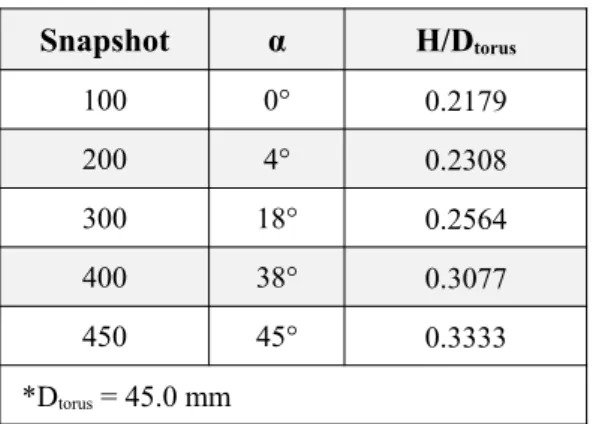
On the basis of iso-surfaces of the Q-criterion (Hunt et al. 1988) the previously implied growing conical surface can be seen in Fig. 12. During the life cycle the wave grows in a conical surface (Widnall & Sullivan 1973) from nearly 0° (initial phase) to 45° relative to the axis of vortex travel direction (see Fig. 12, shortly before the breakdown begins at snapshot 450).
291
292
293
294
295
296
297
298
299
300
301
302
303
304
305
306
Snapshot α H/Dtorus
100 0° 0.2179
200 4° 0.2308
300 18° 0.2564
400 38° 0.3077
450 45° 0.3333
*Dtorus = 45.0 mm
Table2 Parameters tilting angle and height
Table 2 shows the temporal development of the tilting angle α and vortex dimension height H in relation to the initial torus diameter Dtorus. The height is defined in Fig. 12 as the maximum axial
extension of the vortex core between wave trough and crest. It is a measure of the wave amplitude. During the life cycle the torus diameter seems to remain nearly constant. As a reference, the geometry is defined by the iso-surfaces of the Q-criterion with a value of -50.0.
3.3 Visualization via 2-D POD Analysis of the cylindrical projection layer
The geometrical transformation into the vortex-fixed cylindrical coordinates allows us to extract in-formation on cylindrical surfaces centered on the vortex axis. This principle is illustrated in Fig. 13 where a cylindrical surface (Fig. 13 center) is cut out of the original data (Fig. 13 left-hand side) and is finally displayed as a planar sheet with the horizontal axis along the circumference (Fig. 13 right-hand side). This illustration is used in the following figures. For the cylindrical surface with radius r = 14 mm (smaller than the torus radius) the 2-D POD analysis is applied to the streamwise veloc-ity component vz (see Fig. 15) and the streamwise vorticity component ωz (see Fig. 16). Fig. 14
shows the energy distribution diagram for both. The mean data field (mode no. 0) of vz (Fig. 15)
clearly shows the regular pattern of the azimuthal wave-type structure with a varicose modulation of the thickness of the band. Note that mode 1 has roughly the same structure but with inverse sign. Therefore the energy of both modes can be superposed. This leads either to amplification or weak-ening of the accentuation of the azimuthal wave. During the early phase, mode 1 counter balances the pattern of mode no. 0 such that the ring remains of toroidal shape. Interestingly, the second mode shows a zigzag pattern of oblique structures with a phase shift of 180° between the blue and red peak regions as already observed in a similar shape in Fig. 10. When we compare our results to the DNS simulations by Archer et al. (2008) it is obvious that the observed patterns belong to the secondary vortex structures formed by the ‘halo’ vorticity around the torus.
The chronological sequence of mode coefficient no. 2 (Fig. 16) illustrates a negative sign from snapshot 275 to 625 with a negative peak near snapshot 500. At the same time, mode no. 1 has in-309
310
311
312
313
314
315 316
317
318
319
320
321
322
323
324
325
326
327
328
329
330
331
332
333
creasing magnitude continuously counter-acting against mode 0 thus the sum of both (both POD patterns are of similar structure, see above) decreases in energy so that the remaining most domi-nant mode is then no. 2, which forms the mesh-like structure of the halo around the core.
Fig. 17 displays the modes deduced from 2-D POD of the streamwise vorticity on the cylindrical surface around the torus center. Mode 0 clearly highlights the regular arrangement of the 6 pairs of counter-rotating streamwise vortices along the cylindrical surface in the form of straight vertical bands of interchanging colors. Again, mode 1 shows identical patterns to mode 0 but with inverse sign so that their energy can be superposed. When mode 1 is at maximum magnitude at snapshot 500 it is counteracting with maximum strength against the energy of mode 0. Thus both cancel each other to certain degree. Meanwhile the magnitude of mode 2 is rising and reaches a maximum at about 620. The pattern of the second mode of the streamwise vorticity ωz (Fig. 17) again reveals
that the flow contains a significant part of oblique structures to later times, but with somewhat less regularity than observed for mode no. 2 in vz component shown in Fig. 15. Nevertheless, the same
zig-zag type of pattern is observed herein too.
3.4 Visualization via 3-D DMD Analysis based on Q-criterion
In order to reconstruct the dominant vortex dynamics from the measurement, the experimental raw data were analyzed in a second run via the method of Dynamic Mode Decomposition (DMD) and reconstructed again, but using only the most dominant modes in the DMD results. This method of low-dimensional representation allows us to highlight the physical processes and diminish residual measurement noise that is expected to be represented by incoherent higher frequency parts in the DMD modes, see Schmid et al. (2012). Note that the temporal evolution of the vortex ring life cycle is better represented by the DMD method than by the POD since the latter is based on a statistical approach and temporal average, while the DMD computes approximates the underlying dynamics, see Chen et al. (2012). Instead of the standard DMD method we used the so called sparsity-promoting DMD algorithm (SDMD) herein to tackle the memory problem involved with the huge 4-D vortex dataset. This method is described in Tu & Rowley (2012) and the herein applied SDMD-algorithm was inspired by the recent paper of Jovanovi et al. (2014). The sparsity-promoting DMD aims to identify the modes that have the strongest influence on the entire time sequence by setting the amplitudes of the negligible modes to zero. The results of the eigenvalues for both algorithms (DMD versus SDMD) are displayed in Fig. 19 (DMD: circles; SDMD: crosses). Eigenvalues in the interior of the unit cycle are strongly damped. Thus, they influence only early stages in the time evolution. As a consequence of the principle of SDMD these modes in the inner of the circle don’t appear in the SDMD result, besides from other non-dominant modes. This 335
336
337 338 339
340
341
342
343
344
345
346
347
348
349
350 351
352
353
354
355
356
357
358
359
360
361
362
363
364
365
366
367
considerably reduces the number of necessary modes to keep in storage compared to the DMD and thus it requires less memory (Jovanovi et al 2014). This fact is utilized for the present data. As shown in Fig. 19, the SDMD finally emphasizes 15 dominant non-zero amplitudes marked as red crosses in comparison to the larger number of 400 modes obtained in the standard DMD which are marked as circles. As already mentioned, the data presented herein stems from an experimental setup that is always affected by noise and measurement uncertainties. These appear as high-frequency, short-lived and incoherent disturbances. Hence, forcing a low number of non-zero amplitudes in j as in SDMD reduces per se the influence of random uncorrelated noise (Jovanovi et
al. 2014, Schmid et al. 2012).
Fig. 20 illustrates iso-surfaces of constant Q-value as obtained from the reconstructed SDMD analysis for the vortex life cycle. The evolution from the stable torus to the unstable wavy torus is now highlighted against the background and more clearly visible than in Fig. 8. The black colored surface shows the vortex core and the light-blue colored surface reveals the consequence of secondary instabilities (snapshot 500) that lead to the halo vorticity around the vortex core. It is only because of this low-dimensional DMD reconstruction method that we recognized a specific feature of the halo vorticity in the data visualization in snapshots between 450 and 500. Fig. 21 shows some snapshots in this phase more in detail. The images clearly illustrate the emergence of a helical coil-type structure that is wound around the core and separates from it at later times. The separation of vorticity from the core through the formation of such helical coils is indicated by the yellow colored line that is wound around the core axis (see Fig. 21). The experimental results prove, for the first time, the emergence of these helical structures out of the wavy deformation and secondary vortices along the core. Note that CFD results by Archer et al. (2008) show such vortices only in the branch of thin-core vortex rings, whereas our experimental results suggest that the coils also occur in thick-core rings.
369
370
371
372
373
374
375
376
377
378
379
380
381
382
383
384
385
386
387
388
389
390
391
392
393
4. Conclusions
A detailed study of the life cycle of a vortex ring at ReΓ = 5500 is presented using 4-D PIV. A major
feature of the experiments is the moving traverse that allows us to examine the vortex ring in a reference frame which is co-moving with the vortex ring. This offers to observe the life cycle of the vortex ring from birth to breakdown. The primary instability is captured in its temporal evolution showing the growth of a standing wave in the azimuthal mode with n = 6. We observed that axial flow in the toroidal core is already present in this early phase of the growth, though still weak. The conical angle of 45° between the wave and the direction of travel is reached in the final state before the ring-vortex undergoes breakdown. The raw data without further post-processing is already meaningful to recover these characteristics of the primary mode, however smaller-scale features of importance are masked in the iso-surface visualizations because of omnipresent measurement noise. Therefore the described modal analyses were used. The POD modes no. 2 in streamwise vorticity shows the emergence of a zig-zag pattern along the circumference of a cylindrical surface through the ring in the second phase, where secondary structures emerge. These are seen in the iso-surfaces of 3D POD modes as pairs of secondary vortices that grow out of the vortex core and around the torus. The 2-D POD along a cylindrical surface highlights that these vortices appear in a zig-zag pattern, a further clarifying 3D visualization of the pattern could however not be achieved from POD. It was only after post-processing the data with DMD when this zig-zag pattern became visible as an interwoven mesh of tilted secondary vortices around the core, similar as documented in DNS simulations. The DMD method also enabled us to visualize how the interwoven mesh finally disintegrated into helical coil-type ribbons that wrap around the core shortly before breakdown. Archer found such vortices in the branch of thin-core vortex rings with the slenderness ratio ε < 0.360, while our results at ε = 0.373 prove that the coils also occur in thick-core rings. Thus, the lower-dimensional representation of our data sequence using DMD allowed us to capture this essential feature of the flow dynamics, which is so far not reported in experiments. As shown here the synthesis of three-dimensional time-resolved data and efficient DMD analysis give new and valuable insight into complex fluid flow, its principal mechanisms and its inherent spatio-temporal scales, following the recommendation given in Schmid et al. (2012). We conclude herein that the temporal evolution of the vortex ring life cycle as a highly transient process is better represented by the DMD method than by the POD since the latter is based on a statistical approach, while the DMD computes a linear approximation of the underlying dynamics. Schmid et al. (2012) point out in a comparative study that POD analysis represents a static (or averaged) decomposition of a temporal process, since the temporal coordinate direction has been used to perform the averages for 395
396
397
398
399
400
401
402
403
404
405
406
407
408
409
410
411
412
413
414
415
416
417
418
419
420
421
422
423
424
425
426
the spatial correlation matrix. In this way, the time information in the data has been removed from the decomposition while DMD analysis achieves decomposition into coherent structures and their temporal dynamics (Schmid et al. 2012). Applying the sparsity-promoting DMD herein allowed retaining the major dynamics at a number of 15 DMD modes in contrast to a total number of 400 modes present in the original data sequence. This means a data reduction of approximately 95%. Note, that Schmid et al. (2012) used a low-dimensional representation of a transitional water jet at Re=5000 with only two DMD modes. They could show that for flow fields that comprises low-dimensional dynamics a truncated modal DMD expansion is still able to extract the dominant coherent features in the flow.
The following hypothesis about the helical structures is drawn from observations of one of the authors in attached vortex rings, such as those formed in the wake of axisymmetric bluff bodies (Brücker 2001). Therein, the instability of the flow around the vortex ring forms streamwise secondary vortices which start to oscillate at higher Reynolds-number. It is obvious from the planar symmetry of the wake in the low Reynolds-number range 290<Re<420 that two counter-winding helical waves must co-exist, which additionally must have the same amplitude. If so, the counter-rotating waves leads to a perfect planar symmetry of the wake which can be proved by simple additive superposition of both waves. However if this system destabilizes, one of these helical waves would dominate which leads to a helical deformation of the wake and axial flow in the core as observed in experiments at higher Reynolds-number (Brücker 2001). The same argument is applied here to the findings in the travelling vortex ring. The formation of the helical coil-type structure is assumed to be the result of the interaction of two standing helical waves with opposite winding direction around the core, compare the sketch shown in Fig. 21 on the right-hand side. In the early phase, the magnitude of the two waves is assumed to be identical. This forms the observed zigzag pattern. As a consequence of a suspected initial balance of both co-existing waves, there is only marginal axial flow along the core, see Fig 7b until snapshot 400. The emergence of a helical coil-type vortex in the phase snapshot 450-600 goes parallel to the observed increase in the axial velocity (Fig. 7b) which is maximum at snapshot 600. We believe that this is the consequence of growing imbalance of both co-existing waves such that finally one of the waves dominates and forms the helical coil-type vortex ribbons. As a consequence of growing imbalance, axial flow in the core is growing, presumably in form of a propagating wave as observed by Naitoh et el. (2002) or Maxworthy (1977).
428
429
430
431
432
433
434
435
436
437
438
439
440
441
442
443
444
445
446
447
448
449
450
451
452
453
454
455
456
457
458
459
460
ACKNOWLEDGEMENT
The modal analyses using DMD is based upon work supported by the Air Force Office of Scientific Research, Air Force Material Command, USAF under Award No. FA9550-14-1-0315 and program manager Gregg Abate.
462
463
464
465
466
5. Appendix
The measurement domain cut off as documented in Fig. 4 and seen in Fig. 8 is throughout the results of this paper. It is a consequence of the loss of velocity information at the borders of the domain due to the larger search cuboids in the LSM software package used (Dynamic Studio V4.1). At the time of processing this problem could not be solved. For calculation of the mean values grid nodes were only considered where azimuthal vorticity is of considerable magnitude. Note that the vortex core region is to 80% inside the box, see Fig 11. For the modal analyses the truncated part of the vortex ring might affect the higher modes. However, POD modes shown herein are limited to a maximum of mode #3 and the highest mode used for sparse-promoting DMD is 15 out of a total of 400. In addition the 2-D POD is mostly used for the cylindrical surface at a radius of 14 mm which is completely covered by the data in the measurement box.
Part A - Proper Orthogonal Decomposition Analysis (POD)
Proper Orthogonal Decomposition is one common method to perform a modal reduction of a snapshot series of observables (e.g. velocity field). For more information, the reader is referred to Berkooz et al. (1993) and Andrianne et al. (2011). In fluid dynamics, POD is used to extract dominant flow characteristics by identifying spatial structures based on their statistical occurrences. The applied POD-algorithm results in orthogonal structures (Topos or POD-Modes) and their temporal behavior (Chronos, temporal POD-coefficients or weighting factors). Thus, a snapshot can be reconstructed by summing the mean flow field and all modes multiplied by the coefficient of the particular snapshot. Let
be a vector of observables (e.g. velocity components) with M directions at a specific time step j. All snapshots of the time series are stacked such that follows
The mean flow field
is subtracted from each snapshot to achieve a time series of fluctuations
on which the decomposition is applied. Therefore, the covariance matrix C is calculated using the following equation
. 468
469 470 471 472 473 474 475 476 477 478 479
480 481
482
483
484
485
486
487
488
489 490
491
492 493
494 495
496 497
498
The eigendecomposition of leads to the eigenvectors and eigenvalues .
In the decomposition process, the eigenvectors are used to calculate the orthogonal modes as follows
.
The eigenvalues characterize the energy spectrum of the fluctuations. In order to perform a recalculation of the original data field, each of the POD-modes must be multiplied by a temporal coefficient . These coefficients are generated by projecting each orthogonal structure (POD-mode) onto each snapshot of the original data field. A memory efficient variant - which does not rely on the calculation of the POD-modes - is presented in the following expression:
. The following equation demonstrates the whole recalculation process
.
The resulting modes of the POD analysis are used to identify the most energetic flow structures and to distinguish the different phases of the transition from laminar state to turbulent breakdown.
Part B - Dynamic Mode Decomposition Analysis (DMD)
DMD (Dynamic Mode Decomposition) is a novel data processing technique from fluid dynamics, which was introduced by Schmid (2010). It presents a modal decomposition for nonlinear flows and features the extraction of coherent structures with a single frequency and growth/decay rate. However, the data stems from a nonlinear process: the DMD computes a linear model, which then approximates the underlying dynamics. An equidistant snapshot sequence N+1 of an observable
(measuring data) is stacked into two matrices: and
. The matrices and are shifted by one time step and can be linked
via the mapping matrix (system matrix) such that . Since the data stems from experiments, the system matrix A is unknown. For a very large system, it is computationally impossible to solve the eigenvalue problem directly as well as fulfilling the storage demand (Bagheri 2010). The idea is to solve an approximate eigenvalue problem by projecting A onto an N -dimensional Krylov subspace and to compute the eigenvalues and eigenvectors of the resulting low-rank operator (Rowley et al. 2009). One type of Krylov method is the Arnoldi algorithm and the 500
501 502
503
504
505
506
507
508
509
510
511
512
513
514
515 516
517
518
519
520
521
522
523
524
525
526
527
knowledge of A is not required for the following variant:
.
The final snapshot can be expressed as a linear combination of the previous ones
by computing the weighting factors - considering that the residual r is minimized (least-squares problem) - to form the companion matrix
.
In Schmid (2010) the author describes a more robust solution, which is achieved by applying a
singular value decomposition (SVD) on such that . The full-rank matrix is
determined on the subspace spanned by the orthogonal basis vectors (POD modes) of ,
described by the following equation . Solving the eigenvalue problem
leads to a subset of complex eigenvectors . The DMD modes are defined by , which
implies a mapping of the eigenvectors form lower to higher dimensional
space. The complex eigenvalues contain growth/decay rates and frequencies
of the corresponding DMD modes . The temporal behavior of the DMD
modes is contained in the Vandermonde matrix , which is expressed as
The DMD modes must be scaled in order to perform a data recalculation of the first snapshot
sequence . Therefore, having a look into shows, that the first snapshot is
independent from temporal behavior since . The scaling factors 529
530
531
532
533
534
535
536
537
538
539
540
541
542
543
544 545
546
547
(amplitudes) are calculated such that , where .
Detailed descriptions about the different variants of the calculation of DMD-modes combined with the basic theories are presented in Tu et al. (2013). A new solution to find the scaling vector was introduced in Jovanovi et al. (2014). Here, the scaling vector is obtained by considering the temporal growth/decay rates of the DMD modes in order to approximate the entire data sequence
optimally. Therefore, the problem can be brought into the following form
.
This expression is a convex optimization problem which can be formed into
where , and .
Its solution leads to the following equation:
.
Please note that the overbar signifies the complex conjugate of a vector/matrix, indicates the complex-conjugate-transpose and denotes the element-wise multiplication. For a very detailed step-by-step description the reader is referred to Jovanovi et al. (2014).
Sparsity-promoting DMD
The key challenge is to identify a subset of DMD modes that captures the most important dynamic structures in order to achieve a good high-quality approximation of the real process. To solve this problem, sparse-promoting DMD was developed. The user defines a threshold between a number of extracted DMD modes and approximation quality. The sparsity structure of the vector of amplitudes is fixed in order to determine the optimal values of the non-zero amplitudes. Therefore, the
objective function is extended with an additional term such that
, where denotes a regularization parameter that reflects the emphasis on sparsity of the vector .
549
550
551
552
553
554
555
556
557
558
559
560
561
562
563
564
565
566
567
568
569
570
571
572
573
6. References
Archer PJ, Thomas TG, Coleman GN (2008) Direct numerical simulation of vortex ring evolution from the laminar to the early turbulent regime. J. Fluid Mech. 598:201–226.
Andrianne T, Norizham AR, Dimitriadis G (2011) Flow Visualization and Proper Orthogonal De-composition of Aeroelastic Phenomena. In: Okamoto, Satoru (ed) Wind tunnels. http://hdl.han-dle.net/2268/73232
Bagheri S (2010) Analysis and control of transitional shear flows using global modes. Stockholm. Bergdorf M, Koumoutsakos P, Leonard A (2007) Direct numerical simulation of vortex rings at Reγ = 7500. J. Fluid Mech. 581:495–505.
Berkooz G, Holmes P, Lumley JL (1993) The Proper Orthogonal Decomposition in the Analysis of Turbulent Flows. Ann. Rev. Fluid Mech. 25:539-575. DOI:10.1146/annurev.fl.25.010193.002543 Brücker C (2001) Spatio-temporal reconstruction of vortex dynamics in axi-symmetric wakes. J. Fluid Struct. 15, 543.
Chen KK, Tu JH, Rowley CW (2012) Variants of Dynamic Mode Decomposition: boundary condi-tions, Koopman, and Fourier analyses. J Nonlinear Sci 22:887–915. DOI:10.1007/s00332-012-9130-9
Gan L, Nickels TB, Dawson JR (2011) An experimental study of a turbulent vortex ring: a three-di-mensional representation. Experiments in Fluids 51:1493-1507. DOI:10.1007/s00348-011-1156-5. Glezer A, Coles D (1990) An experimental study of a turbulent vortex ring. J. Fluid Mech. 211:243–283.
Haller G, Sapsis T (2011) Lagrangian coherent structures and the smallest finite-time Lyapunov ex-ponent. Chaos 21, 023115.
Hunt JCR, Wray A, Moin P (1988) Eddies, stream, and convergence zones in turbulent flows. Center for Turbulence Research Report CTR-S88
Jovanovi MR (2013) URL:http://www.ece.umn.edu/~harj../mihailo/software/dmdsp/download.html Jovanovi MR, Schmid PJ, Nichols JW (2014) Sparsity-promoting Dynamic Mode Decomposition. Phys. Fluids 26, 024103.
Kitzhofer J, Nonn T, Brücker C (2013) Generation and visualization of volumetric PIV data fields. Experiments in Fluids 51:1471–1492. DOI:10.1007/s00348-011-1176-1.
Kumar M, Arakeri J, Shankar P (1995) Translational velocity oscillations of piston generated vortex rings. Phys. Fluids 7:2751–2756.
577 578
Lamb H. (1932) Hydrodynamics, 6th edn. Dover.
Maxworthy T (1972) The structure and stability of vortex rings. J. Fluid Mech. 51:15–32. Maxworthy T (1974) Turbulent vortex rings. J. Fluid Mech. 64:227–239.
Maxworthy T. (1977) Some experimental studies of vortex rings. J. Fluid Mech. 81:465–495. Naitoh T, Fukuda N, Gotoh T, Yamada H, Nakajima K (2002) Experimental study of axial flow in a vortex ring. Phys. Fluids 14(1): 143-149
Ponitz B, Sastuba M, Brücker C, Kitzhofer J (2012) Volumetric velocimetry via scanning back-pro-jection and least-squares-matching algorithms of a vortex ring. 16th International Symposium on
Applications of Laser Techniques to Fluid Mechanics. ISBN: 978-989-98777-5-7.
Rowley CW, Mezic I, Bagheri S, et al. (2009) Spectral analysis of nonlinear flows. J. Fluid Mech. 641:115–127.
Saffman P (1970) The velocity of viscous vortex rings. Stud. Appl. Maths 49:371-380.
Schmid PJ (2010) Dynamic Mode Decomposition of numerical and experimental data. J. Fluid Mech. 656:5–28.
Schmid PJ, Violato D, Scarano F (2012) Decomposition of time-resolved tomographic PIV. Exp. Fluids 52, 1567-1579.
Shadden S, Dabiri J, Marsden J (2006) Lagrangian analysis of fluid transport in empirical vortex ring flows. Phys. Fluids 18:047105.
Shariff K, Leonard A, Ferziger J (2006) Dynamical systems analysis of fluid transport in time-periodic vortex ring flows. Phys. Fluids 18, 047104.
Shariff K, Verzicco R, Orlandi P (1994) A numerical study of 3-D vortex ring instabilities: viscous corrections and early nonlinear stage. J. Fluid Mech. 279:351–375.
Tu JH, Rowley CW (2012) An improved algorithm for balanced POD through an analytic treatment of impulse response tails. Journal of Computational Physics 231:5317-5333. DOI:10.1016/
j.jcp.2012.04.023
Tu JH, Rowley CW, Luchtenburg DM (2013) On Dynamic Mode Decomposition: Theory and Ap-plications. Journal of Computational Dynamics. arXiv:1312.0041
Widnall SE, Sullivan JP (1973) On the Stability of Vortex Rings. Proc. R. Soc. Lond. A 332:335– 353.
Widnall S, Tsai CY (1977) The instability of the thin vortex ring of constant vorticity. Phil. Trans. R. Soc. Lond. 287:273–305.
7. Figure/ESM Legends
Fig. 1a Sketch of the experimental set-up in top view (left) and side view (right). Via traversing the system, the observer is moving with the ring during the entire life cycle.
Fig. 1b Picture of the drum scanner and timing control of the camera image capturing in the repetition of the light sheet scan
Fig. 2 Scheme of the vortex ring (a). The generated vortex ring has a torus radius Rtorus = 22.5 mm, a
core radius δ = 8.4 mm and a travelling speed of Utrav = 50 mm/s. Distribution of the core vorticity
(b).
Fig. 3 Schematics of the volumetric reconstruction via scanning back-projection. Ponitz et al. (2012)
Fig. 4 Reconstructed particles within the Scanning Back Projection SBP domain (a) and 3-D velocity field within the LSM domain (b). The voxel volume has a size of 700x500x519 vox³ with a voxel resolution of 0.1 mm/vox. Colors in (a) are selected to highlight the vortex core against black background. Colors in (b) are in rainbow order from minium (blue) to maximum velocity magnitude (red).
Fig. 5 Cylindrical Projection Layer of the vortex core for a certain radius (a). Cylindrical polar coordinates (b): θ denotes the positive anti-clockwise azimuthal component, r denotes the radial component and z denotes the component inverse to the travelling direction of the vortex ring. Note that the radius of the cylinder in the rest of the paper is always chosen such that I fully lies within the LSM domain.
Fig. 6 Flow visualizations via Rhodamine (left) and particle based pathlines (right). Laminar state with circular vortex core (a), vortex ring with azimuthal instabilities (b), vortex ring breakdown and loss of axial momentum (c).
Fig. 7 Temporal behavior of the: a) relative motion of torus center within the co-moving reference frame (x0, y0, z0), b) the normalized mean velocity components (uθ, ur, uz) and c) the normalized
mean vorticity components (ωθ, ωr, ωz). The non-dimensional time t* span is from 0 to 7.11 at the
last snapshot #800.
Fig. 8 The iso-surfaces illustrate the vorticity components ωθ * D/Utrav (black colored, isovalue =
-10.5) and ωz * D/Utrav (yellow and red colored, iso-value = ±4.1) and the velocity in z-direction vz/
Utrav (blue colored, iso-value = -1.4) , non-dimensional time t* in steps of 0.44 from roughly zero
(n=1) to 6.22 (n=700).
Fig. 9 Energy distribution of velocity (v), vorticity (ω) and Q-criterion (Q).
Fig. 10 POD mean data field (mode no. 0) for the radial velocity component vr. The value of the iso-surfaces is defined by iso = vr/Utrav = ±0.5. The six azimuthal waves along the upper iso-surface
Fig. 11 POD mode no. 2 for the vorticity component ωz visualized with iso-surfaces defined by a
value of iso = ωz * D/Utrav = ±0.0015 (positive iso-values: blue colored, negative iso-values: yellow
colored). The vortex core extracted from the Q-criterion is black colored.
Fig. 12 Side view on the iso-surfaces of Q-values of the vortex ring. Tilting angle α of the conical surface of waves during the life cycle of the ring. Non-dimensional time t* in steps of 0.88 from 0.88 (n=100) to 4.0 (n=500). .
Fig. 13 Illustration of the fold out process of the cylindrical surface data out of the 3D field for further processing. Colors indicate non-dimensional streamwise vorticity in rainbow order from minium (blue, -0.0015) to maximum vorticity (red, +0.0015), see Fig. 11
Fig. 14 Energy distribution of velocity component vz and vorticity component ωz.
Fig. 15 2-D POD results from streamwise velocity component vz . Mode no. 2 shows a significant
zigzag pattern of oblique structures with a phase shift of 180° between the blue and red peak regions. Colors indicate streamwise velocity in rainbow order from minium (blue) to maximum velocity (red) for the different modes.
Fig. 16 Weighting factors for the modes of streamwise velocity component vz . The
non-dimensional time t* span is from 0 to 7.11 at the last snapshot #800.
Fig. 17 2-D POD results from non-dimensional streamwise vorticity component ωz. The mode no. 0
(mean data field) and no. 1 show identical patterns, but with different signs. Colors indicate non-dimensional streamwise vorticity in rainbow order from minium (blue) to maximum vorticity (red) for the different modes, see Fig. 11.
Fig. 18 Weighting factors for the modes of vorticity component ωz . The non-dimensional time t*
span is from 0 to 7.11 at the last snapshot #800.
Fig. 19 Left: eigenvalues λi from standard DMD (red circles), subset of eigenvalues from
sparsity-promoting DMD (red crosses), right: amplitudes αi of standard DMD (black circles) and
sparsity-promoting DMD (red crosses)
Fig. 20 The iso-surfaces illustrate the DMD-reconstructed mode of the Q-criterion Qsum * D²/U²trav
(black colored: iso-value = -50.0; light-blue colored: iso-value = -15.0). The non-dimensional time t* span is from 0.88 to 5.78 at the last snapshot #650.
Fig. 21 Detailed view of snapshot 500 (a) from Fig. 23. The helical coil-type structure of halo vorticity wrapped around the core is shown as yellow line. b) Schematics illustrating the arrangement of the two standing helical waves (blue and red) around the core.
ESM_1 Vortex ring life cycle animation: Visualization by reconstructed particle distribution and evaluated vortex core (red and blue iso-contours) within the SBP domain.
ESM_2 Vortex ring life cycle animation: Visualization by dye flow tracing of the symmetrical axis of the vortex ring.
ESM_3 Vortex ring life cycle animation: Visualization by iso-surfaces of the vorticity components ωθ * D/Utrav (black colored, iso-value = -10.5) and ωz * D/Utrav (yellow and red colored,
iso-value = ±4.1) and the velocity in z-direction vz/Utrav (blue colored, iso-value = -1.4).