Volume 2007, Article ID 96747,14pages doi:10.1155/2007/96747
Research Article
Wideband Impulse Modulation and Receiver Algorithms for
Multiuser Power Line Communications
Andrea M. Tonello
Dipartimento di Ingegneria Elettrica, Gestionale, e Meccanica (DIEGM), Universit`a di Udine, Via delle Scienze 208, 33100 Udine, Italy
Received 8 November 2006; Accepted 23 March 2007
Recommended by Mois´es Vidal Ribeiro
We consider a bit-interleaved coded wideband impulse-modulated system for power line communications. Impulse modulation is combined with direct-sequence code-division multiple access (DS-CDMA) to obtain a form of orthogonal modulation and to multiplex the users. We focus on the receiver signal processing algorithms and derive a maximum likelihood frequency-domain detector that takes into account the presence of impulse noise as well as the intercode interference (ICI) and the multiple-access interference (MAI) that are generated by the frequency-selective power line channel. To reduce complexity, we propose several simplified frequency-domain receiver algorithms with different complexity and performance. We address the problem of the prac-tical estimation of the channel frequency response as well as the estimation of the correlation of the ICI-MAI-plus-noise that is needed in the detection metric. To improve the estimators performance, a simple hard feedback from the channel decoder is also used. Simulation results show that the scheme provides robust performance as a result of spreading the symbol energy both in frequency (through the wideband pulse) and in time (through the spreading code and the bit-interleaved convolutional code).
Copyright © 2007 Andrea M. Tonello. This is an open access article distributed under the Creative Commons Attribution License, which permits unrestricted use, distribution, and reproduction in any medium, provided the original work is properly cited.
1. INTRODUCTION
The design of broadband communication modems for trans-mission over power lines (PL) is an interesting and open problem especially with reference to the development of reli-able transmission and advanced signal processing techniques that are capable of coping with the harsh properties of the power line channel and noise [1]. In this paper, we deal with advanced signal processing algorithms for a wideband (beyond 20 MHz) impulse-modulated modem [2–4]. Up to date, impulse modulation has only been considered for ap-plication in ultra-wideband (UWB) wireless channels [5–7]. It has interesting properties in terms of simple baseband im-plementation and robustness against channel frequency se-lectivity and interference. Differently from the wireless con-text, PL channels have a narrower transmission bandwidth [8] and are characterized by several background disturbances as colored and impulse noise [9]. Nevertheless, wideband im-pulse modulation is an attractive scheme for application over this medium as experimental trials have shown [4]. The basic idea behind impulse modulation is to convey information by mapping an information symbol stream into a sequence of short-duration pulses. Pulses (referred to as monocycles) are
y(t) y(nTc) yk(nTc)
Sample
r
S/
P
M
-point FT
T FD
detection
De-interleaver
Viterbi decoder
FD parameters estimation
Encode and interleave Convolutional
encoder
Bit interleaver
DS-CDMA impulse modulation
s(u)(t)
PL channel +
MAI
Noise
Front-end filter
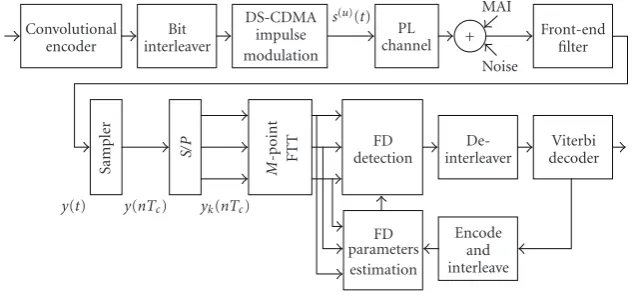
Figure1: Impulse-modulated PL system with frequency-domain receiver processing and iterative decoding.
A key point in the proposed approach is that the sym-bol energy is spread over a wideband which makes the sys-tem robust to narrowband interference and capable of ex-ploiting the channel frequency diversity. Furthermore, this modulation approach is simple at the transmitter side and re-quires a baseline correlation receiver that filters the received signal with a template waveform [2,7]. The template wave-form has to be matched to the equivalent impulse response that comprises the desired user’s waveform and the chan-nel impulse response. To achieve high performance, this re-ceiver requires accurate estimation of the channel which can be complex if performed in the time domain [13,14] because of the large time dispersion that is introduced by the wide-band frequency-selective PL channel. Further, the channel-frequency selectivity introduces intercode interference (ICI) (interference among the codes that are assigned to the same user) and multiple-access interference (MAI) when multiple users access the network. This translates into performance losses and suggests some form of multiuser detection or in-terference cancellation. Therefore, in this paper we focus on the receiver side and we propose a novel frequency-domain (FD) detection approach which allows to obtain high per-formance and to keep the complexity at moderate levels. FD receivers have recently attracted considerable attention both for equalization in single carrier systems [15] and in multi-carrier (OFDM) systems [16,17]. We have investigated FD processing in a UWB wireless system in [10], and described preliminary results for the power line scenario in [11,12]. The contribution of the present paper is about the derivation of a maximum likelihood joint detector that operates in the frequency domain in the presence of MAI and impulse noise (Section 3). The detection metric used in this receiver is con-ditional on the knowledge of the channel of the desired user and on the knowledge of the occurrence of the impulse noise. From this receiver, with certain approximations, we de-scribe inSection 4several novel FD algorithms, in particular, a simplified FD joint detector, an FD iterative detector, and an FD interference decorrelator. They all include the capabil-ity of adapting to impulse noise and rejecting the ICI/MAI, but have different levels of performance and complexity.
We focus on the practical estimation of the parameters that are needed in the detection algorithms (Section 5). In particular, we address the FD channel estimation problem, the estimation of the correlation of the noise and the inter-ference, and the estimation of the impulse noise occurrence. Frequency-domain channel estimation for the desired user is done with a recursive least-squares (RLS) algorithm [18]. Further, channel coding is also considered and it is based on bit-interleaved convolutional codes. In this case, we show that iterative processing [19] with simple hard feedback from the decoder allows to run the parameter estimators in a data decision-driven mode which betters the overall receiver per-formance.
Finally, we describe inSection 6the key features of a PL impulse-modulated modem that has been used to assess per-formance and whose hardware prototype is described in [4]. To this respect, we propose the use of a wideband statisti-cal channel model that allows to evaluate the system perfor-mance by capturing the ensemble of indoor PL grid topolo-gies.
2. WIDEBAND SYSTEM MODEL
We consider a system where a number of nodes (users) com-municate sharing the same PL network. Communication is from one node to another, such that if other nodes simul-taneously access the medium, they are seen as potential in-terferers. The transmission scheme (Figure 1) uses wideband impulse modulation combined with DS data spreading [11]. Users’ multiplexing is obtained in a CDMA fashion allocat-ing the spreadallocat-ing codes among the users.
The signal transmitted by userucan be written as
s(u)(t)= k
i∈Cu
bk(u,i)g(u,i)
t−kTf
, (1)
whereg(u,i)(t) is the waveform (signature code) used to con-vey theith information symbolb(ku,i)of useruthat is
c(0u,i) · · · c(L−u,i1)
Tg T
Tf
Figure2: Frame format for useruand codei.
carries log2MS information bits where MS is the number
of PAM levels, for example, with 2-PAMb(ku,i)has alphabet {−1, 1}.Tf is the symbol period (frame duration) as shown
inFigure 2.Cudenotes the set of code indices that are
allo-cated to useru. Thus, userucan adapt its rate by transmitting |Cu| =size{Cu}information symbols per frame.
The signature code (Figure 2) comprises the weighted repetition ofL≥1 narrow pulses (monocycles):
g(u,i)(t)= L−1
m=0
c(u,i)
m gM(t−mT), (2)
wherec(mu,i)∈ {−1, 1}are the codeword elements (chips), and
Tis the chip period. The monocyclegM(t) can be
appropri-ately designed to shape the spectrum occupied by the trans-mission system. In this paper we consider the second deriva-tive of the Gaussian pulse (Figure 3(a)). An interesting prop-erty is that its spectrum does not occupy the low frequencies where we experience higher levels of man-made background noise (Figure 3(b)). Further, the symbol energy is spread over a wideband which makes the system robust to narrowband interference and capable of exploiting the channel frequency diversity. Since the attenuation in PL channels increases with frequency, we limit the transmission bandwidth to about 50 MHz using a pulse withD = 126 nanoseconds. In typi-cal system design, we choose the chip periodT ≥Dand we further insert a guard timeTg between frames to cope with
the channel time dispersion (Figure 2). The frame duration has, therefore, durationTf =LT+Tg.
2.1. User multiplexing
Users are multiplexed by assigning distinct codes to distinct users. In our design, the codes are defined as follows:
c(mu,i)=c (u) 1,mc
(i)
2,m, m=0,. . .,L−1,i=0,. . .,L−1, (3)
where {c(1,um)} is a binary (±1) pseudorandom sequence of
lengthL allocated to useru, while{c(2,i)m}is theith binary
(±1) Walsh Hadamard sequence of lengthL[18]. With this choice, each node can use all LWalsh codes, which yields a peak data rate per user equal toR = L/Tfsymb/s. It
ap-proaches log2MS/Tbit/s with long codes. While the signals
of a given user are orthogonal, the ones that belong to dis-tinct transmitting nodes are not. The random code{c(1,um)}is
used to introduce code diversity and to randomize the effect of the MAI.
2.2. Channel coding
We consider the use of bit-interleaved convolutional codes (Figure 1) [18]. A block of information bits is coded, inter-leaved, and then modulated. Interleaving spans a packet of
N frames that we refer to as superframe. This coding ap-proach yields good performance also in the presence of im-pulse noise as it will be shown in the following.
2.3. Received signal
The signals that are transmitted by distinct nodes (users) propagate through distinct channels with impulse response
h(u)(t). At the receiver of the desired node, we deploy a band-pass front-end filter with impulse responsegFE(t)=gM(−t)
that is matched to the transmit monocycle and that sup-presses out-of-band noise and interference. Then, the output signal in the presence ofNIother users (interferers) reads
y(t)=
k
i∈C0
b(0,k i)gEQ(0,i)
t−kTf
+I(t) +η(t)
I(t)=
k NI
u=1
i∈Cu
b(ku,i)gEQ(u,i)
t−kTf −Δu
,
(4)
where the equivalent impulse response for useruand sym-bol i (equivalent signature code) is denoted as gEQ(u,i)(t) =
g(u,i)∗h(u)∗g
FE(t). It comprises the convolution of the signa-ture code of indices (u,i) with the channel impulse response of the corresponding user, and the front-end filter. The in-dexu=0 denotes the desired user.Δudenotes the time de-lay of useruwith respect to the desired user’s frame timing.
I(t) is the MAI term, whileη(t) denotes the additive noise. The users experience distinct channels that introduce identi-cal maximum time dispersion.
2.4. Noise models
0 30 60 90 120 t(ns)
−0.5 0 0.5 1
g
(
t
)
(a)
0 10 20 30 40 50
f(MHz) −50
−40 −30 −20 −10 0
|
G
(
f
)
|
(d
B
)
(b)
Figure3: (a) Monocycle impulse response,gM(t)∼(1−π((t−D/2)/T0)2) exp(−π/2((t−D/2)/T0)2), whereD≈5.23T0is the monocycle
duration. (b) Monocycle frequency response.
(seeSection 3), the receiver adapts to the impulse noise oc-currence and treats it as a nonstationary colored Gaussian process. To do so, as it will be explained, we need to estimate the impulse noise occurrence and its locally stationary corre-lation.
2.5. Statistical channel model
The frequency-selective PL channel is often modelled accord-ing to [8], that is, we synthesize the bandpass frequency re-sponse withNPmultipaths as
H+(f)= NP
p=1
gpe−j(2πdp/v)fe−(α0+α1f
K)dp
, 0≤B1≤f ≤B2,
(5)
where|gp| ≤1 is the transmission/reflection factor for path
p,dpis the length of the path,v=c/√εrwithcspeed of light,
andεr, dielectric constant. The parametersα0,α1,Kare cho-sen to adapt the model to a specific network. To assess the system performance, we may use this model once the refer-ence parameters are chosen. Instead, we propose to evaluate performance with a statistical model that allows to capture the ensemble of PL grid topologies. It is obtained by consid-ering the parameters in (5) as random variables. Then, we generate channel realizations through realization of the ran-dom parameters. We assume the reflectors (that generate the paths) to be placed over a finite distance interval. We fix the first reflector at distanced1and we assume the other reflec-tors to be located according to a Poisson arrival process with intensityΛ[m−1]. The reflection factorsg
p are assumed to
be real, independent, and uniformly distributed in [−1, 1]. Finally, we appropriately chooseα0,α1,K to a fixed value. If we further assumeK = 1, the real impulse response can be obtained in closed form. This allows to easily generate a realization for useru(corresponding to a realization of the
random parametersNP,gp,dp) as follows:
h(u)(t)=2 Re
NP
p=1
gpe−α0d p
α1dp+j2π
t−dp/v
α1dp
2
+ 4π2t−d p/v
2
×ej2πB1(t−dp/v)−α1B1dp
−ej2πB2(t−dp/v)−α1B2dp
.
(6)
We assume distinct users to experience independent chan-nels, that is, the random parameters are independent for the channels of distinct users, which is appropriate in indoor PL channels due to the large number of path components. The impulse responses are assumed to be constant for a given amount of time and they change for a new (randomly picked) topology.
3. DETECTION ALGORITHMS FOR THE
IMPULSE-MODULATED SYSTEM
In this section, we derive several detection algorithms that operate in the frequency domain (FD). Their performance is compared with the baseline correlation receiver as reported inSection 6.
3.1. Baseline receiver
The baseline receiver for the impulse-modulated system is the correlation receiver. Assuming binary data symbols, it computes the correlation between the received signal y(t) and the real equivalent impulse responsegEQ(0,i)(t). Thus, we obtain the decision metricz(0,DMi)(kTf)=Ry(t)gEQ(0,i)(t−kTf)dt
for the ith symbol that is transmitted by user 0 in the
bk(0,i) = sign{z (0,i)
DM(kTf)}. This baseline correlation receiver
is optimal when the background noise is white Gaussian and there is perfect orthogonality among the received signature codes [2]. To implement the correlation receiver, we need to estimate the channel. Time-domain channel estimation [3,13,14] is complicated due to the large time dispersion of the PL channel that implies thatgEQ(0,i)(t) is an involved func-tion of the channel and the transmitted waveform. Further-more, the correlation receiver suffers from the presence of intercode interference (ICI) and multiple-access interference (MAI) that is generated by the dispersive PL channel in the presence of multiple users.
3.2. Maximum likelihood frequency-domain receiver
To improve the performance of the baseline receiver, we pro-pose an FD signal processing approach. To derive the receiver algorithms, we treat the noise as the sum of two Gaussian dis-tributed processes. Similarly, the receiver treats the MAI as Gaussian. Therefore, the overall impairment process is mod-eled by the receiver as
z(t)=η(t) +I(t)=wT(t) +α(t)wIM(t) +I(t), (7)
wherewT(t) is the thermal noise,wIM(t) is the impulse noise, andI(t) is the MAI. The multiplicative processα(t) accounts for the presence or absence of impulse noise. That is, at time instant t, the random variable α(t) is a Bernoulli random variable with parameterpand alphabet{0, 1}. We refer to it as Bernoulli process. All processes are treated as independent zero-mean Gaussian, not necessarily stationary, with corre-lation, respectively, as
κT
τ1,τ2
=EwT
τ1 wT τ2 , κIM τ1,τ2
=EwIM
τ1 wIM τ2 , κI τ1,τ2
=EIτ1
Iτ2
.
(8)
Conditional on the Bernoulli process, the impairment is a Gaussian process with correlation
κz|α
τ1,τ2|α(t), t∈R
=κW
τ1,τ2
+ατ1
ατ2
κIM
τ1,τ2
+κI
τ1,τ2
.
(9)
The Gaussian approximation for the MAI improves as the number of interferers increases. The model used for the overall noise contribution allows to capture both stationary and nonstationary components of it. Further, it allows to de-scribe impulse spikes of certain duration, power decay pro-file, and colored spectral components.
To proceed, we assume discrete-time processing (Figure 1) such that the received signal is sampled with periodTc =
Tf/M, whereMis the number of samples/frame, to obtain
ynTc
=
k
i∈C0
b(0,k i)g (0,i) EQ
nTc−kTf
+znTc
. (10)
If we acquire frame synchronization with the desired user and we assume that the guard time is sufficiently long not to have interframe interference, that is, interference among the symbols of adjacent frames, we can write
yk
nTc
=
i∈C0
b(0,k i)g (0,i) EQ
nTc−kTf
,
+zk
nTc
n=0,. . .,M−1,
(11)
withyk(nTc)=y(kMTc+nTc), andzk(nTc)=z(kMTc+nTc),
k∈Z.
Under the colored Gaussian impairment model in (7), and under the knowledge of both the channel and the Bernoulli process α(t) (meaning that we assume to know when the impulse noise occurs), the maximum likelihood receiver searches for the sequence of transmitted symbols b(0)={b(0,i)
k ,k∈Z,i∈C0}(belonging to the desired user) that maximizes the logarithm of the probability density function of the received signaly = {. . .,y(0),y(Tc),. . .}conditional
on a given hypothetical transmitted symbol sequence, that is, logp(y |b(0)), [18,25]. It follows that we have to search for the symbol sequence that minimizes the following log-likelihood function1
Λb(0)
= ∞ l=−∞ ∞ m=−∞
ylTc
−
k
i∈C0
b(0,k i)g (0,i) EQ
lTc−kTf
×K−1lTc,mTc
×
ymTc
−
k
i∈C0
bk(0,i)g (0,i) EQ
mTc−kTf
,
(12)
whereK−1(lT
c,mTc) is the element of indices (l,m) of the
matrixK−1, that is, the inverse of the correlation matrix of the impairment vectorz=[. . .,z(0),z(Tc),. . .],
K=EzzT. (13)
The elements ofKare obtained by sampling (9) in the ap-propriate time instants, that is,
K(lTc,mTc)=κz|α(lTc,mTc|α(t), t∈R). (14)
As an example, if we suppose the absence of MAI, the diag-onal elements ofKrepresent the power of the thermal plus impulse noise, and they are typically large in the presence of impulse noise.
The likelihood (12) can be written as the scalar product
Λ(b(0)) = e†K−1e = e,K−1eif we define the vector e = [. . .,e(0),e(Tc),. . .]T, withe(lTc)=y(lTc)−
k
i∈C0b
(0,i)
k ×
gEQ(0,i)(lTc −kTf). Since the scalar product is irrelevant to
an orthonormal transform (Parseval theorem), we have that
Λ(b(0))= Fe,FK−1ewithFbeing the block diagonal or-thonormal matrix that has blocks all identical to theM-point discrete Fourier transform (DFT) matrix F. If we assume the guard time to be sufficiently long such that gEQ(0,i)(nTc)
has support in [0,MTc), the vector E = Fe can be
par-titioned into nonoverlapping blocks equal to Ek = Yk −
i∈C0b
(0,i)
k G
(0,i) EQ, where
Yk=
Yk
f0
,. . .,Yk
fM−1
T
=DFTyk
,
G(0,EQi)=
G(0,EQi)
f0
,. . .,G(0,EQi)
fM−1
T
=DFTg(0,EQi)
(15)
are theM-element vectors that are obtained by computing theM-point DFT at frequencyfn=n/(MTc),n=0,. . .,M−
1, of the kth vector of samples yk = [yk(0),. . .,yk((M −
1)Tc)]T, and of the ith equivalent signature code g(0,EQi) = [gEQ(0,i)(0),. . .,g
(0,i)
EQ ((M−1)Tc)]T.
It follows that
Λb(0)=E,FK −1F†E=E,R−1E, (16)
where we have used the identityF−1=F†, and
FKF†=EFzzTF†=EZZ†=R. (17)
Therefore, from (16), if we denote withR−1
k,mtheM×M
block of indices (k,m) ofR−1, the FD maximum likelihood receiver searches for the sequence of data symbolsb(0) (be-longing to the desired user) that minimizes the log-likelihood function
Λb(0)=
∞ k=−∞ ∞ m=−∞
Yk−
i∈C0
b(0,k i)G(0,EQi)
†
×R−k,1m
Ym−
n∈C0
b(0,n)
m G
(0,n) EQ
.
(18)
Remarks 1. To compute the metric (18), we need to compute the DFT of each received frame (efficiently, via fast Fourier transform, FFT), and to estimate the channel frequency re-sponse, the impulse noise occurrence, and the correlation matrix of the impairment. This is treated inSection 5.
In (18), detection is jointly performed for the desired user’s symbols, while all signals belonging to the other nodes are treated as interference whose FD correlation is included in the matrixRtogether with the correlation of the noise.
The metric can be easily extended to include a time-variant channel. The case, for instance, of a fast time-time-variant channel that is static only for a duration of frame can be cap-tured in the metric (18) by changingG(0,EQi)intoG(0,EQ,i)k, that is, the frequency response of the channel for thekth frame.
The metric (18) provides a soft metric for the Viterbi channel decoder when convolutional codes are used. In the presence of impulse, noise some terms of (18) have negli-gible weight which corresponds to neglecting (puncturing) some of the trellis sections.
The DFT of the kth frame can be written as Yk =
i∈C0b
(0,i)
k G
(0,i)
EQ +Zk. The impairment multivariate process Zk =[Zk(f0),. . .,Zk(fM−1)]T hastime-frequencycorrelation
matrix equal to
Rk,m=E
ZkZ†m
=FKk,mF†, (19)
where Kk,m is theM ×M matrix with entriesκz|α((kM+
n)Tc, (mM+l)Tc) forn,l=0,. . .,M−1, andFis theM-point
DFT orthonormal matrix. In (18),R−1
k,mdenotes theM×M
block of indices (k,m) ofR−1, whereR−1is the inverse of the matrixRwhoseM×Mblock of indices (k,m) isRk,m. IfR
is block diagonal, for example, when we neglect the impair-ment correlation across frames,R−1
k,kis equal to the inverse of
thekth block, that is, equal to (Rk,k)−1. As an example, if we
consider independent noise samples, when the impulse noise hits a frame,Rk,k has diagonal elements that go to infinity.
Then, (Rk,k)−1has diagonal elements that go to zero.
Conse-quently, the corresponding additive terms in the metric (18) have zero weight.
4. SIMPLIFIED FD DETECTION ALGORITHMS
4.1. Simplified FD joint detector
To simplify the algorithm complexity, we neglect the tempo-ral correlation of the impairment (MAI + noise) vectorZk,
that is, we assumeRk,m =0 fork =m, and we denoteRk,k
withRk=E[ZkZ†k]. Then, by dropping the terms that do not
depend on the information symbolsb(0)k = {bk(0,i), i ∈C0} that are transmitted in thekth frame by the desired user, the log-likelihood function simplifies to
Λb(0)k
∼−Re
i∈C0
b(0,k i)G (0,i) EQ
†
R−k1
Yk−1
2
n∈C0
bk(0,n)G (0,n) EQ
.
(20)
We then make a decision on the transmitted symbols of framekand useru=0, as follows:
b(0)k =arg minb(0)
k
Λb(0)k . (21)
4.2. Iterative FD joint detector
The complexity of thesimplified FD joint detectoris still high because it increases exponentially with the number of sym-bols that are simultaneously transmitted by the desired user in a frame (equal to the number of assigned spreading codes). A possible way to simplify complexity is to search for the maximum of the metric in an iterative fashion. That is, we first detect symbolb(0,0)k by setting to zero all other symbols in Λ(b(0)k ). Then, we detect symbolbk(0,1)by settingbk(0,0)=b(0,0)k
inΛ(b(0)k ). We detect new symbols using past decisions. Once all symbols are detected, we can rerun an iterative detection pass. This algorithm is similar in spirit to interference cancel-lation in CDMA systems [26] but it operates in the frequency domain.
4.3. FD full decorrelator
Another possibility is to perform detection of the symbols that belong to the desired node in a symbol-by-symbol fash-ion. That is, when we detect one symbol, we treat as inter-ference both the signals of other users and the signals of the desired user that are associated to the other codes. Thus, the decision metric for theith symbol of user 0 and framek, can be derived similarly to (18) and (20), and it corresponds to
Λb(0,k i)
∼−Re
bk(0,i)G
(0,i) EQ
†
R(0,k i)−1
Yk−1
2b (0,i)
k G
(0,i) EQ
,
(22)
where R(0,k i) is the correlation matrix of the impairment (MAI + ICI + noise + other codes) that is seen by the sym-bol associated to theith signature code of framek:
Rk(0,i)=EE(0,k i)Ek(0,i)†, E(0,k i)=Zk+
c∈C0
c=i
b(0,k c)G (0,c) EQ . (23)
This algorithm requires a matrix inversion for each code. When all codes are assigned, its complexity is lower than the FD joint detector when the channel and interference remain static for a long time, such that the inverse matrices can be computed once. A way to reduce further its complexity is to use a rank reduction approach, that is, we process only the frequency bins that exhibit sufficiently high energy. Finally, this algorithm becomes identical to the joint detector algo-rithm if the desired user deploys a single code.
5. PRACTICAL IMPLEMENTATION ALGORITHMS
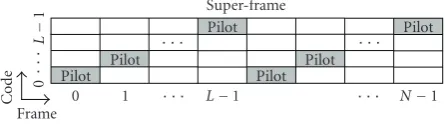
The practical implementation of the above algorithms re-quires to estimate the frequency response of the desired user channel and the impairment correlation matrix. In this paper we propose to use a pilot channel (a Walsh code) as shown in
Figure 4. We assume, instead, perfect frame synchronization with the desired user whose practical implementation is dis-cussed in [27].
Assuming packet transmission of duration N frames, (super-frame), the pilot channel spansNframes, that is, it
Frame
Co
d
e
0 1 · · · L−1 · · · N−1
0
··
·L
−
1
Pilot Pilot
· · · Pilot
Pilot
· · · Pilot
Pilot Super-frame
Figure4: Super-frame format with pilot channel.
corresponds to a training sequence of lengthNsymbols that we assume to have{−1, 1}alphabet.
In order to better sound the channel, we propose to change the assigned Walsh code (pilot code) at each new frame (Figure 4). If we assume full-rate transmission, that is, a user is allocated to allL−1 Walsh codes, channel sounding is done in a cyclic manner as follows. The pilot channel uses the Walsh code 0 in the first frame of the super-frame, while the remainingL−1 codes are used for data transmission. Then, it uses code 1 in the second frame, and so on in a cyclic manner asFigure 4shows. Distinct users deploy distinct pilot codes.
To improve the performance of the estimators, we con-sider the use of an iterative approach where we first take into account only the knowledge of the pilot symbols. Then, after detection/channel decoding, we rerun an estimation pass by exploiting the knowledge of all detected symbols.
We assume the user channel and the MAI vector to be stationary over the transmission of a super-frame. This holds true, for instance, assuming users with identical frame dura-tion and spreading code length. However, we point out that during the detection stage the algorithms that we describe al-low to perform adaptation to channel and MAI variations in a data decision-directed mode.
While the background noise is stationary, the impulse noise is in general not stationary such that the estimation of its correlation is not feasible. To solve this problem, we assume that conditional on its occurrence, the overall noise is locally stationary. This means that the correlation of the impulse noise can be estimated by averaging over the time windows where it is present. Clearly, the first thing to do is to locate the impulse noise.
5.1. Locating the impulse noise
To simplify the task, the estimation of the impulse noise oc-currence is done on a frame-by-frame basis by making a comparison between the average received signal energy com-puted over a super-frame ESF =
N−1
k=0 Y†kYk/N/M, and the
energy computed over a frameEF(k)=Y†kYk/M.
To simplify further the algorithms, in the Viterbi de-coding stage, we disregard the frames of indexk for which
Finally, the adaptive estimations of the channel and the MAI-plus-background-noise correlation matrix are done ne-glecting the frames that are hit by impulse noise.
5.2. FD channel estimation
We implement FD channel estimation independently over the DFT output subchannels (frequency bins) using a one-tap recursive least-square (RLS) algorithm [18]. We approximate the equivalent channel frequency response for theith code of the desired user (user 0) as follows:
G(0,EQi)
fn
≈W(0,i)fn H
fn
, i=0,. . .,L−1,n=0,. . ., M−1, (24)
whereW(0,i)(f
n) denotes theM-point DFT (at frequencyfn)
of the pilot signature code that comprises the front-end filter. The channel estimateH(fn) is obtained via a one-tap RLS
al-gorithm that uses the following error signal for thekth frame:
ek
fn
=Yk
fn
−Hk−1
fn
W(0, mod (k,L))f n
bTR,k, (25)
wherebTR,k,k = 0,. . .,N−1, is the known training
sym-bol that is transmitted in thekth frame by the desired user,
Hk(fn) is the channel estimate for the kth iteration, and
mod(·,·) denotes the remainder of the integer division (re-call that the Walsh code that is associated to the pilot channel is cyclically updated frame after frame).
5.3. FD estimation of the MAI-plus-noise correlation matrix
Once we have obtained an estimate of the equivalent signa-ture code frequency responseG(0,EQi), the MAI-plus-noise cor-relation matrix that is required in algorithm (20) can be es-timated via time-averaging the error vector that is defined as
Ek=Yk−bTR,kG(0, mod (EQ k,L)):
R= 1
N
N−1
k=0
EkE†k. (26)
To introduce a tradeoffbetween the effects of noise and the effects of the MAI, we can perform diagonal loading of the estimated correlation matrix which also assures that the cor-relation matrix is full rank.
5.4. FD estimation of the ICI correlation matrix
Under the assumption of independent zero-mean symbols, and MAI uncorrelated from the desired user signal, the cor-relation of the interference that is seen by theith signature code of the desired user can be written as
R(0,i)=R+R(0,ICIi); (27)
that is, as the sum of the correlation matrix of the MAI-plus-noise and the correlation matrix of the ICI experienced by
theith code of the desired user. After channel estimation, we can obtain an estimate of the ICI correlation matrix (assum-ing unit power data symbols) as follows:
R(0,ICIi)=
c∈C0,c=i
G(0,EQc)G(0,EQc)†. (28)
5.5. Data-aided iterative estimation with feedback from the channel decoder
The estimators can be improved by using a data decision-aided approach. That is, we can iteratively refine the estima-tion as data decisions are made. This turns out to be eff ec-tive when the desired user transmits at high rate, and con-sequently the ICI is high. At the first pass, we estimate the channel and the correlation matrix assuming knowledge of only the pilot symbols. Then, in a second pass, we rerun es-timation of the channel and the correlation matrix using the data decisions made at the first pass. In particular, if we as-sume to have detected all symbols in a super-frame of length
N frames, we can rerun RLS channel estimation using the following error signal:
ek
fn
=Yk
fn
−Hk−1
fn
c∈C0
W(0,c)f
nb(0,k c), (29)
where{b(0,k c), c∈ C0}are all detected symbols plus the pi-lot symbol that is transmitted in thekth frame by the desired user. To re-estimate the correlation matrix of the MAI-plus-noise, we can implement (26) using the following error vec-tor:
Ek=Yk−
c∈C0
b(0,k c)G
(0,c)
EQ , (30)
whereG(0,EQc)are the new channel estimates. Similarly, we can re-estimate the correlation matrix of the ICI-plus-noise ac-cording to (28) using, however, the new channel estimates.
The data decisions that are used in the above algorithms can be provided by the detector, or by the channel decoder. In the latter case, we just need to use a standard soft-input hard-output Viterbi decoder followed by re-encoding and in-terleaving, asFigure 1shows. Further, to minimize the corre-lation with previous estimates, we can partition the super-frame into two parts so that we can obtain two estimates for the channel and the correlation matrix. The former estimates that are used for data detection in the first half of the super-frame are obtained running training with data decisions be-longing to the second half of the super-frame, and vice versa.
6. PERFORMANCE RESULTS
6.1. System parameters
The performance of the system is assessed via simulations. We assume a frame durationTf =4.096 microseconds and
0 1 2 3 4 t(μs)
−1 −0.5 0 0.5 1
h
(
t
)
(a) Realization of channel response
0 1 2 3 4
t(μs) −1
−0.5 0 0.5 1
gEQ
(
t
)
(b) Realization of equivalent response
Figure5: Examples of statistical channel realization (a) and equivalent impulse response (b).
Tg =2.048 microseconds. The monocycle (at the transmitter
and receiver front-end) and the channel are simulated with a sampling period of 2 nanoseconds (63 samples per mono-cycle). Then, the front-end filter output signal is downsam-pled to obtain a period Tc=16 nanoseconds. Thus, we
col-lectM =256 samples per frame and we use an FFT of size 256. The spreading codes have lengthL = 16 with a chip period T = 128 nanoseconds. The codes are obtained by the chip-by-chip product of the 16 Walsh-Hadamard codes and a random code for each user to be multiplexed. One code is reserved for training. We consider binary data sym-bols. Furthermore, a bit-interleaved convolutional code of rate 1/2 and memory 4 is used. The transmission rate can be adjusted according to the number of signature codes that are allocated to each user. The super-frame spansN = 540 frames (2.21 milliseconds). Consequently, the coded packet has length from a minimum of 540 bits with single code, to a maximum of 8100 coded bits with fulls-rate transmission (15 codes). A block interleaver that spans 540 frames is used. With these parameters, the uncoded transmission rate ranges from 244 kbit/s to 3.66 Mbit/s, while the net rate with coding is half of that. Clearly, it can be increased with higher level PAM or longer spreading codes, but we have made this choice to keep the simulation runtime within tolerable values.
6.2. Channel parameters
Starting from the channel model inSection 2.3, we setB1=0 andB2 =55 MHz. Having in mind an indoor environment where the number of paths is typically high, we fix for the underlying Poisson process an intensityΛ=1/15 m−1, that is, one reflector every 15 m in average. The first one is set at distance 30 m withg1 =1, while the maximum path dis-tance is 300 m. Finally, we chooseK = 1,α0 = 10−5m−1,
α1=10−9s/m. InFigure 5(a), we plot an example of channel
realization while inFigure 5(b)we plot the equivalent chan-nel responsegEQ(t)=gM∗h(u)∗gFE(t). The equivalent re-sponse is significantly compressed because the monocycle fil-ters out the low-frequency components that are responsible for longer channel delays according to model (5). The chan-nel is assumed to be static for the duration of a super-frame equal to 2.21 milliseconds, and then it randomly changes. In the simulations we truncate the channel impulse responses to 4 microseconds. However, we use a guard time of only 2.048 microseconds. The performance degradation that is due to the interframe interference that is generated by the tail of the channel is negligible.
6.3. Full-rate single-user performance
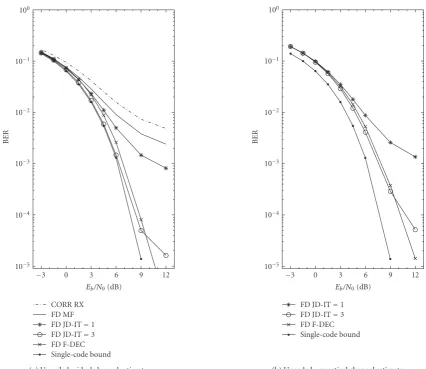
InFigure 6, we report the bit-error-rate (BER) performance before channel decoding averaged over at least 1500 PL grid topologies (channel realizations) as a function ofEb/N0, that is, the energy per bit at the front-end output, over the noise spectral density. The additive background noise is white Gaussian. We point out that we normalize the channel such that the received bit energy is constant for all channel real-izations. This choice removes the fading effect which is ap-propriate in the PL context differently, for instance, from the mobile wireless context [18]. A single full-rate user that de-ploys all available 16 Walsh codes is present.
−3 0 3 6 9 12
Eb/N0(dB) 10−5
10−4 10−3 10−2 10−1 100
BER
CORR RX FD MF FD JD-IT=1 FD JD-IT=3 FD F-DEC Single-code bound
(a) Uncoded—ideal channel estimate
−3 0 3 6 9 12
Eb/N0(dB) 10−5
10−4 10−3 10−2 10−1 100
BER
FD JD-IT=1 FD JD-IT=3 FD F-DEC Single-code bound
(b) Uncoded—practical channel estimate
Figure6: Average BER with one full-rate user without channel coding in AWGN.
the monocycle) colors the noise, the FD MF detector that takes it into account improves performance compared to the correlation receiver. However, the severely dispersive channel introduces intercode interference, thus an error floor is vis-ible. If we use the FD full decorrelator, we get a significant performance gain. Here, to simplify complexity, we actu-ally combine only the frequency bins that have energy above 1% of the maximum. Near ideal performance (single-code performance bound) is achieved with the FD iterative detec-tor with only 3 iterations forEb/Nobelow 9 dB.
Figure 6(b)shows that with practical channel estimation (with the method inSection 5.2), the BER performance is within 1.5 dB from the ideal curves.
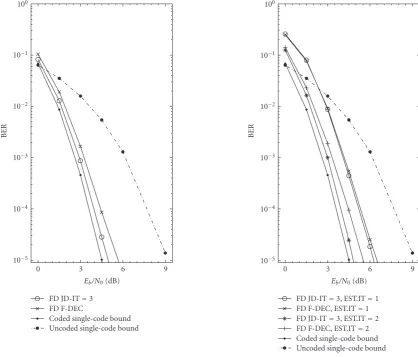
InFigure 7(a), we report BER at the output of the soft-input Viterbi decoder assuming ideal channel estimation, while in Figure 7(b) we assume practical channel estima-tion. With channel coding, the performance is improved. The curves with practical channel estimation are very close to the ideal curves. Here, curves labeled with EST.IT = 2 assume two channel estimation passes using hard feedback from the decoder (as explained inSection 5.5). With 3 iterative
detec-tion passes, we are within 0.5 dB from the single-code bound that corresponds to single code transmission and ideal chan-nel estimation. The simplified F-DEC is within 0.5 dB from the iterative detector.
InFigure 8(a), we assume the presence of impulse noise and ideal channel estimation, while inFigure 8(b)we assume practical channel estimation. We report the BER both with channel coding (Cod) and without it (Uncod). In the simula-tion the impulse noise is generated according to the two-term Gaussian model [21,22] whose probability density function can be defined aspη(a)=(1−ε)N(0,σ12)+εN(0,σ22). The first term gives the zero-mean Gaussian background noise with varianceσ12. The second term represents the impulse compo-nent and it has varianceσ22=100σ12. The occurrence proba-bility isε=0.01. To stress the system performance, when an impulse occurs, we assume the Gaussian process with vari-anceσ2
0 3 6 9
Eb/N0(dB) 10−5
10−4 10−3 10−2 10−1 100
BER
FD JD-IT=3 FD F-DEC
Coded single-code bound Uncoded single-code bound
(a) Coded—ideal channel estimate
0 3 6 9
Eb/N0(dB) 10−5
10−4 10−3 10−2 10−1 100
BER
FD JD-IT=3, EST.IT=1 FD F-DEC, EST.IT=1 FD JD-IT=3, EST.IT=2 FD F-DEC, EST.IT=2 Coded single-code bound Uncoded single-code bound
(b) Coded—practical channel estimate
Figure7: Average BER with one full-rate user and with channel coding in AWGN.
not occupy the low frequencies. The position of the noise spikes within a super-frame is estimated. The results show that a performance degradation is introduced compared to the AWGN case. However, if we use the proposed modified Viterbi algorithm (curves labeled with Erasure), the perfor-mance comes close to that of the single code in AWGN. As
Figure 8(b) shows a second channel estimation pass with feedback from the decoder yields near-ideal performance.
6.4. Multiuser performance with full-rate users
Users multiplexing can be done by partitioning theLWalsh codes among the users. To stress the system, we have as-sumed all users to be at full rate, that is, they deploy all 16 Walsh-Hadamard codes. As explained in Section 2.1, a random code is also used on top of the Walsh codes. In
Figure 9(a), we assume the presence of one interferer with ideal channel/correlation estimation while inFigure 9(b)we assume the presence of three interferers with practical es-timation. The overall interferers power equals the desired
user power. The channels are independently drawn accord-ing to the statistical model, however, they are assumed to be static for the whole duration of a super-frame. The ad-ditive background noise is white Gaussian. Users are asyn-chronous with a random starting phase.Figure 9shows that although there is some performance penalty compared to single-code single-user case due to the MAI, the FD detec-tion algorithms allow to keep such a penalty small. This can be explained by the fact that the random codes and the multiple-access channel diversity introduce some de-grees of freedom that can be exploited in the frequency do-main by the interference cancellation algorithms. The itera-tive detector with 3 iterations performs better than the sim-plified full decorrelator forEb/Nosmaller than 9 dB. Then,
an error floor appears, though it may be reduced with fur-ther iterations. The simple bit-interleaved memory-4 convo-lutional code allows to significantly improve the BER perfor-mance.
0 3 6 9 12
Eb/N0(dB) 10−5
10−4 10−3 10−2 10−1 100
BER
Uncoded FD JD-IT=3 Cod FD JD-IT=3 Cod FD JD-IT=3, erasure Cod single-code AWGN bound
(a) Impulse noise—ideal channel estimate
0 3 6 9 12
Eb/N0(dB) 10−5
10−4 10−3 10−2 10−1 100
BER
Coded FD JD-IT=3, EST.IT=1 Cod FD JD-IT=3, EST.IT=1, erasure Cod FD JD-IT=3, EST.IT=2, erasure Cod single-code AWGN bound
(b) Impulse noise—practical channel estimate
Figure8: Average BER with one full-rate user and with impulse noise.
estimation pass (curves labeled with EST.IT =1). Here, we assume to first run detection and channel decoding without performing MAI cancellation. For the JD-IT scheme, we run 3 iterations. Then, for the curves labeled with EST.IT = 2 we rerun a second channel estimation pass followed by prac-tical estimation of the MAI correlation matrix using hard feedback from the convolutional decoder. Now, the practi-cal curves are within about 1 dB from the curves with ideal channel/correlation estimation.
7. CONCLUSIONS
In this paper, we have investigated the application of wide-band impulse modulation combined with CDMA for PL communications. This modulation approach requires a sim-ple baseband time-domain imsim-plementation of the transmit-ter and the receiver. A key aspect is that the energy of each information symbol is spread over a wideband (yielding a low-spectral density signal) contrary to narrowband or mul-ticarrier architectures that can be seen as a bank of narrow-band systems. This allows to exploit the channel frequency diversity and to be robust to narrowband interference.
Fur-ther, time diversity is exploited via the CDMA signature code together with the bit-interleaved convolutional code. This yields robustness to impulse noise.
Improved performance, relatively to the baseline corre-lation receiver, can be obtained with a maximum likelihood FD joint detector. This receiver adapts to channel time vari-ations and to asynchronous impulse noise, and mitigates the detrimental effect of the ICI and MAI that are generated by the time-dispersive channel and that are significant in full-rate transmission. With certain simplifications we have de-rived a simplified FD joint detector, an FD iterative detector, and an FD interference decorrelator. They all include the ca-pability of rejecting the ICI/MAI but have different levels of performance and implementation complexity. In particular, the FD full decorrelator receiver has the lowest complexity es-pecially when we process a subset of the available frequency bins.
0 3 6 9 12
Eb/N0(dB) 10−5
10−4 10−3 10−2 10−1 100
BER
Uncoded FD JD-IT=1 Uncod FD JD-IT=3 Uncod FD F-DEC Cod FD JD-IT=3 Cod FD F-DEC
Cod single-user\code bound
(a) 1 Interferer-ideal channel/correlation estimate
0 3 6 9 12
Eb/N0(dB) 10−5
10−4 10−3 10−2 10−1 100
BER
Coded FD JD-IT=3 EST.IT=1 Cod FD F-DEC EST.IT=1 Cod FD JD-IT=3 EST.IT=2 Cod FD F-DEC EST.IT=2 Cod single-user\code bound
(b) 3 Interferers-practical channel/correlation es-timate
Figure9: Average BER with (a) one and three full-rate interferers (b) (worst-case scenario). (a) Ideal channel/correlation estimation. (b) Practical estimation of the channel/correlation.
aided approach with hard feedback from the Viterbi decoder. Few iterations have proved to be effective.
REFERENCES
[1] E. Biglieri, “Coding and modulation for a horrible channel,”
IEEE Communications Magazine, vol. 41, no. 5, pp. 92–98, 2003.
[2] A. M. Tonello, R. Rinaldo, and L. Scarel, “Detection algorithms for wide band impulse modulation based systems over power line channels,” inProceedings of the 8th International Sympo-sium on Power-Line Communications and Its Applications (IS-PLC ’04), pp. 367–372, Zaragoza, Spain, March-April 2004. [3] A. M. Tonello, R. Rinaldo, and M. Bellin, “Synchronization
and channel estimation for wide band impulse modulation over power line channels,” inProceedings of the 8th Interna-tional Symposium on Power-Line Communications and Its Ap-plications (ISPLC ’04), pp. 206–211, Zaragoza, Spain, March-April 2004.
[4] G. Mathisen and A. M. Tonello, “Wirenet: an experimental system for in-house powerline communication,” in
Proceed-ings of International Symposium on Power-Line Communica-tions and Its ApplicaCommunica-tions (ISPLC ’06), pp. 137–142, Orlando, Fla, USA, March 2006.
[5] M. Z. Win and R. A. Scholtz, “Impulse radio: how it works,”
IEEE Communications Letters, vol. 2, no. 2, pp. 36–38, 1998. [6] G. Durisi and S. Benedetto, “Performance evaluation and
comparison of different modulation schemes for UWB multi-access systems,” inProceedings of IEEE International Conference on Communications (ICC ’03), vol. 3, pp. 2187–2191, Anchor-age, Alaska, USA, May 2003.
[7] J. D. Choi and W. E. Stark, “Performance of ultra-wideband communications with suboptimal receivers in multipath channels,”IEEE Journal on Selected Areas in Communications, vol. 20, no. 9, pp. 1754–1766, 2002.
[8] M. Zimmermann and K. Dostert, “A multipath model for the powerline channel,” IEEE Transactions on Communications, vol. 50, no. 4, pp. 553–559, 2002.
[10] A. M. Tonello and R. Rinaldo, “A time-frequency domain ap-proach to synchronization, channel estimation, and detection for DS-CDMA impulse-radio systems,”IEEE Transactions on Wireless Communications, vol. 4, no. 6, pp. 3018–3030, 2005. [11] A. M. Tonello, “An impulse modulation based PLC system
with frequency domain receiver processing,” inProceedings of the 9th International Symposium on Power-Line Communica-tions and Its ApplicaCommunica-tions (ISPLC ’05), pp. 241–245, Vancouver, Canada, April 2005.
[12] A. M. Tonello, “A wide band modem based on impulse mod-ulation and frequency domain signal processing for power-line communication,” inProceedings of the 49th Annual IEEE Global Telecommunications Conference (GLOBECOM ’06), San Francisco, Calif, USA, November-December 2006.
[13] M. Z. Win and R. A. Scholtz, “Characterization of ultra-wide bandwidth wireless indoor channels: a communication-theoretic view,”IEEE Journal on Selected Areas in Communica-tions, vol. 20, no. 9, pp. 1613–1627, 2002.
[14] V. Lottici, A. D’Andrea, and U. Mengali, “Channel estimation for ultra-wideband communications,”IEEE Journal on Selected Areas in Communications, vol. 20, no. 9, pp. 1638–1645, 2002. [15] M. V. Clark, “Adaptive frequency-domain equalization and di-versity combining for broadband wireless communications,”
IEEE Journal on Selected Areas in Communications, vol. 16, no. 8, pp. 1385–1395, 1998.
[16] J. A. C. Bingham, “Multicarrier modulation for data transmis-sion: an idea whose time has come,”IEEE Communications Magazine, vol. 28, no. 5, pp. 5–14, 1990.
[17] M. K. Lee, R. E. Newman, H. A. Latchman, S. Katar, and L. Yonge, “HomePlug 1.0 powerline communication LANs-protocol description and performance results,”International Journal of Communication Systems, vol. 16, no. 5, pp. 447–473, 2003.
[18] J. G. Proakis, Digital Communications, McGraw-Hill, New York, NY, USA, 3rd edition, 1995.
[19] C. Luschi, M. Sandell, P. Strauch, et al., “Advanced signal-processing algorithms for energy-efficient wireless communi-cations,”Proceedings of the IEEE, vol. 88, no. 10, pp. 1633– 1650, 2000.
[20] D. Middleton, “Statistical-physical models of electromagnetic interference,”IEEE Transactions on Electromagnetic Compati-bility, vol. 19, no. 3, pp. 106–127, 1977.
[21] R. S. Blum, Y. Zhang, B. M. Sadler, and R. J. Kozick, “On the approximation of correlated non-Gaussian noise pdfs using Gaussian mixture models,” inProceedings of the 1st Conference on the Applications of Heavy Tailed Distributions in Economics, Engineering, and Statistics, Washington, DC, USA, June 1999. [22] H. Dai and H. V. Poor, “Advanced signal processing for
power line communications,” IEEE Communications Maga-zine, vol. 41, no. 5, pp. 100–107, 2003.
[23] H. Nakagawa, D. Umehara, S. Denno, and Y. Morihiro, “A de-coding for low density parity check codes over impulse noise channels,” inProceedings of the 9th International Symposium on Power-Line Communications and Its Applications (ISPLC ’05), pp. 85–89, Vancouver, Canada, April 2005.
[24] R. Pighi, M. Franceschini, G. Ferrari, and R. Raheli, “Fun-damental performance limits for PLC systems impaired by impulse noise,” inProceedings of International Symposium on Power-Line Communications and Its Applications (ISPLC ’06), pp. 277–282, Orlando, Fla, USA, March 2006.
[25] G. Ungerboeck, “Adaptive maximum-likelihood receiver for carrier-modulated data-transmission systems,”IEEE Transac-tions on CommunicaTransac-tions, vol. 22, no. 5, pp. 624–636, 1974.
[26] R. M. Buehrer, A. Kaul, S. Striglis, and B. D. Woerner, “Analy-sis of DS-CDMA parallel interference cancellation with phase and timing errors,”IEEE Journal on Selected Areas in Commu-nications, vol. 14, no. 8, pp. 1522–1535, 1996.
[27] A. M. Tonello and F. Pecile, “Synchronization for multiuser wide band impulse modulation systems in power line chan-nels with unstationary noise,” inProceedings of International Symposium on Power-Line Communications and Its Applica-tions (ISPLC ’07), Pisa, Italy, March 2007.
Andrea M. Tonello received the Doctor of engineering degree in electronics (cum laude) in 1996, and the Doctor of research degree in electronics and telecommunica-tions in 2002, both from the University of Padova, Italy. On February 1997, he joined as a Member of Technical Staff, Bell Labs— Lucent Technologies, where he worked on the development of baseband algorithms for cellular handsets, first in Holmdel, NJ,