Linguistic Steganography Using Automatically Generated Paraphrases
Ching-Yun Chang University of Cambridge
Computer Laboratory
Stephen Clark University of Cambridge
Computer Laboratory
Abstract
This paper describes a method for checking the acceptability of paraphrases in context. We use the Google n-gram data and a CCG
parser to certify the paraphrasing grammati-cality and fluency. We collect a corpus of hu-man judgements to evaluate our system. The ultimate goal of our work is to integrate text paraphrasing into a Linguistic Steganography system, by using paraphrases to hide informa-tion in a cover text. We propose automati-cally generated paraphrases as a new and use-ful source of transformations for Linguistic Steganography, and show that our method for checking paraphrases is effective at maintain-ing a high level of imperceptibility, which is crucial for effective steganography.
1 Introduction
Steganography is concerned with hiding informa-tion in some cover medium, by manipulating prop-erties of the medium in such a way that the hidden information is not easily detectable by an observer (Fridrich, 2009). The covert communication is such that the very act of communication is to be kept se-cret from outside observers. A related area is Wa-termarking, in which modifications are made to a cover medium in order to identify it, for example for the purposes of copyright. Here the changes may be known to an observer, and the task is to make the changes in such a way that the watermark cannot easily be removed.
There is a large literature on image steganogra-phy and watermarking, in which images are mod-ified to encode a hidden message or watermark. Image stegosystems exploit the redundancy in an
image representation together with limitations of the human visual system. For example, a stan-dard image stegosystem uses the least-significant-bit (LSB) substitution technique. Since the difference between 11111111 and 11111110 in the value for red/green/blue intensity is likely to be undetectable by the human eye, the LSB can be used to hide infor-mation other than colour, without being perceptable by a human observer.1
A key question for any steganography system is the choice of cover medium. Given the ubiqui-tous nature of natural languages and electronic text, text is an obvious medium to consider. However, the literature on Linguistic Steganography, in which linguistic properties of a text are modified to hide information, is small compared with other media (Bergmair, 2007). The likely reason is that it is easier to make changes to images and other non-linguistic media which are undetectable by an ob-server. Language has the property that even small local changes to a text, e.g. replacing a word by a word with similar meaning, may result in text which is anomalous at the document level, or anomalous with respect to the state of the world. Hence find-ing lfind-inguistic transformations which can be applied reliably and often is a challenging problem for Lin-guistic Steganography.
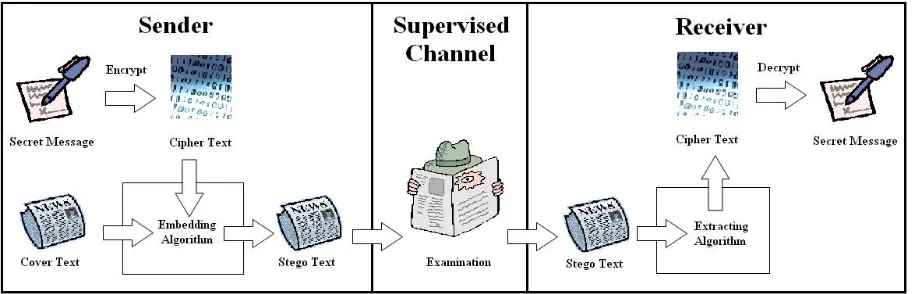
In this paper we focus on steganography rather than watermarking, since we are interested in the re-quirement that any changes to a text be impercep-tible to an observer. Figure 1 shows the Linguistic Steganography framework. First, some secret mes-sage, represented as a sequence of bits, is hidden in a
1
The observer may also be a computer program, designed to detect statistical anomalies in the image representation which may indicate the presence of hidden information.
Figure 1: The Linguistic Steganography framework
cover textusing the embedding algorithm, resulting in thestego text.2 Next, the stego text passes the hu-man observer, who is happy for innocuous messages to pass between the sender and receiver, but will ex-amine the text for any suspicious looking content. Once the stego text reaches the receiver, the hidden message is recovered using the extracting algorithm. There is a fundamental tradeoff in all steganogra-phy systems, and one that is especially apparent in the Linguistic Steganography framework: the trade-off betweenimperceptibility andpayload. Payload is the number of bits that can be encoded per unit of cover medium, for example per sentence in the linguistic case. The tradeoff arises because any at-tempt to hide additional information in the cover text, through the application of more linguistic trans-formations, is likely to increase the chances of rais-ing the suspicions of the observer, by introducrais-ing anomalies into the text.
The key elements of a Linguistic Steganography system are the linguistic transformation and the em-bedding method. In this paper we focus on the lin-guistic transformation. Section 5 describes a pos-sible embedding method for our framework, and for readers unfamiliar with linguistic steganography shows how linguistic transformations can be used to embed hidden bits in text.
Section 2 describes some of the previous transfor-mations used in Linguistic Steganography. Note that we are concerned with transformations which are
2
The message may have been encrypted initially also, as in the figure, but this is not important in this paper; the key point is that the hidden message is a sequence of bits.
linguistic in nature, rather than dealing with superfi-cial properties of the text, e.g. the amount of white space between words (Por et al., 2008). Our pro-posed method is based on the automatically acquired paraphrase dictionary described in Callison-Burch (2008), in which the application of paraphrases from the dictionary encodes secret bits. One advantage of the dictionary is that it has wide coverage, be-ing automatically extracted; however, a disadvan-tage is that it contains many paraphrases which are either inappropriate, or only appropriate in certain contexts. Since we require any changes to be im-perceptible to a human observer, it is crucial to our system that any uses of paraphrasing are grammati-cal and retain the meaning of the original cover text.
the sameCCGlexical categories by the parser. This
method increases the precision of the Google n-gram check with a slight loss in recall.
A contribution of this paper is to advertise the Lin-guistic Steganography problem to theACL
commu-nity. The requirement that any linguistic transfor-mation maintain the grammaticality and meaning of the cover text makes the problem a strong test for existingNLPtechnology.
2 Previous Work
2.1 Synonym Substitution
The simplest and most straightforward subliminal modification of text is to substitute selected words with their synonyms. The first lexical substitu-tion method was proposed by Chapman and Davida (1997). Later works, such as Atallah et al. (2001a), Bolshakov (2004), Taskiran et al. (2006) and Top-kara et al. (2006b), further made use of part-of-speech taggers and electronic dictionaries, such as WordNet and VerbNet, to increase the robustness of the method. Taskiran et al. (2006) attempt to use context by prioritizing the alternatives using an n-gram language model; that is, rather than randomly choose an option from the synonym set, the system relies on the language model to select the synonym. Topkara et al. (2005) and Topkara et al. (2006b) re-port an average embedding capacity of 0.67 bits per sentence for the synonym substitution method.
2.2 Syntactic Transformations
The second and the most widely used manipulations for linguistic steganography are syntactic transfor-mations. This method is based on the fact that a sen-tence can be transformed into more than one seman-tically equivalent syntactic structure, using trans-formations such as passivization, topicalization and clefting. The first syntactic transformation method is presented by Atallah et al. (2001a). Later, Atallah et al. (2001b) embedded information in the tree struc-ture of the text by adjusting the structural proper-ties of intermediate representations of sentences. In other words, instead of performing lexical substitu-tion directly to the text, the secret message is embed-ded into syntactic parse trees of the sentences. Liu et al. (2005), Meral et al. (2007), Murphy (2001), Murphy and Vogel (2007) and Topkara et al. (2006a)
all belong to the syntactic transformation category. After embedding the secret message, modified deep structure forms are converted into the surface struc-ture format via language generation tools. Atallah et al. (2001b) and Topkara et al. (2006a) attained the embedding capacity of 0.5 bits per sentence with the syntactic transformation method.
2.3 Semantic Transformations
The semantic transformation method is the most so-phisticated approach for linguistic steganography, and perhaps impractical given the current state-of-the-art forNLPtechnology. It requires some sophis-ticated tools and knowledge to model natural lan-guage semantics. Atallah et al. (2002) used seman-tic transformations and embed information in text-meaning representation (TMR) trees of the text by either pruning, grafting or substituting the tree struc-ture with information available from ontological se-mantic resources. Vybornova and Macq (2007) aimed to embed information by exploiting the lin-guistic phenomenon of presupposition, with the idea that some presuppositional information can be re-moved without changing the meaning of a sentence.
3 Data Resources
3.1 Paraphrase Dictionary
The cover text used for our experiments consists of newspaper sentences from Section 00 of the Penn Treebank (Marcus et al., 1993). Hence we require possible paraphrases for phrases that occur in Sec-tion 00. The paraphrase dictionary that we use was generated for us by Chris Callison-Burch, using the technique described in Callison-Burch (2008), which exploits a parallel corpus and methods devel-oped for statistical machine translation.
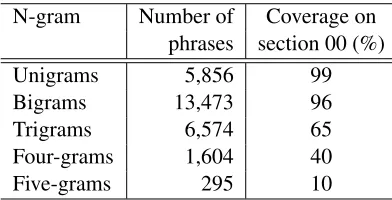
Table 1 gives summary statistics of the paraphrase dictionary and its coverage on Section 00 of the Penn Treebank. The length of the extracted n-gram phrases ranges from unigrams to five-grams. The coverage figure gives the percentage of sentences which have at least one phrase in the dictionary. The coverage is important for us because it determines the payload capacity of the embedding method de-scribed in Section 5.
N-gram Number of Coverage on phrases section 00 (%)
Unigrams 5,856 99
Bigrams 13,473 96
Trigrams 6,574 65
Four-grams 1,604 40
[image:4.612.86.282.59.159.2]Five-grams 295 10
Table 1: Statistics for the paraphrase dictionary
Original phrase Paraphrases the end of this year later this year
the end of the year year end
a number of people some of my colleagues differences
the European peoples party the PPE group
Table 2: Example phrases and paraphrases from the dic-tionary
dictionary is a mapping from phrases to sets of pos-sible paraphrases. Each paraphrase also has a prob-ability, based on a statistical machine translation model, but we do not use that feature here. The ex-amples show that, while some of the paraphrases are of a high quality, some are not. For example, dif-ferences is unlikely to be a suitable paraphrase for a number of peoplein any context. Moreover, there are somehphrase, paraphrasei pairs which are only suitable in particular contexts. For example, year end is an unsuitable paraphrase for the end of this year in the sentence The chart compares the gold price at the end of last year with the end of this year. Barzilay and McKeown (2001) also note that the ap-plicability of paraphrases is strongly influenced by context. Section 4 describes our method for deter-mining if a paraphrase is suitable in a given context.
3.2 Google N-gram Data
[image:4.612.321.542.114.150.2]The Google n-gram data was collected by Google Research for statistical language modelling, and has been used for many tasks such as lexical disam-biguation (Bergsma et al., 2009), and contains En-glish n-grams and their observed frequency counts, for counts of at least 40. The striking feature of
Figure 2: The web-based annotation system
the n-gram corpus is the large number of n-grams and the size of the counts, since the counts were ex-tracted from over 1 trillion word tokens of English text on publicly accessible Web pages collected in January 2006. For example, the 5-gram phrasethe part that you were has a count of 103. The com-pressed data is around 24GBon disk.
3.3 Paraphrase Judgement Corpus
The focus of the paper is to develop an automatic system for checking the grammaticality and flu-ency of paraphrases in context. In order to evaluate the system, we collected some human judgements, based on 70 sentences from Section 00 of the Penn Treebank. For each sentence, we took every phrase in the sentence which is in the dictionary, and for each paraphrase of that phrase, replaced the phrase with the paraphrase to create an instance. This pro-cedure resulted in 500 cases of paraphrases in con-text.
Each case was then evaluated by a human judge, using a web-based annotation system that we devel-oped. The judges were asked to judge each case on two dimensions: a) whether the paraphrase is gram-matical in context; and b) whether the paraphrase retains the meaningof the original phrase given the context. Figure 2 gives a screen shot of the annota-tion system.
[image:4.612.73.299.196.311.2]annota-tors to judge the meaning retention of paraphrases which had been judged to be ungrammatical in con-text, which may not be a meaningful task. For the grammatical check, 42 out of the 50 cases received the same judgement, a much higher level of agree-ment.
Since the meaning retention judgements were un-reliable, we used only the grammatical judgements to evaluate our system. Hence we are interested in evaluating whether our n-gram and parser-based systems can determine if a paraphrase is grammat-icalin context. Meaning retention is important for the imperceptibility requirement, but grammatical-ity is even more so, since ungrammatical sentences will be easy for an observer to spot. However, we recognise that only testing for grammaticality does not fully test the imperceptibility properties of the system, only part of it.
For the 8 cases which received different judge-ments on grammaticality, the second author of this paper made the definitive judgement, which resulted in a test set of 308 paraphrases judged as grammat-ical in context, and 192 paraphrases judged as un-grammatical in context.
4 Proposed Method and Experiments
4.1 Google N-gram Method
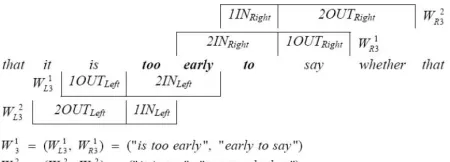
The main idea for testing the use of paraphrases is to check if the various contextual n-grams appear in the Google n-gram data, or were already in the original sentence (before paraphrasing). Let us first define some notation to be used in describing the method. The leftmost and rightmost<m>words in the phrase/paraphrase are represented as<m>INLeft
and<m>INRight, respectively. Words at the left and
right side of the substituted phrase are defined as
<c>OUTLeft and <c>OUTRight, where <c> is an
integer which indicates the number of words rep-resented. Also, we define a context window pair
W<n><c> = (WL<c><n>, WR<c><n>), where WL<c><n> is composed by <c>OUTLeft concatenated with <
n-c>INLeft, andWR<c><n>is composed by<n-c>INRight
concatenated with<c>OUTRight. Figure 3 gives an
[image:5.612.315.540.59.140.2]example of the context window pairsW31andW32in the sentence Soviets said that it istoo early to say whether that will happenwhere the phrasetoo early tois being considered in context.
Figure 3: An example of the context window pair
INPUT:S, P, P0, n, maxC
OUTPUT: the acceptability of paraphrase P0
checked by (n,maxC)
FOReach context sizeCfrom 1 tomaxC
GETa context window pairWC n
IFO(WnC)is zeroTHEN
OUTPUTparaphraseP0fails
END FOR
OUTPUTparaphraseP0passes
Figure 4: Procedure for checking acceptability
We define agoogle-count function G(). This func-tion takes a context window pairW<n><c>as input and outputs a frequency count pair ofW<n><c>recorded in the Google n-gram data. If a context window cannot be found in the Google n-gram data, the frequency count of that window is zero. Also, we define a bi-nary occurrence function O(). It is used to deter-mine whether a context window pair can be passed as acceptable. The input of this function isW<n><c>. The function outputs one if either bothWL<c><n>and
WR<c><n> already occurred in the original sentence (before paraphrasing) or if the frequency counts out-put byG(W<c>
<n>)are both greater than zero.
The two major components in our method are the paraphrase dictionary and the Google n-gram data. Once a phrasePin the cover sentenceSis matched with that in the paraphrase dictionary, we test the use of its paraphraseP0 by the following method. This method takes into account maximum C contextual words at both sides of the target phrase, and uses Google n-gram data as a check, wheren= 2, 3, 4 or 5, andmaxC= 1 ton−1. Each pair of (n,maxC) provides a separate check, by considering both left and right contexts for these values.
acceptability of paraphrasing phrase P with P0 in a given sentence S, given the n-gram size and the maximum considered context size maxC. For ex-ample, we want to check the acceptability of the paraphrase in context shown in Figure 3 by using google tri-gram data (n = 3) and taking maximum context size equal to two into consideration (maxC
= 2). The procedure starts from taking context size
C equal to one into account, namely checking the occurrence ofW31. If the paraphraseP0 passes the current test, in the next iteration it will be tested by taking one more context word into account, namely
W32. However, If the paraphraseP0fails the current (n,C) check the checking procedure will terminate and report that the paraphrase fails. In contrast, if the paraphrase passes all the (n, C) checks where
C= 1 tomaxC, the procedure determines the para-phrase as acceptable. What is happening is that an n-gram window is effectively being shifted across the paraphrase boundary to include different amounts of context and paraphrase.
4.2 Syntactic Filter
In order to improve the grammaticality checking, we use a parser as an addition to the basic Google n-gram method. We use the Clark and Curran (2007)
CCG parser to analyse the sentence before and af-ter paraphrasing. Combinatory Categorial Grammar (CCG) is a lexicalised grammar formalism, in which
CCGlexical categories — typically expressing sub-categorisation information — are assigned to each word in a sentence. The grammatical check works by checking if the words in the sentence outside of the phrase and paraphrase receive the same lexical categories before and after paraphrasing. If there is any change in lexical category assignment to these words then the paraphrase is judged ungrammati-cal. Hence the grammar check is at the word, rather than derivation, level; however, CCG lexical cate-gories contain a large amount of syntactic informa-tion which this method is able to exploit.
4.3 Results
The test corpus described in Section 3.3 was split into development and test data: 100 instances for development and 400 for testing. The development data was used for preliminary experiments. For the test data, 246 of the examples (61.5%) had been
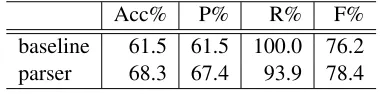
Acc% P% R% F%
[image:6.612.331.521.60.107.2]baseline 61.5 61.5 100.0 76.2 parser 68.3 67.4 93.9 78.4
Table 3: Grammar check usingCCGparser
judged as grammatical, and 154 (38.5%) had been judged as ungrammatical by the annotators.
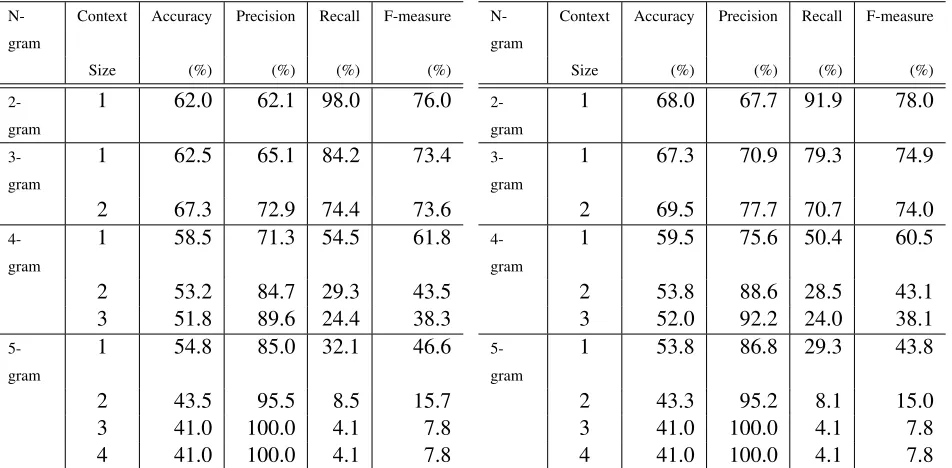
The performance of the system is evaluated us-ing accuracy, precision, recall and balanced F-measure. Accuracy is the percentage of correct judgements over all grammatical and ungrammati-cal paraphrases. Precision is the percentage of para-phrases judged grammatical by the system which are judged grammatical by the human judges, and recall is the percentage of paraphrases judged grammatical by human judges which are also judged grammatical by the system. Precision and recall are relevant in our setting because high precision implies high im-perceptibility, since grammatical phrases in context are less likely to be viewed as suspicious by the ob-server; whereas high recall maximises the payload (given the dictionary), since high recall implies that phrases are being paraphrased where possible (and hence embedding as much information as possible). An accuracy baseline is obtained by always re-turning the majority class, in this case always judg-ing the paraphrase grammatical, which gives an ac-curacy of 61.5%. Table 3 gives the performance when only theCCGparser is used for checking
gram-maticality. As far as steganography is concerned, the precision is low, since over 30% of the paraphrases used are ungrammatical, which is likely to raise the suspicions of the observer.
imperceptibil- N-gram
Context Accuracy Precision Recall F-measure
Size (%) (%) (%) (%)
2-gram
1 62.0 62.1 98.0 76.0
3-gram
1 62.5 65.1 84.2 73.4
2 67.3 72.9 74.4 73.6
4-gram
1 58.5 71.3 54.5 61.8
2 53.2 84.7 29.3 43.5 3 51.8 89.6 24.4 38.3
5-gram
1 54.8 85.0 32.1 46.6
[image:7.612.74.550.61.295.2]2 43.5 95.5 8.5 15.7 3 41.0 100.0 4.1 7.8 4 41.0 100.0 4.1 7.8
Table 4: Performance of google n-gram method
ity is achieved at the cost of a reduced payload, since many of the grammatical paraphrases that could be used to embed information are being discarded.
Table 5 shows the results for the Google n-gram method followed by the parser check; that is, if the Google n-gram method judges the paraphrase to be grammatical, then it is passed to theCCGparser for an additional check. Adding the parser generally increases the precision with a slight loss in recall. Which settings are best to use in practice would de-pend on how the steganography user wished to trade off imperceptibility for payload.
5 Possible embedding method
In this section, we propose a linguistic hiding method which can be integrated with an automatic paraphrasing system. It needs a large paraphrase dictionary to determine modifiable phrases and pro-vide available paraphrases. The embedding capacity of the proposed linguistic stegosystem relies on the number of paraphrasable sentences in the cover text. If every sentence in the cover text is paraphrasable, the system can have the maximum embedding ca-pacity equal to 1 bit per sentence which is compara-ble to other linguistic steganography methods using syntactic transformations and synonym substitution.
N-gram
Context Accuracy Precision Recall F-measure
Size (%) (%) (%) (%)
2-gram
1 68.0 67.7 91.9 78.0
3-gram
1 67.3 70.9 79.3 74.9
2 69.5 77.7 70.7 74.0
4-gram
1 59.5 75.6 50.4 60.5
2 53.8 88.6 28.5 43.1 3 52.0 92.2 24.0 38.1
5-gram
1 53.8 86.8 29.3 43.8
2 43.3 95.2 8.1 15.0 3 41.0 100.0 4.1 7.8 4 41.0 100.0 4.1 7.8
Table 5: Performance of google n-gram method with the
CCGparser filter
5.1 Data Embedding Procedure
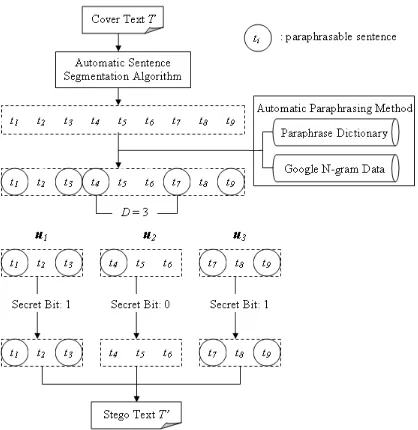
First the sentences in a cover text T are identi-fied using a sentence segmentation algorithm, giv-ingN sentencess1,s2,. . . ,sN. The paraphrasabil-ity of each sentence is then checked using our au-tomatic method. If a sentence contains at least one paraphrasable phrase, we call the sentence a para-phrasable sentence or a non-paraphrasable sen-tenceotherwise. LetDbe the maximum number of sentence boundaries between two subsequent para-phrasable sentences in T. Thus, for every D sen-tences within a cover text T, there will be at least one paraphrasable sentence. Let every unit ofD sen-tences serve as one embedding unit in which a single secret bit can be embedded. If we want to embed 0 in an embedding unit, we transform all the para-phrasable sentences in this embedding unit to non-paraphrasable sentences (assuming certain proper-ties of the dictionary; see end of this section for dis-cussion). If we want to embed 1, we leave the em-bedding unit without any modifications.
Figure 5: Embedding secret bits in a cover text using sen-tence segmentation method
size of an embedding unit, is 3. Next, we segment the cover text into three embedding unitsu1,u2 and
u3, each of which contains three sentences. Since we want to embed secret bits 101 inu1,u2andu3 re-spectively, the embedding unitu2should contain no paraphrasable sentence. That is, the paraphrasable phrase in t4 should be replaced by its paraphrase. Finally, the stego text is output and sent along with the private keyDto the other party. A private key is known only to the parties that exchange messages.
In order for this method to work, we require cer-tain properties of the paraphrase dictionary. For ex-ample, it is crucial that, once a phrase has been para-phrased, it does not produce another phrase that can be paraphrased. This can be achieved by simply requiring that any paraphrase ‘on the RHS’ of the dictionary does not also appear as a phrase on the LHS. In fact, this is not so unnatural for the Callison-Burch dictionary, which consists of phrases mapped to sets of paraphrases, many of which only appear on one side.
5.2 Data Extracting Procedure
For extracting the secret data, first, the stego text
T0undergoes sentence segmentation, andNdefined sentences s01, s02,. . . , s0N are obtained. According to the private keyD, every Dsentences are treated as an information unit, and in each unit we check
the occurrence of paraphrasable sentences making use of our paraphrasing method. If an information unit contains at least one paraphrasable sentence, this information unit implies the embedding of 1. In contrast, if none of the sentences in the informa-tion unit are paraphrasable, it implies the embedding of 0. Hence, in order to recover the hidden mes-sage, the receiver requires the sentence segmentation algorithm, the paraphrase dictionary, the automatic program determining grammaticality of paraphrases in context, and the secret keyD. The extraction pro-cess essentially reverses the embedding method.
6 Conclusions
The contributions of this paper are to develop an automatic system for checking the grammaticality and fluency of paraphrases in context, and the pro-posal of using paraphrases as a suitable transfor-mation for Linguistic Steganography. An advan-tage of our proposed method is that it is somewhat language and domain independent, requiring only a paraphrase dictionary and a Google n-gram corpus, both of which are likely to be available for a range of languages in the future.
There are various practical issues in the applica-tion of Linguistic Steganography systems that we have chosen to ignore. For example, we have not discussed the choice of cover text. If a newspaper ar-ticle were chosen as the cover text, then any changes could be easily found in practice by comparing the stego text with the original article, which is likely to be readily available. Another interesting ques-tion that we have not addressed is whether some lan-guages are better suited to Linguistic Steganography than others, or whether some languages are better suited to particular linguistic transformations than others. Finally, we have only evaluated our gram-matical checker and not the steganography system itself (other than giving an indication of the likely payload). How best to evaluate the imperceptibility of such a system we leave to future work.
Acknowledgements
References
Mikhail J. Atallah, Craig J. McDonough, Victor Raskin, and Sergei Nirenburg. 2001a. Natural language pro-cessing for information assurance and security: an overview and implementations. InProceedings of the 2000 workshop on New security paradigms, pages 51– 65, Ballycotton, County Cork, Ireland.
Mikhail J. Atallah, Victor Raskin, Michael C. Crogan, Christian Hempelmann, Florian Kerschbaum, Dina Mohamed, and Sanket Naik. 2001b. Natural lan-guage watermarking: design, analysis, and a proof-of-concept implementation. InProceedings of the 4th International Information Hiding Workshop, volume 2137, pages 185–199, Pittsburgh, Pennsylvania. Mikhail J. Atallah, Victor Raskin, Christian F.
Hempel-mann, Mercan Karahan, Umut Topkara, Katrina E. Triezenberg, and Radu Sion. 2002. Natural language watermarking and tamperproofing. InProceedings of the 5th International Information Hiding Workshop, pages 196–212, Noordwijkerhout, The Netherlands. Regina Barzilay and Kathleen R. McKeown. 2001.
Ex-tracting paraphrases from a parallel corpus. In Pro-ceedings of the 39th ACL, pages 50–57, Toulouse. Richard Bergmair. 2007. A comprehensive
bibliogra-phy of linguistic steganograbibliogra-phy. InProceedings of the SPIE Conference on Security, Steganography, and Wa-termarking of Multimedia Contents, volume 6505. Shane Bergsma, Dekang Lin, and Randy Goebel. 2009.
Web-scale n-gram models for lexical disambiguation. In Proceedings of the 21st International Joint Con-ference on Artifical Intelligence, pages 1507–1512, Pasadena, CA.
Igor A. Bolshakov. 2004. A method of linguistic steganography based on coladdressally-verified syn-onym. InInformation Hiding: 6th International Work-shop, volume 3200, pages 180–191, Toronto, Canada. Chris Callison-Burch. 2008. Syntactic constraints on paraphrases extracted from parallel corpora. In Pro-ceedings of the EMNLP Conference, pages 196–205, Honolulu, Hawaii.
Mark Chapman and George I. Davida. 1997. Hiding the hidden: A software system for concealing ciphertext as innocuous text. InProceedings of the First Interna-tional Conference on Information and Communication Security, volume 1334, pages 335–345, Beijing. Stephen Clark and James R. Curran. 2007.
Wide-coverage efficient statistical parsing with CCG and log-linear models.Comp. Ling., 33(4):493–552. Jessica Fridrich. 2009. Steganography in Digital Media:
Principles, Algorithms, and Applications. Cambridge University Press, first edition.
Yuling Liu, Xingming Sun, and Yong Wu. 2005. A nat-ural language watermarking based on Chinese syntax.
In Advances in Natural Computation, volume 3612, pages 958–961, Changsha, China.
Mitchell P. Marcus, Beatrice Santorini, and Mary A. Marcinkiewicz. 1993. Building a large annotated cor-pus of English: the Penn Treebank. Computational Linguistics, 19:313–330.
Hasan M. Meral, Emre Sevinc, Ersin Unkar, Bulent Sankur, A. Sumru Ozsoy, and Tunga Gungor. 2007. Syntactic tools for text watermarking. In Proceed-ings of the SPIE Conference on Security, Steganogra-phy, and Watermarking of Multimedia Contents, vol-ume 6505, San Jose, CA.
Brian Murphy and Carl Vogel. 2007. The syntax of con-cealment: reliable methods for plain text information hiding. InProceedings of the SPIE Conference on Se-curity, Steganography, and Watermarking of Multime-dia Contents, volume 6505, San Jose, CA.
Brian Murphy. 2001. Syntactic information hiding in plain text. Masters Thesis. Trinity College Dublin. Lip Y. Por, Ang T. Fong, and B. Delina. 2008.
Whitesteg: a new scheme in information hiding using text steganography. WSEAS Transactions on Comput-ers, 7:735–745.
Cuneyt M. Taskiran, Mercan Topkara, and Edward J. Delp. 2006. Attacks on linguistic steganography sys-tems using text analysis. InProceedings of the SPIE Conference on Security, Steganography, and Water-marking of Multimedia Contents, volume 6072, pages 97–105, San Jose, CA.
Mercan Topkara, Cuneyt M. Taskiran, and Edward J. Delp. 2005. Natural language watermarking. In Proceedings of the SPIE Conference on Secu-rity, Steganography, and Watermarking of Multimedia Contents, volume 5681, pages 441–452, San Jose, CA. Mercan Topkara, Umut Topkara, and Mikhail J. Atallah. 2006a. Words are not enough: sentence level natural language watermarking. InProceedings of the ACM Workshop on Content Protection and Security, pages 37–46, Santa Barbara, CA.
Umut Topkara, Mercan Topkara, and Mikhail J. Atal-lah. 2006b. The hiding virtues of ambiguity: quan-tifiably resilient watermarking of natural language text through synonym substitutions. InProceedings of the 8th Workshop on Multimedia and Security, pages 164– 174, Geneva, Switzerland.