Learning to Link Entities with Knowledge Base
Zhicheng Zheng, Fangtao Li, Minlie Huang, Xiaoyan Zhu State Key Laboratory of Intelligent Technology and Systems Tsinghua National Laboratory for Information Science and Technology
Department of Computer Science and Technology, Tsinghua University, Beijing 100084, China
{zhengzc04,fangtao06}@gmail.com, {aihuang,zxy-dcs}@tsinghua.edu.cn
Abstract
This paper address the problem of entity link-ing. Specifically, given an entity mentioned in unstructured texts, the task is to link this entity with an entry stored in the existing knowledge base. This is an important task for informa-tion extracinforma-tion. It can serve as a convenient gateway to encyclopedic information, and can greatly improve the web users’ experience. Previous learning based solutions mainly fo-cus on classification framework. However, it’s more suitable to consider it as a ranking prob-lem. In this paper, we propose a learning to rank algorithm for entity linking. It effectively utilizes the relationship information among the candidates when ranking. The experi-ment results on the TAC 20091dataset demon-strate the effectiveness of our proposed frame-work. The proposed method achieves 18.5% improvement in terms of accuracy over the classification models for those entities which have corresponding entries in the Knowledge Base. The overall performance of the system is also better than that of the state-of-the-art methods.
1 Introduction
The entity linking task is to map a named-entity mentioned in a text to a corresponding entry stored in the existing Knowledge Base. The Knowledge Base can be considered as an encyclopedia for en-tities. It contains definitional, descriptive or rele-vant information for each entity. We can acquire the knowledge of entities by looking up the Knowledge
1
http://www.nist.gov/tac/
Base. Wikipedia is an online encyclopedia, and now it becomes one of the largest repositories of encyclo-pedic knowledge. In this paper, we use Wikipedia as our Knowledge Base.
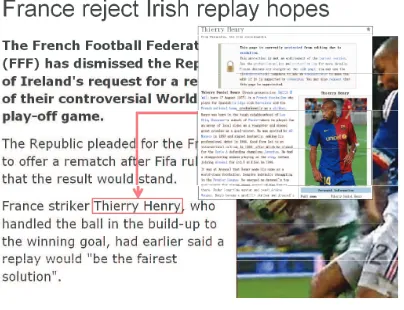
[image:1.612.331.533.427.582.2]Entity linking can be used to automatically aug-ment text with links, which serve as a conve-nient gateway to encyclopedic information, and can greatly improve user experience. For example, Fig-ure 1 shows news from BBC.com. When a user is interested in ”Thierry Henry”, he can acquire more detailed information by linking ”Thierry Henry” to the corresponding entry in the Knowledge Base.
Figure 1: Entity linking example
Entity linking is also useful for some information extraction (IE) applications. We can make use of information stored in the Knowledge Base to assist the IE problems. For example, to answer the ques-tion ”When was the famous basketball player
Jor-dan born?”, if the Knowledge Base contains the
tity of basketball player Michael Jordan and his in-formation (such as infobox2 in Wikipedia), the cor-rect answer ”February 17, 1963” can be easily re-trieved.
Entity linking encounters the problem of entity ambiguity. One entity may refer to several entries in the Knowledge Base. For example, the entity ”Michael Jordan” can be linked to the basketball player or the professor in UC Berkeley.
Previous solutions find that classification based methods are effective for this task (Milne and Wit-ten, 2008). These methods consider each candidate entity independently, and estimate a probability that the candidate entry corresponds to the target entity. The candidate with the highest probability was cho-sen as the target entity. In this way, it’s more like a ranking problem rather than a classification prob-lem. Learning to rank methods take into account the relations between candidates, which is better than considering them independently. Learning to rank methods are popular in document information re-trieval, but there are few studies on information ex-traction. In this paper, we investigate the application of learning to rank methods to the entity linking task. And we compare several machine learning methods for this task. We investigate the pairwise learning to rank method, Ranking Perceptron (Shen and Joshi, 2005), and the listwise method, ListNet (Cao et al., 2007). Two classification methods, SVM and Per-ceptron, are developed as our baselines. In com-parison, learning to rank methods show significant improvements over classification methods, and List-Net achieves the best result. The best overall per-formance is also achieved with our proposed frame-work.
This paper is organized as follows. In the next section we will briefly review the related work. We present our framework for entity linking in section 3. We then describe in section 4 learning to rank methods and features for entity linking. A top1 can-didate validation module will be explained in section 5. Experiment results will be discussed in section 6. Finally, we conclude the paper and discusses the fu-ture work in section 7.
2
Infoboxes are tables with semi-structured information in some pages of Wikipedia
2 Related Work
There are a number of studies on named entity dis-ambiguation, which is quite relevant to entity link-ing. Bagga and Baldwin (1998) used a Bag of Words (BOW) model to resolve ambiguities among people. Mann and Yarowsky (2003) improved the perfor-mance of personal names disambiguation by adding biographic features. Fleischman (2004) trained a Maximum Entropy model with Web Features, Over-lap Features, and some other features to judge whether two names refer to the same individual. Pedersen (2005) developed features to represent the context of an ambiguous name with the statistically significant bigrams.
Bunescu (2006) used Wikipedia’s category informa-tion in the disambiguainforma-tion process. Using different background knowledge, researcher may find differ-ent efficidiffer-ent features for disambiguation.
Hence researchers have proposed so many effi-cient features for disambiguation. It is important to integrate these features to improve the system per-formance. Some researchers combine features by manual rules or weights. However, it is not conve-nient to directly use these rules or weights in another data set. Some researchers also try to use machine learning methods to combine the features. Milne and Witten (2008) used typical classifiers such as Naive Bayes, C4.5 and SVM to combine features. They trained a two-class classifier to judge whether a can-didate is a correct target. And then when they try to do disambiguation for one query, each candidate will be classified into the two classes: correct tar-get or incorrect tartar-get. Finally the candidate answer with the highest probability will be selected as the target if there are more than one candidates classi-fied as answers. They achieve great performance in this way with three efficient features. The classifier based methods can be easily used even the feature set changed. However, as we proposed in Introduc-tion, it’s not the best way for such work. We’ll detail the learning to rank methods in the next section.
3 Framework for Entity Linking
Input%a%query
[image:3.612.115.250.467.600.2]Output%the% final answer final%answer
Figure 2: The framework for entity linking
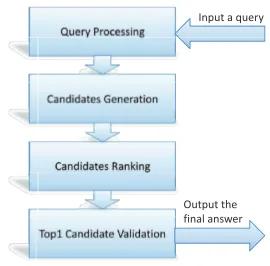
Entity linking is to align a named-entity men-tioned in a text to a corresponding entry stored in the existing Knowledge Base. We proposed a frame-work to solve the ”entity linking” task. As illustrated in Figure 2, when inputting a query which is an
en-tity mentioned in a text, the system will return the target entry in Knowledge Base with four modules:
1. Query Processing. First, we try to correct the spelling errors in the queries by using query spelling correction supplied by Google. Sec-ond, we expand the query in three ways: ex-panding acronym queries from the text where the entity is located, expanding queries with the corresponding redirect pages of Wikipedia and expanding queries by using the anchor text in the pages from Wikipedia.
2. Candidates Generation. With the queries gen-erated in the first step, the candidate genera-tion module retrieves the candidates from the Knowledge Base. The candidate generation module also makes use of the disambiguation pages in Wikipedia. If there is a disambigua-tion page corresponding to the query, the linked entities listed in the disambiguation page are added to the candidate set.
3. Candidates Ranking. In the module, we rank all the candidates with learning to rank methods.
4. Top1 Candidate Validation. To deal with those queries without appropriate matching, we fi-nally add a validation module to judge whether the top one candidate is the target entry.
The detail information of ranking module and val-idation module will be introduced in next two sec-tions.
4 Learning to Rank Candidates
In this section we first introduce the learning to rank methods, and then describe the features for ranking methods.
4.1 Learning to rank methods
ranking objects. Then a classification model can be trained on the labeled data and then be used for rank-ing. The pairwise approach has advantages in that the existing methodologies on classification can be applied directly. The listwise approach takes can-didate lists for a query as instances to train ranking models. Then it trains a ranking function by min-imizing a listwise loss function defined on the pre-dicted list and the ground truth list.
To describe the learning to rank methods, we first introduce some notations:
∙ Query set Q ={𝑞(𝑖)∣𝑖= 1 :𝑚}.
∙ Each query𝑞(𝑖)is associated with a list of ob-jects(in document retrieval, the objects should be documents),𝑑(𝑖) ={𝑑(𝑖)
𝑗 ∣𝑗 = 1 :𝑛(𝑖)}.
∙ Each object list has a labeled score list𝑦(𝑖) =
{𝑦(𝑗𝑖)∣𝑗 = 1 :𝑛(𝑖)}represents the relevance
de-gree between the objects and the query.
∙ Features vectors 𝑥(𝑗𝑖) from each query-object pair,𝑗= 1 :𝑛(𝑖).
∙ Ranking function f, for each 𝑥(𝑗𝑖) it outputs a
score𝑓(𝑥(𝑗𝑖)). After the training phase, to rank the objects, just use the ranking function f to output the score list of the objects, and rank them with the score list.
In the paper we will compare two different learn-ing to rank approaches: Ranklearn-ing Perceptron for pair-wise and ListNet for listpair-wise. A detailed introduc-tion on Ranking Perceptron (Shen and Joshi, 2005) and ListNet (Cao et al., 2007) is given.
4.1.1 Ranking Perceptron
Ranking Perceptron is a pairwise learning to rank method. The score function 𝑓𝜔(𝑥(𝑗𝑖)) is defined as
< 𝜔, 𝑥(𝑗𝑖)>.
For each pair (𝑥(𝑗𝑖1), 𝑥𝑗(𝑖2)),𝑓𝜔(𝑥(𝑗𝑖1)−𝑥 (𝑖)
𝑗2)is com-puted. With a given margin function𝑔(𝑥𝑗(𝑖1), 𝑥(𝑗𝑖2))and
a positive rate𝜏, if𝑓𝜔(𝑥(𝑗𝑖1)−𝑥 (𝑖)
𝑗2)≤𝑔(𝑥 (𝑖)
𝑗1, 𝑥 (𝑖)
𝑗2)𝜏, an update is performed:
𝜔𝑡+1=𝜔𝑡+ (𝑥(𝑗𝑖1)−𝑥𝑗(𝑖2))𝜏 𝑔(𝑥(𝑗𝑖1), 𝑥(𝑗𝑖2))
After iterating enough times, we can use the func-tion𝑓𝜔to rank candidates.
4.1.2 ListNet
ListNet takes lists of objects as instances in learn-ing. It uses a probabilistic method to calculate the listwise loss function.
ListNet transforms into probability distributions both the scores of the objects assigned by the ora-cle ranking function and the real score of the objects given by human.
Let𝜋denote a permutation on the objects. In List-Net algorithm, the probability of𝜋with given scores is defined as:
𝑃𝑠(𝜋) = 𝑛 ∏
𝑗=1
𝑒𝑥𝑝(𝑠𝜋(𝑗))
∑𝑛
𝑘=𝑗𝑒𝑥𝑝(𝑠𝜋(𝑘))
Then the top k probability ofG𝑘(𝑗1, 𝑗2, ..., 𝑗𝑘)can
be calculated as:
𝑃𝑠(G𝑘(𝑗1, 𝑗2, ..., 𝑗𝑘)) = 𝑘 ∏
𝑡=1
𝑒𝑥𝑝(𝑠𝑗𝑡)
∑𝑙
𝑙=𝑡𝑒𝑥𝑝(𝑠𝑗𝑙)
The ListNet uses a listwise loss function with Cross Entropy as metric:
𝐿(𝑦(𝑖), 𝑧(𝑖)) =− ∑
∀𝑔∈G𝑘
𝑃𝑦(𝑖)(𝑔)𝑙𝑜𝑔(𝑃
𝑧(𝑖)(𝑔))
Denote as 𝑓𝜔 the ranking function based on
Neural Network model 𝜔. The gradient of 𝐿(𝑦(𝑖), 𝑧(𝑖)(𝑓𝜔))with respect to parameter𝜔can be
calculated as:
Δ𝜔 = ∂𝐿(𝑦
(𝑖), 𝑧(𝑖)(𝑓
𝜔))
∂𝜔
= − ∑
∀𝑔∈G𝑘
∂𝑃𝑧(𝑖)(𝑓𝜔)(𝑔)
∂𝜔
𝑃𝑦(𝑖)(𝑔)
𝑃𝑧(𝑖)(𝑓𝜔)(𝑔)
In each iteration, the𝜔is updated with−𝜏×Δ𝜔 in a gradient descent way. Here 𝜏 is the learning rate.
4.2 Features for Ranking
In the section, we will introduce the features used in the ranking module. For convenience, we define some symbols first:
∙ Q represents a query, which contains a named entity mentioned in a text. CSet represents the candidate entries in Knowledge Base for the query Q. C represents a candidate in CSet.
∙ Q’s nameString represents the name string of Q. Q’s sourceText represents the source text of Q. Q’s querySet represents the queries which are expansions of Q’s nameString.
∙ C’s title represents the title of corresponding Wikipedia article of C. C’s titleExpand repre-sents the union set of the redirect set of C and the anchor text set of C. C’s article represents the Wikipedia article of C.
∙ C’s nameEntitySet represents the set of all named entities in C’s article labeled by Stan-ford NER (Finkel et al., 2005). Q’s nameEnti-tySet represents the set of all named entities in Q’s sourceText.
∙ C’s countrySet represents the set of all coun-tries in C’s article, and we detect the councoun-tries from text via a manual edited country list. Q’s countrySet represents the set of all countries in Q’s sourceText. C’s countrySetInTitle rep-resents the set of countries exist in one of the string s from C’s titleExpand.
∙ C’s citySetInTitle represents the set of all cities exist in one of the string s from C’s titleExpand, and we detect the cities from text via a manual edited list of famous cities. Q’s citySet repre-sents the set of all cities in Q’s sourceText.
∙ Q’s type represents the type of query Q. It’s la-beled by Stanford NER. C’s type is manually labeled already in the Knowledge Base.
The features that used in the ranking module can be divided into 3 groups: Surface, Context and Spe-cial. Each of these feature groups will be detailed next.
4.2.1 Surface Features
The features in Surface group are used to measure the similarity between the query string and candidate entity’s name string.
∙ StrSimSurface. The feature value is the max-imum similarity between the Q’s nameString and each string s in the set C’s titleExpand. The string similarity is measured with edit distance.
∙ ExactEqualSurface. The feature value is 1 if there is a string s in set C’s titleExpand same as the Q’s nameString, or the Candidate C is ex-tracted from the disambiguation page. In other case, the feature value is set to 0.
∙ StartWithQuery. The feature value is 1 if there is a string s in set C’s titleExpand starting with the Q’s nameString, and C’s ExactEqualSur-face is not 1. In other case, the feature value is set to 0.
∙ EndWithQuery. The feature value is 1 if there is a string s in set C’s titleExpand ending with the Q’s nameString, and C’s ExactEqualSur-face is not 1. In other case, the feature value is set to 0.
∙ StartInQuery. The feature value is 1 if there is a string s in set C’s titleExpand that s is the prefix of the Q’s nameString, and C’s ExactEqualSur-face is not 1. In other case, the feature value is set to 0.
∙ EndInQuery. The feature value is 1 if there is a string s in set C’s titleExpand that s is the post-fix of the Q’s nameString, and C’s ExactEqual-Surface is not 1. In other case, the feature value is set to 0.
∙ EqualWordNumSurface. The feature value is the maximum number of same words between the Q’s nameString and each string s in the set C’s titleExpand.
4.2.2 Context Features
The features in Context group are used to measure the context relevance between query and the candi-date entity. We mainly consider the TF-IDF similar-ity and named entsimilar-ity co-occurrence.
∙ TFSimContext. The feature value is the TF-IDF similarity between the C’s article and Q’s sourceText.
∙ TFSimRankContext. The feature value is the inverted rank of C’s TFSimContext in the CSet.
∙ AllWordsInSource. The feature value is 1 if all words in C’s title exist in Q’s sourceText, and in other case, the feature value is set to 0.
∙ NENumMatch. The feature value is the num-ber of of same named entities between C’s nameEntitySet and Q’s nameEntitySet. Two named entities are judged to be the same if and only if the two named entities’ strings are iden-tical.
4.2.3 Special Features
Besides the features above, we also find that the following features are quite significant in the entity linking task: country names, city names and types of queries and candidates.
∙ CountryInTextMatch. The feature value is the number of same countries between C’s coun-trySet and Q’s councoun-trySet.
∙ CountryInTextMiss. The feature value is the number of countries that exist in Q’s country-Set but do not exist in C’s countrycountry-Set.
∙ CountryInTitleMatch. The feature value is the number of same countries between C’s coun-trySetInTitle and Q’s countrySet.
∙ CountryInTitleMiss. The feature value is the number of countries that exist in C’s country-SetInTitle but do not exist in Q’s countrySet.
∙ CityInTitleMatch. The feature value is the number of same cities between C’s citySetInTi-tle and Q’s citySet.
∙ TypeMatch. The feature value is 0 if C’s type is not consistent with Q’s type, in other case, the feature value is set to 1.
When ranking the candidates in CSet, the fea-tures’ value was normalized into [0, 1] to avoid noise caused by large Integer value or small double value.
5 Top 1 Candidate Validation
To deal with those queries without target entities in the Knowledge Base, we supply a Top 1 candidate validation module. In the module, a two-class classi-fier is used to judge whether the top one candidate is the true target entity. The top one candidate selected from the ranking module can be divided into two classes: target and non-target, depending on whether it’s the correct target link of the query. According to the performance of classification, SVM is chosen as the classifier (In practice, the libsvm package is used) and the SVM classifier is trained on the entire training set.
Most of the features used in the validation mod-ule are the same as those in ranking modmod-ule, such as StrSimSurface, EqualWordNumSurface, MissWord-NumSurface, TFSimContext, AllWordsInSource, NENumMatch and TypeMatch. We also design some other features, as follows:
∙ AllQueryWordsInWikiText. The feature value is one if Q’s textRetrievalSet contains C, and in other case the feature value is set to zero. The case that Q’s textRetrievalSet contains C means the candidate C’s article contains the Q’s nameString.
∙ CountryInTextPer. The feature is the percent-age of countries from Q’s countrySet exist in C’s countrySet too. The feature can be seen as a normalization of CountryInTextMatch/Miss features in ranking module.
6 Experiment and Analysis
6.1 Experiment Setting
Algorithm Accuracy Improvement over SVM
ListNet 0.9045 +18.5%
Ranking Perceptron 0.8842 +15.8%
SVM 0.7636
[image:7.612.339.516.52.179.2]-Perceptron 0.7546 -1.2%
Table 1: Evaluation of different ranking algorithm
Entity linking is initiated as a task in this year’s TAC-KBP3track, so we use the data from this track. The entity linking task in the KBP track is to map an entity mentioned in a news text to the Knowl-edge Base, which consist of articles from Wikipedia. The KBP track gives a sample query set which sists of 416 queries for developing. The test set con-sists of 3904 queries. 2229 of these queries can’t be mapped to Knowledge Base, for which the sys-tems should return NIL links. The remaining 1675 queries all can be aligned to Knowledge Base. We will firstly analyze the ranking methods with those non-NIL queries, and then with an additional vali-dation module, we train and test with all queries in-cluding NIL queries.
As in the entity linking task of KBP track, the ac-curacy is taken as
𝑎𝑐𝑐𝑢𝑟𝑎𝑐𝑦= #(correct answered queries) #(total queries)
6.2 Evaluation of Machine Learning Methods
in ranking
As mentioned in the section of related work, learn-ing to rank methods in entity linklearn-ing performs bet-ter than the classification methods. To justify this, some experiments are designed to evaluate the per-formance of our ranking module when adopting dif-ferent algorithms.
To evaluate the performance of the ranking mod-ule, we use all the queries which can be aligned to a target entry in the Knowledge Base. The training set contains 285 valid queries and the test set contains 1675.
3
http://apl.jhu.edu/ paulmac/kbp.html
Set Features in Set Set1 Surface Features Set2 Set1+TF-IDF Features Set3 Set2+AllWordsInSource Set4 Set3+NENumMatch
[image:7.612.75.297.107.191.2]Set5 Set4+CountryInTitle Features Set6 Set5+CountryInText Features Set7 Set6+CityInTitleMatch Set8 Set7+MatchType
Table 2: Feature Sets
Three algorithms are taken into comparison: List-Net, Ranking Perceptron, and classifier based meth-ods. The classifier based methods are trained by di-viding the candidates into two classes: target and non-target. Then, the candidates are ranked accord-ing to their probability of beaccord-ing classified as target. two different classifiers are tested here, SVM and Perceptron.
! 0.5
0.55 0.6 0.65 0.7 0.75 0.8 0.85 0.9 0.95
Set1 Set2 Set3 Set4 Set5 Set6 Set7 Set8
Accuracy
Feature)Set
ListNet Ranking!Perceptron
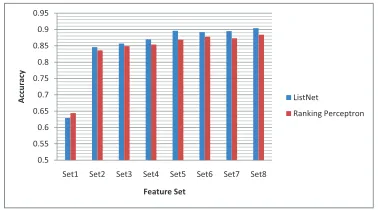
Figure 3: Comparison of ListNet and Ranking Perceptron
[image:7.612.332.521.348.453.2]er-Systems Accuracy of all queries Accuracy of non-NIL queries Accuracy of NIL queries
System1 0.8217 0.7654 0.8641
System2 0.8033 0.7725 0.8241
System3 0.7984 0.7063 0.8677
[image:8.612.81.533.55.125.2]ListNet+SVM 0.8494 0.79 0.8941
Table 3: Evaluation of the overall performance, compared with KBP results (System 1-3 demonstrate the top three ranked systems)
rors but not to minimize the errors in ranking; sec-ond, the number of pairs generated from list varies largely from list to list, which will result in a model biased toward lists with more objects. The issues are also discussed in (Y.B. Cao et al., 2006; Cao et al., 2007). And the listwise approach can fix the prob-lems well.
As the feature sets are added incrementally, it can be used for analyzing the importance of the features to the ranking task. Although Surface Group only takes into consideration the candidate’s title and the query’s name string, its accuracy is still higher than 60%. This is because many queries have quite small number of candidates, the target entry can be picked out with the surface features only. The result shows that after adding the TF-IDF similarity related fea-tures, the accuracy increases significantly to 84.5%. Although TF-IDF similarity is a simple way to mea-sure the contextual similarity, it performs well in practice. Another improvement is achieved when adding the CountryInTitleMatch and CountryInTi-tleMiss features. Since a number of queries in test set need to disambiguate candidates with different countries in their titles, the features about coun-try in the candidates’ title are quite useful to deal with these queries. But it doesn’t mean that the features mentioned above are the most important. Because many features correlated with each other quite closely, adding these features doesn’t lead to remarkable improvement. The conclusion from the results is that the Context Features significantly im-prove the ranking performance and the Special Fea-tures are also useful in the entity linking task.
6.3 Overall Performance Evaluation
We are also interested in overall performance with the additional validation module. We use all the 3904 queries as the test set, including both NIL and non-NIL queries. The top three results from
the KBP track (McNamee and Dang, 2009) are se-lected as comparison. The evaluation result in Table 3 shows that our proposed framework outperforms the best result in the KBP track, which demonstrates the effectiveness of our methods.
7 Conclusions and Future Work
This paper demonstrates a framework of learning to rank for linking entities with the Knowledge Base. Experimenting with different ranking algorithms, it shows that the learning to rank methods perform much better than the classification methods in this problem. ListNet achieves 18.5% improvement over SVM, and Ranking Perceptron gets 15.8% improve-ment over SVM. We also observe that the listwise learning to rank methods are more suitable for this problem than pairwise methods. We also add a vali-dation module to deal with those entities which have no corresponding entry in the Knowledge Base. We also evaluate the proposed method on the whole data set given by the KBP track, for which we add a bi-nary SVM classification module to validate the top one candidate. The result of experiment shows the proposed strategy performs better than all the sys-tems participated in the entity linking task.
In the future, we will try to develop more sophis-ticated features in entity linking and design a typical learning to rank method for the entity linking task.
Acknowledgments
References
Bagga and Baldwin. 1998. Entity-Based Cross-Document Coreferencing Using the Vector Spcae Model. in Proceedings of HLT/ACL.
Gideon S. Mann and David Yarowsky. 2003. Unsuper-vised Personal Name Disambiguation. in Proceedings of CONIL.
Michael Ben Fleishman. 2004. Multi-Document Person Name Resolution. in Proceedings of ACL.
Ted Pedersen, Amruta Purandare and Anagha Kulkarni. 2005. Name Discrimination by Clustering Similar Contexts. in Proceedings of CICLing.
B.Malin and E. Airoldi. 2005. A Network Analysis Model for Disambiguation of Names in Lists. in Pro-ceedings of CMOT.
Einat Minkov, William W. Cohen and Andrew Y. Ng. 2006. Contextual Search and Name Disambiguation in Email Using Graph. in Proceedings of SIGIR. Ron Bekkerman and Andrew McCallum. 2005.
Disam-biguating Web Appearances of People in a Social Net-work. in Proceedings of WWW.
Xianpei Han and Jun Zhao. 2009. Named Entity Disam-biguation by Leveraging Wikipedia Semantic Knowl-edge. in Proceedings of CIKM.
David Milne and Ian H. Witten. 2008. Learning to Link with Wikipedia. in Proceedings of CIKM.
Herbrich, R., Graepel, T. and Obermayer K. 1999. Sup-port vector learning for ordinal regression. in Pro-ceedings of ICANN.
Freund, Y., Iyer, R., Schapire, R. E. and Singer, Y. 1998. An efficient boosting algorithm for combining prefer-ences. in Proceedings of ICML.
Burges, C., Shaked, T., Renshaw, E., Lazier, A., Deeds, M., Hamilton, N. and Hullender, G. 2005. Learning to rank using gradient descent. in Proceedings of ICML. Cao, Y. B., Xu, J., Liu, T. Y., Li, H., Huang, Y. L. and Hon, H. W. 2006. Adapting ranking SVM to document retrieval. in Proceedings of SIGIR.
Cao, Z., Qin, T., Liu, T. Y., Tsai, M. F. and Li, H. 2007. Learning to rank: From pairwise approach to listwise approach. in Proceedings of ICML.
Qin, T., Zhang, X.-D., Tsai, M.-F., Wang, D.-S., Liu, T.Y., and Li, H. 2007. Query-level loss functions for information retrieval. in Proceedings of Information processing and management.
L. Shen and A. Joshi. 2005. Ranking and Reranking with Perceptron. Machine Learning,60(1-3),pp. 73-96. Silviu Cucerzan. 2007. Large-Scale Named Entity
Dis-ambiguation Based on Wikipedia Data. in Proceed-ings of EMNLP-CoNLL.
Razvan Bunescu and Marius Pasca. 2006. Using En-cyclopedic Knowledge for Named Entity Disambigua-tion. in Proceedings of EACL.
Paul McNamee and Hoa Dang. 2009. Overview of the TAC 2009 Knowledge Base Population Track (DRAFT). in Proceedings of TAC.