Formatting Time-Aligned ASR Transcripts for Readability
Maria Shugrina∗ Google Inc. New York, NY 10011 [email protected]
Abstract
We address the problem of formatting the out-put of an automatic speech recognition (ASR) system for readability, while preserving word-level timing information of the transcript. Our system enriches the ASR transcript with punc-tuation, capitalization and properly written dates, times and other numeric entities, and our approach can be applied to other format-ting tasks. The method we describe combines hand-crafted grammars with a class-based lan-guage model trained on written text and relies on Weighted Finite State Transducers (WF-STs) for the preservation of start and end time of each word.
1 Introduction and Prior Work
The output of a typical ASR system lacks punctua-tion, capitalization and proper formatting of entities such as phone numbers, time expressions and dates. Even if such automatic transcript is free of recogni-tion errors, it is difficult for a human to parse. The proper formatting of the transcript gains particular importance in applications where the user relies on ASR output for information and where information-rich numeric entities (e.g. time expressions, mone-tary amounts) are common. A good example of such application is a voicemail transcription system. The goal of our work is to transform the raw transcript into its proper written form in order to optimize it for the visual scanning task by the end user. We present quantitative and qualitative evaluation of our system with a focus on numeric entity formatting, punctua-tion and capitalizapunctua-tion (See Fig. 1).
Apart from text, the ASR output usually con-tains word-level metadata such as time-alignment and confidence. Such quantities may be useful for a variety of applications. Although simple to recover
∗
Thank you to Michiel Bacchiani, Martin Jansche, Michael Riley and Cyril Allauzen for discussion and support.
Raw Transcript:
hi bill it’s tracy at around three thirty P M just got an apartment for one thousand three thirty one thou-sand four hundred a month my number is five five five eight eight eight eight extension is three thirty bye Our Result:
Hi Bill, it’s Tracy at around 3:30 PM, just got an apartment for 1,330 1,400 a month. My number is 555-8888 extension is 330. Bye.
Figure 1: An example of a raw transcript with ambiguous written forms and the output of our formatting system.
via word alignment after some types of formatting, word-level quantities may be difficult to preserve if the original text has undergone a significant transfor-mation. We present a formal and general augmen-tation of our WFST-based technique that preserves word-level timing and confidence information dur-ing arbitrary formattdur-ing.
The problems of sentence boundary detection and punctuation of transcripts have received a substantial amount of attention, e.g. (Beeferman et al., 1998; Shriberg et al., 2000; Christensen et al., 2001; Liu et al., 2006; Gravano et al., 2009). Capitalization of ASR transcripts received less attention (Brown and Coden, 2002; Gravano et al., 2009), but there has also been work on case restoration in the context of machine translation (Chelba and Acero, 2006; Wang et al., 2006). Our work does not propose competing methods for transcript punctuation and capitalization. Instead, we aim to provide a com-mon framework for a wide range of formatting tasks. Our method extends the approach of Gravano et al. (2009) with a general WFST formulation suitable for formatting monetary amounts, time expressions, dates, phone numbers, honorifics and more, in addi-tion to punctuaaddi-tion and capitalizaaddi-tion.
To our knowledge, this scope of the problem has not been addressed in literature. Yet such format-ting can have a high impact on transcript readabil-ity. In this paper we focus on numeric entity
ting. In general, context independent rules fail to adequately perform this task due to its inherent am-biguity (See Fig. 1). For example, the spoken words “three thirty” should be written differently in these three contexts:
• meet me at 3:30
• you owe me 330
• dinner for three 30 minutes later
The proper written form of a numeric entity depends on its class (time, monetary amount, etc). In this sense, formatting is related to the problem of named entity (NE) detection and value extraction, as de-fined by MUC-7 (Chinchor, 1997). Several authors have considered the problem of NE value extraction from raw transcripts (Huang et al., 2001; Jansche and Abney, 2002; B´echet et al., 2004; Levit et al., 2004). This is an information extraction task that in-volves identifying transcript words corresponding to a particular NE class and extracting an unambigu-ous value of that NE (e.g. the value of the date NE “december first oh nine” is “12/01/2009”). Al-though relevant, this information extraction does not directly address the problem of proper formatting and ordinarily requires a tagged corpus for training. A parallel corpus containing raw transcriptions and the corresponding formatted strings would facil-itate the solution to the transcript formatting prob-lem. However, there is no such corpus available. Therefore, we follow the approach of Gravano et al. and provide an approximation that exploits readily available written text instead. In section 2 we de-tail our method, provide a probabilistic interpreta-tion and present a practical formulainterpreta-tion of the solu-tion in terms of WFSTs. Secsolu-tion 3 shows how to augment the WFST formulation to preserve word-level timing and confidence. Section 4 presents both qualitative and quantitative evaluation of our system.
2 Method
First, handwritten grammars are used to generate all plausible written forms. These variants are then scored with a language model (LM) approximating probability over written strings. To overcome data sparsity associated with written numeric strings, we introduce numeric classes into the LM. In section 2.1 we give a probabilistic formulation of this ap-proach. In section 2.2 we comment on the hand-written grammars, and in section 2.3 we discuss the
class-based language model used for scoring. Sec-tion 2.4 provides the WFST formulaSec-tion of the solu-tion.
2.1 Probabilistic Formulation
The problem of estimating the best written form wˆ of a spoken sequence of wordsscan be formulated as a Machine Translation (MT) problem of translat-ing a strtranslat-ing sfrom the language of spoken strings into a language of written strings. From a statistical standpoint,wˆcan be estimated as follows:
ˆ
w = argmax w {
P(w|s)} ≈argmax w {
P′(s|w)P′(w)},
where P(·) denotes probability, and P′(·) a prob-ability approximation. The probprob-ability over written stringsP(w)can be estimated by training ann-gram language model on amply available written text. The absence of a parallel corpus containing sequences of spoken words and their written renditions makes the conditional distribution P(s|w) impossible to esti-mate. An approximationP′(s|w)can be obtained by defining handwritten grammars that generate multi-ple unweighted written variants for any spoken se-quence. For a givens, a collection of grammars en-codes a uniform probability distribution across the set of all written variants generated for s and as-signs a zero probability to any string not in this set. Such grammar-based modeling ofP(s|w)combined with statistical estimation ofP(w)takes advantage of prior knowledge, but does not share the disadvan-tages of rigid, fully rule-based systems.
2.2 Handwritten Grammars
Handwritten grammars G1...Gm are used to
gener-ate unweighted written variants for a raw strings. In Gravano’s work (Gravano et al., 2009) the generated variants include optional punctuation between every two words and an optional capitalization for every word. Our system supports a wider range of vari-ants, including but not limited to multiple variants of number formatting.
0
2 three
1 3
3 <space>
<space>
<column> <period>
ε
5 thirty
4
[image:3.612.314.536.64.332.2]3 0
Figure 2: An FSA encoding all variants generated by the number grammar for a spoken string “three thirty”.
hand, the grammar for number formatting could be very liberal in producing written variants (See Fig. 2). Jansche and Abney (2002) observe that handwritten rules deterministically tagging numeric strings of certain length as phone numbers perform surprisingly well on phone number NE identification in voicemail. If appropriate to the task, determinis-tic grammars can be incorporated into the grammar stack. The unweighted written variants generated by applyingG1...Gmtosare then scored with the
lan-guage model.
2.3 Language Model
The probability distribution over written textP(w) can be approximated by a Katz back-offn-gram lan-guage model trained on written text in a domain semantically similar to the domain for which the ASR engine is deployed. Unlike some of the ap-proaches used for NE identification (Jansche and Abney, 2002; Levit et al., 2004) and sentence bound-ary detection (Christensen et al., 2001; Shriberg et al., 2000; Liu et al., 2006), LM-based scoring can-not exploit a larger context thanntokens or prosodic features. The advantage of the LM approach is the ease of applying it to new formatting tasks: no new tagged corpus, and only trivial changes to the pre-processing of the training text would be required.
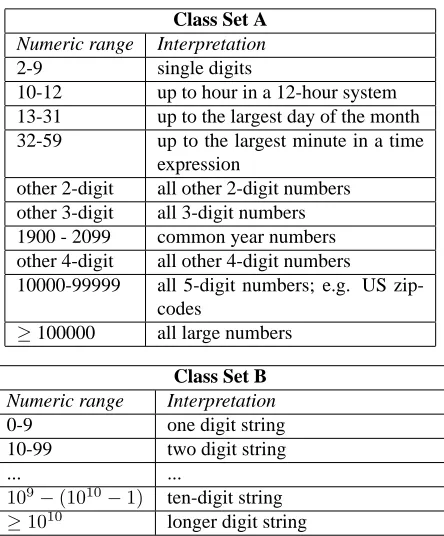
If the LM is to score written numeric strings, care must be taken in modeling numbers. Representing each written number as a token (e.g. tokens “1,235”, “15”) during training results in a very large model and suffers from data sparsity even with very large training corpora. An alternative approach of model-ing every digit as a token (e.g. “15” is comprised of tokens “1” and “2”) fails to model sufficient context for longer digit strings. A partially class-based LM remedies the drawbacks of both approaches, and has been used for tasks such as NE tagging (B´echet et
Class Set A
Numeric range Interpretation
2-9 single digits
10-12 up to hour in a 12-hour system 13-31 up to the largest day of the month 32-59 up to the largest minute in a time
expression
other 2-digit all other 2-digit numbers other 3-digit all 3-digit numbers 1900 - 2099 common year numbers other 4-digit all other 4-digit numbers
10000-99999 all 5-digit numbers; e.g. US zip-codes
≥100000 all large numbers
Class Set B
Numeric range Interpretation
0-9 one digit string
10-99 two digit string
... ...
109
−(1010
−1) ten-digit string
≥1010
longer digit string
Table 1: Two sets of number classes used in our system. Each sequence of consecutive digit characters is mapped to the appropriate class. For example, “$1,235.12” would become “hdollari 1 hcommai hnum 100 999i hperiodi hnum 10 12i” in Class Set A and “hdollari hnum 1Di hcommai hnum 3Di hperiodi hnum 2Diin Class Set B.
al., 2004). The generalization provided by classes eliminates data sparsity, and is able to model suffi-cient context.
[image:3.612.91.289.71.143.2]and it is therefore important to consider whitespace when scoring the written variants. Because of this, we model space as a token in the LM.
2.4 WFST Formulation
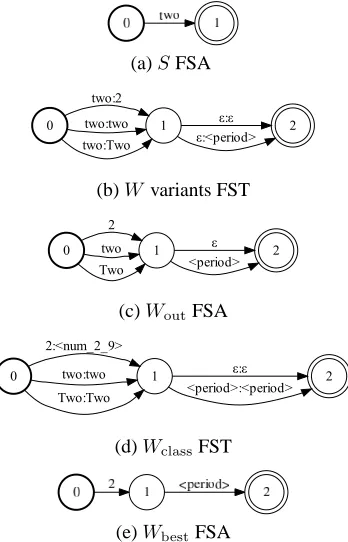
The one-best1ASR outputscan be represented by a Finite State Acceptor (FSA)S. We describe a series of standard WFST operations onS resulting in the FSA Wbest encoding the best estimated formatted
variantwˆ. Current section assumes familiarity with WFSTs; for background see (Mohri, 2009).
(a)SFSA
(b)Wvariants FST
(c)WoutFSA
(d)WclassFST
[image:4.612.101.275.228.499.2](e)WbestFSA
Figure 3: An example showing transducers produced dur-ing formattdur-ing.
We encode each grammar Gi as an unweighted
FSTTi that transduces the raw transcript to its
for-matted versions. The necessity to encode them as FSTs restricts the set of grammars to regular grammars (Hopcroft and Ullman, 1979), sufficiently powerful for most formatting tasks. The back-off
n-gram LM is naturally represented as a weighted deterministic FSA Gwith negative log probability weights (Mohri et al., 2008). The deterministic map-ping of digit strings to number class tokens can also
1
This WFST formulation can also be applied to the ASR lat-tice orn-best list with some modification to the scoring phase.
be accomplished by an unweighted transducer K, which passes all non-numeric strings unchanged.
Composing the input acceptor S with the gram-mar transducers Ti results in a transducer W with
all written variants on the output. Projected onto its output labels,Wbecomes an acceptorWout.Wclass,
the result of the composition of Wout withK, has all formatted written variants on the input side and the formatted variants with digit strings replaced by class tokens on the output. The output side ofWclass
can then be scored via composition withGto pro-duce a weighted transpro-ducer Wscored. The shortest
path in the Tropical Semiring on Wscored contains
the estimate of the best written variant on the input side. This algorithm can be summarized as follows (See Fig. 3):
1. W =S◦T1◦T2...◦Tm
2. Wout= Projout(W)
3. Wclass=Wout◦K
4. Wscored=Wclass◦G
5. Wbest= Projin(BestPath(Wscored))
where ◦ denotes FST composition, Projin and
Projout denote projection on input and output
la-bels respectively, and BestPath(X) as a function returning an FST encoding the shortest path of X. The key Step 2 ensures that the target written vari-ants are not consumed in the consequent composi-tion operacomposi-tions. For efficiency reasons it is advisable to apply optimizations such as epsilon removal and determinization to the intermediate results.2
3 Preserving Word-Level Metadata
We extend the WFST formulation to preserve word-level timing and confidence information.
3.1 Background
A WFST is a finite set of states and transitions connecting them. Each transition has an input la-bel, an output label and a weight in some semir-ing K. A semiring is informally defined as a tou-ple(K,⊕,⊗,0,1), whereK is the set of elements,
⊕ and⊗are the addition and multiplication opera-tions,0is the additive identity and multiplicative an-nihilator,1is the multiplicative identity (See (Mohri,
2
2009)). By defining new semirings we can use stan-dard FST operations to accomplish a wide range of goals.
3.2 Timing Semiring
In order to formulate time preservation within the FST formalism, we define the timing semiringKt
where each element is a pair(s, e)that can be inter-preted as the start and end time of a word:
Wt =
(s, e) :s, e∈R+∪ {0,∞}
(s1, e1)⊕(s2, e2) = (max(s1, s2), min(e1, e2))
(s1, e1)⊗(s2, e2) = (min(s1, s2), max(e1, e2))
0 = (0,∞) 1 = (∞,0)
Intuitively, the addition operation takes the largest interval contained by both operand intervals, while multiplication returns the smallest interval fully con-taining both operand intervals.3 This definition
ful-fills all the semiring properties as defined in (Mohri, 2009). Note that encoding only the duration of each word is not sufficient, as there may be time gaps between the words due to the segmentation of the source audio. Let S˜ denote the Weighted Finite State Acceptor (WFSA) encoding the raw ASR out-put with the start and end time stored in the weight of each arc.
In order to preserve word-level confidence in ad-dition to timing information, a Cartesian product of
Kt and the Log semiring can be used to store both
time and confidence in an arc weight.
3.3 Weight Synchronization
The goal is to associate the timing/confidence weights ofS˜with the word labels ofWbest, the best
formatted string (See Sec. 2.4). Because the weight of each transition in S˜ already expresses the tim-ing/confidence corresponding to its word label, it is sufficient to associate the labels ofS˜with the labels ofWbest. This is equivalent to identifying the output
labels to which each input label is transduced during Step 1 in section 2.4. However, in general WFST op-erations may desynchronize input and output labels
3
Note that this is just a Cartesian product of min-max and max-min semirings. The elements ofKtare not proper
inter-vals, as it is possible forsto exceede.
and weights, as the FST structure itself does not in-dicate a semantic correspondence between them. To alleviate this, we guarantee such a correspondence in our grammars by enforcing that for all paths in any grammar FSTTi:
• an input label appears before any of the corre-sponding output labels, and
• output labels corresponding to a given input la-bel appear before the next input lala-bel.
In practice, these assumptions are usually met by handwritten grammars. Even if these assumptions are violated for a small number of paths, only small word-level timing discrepancies will be incurred. Each path inW can be thought of as a sequence of subpaths with only the first transition containing a non-ǫinput label. We say that the input label of each such subpath corresponds to that subpath’s output la-bels.
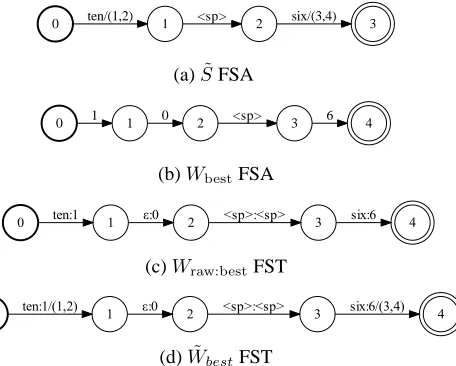
0 ten/(1,2) 1 <sp> 2 six/(3,4) 3
(a)S˜FSA
0 1 1 0 2 <sp> 3 6 4
(b)WbestFSA
0 ten:1 1 ε:0 2 <sp>:<sp> 3 six:6 4
(c)Wraw:bestFST
0 ten:1/(1,2) 1 ε:0 2 <sp>:<sp> 3 six:6/(3,4) 4
[image:5.612.316.544.320.503.2](d)W˜bestFST
Figure 4: A small example of time preservation section of the algorithm. Arcs with non-unity timing weights show parenthesized pair of start and end time.
The best path that has input labels corresponding to the raw ASR output can be obtained by compos-ing the variants FSTW with the best formatted FSA
Wbestand picking any path. The timing weights are
restored to by composing the weighted S˜ with this result. To preserve timing we add two more steps to Steps 1–5 in section 2.4:
6. Wraw:best= RmEps(AnyPath(W ◦Wbest))
7. Wbest˜ = ˜S◦Mapt(Wraw:best)
all non-zero weights ofXto the unity weight in the timing semiring. BecauseS˜is an epsilon-free accep-tor, the resultW˜bestwill contain the original weights
ofS˜on the arcs with the corresponding input labels (See Fig. 4 for an example). The space-delimited words and the corresponding weights can then be read off by walkingWbest˜ .
4 Evaluation
Section 4.1 presents our datasets and an evaluation metric specific to number formatting, and section 4.2 describes our experimental system. We present quantitative evaluation of capitalization/punctuation performance and number formatting performance separately in sections 4.3 and 4.4. Because the ul-timate goal of our work is to improve the readability of ASR transcripts, we also present the result of a user study of transcript readability in section 4.5.
4.1 Data and Metrics
The training corpus contains 185M tokens of written text normalized to contain only comma and period punctuation marks. A set of 176M tokens (TRS) is used for training and a set of 7M tokens (PTS) is held back for testing punctuation and capitalization (See Table 3). To obtain a test input (NPTS) for our system, PTS is lowercased and all punctuation is re-moved.
words commas periods capitals
TRS 176M 10.6M 11.8M 24.3M
PTS 7M 420K 440K 880K
Table 3: Training set TRS and test set PTS.
Number formatting is evaluated on a manually formatted test set. We manually processed the set of raw manual transcripts (NNTS) from the LDC Voicemail Part I training set (Padmanabhan et al., 1998) to obtain a reference number formatting set (NTS). All numeric entities in NTS were formatted according to the following conventions:
• all quantities under 10 are spelled out
• time is written in a 12-hour system as “xx:xx” or “xx”
• dollar amounts are written as “$x,xxx.xx” with cents included if spoken
• US phone numbers are written as “(xxx) xxx-xxxx” or “xxx-xxx-xxxx”
• other phone numbers are written as digit strings
• decimals are written as “x.x”
• large amounts include commas: “x,xxx,xxx” All contiguous sequences of words in NTS that could be a target for number formatting were marked as numeric entities, whether or not these words were formatted by the labeler (for example “six” is a nu-meric entity). To evaluate number formatting per-formance, we process NNTS with our full experi-mental system, then remove all capitalization and inter-word punctuation. This result is aligned with NTS, and each entity is scored separately as totally correct or totally incorrect (See Table 2), yielding:
Numeric Entity Error Rate = 100· I N
where I is the count of entities that did not match the reference entity string exactly andN is the total entity count. This error rate is independent of the numeric entity density in the test set. The errors are broken down into three types:
• incorrect formatting - when the system incor-rectly formats an entity that is formatted in the reference
• overformatting - when the system formats an entity that stays unformatted in the reference
• underformatting - when the system does not format an entity formatted in the reference Out of 1801 voicemail transcripts in NTS, 1347 con-tain at least one entity for a total of 3563 entities, signifying a frequent occurrence of numeric entities in voicemail. There is an average of 7 raw transcript words per entity, suggesting that in many cases en-tity formatting is non-trivial.
4.2 Experimental System
The experimental system includes a 5-gram LM trained on TRS with spaces treated as tokens. Num-ber evaluation is performed with two sets of numNum-ber classes, listed in Table 1. System A contains LM with classes from set A, and System B contains LM with classes from set B. The experimental setup also includes the following grammars:
• Gphone - deterministically formats as a phone
number any string spoken like a US 7 or 10 digit phone number
• Gnumber- expands all spoken numbers to a full
range of variants, with support for time expres-sions, ordinals, decimals, dollar amounts
• Gcap punct - generates all possible
Raw: for six people at five five thirty cost is eleven hundred dollars
Ref: for six people at 5 5:30 cost is $1,100
Hyp: for 6 people at 5 5:30 cost is 11 $100
[image:7.612.118.495.67.118.2]Score: - incorrect - correct - incorrect
Table 2: A example of a raw transcript, reference transcript with number formatting and the hypothesis produced by the system. The entities (bold) in reference and hypothesis are aligned and scored.
4.3 Evaluation of Punctuation
To evaluate the performance of capitalization and punctuation we run System A on NPTS with only
theGcap punct (in order not to introduce errors due
to numeric formatting). The precision, recall and F-measure rates for periods, commas and capitals are computed using PTS as reference (See Fig. 5).
Precision Recall F-Measure Capitals 0.7902 0.5356 0.6385
Comma 0.5527 0.3129 0.3996
[image:7.612.92.281.260.310.2]Period 0.6672 0.6783 0.6727
Figure 5: Punctuation and capitalization results.
It should be noted that a 5-gram language model that treats spaces as words models the same history as a 3-gram model that omits the spaces from train-ing data. When this is taken into account, our re-sults with a much smaller training set are compara-ble to Gravano et al. (2009). The F-measure scores for commas and periods are also comparable to the prosody-based work of (Christensen et al., 2001), with the precision of the period slightly lower, but compensated by recall. Thus, our system can per-form additional per-formatting, while retaining a reason-able capitalization and punctuation performance.
4.4 Evaluation of Number Formatting
We evaluate number formatting performance of Sys-tems A and B, which use different sets of classes for the language modeling (See Table 1). We process NNTS with both systems and score against the ref-erence formatted set NTS to obtain Numeric Entity Error Rate (NEER). Class Set B naively breaks num-bers into classes by digit count. System B using this class set performs worse than System A by 1.7% ab-solute (See Table 4). In particular, the overformat-ting rate (OFR) is higher by 1.2% absolute in System B than in System A. An example of overformatting is the mis-formatting of the English impersonal pro-noun “one” as the digit “1”. Such overformatting errors are much more noticeable than the
underfor-NEER IFR OFR UFR
System A
exact 16.1% 9.7% 5.4% 1.0%
ignore space 11.2% 4.9% 5.4% 1.0% System B
exact 17.8% 10.6% 6.6% 0.6% ignore space 13.2% 6.0% 6.6% 0.6%
Table 4: The total NEER score, NEER due to incorrect formatting (IFR), NEER due to overformatting (OFR) and NEER due to underformatting (UFR); NEER rates with whitespace errors ignored are also listed.
matting errors, which are higher by 0.4% absolute in System A. This result shows that the choice of classes for the class-based LM significantly impacts number formatting performance. Superior overall performance of System A suggests that prior knowl-edge in the choice of classes favorably impacts per-formance.
In order to estimate the error rate not caused by whitespace errors, we also compute the NEER with whitespace errors ignored. It turns out that between 4 and 5% absolute of the errors are whitespace er-rors. Even if all whitespace errors are significant, the 83.9% of perfectly formatted entities suggests that the proposed formatting approach can achieve good performance on the number formatting task.
entities : . $ ,
Reference totals 3563 310 50 39 17 System A correct 3161 232 36 33 10 System B correct 2923 204 35 31 5
Table 5: The count of formatted entities in NTS contain-ing various formattcontain-ing characters; the counts of these en-tities correctly formatted by the systems A and B.
appli-cation like voicemail transcription. System A per-forms significantly better on the formatting of time expressions containing a colon, getting 74.8% cor-rect. The NEER of System A for entities containing special formatting characters is under 28% for all formatting characters except comma, which is used inconsistently in training text.
4.5 Qualitative Evaluation
In addition to quantitative evaluation we have con-ducted a small-scale study of transcript readability. The study aims to compare raw ASR transcripts, ASR transcripts formatted by our system and raw manual transcripts. We have processed LDC Voice-mail Part 1 with our ASR engine achieving an er-ror rate of 30%, and have selected 50 voicemails with error rate under 30% and high informational content. Messages containing names, addresses and numbers were preferred. The word error rate on the selected voicemails is 20%. For each voicemail we have constructed three semantic multiple-choice questions, aimed at information extraction. We have asked each of 15 volunteers to answer all 3 questions about half of the voicemails. The questions were shown in sequence, while the transcript remained on the screen. The transcript for each voicemail was randomly selected to be ASR raw, ASR formatted or manual raw. The response time was measured in-dividually for each question.
The analysis of the responses reveals a statis-tically significant difference in response time be-tween formatted and raw ASR transcripts (p= 0.02, even allowing for per-item and per-subject effects; see also Fig. 6) and comparable accuracy. The re-sponse times for formatted ASR were comparable to the response times for manual unformatted tran-scripts. This suggests that for transcripts with low error rates the formatting of the ASR output signif-icantly impacts readability. This disagrees with a similar study (Jones et al., 2003), which found no significant difference in the comprehension rates be-tween raw ASR transcripts and capitalized, punctu-ated ASR output with disfluencies removed. This could be due to a number of factors, including a dif-ferent type of transformation performed on the ASR transcript, a different corpus, and a lower word error rate of transcripts in our user study.
ASR Formatted ASR Raw Manual Raw
0
20
40
60
80
100
Time to answer (seconds)
[image:8.612.316.523.68.294.2]90.0% 90.7% 94.4%
Figure 6: The standard R box plot of the response time for different transcript types and the corresponding accuracy.
5 Conclusion
References
C. Allauzen, M. Riley, J. Schalkwyk, W. Skut, and M. Mohri. 2007. Openfst: A general and efficient weighted finite-state transducer library. In
Proceed-ings of CIAA, pages 11–23.
F. B´echet, A. Gorin, J. Wright, and D. Hakkani-T¨ur. 2004. Detecting and extracting named entities from spontaneous speech in a mixed-initiative spoken dia-logue context: How may i help you? Speech
Commu-nication, 42(2):207–225.
D. Beeferman, A. Berger, and J. Lafferty. 1998. Cyber-punc: A lightweight punctuation annotation system for speech. In Proceedings of ICASSP, pages 689–692. E. Brown and A. Coden. 2002. Capitalization
re-covery for text. In Information Retrieval Techniques
for Speech Applications, pages 11–22, London, UK.
Springer-Verlag.
C. Chelba and A. Acero. 2006. Adaptation of maximum entropy capitalizer: Little data can help a lot.
Com-puter Speech and Language, 20(4):382–399.
N. Chinchor. 1997. Muc-7 named entity task definition. In Proceedings of MUC-7.
H. Christensen, Y. Gotoh, and S. Renals. 2001. Punc-tuation annotation using statistical prosody models. In
ISCA Workshop on Prosody in Speech Recognition and Understanding.
A. Gravano, M. Jansche, and M. Bacchiani. 2009. Restoring punctuation and capitalization in transcribed speech. In Proceedings of ICASSP, pages 4741–4744. IEEE Computer Society.
J. Hopcroft and J. Ullman, 1979. Introduction to au-tomata theory, languages, and computation, pages
218–219. Addison-Wesley.
J. Huang, G. Zweig, and M. Padmanabhan. 2001. Infor-mation extraction from voicemail. In Proceedings of
the Conference of the ACL, pages 290–297.
M. Jansche and S. P. Abney. 2002. Information extrac-tion from voicemail transcripts. In In EMNLP. D. Jones, F. Wolf, E. Gibson, E. Williams, E. Fedorenko,
D. Reynolds, and M. Zissman. 2003. Measuring the readability of automatic speech-to-text transcripts. In
Proceedings of EUROSPEECH, pages 1585–1588.
M. Levit, P. Haffner, A. Gorin, H. Alshawi, and E. N¨oth. 2004. Aspects of named entity processing. In
Pro-ceedings of INTERSPEECH.
Y. Liu, E. Shriberg, A. Stolcke, D. Hillard, M. Ostendorf, and M. Harper. 2006. Enriching speech recognition with automatic detection of sentence boundaries and disfluencies. IEEE Transactions on Audio, Speech, and Language Processing, 14(5):1526–1540.
M. Mohri, F. Pereira, and M. Riley. 2008. Speech recog-nition with weighted finite-state transducers. In
Hand-book on Speech Processing and Speech Communica-tion. Springer.
M. Mohri. 2009. Weighted automata algorithms. In
Handbook of Weighted Automata. Monographs in The-oretical Computer Science., pages 213–254. Springer.
M. Padmanabhan, G. Ramaswamy, B. Ramabhadran, P. Gopalakrishnan, and C. Dunn. 1998. Voicemail corpus part i. Linguistic Data Consortium, Philadel-phia.
E. Shriberg, A. Stolcke, D. Hakkani-T¨ur, and G. T¨ur. 2000. Prosody-based automatic segmentation of speech into sentences and topics. Speech
Communi-cations, 32(1-2):127–154.