Transliterated Mobile Keyboard Input via
Weighted Finite-State Transducers
Lars Hellsten†, Brian Roark†, Prasoon Goyal∗, Cyril Allauzen†, Françoise Beaufays†, Tom Ouyang†, Michael Riley†and David Rybach†
†Google, Inc. ∗New York University
{lhellsten,roark,allauzen,fsb,ouyang,riley,rybach}@google.com
Abstract
We present an extension to a mobile key-board input decoder based on finite-state transducers that provides general
translit-eration support, and demonstrate its use for input of South Asian languages using a QWERTY keyboard. On-device keyboard
decoders must operate under strict latency and memory constraints, and we present several transducer optimizations that
al-low for high accuracy decoding under such constraints. Our methods yield substan-tial accuracy improvements and latency
re-ductions over an existing baseline translit-eration keyboard approach. The resulting system was launched for 22 languages in
Google Gboard in the first half of 2017.
1 Introduction
The usefulness of weighted finite-state
transduc-ers (WFSTs) has been well-documented for speech recognition decoding. Large component WFSTs representing a context-dependent phone sequence
model (C), the pronunciation lexicon (L) and the language model (G) can be composed into a sin-gle large transducer (C ◦ L ◦ G, or CLG for short) mapping from context-dependent phone se-quences on the input to word sese-quences on the out-put and optimized for efficient decoding (Mohri
et al., 2002). In addition to forming the basis of numerous commercial and research speech recog-nition engines, this is the approach taken by the widely-used open-source toolkit Kaldi (Povey et
al., 2011), which makes use of the OpenFst li-brary (Allauzen et al., 2007) to represent and ma-nipulate the WFSTs. Decoding via such an
opti-mized graph permits the efficient combination of acoustic model scores of context-dependent phone sequences with the scores associated with larger
(word n-gram) sequences contributed by the
lan-guage model.
Speech is not the only uncertain input sequence
modality requiring transcription to yield word strings – others include optical character recogni-tion (OCR) and handwriting recognirecogni-tion.
WFST-based methods have also recently been applied to soft keyboard decoding (Ouyang et al., 2017), where a sequence of taps or continuous gestures
is decoded to the most likely word or word se-quence. Unlike typing on a standard physical key-board (such as a QWERTY keykey-board on a laptop),
ambiguity arises on a soft (on-screen) keyboard due to the relatively small size of the keyboard (e.g., on a smartphone) and the resulting
impreci-sion of the tap or gesture. In such an approach, the same sort of off-line composition of weighted FSTs provides low latency decoding with a modest
memory footprint, which is essential for on-device keyboard functionality. The FST-based decoder described in that paper was launched in the Google
Gboard keyboard system in early 2017.
In this paper, we present methods for
extend-ing this finite-state decodextend-ing approach for mobile keyboard input to transliterated keyboards, where the keyboard representation differs from the output
script. One very common scenario of this sort is the use of a standard QWERTY-style soft keyboard for entering text in a language with another
writ-ing system, typically because the Latin alphabet is simpler to represent on a compact soft keyboard. Systems for mapping from sequences of symbols
in the target script to sequences of Latin symbols are known asromanization.
The most widely known romanization system is Pinyin, which is a fully conventionalized system for Chinese. For example, the word水(water) in
Chinese is written as “shuĭ” in Pinyin. Roman-ization, however, is quite widely used around the world, with such writing systems as Arabic,
Cyril-10
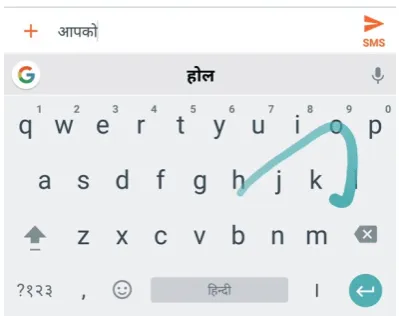
Figure 1:Screen capture of a transliteration keyboard with a user’s gesture trace for the target word.
lic, Greek and Thai. In many cases, unlike Chi-nese, there is no agreed upon standard
romaniza-tion system, leading to an increase in ambiguity and noise when decoding to the target words in the native script. In this paper, we present a general
transliteration approach applied to South Asian languages, transliterated from romanized input to a number of scripts, including Devanagari, Bengali and Perso-Arabic. Figure 1 shows a screenshot of a
mobile transliteration keyboard for Hindi with the Devanagari script, showing the trace of the user’s input gesture. While the user inputs romanized
se-quences, suggested word completions, as well as output strings, are in the target script.
In this context, we find that a WFST encod-ing of transliteration models allows for several optimizations that yield good accuracy under the
strict resource and operating constraints of the on-device keyboard decoding. In what follows, we first provide background and preliminaries on
In-dic languages and their various scripts, as well as finite-state transducer terminology that will be used. We then describe our transliteration
mod-eling approach and a number of WFST optimiza-tions that we perform to achieve the accuracy, la-tency and memory usage operating points.
Fi-nally we present some experiments demonstrat-ing the impact of the optimizations and compar-ing to an existcompar-ing baseline. On Hindi and Tamil validation sets, we demonstrate strong word
er-ror rate and latency reductions versus an exist-ing baseline. We conclude by presenting the var-ious languages and associated scripts for which
transliteration keyboards using this approach have so far been launched in Google Gboard, and by dis-cussing future directions of this work.
2 Background and preliminaries
2.1 Indic scripts
While our approach is general enough to be
broadly applicable to any transliteration pair, it is useful to have a running example, and since we later evaluate on South Asian languages, it makes
sense to review Indic (or Brahmic) scripts here. We lack space to provide a full treatment of the scripts, but will provide details sufficient to
under-stand our overall approach. We refer the interested reader to Sproat (2003) for further details.
Brahmic scripts are a class of writing systems
that have descended from the Brahmi script and hence share certain characteristics. Well-known Brahmic scripts include Devanagari (the standard
script for many languages, including Hindi and Sanskrit), Bengali, Gujarati and Tamil. Some South Asian languages have non-Brahmic native
scripts, such as those that use the Perso-Arabic script (e.g., Urdu) and others that use modern scripts not descended from Brahmi (e.g., Ol Chicki
for Santali). Still, Brahmic scripts are pervasive in South Asian languages, hence a key focus for key-board entry in these languages.
While the Brahmic scripts can look very dis-tinct, they have some central shared characteris-tics. The scripts are organized around what is
termed an orthographic syllable (akṣara), which groups one or more consonants together with as-sociated vowels. Each consonant has an inherent
vowel, and other vowels – or different qualities of the vowels, such as nasalization, or also the ab-sence of the inherent vowel – are indicated for that
consonant via a mark or diacritic on the consonant. In most Brahmic scripts, vowels that are used in-dependently of a consonant – e.g., word initially – have their own symbols. Finally, sequences of
multiple consonants can be combined via ligatures.
For example, take the word “Sanskrit”, written संस्कृतin Hindi. The initial syllableसंconsists of the consonant स (s) which comes with its inher-ent vowel (sa), and ananusvaradiacritic indicat-ing that it is nasalized (san). This is followed by स्कृ (skr) which consists of four pieces combined into a single ligature: (1) a consonantस (s) with (2) aviramadiacritic canceling its inherent vowel स्, followed by (3) another consonantक(k), which combines into the ligatureस्क(sk)1plus (4) a vo-calic ‘r’ diacritic, to yield the full glyph. Finally,
1
the consonantत(t) completes the full word. Note that this word is encoded as a string of seven Uni-code Uni-codepoints: स ◌ं स ◌् क ◌ृ त, and it is up
to a rendering system to assemble these symbols into the appropriate two dimensional glyphs. See Sproat (2003) for more details.
2.2 Romanization and transliteration
Transliteration – converting from one writing sys-tem to another – is a widespread
sequence-to-sequence mapping problem that arises in multiple contexts. For example, proper names must be rep-resented in various writing systems, so
transliter-ating names and places can be very important for translation or querying knowledge bases. While it is true thatप्रणब मुखज is the president of India
and was born inप म बंगाल, it is more useful for those who do not read the Devanagari script to be presented with the information that Indian
presi-dent Pranab Mukherjee was born in West Bengal. Hence, much work in transliteration is focused on translation and information retrieval (Knight and Graehl, 1998; Chen et al., 1998; Virga and
Khu-danpur, 2003; Haizhou et al., 2004; Gupta et al., 2014).
Knight and Graehl (1998) took pronunciation as a mediating variable in mapping between
the two writing systems, and explicitly modeled grapheme-to-phoneme and cross-lingual pronun-ciation mapping in their model. For example, the
probability of mapping to “Sanskrit” fromसंस्कृत would include probabilities for English pronunci-ation given the written form (e.g., S AE N S K R IH T), the Hindi pronunciation (S AH N S K R AX T) given the English pronunciation, and the Devanagari string given the Hindi pronunciation.
Haizhou et al. (2004) took a more direct model-ing approach, simply modelmodel-ing the observed
map-ping between one writing system representation and the other, with strong gains in accuracy. Un-der such an approach, transliteration is very similar
to grapheme-to-phoneme recognition (g2p), where written representations of words (e.g., “sanskrit”) are converted to pronunciations, represented by phone symbols (“S AE N S K R IH T” in the
ARPAbet representation). This sort of pronuncia-tion modeling is also a well-studied problem, being very important to both text-to-speech and
speech-to-text, for deriving pronunciations of items that are out-of-vocabulary. A number of approaches have been used to model this conversion from
one symbolic representation (letters) to another (phones) falling in rough monotonic alignment, in-cluding log linear models (Wu et al., 2014) and
neural sequence models (Rao et al., 2015). Ex-plicit finite-state methods such as Bisani and Ney (2008) and Novak et al. (2013; 2015) have been
shown to be very competitive for g2p (Wu et al., 2014; Rao et al., 2015), and we adopt such meth-ods here (see Section 3.1).
Romanization is the special case of mapping from other writing systems to the Latin script,
of-ten to permit easier keyboard input. As we can see from the Hindi example in the last section, the number of possible symbols in Brahmic scripts is
large, due to the combinations of consonants and vowels via diacritics, and the multi-symbol liga-tures. While keyboard layouts do exist for these
scripts, transliteration from romanized input to the target Brahmic script is a common form of key-board input, especially for mobile devices. As
mentioned earlier, there are many romanization systems for these languages (in contrast to broadly conventionalized Pinyin systems), making this sort
of transliteration keyboard challenging for Indic languages (Ahmed et al., 2011).
2.3 Weighted finite-state transducers
A weighted finite-state transducer T = (Σ,∆, Q, I, F, E,K) consists of: input (Σ) and output (∆) vocabularies; a finite set of states Q, of which (without loss of generality) one is
the initial state I, and a subset of states F ⊆ Q are final states; a weight semiringK; and a set of transitions (q, σ, δ, w, q′) ∈ E, where q, q′ ∈ Q are, respectively, the source and destination states of the transition, σ ∈ Σ, δ ∈ ∆ and w ∈ K. A weighted finite-state automaton is a special
case where Σ = ∆ and, for every transition (q, σ, δ, w, q′) ∈ E, σ = δ. For the work in this paper, we make use of the OpenFst library
(Allauzen et al., 2007) to encode and manipulate WFSTs, and, unless otherwise stated, use the tropical semiring for weights.
Encoding n-gram language models as WFSTs involves the use of failure-transitions (Allauzen
et al., 2003) with a particular ‘canonical’ struc-ture that corresponds to backoff smoothing. We use such an encoding for building word-based
transducer, as described in Section 3.1. For this language model training and encoding, we make use of the OpenGrm n-gram library (Roark et al.,
2012), which provides counting, smoothing and pruning functions resulting in an OpenFst encoded model.
In speech recognition, a pronunciation lexicon, consisting of words found in the vocabulary of the
n-gram model along with their pronunciations, can be compiled into a WFST with input vocabulary Σ of phones and output vocabulary ∆of words.
When this lexiconLis composed with the n-gram modelG, various optimizations can be carried out on the resulting transducer, to share structure and
accrue costs as early as possible (Mohri et al., 2002). Similar optimizations are possible for key-board models, where the input vocabularyΣof the lexiconLis the letters that spell the words (see sec-tion 3.3).
2.4 WFST-based keyboard decoding
There are some differences between speech and keyboard decoding, which are presented in detail in Ouyang et al. (2017), and which we
summa-rize here. The need for decoding arises in key-board due to so-called ‘fat finger’ errors, where the actual point on the keyboard that was touched is
not within the bounding box of the intended letter. The term for the sequence of letters correspond-ing to actual touch points is ‘literal’. For
exam-ple, on a mobile device, with a relatively small QWERTY keyboard, the literal string typed may be “sabsjriy” when the intended word was “san-skrit”. In that example, three letters (b,j,y)
adja-cent to the intended letters (n,k,t) were touched. For possible intended keys, a spatial model pro-vides likelihoods for touch points, via, for
exam-ple, a Gaussian for each key centered at its central point, or perhaps a neural network learned from real touch data. As with speech, there is
contex-tual dependency between adjacent keys, e.g., the distribution over touch points for a given key may depend on the previous key typed. The decoder
takes as input a sequence of touch inputs on the device and combines the context dependent spatial model scores (analogous to the acoustic model in
speech) with language model scores to determine the most likely intended word.
One key difference between speech and key-board decoding is the privileged nature of the lit-eral string in keyboard decoding. Free entry of text
via a keyboard is by its nature an open-vocabulary interface, i.e., the user should be able to type what-ever they want. The keyboard decoder must
de-cide whether the most likely word according to its models is sufficiently more likely than the literal to warrant auto-correction. If the margin between the
score of the best scoring candidate and the literal score falls below the margin required for correc-tion, the literal is output, thus allowing for
out-of-vocabulary (OOV) items to be typed.
In addition to touch typing, the WFST-based
keyboard decoder also permits gesture input (Zhai and Kristensson, 2003), which involves tracing a path from the first letter of a word through all the
letters to the final letter before lifting the finger. With gesture, there is no natural notion of literal string, since multiple words may have the same
path, e.g., ‘or’ and ‘our’ on a QWERTY keyboard. As a result, OOV processing is restricted, much as with speech, and users must revert to touch
typ-ing to input OOVs. The same decoder, however, is used to combine scores from a gesture spatial model with the language model to find the most
likely word string.
We train a weighted transducer to provide likely
transliterations for unseen words and permit non-canonical transliterations for existing words, in-creasing uncertainty in the decoder. This is a
par-ticular challenge given the strict constraints that come with on-device keyboard modeling: latency can be no more than 20 msec, models must, in
ag-gregate, be on the order of 10MB in size, and mem-ory usage during decoding is strictly constrained.
3 Methods
3.1 Pair language models
Due to the latency and memory constraints of our
keyboard application, we pursued methods that re-sulted in models that could be encoded in relatively compact WFSTs. As mentioned in section 2.2,
explicit finite-state methods used for grapheme-to-phoneme conversion, such as Bisani and Ney (2008) and Novak et al. (2013; 2015) are very
competitive. The starting point for all such meth-ods is a simple per-symbol alignment of both the input string and the output string. Thus, for
ex-ample, the word “phlegm” is pronouncedF L EH M(again using the ARPAbet representation), and one natural alignment between the grapheme and
script Hindi word (संस्कृत) with its romanization (sanskrit or sanskrt), where we make use of the Unicode symbol sequence (स◌ंस◌्क◌ृत):
s:स a:ϵ n:◌ं s:स ϵ:◌् k:क r:◌ृ i:ϵ t:त
Note that symbols on either the input or the out-put may not directly correspond to a symbol on the other side (such as ‘a’, ‘i’ and◌्in the above
example), which we represent with an ϵ on the other side of the transduction. Given a lexicon of words and their pronunciations or transliterations
(e.g., that ‘sanskrit’ is a romanization ofसंस्कृत), expectation maximization (EM) can be straightfor-wardly used to learn effective alignments of this
sort.
Given an aligned sequence of input:output ‘pair’ symbols such as e:EH, we can build an n-gram
model to produce joint probabilities over se-quences of such pairs. We refer to these models as pair language models, though they are
alterna-tively called joint multi-gram models (Bisani and Ney, 2008). By conditioning the probability of these input:output mappings on the prior context,
the model appropriately conditions the probability of h:F on whether the previous mapping was p:ϵ. As stated above, results have shown these models
yield very similar performance to more complex and compute-intensive modeling methods (Wu et al., 2014; Rao et al., 2015), and they can be directly
encoded as WFSTs (Novak et al., 2013; Wu et al., 2014), making them excellent candidates for low-resource, low-latency keyboard decoder models.
One useful variant of these models are those that
reduce or eliminate input and/or outputϵsymbols (insertions/deletions), by allowing the merger of multiple symbols on either the input or the output
side. For example, for our pronunciation example above, we may derive an alignment ph:Finstead of p:ϵh:F, which can also be learned using EM (Novak et al., 2013; Novak et al., 2015). Given the structure of WFST-based language models (see section 2.3), which make use of ϵ-transitions to encode backoff, reducing the number of deletions and insertions is important when reducing epsilon cycles in the WFST.
3.2 TransliterationWFSToptimization
Figure 2 shows a fragment of the bigram pair lan-guage model encoded as a WFST, with model
weights not shown for clarity reasons. It is a bi-gram model, so the incoming arcs into any state are labeled with the same pair symbol, e.g., state 5
1
2 5
3
4
...
6
... ... ...
...
s:स sa:स
m:म n:◌ं k:◌्त
k:क
ri:◌ृ
wa:व sha:श
s:स ्
s:स
[image:5.595.335.496.63.196.2]s:स ् k:क
Figure 2: Fragment of the topology of a bigram pair lan-guage model, weights omitted for clarity.
has two incoming arcs, both labeled with k:क. The weights on each arc are the (typically negative log) probabilities of the pair symbols on the arcs given
the state.
This WFST is an automaton over pair symbols, but we need a transducer mapping between
Uni-code Uni-codepoints on the input (QWERTY keyboard letters) and output (target script). If these were sin-gle symbol pairs, then converting to a transducer
would be trivial: just change from a pair (encoded) symbol (k:क) to an input symbol (k) and an output symbol (क). However, as stated earlier, we merge
symbols to reduce the number of insertions or dele-tions2, as well as to increase the parameterization of the model, so the conversion to transducer is
slightly more involved.
We illustrate our approach by considering the four arcs leaving state 1 in the pair language model
automaton in Figure 2, all of which start with an ‘s’ on the input side. Two arcs leaving state 1 have symbols consisting of multiple input Unicode
sym-bols (‘sa’ and ‘sha’); and one of the arcs leaving state 1 has a symbol consisting of multiple out-put Unicode symbols (स्which is two symbolsस
and◌्). Figure 3 shows transducers that map these four pair symbols to their corresponding input and output strings. Figure 3a shows a transducer (call it I) with pair language model symbols (disam-biguated with parentheses just for ease of visual-ization) on the output side and QWERTY key se-quences on the input side. Figure 3b shows a
trans-ducer (call itO) with pair language model symbols on the input side and Devanagari Unicode sym-bols on the output side. For a pair language model P, we can derive our transliteration transducerT
2
s:(s:स)
s:(s:स) a:
s:(s:स ्)
s:(sha:श) h:a:
(s:स):स
(sha:श):श
(s:स ्):स :◌्
[image:6.595.77.283.65.131.2]a) b)
Figure 3: Fragments of transducers mapping a) from input Unicode symbols to symbols in the pair language model, and b) from symbols in the pair language model to output Uni-code symbols. Parentheses in symbols are just to assist dis-ambiguation in the figure.
1
2
3
4
...
s:स
a:
:◌् s:श
h:
a: s:स
s:स
2
4
...
:◌् h:
a:श a:स
:स 1
s: 3
a) b)
:स
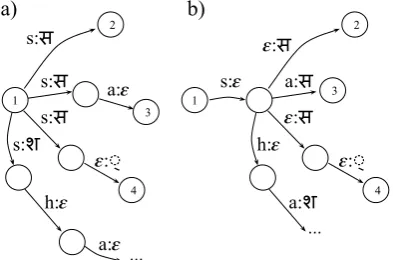
Figure 4: Illustration of conversion of pair language model to Unicode symbol transducer, showing state 1 of Figure 2: a) shows a direct conversion into single Unicode symbol trans-ducer; b) shows a determinized structure which allows struc-ture sharing and proper weight pushing. Numbered states are the same as in Figure 2 and unnumbered states are new.
by composing these together: T = I ◦P ◦O. The resulting transducer looks like the fragment
shown in Figure 4a, where the original destination states from the pair language model in Figure 2 re-tain their numbers and new states are unnumbered.
This is a simple conversion, with no structure shar-ing among arcs leavshar-ing the state, and the original model weights are accrued upon leaving state 1.
An alternate construction can be used, resulting in a transducer with structure like that shown in Figure 4b. This involves determinizing the input
side of the transducer in Figure 3a mapping be-tween input strings and pair language model sym-bols. As there are two paths with “s” on the input
side (which is also a prefix of the other strings) this is not determinizable as is, much like pronuncia-tion lexicons are not generally determinizable. We use a variant of the method presented in Mohri et
al. (2002) to permit determinization in these cases. In their algorithm, they added an auxiliary phone symbol to the end of each pronunciation that
in-dicated the word identity. In our case, as seen in Figure 5a, we create a transducer with each input symbol paired withϵ, followed by an extra arc that
pairs an inputϵwith the full pair symbol. We then encode the transducer (treating the input:output as a a single symbol), determinize it, then decode it
again to a transducer, resulting in the transducer in Figure 5b. We further reduce the size of this by combining sequential arcs labeled withx:ϵandϵ:y into a single arcx:y in cases where the interme-diate state has only one incoming and one outgo-ing arc. This results in the transducer in Figure 5c,
which we can use in lieu of the transducer in Fig-ure 3a to produce the final transducer, as illustrated in 4b.
While the structure sharing that results from this weighted determinization is important, its most important feature is the weight pushing that results.
When building the encoded automaton in Figure 5a, we put the pair language model weight from the model on the first arc of each path, i.e., the
arcs labeled S:ϵ in this example. When that au-tomaton is determinized, the weights get pushed along the path, leaving only the minimum cost over
all paths for which the transition is a prefix. This correct weight pushing of the transliteration cost yields major benefit during decoding.
One complication to keep in mind is that the transliteration cost provided by this model is based on a joint probability over input/output relations,
not a conditional probability of the input given the output, which is what is needed (see Section 3.4).
3.3 L◦G optimization
In speech recognition, the L◦ G transducer has phones on the input side and words on the output
side. Unlike speech, however, in the current case the input symbols are individual Unicode symbols in the target script, the concatenation of which
spells out the target word. Since the words can be inferred from the input symbols, we do not need to store the word labels explicitly; we projectL◦Gto its input labels (with an appropriate word bound-ary symbol to determine where such boundaries occur), and the decoder outputs concatenations of
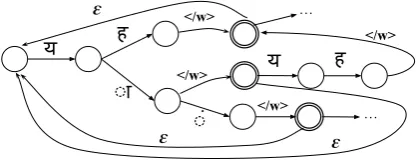
character label strings. Fig. 6 shows the structure of the optimizedL◦Gautomaton.
The construction ofL◦Gis as follows. Starting with G, replace each non-backoff arc – i.e., arcs with word labels rather thanϵ– with a linear path corresponding to the word’s symbols followed by
[image:6.595.84.281.212.342.2]un-:(s:स)
a:
h:
a) b)
s:
:(sa:स) s:
:(s:स ्) :(sha:श) s:
s: :(s:स ्) s: :(s:स)
h:
a:
a:
:(sha:श)
a:
:(sa:स)
c)
s: :(s:स) :(s:स ्)
h:
a:(sha:श)
[image:7.595.98.498.65.168.2]a:(sa:स)
Figure 5: Fragments of transducers mapping from input Unicode symbols to symbols in the pair language model: a) with extra transition allowing for determinization; b) determinized on the encoded symbols; and c) combining sequential output and inputϵtransitions. Parentheses are just to assist disambiguation in the figure.
य ह
◌ा
</w>
◌ं
य ह
. . . . . .
</w>
</w>
</w>
Figure 6: Illustration of the topology ofL◦G, for a frag-ment beginning at the unigram state containing the wordsया,
यां, andयह, with the word end delimiter </w>. Weights are omitted.
changed, and weights are 8-bit quantized. Finally, the automaton is encoded using a variation of the
LOUDS-based representation in Sorensen and Al-lauzen (2011). The topology of L◦ G does not permit the use of the context trees from that
rep-resentation. Instead, we store explicit 32-bit next state IDs for each backoff arc, indexed by rank in an indicator bit vector over states. We also store
a bit vector indicating which states have a context transition arc, which must be an outgoing arc with the word end label. To find the destination state
for these arcs, we recursively follow backoff arcs from the most recent word boundary state in the L◦Gtraversal until we’re able to successfully find
a context match.
Note that this structure is suboptimal in state/arc size, since common suffixes (tails) are not merged.
But the topology allows for the LOUDS-based en-coding which is more compact than a general com-paction method could achieve on a more minimal
but less regular topology.
3.4 Transliteration cost normalization
One key complication is the need for a conditional (not joint) transliteration model. The overall joint
model of the words, transliterations, and touch points must be broken down into probabilities of: (1) the words (language modelG); (2) the
translit-eration giventhe words; and (3) the touch points given the romanized symbols. Yet the translitera-tion modelTis a joint model of aligned romanized and word strings. Thus each word requires an ad-ditional normalization factor.
We achieve this by dividing the probability of
eachwoutput byL◦Gby the marginalization sum:
Nw= ∑
s,t∈T|concat(t)=w
PT(s,t)
wheres andtare input and output sequences in
the source and target scripts, respectively. Notice that in the log semiring,Nw is simply the weight of the shortest path inT that outputs an encoding ofw. Thus, we projectT ◦Lto output labels, de-terminize, invert weights, and compose the result withLto get a “conditional lexicon”L′, such that T◦L′◦Gmodels the joint probability of a sequence
of words and a corresponding transliteration. We distribute this normalization factor via
weighted determinization when building the trie leaving each language model state, as discussed in Section 3.3 and shown in Figure 6. Similar to the
weight pushing that we get when determinizing the transliteration transducer, we put the negative nor-malization cost on the first arc of each path, then
determinize, which distributes the weights cor-rectly, and finally take the negative again to yield the correct normalization factor, which is now
ac-crued incrementally at each character. Finally, to achieve full weight pushing in theL◦G, we push the language model weights.
In addition to decoding sequences of taps and
gestures, our keyboard application implements functionality that predicts the most likely comple-tions and next word prediccomple-tions (Ouyang et al.,
[image:7.595.77.286.232.312.2]en-countered. However, note that theL′◦GFST de-scribed above has the transliteration normalization factor built into the cost. Thus we require a further
modification to the next word prediction algorithm to remove the normalization factors: we store the normalization factors in a LOUDS trie (Delpratt
et al., 2006) over the lexicon, and adjust the next word prediction costs correspondingly.
3.5 Decoder optimization
For conventional models, our keyboard decoder (Ouyang et al., 2017) uses on-the-fly composition of(C◦L)(statically composed) andGusing look-ahead composition filters (Allauzen et al., 2009). Because of the ambiguity of transliteration, a stat-ically composedC◦T◦Lis typically too large for a mobile application. For example, in a conven-tional Hindi model, C ◦L contained fewer than 500k arcs, while incorporatingT resulted in 35M arcs, requiring over 800 MB of storage. We ad-dressed this by refactoring the composition so that a staticC◦T is composed on-the-fly with a static L◦G. With the optimizations discussed in
previ-ous sections, the former consists of approximately 100k arcs (1.7 MB), and the latter approximately
3M arcs (6.7 MB), which both fit within our con-straints.
While the decoder graph optimizations achieve
good model size characteristics, the overall num-ber of states and arcs is much higher than in con-ventional models. If we use the same decoder meta-parameters as we do for a non-transliteration
model, the decoder will search many more states, increasing latency and memory use. We em-ployed the following optimizations, relative to
non-transliterated models, to remain within our de-sired constraints:
Reduced beam width. The decoder prunes low-scoring hypotheses more aggressively.
Stricter error correction model. The decoder supports correction of insertion, substitution, and
deletion errors (Ouyang et al., 2017). This model is assumed to be independent from the translitera-tion model, whereas in fact there is some overlap.
For instance, doubling or interchanging vowels is one common source of transliteration ambiguity. We lowered probabilities in the edit model to help
offset this.
Stricter spatial model. We used a slightly lower Gaussian variance in the tapping model, optimized for WER by sweeping over settings.
[image:8.595.312.521.60.232.2]Latency per word (ms)
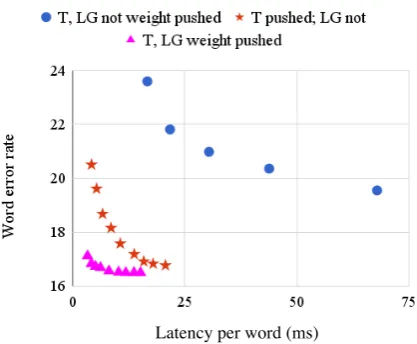
Figure 7: Sweep over beam sizes on Hindi dev set before and after transliteration transducerTweight pushing andL◦
Gweight pushing.
4 Experiments
4.1 Data
As is typical with non-transliterated systems, we use low order n-gram language models over a lim-ited vocabulary. For the current study, vocabulary
was 150k words and models were pruned trigrams with 750k n-grams.
Transliteration model training data consists of individual word transliterations for each native word in the vocabulary, collected from a small
number (approximately 5) of speakers drawn from a larger overall pool of speakers. Each pair of (na-tive word, transliteration) constituted one training
instance used by the pair LM method described in Section 3.1. We ensured, using random sampling where necessary, that all words in the native vo-cabulary had the same number of training instances
to avoid introducing bias.
Performance was evaluated on blind test datasets of tapped and gestured sentences in Hindi and Tamil (over 3000 words total for each input
modality and language). In the data collection study, participants tapped and gestured sentences written in the native script on a smartphone
QWERTY keyboard that produced no output, using their preferred transliteration. The prompts were sentences sampled from transcribed speech interactions. Participants were asked to type at
a natural pace and not worry about fixing any mistakes, to collect natural errors and test the correction capability of the decoder and
L◦Gsize (MB)
[image:9.595.100.259.62.104.2]Language standard compact LOUDS Hindi 85.3 26.3 6.72 Tamil 126.5 37.1 9.80
Table 1: Size savings via LOUDSL◦Gconstruction.
presented as a percentage.
The baseline system in our experiments comes
from the Google Indic Keyboard, an existing prod-uct with between 50 and 100 million installations from the Google Play Store. It uses an HMM-based decoder, with a standard n-gram language
model and a transliteration component consisting of conditional probability distributions P(s | t) trained using the EM algorithm over a set of
sub-word (primarily syllable) transliteration rules. The sub-word transliteration probabilities are assumed to be independent, in contrast to our approach. For
this study, its language model and transliteration training data were identical to our system.
4.2 WFST optimizations
Table 1 presents the size in megabytes of theL◦ G compiled in the standard way, with a general
method of compression (compact), and with the specialized LOUDS format.
Figure 7 presents a sweep over beam search pa-rameters on the Hindi dev set, for identical
mod-els compiled with and without weight pushing. As can be seen from that plot, with both transliteration transducer optimization (section 3.2) andL◦G op-timization (section 3.3), very large latency
reduc-tions were achieved versus the unoptimized sys-tem, yielding the lowest word error rate along with the lowest latencies.3 Due to these optimizations, low word error rates are achieved within the la-tency constraints imposed by the application.
4.3 Blind test evaluation
After setting meta-parameters on the development set for Hindi, we ran the decoder on blind test sets
for both Hindi and Tamil. Table 2 presents a com-parison between the WFST-based decoder and a baseline system.
5 Summary and future directions
We have presented a WFST-based approach to transliteration support in keyboards on mobile
de-3
Active memory usage is highly correlated with latency – being due to decoder search – hence we do not show that plot, though it shows a similar trend.
[image:9.595.320.514.64.104.2]Hindi Tamil System WER LPC WER LPC Baseline HMM system 19.5 3.0 26.2 2.1 WFST-based 16.4 0.5 22.6 0.2
Table 2: Word error rate (WER) and latency per character (LPC) results on blind test sets.
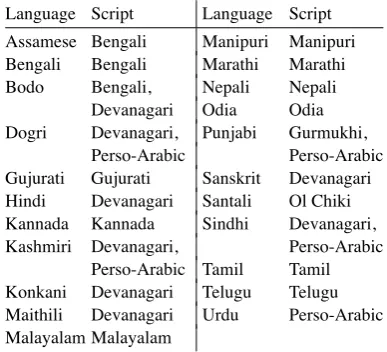
Language Script Language Script Assamese Bengali Manipuri Manipuri Bengali Bengali Marathi Marathi Bodo Bengali, Nepali Nepali
Devanagari Odia Odia Dogri Devanagari, Punjabi Gurmukhi,
Perso-Arabic Perso-Arabic Gujurati Gujurati Sanskrit Devanagari Hindi Devanagari Santali Ol Chiki Kannada Kannada Sindhi Devanagari, Kashmiri Devanagari, Perso-Arabic
Perso-Arabic Tamil Tamil Konkani Devanagari Telugu Telugu Maithili Devanagari Urdu Perso-Arabic Malayalam Malayalam
Table 3: Languages and scripts launched in GBoard using the methods presented in this paper.
vices, with specific results in South Asian lan-guages. The presented WFST optimization meth-ods yielded very large model size reductions,
crit-ical for on-device models. We also presented weight pushing approaches that yielded large speedups in decoding, with a commensurate
reduc-tion in active memory usage. The resulting system achieves large accuracy improvements in addition to strong latency reductions.
This approach has been used to build translitera-tion keyboard systems for the 22 languages shown
in Table 3, some of which can be transliterated to different scripts. These keyboards were launched as part of Google Gboard in the first half of 2017.
We continue to investigate new methods for train-ing such models, includtrain-ing jointly traintrain-ing target script language models and transliteration models.
Acknowledgments
Thanks to Daan van Esch, Elnaz Sarbar and Cory Massaro for invaluable support with data curation;
to Richard Sproat for useful guidance at the outset of this project and helpful perspectives throughout; and to Yuanbo Zhang for helping understand the
[image:9.595.319.513.149.325.2]References
Umair Z Ahmed, Kalika Bali, Monojit Choudhury, and Sowmya VB. 2011. Challenges in designing in-put method editors for Indian languages: The role of word-origin and context. Workshop on Advances in Text Input Methods (WTIM 2011), pages 1–9.
Cyril Allauzen, Mehryar Mohri, and Brian Roark. 2003. Generalized algorithms for constructing sta-tistical language models. InProceedings of the 41st Annual Meeting on Association for Computational Linguistics, pages 40–47.
Cyril Allauzen, Michael Riley, Johan Schalkwyk, Wo-jciech Skut, and Mehryar Mohri. 2007. OpenFst: A general and efficient weighted finite-state transducer library. InImplementation and Application of Au-tomata, pages 11–23. Springer.
Cyril Allauzen, Michael Riley, and Johan Schalkwyk. 2009. A generalized composition algorithm for weighted finite-state transducers. InProceedings of Interspeech, pages 1203–1206.
Maximilian Bisani and Hermann Ney. 2008. Joint-sequence models for grapheme-to-phoneme conver-sion.Speech Communication, 50(5):434–451.
Hsin-Hsi Chen, Sheng-Jie Hueng, Yung-Wei Ding, and Shih-Chung Tsai. 1998. Proper name translation in cross-language information retrieval. In Proceed-ings of the 36th Annual Meeting of the Associa-tion for ComputaAssocia-tional Linguistics and 17th Inter-national Conference on Computational Linguistics-Volume 1, pages 232–236. Association for Compu-tational Linguistics.
O’Neil Delpratt, Naila Rahman, and Rajeev Raman. 2006. Engineering the louds succinct tree repre-sentation. In Carme Àlvarez and María Serna, ed-itors, Experimental Algorithms: 5th International Workshop, WEA 2006, Cala Galdana, Menorca, Spain, May 24-27, 2006. Proceedings, pages 134– 145. Springer Berlin Heidelberg, Berlin, Heidelberg.
Parth Gupta, Kalika Bali, Rafael E Banchs, Monojit Choudhury, and Paolo Rosso. 2014. Query expan-sion for mixed-script information retrieval. In Pro-ceedings of the 37th international ACM SIGIR con-ference on Research & development in information retrieval, pages 677–686. ACM.
Li Haizhou, Zhang Min, and Su Jian. 2004. A joint source-channel model for machine transliteration. In Proceedings of the 42nd Annual Meeting on associ-ation for Computassoci-ational Linguistics, page 159. As-sociation for Computational Linguistics.
Kevin Knight and Jonathan Graehl. 1998. Ma-chine transliteration. Computational Linguistics, 24(4):599–612.
Mehryar Mohri, Fernando Pereira, and Michael Ri-ley. 2002. Weighted finite-state transducers in speech recognition. Computer Speech & Language, 16(1):69–88.
Josef R Novak, Nobuaki Minematu, and Keikichi Hi-rose. 2013. Failure transitions for joint n-gram mod-els and g2p conversion. In Proceedings of Inter-speech.
Josef Robert Novak, Nobuaki Minematsu, and Keikichi Hirose. 2015. Phonetisaurus: Exploring grapheme-to-phoneme conversion with joint n-gram models in the WFST framework.Natural Language Engineer-ing, pages 1–32.
Tom Ouyang, David Rybach, Françoise Beaufays, and Michael Riley. 2017. Mobile keyboard input de-coding with finite-state transducers. arXiv preprint arXiv:1704.03987.
Daniel Povey, Arnab Ghoshal, Gilles Boulianne, Lukas Burget, Ondrej Glembek, Nagendra Goel, Mirko Hannemann, Petr Motlicek, Yanmin Qian, Petr Schwarz, et al. 2011. The Kaldi speech recogni-tion toolkit. InIEEE workshop on automatic speech recognition and understanding (ASRU).
Kanishka Rao, Fuchun Peng, Haşim Sak, and Françoise Beaufays. 2015. Grapheme-to-phoneme conver-sion using long short-term memory recurrent neural networks. InProceedings of ICASSP, pages 4225– 4229.
Brian Roark, Richard Sproat, Cyril Allauzen, Michael Riley, Jeffrey Sorensen, and Terry Tai. 2012. The OpenGrm open-source finite-state grammar soft-ware libraries. InProceedings of the ACL 2012 Sys-tem Demonstrations, pages 61–66.
Jeffrey Sorensen and Cyril Allauzen. 2011. Unary data structures for language models. InProceedings of Interspeech, pages 1425–1428.
Richard Sproat. 2003. A formal computational analy-sis of Indic scripts. InInternational symposium on Indic scripts: past and future, Tokyo.
Paola Virga and Sanjeev Khudanpur. 2003. Transliter-ation of proper names in cross-lingual informTransliter-ation retrieval. In Proceedings of the ACL 2003 work-shop on Multilingual and mixed-language named en-tity recognition-Volume 15, pages 57–64. Associa-tion for ComputaAssocia-tional Linguistics.
Ke Wu, Cyril Allauzen, Keith Hall, Michael Riley, and Brian Roark. 2014. Encoding linear models as weighted finite-state transducers. InProceedings of Interspeech.