Concavity and Initialization for Unsupervised Dependency Parsing
Kevin Gimpel and Noah A. Smith
Language Technologies Institute Carnegie Mellon University Pittsburgh, PA 15213, USA
{kgimpel,nasmith}@cs.cmu.edu
Abstract
We investigate models for unsupervised learn-ing with concave log-likelihood functions. We begin with the most well-known example, IBM Model 1 for word alignment (Brown et al., 1993) and analyze its properties, dis-cussing why other models for unsupervised learning are so seldom concave. We then present concave models for dependency gram-mar induction and validate them experimen-tally. We find our concave models to be effec-tive initializers for the dependency model of Klein and Manning (2004) and show that we can encode linguistic knowledge in them for improved performance.
1 Introduction
In NLP, unsupervised learning typically implies op-timization of a “bumpy” objective function riddled with local maxima. However, one exception is IBM Model 1 (Brown et al., 1993) for word alignment, which is the only model commonly used for unsu-pervised learning in NLP that has a concave log-likelihood function.1 For other models, such as those used in unsupervised part-of-speech tagging and grammar induction, and indeed for more sophis-ticated word alignment models, the log-likelihood function maximized by EM is non-concave. As a result, researchers are obligated to consider initial-ization in addition to model design (Klein and Man-ning, 2004; Goldberg et al., 2008).
For example, consider the dependency grammar induction results shown in Table 1 when training the
1
It is notstrictlyconcave (Toutanova and Galley, 2011).
widely used dependency model with valence (DMV; Klein and Manning, 2004). Using uniform distri-butions for initialization (UNIF) results in an
accu-racy of 17.6% on the test set, well below the base-line of attaching each word to its right neighbor (ATTACHRIGHT, 31.7%). Furthermore, when using
a set of 50 random initializers (RAND), the standard
deviation of the accuracy is an alarming 8.3%. In light of this sensitivity to initialization, it is compelling to consider unsupervised models with concave log-likelihood functions, which may pro-vide stable, data-supported initializers for more complex models. In this paper, we explore the issues involved with such an expedition and elucidate the limitations of such models for unsupervised NLP. We then present simple concave models for depen-dency grammar induction that are easy to implement and offer efficient optimization. We also show how linguistic knowledge can be encoded without sacri-ficing concavity. Using our models to initialize the DMV, we find that they lead to an improvement in average accuracy across 18 languages.
2 IBM Model 1 and Concavity
IBM Model 1 is a conditional model of a target-language sentenceeof lengthm and an alignment
a given a source-language sentence f of length l. The generation ofmis assumed to occur with some (inconsequential) uniform probability. The align-ment vector a, a hidden variable, has an entry for each element of e that contains the index in f of the aligned word. These entries are used to define which translation parameterst(ej | faj)are active.
Model 1 assumes that the probability of theith
ment in a, denoted a(i | j, l, m), is simply a uni-form distribution over all l source words plus the null word. These assumptions result in the follow-ing log-likelihood for a sentence pair hf,ei under Model 1 (marginalizinga):
logp(e|f) = log(l+1) m+ Pm
j=1log Pl
i=0t(ej |fi)
(1) The only parameters to be learned in the model are
t = {t(e |f)}e,f. Since a parameter is concave in itself, the sum of concave functions is concave, and the log of a concave function is concave, Eq. 1 is concave int(Brown et al., 1993).
IBM Model 2 involves a slight change to Model 1 in which the probability of a word link depends on the word positions. However, this change renders it no longer concave. Consider the log-likelihood function for Model 2:
log+Pm
j=1log Pl
i=0t(ej |fi)·a(i|j, l, m) (2)
Eq. 2 is not concave in the parameterst(ej |fi)and a(i|j, l, m)because a product is neither convex nor concave in its vector of operands. This can be shown by computing the Hessian matrix off(x, y) = xy and showing that it is indefinite.
In general, concavity is lost when the log-likelihood function contains a product of model pa-rameters enclosed within alogP
. If the sum is not present, the log can be used to separate the prod-uct of parameters, making the function concave. It can also be shown that a “featurized” version (Berg-Kirkpatrick et al., 2010) of Model 1 is not con-cave. More generally, any non-concave function en-closed within logP
will cause the log-likelihood function to be non-concave, though there are few other non-concave functions with a probabilistic se-mantics than those just discussed.
3 Concave, Unsupervised Models
Nearly every other model used for unsupervised learning in NLP has a non-concave log-likelihood function. We now proceed to describe the conditions necessary to develop concave models for two tasks.
3.1 Part-of-Speech Tagging
Consider a standard first-order hidden Markov model for POS tagging. Letting y denote the tag
sequence for a sentenceewithmtokens, the single-example log-likelihood is:
logP
yp(stop|ym)
Qm
j=1p(yj |yj−1)·p(ej |yj)
(3) wherey0is a designated “start” symbol. Unlike IBM
Models 1 and 2, we cannot reverse the order of the summation and product here because the transition parametersp(yj | yj−1) cause each tag decision to
affect its neighbors. Therefore, Eq. 3 is non-concave due to the presence of a product within alogP
. However, if the tag transition probabilitiesp(yj | yj−1) are all constants and also do not depend on the previous tagyj−1, then we can rewrite Eq. 3 as
the following concave log-likelihood function (using C(y)to denote a constant function of tagy, e.g., a fixed tag prior distribution):
logC(stop) + logQm
j=1 P
yjC(yj)·p(ej |yj)
Lacking any transition modeling power, this model appears weak for POS tagging. However, we note that we can add additional conditioning information to thep(ej | yj) distributions and retain concavity, such as nearby words and tag dictionary informa-tion. We speculate that such a model might learn useful patterns about local contexts and provide an initializer for unsupervised part-of-speech tagging.
3.2 Dependency Grammar Induction
To develop dependency grammar induction models, we begin with a version of Model 1 in which a sen-tenceeis generated from a copy of itself (denoted
e0):logp(e|e0)
= log(m+1) m + Pm
j=1log Pm
i=0,i6=jc(ej |e0i) (4)
If a wordej is “aligned” to e00, ej is a root. This is a simple child-generation model with no tree con-straint. In order to preserve concavity, we are forbid-den from conditioning on other parent-child assign-ments or including any sort of larger constraints.
We note that we can also include constraints in the sum over possible parents and still preserve concav-ity. Naseem et al. (2010) found that adding parent-child constraints to a grammar induction system can improve performance dramatically. We employ one simple rule: roots are likely to be verbs.2 We mod-ify CCV1 to restrict the summation over parents to excludee00if the child word is not a verb.3 We only employ this restriction during EM learning for sen-tences containing at least one verb. For sensen-tences without verbs, we allow all words to be the root. We denote this model byCCV2.
In related work, Brody (2010) also developed grammar induction models based on the IBM word alignment models. However, while our goal is to develop concave models, Brody employed Bayesian nonparametrics in his version of Model 1, which makes the model non-concave.
4 Experiments
We ran experiments to determine how well our con-cave grammar induction modelsCCV1andCCV2can perform on their own and when used as initializers for the DMV (Klein and Manning, 2004). The DMV is a generative model of POS tag sequences and pro-jective dependency trees over them. It is the foun-dation of most state-of-the-art unsupervised gram-mar induction models (several of which are listed in Tab. 1). The model includes multinomial distribu-tions for generating each POS tag given its parent and the direction of generation: whereeiis the par-ent POS tag andej the child tag, these distributions take the formc(ej | ei,sign(j−i)), analogous to the distributions used in our concave models. The DMV also has multinomial distributions for decid-ing whether to stop or continue generatdecid-ing children in each direction considering whether any children have already been generated in that direction.
The majority of researchers use the original ini-tializer from Klein and Manning (2004), denoted hereK&M.K&Mis a deterministic harmonic initial-izer that sets parent-child token affinities inversely
2
This is similar to the rule used by Mareˇcek and ˇZabokrtsk´y (2011) with empirical success.
3As verbs, we take all tags that map to V in the universal tag mappings from Petrov et al. (2012). Thus, to apply this con-straint to a new language, one would have to produce a similar tag mapping or identify verb tags through manual inspection.
Train≤10 Train≤20
Test Test
Model Init. ≤10 ≤ ∞ ≤10 ≤ ∞
ATTRIGHT N/A 38.4 31.7 38.4 31.7 CCV1 UNIF 31.4 25.6 31.0 23.7 CCV2 UNIF 43.1 28.6 43.9 27.1 UNIF 21.3 17.6 21.3 16.4 RAND∗ 41.0 31.8 - -DMV K&M 44.1 32.9 51.9 37.8
CCV1 45.3 30.9 53.9 36.7 CCV2 54.3 43.0 64.3 53.1 Shared LN K&M 61.3 41.4
L-EVG RAND† 68.8
-Feature DMV K&M 63.0 -LexTSG-DMV K&M 67.7 55.7 Posterior Reg. K&M 64.3 53.3
[image:3.612.315.543.58.268.2]Punc/UTags K&M0 - 59.1‡
Table 1: English attachment accuracies on Section 23, for short sentences (≤10words) and all (≤∞). We include selected results on this same test set: Shared LN = Cohen and Smith (2009), L-EVG = Headden III et al. (2009), Feature DMV = Berg-Kirkpatrick et al. (2010), LexTSG-DMV = Blunsom and Cohn (2010), Posterior Reg. = Gillenwater et al. (2010), Punc/UTags = Spitkovsky et al. (2011a). K&M0 is from Spitkovsky et al. (2011b). ∗Accuracies are averages over 50 random initializers;
σ= 10.9for test sentences≤10and 8.3 for all. †Used many random initializers with unsupervised run selec-tion.‡Used staged training with sentences≤45words.
proportional to their distances, then normalizes to obtain probability distributions. K&M is often de-scribed as corresponding to an initial E step for an unspecified model that favors short attachments.
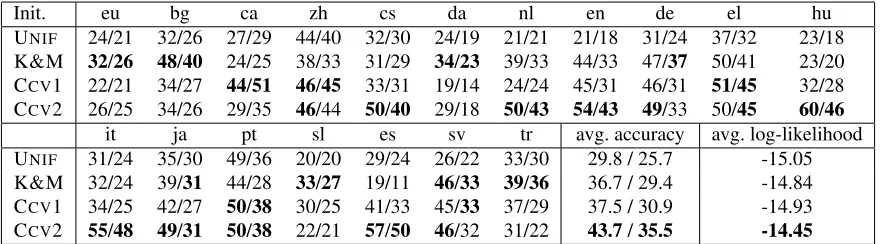
Init. eu bg ca zh cs da nl en de el hu UNIF 24/21 32/26 27/29 44/40 32/30 24/19 21/21 21/18 31/24 37/32 23/18 K&M 32/26 48/40 24/25 38/33 31/29 34/23 39/33 44/33 47/37 50/41 23/20 CCV1 22/21 34/27 44/51 46/45 33/31 19/14 24/24 45/31 46/31 51/45 32/28 CCV2 26/25 34/26 29/35 46/44 50/40 29/18 50/43 54/43 49/33 50/45 60/46
[image:4.612.87.527.57.179.2]it ja pt sl es sv tr avg. accuracy avg. log-likelihood UNIF 31/24 35/30 49/36 20/20 29/24 26/22 33/30 29.8 / 25.7 -15.05 K&M 32/24 39/31 44/28 33/27 19/11 46/33 39/36 36.7 / 29.4 -14.84 CCV1 34/25 42/27 50/38 30/25 41/33 45/33 37/29 37.5 / 30.9 -14.93 CCV2 55/48 49/31 50/38 22/21 57/50 46/32 31/22 43.7/35.5 -14.45
Table 2: Test set attachment accuracies for 18 languages; first number in each cell is accuracy for sentences≤ 10
words and second is for all sentences. For training, sentences≤10words from each treebank were used. In order, languages are Basque, Bulgarian, Catalan, Chinese, Czech, Danish, Dutch, English, German, Greek, Hungarian, Italian, Japanese, Portuguese, Slovenian, Spanish, Swedish, and Turkish.
Data We use data prepared for the CoNLL 2006/07 shared tasks (Buchholz and Marsi, 2006; Nivre et al., 2007).4 We follow standard practice in removing punctuation and using short sentences (≤10 or≤20 words) for training. For all experi-ments, we train on separate data from that used for testing and use gold POS tags for both training and testing. We report accuracy on (i) test set sentences
≤10words and (ii) all sentences from the test set.
Results Results for English are shown in Tab. 1. We train on §2–21 and test on §23 in the Penn Tree-bank. The constraint on sentence roots helps a great deal, asCCV2by itself is competitive with the DMV when testing on short sentences. The true benefit of the concave models, however, appears when using them as initializers. The DMV initialized withCCV2
achieves a substantial improvement over all others. When training on sentences of length ≤20 words (bold), the performance even rivals that of several more sophisticated models shown in the table, de-spite only using the DMV with a different initializer. Tab. 2 shows results for 18 languages. On av-erage, CCV2 performs best and CCV1 does at least as well asK&M. This shows that a simple, concave model can be as effective as a state-of-the-art hand-designed initializer (K&M), and that concave mod-els can encode linguistic knowledge to further im-prove performance.
4
In some cases, we did not use official CoNLL test sets but instead took the training data and reserved the first 80% of the sentences for training, the next 10% for development, and the final 10% as our test set; dataset details are omitted for space but are the same as those given by Cohen (2011).
Average log-likelihoods (micro-averaged across sentences) achieved by EM training are shown in the final column of Tab. 2. CCV2 leads to substantially-higher likelihoods than the other initializers, sug-gesting that the verb-root constraint is helping EM to find better local optima.5
5 Discussion
Staged training has been shown to help unsupervised learning in the past, from early work in grammar in-duction (Lari and Young, 1990) and word alignment (Brown et al., 1993) to more recent work in depen-dency grammar induction (Spitkovsky et al., 2010). While we do not yet offer a generic procedure for extracting a concave approximation from any model for unsupervised learning, our results contribute evi-dence in favor of the general methodology of staged training in unsupervised learning, and provide a sim-ple and powerful initialization method for depen-dency grammar induction.
Acknowledgments
We thank Shay Cohen, Dipanjan Das, Val Spitkovsky, and members of the ARK research group for helpful com-ments that improved this paper. This research was sup-ported in part by the NSF through grant IIS-0915187, the U. S. Army Research Laboratory and the U. S. Army Re-search Office under contract/grant number W911NF-10-1-0533, and Sandia National Laboratories (fellowship to K. Gimpel).
References
T. Berg-Kirkpatrick, A. Bouchard-Cˆot´e, J. DeNero, and D. Klein. 2010. Painless unsupervised learning with features. InProc. of NAACL.
P. Blunsom and T. Cohn. 2010. Unsupervised induction of tree substitution grammars for dependency parsing. InProc. of EMNLP.
S. Brody. 2010. It depends on the translation: Unsu-pervised dependency parsing via word alignment. In
Proc. of EMNLP.
P. F. Brown, S. A. Della Pietra, V. J. Della Pietra, and R. L. Mercer. 1993. The mathematics of statistical machine translation: Parameter estimation. Computa-tional Linguistics, 19(2):263–311.
S. Buchholz and E. Marsi. 2006. CoNLL-X shared task on multilingual dependency parsing. InProc. of CoNLL.
S. Cohen and N. A. Smith. 2009. Shared logistic normal distributions for soft parameter tying in unsupervised grammar induction. InProc. of NAACL.
S. Cohen. 2011. Computational Learning of Probabilis-tic Grammars in the Unsupervised Setting. Ph.D. the-sis, Carnegie Mellon University.
J. Gillenwater, K. Ganchev, J. Grac¸a, F. Pereira, , and B. Taskar. 2010. Posterior sparsity in unsupervised dependency parsing. Journal of Machine Learning Research.
Y. Goldberg, M. Adler, and M. Elhadad. 2008. EM can find pretty good HMM POS-taggers (when given a good start). InProc. of ACL.
W. Headden III, M. Johnson, and D. McClosky. 2009. Improving unsupervised dependency parsing with richer contexts and smoothing. InProc. of NAACL. D. Klein and C. D. Manning. 2004. Corpus-based
induc-tion of syntactic structure: Models of dependency and constituency. InProc. of ACL.
K. Lari and S. J. Young. 1990. The estimation of stochas-tic context-free grammars using the inside-outside al-gorithm. Computer Speech and Language, 4:35–56. D. Mareˇcek and Z. ˇZabokrtsk´y. 2011. Gibbs sampling
with treeness constraint in unsupervised dependency parsing. In Proc. of Workshop on Robust Unsuper-vised and SemisuperUnsuper-vised Methods in Natural Lan-guage Processing.
T. Naseem, H. Chen, R. Barzilay, and M. Johnson. 2010. Using universal linguistic knowledge to guide gram-mar induction. InProc. of EMNLP.
J. Nivre, J. Hall, S. K¨ubler, R. McDonald, J. Nils-son, S. Riedel, and D. Yuret. 2007. The CoNLL 2007 shared task on dependency parsing. InProc. of CoNLL.
S. Petrov, D. Das, and R. McDonald. 2012. A universal part-of-speech tagset. InProc. of LREC.
V. I. Spitkovsky, H. Alshawi, and D. Jurafsky. 2010. From Baby Steps to Leapfrog: How “Less is More” in unsupervised dependency parsing. In Proc. of NAACL-HLT.
V. I. Spitkovsky, H. Alshawi, A. X. Chang, and D. Juraf-sky. 2011a. Unsupervised dependency parsing with-out gold part-of-speech tags. InProc. of EMNLP. V. I. Spitkovsky, H. Alshawi, and D. Jurafsky. 2011b.
Punctuation: Making a point in unsupervised depen-dency parsing. InProc. of CoNLL.