Volume 2006, Article ID 27390, Pages1–12 DOI 10.1155/ASP/2006/27390
Semantic Context Detection Using Audio Event Fusion:
Camera-Ready Version
Wei-Ta Chu,1Wen-Huang Cheng,2and Ja-Ling Wu1, 2
1Department of Computer Science and Information Engineering, National Taiwan University, Taipei 106, Taiwan 2Graduate Institute of Networking and Multimedia, National Taiwan University, Taipei 106, Taiwan
Received 31 August 2004; Revised 20 February 2005; Accepted 5 April 2005
Semantic-level content analysis is a crucial issue in achieving efficient content retrieval and management. We propose a hierarchical approach that models audio events over a time series in order to accomplish semantic context detection. Two levels of modeling, audio event and semantic context modeling, are devised to bridge the gap between physical audio features and semantic concepts. In this work, hidden Markov models (HMMs) are used to model four representative audio events, that is, gunshot, explosion, engine, and car braking, in action movies. At the semantic context level, generative (ergodic hidden Markov model) and dis-criminative (support vector machine (SVM)) approaches are investigated to fuse the characteristics and correlations among audio events, which provide cues for detecting gunplay and car-chasing scenes. The experimental results demonstrate the effectiveness of the proposed approaches and provide a preliminary framework for information mining by using audio characteristics.
Copyright © 2006 Hindawi Publishing Corporation. All rights reserved.
1. INTRODUCTION
As the rapid advance in media creation, storage, and com-pression technologies, large amounts of multimedia content have been created and disseminated by various ways. Massive multimedia data challenge users in content browsing and re-trieving, thereby motivating the urging needs of information
mining technologies. To facilitate effective or efficient
mul-timedia document indexing, many research issues have been investigated. Shot boundary detection algorithms are amply
studied [1,2] to discover the structure of video. With the
un-derstanding of video structure, video adaptation applications [3] are then developed to manipulate information more flex-ibly. Moreover, techniques for genre classification are also in-vestigated to facilitate browsing and retrieval. Audio
classifi-cation and segmentation techniques [4,5] are proposed to
discriminate different types of audio, such as speech, mu-sic, noise, and silence. Additional work focuses on classify-ing musical sounds [6] and automatically constructclassify-ing mu-sic snippets [7]. For video content, genres of films [8] and TV programs [9] are automatically classified by exploring various features. Features from audio, video, and text [10] could be exploited to perform content analysis, and
multi-modal approaches are proposed to efficiently cope with the
access and retrieval issues of multimedia content.
On the basis of physical features, the paradigms described above are developed to automatically analyze multimedia
content. However, they pose many problems in today’s ap-plications. The semantic gap between low-level features and high-level concepts degrades the performance of multimedia content management systems. Similarities in low-level fea-tures do not certainly match with user’s perception. Scenes or shots are associated due to semantics rather than physical features like color layouts and motion trajectories. Therefore, it would be more reasonable to discover information from meaningful events or objects rather than physical features.
To diminish the differences between analysis results and
user’s expectation, two research directions are emerged. The first is to detect attractive parts of movies or TV programs by exploiting the domain knowledge and production rules. According to media aesthetics [11], which includes the study and analysis of media elements commonly applied, the re-lated studies attempt to uncover the semantic and semiotic information by computational frameworks. Preliminary re-sults have been reported on film tempo analysis [12] and scare scene detection in horror movies [13].
Semantic indexing is another emerging study that iden-tifies objects and events in audiovisual streams and facili-tates semantic retrieval or information mining. The major challenge of this work is to bridge the gaps between physi-cal features and semantic concepts. Studies on semantic in-dexing can be separated into two levels: isolated audio/video event detection and semantics identification. Former
Gunplay scene Gunplay scene
t1 t2 t3 t4 t5 t6 t7 t8
Gunshot Explosion
Audio
Figure1: Examples of audio semantic contexts.
tackle event detection. Audio events such as applause, laugh-ter, and cheer are modeled. However, in today’s applications, detecting isolated audio/video events is not quite intuitive to users. For example, rather than identifying individual gun-shots in an action movie, we are more likely to recognize a scene of gunplay, which may consist of a series of gunshots, explosions, sounds of jeeps, and screams from soldiers. Such a scene conveys a solid semantic meaning and is at a reason-able granularity for semantic retrieval. For modeling visual semantics, some approaches based on Bayesian network [16] and support vector machine [17] have been proposed to fuse the information of visual events and to infer some semantic concepts, such as “outdoor” or “beach” concepts. However, few studies are reported to perform audio-based semantic context detection. In some types of videos, such as action movies, audio information plays a more important role than visual ones. For example, a gunplay scene may occur in a rainforest or a downtown street, at day or night, which has significant variations in vision. On the contrary, aural infor-mation remains similar in different gunplay scenes, and some typical audio events (e.g., gunshot and explosion sounds in gunplay scenes) significantly provide the clues for detecting semantic concepts.
Due to rapid shot changes and dazzling visual varia-tions in action movies, our studies focus on analyzing au-dio tracks and accomplish semantic indexing via aural clues. In this paper, an integrated hierarchical framework is pro-posed to detect two semantic contexts, that is, “gunplay” and “car chasing,” in action movies. To characterize these two se-mantic contexts by event fusion, “gunshot” and “explosion” sound effects are detected for “gunplay” scenes, and “car-braking” and “engine” sounds are detected for “car-chasing” scenes. For audio event modeling, HMM-based approaches that have been applied in visual event modeling [15] are used. Then, “gunplay” and “car-chasing” scenes are modeled based on the statistical information from audio event de-tection. For semantic context modeling, generative (hidden Markov model) and discriminative (support vector machine) approaches are investigated. We view semantic context detec-tion as a problem of pattern recognidetec-tion, and similar feature values (detection results of audio events) would be fused to represent a semantic context. For example, gunplay scenes may have similar gunshot and explosion occurrence patterns and are distinguished from other scenes by pattern
recogni-tion techniques. We discuss how the fusion approaches work and show the effectiveness of this event fusion framework. The results of semantic context detection can be applied to
multimedia indexing and facilitate efficient media access.
The remainder of this paper is organized as follows. Section 2 describes the definitions of audio event and se-mantic context and states the concept of hierarchical audio models. The audio features we used for event modeling are
briefly introduced inSection 3. InSection 4, HMMs are used
to model audio events, and we introduce the idea of event
fusion by constructing pseudosemantic features. Sections5
and6address issues on fusion schemes based on HMM and
SVM, respectively. Performance evaluation, comparison, and
some discussions are shown inSection 7, and the concluding
remarks are given inSection 8.
2. HIERARCHICAL AUDIO MODELS
The semantic indexing process is performed in a hierarchi-cal manner. At the audio event level, the characteristics of each audio event are modeled by an HMM in terms of the extracted audio features. At the semantic context level, the results of audio event detection are fused by using generative (HMM) or discriminative (SVM) schemes.
2.1. Audio event and semantic context
Audio events are defined as short audio clips which represent the sound of an object or an event. On the basis of elaborately selected audio features, fully connected (ergodic) HMMs are used to characterize audio events, with Gaussian mixtures modeling for each state. Four audio events, including gun-shot, explosion, engine, and car braking, are considered in this work.
In this study, we aim at indexing multimedia documents by detecting semantic concepts. A semantic concept may be derived from the association of various events. Therefore, we introduce the idea of modeling a semantic concept via the context of relevant events, which is then called semantic con-text for short. To characterize a semantic concon-text, the infor-mation of specific audio events, which are highly relevant to some semantic concepts, are collected and modeled. In ac-tion movies, the occurrences of gunshot and explosion events are used to characterize “gunplay” scenes. The occurrences of engine and car-braking events are used to characterize “car-chasing” scenes.
For a semantic context, there may be no specific evo-lution pattern along the time axis. For example, in a gun-play scene, we cannot expect that explosions always occur af-ter gunshots. Moreover, there may be some silence segments which contain no relevant audio events, but they are viewed
as parts of the same gunplay scene in human’s sense.Figure 1
illustrates examples of “gunplay” semantic concepts. The
au-dio clip fromt1 tot2 is a typical gunplay scene which
con-tains mixed relevant audio events. In contrast to this case, no
relevant event exists fromt4 tot5 and fromt6 tot7.
Calculation of confidence scores
Construction of pseudosemantic features Feature extraction
Input audio stream
HMM 1 HMM 2 · · · HMMk
SVM HMM
Confidence scores
Semantic context labels
(a) (b)
Figure2: The proposed hierarchical framework contains (a) audio event and (b) semantic context modeling.
clip” does not exceed users’ tolerance. Therefore, to model the characteristics of semantic contexts, we develop an ap-proach that takes a series of events along the time axis into account rather than just the information at a time instant.
Note that multiple audio events may occur
simultane-ously, as shown in the duration from t1 to t2 inFigure 1.
Some studies have been conducted to separate mixed audio signals in speech and music domains, by using independent component analysis [18]. The reported works are mainly performed on synthetically mixed audio signals or sounds recorded at simple acoustic conditions. However, separating
mixed audio effects recorded in complicated real-world
sit-uations is not widely studied. In this work, when multiple audio events are mixed, we simply select two representative events to describe the characteristics of the corresponding audio clip. Although separating mixed audio effects is pos-sible, elaborate studies on this issue are beyond the scope of this paper.
2.2. Hierarchical framework
The proposed framework consists of audio event and se-mantic context modeling. Some essential audio features from training corpus are first extracted and modeled by HMMs,
as shown inFigure 2(a). After constructing each audio event
model, the likelihood of a test audio segment with respect to each audio event can be computed through the Forward algorithm [19]. To determine how a segment is close to an audio event, a confidence metric based on the likelihood ra-tio test [20] is defined. We say that the segments with higher confidence scores from the gunshot model, for example, im-ply higher probability of the occurrence of gunshot sounds.
In the stage of semantic context modeling/detection, the confidence values from event detection constitute the cues
for characterizing high-level semantic contexts. The
pseu-dosemantic features that indicate the occurrences of events
are constructed to represent the association of audio clips.
We call them pseudosemantic features because they repre-sent the interrelationship of several audio events, which are grounds for users to realize what the clip presents. With these features, two approaches based on generative and discrimi-native strategies are investigated to model semantic contexts,
as shown inFigure 2(b). As the usage in pattern recognition
and data classification, HMM and SVM shed lights on clus-tering these pseudosemantic features and facilitate detection processes.
3. AUDIO FEATURE EXTRACTION
One important factor for pattern recognition is the selec-tion of suitable features that characterize original data ade-quately. To analyze audio sequences, several audio features from time-domain amplitude and frequency-domain spec-trogram are extracted and utilized. In our experiments, all audio streams are downsampled to the 16 KHz, 16 bits, and monochannel format. Each audio frame is of 25 millisec-onds, with 50% overlaps. Two types of features, that is,
perceptual features and Mel-frequency cepstral coefficients
(MFCC), are extracted from each audio frame. The percep-tual features include short-time energy, band energy ratio, zero-crossing rate, frequency centroid, and bandwidth [10]. These features are shown to be beneficial for audio analysis
and are widely adopted [4–7,14].
Short-time energy (STE) is the total spectrum power of an audio signal at a given time and is also referred to loud-ness or volume in the literature. It provides a convenient rep-resentation of the amplitude variations over time. To reduce the clip-level fluctuation of volume mean, we normalize the volume of a frame based on the maximum volume of the cor-responding audio clip.
ratio number is calculated from the energy of each band di-vided by the total energy value.
Zero-crossing rate (ZCR) is defined as the average num-ber of signal sign changes in an audio frame. It gives a rough estimate of frequency content and has been extensively used in many audio processing applications, such as voiced and unvoiced components discrimination, endpoint detection, and audio classification.
After Fourier transformation, frequency centroid (FC) and bandwidth (BW) are calculated to present the first- and second-order statistics of the spectrogram. They, respectively, represent the “center of gravity” and variances of the spec-trogram, and their reliability and effectiveness have been demonstrated in previous studies [10].
Mel-frequency cepstral coefficients (MFCCs) are the
most widely used features in speech recognition and other audio applications. They effectively represent human per-ception because the nonlinear scale property of frequencies in the human hearing system is considered. In this work, based on the suggestion in [21], 8-order MFCCs are com-puted from each frame.
The extracted features from each audio frame are con-catenated as a 16-dimensional (1(STE) + 4(BER) + 1(ZCR) + 1(FC) + 1(BW) + 8(MFCC)) feature vector. Details of the au-dio feature extraction processes can be found in [10]. Note that the temporal variations of the adopted features are also considered. That is, the differences of the features between two adjacent frames are calculated. Therefore, by
concate-nating the feature vector of theith frame and the differences
between theith and the (i+ 1)th frames, a 32-dimensional
(32D) vector is finally generated for each audio frame.
4. AUDIO EVENTS MODELING
Detecting specific events in audio streams is crucial, which will benefit the higher-level analysis of multimedia docu-ments and facilitate the modeling of the human attention and perception more accurately. This section addresses some issues of audio event modeling, including the determination of model size, model training process, and the construction of pseudosemantic features for semantics modeling.
4.1. Model size estimation
We use HMMs to describe the characteristics of audio events. The 32D feature vectors from a type of audio event are grouped into several sets. Each set denotes one kind of tim-bre, and is modeled later by one state of an HMM. Deter-mining a proper model size is crucial in applying HMMs. The state number should be large enough to describe the variations of features, while it should also be compact when we consider computational cost of model training process. In this work, an adaptive sample set construction technique [22] is adopted to estimate a reasonable model size of each
audio event. The algorithm is described inAlgorithm 1.
The thresholdst1,t2, andρ are heuristically designated
such that different clusters (states) have distinct differences.
In this work,ρ is set as 0.1 to guarantee more than ninety
percent of data are clustered. The initial values oft1 andt2
(1) Define two thresholds:t1andt2, with
t1> t2.
(2) Take the first samplev1as the
representative of the first cluster:z1=v1,
wherez1is the center of the first cluster.
(3) Take the next samplevand compute its distancedi(v,zi) to all the existing clusters, and choose the minimum ofdi: min{di}.
(a) If min{di}t2, assignvto clusteri
and update the center of this cluster:zi.
(b) If min{di}> t1, a new cluster with
centervis created.
(c) Ift2<min{di}t1, no decision will
be made as the samplevis in the intermediate region.
(4) RepeatStep 3until all samples have been checked once. Calculate the variances of all clusters.
(5) If the current variance is the same as that of the last iteration, the clustering process has converged, go toStep 6. Otherwise, return to Step 3for further iteration.
(6) If the number of unassigned samples is larger than a certain percentageρ(0ρ1), increaset1or decreaset2while remaining
t2>2t1and start withStep 2again. Otherwise,
assign the unassigned samples to the nearest clusters and end the process.
Algorithm1: Adaptive sample set construction.
could be empirically set, as their initial values just affect the number of iterations for convergency, but not the final re-sults that indicate the number of major clusters. The distance measuredi(v,zi) we used is the Euclidean distance. As
Gaus-sian mixtures are able to handle the slight differences within
each state, we tend to keep the number of states less than ten by considering the effectiveness and efficiency of the training process.
A professional sound effects library is used to be
the training corpus [23]. Through the above process, the estimated state numbers for car braking and engine are two and four, and both the state numbers for gunshot and explo-sion are six. These results make sense because, for each audio event, various kinds of sounds are collected in this sound li-brary, and these numbers represent the degree of variations of each audio event. For example, the sounds of rifle and hand/machine gun are all collected as the gunshots. They vary significantly and should be represented by more state numbers than simple sounds, such as the sharp but simple car-braking sounds.
4.2. Model training
Audio wave files Engine Gun Explosion · · ·
· · ·
Explosion Engine Gun
HMMs
T
raining
Features
(a) Specific distribution
(b) World distribution
0 20 40 60 80 100 120 Log-likelihood value
p(x|θ1)
Pe
rc
en
t
0 0.05 0.1 0.15 0.2
0 20 40 60 80 100 120
Pe
rc
en
t
0 0.02 0.04 0.06 0.08
Log-likelihood value
p(x|θ0)
Figure3: Construction of (a) specific distributionp(x|θ1) and (b) world distributionp(x|θ0) for engine events.
engine, and car braking. For each audio event, 100 short au-dio clips, each with length 3–10 seconds, are selected from
the SoundIdeas sound effects library as the training data.
In the training stage, the training audio streams are seg-mented into overlapped frames, and the features described inSection 3 are extracted. Based on these features, a com-plete specification of HMM, which includes two model pa-rameters (model size and number of mixtures in each state) and three sets of probabilities (initial probability, observa-tion probability, and transiobserva-tion probability), are determined. The model size and initial probability could be decided by the clustering algorithm described in the previous subsec-tion, and the number of mixtures in each state is empirically set as four because it is insensitive to the system performance according to our experiments. The Baum-Welch algorithm is then applied to estimate the transition probabilities between states and the observation probabilities within each state. Fi-nally, four HMMs are constructed for the audio events we concern. Details of the HMM training process can be found in [19].
4.3. Specific and world distributions
After audio event modeling, for a given audio clip, the log-likelihood values with respect to each event model are
calcu-lated by the Forward algorithm. Because a sound effect often
lasts more than one second, the basic units we analyze for
event detection are 1-second audio segments (called
analy-sis window in this work) with 50% overlapping with
adja-cency segments. In event detection, the most important is-sue is how to decide whether an event occurs. According to the definition of HMM’s evolution problem, the solution of Forward algorithm scores how well a given model matches a given observation sequence. However, unlike audio classi-fication or speech recognition, we cannot simply classify an audio segment as a specific event even if it has the largest log-likelihood value. It may just present general environ-mental sound, and does not belong to any predefined audio
event. Therefore, to evaluate how likely an audio segment be-longs to a specific audio event, a log-likelihood-based deci-sion method motivated from the speaker and world models in speaker verification [24] is proposed.
For each type of audio event, two distributions are con-structed from the log-likelihood values. The first distribution represents the distribution of the log-likelihood values
ob-tained from a specific event modeliwith respect to the
cor-responding audio sounds. For example, from the “engine” model with the set of engine sounds as inputs, the result-ing log-likelihood values are gathered to form the
distribu-tion.Figure 3(a) illustrates this construction process, and we
call this distribution the specific distribution, p(x | θ1), of the engine model. In contrast, the second distribution rep-resents the distribution of the log-likelihood values obtained from a specific audio event model with respect to other
au-dio sounds. As shown inFigure 3(b), theworld distribution,
p(x | θ0), of the engine model is constructed from the log-likelihood values gathered from the engine model with the sets of gun, explosion, and car-braking sounds as inputs. Overall, engine model’s specific distribution describes how the engine HMM evaluates engine sounds, while its world distribution describes how the engine HMM evaluates other kinds of sounds. These two distributions show how log-likelihood values vary with respect to a specific audio event and help us discriminate a specific audio event from others.
4.4. Pseudosemantic features
Analysis window
Confidence scores 1s
Audio
(a)
5s
Audio
Texture window Means of confidence scores
(b)
Figure4: Pseudosemantic features calculation for semantic contexts modeling: (a) analysis windows and (b) texture windows.
x, the confidence score with respect to audio eventiis defined as
ci= pi
x|θ1
pi
x|θ0
, (1)
wherepi(x|θ1) andpi(x|θ0), respectively, denote the
mag-nitudes of log-likelihood valuexwith respect to the specific
and world distributions of eventi. The valuecirepresents the
confidence score of the audio segment belonging to eventi.
Note that if the testing audio segment is out of the prede-fined set, both log-likelihood values with respect to the spe-cific and world distributions are very likely to be zeros. We heuristically set the valuecias zero for rejection in this case.
By the definition inSection 2.1, a semantic context
of-ten lasts for at least a period of time, and not all the relevant audio events exist at every time instant. Therefore, the confi-dence scores of several consecutive audio segments are con-sidered integrally to capture the temporal characteristics in a
time series [6]. We define atexture window(cf.,Figure 4(b))
of 5-second long, with 2.5-second overlaps, to go through the
confidence scores ofanalysis windows.
For describing the semantic contexts of audio streams,
pseudosemantic featuresthat are constructed from the results
of event detection are proposed. Based on the idea of event fusion, the pseudosemantic features for each texture window are constructed as follows.
(1) For each texture window, the mean values of confi-dence scores are calculated:
mi=mean
ci,1,ci,2,. . .,ci,N
, i=1, 2, 3, 4, (2)
where ci,j denotes the confidence score of the jth analysis
window with respect to eventi, andNdenotes the total
num-ber of analysis windows in a texture window.
By the settings described above, nine analysis windows
(N=9), with 50% overlapping, construct a texture window.
The corresponding sound effects to events 1 to 4 are “gun-shot,” “explosion,” “engine,” and “car braking.”
(2) Letbibe a binary variable describing the occurrence
situation of eventi. The pseudosemantic feature vectorvtfor
thetth texture window is defined as
vt=
b1,b2,b3,b4
, (3)
bi=1 andbj=1 if the correspondingmiandmjare the first
and the second maximums of (m1,m2,m3,m4). Otherwise,
bk=0.
(3) The total pseudosemantic featuresVis represented as
V=
⎡ ⎢ ⎢ ⎢ ⎢ ⎣
v1 v2 .. . vT
⎤ ⎥ ⎥ ⎥ ⎥
⎦, (4)
whereTis the total number of texture windows in the audio
clip.
Calculating running mean values of confidence scores is to describe the characteristics over a number of analysis win-dows. We did also consider running variances in pseudose-mantic features construction, but the final detection perfor-mance does not change significantly. The process of bina-rization is to emphasize the differences between confidence values with respect to different events. If a sound effect is more apparent than others, larger confidence score will be obtained. Therefore, we prompt the events with the first and the second largest confidence values and suppress those with smaller confidence values.
We call the features pseudosemantic features because they represent the intermediate characteristics between low-level physical features and high-low-level semantic concepts. The audio segments with higher confidence scores in the audio events relevant to a concept are more likely to convey this concept. For example, the audio segments with higher confi-dence scores in gunshot and explosion events somehow drop hints on the occurrence of gunplay scenes. To accomplish
fusing information from different events, we investigate
gen-erative and discriminative approaches to model the pseu-dosemantic features. HMM is selected to be the instance of generative approach, and SVM is treated as the instance of discriminative approach.
5. HMM FOR SEMANTIC CONTEXT MODELING
some segments may pose higher confidence because the au-dio events raise or explosively emerge. A model with more descriptive capability should take the temporal variations into consideration.
HMM is widely applied in speech recognition to model the spectral variations of acoustic features. It captures the time variation and state transition duration from training data. In speech-related applications, the left-right HMMs, which only allow state index increasing (or staying the same) as time goes by, are considered to be suitable. But in the case of semantic context modeling, there is no specific conse-quence formally representing the time evolution. Therefore, ergodic HMMs, or the so-called fully connected HMMs, are used in this work.
5.1. Model training
To perform model training, ten gunplay and car-chasing scenes, each with length 3–5 minutes, are manually selected from several Hollywood action movies as the training cor-pus. Based on user’s sense, the movie clips that completely present gunplay or car-chasing scenes are selected, no matter how many gunshots, engine, or other relevant audio events occur. In model training, audio events are first detected and the pseudosemantic features are constructed based on the re-sults of event detection. The pseudosemantic features from each semantic context are then modeled by an HMM again. For each HMM, the state number is estimated as two and the characteristics of each state are described by one Gaus-sian mixture. The obtained HMMs elaborately characterize the densities of time-variant features and present the struc-tures of sophisticated semantic contexts.
5.2. Semantic context detection
The semantic context detection process is conducted follow-ing the same idea as that of the audio event detection. For every 5-second audio segment (a texture window), the log-likelihood calculated by the Forward algorithm represents how the semantic context models match the given
pseudose-mantic features. The binary indicatorαs,tis defined to show
the appearance of semantic contextsat thetth texture
win-dow,s =1 and 2, respectively, for gunplay and car-chasing
scenes. That is,
Ifσs> ε, αs,t=1. Otherwise, αs,t=0, (5)
whereσsis the log-likelihood value under semantic context
models, andεis a predefined threshold for filtering out those texture windows with too small values. The threshold can be
adjusted by the user to tradeoffthe precision and recall of
semantic context detection.
6. SVM FOR SEMANTIC CONTEXT
Support vector machine (SVM) has been shown to be a pow-erful discriminative technique [25]. It focuses on structural risk minimization by maximizing the decision margin. The goal of SVM is to produce a model which predicts target
value of data instances in the testing set. In our work, we view the detection process as classifying testing feature vectors (pseudosemantic features) into one of the predefined classes (semantic context). Thus we exploit SVM classifiers to dis-tinguish the textures of “gunplay,” “car-chasing,” and “oth-ers” scenes. Although the features obtained from the same semantic context may disperse variably in the feature space (which is caused by the various patterns of the same seman-tic context), the SVM classifier, which maps features into a higher dimensional space and finds a linear hyperplane with the maximal margin, can effectively distinguish one semantic context from others.
Note that SVMs were originally designed for binary clas-sification. In this work, we should classify a segment into three scenes, thus the SVM classifiers should be extended to handle multiclass classification both in training and testing processes.
6.1. Model training
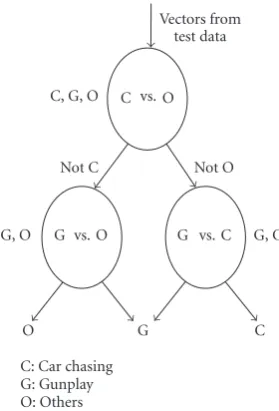
Recently, a few researches are conducted to reduce a multi-class SVM into several binary SVM multi-classifiers [26]. Accord-ing to the performance analysis of multiclass SVM classi-fiers [27], we adopt the “one-against-one” strategy to model these three scenes. Three SVM models are constructed, that is, “gunplay versus car chasing,” “gunplay versus others,” and “car chasing versus others.” For training each classifier, fea-ture vectors are collected and their labels are manually deter-mined to construct instance-label pairs (xi,yi), wherexi∈Rn
andyi∈ {1,−1}. An SVM finds an optimal solution of data
separation by mapping the training dataxi to a higher
di-mensional space by a kernel functionφup to a penalty
pa-rameterC of the error term. In model training, the kernel
function we used is the radial basis function (RBF), which has been suggested in many SVM-based researches. That is, our kernel function is
K(x,y)=exp−γxi−xj2
, γ >0. (6)
It is crucial to find the right parametersCandγin RBF.
Therefore, we apply five-fold cross validation with a grid search of varying (C,γ) on the training set to find the best parameters achieving the highest classification accuracy.
For training SVM classifiers, the pseudosemantic features obtained from four audio events are labeled manually based on the unit of a texture window. Then all labeled texture win-dows are collected together to produce the training vectors. Three binary SVM classifiers will be combined later to iden-tify which semantic context a texture window belongs to.
6.2. Semantic context detection
Vectors from test data
C, G, O C vs. O
Not C Not O
G, O G vs. O G vs. C G, C
O G C
C: Car chasing O: Others G: Gunplay
Figure5: The testing procedure of DAGSVM.
three concepts. In the first step of detection, the test vec-tors are input to the root SVM classifier, that is, “car-chasing versus others” classifier. After this evaluation, the process branches to left if more vectors are predicted as the “others” category; and the “car-chasing” concept is removed from the candidate list. The “gunplay versus others” classifier is then used to reevaluate the test vectors. After these two steps, the vectors representing the characteristics of texture windows are labeled as “gunplay” or “others.”
The DAGSVM separates the individual classes with large margins. It is safe to discard the losing class at each one-against-one decision because, for the hard margin case, all of the examples of the losing class are far away from the deci-sion surface. Hence, the choice of the class order in detection procedure is arbitrary.
7. PERFORMANCE EVALUATION
We may first describe the characteristics of sound effects in movies before preparing the evaluation data. According to our observations, although the acoustic conditions may vary differently in different movies, the sound effects indicating a specific semantic concept fall into several fixed types. The reasons for this phenomenon include the following: (1) there have been some conventions to construct a concept in movie
making, and (2) the sound effects are often added or
em-bellished after shooting according to commonly used tech-niques. For example, in a gunplay scene, the sounds of gun-shots can be often categories as several canonical types: hand gun, rifle, machine gun, and ricochet. Therefore, very huge amount of training data are not necessarily required.
For each audio event, 100 short audio clips, each with length 3–10 seconds, are selected. For semantic context mod-eling, because there is no standard corpus for audio seman-tic contexts, the evaluation data are manually selected from Hollywood movies. Thirty movie clips, each with length 3–5
minutes, are selected and labeled for each semantic context. Half of them are used as the dataset for model training, while half of them are used for model testing. Note that the cri-teria of selecting training data for audio events and seman-tic contexts are different. For semanseman-tic context modeling, we collected the “gunplay” and “car-chasing” scenes based on the experienced user’s subjective judgments, no matter how many relevant audio events exist in the scene. On the con-trary, the training data for audio event modeling are short audio segments that are exactly the audio events.
We evaluate the performance for both audio event detec-tion and semantic context detecdetec-tion. Moreover, the effective-ness of this later fusion approach is evaluated by comparing it with the baseline approach that only exploits low-level audio features and works in an early fusion manner.
7.1. Evaluation of audio event detection
In audio event detection, audio streams are segmented into audio clips through analysis windows, as illustrated in Figure 4(a), and the log-likelihood values of audio clips in each analysis window with respect to four audio events are evaluated. The audio clip in an analysis window is correctly detected as the eventiif its corresponding confidence score is larger than a predefined threshold and is the maximum value with respect to all events. That is,
C=maxc1,c2,c3,c4
, C > δ, (7)
whereci(i=1,. . ., 4), calculated from (1), is the confidence
score with respect to event i, and δ is determined by the
Bayesian optimal decision rule [20] on the basis of specific and world distributions. We decide that the analysis window
with confidence scorexbelongs to a specific event (category
θ1) if
λ01P
θ1|x
> λ10P
θ0|x
, (8)
whereλi j is the cost incurred for decidingθiwhen the true
state of nature isθj.
By employing Bayes formula, we can replace the poste-rior probabilities by the pposte-rior probabilities and conditional densities. Then we decideθ1if
λ01p
x|θ1
Pθ1
> λ10p
x|θ0
Pθ0
, (9)
and otherwise decideθ0.
Then we alternatively rewrite (9) and decideθ1if
C= p
x|θ1
px|θ0 >λ10
λ01 Pθ0
Pθ1
=δ. (10)
The prior probabilities are estimated based on our
train-ing data. The costsλ10andλ01could be adjusted to vary the
value of threshold such that higher precision or recall could be achieved in the detection stage.
7.1.1. Overall performance
The overall detection performance is listed in Table 1. The
Table1: Overall performance of audio event detection.
Audio event Recall Precision
Gun 0.938 0.95
Explosion 0.786 0.917
Brake 0.327 0.571
Engine 0.890 0.951
Average 0.735 0.847
85%. Although the detection accuracy is often sequence-dependent and affected by confused audio effects, the re-ported performances support the applicability and superior-ity of the event modeling. In addition, different audio events
have different evaluation results. Because the car-braking
sounds are often very short in time (less than one second, which is the length of one basic analysis unit defined in our work) and are mixed with other environment sounds, the de-tection accuracy is particularly worse than others. This
situ-ation is different from gunshot sounds because there is often
a continuity of gunshots (the sounds of a machine gun or successive handgun/rifle shoots) in a gunplay scene.
The detection performance is more encouraging if we ne-glect the particular case in car-braking detection. For other audio events, the average recall is 87%, and the average pre-cision is 94%. On the other hand, because the car-braking sound is a representative audio cue of car-chasing scenes, we still take the detection results of car-braking sounds into ac-count in car-chasing context modeling.
We also briefly investigate how different thresholds in (7)
affect the detection performance. When we penalize
misclas-sifyingθ0 asθ1 (false alarm) more than the converse (i.e.,
λ10 > λ01), we get larger thresholdδ, and hence higher
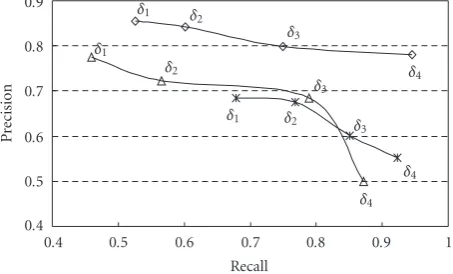
pre-cision but lower recall is expected.Figure 6shows detection
performance with four different thresholds (δ1 > δ2 > δ3 > δ4) from three different test sequences. Note that the trend of detection performance conforms to the general principle of pattern classification, while detection results are sequence-dependent.
7.1.2. Performance comparison
To compare the performance of video retrieval/indexing be-tween various approaches, some institutes such as TREC Video Retrieval Evaluation [30] developed corpus for video event evaluation. However, few standard datasets are de-signed for audio event detection. Most works of audio event detection (including our work) use privately collected
datasets. Direct comparison between different approaches,
which use different datasets and model different events, is not plausible. However, in order to show that the proposed approach achieves promising performances in detecting var-ious audio events, we refer to other works that focused on au-dio events in sports games [28], TV shows [14], and movies [29].
Because not all referred works report precision and re-call values, we only list the detection accuracy (precision) in Table 2 for fair comparison. In [28], four audio events
in-0.4 0.5 0.6 0.7 0.8 0.9 1 0.4
0.5 0.6 0.7 0.8
0.9 δ
1 δ2
δ3
δ4
δ1
δ2
δ3
δ4
δ1 δ2 δ
3
δ4
Recall
P
recision
Figure6: Three examples of detection performance with different thresholds (δ1> δ2> δ3> δ4).
cluding “acclaim,” “whistle,” “commentator speech,” and “si-lence” are detected in soccer videos, while the “speech” and
“silence” generally are not viewed as special sound effects.
More than 90% of detection accuracy is achieved. In [14], the events of “laughter,” “applause,” and “cheer” are detected in TV shows. For each event, average precision values from three test sequences are listed. The most similar work to ours is [29]. It also introduces a variation of HMM to model au-diovisual features of explosion events. More than 86% of ex-plosion events are correctly detected, while we achieve 91.7% of precision. From these results, we can see that the proposed audio event detection module works at least as well as other reported approaches, and is capable of being a robust basis for higher level modeling.
7.2. Evaluation of semantic context detection
In semantic context detection, the models based on HMM and SVM are evaluated, respectively. As the basic analysis unit is one texture window, the metrics of recall and precision are calculated to show the detection performance, as shown inTable 3. We tested movie clips from “We Were Soldiers,” “Windtalker,” “The Recruit,” “Band of Brother,” and so forth, for gunplay and movie clips from “Terminator 3,” “Ballistic: Ecks vs. Sever,” “The Rock,” “2 Fast 2 Furious,” and so forth, for car chasing. The detection performance is somewhat sequence-dependent because different movies posses differ-ent acoustic conditions. However, both the HMM-based and SVM-based approaches averagely achieve over 90% recall and near 70% precision in detecting gunplay and car-chasing scenes. These results show the promising achievement of the proposed fusion schemes.
Table2: Detection accuracy of different approaches.
[28] [14] [29] Our approach
Audio events
Acclaim 98% Laughter 82.3% Explosion 86.8% Explosion 91.7%
Whistle 97.3% Applause 87.4% Gun 95%
Commentator speech 92.6% Cheer 92.6% Brake 57.1%
Silence 91.1% Engine 95.1%
Table3: Average performance of semantic context detection by (a) HMM and (b) SVM.
Semantic context Recall (a) Precision (a) Recall (b) Precision (b)
Gunplay 0.612 0.727 0.531 0.741
Car chasing 0.697 0.731 0.661 0.702
Table4: Some detailed results in semantic context detection by (a) the HMM-based approach and (b) the SVM-based approach.
Semantic context Recall (a) Precision (a) Recall (b) Precision (b)
“We Were Soldiers” 0.88 0.75 0.859 0.832
Gunplay “44 Minutes” 0.98 0.95 0.98 0.813
“Imposter” 0.982 0.659 0.965 0.567
“Ballistic: Ecks vs. Sever” 0.99 0.83 0.98 0.839
Car chasing “2 Fast 2 Furious” 0.985 0.917 0.977 0.914
“The Rock” 0.99 0.629 0.99 0.619
music occur in the test audio clip. These sound effects are often misdetected as explosion sounds and degrade the de-tection performance. Similar situations occur in the case of “The Rock” in car-chasing detection.
We further investigate how system performance varies with respect to different lengths of texture windows. The F1-metric, which jointly considers precision and recall, is used to indicate the system performance:
F1=2×Precision×Recall
Precision + Recall . (11)
Figure 7shows the relationship between average perfor-mance of the HMM-based approach and lengths of texture windows. It is clear that the proposed system works particu-larly well when the length of texture window is set as five or six seconds. In this work, we simply take 5-second segments as the basic units for semantic context detection.
7.3. Comparison with baseline system
To show the superiority of the proposed framework, we com-pare the detection performance with that of the baseline case. The baseline system models semantic contexts directly by low-level features. For the semantic context training data, the
audio features described inSection 3are first extracted. Then
these features are modeled by HMMs rather than construct-ing pseudosemantic features. In the experiment, the same training and testing data are used for the baseline system and the proposed framework.
Figure 8illustrates the recall-precision curves of average detection performance. The proposed hierarchical
frame-work shows its superiority over the baseline system. Because the baseline system does not take account of the informa-tion at event level, the precision rate degrades significantly as we increase recall. Linking the low-level features and high-level semantics by event fusion, that is, the construction of pseudosemantic features, provides a more robust perfor-mance in semantic context detection.
7.4. Discussion
Both the HMM-based fusion scheme and the SVM-based fusion scheme show their promising performance achieve-ments. The most important advantage of event fusion ap-proach is that event models can be trained separately, and new impacts from other events can be easily added to the framework. For example, more gunplay-related events such as helicopter-flying or people yelling can be modeled to aug-ment the pseudosemantic features.
Although the effectiveness of this work has been shown,
2 3 4 5 6 7 8 0
0.1 0.2 0.3 0.4 0.5 0.6 0.7
Length of texture window (s)
F1-met
ric
Figure7: Relationship between lengths of texture windows and sys-tem performance.
0 0.2 0.4 0.6 0.8 1
0 0.1 0.2 0.3 0.4 0.5 0.6 0.7 0.8 0.9 1
Recall
P
recision
Proposed Baseline
Figure 8: Comparison of the baseline and the proposed HMM-based approaches.
7.5. Semantic indexing based on the
proposed framework
This work presents a preliminary try to identify the context of a semantic concept to facilitate multimedia retrieval. The results of semantic context detection index videos with dis-tributions of semantic concepts rather than occurrences of isolated events or objects. It provides the idea that concept-based indexing could be achieved by fusing the information of relevant events/objects. Although the proposed frame-work is only applied to action movies, it is believed to be generalized to other types of videos. Meanwhile, another en-couraging idea of this work is the introduction of the late fusion of individual classifiers. Individual classifiers can be trained separately and added adaptively to the final
meta-classifier. On the basis of this framework, different semantic
contexts could be modeled and detected by taking account of various visual and aural events. For example, replacing audio event models by visual object models, visual seman-tic context such as multispeaker conversation could be
mod-eled by the same framework. Results from different
modal-ities can also be fused (by careful design of pseudosemantic features) to construct a multimodal metaclassifier. Hence the proposed framework can qualify general semantic indexing tasks.
8. CONCLUSION
We present a hierarchical approach that bridges the gaps be-tween low-level features and high-level semantics and fa-cilitates semantic indexing in action movies. The proposed framework hierarchically conducts modeling and detection at two levels: audio event level and semantic context level. After careful selection of audio features, HMMs are applied to model the characteristics of audio events. At the semantic context level, generative (HMM) and discriminative (SVM) approaches are used to fuse pseudosemantic features ob-tained from the results of event detection. Experimental re-sults demonstrate a remarkable performance of the fusion schemes, and signify that the proposed framework draws a
sketch for constructing an efficient semantic indexing
sys-tem.
The proposed framework can be extended to model ferent semantic concepts. It may be necessary to consider dif-ferent combinations of events or include visual information according to the production rules of targeted films. Another possible improvement may include the elaborate feature se-lection by developing an automatic feature induction mech-anism or applying the techniques of blind signal processing to deal with the problem of mixed audio effects.
ACKNOWLEDGMENT
This work was partially supported by the National Science Council and the Ministry of Education of Taiwan under the Contract no. 2752-E-002-006-PAE and NSC94-2213-E-002-078.
REFERENCES
[1] R. W. Lienhart, “Comparison of automatic shot boundary de-tection algorithms,” in Storage and Retrieval for Image and Video Databases VII, vol. 3656 ofProceedings of SPIE, pp. 290– 301, San Jose, Calif, USA, January 1999.
[2] A. Hanjalic, “Shot-boundary detection: unraveled and re-solved?”IEEE Transactions on Circuits and Systems for Video Technology, vol. 12, no. 2, pp. 90–105, 2002.
[3] S.-F. Chang and A. Vetro, “Video adaptation: concepts, tech-nologies, and open issues,”Proceedings of the IEEE, vol. 93, no. 1, pp. 148–158, 2005.
[4] L. Lu, H.-J. Zhang, and H. Jiang, “Content analysis for audio classification and segmentation,”IEEE Transactions Speech Au-dio Processing, vol. 10, no. 7, pp. 504–516, 2002.
[5] T. Zhang and C.-C. Jay Kuo, “Hierarchical system for content-based audio classification and retrieval,” inMultimedia Storage and Archiving Systems III, vol. 3527 ofProceedings of SPIE, pp. 398–409, Boston, Mass, USA, November 1998.
[7] L. Lu and H.-J. Zhang, “Automated extraction of music snip-pets,” inProc. 11th ACM International Conference on Multime-dia, pp. 140–147, Berkeley, Calif, USA, November 2003. [8] S. Fischer, R. Lienhart, and W. Effelsberg, “Automatic
recog-nition of film genres,” inProc. 3rd ACM International Confer-ence on Multimedia, pp. 295–304, San Francisco, Calif, USA, November 1995.
[9] Z. Liu, J. Huang, and Y. Wang, “Classification of TV programs based on audio information using hidden Markov model,” inProc. IEEE 2nd Workshop on Multimedia Signal Processing (MMSP ’98), pp. 27–31, Redonda Beach, Calif, USA, Decem-ber 1998.
[10] Y. Wang, Z. Liu, and J.-C. Huang, “Multimedia content analysis-using both audio and visual clues,”IEEE Signal Pro-cessing Magazine, vol. 17, no. 6, pp. 12–36, 2000.
[11] H. Zettl, Sight Sound Motion: Applied Media Aesthetics, Wadsworth, Belmont, Calif, USA, 1999.
[12] C. Dorai and S. Venkatesh, Media Computing: Computa-tional Media Aesthetics, Kluwer Academic, Boston, Mass, USA, 2002.
[13] S. Moncrieff, S. Venkatesh, and C. Dorai, “Horror film genre typing and scene labeling via audio analysis,” inProc. IEEE In-ternational Conference on Multimedia and Expo (ICME ’03), vol. 2, pp. 193–196, Baltimore, Md, USA, July 2003.
[14] R. Cai, L. Lu, H.-J. Zhang, and L.-H. Cai, “Highlight sound effects detection in audio stream,” inProc. IEEE International Conference on Multimedia and Expo (ICME ’03), vol. 3, pp. 37– 40, Baltimore, Md, USA, July 2003.
[15] M. R. Naphade, T. Kristjansson, B. Frey, and T. S. Huang, “Probabilistic multimedia objects (multijects): a novel ap-proach to video indexing and retrieval in multimedia systems,” in Proc. International Conference on Image Processing (ICIP ’98), vol. 3, pp. 536–540, Chicago, Ill, USA, October 1998. [16] M. R. Naphade and T. S. Huang, “Extracting semantics from
audio-visual content: the final frontier in multimedia re-trieval,”IEEE Transactions on Neural Networks, vol. 13, no. 4, pp. 793–810, 2002.
[17] J. R. Smith, M. Naphade, and A. Natsev, “Multimedia seman-tic indexing using model vectors,” inProc. IEEE International Conference on Multimedia and Expo (ICME ’03), vol. 2, pp. 445–448, Baltimore, Md, USA, July 2003.
[18] A. Hyv¨arinen, J. Karhunen, and E. Oja,Independent Compo-nent Analysis, John Wiley & Sons, New York, NY, USA, 2001. [19] L. R. Rabiner, “A tutorial on hidden Markov models and
se-lected applications in speech recognition,”Proceedings of the IEEE, vol. 77, no. 2, pp. 257–286, 1989.
[20] R. O. Duda, P. E. Hart, and D. G. Stork,Pattern Classification, John Wiley & Sons, New York, NY, USA, 2001.
[21] S. Z. Li, “Content-based audio classification and retrieval us-ing the nearest feature line method,”IEEE Transactions Speech Audio Processing, vol. 8, no. 5, pp. 619–625, 2000.
[22] S.-T. Bow,Pattern Recognition and Image Preprocessing, Marcel Dekker, New York, NY, USA, 2002.
[23] “Sound Ideas: Sound Effects Library,” http://www.sound-ideas.com/.
[24] R. D. Zilca, “Text-independent speaker verification using co-variance modeling,”IEEE Signal Processing Letters, vol. 8, no. 4, pp. 97–99, 2001.
[25] V. N. Vapnik,Statistical Learning Theory, John Wiley & Sons, New York, NY, USA, 1998.
[26] J. C. Platt, N. Cristianini, and J. Shawe-Taylor, “Large margin DAGs for multiclass classification,” inAdvances in Neural In-formation Processing Systems, vol. 12, pp. 547–553, MIT Press, Cambridge, Mass, USA, 2000.
[27] C.-W. Hsu and C.-J. Lin, “A comparison of methods for multi-class support vector machines,”IEEE Transactions Neural Net-works, vol. 13, no. 2, pp. 415–425, 2002.
[28] J. Wang, C. Xu, E. Chng, and Q. Tian, “Sports highlight de-tection from keyword sequences using HMM,” inProc. IEEE International Conference on Multimedia and Expo (ICME ’04), vol. 1, pp. 599–602, Taipei, Taiwan, June 2004.
[29] M. R. Naphade, A. Garg, and T. S. Huang, “Audio-visual event detection using duration dependent input output Markov models,” inProc. IEEE Workshop on Content-Based Access of Image and Video Libraries (CBAIVL ’01), pp. 39–43, Kauai, Hawaii, USA, December 2001.
[30] “TREC Video Retrieval Evaluation,” http://www-nlpir.nist. gov/projects/trecvid/.
Wei-Ta Chureceived the B.S. and M.S. de-grees in computer science and information engineering from National Chi Nan Univer-sity in Nantou, Taiwan, in 2000 and 2002. He is currently pursuing his Ph.D. degree in the Department of Computer Science and Information Engineering, National Taiwan University, Taiwan. As he is in the Commu-nication and Multimedia Laboratory, his re-search interests include digital content
anal-ysis, multimedia indexing, digital signal process, and pattern recog-nition.
Wen-Huang Cheng received the B.S. and M.S. degrees in computer science and in-formation engineering from National Tai-wan University, Taipei, TaiTai-wan, in 2002 and 2004, respectively, where he is currently pursuing the Ph.D. degree in the Gradu-ate Institute of Networking and Multime-dia. His research interests include multime-dia data management and analysis.
Ja-Ling Wureceived the B.S. degree in elec-tronic engineering from TamKang Univer-sity, Tamshoei, Taiwan, in 1979, and the M.S. and Ph.D. degrees in electrical engi-neering from Tatung Institue of Technol-ogy, Taipei, Taiwan, in 1981 and 1986. Since 1987, he has been with the Department of Computer Science and Information Engi-neering, National Taiwan University, where he is presently a Professor. He has published