A Comparative Analysis of Computer Codes for Strength Calculations of Pipeline
Systems
S. Boutorin,1) R. F. Kulak2) and M. Malov1)
1) Energy Division, VNIPIET, St. Petersburg, Russian Federation
2) Reactor Analysis and Engineering Division, Argonne National Laboratory, Argonne, IL 60439
ABSTRACT
The Russian Federation, through the Russian International Nuclear Safety Center, and the United States, through the U.S. International Nuclear Safety Center, are collaborating on a joint project for advanced structural analysis aimed at im-proving, verifying and validating structural analysis computer codes used for the assessment of structural integrity of Russian and U.S. nuclear power plants. This paper present the results of the work performed on strength calculations of pipeline sys-tems. This paper describes three Russian-developed computer codes (CANPIPE, TP-95PC and dPIPE) that have been used to determine the structural integrity of piping systems. Nine benchmark problems were identified for code verifica-tion/validation. Detailed results for one of the problems are presented here.
INTRODUCTION
One of the tasks of the joint collaboration between the U.S. and the Russian Federation on advanced structural analysis is the validation of computer software used for the estimation of the structural integrity/capacity of NPP components and struc-tures. These components can be associated with different types of reactors (VVER, RBMK, LWR) and can be subjected to design-basis and beyond-design-basis loadings. One of the important aspects of the collaboration is the establishment of a validation basis for the software.
One class of NPP equipment that the computer codes need to be validated for are two- and three-dimensional pipelines with constrained and intermediate supports. The major objective of this joint effort was to conduct a comparative analysis of Russian computer codes used for strength calculations in the design of pipeline systems for nuclear power facilities in Russia.
The section below describes three Russian-developed computer codes (CANPIPE, TP-95PC and dPIPE) that have been used to determine the structural integrity of piping systems. The next section present descriptions of nine valadi-tion/verification problems used to benchmark the codes and detailed results from problem 6, which is a 3-D pipeline with one branch subject to seismic loading.
PIPING CODES
The following three Russian-developed computer codes, which are used for strength calculations of pipeline systems, were reviewed: CANPIPE, TP-95PC and dPIPE.
CANPIPE Code
The CANPIPE code (version 2.0) has been developed by SEC of Minatom RF (Moscow). The code employs the finite element method (FEM) for strength calculations of pipelines. The code was licensed by GAN RF, which is the regulatory agency of the Russian Federation, to be used for static loading calculations. The code section for linear-spectral dynamic impact calculation technique has been submitted to GAN RF for certification and is currently in the review process.
The CANPIPE software package has capabilities to perform calculations of low temperature pipelines associated with NPPs. According to the Norms /1/, the low temperature pipelines comprise pipelines under design temperature equal or below Tt, which is determined as follows: for aluminum and titanium alloys – 239
o
K (20oC); for zirconium alloys – 523oK (250oC); for carbon, alloyed, silicon-manganese and high-chromium steels – 623oK (350oC); for austenitic corrosion resistant steels, high-temperature chromium-molybdenum steels and ferronickel alloys – 723oK (450oC).
TP-95PC Code
The TP-95PC software package has been developed by GI “VNIPIET” (Saint-Petersburg). It is designed for comprehensive strength calculations of pipeline systems /1/. The software package also allows performing calculations to select springs for elastic supports with regard to both low-temperature and high-temperature pipelines. TP-95PC software package has been submitted to GAN RF for certification and is the review process.
SMiRT 16, Washington DC, August 2001 Paper # 1934
The program resolves two main problems:
a) It performs calculations to select the characteristics for elastic intermediate supports (hangers). For the case of static calculations, a selection of springs for elastic supports takes place along with the determination of their characteristics (chain structure, spring characteristics, their straining values, operational and construction loads). Also, the internal forces and strains in pipelines are determined.
b) It verifies the strength calculation of a pipeline system for the stationary operational mode at the preset characteristics of elastic supports (hangers).
The problems under resolution are determined by the regulatory requirements set forth for a verifying strength calculation of pipeline systems under combined loads in the stationary operational conditions and designed seismic impact.
A pipeline is considered as the linear-elastic spatial rod (beam) system consisting of rectilinear and arc-like elements of tubular cross-section. The masses are discretely distributed, and feature concentrated and elastic bonds and the finite number of degrees of freedom/2-3/.
dPIPE Code
The dPIPE software package (version 2.3) has been developed by JSC “CKTI-Vibroseism” (Saint-Petersburg) and designed for static and dynamic strength analysis of NPP pipeline systems. The dPIPE code is based on the finite element method. dPIPE features a capability of performing calculations using dynamic analysis technique with regard to non-linear support constraint systems. Such types of constraints include damper supports (there are several models for taking such supports into account, including disproportionate damping), mechanical and hydraulic shock absorbers, and supports with supplementary constraints (stops with gaps). This software package was successfully used for calculations of the pipeline systems of NPP built under Russian designs in other countries (Armenia, Hungary, Finland, Chec Republic, etc.).
Common Features
The common features of all these codes are:
1. They are based on the Russian regulatory requirements, in particular, they comply with the Norms for calculations given in Reference /1/;
2. They have a capability of doing calculations as for static loading under stationary modes considerations as for seismic impact calculations under linear-spectral approach;
3. They do not consider transients during pipeline operation;
4. The direct calculation for cyclic strength, long-term cyclic strength and vibration strength is not done
5. Generally, the equipment in a calculation scheme is not modeled, and the pipeline system is considered to be fixed to “rigid” supports (equipment), which may displace under temperature, impact (construction displacements) and forces.
BENCHMARK PROBLEMS
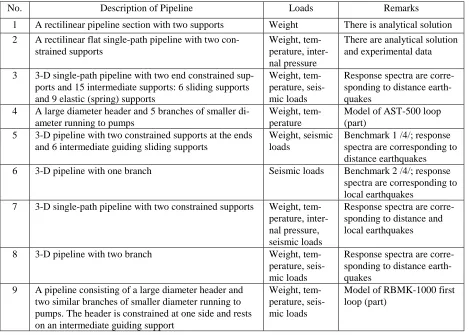
A benchmark problem set was created for comparing the computational results of the above codes. The basic criteria for selection of the benchmark problems were: (1) each problem would contribute to verifying one or more features needed to analyze a piping system, and (2) each problem would be verified/validated against known analytical solutions, verified benchmark problems or experimental data. There are nine problems in this set. The basic loads considered were weight, tem-perature, internal pressure and seismic impacts. The loads and impacts were considered separately for the purposes of com-paring results.
The description of benchmark problems is given in the Table 1. The description of each benchmark problem includes: - Input data on the pipeline geometrical dimensions (calculation model);
- Input data on mechanical properties of materials; - Initial data on loadings;
- Comparison of results (displacements of points, natural frequencies, support reactions and others)
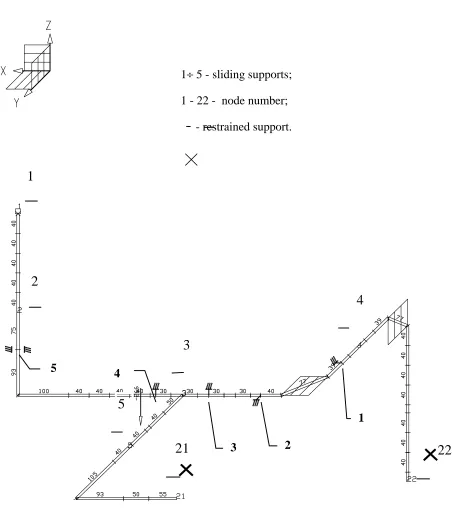
For example, benchmark problem 6 is a pipeline with one branch. The geometric dimensions are given in Fig. 1 and cor-respond to benchmark problem 2 as described in Reference /4/. The end support of the pipeline at nodes 21 and 22 (see Fig. 1) are constrained; the support at node 1 constraints the linear displacements only. A comparison of calculated results was performed for a case with seismic loading. Response spectra are given in Fig. 2, which corresponds to local earthquakes. Some comparative results are presented in Tables 2 and 3: natural frequencies and support reactions.
Table 1. Description of Benchmark Problems
No. Description of Pipeline Loads Remarks
1 A rectilinear pipeline section with two supports Weight There is analytical solution
2 A rectilinear flat single-path pipeline with two con-strained supports
Weight, tem-perature, inter-nal pressure
There are analytical solution and experimental data
3 3-D single-path pipeline with two end constrained sup-ports and 15 intermediate supsup-ports: 6 sliding supsup-ports and 9 elastic (spring) supports
Weight, tem-perature, seis-mic loads
Response spectra are corre-sponding to distance earth-quakes
4 A large diameter header and 5 branches of smaller di-ameter running to pumps
Weight, tem-perature
Model of AST-500 loop (part)
5 3-D pipeline with two constrained supports at the ends and 6 intermediate guiding sliding supports
Weight, seismic loads
Benchmark 1 /4/; response spectra are corresponding to distance earthquakes 6 3-D pipeline with one branch Seismic loads Benchmark 2 /4/; response
spectra are corresponding to local earthquakes
7 3-D single-path pipeline with two constrained supports Weight, tem-perature, inter-nal pressure, seismic loads
Response spectra are corre-sponding to distance and local earthquakes
8 3-D pipeline with two branch Weight,
tem-perature, seis-mic loads
Response spectra are corre-sponding to distance earth-quakes
9 A pipeline consisting of a large diameter header and two similar branches of smaller diameter running to pumps. The header is constrained at one side and rests on an intermediate guiding support
Weight, tem-perature, seis-mic loads
Model of RBMK-1000 first loop (part)
Table 2. Natural Frequencies (Hz) for Benchmark Problem 6.
Mode Number CANPIPE dPIPE TP-95PC
1 12.95 12.94 13.86 2 14.94 15.49 15.76 3 16.2 16.78 16.63 4 18.94 18.75 18.35 5 23.71 25.08 24.62 6 31.13 31.42 31.78
Table 3. Support Reactions for Benchmark Problem 6.
Reactions→ Code↓ Px (N) Py (N) Pz (N) Mx (N-cm) My (N-cm) Mz (N-cm) Node 1
CANPIPE 163 254 181 0 0 0
dPIPE 163 221 145 0 0 0
TP-95PC 181 244 127 0 0 0
Node 22
1
2
3
4
22
5
21
Fig. 1. Benchmark Problem 6. Design Pipeline Diagram (geometrical dimensions in cm)
1
2
3
4
5
1
÷
5 - sliding supports;
1 - 22 - node number;
X-direction
0.00 1.00 2.00 3.00 4.00
0.00 10.00 20.00 30.00 40.00 50.00
Frequency, Hz
Acceleration, g
Y-direction
0.00 1.00 2.00 3.00 4.00 5.00
0.00 10.00 20.00 30.00 40.00
Frequency, Hz
Acceleration, g
Z-direction
0.00 1.00 2.00 3.00
0.00 10.00 20.00 30.00 40.00
Frequency, Hz
Acceleration, g
SUMMARY AND CONCLUSIONS
The developed set was included in new chapter of the USINSC and RINSC problem database. It is necessary to note the following basic results from the joint research:
1. The set of test tasks for the strength analysis of pipelines is developed for both static and seismic loadings.
2. The comparison of numerical results for the three Russian codes was carried out. The results of the comparative analysis establish the validity of using these codes for both designing new NPPs and for analyzing the safety of existing NPPs.
3. The developed unit of the USINSC and RINSC problem database can be used as good base for verification of new software and certification of codes in GAN, a supervising body of the Russian Federation.
ACKNOWLEDGEMENT
The Russian Federation work was performed under the auspices of the Russian MINATOM, Russian International Nu-clear Safety Center. The U.S. work was performed under the auspices of the U. S. Department of Energy, Office of Interna-tional Nuclear Safety and Cooperation, under Contract W-31-109-Eng-38.
REFERENCES
1. Norms for strength calculations of equipment and pipelines of nuclear power facilities. PNAE G-7-002-86. 2. RTM108.020.01-75. Strength calculations of NPP pipelines.
3. Pipelines of stationary steam boilers. Self-compensation calculations. RTM 108.038.101-77. SPA CKTI. 1977. 68p. 4. P. Bezler. M. Subudhi. and M. Hartzman. Report NUREG/CR-1677 “Piping Benchmark Problems. Dynamic