ABSTRACT
PARK, JONG BEOM. 3D-DATE: A Circuit-Level Three-Dimensional DRAM Area, Timing, and Energy Model. (Under the direction of W. Rhett Davis and Paul D. Franzon.)
Three-dimensional stacked DRAM technology has emerged recently. Many studies have
shown that 3D DRAM is most promising solutions for future memory architecture to fulfill
high bandwidth and high-speed operation with low energy consumption. It is necessary
to explore 3D DRAM design space and find the optimum DRAM architecture in different
system needs. However, a few studies have offered models for power and access latency
calculations of DRAM designs in limited ranges. This has led to a growing gap in knowledge
of the area, timing, and energy modeling of 3D DRAMs for utilization in the design process
of processor architectures that could benefit from 3D DRAMs. This paper presents a circuit
level DRAM Area, Timing, and Energy model (DATE) which supports 3D DRAM design with
TSV. DATE provides front-end and back-end DRAM process roadmap from 90 nm to 16 nm
node and provides a broader range 3D DRAM design model along with emerging transistor
device. DATE is successfully validated against several commodity planar and 3D DRAMs
and published prototype DRAMs with emerging device. Energy verification has a mean
error of about -5% to 1%, with a standard deviation of up to 9.8%. Speed verification has
a mean error of about -13% to -27% and a standard deviation of up to 24%. In the case of
the area, the bank has a mean error of -3% and the whole die has a mean error of -1%. The
standard deviation for area is up to 4.2%. In the case study, we demonstrate that 1Gb DDR3
DRAM designs achieve up to about 0.7 Gb/sec data throughput and energy efficiency of
© Copyright 2018 by Jong Beom Park
3D-DATE: A Circuit-Level Three-Dimensional DRAM Area, Timing, and Energy Model
by Jong Beom Park
A dissertation submitted to the Graduate Faculty of North Carolina State University
in partial fulfillment of the requirements for the Degree of
Doctor of Philosophy
Electrical Engineering
Raleigh, North Carolina
2018
APPROVED BY:
James Tuck Hans Hallen
W. Rhett Davis
Co-chair of Advisory Committee
Paul D. Franzon
DEDICATION
My Lord, Jesus
BIOGRAPHY
Jong Beom Park was born in Seoul, Korea in March 1978. He earned a Bachelors of Science
at Hanyang University at Ansan in 2001. In 2003, he earned a Master of Science in Electronic,
Electrical, Control and Instrumentation Engineering from Hanyang University at Seoul in
2003, with a thesis entitled "Implementation of the Multirate Viterbi Algorithm for IEEE
802.11a Wireless LAN System." After working in the industry for several years, Mr. Park
entered the ECE graduate program at North Carolina State University in 2009, where he
earned a Masters of Science in Computer Engineering from North Carolina State University
in 2010. He initiated his Ph.D. studies in Electrical Engineering in 2011 working on the
NSF’s Underwater Optical Communication program with Dr. John Muth. In 2012, Mr. Park
switched his research focus to the circuit design area rather than embedded system. Thus,
he joined Dr. Paul D. Franzon’s research group in 2012. He started working on the DARPA
PERFECT program in 2012 and 2013, focusing on the design of a custom, low power memory.
Mr. Park also maintains an active interest in computer architecture, digital VLSI design,
ACKNOWLEDGEMENTS
First, I would like to thank Dr. Paul D. Franzon, my advisor. I still remember the moment I
first joined his research group. Dr. Franzon told me, "Welcome aboard" with a generous
smile. It was a great fortune for me to be on his ship. Without his mentorship and guidance,
this journey would not have been possible. I also would like to thank my co-advisor, Dr.
W. Rhett Davis for being supportive on many occasions, his valuable comments on my
research, and providing the research opportunity. In addition, I would like to thank the
following faculty members: Dr. John Muth for giving me my first research opportunity at NC
State; Dr. James Tuck for his mentoring on PERFECT projects and for being my committee;
and Dr. Hans Hallen for his valuable comments on my research and for being my committee.
I would like to thank the following people for their contributions that have made my
dissertation possible: Joshua C. Schabel for motivating me and helping me to write this
thesis with creative discussions; Kirti Bhanushali and Wenxu Zhao for being great colleagues
throughout the research with discussions that made ambiguities clear; Randy and Weiyi Qi
for sharing insights on modeling algorithms into the program; and Lee B. Baker for sharing
insights on machine learning.
Finally, I would like to thank my parents and parents-in-law who would be glad in
Heaven with God, my wife Jina and two lovely daughters, Songee and Yuni. I appreciate
TABLE OF CONTENTS
LIST OF TABLES . . . vii
LIST OF FIGURES. . . ix
Chapter 1 Introduction. . . 1
1.1 Motivation . . . 1
1.2 Original Contributions . . . 2
1.3 Related Work . . . 3
1.4 Organization of Dissertation . . . 5
1.5 Abbreviations . . . 5
Chapter 2 DRAM Process Roadmap. . . 7
2.1 Transistor Model and Scaling . . . 9
2.1.1 Gate Transistor Model and Scaling . . . 11
2.1.2 High-Voltage and Peripheral transistor . . . 17
2.2 Interconnect . . . 18
2.2.1 Wire . . . 18
2.2.2 Through Silicon Via . . . 24
2.3 Roadmap and discussion . . . 27
2.3.1 Gate Transistor . . . 27
2.3.2 High Voltage and Peripheral Transistor . . . 31
2.3.3 Wire . . . 35
2.3.4 Through Silicon Via . . . 40
Chapter 3 DRAM Circuit Level Modeling . . . 43
3.1 Component Modeling . . . 46
3.1.1 General Layout and Drain Capacitance . . . 46
3.1.2 Digital Logic and Driving Buffer . . . 51
3.1.3 Repeater for Wire . . . 58
3.1.4 Address Decoder . . . 60
3.1.5 Bitline and Bitline Sense Amplifier . . . 63
3.2 Architecture Level Modeling . . . 65
3.3 Validation . . . 72
3.4 Comparison with Other Models . . . 79
Chapter 4 Case Study: DRAM Design Space Exploration . . . 82
4.1 Planar Design Space Exploration in 35 nm Node . . . 83
4.1.1 Single Bank Design Space . . . 83
4.2 3D Design Space Exploration in 35 nm Node . . . 106
4.2.1 Area Efficiency . . . 107
4.2.2 Energy Efficiency . . . 109
4.2.3 Throughput . . . 111
4.2.4 Product of Design Metric . . . 113
4.2.5 Design Metric Comparison in Different Technology . . . 116
Chapter 5 Conclusion and Future Work. . . 119
5.1 Summary of Contributions . . . 119
5.2 Future Work . . . 121
BIBLIOGRAPHY . . . 122
APPENDICES . . . 129
Appendix A Derivation of the Leakage Current Equation . . . 130
Appendix B TCAD Simulation Code . . . 133
B.1 Sentaurus Structure Editor Code . . . 133
B.2 Sentaurus Device Code . . . 140
B.3 Inspect Code . . . 144
Appendix C Definition and Derivation of the Path Effort . . . 147
Appendix D Reference of Commodity DRAM Part . . . 150
Appendix E How to run DATE . . . 153
E.1 Read-me First . . . 153
LIST OF TABLES
Table 2.1 Material and doping method of gate transistor . . . 13
Table 2.2 Leakage Current Criterion (fA/cell) . . . 15
Table 2.3 ITRS Saturation Current Roadmap of Supportive NMOSFET at 25◦C . 18 Table 2.4 Gate transistor roadmap . . . 29
Table 2.5 High voltage transistor roadmap . . . 33
Table 2.6 Peripheral transistor roadmap . . . 33
Table 2.7 DATE wire roadmap . . . 34
Table 2.8 Wire comparison with commodity logic design process . . . 39
Table 2.9 ITRS TSV physical dimension roadmap . . . 41
Table 2.10 CACTI-3DD TSV physical dimension roadmap . . . 41
Table 2.11 DATE TSV area, capacitance, and resistance roadmap . . . 41
Table 2.12 ITRS TSV area, capacitance, and resistance roadmap . . . 42
Table 3.1 The logical effort of logic gates . . . 52
Table 3.2 Validation of energy calculation . . . 73
Table 3.3 Validation of key timing parameter calculation . . . 74
Table 3.4 Validation of area calculation . . . 76
Table 3.5 Validation of timing parameter of VCAT based and 3D DRAM . . . 77
Table 3.6 Validation of area calculation of VCAT based and 3D DRAM . . . 77
Table 3.7 Timing parameter change according to process change . . . 78
Table 3.8 Energy change according to process change . . . 79
Table 3.9 Circuit level model comparison . . . 81
Table 4.1 Address bit and physical dimension of bank matched to each page size at in 1 Gb single bank, 6F2layout . . . . 84
Table 4.2 Area efficiency of single bank DRAM . . . 85
Table 4.3 Read energy efficiency of single bank DRAM, 6F2layout . . . . 86
Table 4.4 Read operation energy change in each component as page size change 88 Table 4.5 Bank size of single bank DRAM as subarray size change, 6F2layout . 89 Table 4.6 Read operation energy change as subarray row size change . . . 90
Table 4.7 Read operation energy change as subarray column size change . . . . 91
Table 4.8 Read energy efficiency of single bank DRAM, 4F2layout . . . . 92
Table 4.9 Throughput of read operation, single bank DRAM, 6F2layout . . . . . 94
Table 4.10 Speed of each component and read throughput as page size change . 94 Table 4.11 Speed of each component and read throughput as subarray row size change . . . 97
Table 4.12 Speed of each component and throughput as subarray column size change . . . 98
Table 4.14 Area efficiency of planar multibank DRAM . . . 100
Table 4.15 Read Energy and Efficiency of 1 Gb 2D Multibank DRAM in 35 nm node, 6F2layout . . . 101
Table 4.16 Read Energy and Efficiency of 1 Gb 2D Multibank DRAM in 35 nm node, 4F2layout . . . 103
Table 4.17 Throughput of 1 Gb 2D Multibank DRAM, 6F2layout . . . 105
Table 4.18 Area efficiency of 1 Gb 3D multibank DRAM in 35 nm node . . . 109
Table 4.19 Energy efficiency of 1 Gb 3D multibank DRAM in 35 nm node . . . 111
LIST OF FIGURES
Figure 2.1 Cross-section of various gate transistor . . . 10
Figure 2.2 3D Schematic diagram of VCAT-based DRAM cell . . . 11
Figure 2.3 DRAM Cell Layout . . . 12
Figure 2.4 Gate transistor structures . . . 14
Figure 2.5 Recessed gate transistor threshold voltage trend . . . 16
Figure 2.6 MASTAR graphical user interface . . . 17
Figure 2.7 Wire and wire cross section for resistance calculation . . . 19
Figure 2.8 Wire cross section for capacitance calculation . . . 19
Figure 2.9 Typical cross-section of interconnect architectures . . . 22
Figure 2.10 Cross section and top view of single TSV with capacitance . . . 25
Figure 2.11 TSV bundles and coupled capacitance . . . 25
Figure 2.12 TCAD simulation snapshot of recessed transistors . . . 27
Figure 2.13 Three dimensional view and cross section of TCAD simulation of VCAT 28 Figure 2.14 Gate transistor roadmap . . . 30
Figure 2.15 Detail view of source or drain junction of MOSFET . . . 31
Figure 2.16 Wire resistance roadmap . . . 35
Figure 2.17 Wire capacitance roadmap . . . 36
Figure 2.18 Metal capacitance comparison . . . 37
Figure 2.19 Metal resistance comparison . . . 38
Figure 3.1 DATE program flow . . . 45
Figure 3.2 Wide width transistor layout . . . 46
Figure 3.3 Folded transistor layout . . . 47
Figure 3.4 Drain region of the folded transistor . . . 48
Figure 3.5 Internal layout height assumption . . . 49
Figure 3.6 Two input NAND gate schematic and layout example . . . 50
Figure 3.7 Drain region of series-connected transistor . . . 50
Figure 3.8 DATE logic design assumption . . . 51
Figure 3.9 Transistor size of inverter, NAND, and NOR gate . . . 55
Figure 3.10 Horowitz gate model . . . 56
Figure 3.11 Two input NAND gate . . . 57
Figure 3.12 Interconnect line with repeater . . . 59
Figure 3.13 Nine bit row address decoding path . . . 61
Figure 3.14 Predecoder structure . . . 62
Figure 3.15 Two input NOR gate . . . 62
Figure 3.16 Bitline sense amplifier . . . 63
Figure 3.17 Eight bank DDR DRAM floor plan . . . 66
Figure 3.19 Schematic diagram of primitive core array for the conventional 6F2 DRAM. . . 70
Figure 3.20 Schematic diagram of primitive core array for the 4F2DRAM . . . . . 71
Figure 4.1 Energy efficiency as subarray size change with 6F2layout, 16384-bit
page size . . . 88
Figure 4.2 Energy efficiency as subarray size change with 4F2bitcell layout,
16384-bit page size . . . 92
Figure 4.3 Read throughput as subarray size change at 6F2layout, 16384-bit
page size . . . 96
Figure 4.4 Data Throughput as subarray size change at 4F2layout with
16384-bit page size . . . 99
Figure 4.5 Energy sum of wire component in multi-bank 2D DRAM, 6F2Layout102
Figure 4.6 Energy sum of wire component in multibank 2D DRAM, 4F2Layout 104
Figure 4.7 Sum of each component delay in multibank 2D DRAM, 6F2Layout 105
Figure 4.8 Rank level die-stacking . . . 107
Figure 4.9 Chip micrograph of the fabricated DRAM die and cross-sectional
view of TSVs . . . 108 Figure 4.10 Bank level die-stacking . . . 108 Figure 4.11 Energy sum of wire components and TSV in 35 nm node . . . 110 Figure 4.12 Delay sum of each design component with TSV in 35 nm node . . . . 113 Figure 4.13 Multiple design metric trend in 35 nm node . . . 115 Figure 4.14 Design metric comparison between 68 nm, 35 nm and 16 nm node
in 6F2cell layout . . . 117
CHAPTER
1
INTRODUCTION
1.1
Motivation
Three-dimensional die stacking involves connecting multiple silicon dies with a vertical
interconnect, such as through-silicon vias (TSVs) or micro-bumps. Three-dimensional
die stacking reduces global wire routing inside of integrated circuits[1]. Implementing dynamic random access memory(DRAM) in three-dimensional stacks could minimize
random access latencies, internal cycle time and power consumption. These benefits have
motivated industry to implement 3D die stacked DRAM for off-chip, and on-chip stacked
One example is Micron’s Hybrid Memory Cube (HMC) which utilizes an off-chip, 3D
DRAM. A single HMC provides 160 GB/s to 320 GB/s peak transfer bandwidth while DDR3
DRAM module offers tens of GB/s[2, 3]. The Wide-I/O and Wide-I/O 2 standards also have been proposed for on-chip stacked DRAM by Joint Electron Device Engineering Council
(JEDEC)[4, 5]. Samsung has shown that Wide-I/O has 330.6 mW read operating power in
50 nm process which is almost equal to LPDDR2 read power at the same process node.
Samsung also has shown that Wide-I/O has 12.8 GB/s data bandwidth, which is four times
of LPDDR2’s[6].
Many studies have shown that 3D DRAM provides higher bandwidth with lower power
consumption, as well as methods to utilize 3-D DRAM in memory hierarchies[2, 7–10].
However, few studies have offered models for power and access latency calculations of
custom designs. This has led to a growing gap in knowledge of the area, timing, and energy
modeling of 3D DRAMs for utilization in the design process of processor architectures that
could benefit from 3D DRAMs.
1.2
Original Contributions
The goal of this work is to provide a 3D DRAM Area, Timing and Energy (DATE) model.
DATE not only can be used to model existing standard planar DRAM, but also for custom 3D
DRAM designs or to find the optimal 3D DRAM design for architectures under exploration
using traditional or emerging devices. To support the goal, this work includes the following
original contributions:
• DATE provides transistor-level accuracy across various DRAM process nodes, from
• DATE presents four different transistor models for modeling DRAM. The recessed
channel array transistor (RCAT) and the Sphere-shaped-RCAT (SRCAT) models are
provided in DATE for modeling traditional commodity DRAMs. DATE also provides
an emerging gate transistor device, the vertical channel access transistor (VCAT) to
reflect the future DRAM layout trend and thus its effect on area, energy, and speed.
To support modeling of general transistor models in DRAM peripheral circuits, a
conventional metal-oxide-semiconductor field-effect transistor (MOSFET) model is
provided in DATE.
• DATE demonstrates a new core design to support emerging VCAT based cell array
layout as depicted in[11]. The new core design includes sense-amplifier (SA) rotation and hybridization, conjunction restructuring, word line (WL) strapping, etc.
• DATE is validated against 22 planar and 3D DRAMs from 80 nm to 30 nm technology.
The details are shown in Section 3.3.
A more detailed comparison with other models are presented in Section 3.4.
1.3
Related Work
There are two approaches for analyzing DRAM: (a) circuit-level and (b) system-level power
models. Briefly, the circuit-level model examines DRAM based on given front-end, back-end
process, and architectural assumptions. Thus, this model can calculate energy, speed, and
area of DRAM. The accuracy of the model depends on the accuracy of the DRAM process
model and architectural assumptions.
The system-level power model utilizes the DRAM’s JEDEC standard operating-scenario
While this energy model gives precise energy numbers for standard DRAMs, the
system-level power model is limited to only those DRAMs with data sheets provided. Thus, the
system-level power model cannot be utilized to explore new DRAM architectures in which
there is no datasheet available. The system-level power model is also limited in that it
cannot address sub-logic level power numbers. Thus, this model cannot clarify specific
parts of the architecture if the power optimization is required.
Many circuit-level power, area, and timing models have been introduced. CACTI[12]is
the most widely known of these models. CACTI models caches, SRAMs and DRAMs. The
architectural and circuit level model includes assumptions of optimizing cache and SRAM
and is suitable for modeling embedded DRAM.
Rambus has also proposed a circuit-level commodity DRAM power model[13]. The
Rambus model calculates power and area but does not calculate the speed nor provide a
detailed circuit model of the DRAM sub-logic blocks. Although it allows the user to choose
design assumptions, without providing detail design guidance, the user could encounter
the pitfall of wrong assumptions on energy and area prediction by choosing false DRAM
sub-logic blocks. Both the CACTI and Rambus models are derived from planar die models.
CACTI-3DD is published to model commodity 3D-DRAMs[14]. The model does not
sup-port DRAMs implemented in or below the 21 nm technology node nor DRAMs implemented
with emerging gate transistor devices with related architectural changes. CACTI-3DD does
not provide a gate-transistor model, but rather a model designed upon the planar transistor
model with ideal assumptions.
For modeling power at system-level, Micron provides support for power analysis of their
planar DRAM in their application notes[15]. Chandrasekar et al. have improved Micron’s
system-level energy model and released it online, applying it to the Wide-I/O standard
optimization at the extension of system-level power model[19]. The Weis’ study shows area, energy, and speed of 58 nm, 46 nm, and 45 nm process node DRAM. In the study,
necessary information is extracted from real measurement or simulations of commodity
DRAM device. The Weis’ study is limited to specific technology node (58 nm, 46 nm and
45 nm) and not support emerging devices as well.
1.4
Organization of Dissertation
This dissertation is organized as follows. Chapter 2 presents DRAM process node
charac-terization. Transistors, wires, and through silicon via (TSV) models, modeled from 90 nm
to 16 nm technology nodes, are discussed. Chapter 3 presents circuit-level model and
architectural-level model of 3D DRAM. Chapter 4 presents the first case study, which
ex-plores the benefits of 3D design space using a 1 Gb standard double-data-rate DRAM.
Summary and future work are outlined in Chapter 5.
1.5
Abbreviations
ASC Asymmetric Channel Doping
BL BitLine
DATE DRAM Area, Timing, and Energy model
DDR Double Data Rate
DRAM Dynamic Random Access Memory
F minimum Feature size
FEOL Front-End-Of-Line
ITRS International Technology Roadmap for Semiconductors
JEDEC Joint Electron Device Engineering Council
LPDDR Low Power Double Data Rate
MASTAR Model for Assessment of cmoS Technology And Roadmaps
MOSFET Metal-Oxide-Semiconductor Field-Effect Transistor
MWL Main WordLine
NMOS n-channel MOSFET
PMOS p-channel MOSFET
RCAT Recessed Channel Array Transistor
SRAM Static Random Access Memory
SRCAT Sphere-shaped Recessed Channel Array Transistor
SWL Sub-WordLine
TCAD Synopsys Technology Computer-Aided Design
TSV Through Silicon Via
VCAT Vertical Channel Access Transistor
CHAPTER
2
DRAM PROCESS ROADMAP
As process technology advances, the needs of differing applications have led to different
process roadmaps. The international technology roadmap for semiconductors (ITRS)
pro-vides application-specific roadmaps that reflect the industry needs[20]. For the DRAM,
ITRS provides a roadmap of scaling for several key features. In 2001 and 2003, ITRS provided
cell size, storage cell dielectric thickness and minimum retention time from 130 nm node
down to 18 nm node. In 2005, ITRS added more features including storage cell capacitor
dielectric thickness, gate transistor dielectric thickness, maximum wordline voltage level,
electric field of capacitor dielectric, and electric field of gate transistor dielectric. ITRS2005
structure, supportive transistor supply voltage, saturation current of NMOS and PMOS
sup-portive transistor with gate materials, and oxide thickness of NMOS supsup-portive transistor
from 68 nm node. Since 2007, the ITRS has updated information on each feature.
The ITRS roadmap is not sufficient to reveal overall area, energy and performance
information. ITRS2001 and ITRS2003 does not provide any DRAM transistor information.
ITRS2005 roadmap provides partial information of gate transistor with wordline voltage
from 80 nm node. From the ITRS2007 roadmap, ITRS provides information for supportive
transistors from 68 nm node but no information about the gate transistors.
Rambus has built DRAM power model which provides DRAM process technology
roadmap from 140 nm node[13]. The roadmap contains projection for the capacitance
and voltage of transistors and interconnects. In detail, it provides length, width and oxide
thickness for transistors on each technology node. However, the roadmap does not provide
any resistance and current information to calculate speed. Instead, the Rambus model
evaluates the power according to the clock speed from DDR specification.
CACTI-3DD[14]utilizes the ITRS low standby power (LSTP) process technology roadmap,
also implemented in CACTI.The LSTP process technology roadmap is designed for
mod-eling low power digital IC processes, but the bitcell transistors modeled in CACTI-3DD
utilizes a constant turn-on current, which can lead to inaccurate performance estimations
in future process technologies.
DATE presents DRAM roadmap from 90 nm technology node. As we discussed above,
previous roadmaps do not provide sufficient information about area, speed, and energy
from 90 nm technology node. Since there are discrepancies, and indeed even inaccuracies
between DRAM roadmap, we deploy the DRAM process roadmap in this chapter. The
2.1
Transistor Model and Scaling
In DRAM, a gate transistor is required to reduce the leakage current and to retain the stored
data in the cell capacitor during the required data retention time. As feature size reduces,
conventional planar transistors suffer from higher leakage current, mainly due to higher
electric field across the channel since supply voltage does not linearly scale with the channel
length. Increasing channel doping suppresses the subthreshold current with a counter
effect of an increase in the electric field across the device junction to the storage capacitor.
This increases the junction leakage in the storage node.
Researchers have proposed several different devices for a bitcell transistor to reduce
leakages[21–28]. Samsung proposed the recessed channel array transistor (RCAT) with
88 nm DRAM technology[21]and scaling RCAT down to 50 nm process[22]. The recessed
gate structure increases the effective channel length of gate which helps reduce the leakage
current. The channel doping density can be reduced; therefore RCAT reduces junction
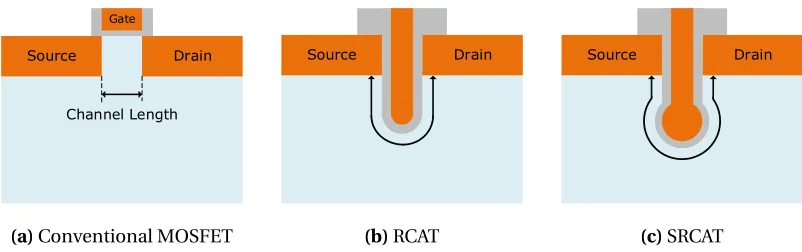
leakage and overall leakage current[29]. Samsung also proposed a sphere-shaped recessed channel array transistor (SRCAT) with the 70 nm process and expected extendable scaling
down to sub-50 nm process. SRCAT provides more recessed channel effect than RCAT
[23]. Figure 2.1 shows the cross-section of various gate transistor. Arrows indicate channel
length. As depicted in the Figure 2.1, SRCAT has longer channel length than RCAT or planar
MOSFET.
FinFET or its hybrid are also studied as a bitcell transistor in DRAMs[25–27, 30]. Fin-FETs have a more extensive channel width compared to a planar transistor which helps to
suppress short channel effect. Thus, FinFET can be used as a gate transistor in a smaller
Gate
Drain Source
Channel Length
(a)Conventional MOSFET
v Drain Source
(b)RCAT
Drain Source
(c)SRCAT
Figure 2.1Cross-section of various gate transistor.
[31]. These limitations make FinFET less attractive than RCAT and SRCAT.
Vertical channel access transistor (VCAT) is another transistor that has been proposed
as a bitcell transistor alternative for DRAMs[11, 24]. The major benefit from VCAT is area efficiency; the VCAT is a three-dimensional structure in which the channel exists vertically,
surrounded by the gate as depicted in Figure 2.2. This allows for the bitcell transistor to be
placed at the cross section of bitline and wordline and also allows VCAT dedicated denser
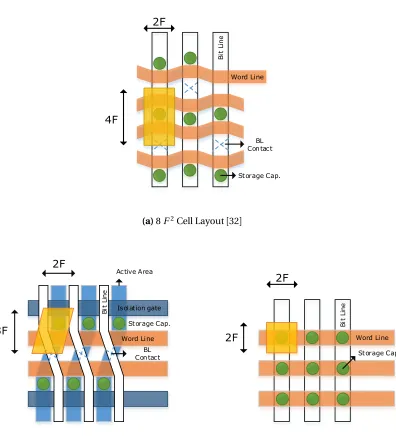
cell layout such as 4F2. Even though VCAT does not support RCAT or SRCAT based cell
layouts such as 8F2or 6F2cell layout, VCAT drives cell area from 8F2or 6F2to 4F2as
shown in Figure 2.3. The unit,F, is denoted in minimum feature size (half pitch of the
first metal layer). Since 4F2cell array layout could increase the gross die about 1.35 times compared to 6F2cell array layout, the industry expected VCAT as the next gate device[20, 24].
Compared to all other supportive circuits, satisfying the speed margin of DRAM standard
(i.e.DDR, DDR2, etc.) is the driving force that underlines most design and technology
P-Sub.
Bit Line Bit Line
VCAT Word Line
Storage Cap.
Figure 2.23D Schematic diagram of VCAT-based DRAM cell[11].
in the bitcell array area are depicted in reference[13].
2.1.1
Gate Transistor Model and Scaling
In this work, our gate transistor roadmap is deployed with Synopsys Technology
Computer-Aided Design (TCAD) device simulator technology. Unlike MOSFET or FinFET, RCAT, SRCAT,
and VCAT do not have an appropriate numerical device model. DATE provides a gate
transistor roadmap of recessed devices like RCAT, SRCAT, and of emerging devices such as
VCAT since the industry has extensively used it and is expected to continue its use in the
future. RCAT, SRCAT, and VCAT structures and simulation conditions are shown in Figure 2.4
and Table 2.1. As shown in Figure 2.4c, the top part of the VCAT pillar diameter would be
assumed as 0.5F due to the etching process. During the evaluation, general feature size
B it L in e Storage Cap. BL Contact 2F 4F Word Line
(a)8F2Cell Layout[32]
Isolation gate Word Line Active Area B it L in e Storage Cap. BL Contact 2F 3F
(b)6F2Cell Layout[33]
Word Line B it L in e Storage Cap. 2F 2F
(c)4F2Cell Layout[24]
Table 2.1Material and doping method of gate transistor
Structure Tech. node Depth or Height Gate Material Substrate
Doping Method
(nm) (nm)
RCAT 90,75 200 WSi Uniform
SRCAT 65,55,45,40,
36,31,27,24, 21,18,16
190 WSi(65 nm),
W
Uniform(65 nm), Asymmetric
VCAT 90,65,45,31,
21,16
250 Poly Silicon Uniform
DATE adopts linearly interpolated values.
In RCAT and SRCAT, we assume RCAT would dominate in 90 nm and 75 nm process,
and SRCAT would dominate from 65 nm to 16 nm[23, 35]. The trench depth of the recessed
devices has dependency with the threshold voltage. A deeper trench would result in lower
threshold voltage even while all the other conditions are unchanged[36]. The trench depth
would follow the results published in reference[23], which examined 110 nm to 60 nm
process. Below 60 nm process, we assume that the trench depth would remain as it is on
the 60 nm process. For the gate material, we assume it is tungsten silicide from 75 nm and
tungsten from 55 nm[34]. These work functions are 4.82 eV and 5.12 eV in each case[37,
38]. Asymmetric Channel Doping (ASC) is assumed from 55 nm to reduce junction leakage
between capacitor and gate transistor[34, 39].
VCAT would be used as gate transistor from approximately 28 nm and below according
to ITRS roadmap[20]. However, DATE provides roadmap from 90 nm for the comparison
F
Tox
Trench Depth
(a)RCAT structure.
Tox
F
1.5F
Trench Depth
(b)SRCAT structure.
Tox F Offset F Pillar Height 250 nm 1/2F
(c)VCAT structure.
Figure 2.4Gate transistor structures.
Low leakage current (Io f f) is the primary decision criterion for the gate-transistor design parameters. The JEDEC standard requires 64 ms data retention time at 85◦C for the storage
node[40]. The relationship between storage node retention time (tR E F) andIo f f is described by the equation[41, 42]:
Io f f =
CS(Va r r a y/2−∆VB L)−CB∆VB L tR E F
. (2.1)
∆VB L is the bitline sensing voltage and is given by the equation,
∆VB L = CS CB+CS
×(1
2Va r r a y−∆VM AX) (2.2)
Table 2.2Leakage Current Criterion (fA/cell)
tr e f DRAM Process Node (nm)
(ms) 90 75 65 55 44 40 36 31 27 24 21 18 16
64 94.2 96.1 97.7 71.7 63.9 63.6 58.6 60.0 61.3 56.3 57.5 59.1 60.3
500 12.1 12.3 12.5 9.2 8.2 8.1 7.5 7.7 7.8 7.2 7.4 7.6 7.7
1000 6.0 6.2 6.3 4.6 4.1 4.1 3.8 3.8 3.9 3.6 3.7 3.8 3.9
capacitance. Detailed derivation is provided in Appendix A.
DATE adopts internal and supply voltage projection from the Rambus roadmap and
assumes storage capacitor has 30 fF as CACTI model. Bitline capacitance could change
according to bank design. Rambus assumes bitline capacitance about 192 fF on 90 nm
node[13]. DATE calculates bitline capacitance about 90 fF to 100 fF on 80 nm node while
evaluates 1 Gb commodity DRAM[43]. For conservative prediction, we assume bitline
capacitance as 300 fF on 90 nm node and linearly reduce according to the technology node.
The∆VM AX is 10% ofVa r r a y for calculation.
Table 2.2 shows the leakage current calculation result that meets the required retention
time with these assumptions. The DRAM vendors set theIo f f criterion as less than 1 fA/cell
[34, 44, 45]. However, based on Table 2.2, 5 fA/cell would be a good criterion to satisfy, even
thoughtR E F is 500 ms. Thus, we assume 5 fA is the requirement for gate transistor leakage current as our TCAD device simulation result.
The leakage current is inversely proportional to the threshold voltage of the device.
Thus, when the threshold voltage and the trend are known, the remaining device design
parameters can be approximated.
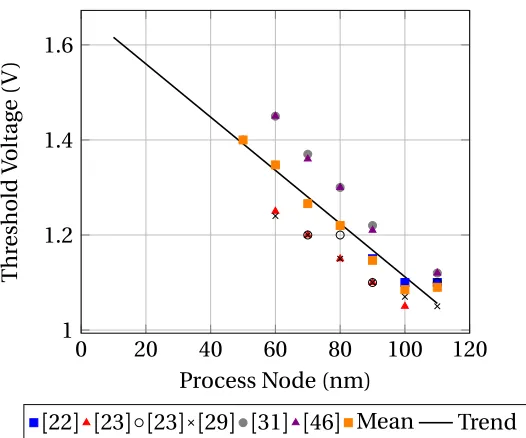
RCAT and SRCAT threshold voltage projections have been provided in references[22,
0 20 40 60 80 100 120 1
1.2 1.4 1.6
Process Node (nm)
Thr
eshold
V
oltage
(V
)
[22] [23] [23] [29] [31] [46] Mean Trend
Figure 2.5Recessed gate transistor threshold voltage trend.
in Figure 2.5. For DATE model, it is assumed that the trend for RCAT threshold will best fit
the straight line of the mean value of threshold data. Thus, the trend would follow equation
(2.3).
Vt h−t r e n d=– 0.0056×Process Node+1.672 (2.3)
The straight line in Figure 2.5 represents the RCAT threshold trend shown in Equation 2.3.
The standard deviation of data from the trend line is 0.0664. For the SRCAT, the threshold
voltage is assumed to be 200 mV lower than RCAT when all other conditions are kept
constant[23].
Overall, for the recessed gate transistors, DATE admits the result to the roadmap when
theIo f f is less than 5 fA/cell, when comparing the result with the threshold projection (within the standard deviation range). For the VCAT, the leakage current is the only criterion
Figure 2.6MASTAR graphical user interface[47].
2.1.2
High-Voltage and Peripheral transistor
Peripheral and high voltage transistor roadmaps are deployed with a Model for
Assess-ment of cmoS Technology And Roadmaps (MASTAR) from ITRS[47]. Figure 2.6 shows the
graphical user interface of MASTAR. MASTAR has high performance (HP), low stand-by
power (LSTP) and low operating power (LOP) process roadmaps with physical models
of planar bulk, double gate (DG) and silicon on insulator (SOI) transistor. MASTAR could
Table 2.3ITRS Saturation Current Roadmap of Supportive NMOSFET at 25◦C
DRAM Process Node (nm)
90 75 65 55 44 40 36 31 27 24 21 18 16
Is a t-n
500 500 500 465 450 410 410 400 400 400 450 450 450
(µA/µm)
etc.) with several transistor geometry values like gate length, oxide thickness and so on.
We assume peripheral and high voltage transistors to be planar bulk, and the additional
fabrication process for peripherals would be optimized for speed with low leakage current.
From this assembly, we rely upon MASTAR process assumptions along with Rambus size
projections.
ITRS provides saturation current roadmap of supportive transistors as shown in Table 2.3.
DATE admits the ITRS projection for adjusting channel doping concentration. Since the
ITRS roadmap was generated at 25◦C, we extended temperature from 300 K to 400 K using
MASTAR.
2.2
Interconnect
2.2.1
Wire
For the wire resistance and wire capacitance calculation, DATE adopts Horowitz wire
model[48]. From the model, the general metal wire resistance is given by Equation 2.4:
R=ρ Length
Conductor’s Cross-sectional Area (2.4)
Copper
Thickness
Width
Length
Barrier Thickness
(BT) Cross
section
Barrier Dielectric
Figure 2.7Wire and wire cross section for resistance calculation[48].
C_top
C_right C_left
C_bottom
Ground Copper Dielectric Inter Layer Dielectric (ILD)
In the case of copper wire, a thin barrier layer is needed on three sides to prevent copper
from diffusing into surrounding oxides, as shown in Figure 2.7. The copper wire resistance
per unit length is given as,
Ru n i t-l e n g t h=ρ
1
(Thickness – BT)×(Width – 2×BT) (2.5)
As shown in Figure 2.8, copper wire capacitance consists of the surrounding sheet
capaci-tance with fringe capacicapaci-tance. The capacicapaci-tance is driven as,
Cu n i t-l e n g t h=Ch o r i z o n t a l+Cv e r t i c a l +Cf r i n g e (2.6)
Ch o r i z o n t a l andCv e r t i c a l are given by the equation,
Ch o r i z o n t a l =2×εd i e l e c t r i cεo
wire thickness
wire spacing (2.7)
Cv e r t i c a l=2×εI L Dεo
wire width
ILD thickness (2.8)
For the general metal wire material, Horowitz and ITRS expected the technology would
migrate from aluminum to copper because aluminum wires have a resistivity of 282Ω·cm
while copper wires have a resistivity of 170Ω·cm at 20◦C [48–50]. DATE adopts copper as a
wire material as ITRS and Horowitz. Rambus model[13]and the cross-section of specific
commodity DRAM[51]has shown that aluminum is used wire material in DRAM. However,
even though copper has smaller resistivity compare to aluminum because of the thin barrier
layer, wire resistance does not quite decrease as much as the ratio of two materials[48]. For the wordline and bitline, polysilicon or tungsten silicide or the combination of
Tungsten silicide could have different resistivity according to the different process recipes.
Higher temperature and longer time on annealing process give lower resistivity [52]. For calculating resistance, DATE use 80µΩ·cm.
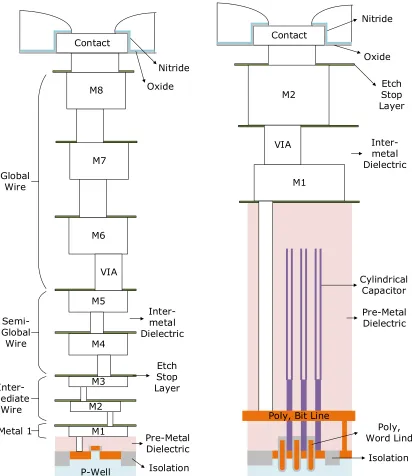
Figure 2.9 shows a cross-section of interconnect architecture. Figure 2.9a shows the
in-terconnect architecture of the general microprocessor. Figure 2.9b shows the cross-section
view of the DRAM interconnect architecture. In Figure 2.9b, cylindrical capacitors are
connected to the drain region of the RCAT, not the polysilicon bit line.
As depicted in Figure 2.9, in general, commodity DRAM has capacitors between poly
and metal layer one (M1) at the cell region and uses fewer metal layers (overall two to four
layers[13, 49]) than the microprocessor technology. In the technical report[51], DRAM uses a metal size similar to the global wire size of a microprocessor process.
ITRS provides the detail size projection for general microprocessor interconnect with
dielectric material properties and effective copper resistivity according to the metal size
[49]. ITRS also offers M1 pitch and contact resistance and few more information as the
indicative key feature for the DRAM wire projection but the provided information is not
detailed for revealing entire wire projection: there is no DRAM wire size projection.
From the DRAM cross-sectional report[51], we can find detailed physical dimensions of the entire DRAM wire layer of a specific commodity DRAM, but little detail for the dielectric
material properties. Thus, for deploying DRAM wire roadmap, ITRS roadmap alone or the
technical report alone is insufficient.
As in ITRS roadmap, DATE assumes copper as a base wire material. This allows DATE to
use ITRS wire material property roadmap. In addition, DATE adopts the physical dimension
from the cross-sectional report to construct the DRAM wire roadmap. For the bitline and
wordline, DATE assumes aspect ratio of 2.2 in all technology node as similar in the
M1 M2 M3 M4 M5 M6 VIA P-Well Contact Isolation Inter-metal Dielectric Pre-Metal Dielectric Etch Stop Layer Metal 1 Inter-Mediate Wire Semi-Global Wire Global Wire Oxide Nitride M7 M8
(a)Cross-section of microprocessor[49].
v v M1 VIA Poly, Word Lind Pre-Metal Dielectric Inter-metal Dielectric Contact Oxide Nitride Cylindrical Capacitor Etch Stop Layer M2 Isolation Poly, Bit Line
(b)Cross-section of 6F2layout DRAM[51].
a condensed bit-cell array layout. Silicon-oxide is assumed as a dielectric material of
poly-wires since the poly-wires are used as a gate material of the gate transistor. The oxide thickness
follows Rambus projection of the gate transistor.
DATE assumes three copper metal layers with polysilicon wordline and polysilicon
bitline. DATE limits the use of the first metal layer (M1) to the inter-cell routing within small
peripherals. There is a significant difference in the choice of inter-cell routing materials
assumed between DATE and the technical report[51]. In the technical report, polysilicon plays a role of inter-cell routing layer. During peripheral circuit speed and energy
calcula-tions, the M1 capacitance is only included for energy calculacalcula-tions, but the M1 resistance is
ignored for the speed due to the short routing distance. The M1 capacitance has a relatively
small portion of the peripheral circuit compared to the capacitance of the transistors, so
with either copper or polysilicon, the impact of the inter-cell routing layer on the entirety
of the calculations in DATE is limited. Since the lack of physical dimensions of M1 for the
inter-cell routes in the technical report, the width, pitch, and aspect-ratio of the M1 layer
and other properties would follow ITRS M1 layer projection.
For the other metal layers, DATE adopts similar width sizes and aspect ratios from the
cross-sectional report[51]. The metal layer two (M2) and the metal layer three (M3) of DATE match M1 and M2 of the cross-sectional report, respectively. The M2 wire pitch is assumed
8.8 times the feature size and the M3 wire pitch is assumed 15 times the feature size. The
width of each wire is assumed half of the wire pitch. The aspect ratios are 1.5 and 1.75 for
the M2 and M3, respectively. For the M2, effective resistivity and dielectric properties are
following ITRS semi-global wire roadmap. For the M3, material properties are following
ITRS global wire projection.
Once unit resistance and capacitance are deployed, DATE use the value to calculate the
wire bus.
2.2.2
Through Silicon Via
Through silicon via (TSV) is an essential component in configuring 3D DRAM. TSVs are
classified into different categories according to the fabricated order compared to the metal
layer. DATE uses front-end-of-line (FEOL) TSVs which are fabricated right before the first
metal layer processing. FEOL TSV enables the interconnection between the top metal of
bottom die and the first metal layer of the top die. Thus, DATE adopts the analytic model of
the FEOL-TSV proposed in reference[14, 53]. The equations presented in this section are taken from the TSV references[14, 53].
Figure 2.10 shows the cross-sectional view and top view between two stacked dies using
the FEOL TSV. In the figure,rt s v,ro x, andrd e p are the radius of TSV, oxide, and depletion region respectively. Figure 2.11 shows a top view of the FEOL TSV bundles along with
coupled capacitance.
The TSV resistance model is given by Equation:
Rt s v =ρ lt s v
πr2 t s v
(2.9)
whereρis resistivity, andlt s v represents the length of the TSV.
As depicted in Figure 2.10 and Figure 2.11, TSV capacitance consists of intrinsic
capaci-tance with coupling capacicapaci-tance. The TSV capacicapaci-tance model is given by Equation:
TSV
Inter Layer Dielectric Copper, Metal 2
Copper, Top Metal
Copper, Metal 1 Pre-metal Dielectric Inter-die adhesive Copper, Metal P-type Si Substrate Lower Die Upper Die dep C r r r P-type Si Substrate Silicon Oxide Inter Layer Dielectric
ox
C
dep tsv
ox
Figure 2.10Cross section and top view of single TSV with capacitance[53].
P-type Si Substrate TSV C_diagonal_couple C_lateral_couple Silicon Oxide
The TSV intrinsic capacitance,Ci n t r i n s i c, is modeled by Equation:
Ci n t r i n s i c =
Co xCd e p Co x+Cd e p
(2.11)
whereCo x andCd e p are given as following Equations:
Co x=
2πεo xlt s v l n(ro x/rt s v)
(2.12)
Cd e p=
2πεo xlt s v l n(rd e p/ro x)
. (2.13)
In the DRAM layout, the TSVs are arranged close together as in Figure 2.11 Thus, there
is coupling capacitance between the TSVs. TheCc o u p l i n g is modeled by the equation,
Cc o u p l i n g =α
εs i
S πdt s vlt s v. (2.14)
whereαis a fitting constant which is accounting for technology and nonlinearity of coupling
capacitance. Thedt s v is a distance between TSVs. For the detailed calculation for each
technology nodes, DATE follows CACT-3DD size roadmap for a conservative size scaling:
ITRS provide size roadmap of TSVs. CACTI-3DD adds conservative industry perspective on
top of the ITRS projection.
DATE includes TSVs in the driving circuits. The drivers are inserted instantly before and
after a TSV to ensure the driving strength of the TSV. The logical effort method is utilized to
2.3
Roadmap and discussion
2.3.1
Gate Transistor
RCAT, SRCAT and VCAT have been simulated with Synopsys TCAD under the condition
proposed in Table 2.1 and Figure 2.4. The simulation calculates gate capacitance, device
turn-on/off currents (Io n,Io f f) and threshold voltage. The simulation sweeps the temper-ature variation from 300 K to 400 K in 10 K increments, and runs at 358 K to checkIo f f current.
(a)RCAT simulation with uniform channel doping. (b)SRCAT simulation with asymmetric channel doping.
Figure 2.12TCAD simulation snapshot of recessed transistors.
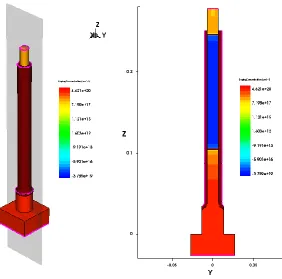
Figure 2.12 shows TCAD simulation of the recessed transistors. RCAT is simulated with
uniform channel doping, and SRCAT is simulated with asymmetric channel doping. Since
the simulation is performed in a 2D cross-sectional environment, TCAD computes the
VCAT TCAD simulation. For the VCAT, the simulation results are per device value since
the simulation runs on a single device. The detail simulation commands of 44 nm SRCAT
device structures are included as an example in Appendix B.
Table 2.4Gate transistor roadmap1
Technology (nm) 90 75 65 55 44 40 36 31 27 24 22 18 16 Gate Capacitance (aF/device)
Rambus MOSFET 55.7 39.2
Recessed 41.0 32.9 24.2 21.2 18.4 14.9 12.5 10.7 8.7 7.0 6.1 CACTI-3DD Unknown 76.5 46.8 24.1 14.5 8.35
DATE *
RCAT 210.4 188.3
SRCAT 174.9 128.7 103.8 98.0 106.2 96.7 85.6 75.6 70.4 61.2 52.8 VCAT 194.4 164.4 125.4 101.5 91.8 79.0 Ion current (𝜇A/device)
CACTI-3DD Unknown 20 20 20 20 20
DATE *
RCAT 24.1 18.8
SRCAT 19.0 17.6 14.0 12.3 12.8 10.7 9.4 4.2 4.9 3.8 3.4 VCAT 36.9 39.6 53.1 36.1 26.3 22.3 Ioff current (fA/device) at 85℃
CACTI-3DD Unknown 1 1 1 1 1
DATE *
RCAT 3.1 5.0
SRCAT 2.1 3.9 4.2 3.3 2.0 1.5 1.3 1.2 1.1 0.9 0.9 VCAT 4.9 2.9 2.0 1.4 4.9 3.6 Vth(V)
Expected Vth** 1.17 1.25 1.11 1.16 1.23 1.25 1.27 1.30 1.32 1.34 1.35 1.37 1.38
DATE * Recessed ** 1.17 1.25 1.10 1.16 1.20 1.20 1.27 1.31 1.32 1.34 1.36 1.38 1.38 VCAT 0.31 0.84 0.72 0.92 0.89 0.68
∗Simulation result at 300 K
∗∗RCAT at 75 nm, SRCAT at 65 nm∼16 nm
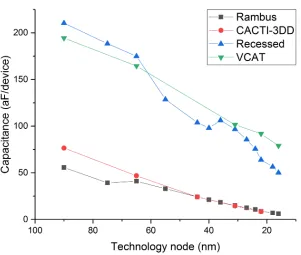
Table 2.4 shows results from the overall device simulation with CACTI-3DD and Rambus
projection. Rambus provides capacitance projection on each node. CACTI-3DD provides
1The Rambus and CACTI-3DD projection was derived and calculated based on the source code or data
Figure 2.14Gate transistor roadmap.
90 nm, 65 nm, 45 nm, 32 nm, 22 nm and 16 nm process node projections in the source code.
The CACTI-3DD source code, provided by the author, does not work below 22 nm, so we
exclude 16 nm. Between these nodes, CACTI-3DD assumes linearly interpolated values at
each node. Both Rambus and CACTI-3DD assume similar capacitance scaling projection
as shown in Figure 2.14. For DATE model, TCAD simulation results exhibit 4 to 13 times
larger capacitance compared to the CACTI-3DD projection from 75 nm to 16 nm nodes.
These differences are to be expected since Rambus and CACTI-3DD estimate shorter and
scaling down channel length while DATE assumes constant trench depth and pillar height
Gate
Side wall Cap.Junction Cap.
Overlap Cap.
Gate Cap. Junction Depth
Gate Width
Junction Length
Figure 2.15Detail view of source or drain junction of MOSFET[55].
For theIo n andIo f f current, CACTI-3DD assumes Io n =20µA,Io f f =1 fA for every
node as an ideal value. In DATE roadmap, we have tried to keepIo f f below 5 fA with the
lowest possible channel doping density while the threshold voltage met threshold voltage
trend within the standard deviation (0.0665 V). With these conditions,Io n of SRCAT scaled to 3.4µAat 16 nm node. For VCAT, we only have tried to meetIo f f below 5 fA as mentioned
above. With this condition, Io n of VCAT is above 20µAfor every technology node. The
Io n simulation results of the recessed transistor are smaller compared to the CACTI-3DD
assumption sinceIo n is inversely proportional to effective channel length. However, the
lower current flow could be compensated by the smaller die size according to technology
scaling. As a result, DRAM specification could be satisfied.
2.3.2
High Voltage and Peripheral Transistor
Table 2.5 shows capacitance and turn-on current roadmap of high-voltage (HV) transistors.
To calculate the capacitance of a single high voltage (HV) transistor, we assume that the
gate width of 3F and also have a junction length of 3F as depicted in Figure 2.15. As a result, CACTI-3DD roadmap expects most optimistic capacitance projection, comparing
DATE to Rambus since CACTI-3DD expects least gate capacitance even though Rambus
does not include side-wall and overlap capacitance. DATE exhibits the most conservative
capacitance because DATE adopts the most conservative side-wall capacitance from ITRS
MASTAR and assumes the most conservative gate capacitance mainly due to longer gate
length expectation of Rambus roadmap. For the turn-on current, CACTI-3DD uses a fixed
number on each node even through temperature changes. DATE follows ITRS roadmap at
25◦C and reflects turn-on current change due to temperature changes based on MASTAR
calculation. Overall, CACTI-3DD expects about two times larger current than DATE.
Table 2.6 shows capacitance and turn-on current roadmap of peripheral transistors. For
the capacitance of a single device comparison, we assume that the peripheral transistors of
all roadmaps have a gate width of 3F. Peripheral transistors are also assumed to have a
junction length of 3F. Rambus roadmap expects most optimistic capacitance projection,
comparing DATE to CACTI-3DD since Rambus does not include side-wall and overlap
capacitance. Between CACTI-3DD and DATE, DATE exhibits more device capacitance
because DATE adopts higher side-wall capacitance as discussed in the case of HV transistor
and also expects more gate capacitance mainly due to longer channel length expectation of
Rambus roadmap. For the turn-on current, CACTI-3DD also uses a fixed number on each
node even though temperature changes. DATE follows ITRS roadmap at 25◦C and reflects
turn-on current change due to temperature changes based on MASTAR calculation. Over
all tech nodes, DATE exhibits turn-on currents that are similar or lower than CACTI-3DD.
2The Rambus and CACTI-3DD projection was derived and calculated based on the source code or data
provided by the author.
3The Rambus and CACTI-3DD projection was derived and calculated based on the source code or data
Table 2.5High voltage transistor roadmap2
Technology (nm) 90 75 65 55 44 40 36 31 27 24 22 18 16
Capacitance (aF/device *)
Rambus 765.4 637.1 536.3 445.9 350.6 313.1 276.9 234.2 204.8 175.0 150.1 125.9 109.3
CACTI-3DD 780.1 509.0 321.4 200.2 127.5
DATE 1309.5 1120.3 955.2 820.5 653.0 570.9 503.7 438.8 379.0 327.8 282.6 238.6 209.0 Ion current (𝜇A/𝜇m)
CACTI-3DD 1094.3 1031.0 999.4 1024.5 910.5
DATE† 440.5 500.6 500.5 465.6 450.8 410.9 410.6 400.3 400.2 400.4 450.2 450.0 450.0
ITRS (Spec.)†‡ 440.0 500.0 500.0 465.0 450.0 410.0 410.0 400.0 400.0 400.0 450.0 450.0 450.0
∗Transistor minimum width is assumed as 3 times of the minimum feature size of each technology. † When temperature at 25◦C
‡ 90 nm follows MASTAR 90 nm LSTP projection. 75 nm and 65 nm nodes follow 68 nm node of ITRS 2007. 55 nm node follows ITRS2007 58 nm node. 44 nm and 40 nm nodes follow ITRS2009. 36 nm, 31 nm and 27 nm nodes follow ITRS2011. 24 nm and below nodes follow ITRS2013.
Table 2.6Peripheral transistor roadmap3
Technology (nm) 90 75 65 55 44 40 36 31 27 24 22 18 16
Capacitance (aF/device *)
Rambus 629.5 482.6 375.9 307.3 229.5 198.3 164.7 130.4 111.4 88.6 75.9 64.2 56.3
CACTI-3DD 912.1 559.0 346.6 222.7 141.9
DATE 976.4 812.5 778.3 653.2 509.6 435.6 382.2 312.2 272.6 233.1 202.7 171.0 153.6
Ion current (𝜇A/𝜇m)
CACTI-3DD 503.6 519.2 666.2 683.6 727.6
DATE† 500.0 500.0 500.1 465.0 450.0 410.2 410.8 400.1 400.5 400.2 450.2 450.4 450.4
ITRS (Spec.)†‡ 500.0 500.0 500.0 465.0 450.0 410.0 410.0 400.0 400.0 400.0 450.0 450.0 450.0
∗Transistor minimum width is assumed as 3 times of the minimum feature size of each technology. † When temperature at 25◦C.
Table 2.7DATE wire roadmap
Technology (nm) 90 75 65 55 44 40 36 31 27 24 22 18 16 Capacitance (fF/𝜇m)
Poly-WL 0.762 0.722 0.684 0.632 0.568 0.549 0.531 0.502 0.476 0.429 0.401 0.346 0.330 Poly-BL 0.762 0.722 0.684 0.632 0.568 0.549 0.531 0.502 0.476 0.429 0.401 0.346 0.330 M1 0.326 0.326 0.326 0.327 0.332 0.332 0.332 0.338 0.343 0.310 0.301 0.281 0.278 M2 0.351 0.351 0.351 0.352 0.342 0.341 0.341 0.332 0.343 0.303 0.293 0.275 0.269 M3 0.350 0.350 0.350 0.351 0.344 0.344 0.344 0.337 0.345 0.303 0.295 0.275 0.268 Resistance (Ω/𝜇m)
Poly-WL 44.893 64.646 86.068 120.21 189.113 227.273 280.584 378.394 498.815 631.313 760.153 1122.334 1420.455
Poly-BL 44.893 64.646 86.068 120.21 189.113 227.273 280.584 378.394 498.815 631.313 760.153 1122.334 1420.455
2.3.3
Wire
Wire capacitance and resistance perµm have been calculated using the Horowitz equation
for DATE. Table 2.7 shows the detailed result.
Figure 2.16Wire resistance roadmap.
Figure 2.16 shows DATE wire resistance roadmap. As an absolute value, poly-wires
(i.e.,poly-wordline and poly-bitline) have the same highest resistance at 16 nm with 1420.46Ω/µm
since DATE assumes the same physical dimension between the wordline and bitline.
Poly-wires also have high resistance in the order of poly-Poly-wires, M1, M2, M3 wire. This sequence
lasts from 90 nm. As for the relative change, the M3 wire has a difference of about 75 fold
poly-wordline difference is about 32-fold. It is assumed that the conductor effective
cop-per resistivity from the ITRS roadmap is gradually increased from 2.2µΩ·cm at 90 nm to
6.88µΩ·cm at the 16 nm node while polysilicon resistivity is assumed as 80µΩ·cm in all
technology nodes.
Figure 2.17 shows DATE wire capacitance roadmap. Overall, wire capacitance decreases
as technology advances. The poly-wire has the highest capacitance in all node, mainly due
to the wire pitch is the smallest. The M2 and M3 has a similar aspect ratio as 1.5 and 1.75
respectively, the same distance ratio (i.e., half of the wire pitch), and a similar dielectric
between wires. Thus, the M2 and M3 have similar capacitance on all nodes as shown in
Table 2.7.
Figure 2.18 compares the capacitance of M2 and M3 with the roadmap of ITRS and
CACTI-3DD. M2 of DATE corresponds to the semi-global metal, and M3 corresponds to the
global metal of ITRS and CACTI-3DD. Since DATE adopts material properties from ITRS
roadmap, the difference between ITRS and DATE is due to geometry prediction differences.
(a)Metal 2 (M2). (b)Metal 3 (M3).
Figure 2.18Metal capacitance comparison4.
CACTI-3DD follows original CACTI wire projection[12]. CACTI assumes different
mate-rial properties and physical dimensions from ITRS. In M2 and M3 layer, DATE has the most
conservative projection. The M2 and M3 projections in Figure 2.18 are approximately twice
the capacitance value compared to the ITRS-aggressive predictions.
Figure 2.19 compares the resistance of M2 and M3 with the roadmap of ITRS and
CACTI-4The ITRS roadmap was calculated from the ITRS physical dimension and material roadmap. The
CACTI-3DD roadmap is derived from the source code.
5The ITRS roadmap was calculated from the ITRS physical dimension and material roadmap. The
(a)Metal 2. (b)Metal 3.
Figure 2.19Metal resistance comparison5.
3DD. Among M2 and M3 layers, ITRS M2 perspective is the most conservative. Except for
ITRS M2 and ITRS M3-aggressive cases, all nodes have resistances of less than 15Ω/µm.
In M2 layer roadmap, DATE expects the smallest resistance in all nodes except
CACTI-3DD aggressive projection. In M3 layer roadmap, DATE expects the smallest resistance in
all nodes mainly due to it have the largest physical dimension compare to the ITRS and
CACTI-3DD.
For comparison, we choose three commodity logic design processes. The normalized
values of wire capacitance and resistance across three anonymous processes with those of
DATE, ITRS, and CACTI-3DD, are presented in Table 2.8.
CACTI-3DD has about 5% to 35% more capacitance than anonymous processes even
though CACTI-3DD assumesSi O2(dielectric constant: 3.9) is used as a dielectric material while ITRS project different dielectric constant in each technology node[49]. CACTI also
6The ITRS roadmap was calculated from the ITRS physical dimension and material roadmap. The
Table 2.8Wire comparison with commodity logic design process6
DATE ITRS CACTI-3DD
Wire Poly,
Wordline M1
M2 (Semi.)
M3
(Global) M1 Semi-Glob. Global M1 Semi-Glob. Global
Capacitance (%)
45 nm 384.7 146.5 160.6 92.1 88.3 94.2 92.1 121.4 134.2 136.9
65 nm – A 404.7 155.8 144.9 158.2 93.2 78.4 97.2 136.2 117.7 137.9
65 nm – B 353.7 128.4 141.5 108.5 76.8 76.6 66.6 112.3 114.9 105.8
Resistance (%)
45 nm 57.7 333.0 85.5 57.5 261.8 1180.1 642.5 66.4 117.9 107.5
65 nm – A 70.0 178.6 71.9 67.6 139.0 964.3 959.5 40.7 121.9 103.6
65 nm – B 84.8 336.7 20.2 21.4 262.1 271.3 303.4 76.6 34.3 32.8
uses constant bulk copper resistivity instead of using effective resistivity for the resistance
calculation. This affects the most optimistic resistance prediction on the M1 layer.
On the other hand, ITRS assumes to use the different dielectric material and relative
resistivity on each node. In the same node, ITRS assumes that the dielectric surrounding
the wire with all metal layers is the same high-k material, whereas some actual processes
use low-k material for the semi-global and global wire. With these differences, ITRS expects
about 6% to 12% less capacitance on 45 nm node. In 65 nm A and B, ITRS projects about
3% to 33% less capacitance.Since ITRS has a different physical dimension with different
resistivity due to different dielectric materials, resistance is 6- to 10-fold different in 45 nm
and 2- to 9-fold different in 65 nm processes in M2 and M3 layer.
The anonymous processes are for the general logic design. However, DATE assumes
DRAM process. Even though it is not an apple to apple comparison, in the case of M2
and M3 layers, it is meaningful to compare DRAM and general process wires. The M1
dielectric of high-k or SiO2. The polysilicon layer is assumed to have larger aspect ratios
than anonymous processes at DATE. Thus, DATE expects about three- to four-fold greater
capacitance, with 16% to 42% less resistance than anonymous processes. In M1 layer, DATE
exhibit about 1.3- to 1.6-fold greater capacitance with about 1.8- to 3.4-fold grater resistance.
From this, we could expect DATE assumes smaller geometry and higher dielectric material
than anonymous processes in M1 layer when M1 layer resistivity is equal. DATE expects
about 14.5% to 80% less resistance than anonymous processes in M2 and M3. On the other
hand, the capacitance is about 1.5-fold greater. When dielectric material between M2 and
M3 layer are similar to anonymous processes, larger physical dimension assumption results
in smaller resistance with larger capacitance.
2.3.4
Through Silicon Via
Through silicon via (TSV) is mainly made by etching or laser drilling. When the TSV is
formed by etching, it is hard to achieve high etch rates, smooth sidewalls with controllable
sidewall angle, and minimal mask undercut. When making a TSV with a laser, the masking
and etching steps are not needed. Although this method has the advantage of reducing
process step, it causes debris or splatters due to laser ablation[49].
Because of these challenges, the ITRS conservatively predicts scaling of the TSV. Table 2.9
shows ITRS TSV roadmap by year. In Table 2.9, despite technology advance, the recent ITRS
roadmap assumes a size of TSV that is still similar or larger than previous years.
CACTI-3DD, on the other hand, assumed that the physical dimension of the TSV
de-creases as the technology advances. However, the assumptions of CACTI-3DD do not go
beyond the premises of the ITRS. Table 2.10 shows CACTI-3DD TSV roadmap.
7Global interconnect level TSV size[49].
Table 2.9ITRS TSV physical dimension roadmap7
ITRS version (year) ITRS 2009 ITRS 2011 ITRS 2013 ITRS 2015
Expecting Year 2009 ~ 2012 2012 ~ 2015 2011 ~ 2014 2015 ~ 2018 2012 ~ 2014 2015 ~ 2018 2013 ~ 2014 2015 ~ 2018
Technology Included (nm) 54 nm ~
32 nm
32 nm ~ 21 nm
36 nm ~ 25 nm
23 nm ~ 16 nm
45 nm ~ 32 nm
32 nm ~ 22 nm
28 nm ~ 26 nm
24 nm ~ 18 nm
Minimum Diameter (μm) 4 ~ 8 2 ~ 4 4 ~ 8 2 ~ 4 4 ~ 8 2 ~ 4 5 ~ 10 2 ~ 4
Minimum Pitch (μm) 8 ~ 16 4 ~ 8 8 ~ 16 4 ~ 8 8 ~ 16 2 ~ 8 10 ~ 20 4 ~ 8
Minimum Depth (μm) 20 ~ 50 20 ~ 50 20 ~ 50 20~50 20 ~ 50 20 ~ 50 40 ~ 100 30 ~ 50
Table 2.10CACTI-3DD TSV physical dimension roadmap
Technology (nm)
90
70
50
40
30
21
16
Diameter (μm)
11.3
11.3
7.5
5
3.8
3.2
2.6
Pitch (μm)
90
90
60
40
30
25
20
Depth (μm)
75
75
63
50
38
32
17
Table 2.11DATE TSV area, capacitance, and resistance roadmap
Technology (nm)
90
70
50
40
30
21
16
Area (mm
2)
0.0081
0.0081
0.0036
0.0016
0.0009
0.0006
0.0004
Capacitance (fF)
127.2
127.2
70.2
38.7
22.5
16.5
7.3
Table 2.12ITRS TSV area, capacitance, and resistance roadmap8
Technology (nm)
90
70
50
45
30
21
18
ITRS year
(version)
N.A.
N.A.
2009
2013
2013
2015
2015
Area (mm
2)
N.A.
N.A.
0.0003
0.0003
0.0001
0.0001
0.0001
Capacitance (fF)
N.A.
N.A.
158.8
158.8
115.0
115.0
115.0
Resistance (Ω)
N.A.
N.A.
0.118
0.118
0.172
0.172
0.172
In DATE, we adopt CACTI-3DD TSV roadmap since we assume TSV size would scale due
to technology advancement. The Table 2.11 shows the DATE TSV roadmap calculated as
described in Section 2.2.2. Compared to Table 2.12 DATE TSV roadmap exhibits larger area
and smaller capacitance projection mainly due to larger pitch. The DATE TSV roadmap
also exhibit larger resistance due to smaller diameter projection. This makes DATE area
predictions more conservative and latency predictions faster than they would be if the ITRS
CHAPTER
3
DRAM CIRCUIT LEVEL MODELING
System level power models calculate system power by using the values shown in the vendor
specification, while circuit level models calculate the resistance, capacitance, and area
values of a single transistor. Circuit level models can be expanded upon to calculate the
resistance, capacitance, and area of the logic composed of multiple transistors. The DRAM
Area Timing and Energy (DATE) model is a circuit level modeling method. By adding more
logic blocks with interconnects, the circuit level model calculates the area, speed, and
energy of the system.
The circuit level model can perform unpredictable area and latency modeling with the
module to the system level of error while the system level model calculates accurate results
based on the vendor specification. Precise modeling is essential for each module in order
to take advantage of the circuit level model.
Examples of circuit level modeling of the DRAM memory system are CACTI, CACTI-D,
CACTI-3DD, and Rambus models introduced in Section 1.3. Rambus released a planar
DRAM energy model in 2010[13]. The Rambus model computes the capacitance and energy
consumption based on a physical dimension scaling projection of a single device as well
as the layout of the peripheral circuitry. The Rambus model also provides detailed DRAM
architecture with peripheral circuitry including hierarchical wordline and bitline.
CACTI[12]is six-transistor (6T) SRAM cell based cache memory model that is widely
used in computer architecture community to model SRAM cache memory. CACTI-D
in-troduces one-transistor-one-capacitor (1T1C) DRAM cells and DRAM subarrays on top of
the CACTI[56]. CACTI 5.1 inherits CACTI-D’s DRAM model. However, the memory control
path and data path were inherited from the SRAM. Thus, CACTI-D or CACTI 5.1 is more
appropriate for modeling embedded DRAM than off-chip DRAM. CACTI-3DD[14]inherits
CACTI 5.1 and adds banks and buses with TSVs for modeling three-dimensional DRAM.
However, CACTI-3DD uses ideal device models, as shown in chapter 2, and does not
sup-port the emerging structure, such as 4F2cell layout. DATE inherits benefits of CACTI with architectural assumptions of Rambus.
Figure 3.1 shows the program flow of the DATE circuit level model. After DATE reads
the user configuration and technology roadmap, physical dimension and properties of
the subarray are established and calculated. With the subarray geometry, bank size is
calculated along with speed and energy of other bank components such as wordline driver
and column select decoder. After calculating the bank properties, DATE computes the
Read and Parse User Configuration
Calculate a Subarray Energy, Area, and Speed
Calculate a Bank Energy, Area, and Speed
with Subarray Info. Calculate Peripheral Circuit
Energy, Area, and Speed
Floor Plan Based on User Input
and Bank Size, Insert TSV
Calculate Total Energy, Speed, and Area
Calculate design component's (Wire, TSV, Logics)
Cap., Resistance, and Area. Read and Parse
Technology Ro