Patients are asking about e-cigarettes. What do we tell them?
D.J Worsley, K. Jones, Z. Marshman
Devina J Worsley, BDS, MDPH
Academic Unit of Dental Public Health
School of Clinical Dentistry
Claremont Crescent
Sheffield
S10 2TA
Dr Zoe Marshman, BDS, MPH, DDPH, FDS (DPH), PhD
School of Clinical Dentistry
Claremont Crescent
Sheffield
S10 2TA
Kate Jones, BDS, MSc, DDPH, MFDS, FDS (DPH)
Consultant in Dental Public Health
Public Health England, South Yorkshire Team
Unit C
Meadow Court
Hayland Street
Sheffield
S9 1BY
Abstract
E-cigarettes are electronic devices which deliver vaporised nicotine liquid into the
lungs. Since the introduction of e-cigarettes in 2004 the e-cigarette market in the
UK has rapidly expanded and increasingly people are asking health professionals
about them. The article gives an overview of e-cigarettes, their use, their
regulatory status and evidence for their safety, quality and efficacy. Advice about
e-cigarettes for dental health professionals to give patients is provided, as well as
the five questions, proposed by Action on Smoking and Health, to consider, when
deciding whether to permit or prohibit use of e-cigarettes on premises.
Introduction
E-cigarettes (also known as electronic cigarettes, electronic vaping devices or electronic nicotine delivery systems [ENDS]) are battery operated devices whose function is to vaporise nicotine. This creates a smoke like effect which can then be inhaled and exhaled, replicating smoking behaviour without the use of tobacco.1
First developed in China in 2003 e-cigarettes are now retailing worldwide. This is a fast growing market likened to a ‘gold rush’ 2 with dedicated e-cigarette companies being
joined by the leading tobacco companies, some of which are launching their own products or buying e-cigarette companies .3,4
The UK market is growing, with an estimated 1.3 million e-cigarettes users in 20135 and
is worth approximately £100 million per year.6 With more healthcare workers and
What are e-cigarettes?
E-cigarettes comprise three main components; a battery, a cartridge and an atomiser, which is an electronic heating element for vaporisation of the liquid. The basic types of e-cigarettes include the disposable e-cigarette, a rechargeable e-cigarette with
replaceable cartridges prefilled with liquid, and a rechargeable e-cigarette with a liquid refillable cartridge/tank (Figure 1).
PHOTO – separate attachment
Fig. 1 Three types of cigarettes: disposable cigarette; rechargeable cartridge
e-cigarette; and rechargeable liquid refillable e-cigarette
The cartridge contains a liquid known as e-liquid, e-juice, or smoke-juice. The ingredients may contain nicotine, flavourings, water, citric acid as well as either
propylene glycol and/or glycerol. The nicotine concentration depends on the brand and the product, ranging from 0mg/ml to 24mg/ml and may be labelled as nicotine-free, or referred to as mild/low, regular/medium or strong/high. In addition e-liquids with 36mg/ml to 50 mg/ml of nicotine are available.
A wide range of natural and/or artificial flavours may be incorporated into the nicotine or nicotine-free versions, e.g. traditional tobacco flavours, fruit, chocolate and various novelty flavours such as candy floss and margarita.
The replaceable cartridges for e-cigarettes are preloaded with e-liquid, and bottles of 10, 30 or 50ml of e-liquid are available for the liquid refillable e-cigarettes.
either ‘vaping’ or ‘smoking’. In this article the use of an e-cigarette will be termed vaping, and the use of a tobacco cigarette termed smoking.
In contrast to a tobacco cigarette, which may provide between 10 to 20 puffs per cigarette and has a natural endpoint, the number of puffs from an e-cigarette depends on brand, product and the way it is used. The range for disposable and replaceable
cartridges is reported to be from 150 puffs to 300 puffs, where 300 puffs is equivalent to 40 cigarettes7 and a 10ml bottle of e-liquid used in refillable e-cigarettes is equivalent to
200 cigarettes.8 E-cigarettes are available to buy on the internet, at dedicated e-cigarette
shops, in the supermarkets and other retail shops, and at street vendors.
Who uses e-cigarettes and why?
E-cigarettes are relatively new on the UK market. Their use is mainly among tobacco smokers, which in England are 19.6% of the population.9
The results of the Smoking Toolkit Study (STS) on e-cigarettes in England showed that the ‘current use’ (people who are using e-cigarettes at the time of the survey) has steadily increased among smokers, rising from 2% in 2011 to 15% in 2013.9 The
Action on Smoking and Health (ASH) survey on e-cigarettes found that current use among ex-smokers had increased from 1% in 2011 to 3% in 2012; among adults who had never smoked current users were 0%; current use among children aged 11 to 18 was rare and there was little use reported was among children who had or who currently smoked.10
smoked 1% had tried them and among children who had never smoked 1% had tried them.10
While the use of electronic cigarettes in children is low in the UK, the results of surveys from the United States have revealed an increasing trend in the use of e-cigarettes among children.11
E-cigarettes are claimed to be cheaper than tobacco cigarettes. A price comparison by one company estimated the cost of using e-cigarettes to be 80% cheaper than smoking tobacco cigarettes.12 The cost estimated for 20 e-cigarettes per day is less than £213
compared to the average cost of about £7 for 20 tobacco cigarettes; the 20% tax on e-cigarettes is lower than the 80% tax on tobacco e-cigarettes.14 Users of e-cigarettes give a
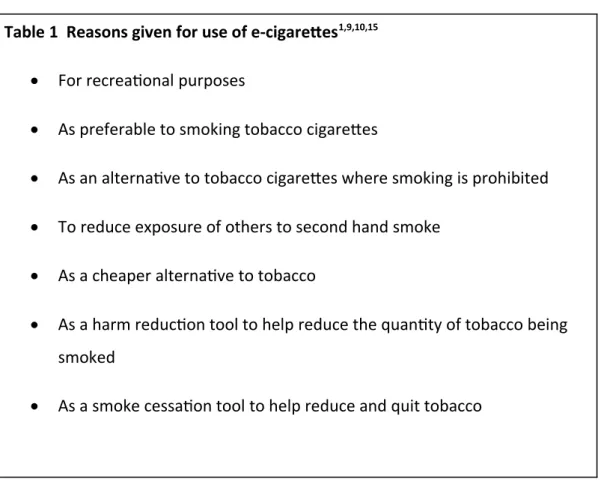
range of reasons for vaping some of which are listed in Table 1.
Table 1 Reasons given for use of e-cigarettes1,9,10,15
For recreational purposes
As preferable to smoking tobacco cigarettes
As an alternative to tobacco cigarettes where smoking is prohibited
To reduce exposure of others to second hand smoke
As a cheaper alternative to tobacco
As a harm reduction tool to help reduce the quantity of tobacco being
smoked
What is the current legislation and regulation of e-cigarettes in the
UK?
In the UK, e-cigarettes are regulated as General Consumer Products and have to meet the General Products Safety regulations 2005, the Chemicals (Hazard Information and Packaging for Supply) Regulations 2009, and are monitored by Trading Standards.1
They are not subject to the stricter medicines regulations unless they claim or imply that they can assist in giving up smoking16 and at present no e-cigarettes are regulated as
medical products.
The advertising of e-cigarettes is becoming reminiscent of the tobacco cigarette advertising of the past; glamorous, desirable, sexy, and fashionable, with marketing being directed at both smokers and non-smokers.2 Adverts for e-cigarettes are subject to
few restrictions at present. The e-cigarette may not be shown in television
advertisements but can be shown in on posters, on the internet etc. Advertisements for e-cigarettes cannot claim or imply that they are a smoking cessation tool, a harm reduction tool, harmless or risk free unless there is evidence to support the claims.17
Despite these restrictions, a recent report found that e-cigarettes were being promoted as ‘a healthier and safer source of nicotine’ and ‘good for cutting down, quitting or
switching from traditional cigarettes’.2 In 2014 the Committee of Advertising Practice
(CAP) launched a public consultation to develop clear advertising rules for the e-cigarette industry.18
E-cigarettes are not subject to tobacco control measures and therefore they may be vaped in public spaces unless organisations have imposed restrictions on their use.
similar ban.20 Some e-cigarette manufacturers and retailers have put in place
self-imposed sales restrictions to those aged 18 years and older.
What is the proposed legislation and regulation of e-cigarettes in the
UK?
In June 2013, following consultations and research into e-cigarettes by the Medicine and Healthcare Regulatory Agency (MHRA) an announcement was made that the UK Government had ‘decided that the MHRA will regulate all nicotine containing products (NCPs) as medicines so that people using these products have the confidence that they are safe, are of the right quality and work’.21 Public Health England is in favour of the
regulation of all NCPs including e-cigarettes as medicines as an important step in managing the risk of poor and ineffective products.22 These pronouncements concurred
with the proposal from the European Commission to the European Parliament that in the revised version of the 2001 Tobacco Products Directive (TPD) e-cigarettes should be regulated as medicines. However in February 2014 the European Parliament approved a revised EU Tobacco Products Directive (TPD).24 The TPD makes a distinction
between e-cigarettes which make medicinal claims such as aiding smoking cessation, and e-cigarettes which don’t, referred to as ‘consumer cigarettes’ in the TPD. E-cigarettes which make medicinal claims will be regulated under medicines regulation and ‘consumer e-cigarettes’ will need to meet the TPD regulations listed below:
Nicotine containing liquids placed on the market should not exceed 20mg/ml
E-cigarettes placed on the market deliver a consistent nicotine dose
E-cigarette products must be child and tamperproof
E-cigarette packaging must include health warnings, information on addictiveness and toxicity and a list of all the ingredients
In addition there is to be monitoring of the market for evidence of e-cigarettes leading to nicotine addiction or acting as a gateway to tobacco consumption. It will be up to each Member State to decide on age limits, regulation of flavouring and rules on free
environments.24,25 The decision by the European Parliament not to regulate all
e-cigarettes as medical products ‘has raised some uncertainty about the MHRA licensing plans’.2 The MHRA will continue to advise e-cigarette companies to license their
products.23
What evidence is there about the safety, quality and efficacy of
e-cigarettes?
There is increasing research into e-cigarettes but at present the evidence base for their safety, quality and efficacy is not extensive. In 2013, the World Health Organisation (WHO)26 stated, ‘the safety of ENDS has not been scientifically demonstrated’ and ‘the
potential risks they pose for the health of users remain undetermined’. This concurs with the findings of the MHRA, which recently completed market and scientific research NCPs including e-cigarettes. They concluded that, ‘although there is no evidence to suggest that using electronic cigarettes is more harmful than smoking tobacco cigarettes there remains a paucity of scientific evidence on the long term effects’.16
the ingredients of the e-liquids, which could vary in nicotine concentration within the same batch; could contain additional additives and contaminants; and could vary in the effectiveness of nicotine delivery from devices.16 Concern was raised at a recent
European Commission27 meeting, by two e-cigarette associations, that ‘there were still
quality and safety issues with some products and that not all producers of electronic cigarettes were ‘responsible’ manufacturers’.
Although the safety of e-liquids for both short term and long term health requires further research ASH5 has stated that ‘they are likely to be a safer alternative to
smoking’. In a study of 20 tobacco cigarette smokers who substituted tobacco cigarettes with e-cigarettes for two weeks all the tobacco smoke toxins tested for were
substantially reduced.28 A study on vapour produced from 12 brands of e-cigarettes
which analysed toxicants normally found in tobacco cigarette smoke found that the toxicants examined for (some of which are carcinogenic) were present, but at a ratio of 9 to 450 times less than in tobacco smoke.29 Another study found that exhaled vapour
produced from three models of e-cigarettes contained nicotine and that people in close proximity would be exposed to the nicotine but it would be at levels ten times lower than nicotine from tobacco cigarette smoke.30
While the use of ‘e-cigarettes may be useful in reducing the harm of cigarette smoking in those unable to quit’28 it ‘may involuntarily expose non-users to nicotine’.30
Nicotine is an addictive substance and can be toxic, however studies on NRT have not found nicotine to be implicated in cardiovascular disease31 or in cancer.32 While tobacco
is known to be harmful to periodontal health,33 nicotine itself may be implicated in
The efficacy of e-cigarettes in smoking cessation
Quitting smoking by stopping abruptly or by gradual reduction with or without aids such as Nicotine Replacement Therapy (NRT) and/or support (National Institute for
Care and Health Excellence [NICE] Guidance P1)35 has, until the 2013 NICE guidance
on tobacco harm reduction,36 been the main approach to reducing tobacco consumption.
The STS9 showed that the percentage of smokers attempting to stop smoking in 2013
ranged from 29 to 36% and smokers trying to quit who used support in the form of smoking cessation services, over the counter NRT or medical prescriptions were
increasingly using e-cigarettes to support their quit attempt. The efficacy of e-cigarettes as a smoking cessation tool has yet to be scientifically demonstrated26 but anecdotal
findings from newspaper articles15 and comments from online newspaper threads
indicates that some users are reporting that use of e-cigarettes has enabled them to quit smoking tobacco.
A recent randomised control study by Bullen et al.37 investigating quit rates using
e-cigarettes and nicotine patches over a six month period, found that although there was no statistically significant difference between the quit rate in the group using
The efficacy of e-cigarettes in harm reduction
Harm reduction may be defined as ‘the long term use by smokers of less harmful non-tobacco products, with or without a quit attempt’.38. The recent NICE guidance on
‘Tobacco Harm Reduction Approaches to Smoking’36 advises that a tobacco harm
reduction approach may be helpful for people who:
May not be able to stop smoking (or do not want to stop) in one step
May want to stop smoking, without necessarily giving up nicotine
May not be ready to stop smoking, but want to reduce the amount they smoke
A broad range of harm reduction strategies are advised, including the use of NRTs, which are licensed nicotine products. E-cigarettes are not licensed as NRTs and because at present their safety, quality and efficacy cannot be assured, they are not recommended. Products on the market which are regulated as medicines, and mimic the hand to mouth action of smoking, are inhalators e.g. Nicorette, NicAssist. The
inhalators do not have an atomiser and the liquid nicotine concentration is 15mg/ml.
Surveys are showing that, despite e-cigarettes not being recommended as a harm reduction approach, there is an increasing use of e-cigarettes by smokers to help them reduce the amount of tobacco they smoke10 with 10% of smokers now using them as a
harm reduction measure and this has overtaken NRTs.9
Evidence of e-cigarettes as a ‘gateway’ to tobacco use
wish to smoke to choose e-cigarettes rather than tobacco cigarettes.41 At present the
surveys in the UK have shown that there is little uptake of e-cigarettes by children or by never smokers10 but the de Andrade et al2 report found marketing strategies targeted
two groups: the committed smoker, who may think about quitting; and the younger social smoker and non-smoker. It may be too early in this emerging market to find evidence of e-cigarettes as a ‘gateway’ to smoking.
Evidence of vaping renormalizing smoking
Smoking was a social norm in the UK in the 1950s and 1960s, advertised widely and allowed in public places, on transport and often in the work place. The comprehensive range of tobacco control measures introduced gradually over recent years has meant that many of those in their early 20s today have grown up without the same exposure to smoking behaviours as experienced by their parents/carers or grandparents. There is a concern that vaping, which mimics smoking behaviour and is being widely advertised and allowed anywhere (unless banned) may renormalize smoking.38,42 Distinguishing
between vaping and smoking may be obvious for some but not for others, e.g.
children,43 it may be difficult to police and it may be too early for research to establish
if, or how, vaping changes the perceptions of smoking.
What do we tell patients? Advice about e-cigarettes for patients.
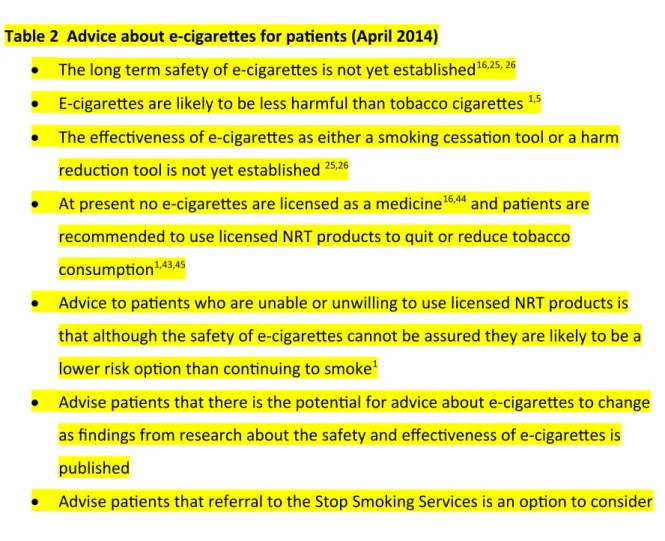
patients may be using and asking the dental team about e-cigarettes, so what do we tell them? Based on the literature reviewed above, current advice about e-cigarettes for patients is summarised in table 2. However dentists and dental care professionals need to recognise the potential for changes to this advice as regulations24 change and findings
from research on the safety and effectiveness of e-cigarettes are published.
Permission or prohibition of e-cigarette use on your premises
With the lack of regulation and legislation regarding where e-cigarettes can be vaped, organisations such as train operators, a chains of pubs, a number of schools and work
Table 2 Advice about e-cigarettes for patients (April 2014)
The long term safety of e-cigarettes is not yet established16,25, 26
E-cigarettes are likely to be less harmful than tobacco cigarettes 1,5
The effectiveness of e-cigarettes as either a smoking cessation tool or a harm
reduction tool is not yet established 25,26
At present no e-cigarettes are licensed as a medicine16,44 and patients are
recommended to use licensed NRT products to quit or reduce tobacco
consumption1,43,45
Advice to patients who are unable or unwilling to use licensed NRT products is
that although the safety of e-cigarettes cannot be assured they are likely to be a
lower risk option than continuing to smoke1
Advise patients that there is the potential for advice about e-cigarettes to change
as findings from research about the safety and effectiveness of e-cigarettes is
published
comprehensive guidance sheet with five questions to ask (see table 3) before deciding whether to permit or prohibit e-cigarette use on premises.
Knowledge of current legislation and regulations as well as the safety of e-cigarettes and their potential to renormalize smoking behaviour may help inform decisions on whether to permit or prohibit use of e-cigarettes on your premises.
What are the public health arguments for and against e-cigarettes?
Statistics from Cancer Research UK45 show that tobacco consumption is the ‘single
greatest cause of preventable illness and early death with an estimated 102,000 people dying in the UK in 2009 from smoking-related-diseases including cancers’. Some argue that e-cigarettes may be a potential revolution to public health41,46 because there is
acceptance that they are likely to be less harmful than tobacco cigarettes,5 that
e-cigarette use is by predominantly by former smokers10 and studies show that their use
can reduce tobacco consumption.37
Table 3 Questions to ask when deciding to permit or prohibit e-cigarette use43
What are the issues you are dealing with?
What do you need to control?
Do you have concerns about the possibility of harm from NCPs?
Will restricting or prohibiting the use of NCPs support compliance with
smoke-free policies?
While some suggest that is it preferable that adolescents try e-cigarettes rather than tobacco cigarettes41 others are concerned that the marketing, combined with the lack of
regulations, may lead to widespread use, a re-socialising of smoking,42 and an
undermining of the prevention and cessation services.1 Whether e-cigarettes are an
effective smoking cessation tool and harm reduction tool has yet to be established. Nicotine is highly addictive, and whether vaping of e-cigarettes will perpetuate nicotine use or act as a gateway to smoking is as yet unknown.
Conclusion
While further research is needed on the safety, quality and effectiveness of e-cigarettes, further research is also needed on their efficacy as a smoking cessation and harm reduction tool. With the rapid expansion of this market and the availability of new and changing products, smokers, former smokers and those who have never smoked are already deciding the purpose of e-cigarettes. Delays in regulation and legislation may potentially allow the markets to determine the course of their use. Meanwhile, as health professionals, we need to be able to answer the questions raised by patients about e-cigarettes and keep abreast of this rapidly developing market.
Acknowledgements:
Figure 1 photographed by PSP Worsley.Declarations of interest:
NoneReferences:
%20change/Improving%20health/tobaccoecigarettespublicplaces_jan2013.pdf
(Accessed 11 December 2013).
2. de Andrade, M., Hastings, G., Angus, K., Dixon, D., Purves, R. The marketing of electronic cigarettes in the UK. 2013. [online] Available at:
https://www.cancerresearchuk.org/sites/default/files/cruk_marketing_of_electronic_cigs _nov_2013.pdf (Accessed 3 January 2014).
3. Esterl, M. Big Tobacco begins takeover of the e-cigarette market. 10 Dec 2013.
Wall Street Journal. Europe edition. 2013. [online] Available at:
http://blogs.wsj.com/corporate-intelligence/2013/11/18/big-tobacco-begins-its-takeover-of-the-e-cigarette-market/ (Accessed 10 December 2013).
4. Titcomb, J. BAT plans to dominate e-cigarette market. 31 July 2013. The Telegraph.
2013. [online] Available at: http://www.telegraph.co.uk/finance/newsbysector/epic/bats/ 10213091/BAT-plans-to-dominate-e-cigarette-market.html (Accessed 3 January 2013).
5. Action on Smoking and Health (ASH). Electronic Cigarettes. 2013. [online] Available at: www.ash.irg.uk/files/documents/ASH_715.pdf (Accessed 29 December 2013).
6. Clancy, R. Imperial Tobacco to launch e-cigarette next year. 15 Aug 2013. The Telegraph. 2013. [online] Available at:
7. VIP E-Cig. How long do cartomisers last? 2014. [online] Available at:
http://www.vipelectroniccigarette.co.uk/how-long-cartomizer-last.html (Accessed 13 January 2014).
8. VIP E-cig. 10ml E-liquid range. 2014. [online] Available at:
http://www.vipelectroniccigarette.co.uk/10ml-e-liquid-c-34_37.html (Accessed 13 January 2014).
9. Smoking Toolkit Study (STS). Latest trends in smoking in England from the
smoking Toolkit Study. 2013. [online] Available at: www.smokingin england.info/latest-statistics/ (Accessed 6 January 2014).
10. ASH. Use of e-cigarettes in Great Britain among adults and young people. 2013. [online] Available at:www.ash.org.uk/files/documents/ASH_891.pdf (Accessed 2 January 2014).
11. Corey, C., Wang, B., Johnson, S.E., Apelberg, B., Husten, C. Electronic cigarette use among middle and high school students – United States, 2011-2012. Morbidity and Mortality Weekly Report 2013; 62: 729-30.
12. VIP E-cig. Price comparison. Electronic cigarettes vs Tobacco Cigarettes Price Comparison. 2012. [online] Available at: www.vipelectroniccigarette.co.uk/price-comparison.hmtl (Accessed 13 January 2014).
14. WHO. WHO Report on the Global Tobacco Epidemic 2013. Country Profile UK.
2013 [online] Available at:
http://www.who.int/tobacco/surveillance/policy/country_profile/gbr.pdf (Accessed 6 January 2014).
15. Ranfanelli, S. Why I vape. The Guardian. 2014. 4 Jan p.24a.
16. Medicines and Healthcare Products Regulatory Authority (MHRA). Working Group on Nicotine Containing Products. 2013. [online] Available at:
http://www.mhra.gov.uk/home/groups/comms-ic/documents/websiteresources/ con286839.pdf (Accessed 29 December 2013).
17. Committee of Advertising Practice (CAP). Electronic Cigarettes. 2013. [online] Available at: http://www.cap.org.uk/Advice-Training-on-the-rules/Advice-Online-Database/Electronic-cigarettes.aspx (Accessed 1 January 2014).
18. CAP. CAP and BCAP propose new rules for electronic cigarette advertising. 2013. [online] Available at: http://www.cap.org.uk/News-reports/Media-Centre/2013/CAP-and-BCAP-propose-new-rules-for-electronic-cigarette-advertising.aspx (Accessed 29 December 2013).
20. BBC.E-cigarettes to be stubbed out for under-18s. 26 January 2014. [online] Available at: http://www.bbc.co.uk/news/uk-25900542 (Accessed 12 April 2014).
21. MHRA. UK moves towards safe and effective electronic cigarettes and other nicotine-containing products. 2013. [online] Available at:
http://www.mhra.gov.uk/home/groups/comms-po/documents/news/con286856.pdf
(Accessed 31 December 2013).
22 Public Health England. Electronic cigarettes: PHE position and Q&A. December 2013. 2013
23. MHRA. European Parliament vote on nicotine containing products. 2013. [online] Available at: http://www.mhra.gov.uk/NewsCentre/CON322753 (Accessed 16
December 2013).
24. European Parliament. Revised Tobacco Products Directive on 26 February 2014. 2014. [online] Available at: http://www.europarl.europa.eu/ (Accessed 12 April 2014).
25. European Commission. Questions & Answers: New rules for tobacco products. 2014. [online] Available at: http://europa.eu/rapid/press-release_MEMO-14-134_en.htm
(Accessed 12 April 2014)
26. World Health Organisation (WHO). Questions and answers on electronic cigarettes or electronic nicotine delivery systems (ENDS). 2013. [online] Available at:
27. European Commission. Minutes of Meeting 22 November 2013. 2013. [online] Available at: http://ec.europa.eu/health/tobacco/docs/ev_20131122_mi_en.pdf (Accessed 7 January 2014).
28. Goniewicz, M.L. E-cigarettes: A review of their efficacy and potential for harm reduction. Presentation given by Dr Maciej Goniewicz, Queen Mary University of London, at an APPG meeting on harm reduction. 2013. [online] Available
at: http://www.ash.org.uk/files/documents/ASH_858.pdf (Accessed 7 January 2014).
29. Goniewicz, M.L., Knysak, J., Gawron, M., Knysak, J., Kosmider, L., Sobczak, A. Levels of selected carcinogens and toxicants in vapour from electronic cigarettes.
Tobacco Control 2013; 0:1-7 doi:10.1136/tobaccocontrol-2012-050859.
30. Czogala, J., Goniewicz, M.L., Fidelus, B., Zielinska-Danch, W., Travers, M.J. Secondhand exposure to vapors from electronic cigarettes. Nicotine and Tobacco
Research 2013; doi:10.1093/ntr/ntt203.
31. Benowitz, N.L , Hanson, A., Jacob, P.I. Cardiovascular effects of nasal and transdermal nicotine and cigarette smoking. Hypertension 2002; 39: 1107-1112.
32. Murray, R.P., Connett, J.E., Zapawa, L.M. Does nicotine replacement therapy cause cancer? Evidence form the Lung Health Study. Nicotine and Tobacco Research 2009;
11: 1076-1082.
34. Genco, R.J., Borgnakke, W.S. Risk factors for periodontal disease. Periodontology 2000. 2013; 62: 59-94.
35. National Institute for Care and Health Excellence (NICE). P1 Brief interventions and referral for smoking cessation. 2006. [online] Available
at:http://guidance.nice.org.uk/PH1 (Accessed 29 December 2013).
36. NICE. P45 Tobacco: Harm reduction approaches to smoking. 2013. [online] Available at: http://publications.nice.org.uk/tobacco-harm-reduction-approaches-to-smoking-ph45(Accessed 29 January, 2013)
37. Bullen, C., Howe, C., Laugesen, M., et al. Electronic cigarettes for smoking cessation: a randomised controlled trial. Lancet 2013; 382: 1629-37.
38. de Andrade, M., Hastings, G. Tobacco harm reduction and nicotine containing products. Research priorities and policy directions. 2013. Cancer Research UK. [online] Available at: www.cancerresearchuk.org/sites/default/files/tobacco-harm-reduction.pdf (Accessed 29 December 2013).
40. Pepper, J.K., McRee A-L., Gilkey, M.B. Healthcare providers beliefs and attitudes about electronic cigarettes and preventive counselling for adolescent patients. Journal of Adolescent Health, in press.
41. Etter, J-F. Should electronic cigarettes be as freely available as tobacco cigarettes? Yes. British Medical Journal 2013; 346: f3845.
42. Chapman, S. Should electronic cigarettes be as freely available as tobacco cigarettes? No. British Medical Journal 2013; 346: f3840.
43. ASH. Will you permit or prohibit e-cigarette use on your premises? 2014. [online] Available at: www.ash.org.uk/files/documents/ASH_900.pdf (Accessed 1 January 2014).
44. Public Health England (2014) Smokefree and Smiling. Helping dental patients to quit tobacco. 2nd edition. Available at:
https://www.gov.uk/government/publications/smokefree-and-smiling (Accessed 23 April 2014)
45. Cancer Research UK. Smoking Statistics. 2013. [online] Available from:
http://www.cancerresearchuk.org/cancer-info/cancerstats/types/lung/smoking/lung-cancer-and-smoking-statistics#cancer (Accessed 6 January 2014).