Volume 2007, Article ID 51648,6pages doi:10.1155/2007/51648
Research Article
A Novel Face Segmentation Algorithm from
a Video Sequence for Real-Time Face Recognition
R. Srikantaswamy1and R. D. Sudhaker Samuel2
1Department of Electronics and Communication, Siddaganga Institute of Technology, Tumkur 572103, Karnataka, India 2Department of Electronics and Communication, Sri Jayachamarajendra College of Engineering, Mysore, India
Received 1 September 2006; Accepted 14 April 2007
Recommended by Ebroul Izquierdo
The first step in an automatic face recognition system is to localize the face region in a cluttered background and carefully seg-ment the face from each frame of a video sequence. In this paper, we propose a fast and efficient algorithm for segmenting a face suitable for recognition from a video sequence. The cluttered background is first subtracted from each frame, in the foreground regions, a coarse face region is found using skin colour. Then using a dynamic template matching approach the face is efficiently segmented. The proposed algorithm is fast and suitable for real-time video sequence. The algorithm is invariant to large scale and pose variation. The segmented face is then handed over to a recognition algorithm based on principal component analysis and linear discriminant analysis. The online face detection, segmentation, and recognition algorithms take an average of 0.06 second on a 3.2 GHz P4 machine.
Copyright © 2007 R. Srikantaswamy and R. D. Sudhaker Samuel. This is an open access article distributed under the Creative Commons Attribution License, which permits unrestricted use, distribution, and reproduction in any medium, provided the original work is properly cited.
1. INTRODUCTION
In literature, it is found that most of the face recognition work is carried out on still face images, which are carefully cropped and captured under well-controlled conditions. The first step in an automatic face recognition system is to lo-calize the face region in a cluttered background and care-fully segment the face from each frame of a video sequence. Various methods have been proposed in literature for face detection. Important techniques include template-matching, neural network based, feature-based, motion-based and face-space methods [1]. Though most of these techniques are effi -cient, they are computationally expensive for real time ap-plications. Skin colour has proved to be a fast and robust cue for human face detection, localization, and tracking [2]. Skin colour based face detection and localization however has the following drawbacks: (a) it gives only a coarse face segmentation, (b) it gives spurious results when the back-ground is cluttered with skin colour regions. Further, ap-pearance based holistic approaches based on statistical pat-tern recognition tools such as principal component analysis and linear discriminant analysis provides a compact nonlo-cal representation of face images, based on the appearance of an image at a specific view. Hence, these algorithms can
be regarded as picture recognition algorithm. Therefore, face presented for recognition to these approaches should be effi -ciently segmented, that is, aligned properly to achieve a good recognition rate. The shape of the face differs from person to person. Segmenting a face uniformly, invariant to shape and pose, suitable for recognition, in real-time is therefore very challenging. Thus, face segmentation “online” in “real-time” sense from a video sequence still emerges as a challenging problem in the successful implementation of a face recogni-tion system. In this work, we have proposed a method which accommodates these practical situations to segment a face ef-ficiently from a video sequence. The segmented face is then handed over to a recognition algorithm based on principal component analysis and linear discriminant analysis to rec-ognize the person online.
2. BACKGROUND SCENE MODELING AND FOREGROUND REGION DETECTION
This distribution is modeled as a Gaussian. This gives the background probability density function (PDF). A pixel
P(x,y) in the scene is classified as foreground if the Ma-hanalobis distance of the pixelP(x,y) from the meanμis greater than a set threshold. This threshold is found experi-mentally. Background PDF is updated using a simple adap-tive filter [3]. The means for the succeeding frame is com-puted using (1), if the corresponding pixel is classified as a background pixel,
μt+1=αPt+ (1−α)μt. (1)
This allows compensating for changes in lighting conditions over a period of time. Whereαis the rate at which the model is compensated for changes in lighting. For an indoor/office environment it was found that a single Gaussian model [4] of the background scene works reasonably well. Hence, a single Gaussian model of the background is used.
3. SKIN COLOUR MODELING
In the foreground regions, skin colour regions are detected. Segmentation of skin colour region becomes robust only if the chrominance component used in analysis and research has shown that skin colour is clustered in a small region of the chrominance plane [2]. Hence, theCbCrplane
(chromi-nance plane) of theYCbCr colour space is used to build the
model where Y corresponds to luminance andCb-Cr
cor-responds to the chrominance plane. Skin colour distribution in the chrominance plane is modeled as a unimodal Gaussian [2]. A large data base of labelled skin pixels of several people both male and female has been used to build the Gaussian model. The mean and the covariance of the database charac-terize the model. Letc=[Cb Cr]T denote the chrominance
vector of an input pixel. Then the probability that the given pixel lies in the skin distribution is given by
p(c|skin)= 1 2πΣse
−(1/2)(c−μs)TΣs−1(c−μs). (2)
Here,cis a color vector,μsandΣsare the mean and
covari-ance, respectively, of the distribution parameters. The model parameters are estimated from the training data by
μs=
1
n n
j=1 cj,
Σs= 1 n−1
n
j=1
cj−μs
cj−μs T
,
(3)
where n is the total number of skin colour samples with colour vectorcj. The probabilityp(c|skin) can be used
di-rectly as a measure of how “skin-like” the pixel colour is. Al-ternately, the Mahalanobis distanceλs, computed using (4),
from the colour vectorcto meanμs, given the covariance
ma-trixΣs, can be used to classify a pixel as skin pixel [2],
λs(c)=
c−μsTΣs−1c−μs. (4)
(a) (b)
(c) (d)
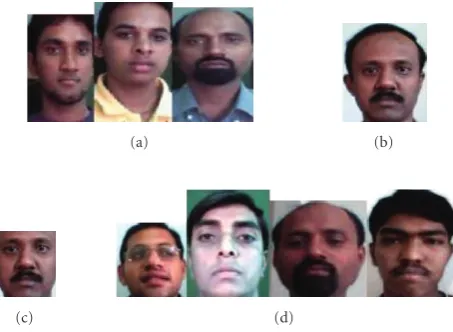
Figure1: (a) Face segmented using skin colour regions (b) full face (c) closely cropped face (d) faces of various shapes.
Skin pixel classification may give rise to some false detection of nonskin tone pixels, which should be eliminated. A, iter-ation of erosion followed by diliter-ation is applied on the bi-nary image. Erosion removes small and thin isolated noise like components that have very low probability of represent-ing a face. Dilation preserves the size of those components that were not removed during erosion.
4. DYNAMIC TEMPLATE MATCHING AND SEGMENTATION OF FACE REGION SUITABLE FOR RECOGNITION
Segmenting a face, using a rectangular window enclosing the skin tone cluster will result in segmentation of the face along with the neck region (see Figure 1(a)). Thus, skin colour based face segmentation provides only coarse face segmen-tation, and cannot be used directly for face recognition. The face presented for recognition can be a full face as shown in
Figure 1(b)or closely cropped face which includes internal structures such as eye-brows, eyes, nose, lips, and chin region as shown inFigure 1(c). It can be seen fromFigure 1(d)that the shape of the face differs from person to person. Here, we propose a fast and efficient approach for segmenting a face suitable for recognition.
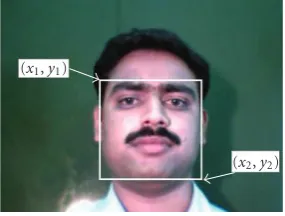
Segmenting a closely cropped face requires finding a rect-angle on the face image with the top left corner coordi-nates (x1,y1) and bottom right corner coordinates (x2,y2)
as shown inFigure 2. The face region enclosed within this rectangle is then segmented.
From a database of about 1000 frontal face images created in our lab, a study on the relationship between the following facial features were made. (i) The ratio of distance between the two eyesWE(extreme corner eye points, seeFigure 3) to
the width of the faceWFexcluding the ear regions. (ii) The
ratio of the distance between the two eyesWEto the height
of the face from the centre of the line joining two eyes to the chinHF. It was found that the ratioWE/WFvary in the range
(x1,y1)
(x2,y2)
Figure2: Rectangular boundary defining the face region.
WF
WE
HF
Figure3: A sketch of face to define feature ratios.
(a) (b)
Figure4: Subject with big ears and the corresponding skin cluster.
4.1. Pruning of ears
For some subjects, the ears may be big and extending out-ward prominently, while for other it may be less prominent. To obtain uniform face segmentation, the ear regions are first pruned. An example of the face with ears extending outward and its corresponding skin tone regions is shown inFigure 4. The vertical projection of the skin tone regions of
Figure 4(b)is obtained. The plot of this projection is shown in Figure 5. The columns which have skin pixels less than 20% of the height of the skin cluster are deleted. The result of this process is shown inFigure 6.
4.2. Rectangular boundary definitionsx1andx2
After the ears are pruned, the remaining skin tone regions are enclosed between two vertical lines as shown inFigure 6. The projection of left vertical (LV) and right vertical line (RV) on thex-axis givesx1andx2, respectively, as shown inFigure 6.
The distance between these two vertical lines gives the width of the faceWF.
0 2000 4000 6000 8000 10000 12000 14000
0 10 20 30 40 50 60 70 80
Figure5: Vertical projection ofFigure 4(b).
WF
RV LV
Figure6: Skin tone cluster without ears.
4.3. Rectangular boundary definitiony1andy2
To find y1, the eye brows and eye regions must be localized.
Template matching is used to localize the eyes and eye brow regions. A good choice of the template containing eyes along with eyebrows should accommodate (i) variations in facial expressions, (ii) variations in structural components such as presence or absence of beard and moustache, and (iii) seg-mentation of faces under varying pose and scale by using a pair of eyes as one rigid object instead of individual eyes. Ac-cordingly, a normalized average template containing eyes in-cluding eyebrows as shown inFigure 7has been developed after considering several face images. The size of the face de-pends on its distance from the camera, and hence a template of fixed size cannot be used to localize the eyes. Here, we in-troduce a concept called dynamic template. After finding the width of the faceWF(seeFigure 6), the width of the template
containing eyes and eyebrows is resized proportional to the width of the faceWFkeeping the same aspect ratio. The
re-sized template whose width is proportional to the width of the face is what we call a dynamic template. As mentioned earlier, the ratioWE/WFvary in the range 0.62–0.72.
There-fore, dynamic templatesDkwith widthsWkare constructed,
whereWkis given by
Figure7: Template.
(xd,yd)
Figure8: Four quadrants of skin tone regions.
where γ varies from 0.62 to 0.72 in steps of 0.02 keep-ing the same aspect ratio. Thus, six dynamic templates
D1,D2,. . .,D6with widthsW1,W2,. . .,W6 are constructed.
Let (xd,yd) be the top left corner coordinates of the
dy-namic template on the image as shown in Figure 8. Let
Rk(xd,yd) denote the correlation coefficient obtained by
template matching when the top left corner of dynamic tem-plateDkis at the image co-ordinates (xd,yd). The correlation
coefficientRkis computed by
Rk=
ITDk
−IT
Dk
σIT
σDk
, (6)
whereITis the patch of the imageIwhich must be matched
toDk,is the average operator, ITDk represents the pixel
by pixel product, andσ is the standard deviation over the area being matched. For real time requirements, (i) tem-plate matching is performed only within the upper left half region of the skin cluster (shaded region in Figure 8). (ii) The mean and the standard deviation of the templateDkis
computed only once for a given frame. (iii) A lower resolu-tion image of size 60×80 is used. However, segmentation of the face is made in the original higher resolution image. LetRkmax(xd,yd) denote the maximum correlation obtained
by template matching with the dynamic templateDk at the
image coordinates (xd,yd). LetRoptdenote the optimum
cor-relation, that is, maximum ofRkmax,k=1, 2, 3,. . ., 6 obtained
with dynamic templatesDk,k=1, 2, 3,. . ., 6. LetWk∗denote
the width of the dynamic templateDkwhich giveRopt. The
optimal correlation is given by
Ropt
x∗,y∗=maxRkmax
xd,yd
k=1, 2,. . ., 6, (7) where (x∗,y∗) is the image coordinates which giveRopt. If Roptis less than a set threshold, the current frame is discarded
and the next frame is processed. Thus, the required point on the imagey1is then given by
y1=y∗. (8)
The distance between the two eyesWE∗ is given by the
width of the optimal dynamic template which give Ropt,
thereforeWE∗=Wk∗.
Figure9: Average face template.
Figure10: Some samples of segmented faces with different values.
After findingx1,y1, andx2, we now need to estimatey2.
As mentioned earlier, the height of the face varies form per-son to perper-son and the ratioHF/WEvary in the range 1.1–1.3.
Several face images, about 450, were manually cropped from images captured in our lab and an average of all these face images forms an average face template as shown inFigure 9. The centre point (xcen,ycen) between the two eyes is found by
the centre of the optimal dynamic template. From this centre point, height of the faceHFkis computed by
HFk=(1.1 +β)×WE∗, k=1, 2,. . ., 10, (9)
whereβis a constant which varies from 0 to 0.2 in steps of 0.02. The face regions enclosed within the boundary of the rectangle formed using the coordinates x1, y1,x2 and the
heights HFk(k = 1, 2,. . ., 10) are segmented and
normal-ized to the size of the average face template. Some of the faces segmented and normalized by this process are shown inFigure 10. Correlation coefficient∂k,k=1, 2,. . ., 10 with
these segmented faces and the average face template is given by (10),
∂k=
IsegAF
Iseg
AF σIseg
σ(AF) , (10) whereIsegis segmented and normalized face images, AF is the
average face template as shown inFigure 9,is the average operator,IsegAF represents the pixel by pixel product, andσ
is the standard deviation over the area being matched. A plot of correlation coefficient∂kversusHFis shown inFigure 11.
For real-time requirement, the mean and the variance of the average face template are computed ahead of time and used as constants for the computation of the correlation coeffi -cient∂k.
The Height (number of pixels) of the face HFk
corre-sponding to the maximum correlation coefficient ∂max =
max(∂k), k = 1, 2,. . ., 10 is added to the y-coordinates
of the centre point between the two eyes to obtain y2.
Finally, the face region enclosed within the boundary of the rectangle formed using the coordinates (x1,y1) and
(x2,y2) is segmented. The results of the proposed face
0 0.1 0.2 0.3 0.4 0.5 0.6 0.7 0.8 0.9
Cor
re
la
ti
o
n
co
e
ffi
cient
88 89 91 93 94 96 97 98 100 102
HF
Figure11: Plot of correlation coefficient ofHFknormalized to the
same size∂kversusHF.
(a) (b)
(c) (d)
(e) (f)
Figure 12: Results of face segmentation using the proposed method.
The segmented face is displayed at the top right corner win-dow labeled SEG FACE of each frame. Observe that the back-ground is cluttered with a photo of a face in it. The red rectangle indicates the coarse face localization based on skin colour. The white rectangle indicates the localization of two eyes including the eye brows. The green rectangle indicates the face regions to be segmented using the proposed method.
4.4. Face segmentation with scale and pose variations
The result of the face segmentation with scale variations is as shown in Figure 13. It can be observed that the pro-posed face segmentation is invariant to large scale variations.
(a) (b)
Figure13: Largest and smallest face images segmented by the pro-posed method.
(a) (b)
(c) (d)
Figure14: Result of face segmentation with pose variations.
.
The smallest face that can be segmented by the proposed method is 3.5% of the frame size as shown inFigure 13(b). However, the largest face that can be segmented depends on the size of the full face that can be captured when the subject is very close to the camera. The results of face segmentation with pose variations are shown inFigure 14.
5. FEATURE EXTRACTION
After the face is segmented, features are extracted. Principal component analysis (PCA) is a standard technique used to approximate the original data with lower dimensional fea-ture vector. The basic approach is to compute the eigenvec-tors of the covariance matrix and approximate the original data by a linear combination of the leading eigenvectors [5]. The features extracted by PCA may not be necessarily good for discriminating among classes defined by a set of samples. On the other hand, LDA produces an optimal linear discrim-inant function which maps the input into the classification space which is well suitable for classification purpose [6].
6. EXPERIMENTAL RESULTS
Table1: Recognition rate of the online face recognition system.
Recognition rate of the online face recognition system
PCA features LDA features
90% 98%
variations captured in our lab was used for training the face recognition algorithm. The result of the online face recogni-tion system using the proposed face segmentarecogni-tion algorithm is shown inTable 1. The entire algorithm for face detection, segmentation, and recognition is implemented in C++ on a 3.2 GHz P4 machine which takes an average of 0.06 seconds per frame to localize, segment, and recognize a face. The face localization and segmentation stage takes an average of 0.04 seconds. The face recognition stage takes 0.02 seconds to rec-ognize a segmented face. The face segmentation algorithm is tolerant to pose variations of±30 degrees of pan and tilt on an average. The recognition algorithm is tolerant to pose variations of±20 degrees of pan and tilt.
7. CONCLUSION
We have been able to develop an online face recognition sys-tem which captures image sequence from a camera, detects, tracks, segments efficiently, and recognizes a face. A method for efficient face segmentation suitable for real-time applica-tion, invariant to scale and pose variations is proposed. With the proposed face segmentation approach followed by lin-ear discriminant analysis for feature extraction from the seg-mented face, a recognition rate of 98% was achieved. Further LDA features provide better recognition accuracy compared to PCA features.
REFERENCES
[1] M.-H. Yang, D. J. Kriegman, and N. Ahuja, “Detecting faces in images: a survey,”IEEE Transactions on Pattern Analysis and Machine Intelligence, vol. 24, no. 1, pp. 34–58, 2002.
[2] V. Vezhnevets, V. Sazonov, and A. Andreeva, “A survey on pixel-based skin color detection techniques,” inProceedings of the International Conference on Computer Graphics (GRAPH-ICON ’03), pp. 85–92, Moscow, Russia, September 2003. [3] C. R. Wren, A. Azarbayejani, T. Darrell, and A. P. Pentland,
“Pfinder: real-time tracking of the human body,”IEEE Transac-tions on Pattern Analysis and Machine Intelligence, vol. 19, no. 7, pp. 780–785, 1997.
[4] C. Stauffer and W. E. L. Grimson, “Adaptive background mix-ture models for real-time tracking,” inProceedings of the IEEE Computer Society Conference on Computer Vision and Pattern Recognition (CVPR ’99), vol. 2, pp. 246–252, Fort Collins, Colo, USA, June 1999.
[5] M. Turk and A. Pentland, “Eigenfaces for recognition,”Journal of Cognitive Neuroscience, vol. 3, no. 1, pp. 71–86, 1991. [6] P. N. Belhumeur, J. P. Hespanha, and D. J. Kriegman,
“Eigen-faces vs. Fisher“Eigen-faces: recognition using class specific linear
projection,” inProceedings of the 4th European Conference on Computer Vision (ECCV ’96), vol. 1, pp. 45–58, Cambridge, UK, April 1996.
R. Srikantaswamyreceived his M.Tech de-gree in industrial electronics in 1995 and Ph.D. degree in electronics in 2006 from University of Mysore, India. He is working as a Professor in the Department of Elec-tronics and Communication, Siddaganga Institute of Technology, Tumkur, India. His research interests include computer vision and pattern recognition, neural networks, and image processing.
R. D. Sudhaker Samuelreceived his M.Tech degree in industrial electronics in 1986 from the University of Mysore, and his Ph.D. de-gree in computer science and automation (robotics) in 1995 from Indian Institute of Science, Bangalore, India. He is work-ing as a Professor and Head of the Depart-ment of Electronics and Communication, Sri Jayachamarajendra College of Engineer-ing, Mysore, India. His research interests