Overdemanding Consequentialism? An Experimental Approach
Martin Bruder and Attila Tanyi
University of Konstanz (Bruder)
University of Konstanz and University of Liverpool (Tanyi)
Abstract
According to act-consequentialism the right action is the one that produces the best results as
judged from an impersonal perspective. Some claim that this requirement is unreasonably
demanding and therefore consequentialism is unacceptable as a moral theory. The paper
breaks with dominant trends in discussing this so-called Overdemandingness Objection.
Instead of focusing on theoretical responses, it empirically investigates whether there exists a
widely shared intuition that consequentialist demands are unreasonable. This discussion takes
the form of examining what people think about the normative significance of consequentialist
requirements. In two experiments, the paper finds that although people are sensitive to
consequentialist requirements and, on average, find more extreme demands less reasonable,
the level of dissent with consequentialism falls short of qualifying as a widely shared
intuition, even when demands are the highest. The paper then ends with a general discussion
I. THE OVERDEMANDINGNESS OBJECTION
Act-consequentialism is the view that the right thing to do in any situation is the act with the
best consequences as judged from an impersonal point of view. Act-consequentialism is thus
a single-principle view; it is exhausted by what is called the optimizing principle of
beneficence. Many disagree with this principle, however, emphasizing the significance of the
personal in moral life. In this paper our subject matter will be an objection that derives from
this complaint and that can be employed against any form of act-consequentialism
(henceforth ‘consequentialism’, unless qualifier needed).
Let us call this charge the Overdemandingness Objection or OD.1 OD is built upon
two pillars: first, that consequentialism is unreasonably demanding and, second, that an
adequate morality cannot be unreasonably demanding. Consequentialism requires the agent
to promote the good until the point where further efforts would burden her as much as they
would benefit others. However, the situation that determines what would be best overall is far
from ideal: today’s world involves, for example, significant levels of poverty, which
charitable donations are insufficient to eradicate. At the same time, those institutions that
might make things better are not effective, neither domestically nor internationally. Given
that acting to alleviate poverty is likely to have, in sum, more positive consequences than
pursuing individual goals and projects, it seems unavoidable that, if one fully accepts
consequentialism, one must devote most of one’s resources to humanitarian work or to the
support of institutions that carry out this work.
At the same time, so advocates of OD assume, people have a firmly held intuition
that this cannot be demanded of them, that they should not be required to forego all or most
of their individual projects for moral causes. This is the second pillar of the objection. If this
avoid unreasonable demands. If they do not, the conclusion follows that these theories should
not be allowed to guide people’s conduct. OD is an attempt to articulate this constraint.
II. THE EMPIRICAL BACKGROUND OF OD
OD, as presented above, can be put more formally as the following argument:2
(1) Consequentialism makes demand D.
(2) Intuitively, demand D is unreasonable.
(3) Therefore, consequentialism makes unreasonable demands.
(4) No acceptable moral theory makes unreasonable demands.
(5) Therefore, consequentialism is an unacceptable moral theory.
(6) Therefore, we have reason to reject consequentialism.
This more detailed structure suggests the possible ways of responding to OD. The dominant
approach is to deny premise (1). This strategy of denial holds that consequentialism does not make the demands attributed to it, either because such attribution rests on false empirical
beliefs or because consequentialism properly understood has a structure from which no such
demands follow.3
Taking a different stance, the strategy of extremism does not deny that consequentialism makes the demands in question; what it denies is that these demands are
indeed unreasonable. People might think so, but then they are wrong, because, as it is
typically argued, their intuitions about these matters are unreliable. Thus, it is argued that the
intuition premise (2) refers to, let us call it the OD-intuition, rests on lack of information, lack
of clear thinking, lack of imaginative empathy or on some psychological ‘failure’, or that it
general are problematic because of their evolutionary background. Consequently, the
inference to sub-conclusion (3) is warranted only if it is made from people’s point of view.
But if this is so, then the argument does not succeed since such unreliable intuitions offer no
ground for rejecting consequentialism.4
Finally, the strategy of moderation points out that the argument implicitly assumes – already in its choice of the term ‘unreasonable’, instead of ‘excessive’ or ‘extreme’ – that
consequentialism adheres to the thesis that moral reasons override non-moral reasons. But
this need not be so: consequentialism can either make no claims about reasons, or even if it
does, it does not have to hold that people have decisive reason to follow its precepts.5 If either
of these claims is true, then it is not the case that consequentialism makes unreasonable
demands: again, people might assume so, but then they are wrong. Therefore the inference to
sub-conclusion (3) is unwarranted. Alternatively, ‘reasonable’ might just stand for
‘excessive’ or ‘extreme’, in which case, however, premise (4) does not hold. For
consequentialism, although it makes excessive demands, does not claim overriding force for
those demands. And, contrary to premise (4) so understood, a moral theory that makes
excessive demands but does not claim to be overriding, is acceptable. After all, why would it
be objectionably demanding what one, all things considered, is not required to do?
However, we intend to keep the structure of consequentialism unchanged and we do
not want to deny that the OD-intuition is reliable and can be used for supporting the
conclusion of the argument. Nor do we want to question the assumption that
consequentialism accepts the overridingness of moral reasons over non-moral reasons or that
the assumption is needed to make OD work. All of these approaches have their – often much
discussed – problems; it would therefore bring fresh impetus to the discussion if one
approached the problematic from a different angle. What would this approach be? We
is to assert the existence of an intuition, i.e. something that people intuit to be the case.
Hence, it appears natural to investigate whether people do indeed have this intuition. For if
they do not, premise (2) can be rejected and the argument of OD collapses.
There are two complications that must be dealt with before we can move on. The first
is that what empirical research can establish is whether the OD-intuition is widely shared: how many people endorse premise (2) of the argument of OD. In other words, this kind of research has a statistical nature: it operates with percentages. Now, it cannot be reasonably
expected that this research could establish that no one has the relevant intuition or that, reversely, everyone has it, which is what, strictly speaking, is needed to establish or deny the truth of premise (2). Is this a problem?
We do not think so: percentages matter. On the one hand, intuitive objections like OD
appeal to those who have the intuitions in question. Hence the more people have the intuition,
the more persuasive the given objection is. On the other hand, for many, intuitions are not
merely devices of persuasion, but have justificatory power: they have the potential to
establish the validity of a conclusion because, say, they serve as evidence for the truth of this
conclusion. In the absence of any reasonable expectation that we can find uniformity
-rejection or acceptance - in people’s intuitions, percentages come to play a crucial more. To
put it simply: the more people have the intuition in question, the more likely it is that they are
getting things right and the validity of the objection can be established. Therefore, what we
will do is to use a statistical criterion in assessing the validity of premise (2). For the intuition
to be able to support a persuasive argument and for it to serve as reliable evidence, it is not
enough if only few people have it. It should be shared by a strong majority. What counts as a
‘strong majority’ is difficult to define. However, other research on moral intuitions has often
found agreement of around 90% of the respondents.6 Yet, because we cannot establish either
conclusion: we will not claim that we refute the idea that there exists an OD-intuition as
premise (2) claims, but only that our research throws doubt on this claim.
The second complication concerns the intuitive background of OD. It is clear that the
OD-intuition, given our acceptance of the role reasons play in the argument, is about what
one is – all things considered – required to do; in short: what one has decisive reason to do.
But is this the only intuition that has a bearing on the failure or success of OD? We do not
think so. We believe that the moral intuition of what one is morally required to do should also be considered in assessing the above argument. This is because one’s judgment of
reasonableness, i.e. what one has decisive reason to do, and one’s judgment of what one is
morally required to do, can come apart.7 People can deny what we called the overridingness
thesis above and assert that moral reasons can be overridden by non-moral reasons. That is,
people can hold that they have decisive reason to do X, that this is what it is reasonable to
require, while maintaining that it is action Y, which is required by morality. And, of course,
the reverse can also happen. In the particular context, this means that people can affirm that a
consequentialist requirement is reasonable, while taking it to be not demanded by morality; or
they can affirm that a consequentialist requirement is unreasonable, while nevertheless taking
it to be moral.
Now, if people can have conflicting intuitions about what they are morally required to
do and what they have decisive reason to do, the moral intuition could be claimed to have a
bearing on the validity of OD. This is because OD is used to reject consequentialism as a
moral theory because it is unreasonably demanding: but what happens if people, although
intuit consequentialism to be unreasonably demanding, still think it to be giving rise to
legitimate moral requirements? In this case, it seems, we have a moral intuition conflicting
with consequentialism’s alleged claim to the overridingness of its reasons (which, recall, we
intuition referred to in premise (2) is taken seriously, although it too conflicts with
consequentialism’s alleged claim to overridingness, then why not take seriously this moral intuition? This is important, because if the intuition is taken seriously, then it has a clear
bearing on OD, since it can happen that although one intuition, that concerning the
reasonableness of its demands, speaks against consequentialism, another, that concerning the
morality of its demands, does not. And since OD is supposed to lead us to the rejection of
consequentialism as a moral theory, this is significant. For it suggests that OD can be false,
even if the intuitive unreasonableness of consequentialist demands is confirmed.8
Consequently, although our research has its focus on the validity of premise (2), i.e. on how
widespread the OD-intuition is, we will, whenever the above contrast occurs, take it into
account in judging the validity of OD itself.
After these preliminaries, we can now turn to the substantive part of our paper. This is
how we will proceed. In what follows (sections III and IV) we will first present the findings
of the experimental research we have conducted on the validity of premise (2). On the basis
of these findings we will claim that there is reason to doubt the truth of the premise. We will
then move on to a more general discussion of our argument, also concerning its methodology
and the interpretation of its results (section V). We will end the paper with a summary and
some concluding remarks (section VI).
III. EXPERIMENT 1: A SCENARIO STUDY
We have carried out two studies to investigate the validity of premise (2): the first is a
scenario study, which is frequently used in experimental research in philosophy and moral
psychology; the second is a study based on an experimental game, the paradigm of which is
adapted from behavioural economics. In each case, we describe the procedure (why the study
set out to test), and the results of our experiments, including a brief discussion (with a more
general discussion, concerning possible problems with our approach, following in section V).
Procedure
We designed an online survey in which participants were confronted with fictitious scenarios
that involved a decision between either following consequentialist requirements or acting in
their own interest. We induced consequentialist demands by varying how attractive it was for
participants to act in their own interest (narrowly enough conceived so that it excludes
impersonal moral interests). If acting in one’s own interest is very attractive, this results in
the fact that the alternative action required by consequentialism places higher demands on an
agent than if the nonconsequentialist option is unattractive.
We distinguished two different kinds of demands corresponding to different kinds of
attractiveness.9 First, acting in one’s self-interest may either be objectively attractive or not.
By this we mean that doing something that is associated with a high reward (e.g. in terms of
monetary value) is generally preferred over doing something that is associated with a lesser
reward. Consequentialist requirements that compete with actions associated with a high
reward should therefore be perceived as more objectively demanding than actions associated
with a low reward. For example, most would agree that helping someone in need of money is
more – objectively – demanding if the amount required to help effectively is high rather than
low. However, even identical rewards may mean different things to different people and be
differentially attractive to them, in the sense that people may feel differently about them. That
is, second, alternative actions may differ in their subjective attractiveness; in contrast to the objective attractiveness of alternative actions, their subjective attractiveness has a certain –
albeit not uniform – phenomenology. Again, consequentialist requirements that compete with
than those competing with actions of low subjective attractiveness. For example, helping
someone in desperate need of a thousand dollars will be less – subjectively – demanding if
one does not care much about money than if one cares deeply.
An exemplary scenario used in our studies may help to further clarify this reasoning
and the design of the experiments. The beginning of one of the four scenarios – let us call it
the Africa scenario – used in our first study read:
‘Imagine that you have completed your studies for becoming a civil engineer. You are
now looking for a job. You are offered to go to an African country to build an
orphanage for children who will suffer from lack of shelter if the orphanage is not
built. There are no other applicants for the position and the project will be cancelled if
you do not take up the offer. Just before taking the final decision, a good friend who is
already an established civil engineer visits you.’
The scenario continued to detail one of four possible job-related offers that the friend made to
the protagonist. These four offers followed the differentiation between objective and
subjective demands. The friend offered either,
‘a job in his civil engineering office’ (both objective and subjective demands are
low), or
‘a job in his civil engineering office. This is the position you have always dreamed
of’ (here, subjective demands are high, but objective demands are low), or
‘a very lucrative job in his civil engineering office. This would mean that you
could live in financial security’ (here, objective demands are high, whereas
‘a very lucrative job in his civil engineering office. This is the position you have
always dreamed of and it would mean that you could live in financial security’
(here, both objective and subjective demands are high).
Participants were instructed that taking up the friends’ offer would mean having to decline
going to Africa. Given the significant level of suffering this would cause to the orphans, it
seems plausible that taking up any alternative offer made by the friend would mean rejecting
consequentialist requirements. In this study, we were interested in observing at what level of
demands in the increasingly burdensome situation participants, putting themselves in the
shoes of the agent in the scenario, would claim that consequentialism demands unreasonably
much and is therefore no longer in line with what they have decisive reason to do.
The three further scenarios of this study revolved around,
Being an investigator with the federal police whose only possibility to prevent a
serial killer from murdering more people lay in paying an informant (the
consequentialist requirement). This, however, would require selling her/his own
car. [Investigator scenario]
Inheriting a large sum of money that could be spent either to support a charity
helping to stop the spread of deadly diseases in the developing world (the
consequentialist requirement) or on buying a house. [Inheritance scenario]
Being someone who is faced with either preventing a fire that could threaten
people’s lives (the consequentialist requirement) or going to a hearing that is
Again, there were four versions of each of these scenarios following our distinction of
objective and subjective demands. Thus, the highly demanding versions of the scenarios
included the information that,
The car held dear memories for the investigator (high subjective demand) and, in
addition to the car sale, (s)he would have to take out a loan to pay off the
informant that will indebt her/him for the next ten years (high objective demand).
[Investigator scenario]
The house was one that the agent who inherited the money had longed for since
being a child (high subjective demand) and the property value is such that the
agent will be financially secure in her/his old age (high objective demand).
[Inheritance scenario]
Missing the hearing would lead to the loss of the protagonist’s professional license
(high objective demand), which was unbearable for her/him since the job was the
most important aspect of her/his life (high subjective demand). [Fire scenario]
Each participant was randomly allocated to one of these scenarios and read all four versions
in random order.
After each scenario, participants answered three questions that were central to our
analysis:10 First, they indicated what they would do in such a situation (e.g. in the Africa
scenario they could ‘go to Africa’ or ‘take up the job’). Second, they answered the question
‘Overall, what is the thing to do?’ (with the same answer options). Third, they indicated what
they believed morality demanded them to do. Most important for our analysis is the second
situation, hence the occurrence of the OD-intuition as it appears in premise (2) in the
argument of OD. The analyses below therefore focus mostly on this question.
However, the other two questions are also important for our analysis, albeit for
different reasons. The first question concerning expected actual behaviour allows for a more
conservative analysis: If answers to the first and the second question differ, this may be due
to people anticipating internal (e.g. weakness of will) or external (e.g. coercion) processes
interfering with the implementation of their intuition. However, in fictitious scenarios like
ours, it sheds some doubt on the strength of an intuition if people anticipate not acting in
accordance with their overall assessment of reasons. We therefore also conducted more
restrictive analyses that required consistent responses to both questions. Thus, in this latter
analysis, we only included people who believed they would actually act on their overall
assessment of reasons and did not anticipate intervening obstacles. Whenever results for the
two types of analyses diverged, we have included a footnote detailing this divergence.
As for the third question, concerning participants’ moral assessment of the situation,
we have used this question to see if the intuitive judgment of the unreasonableness of
consequentialist demands is counteracted by an intuitive judgment of their morality. As
explained earlier, this is relevant because OD is an argument against consequentialism as a
moral theory. But if people intuit that there is nothing morally objectionable about the
unreasonable demands of consequentialism (because what happens is only that non-moral
reasons override the moral reasons), then the intuition, i.e. the answer to our second question,
cannot be used to support OD. This leads again to a more restrictive analysis: If the answers
to our second and third question differ in a particular way, namely, if consequentialist
demands are found unreasonable but not demanded by morality, then these judgments of
unreasonableness are not taken to count in favour of OD. 11 In our presentation, we will
widespread the OD-intuition is, and then the restrictive one, since this is what has the final
word on the validity of OD itself.
One hundred and forty-three students and staff of a German university (84 female, 59
male) with a mean age of 24 years12 participated in the study. Almost all were native speakers
of German (n = 134); all others reported very good German language skills.
Predictions
As argued above, proponents of OD should argue that there is a widespread intuition that
moral agents do not have decisive reason to meet at least some consequentialist requirements.
In our study, this should be reflected in substantial consensus amongst our participants that
the overall assessment of reasons relevant to the decisions posed in the scenarios leads to a
conclusion that is inconsistent with consequentialist requirements. This should be particularly
true for those scenarios that involve consequentialist requirements posing high demands. In
other words, as consequentialist demands increase, we should see an increasing number of
participants that find more reason to follow the nonconsequentialist than the consequentialist
course of action (Hypothesis 1). This tendency of increasing dissent with consequentialism
should then ultimately lead to an overwhelming majority of participants rejecting
consequentialist requirements at least in the most demanding scenarios (Hypothesis 2).
Results and discussion
To test the predictions derived from OD, we conducted an analysis of variance.13 Results
showed that – across all four scenarios – increases in both objective and subjective demands
led to higher levels of dissent with consequentialism.14 That is to say, participants who were
faced with higher demands (be they objective or subjective) saw less reason to comply with
the level of dissent with consequentialism were additive rather than multiplicative.15 Figure 1
details this pattern.
Figure 1. Percentage of nonconsequentialist answers to the overall assessment of reasons relevant to the decision across all four scenarios for each level of objective and subjective demands.
This pattern of results supports Hypothesis 1 in that our participants were indeed
sensitive to the varying demand levels. If consequentialism posed higher demands, they saw
less reason to follow its requirements. However, the findings are inconsistent with Hypothesis
2: On average across the four scenarios, even the most demanding situations had less than
50% of the participants who indicated that they would have more reason to follow the
nonconsequentialist as compared to the consequentialist course of action. This calls into
doubt premise (2) of the argument of OD insofar we found no widespread intuition
Of course, it might have been that people reacted differently to each of the four
scenarios and that OD-intuition was only apparent in a subset of our scenarios. Indeed, the
absolute level of responses varied across scenarios (see Figure 2).16 This is mainly relevant to
Hypothesis 2: Some scenarios were characterized by higher dissent with consequentialism
than others. However, even in the most demanding version of the scenario with the strongest
dissent (in which one is required to donate a substantial inheritance), only 63% of our
participants believed that there was more reason to follow the nonconsequentialist than the
consequentialist course of action. In relation to Hypothesis 1, the overall patterns across the
four differentially demanding versions of each scenario – despite their different absolute level
– did not differ significantly.17
Let us turn now to the more restrictive analysis. The idea, recall, is that if the answers
to questions (2) and (3) differ in a particular way, namely, consequentialist demands are
found unreasonable but moral, the intuition concerning unreasonable demandingness does not
support OD. In the present case, this was easily quantifiable: What we did here was to check,
as the only constellation of answers that clearly supports OD, the percentage of those who
found the consequentialist requirement not only unreasonably demanding, but also not
demanded by morality.
This restrictive analysis again revealed support for Hypothesis 1: increases in
objective and (marginally significant) subjective demands led to higher levels of dissent with
consequentialism.18 More important, however, when only taking into account those patterns
of replies that are fully consistent with OD, the absolute level of dissent with
consequentialism dropped substantially from the unrestricted analysis. On average across all
scenarios, even in the most demanding condition less than 28% of our respondents gave
replies that fully conformed to what proponents of OD would have to expect (see Figure 3).
That is to say, even of those (in the most demanding condition) who thought that they did not
have decisive reason to follow consequentialist demands (the most right-hand bar in Figure
1), nearly half thought that the course of action demanded by consequentialism was what
morality required them to do. A possible – and in our eyes probable – explanation of this
finding is that, while subscribing to a consequentialist morality, they do not consider
Figure 3. Percentage of nonconsequentialist answers to the overall assessment of reasons relevant to the decision across all four scenarios for each level of objective and subjective demands. This restrictive analysis is limited to those who reported that (a) they had no decisive reason to follow the consequentialist demands and (b) the consequentialist course of action was not demanded by morality.
And again, to make sure that we did not miss important differences between the
individual scenarios, we examined each scenario separately. In no condition of any one of the
scenarios did answers consistent with OD (i.e. dissenting with consequentialism) as defined
in this more restrictive analysis exceed 45% of the respondents. Also, the overall pattern of
results shown in Figure 3 did not differ significantly between the four scenarios.19
IV. EXPERIMENT 2: AN EXPERIMENTAL GAME
Critics of Experiment 1 may find intuitions in response to fictitious scenarios lacking (see,
e.g. a recent exchange of letters between David Carmel and Shaun Nichols in Science, 10 June 2011)20. The goal of the second study, therefore, was to create an actual decision
situation with real-life monetary consequences. This was done to investigate the OD-intuition
Procedure
We adapted a paradigm previously used in behavioural economics:22 Participants divided a
certain sum (€100) between themselves and the vaccination program of the United Nations
Children’s Fund (UNICEF) benefiting children in developing countries. Participants knew
that for one randomly determined participant, this choice would be implemented in real. Prior
to the choice, we varied both objective and subjective demands of the consequentialist option
which, we assumed, was to donate as opposed to keep the money. To induce subjective
demands, half of the participants first brainstormed on what they personally could do with
€100 thereby rendering this money more affectively relevant (high subjective demands)
whereas the other half reflected on what they could do with a piece of paper (low subjective
demands). Specifically, in the high subjective demand condition participants were asked to
image that they would win €100 in this study. They were then instructed to ‘consider three
possible ways to spend this money’ and to write down these three possibilities.
The aim of the second task was to induce objective demands. Prior research in
economics has shown that participants distributing money are sensitive to where this money
comes from. In particular, in contrast to so-called ‘windfall endowments’, which are simply
given to participants by the experimenter, endowments that have to be earned are less readily
shared.23 To avoid the possible problem that those higher in ability or motivation may earn
higher endowments, we created a task that allowed us to make all participants believe that
they managed to earn the full amount (i.e. the chance of distributing €100). Participants saw
five pictures with a varying number of black dots on a white background and were asked to
estimate the average number of dots. All of them were later told that they were sufficiently
close to the correct number (which was 150) to participate in the study. Those in the low
distribute the money, without the need to do anything to gain this opportunity (i.e. the money
came as a windfall endowment).
After completing these tasks, participants received some information on the UNICEF
vaccination program and then answered three questions that were central to our analysis:24
First, they indicated how they would actually divide the money between themselves and the
charity (under the supposition that they would be randomly determined to be the person for
whom the decision would be implemented). They could assign any share of the €100 to either
themselves or UNICEF. This question was designed to assess their actual behavioural
responses. Second, they replied to the question ‘Overall, what is the division to make?’
referring to their overall assessment of reasons for the division. Third, they indicated which
distribution they regarded to be morally required of them. As in Experiment 1, our main
focus was on the second question because it most clearly speaks to premise (2) of the
argument of OD. At the same time, answers to the first question help to establish the
credibility of these results and, in particular, their relevance to actual behaviour, while
answers to the third question provide for an importantly more restrictive analysis. If someone
who holds that what there is decisive reason to donate is not in line with consequentialism,
but also affirms that the consequentialist division would be the morally supported division to
make, does not support OD.
We recruited 368 participants online through a university participant panel. Eleven
did either not indicate their age or were underage and were therefore excluded. The
remaining 357 participants were 18 to 57 years of age with a mean of 23.5 years.25 Most
participants were women (n = 215), all but three possessed at least a university entrance diploma, and the overwhelming majority were native speakers of German (93.9% of all
Predictions
As in our previous study, we examined the predictions derived from the relevant literature on
OD that (a) increasing (objective and subjective) demands would lead to higher levels of
dissent with the consequentialist course of action (i.e. lower donations would be perceived as
reasonable; Hypothesis 1) and (b) that the absolute level of dissent with the consequentialist
course of action would be very high at least in the most demanding condition (i.e. the
objection to consequentialism should be based on a widespread intuition; Hypothesis 2).
Results and discussion
To test our hypotheses, we conducted an analysis of variance on each of the three questions
we posed.26 Results for the central second question concerning participants’ overall
assessment of reasons revealed that both increased subjective and objective demands led
participants to keep a higher percentage of the endowment for themselves, that is to reject
consequentialist requirements concerning the support of the vaccination program.27 If
participants had had the opportunity to elaborate on what they would do with the money if
they won it (i.e. if they had brainstormed about the possible use of €100) and if they had the
impression that they had “earned” the possibility to keep the €100 for themselves (i.e. if they
thought they had gained the money by correctly guessing the number of points presented to
them), they, on average, saw less reason to donate. Consistent with the previous study, this
pattern supports Hypothesis 1: People are sensitive to the demands made by consequentialism
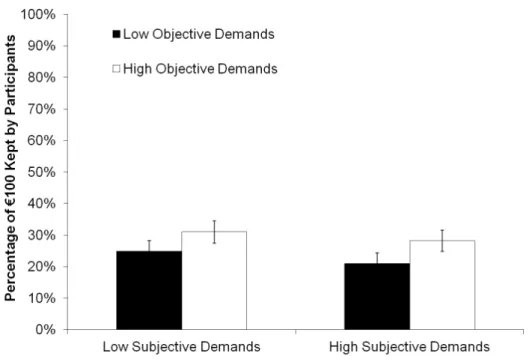
in their assessment of reasons for action. However, the detailed pattern of means shown in
Figure 4 again sheds doubt on the viability of Hypothesis 2. Even in the most demanding
situation, participants saw reason to keep, on average, less than 60% of the money to
Figure 4. Average percentage of €100 that participants thought would be reasonable to keep for themselves (remainder would be donated to UNICEF) for each level of objective and subjective demands.
However, in contrast to Study 1, this experiment offered some opportunity for
weakness of will to reveal itself. In response to our first question – the actual division of
money under the supposition that participants’ would be randomly selected – participants
kept a significantly larger share of the endowment – on average approximately 8 percentage
points more – to themselves, than what they indicated was reasonable to keep in response to
question 2.28 In the most demanding condition, this resulted in participants claiming 67.5% of
Figure 5. Average percentage of €100 that participants intended to keep for themselves (remainder would be donated to UNICEF) for each level of objective and subjective demands.
Finally, the more restrictive analysis is not so easily quantifiable as in the previous
study. What we were interested in here, recall, were constellations of a particular kind in
participants’ answers to our second and third question: when consequentialist demands were
found unreasonable as well as not demanded by morality. We can provide the following data.
Results showed that participants indeed believed that high levels of donations were morally
required of them. As Figure 6 demonstrates, they indicated that – assessing moral reasons
only – they should keep only about one quarter of the endowment to themselves (26.1%).
This was significantly less than both what they believed they, overall, had reason to keep and
Figure 6. Average percentage of €100 that participants believed morality allowed them to keep for themselves (remainder would be donated to UNICEF) for each level of objective and subjective demands.
The restrictive analysis suggests that what most participants experienced was a clash of moral
and non-moral reasons in which the former were overridden. That is, most of our participants
continued to endorse the morality of consequentialist requirements, contrary to their
perceived unreasonableness. And this, as argued earlier, counts against the viability of OD,
despite the more favourable – although, as pointed out above, not too favourable – judgments
of reasonableness.
In sum, the second study corroborated the findings of Study 1 supporting Hypothesis
1. Again, there was evidence that with increasing consequentialist demands people see less
reason to follow its requirements. However, strong doubts remained, even setting the more
restrictive analysis aside, as to whether there really exists a sufficiently widespread intuition
to seriously challenge consequentialism on the basis of OD. The viability of Hypothesis 2
V. GENERAL DISCUSSION
Taken together, we suggest that our empirical studies illustrate two key points. First, in
relation to Hypothesis 1, the more severe the requirements made by consequentialism, the
less reason people think they have to follow these requirements. This is also reflected in their
actual behaviour (Experiment 2). Second, despite this sensitivity to consequentialist demands,
the absolute level of dissent with consequentialism is not such that one would talk of a
widespread OD-intuition. We say this in the absence of normative criteria for what would
constitute a widespread intuition. However, as mentioned earlier, other empirical research in
moral philosophy has found agreement of around 90% of respondents, whereas in our first
study even the most severe version of the scenario with the highest level of dissent with
consequentialism only found consensus among 63% of participants and in the second study,
the donations were not more than 60%. And this only in the analyses solely focusing on
judgements of reasonableness: when placing more severe requirements on respondents’
patterns of answers (namely that they not only considered the consequentialist course of
action unreasonable but also not demanded by morality) the percentages are even lower,
throwing further doubt on the validity of premise (2) of the argument of OD.
Hence, the implications for the viability of OD are mixed. On the one hand, OD
seems to capture an important aspect of folk morality, namely, that, on average, moral
demands are seen as less reasonable when they are high rather than low. On the other hand,
the studies raise doubts about whether the OD-intuition is as uniformly shared as one might
suspect on the basis of the discussions surrounding OD, which do not question this side of the
Objection. The paper therefore contributes to these discussions by showing that while OD
may reflect an important aspect of moral reasoning, those sympathizing with it will need to
and argue for the philosophical relevance of the situations in which these conditions are met.
We will return to this point at the end of this discussion.
Of course, before accepting these conclusions, one may raise a number of critical
points about this research: First, there is the issue of the status of intuitions in moral
philosophy. How can intuitions constrain normative moral theories? Second, even if
intuitions are relevant in moral philosophising, how can we know about them and are the
particular studies presented here suited to revealing them? Third, given the often-observed
variation in intuitions (more precisely, the variation in empirical observations that claim to
correspond with intuitions), there is an issue of whether we need to specify whose intuitions
should be assessed. Is a particular qualification needed to have the ‘right’ moral intuitions?
Finally, fourth, one may have more specific methodological qualms with the testing of our
hypotheses. Even supposing that the prior three issues were resolved, do our studies lead to
the conclusions that we draw from them?
Concerning the first three questions, this is not the place to discuss them in detail.30
Intuitions, as noted earlier, can function as devices of persuasion and as evidence: it is in
these two ways that they can constrain moral theories. The first such role we take to be
uncontroversial (given the weak reading we have given of it) and we find it reasonable to
assume that intuitions can serve as evidence. This view is certainly not undisputed, but this is
not the place to argue for its correctness. 31 We also find it reasonable to assume that one can
construct reliable methods of detecting intuitions. In fact, we think that we have gone to
considerable lengths to investigate intuitions in a way that – given the state of knowledge
about intuitions and the currently available procedures – offers us a good chance that we do at
least as good as others in identifying intuitions. Similar considerations apply to the third
we have acted on the assumption that there is at least as much argument speaking in favour of
investigating folk intuitions as any other intuitions of a defined group of people.32
However, we do have to deal with the fourth worry in more length since it concerns
the particularities of our argument. Let us begin with an issue that connects directly to the
matter discussed above. It could be argued that to test the existence of folk intuitions, the
participant sample should be representative of the general population and that ours is not.
Indeed, this is a much-discussed problem across the empirical social sciences that, we
believe, warrants more careful discussion also within experimental philosophy. And indeed,
there is good reason to be cautious when drawing general conclusions from nonrepresentative
samples.33 However, ‘being cautious’ does not translate into ‘simply discarding’ as soon as
samples are nonrepresentative. This would translate into the absurd claim that we cannot
learn anything general about human nature (from the biological to the psychological) as long
as we do not draw a globally representative sample. Thus, in short, this is not a black or white issue. Our task is to argue that our sample was appropriate for drawing the conclusions
that we propose. We do believe that it was and have tried to ensure this by recruiting a
sample that included students from all disciplines (in contrast to much research only running
classroom experiments with students from one discipline). We did so because we were
worried that any kind of moral education included in the curriculum could bias our results.
Also, we want to argue that this work constitutes a significant improvement of the empirical
basis of the overdemandingness discussion given that – to date – there were no empirical
observations relevant to this controversy outside expert philosophers’ introspection. Finally,
we have tried to be mindful in our conclusions of the danger of generalizing too widely.
The challenge, let us add, is not only ours. Anyone worried about the
representativeness of our samples should specify interesting predictions as to which groups
exciting enough to inspire others to invest time and money in new research that will qualify
our findings, this is, of course, a positive outcome. Although we submit that it is likely that
different groups within one culture and populations from different cultures may vary
somewhat with respect to their consent or dissent with consequentialism, we, at this stage, do
not see very strong reasons to think that the resulting patterns would lead to fundamentally
different conclusions. The content of the scenarios would, of course, have to be adapted (to
ensure equal demandingness in the different cultures); however, the pattern of results, we
propose, should be largely unchanged. But again, that is an empirical claim that advocates of
OD may contest and that would need to be the object of future research.
Another possible methodological criticism concerns our first experiment. One might
ask: could it be that the scenarios are so unrealistic and construed that people more easily
give ‘desirable’ answers than in complex real life settings where the influence of one’s own
actions on the world are less clear and all-or-nothing affairs? In response, let us first point out
that our second study was specifically designed to address this potential shortcoming of the
first experiment. Further, we also doubt that our scenarios are particularly unrealistic; they
are certainly not more unrealistic than most similar philosophical thought experiments
available in the literature. Thus, while our scenarios are certainly not perfectly reflecting
real-life situations, the question is how much better they could really be. In short, we hold that
experimental philosophy must use certain simplifications and perhaps introduce some
artificiality simply because there are many situations to which participants should not or even
must not be exposed. Again, we have taken the potential artificiality of our scenarios into
account in drawing our conclusions.
The last worry we would like to consider can be stated as follows. Since Hypothesis 1
is confirmed, that is, we established that increasing demands lead to increasing dissent with
considered sufficiently extreme situations. Hence, one may argue, these results do not really
question the truth of premise (2) of the argument of OD. Our response to this objection is
threefold. First, what really matters for judging the truth of the premise is whether the
situations we used are such that they invite the intuition underlying OD as it appears in the
premise. In the most demanding versions of our scenarios, we certainly claim this to be the
case, and the objection does nothing to question this assumption. Second, it is a question what
use alternative studies utilizing more extreme situations would have for understanding the
viability OD. Responses to such situations arguably make a difference when what is at stake
are conceptual or metaphysical truths, but the strength of OD lies exactly in its assumed
embeddedness in every-day situations. This of course also connects to the previous concern:
were we to test participants’ reactions in such extreme situations, the charge of unrealistic
experimentation would certainly stick.
Our third response is less speculative. In a follow-up study we affirmed that results
are largely parallel in cases that have been introduced in the philosophical literature to
illustrate the gist of the overdemandingness objection.34 These cases are interesting not only
because they contain more extreme situations, but also because they have among them
scenarios that are more ordinary, yet giving rise to extreme demands, hence immune to our
second response above.35 These are so-called iterative demands, i.e. they are small but
continuously repeated requirements that may easily add up to altogether extreme demands.
The following six cases have been used in our experiment:
S1. On your desk is an envelope addressed to a reputable charity seeking donations to
save the lives of victims of a natural disaster. In the envelope is a cheque totaling
S2. You see an advertisement on television from a charitable organization calling for
volunteers to spend the next thirty years working with destitute people in a very
poor country.
S3. You must decide whether to become a teacher or a merchant banker. Although
you find it very unfulfilling, you have a natural aptitude for banking. You
calcu-late that if you become a banker and donate all your earnings to charity, this will
produce more happiness for others than if you do anything else with your life.
S4. After you have saved a child from a burning building you are told that there is
an-other child still left in the building. You could go back into the building and save
the second child, but you know that this will cause you third-degree burns.
How-ever, if you do not go back, the child will die.
S5. You are wondering whether to spend a pound on chocolate for yourself or to give
it to a certain charity. You know that this charity is unusually effective and that
even a small contribution can help them save a child from some crippling and
painful illness. If you decide to give every spare pound you have to the charity, a
lot of children can be saved.
S6. At the end of a long, tiring day you sit down to relax and watch a TV show.
How-ever, you know that on your desk is a letter from a reputable charity asking for
donations and volunteer contributions. Instead of spending your time relaxing,
you could help the cause of the charity and join in voluntary work. But if you
de-cide to work for the charity whenever you have time on your hands, you will
Participants were 265 students and staff of a German university (154 female, 109 male, 2
unidentified) with a mean age of 24 years36. Two-hundred fifty-four had German as their
native language, the remaining 11 self-reported good or very good German language skills. In this study, no differentially demanding versions of each scenario existed. Thus, all
participants read all scenarios in random order. After each scenario, they were asked the same
three questions concerning what they would do (Q1), what, overall, was the thing to do (Q2),
and what morality demanded them to do (Q3) as in our first scenario study. Just as in that
study, we also carried out a restrictive analysis, counting only those patterns of answers as
supporting OD that identified the consequentialist demand as both unreasonable and not
demanded by morality (Q2+Q3 both consistent with OD). Table 1 summarizes the results of
this study.
Table 1. Percentage of respondents identifying the consequentialist/non-consequentialist course of action as the one that they would choose (Q1), the one that, overall, was the thing to do (Q2), and the one that was demanded by morality (Q3). Q2+Q3 denotes the restricted analysis in which only those claiming that the non-consequentialist course of action was both not the thing to do and not demanded by morality counted as supporting OD (and thus as non-consequentialist).
S1 S2 S3 S4 S5 S6
Q1 4/96 6/94 28/72 70/30 59/41 10/90
Q2 21/79 42/58 36/64 78/22 83/17 38/62
Q3 41/59 60/40 44/56 92/8 90/10 66/34
Q2+Q3 44/56 64/36 52/48 93/7 92/8 67/33
As these data show, on the unrestricted analysis (see underlined numbers in bold), that is,
support OD, and, crucially, one of them is iterative in nature (S5). All other scenarios apart
from S1 also do not reveal dissent with consequentialism at a level higher than that of the
most demanding scenarios in Study 1 thus offering some reassurance that our scenarios were
not less demanding than those discussed in the relevant literature. Therefore, Scenario 1 is the
only one that appears more extreme than the ones we used. On close inspection, however, it
can be questioned whether indeed giving all the money one has to charity is a demand that consequentialism actually would make (in particular, if this endangers one’s own survival).
Furthermore, on the more restrictive analysis (see italicized numbers in bold), parallel to
Study 1, less than half of all responses to questions 2 and 3 are fully consistent with OD
(again with the exception of Scenario 1).
What follows from this, in the final analysis, is that there can be extreme situations in
which the OD-intuition shows itself in a stronger light. However, it is clear from our
investigations that these situations must be rather unusual. And this fact, coupled with our
finding that in the most highly demanding situations, including textbook examples of
unreasonable consequentialist demands, the OD-intuition does not occur widely across our
sample population, puts the burden of proof on advocates of OD. To maintain a strong
challenge, proponents of OD would need to put forth a strong argument why the focus should
be on these extreme cases rather than other more ordinary or similarly extreme cases in which
the OD-intuition, contrary to what they claim, is far from uniformly present. Otherwise, OD looses its force and consequentialists can turn to other, potentially more pressing challenges
to their theory.37
VI. SUMMARY AND CONCLUDING REMARKS
In this paper, we have discussed the Overdemandingness Objection (OD) to
focused on what we take to be the empirical foundation of OD: that people have an intuition
that consequentialist requirements are in certain situations unreasonably demanding. We have
put this claim under empirical scrutiny by designing and carrying out two experiments (as
well as a follow-up study). We have found that the claim is far from obviously true: In our
experiments, although people were sensitive to consequentialist requirements and, on
average, found more extreme demands less reasonable, the level of dissent with
consequentialism fell short of qualifying as a widely shared intuition, even when demands
were the highest. At the same time, as we admitted in our general discussion, there are
several sceptical questions that need to be answered to make this research and experimental
philosophy in general more convincing than it presently is. Primary among them, we believe,
is the task to work out a reliable methodology for detecting intuitions. This is the task,
NOTES
We would like to thank audiences in Konstanz, the Hague, Nottingham, Bayreuth, and Lucca, as
well as all those who have commented on prior versions of the manuscript. We arealso grateful to
two anonymous reviewers of Utilitas for comments that have made us rethink many of the points in the paper. The research reported in this paper was funded by several grants from the Zukunftskolleg
at the University of Konstanz. It was also supported by a grant to Attila Tanyi from the German
Research Foundation (Grant number: TA 820/1-1).
1 OD is one of those charges that are most clearly stated by those who oppose it. For an early
statement see Henry Sidgwick, The Methods of Ethics, 7th ed. (London,1907), p. 87; for a recent
statement see Garrett Cullity, The Moral Demand of Affluence (Oxford, 2004), Chapter 1. For further references see Brad Hooker, ‘The Demandingness Objection’, The Problem of Moral Demandingness: New Philosophical Essays, ed. T. Chappell (London: MacMillan, 2009), pp. 148-163, at p. 162 footnote 4, and Alan Carter, ‘Is Utilitarian Morality Necessarily too Demanding?’, in
The Problem of Moral Demandingness, pp. 163-85, as well as the works to be cited in the next section.
2 A similar presentation of OD can be found in Tim Mulgan, The Demands of Consequentialism
(Oxford, 2001), p. 24 and in his Understanding Utilitarianism (Stocksfield, 2007), p. 99.
3 The first approach is critically discussed in Mulgan, The Demands of Consequentialism.
Influential examples of the second approach include Samuel Scheffler, The Rejection of Consequentialism, Revised edition (Oxford, 1994) and Michael Slote, ‘Satisficing consequentialism’, Proceedings of the Aristotelian Society, Supplementary Volume, 58 (1984), pp. 139-163.
4 See e.g. Peter Singer, ‘Famine, Affluence and Morality’, Philosophy and Public Affairs 1 (1972),
pp. 229-43; Shelly Kagan, The Limits of Morality (Oxford, 1989), and David Sobel, ‘The Impotence of the Demandingness Objection’, Philosophers’ Imprint 7 (2007), pp. 1-17.
5 The recent position of scalar-consequentialism opts for the first alternative. See Alastair Norcross,
Dreier (Oxford, 2006), pp. 38-53. The second alternative is less controversial, and several
consequentialists have held it. Note though, that the position of moral rationalism holds that this is conceptually not possible; see Douglas W. Portmore, Commonsense Consequentialism: Wherein Morality Meets Rationality, (Oxford, 2011) for this claim. See also Krister Bykvist, Understanding Utilitarianism, (London, 2010), pp. 101-102 for a discussion of this strategy of moderation.
6 E.g. Joshua Knobe, ‘Intentional Action in Folk Psychology: An Experimental Investigation’,
Philosophical Psychology 16 (2003), pp. 309-24.
7 We mentioned the opposite of this in our discussion of the strategy of moderation above, i.e., that
people can think that whatever they are morally required to do, they also have the most reason to
do. But of course, there is no reason to think that this is the only way people can think of morality
and its relation to reasons for actions.
8 How about the case when the demands of consequentialism are found intuitively reasonable but
not demanded by morality? Although this case is interesting – not least because one is curious why
these demands are contrary to morality – it does not have relevance for us. For though the moral
intuition now speaks against consequentialism, it does so on grounds other than its alleged overdemandingness. And this has no bearing on OD and hence it is not something we need to be
concerned with in this paper.
9 Although it helped us to design our experiments, our main reason for making this distinction lay in
our interest in the role of emotions not reported in this article. We hypothesized that whereas
subjective demands should be strongly related to anticipated individual emotions in relation to the
decision, objective demands should be more strongly related to anticipations concerning the
emotions of others. Indeed, our analyses suggest that this is the case (research on this is ongoing
and will be reported in another article). Beyond its role in relation to moral emotions and the design
of our experiments, the distinction is, however, also helpful in identifying whether different kinds of
demands are differentially susceptible to perceptions of overdemandingness and in examining
effects).
10 There were further questions that are not relevant to the present purpose. These focused, in
particular, on anticipated emotional reactions to their decisions (see footnote 9 for some details).
11 For the reasons given in footnote 8, the other way that answers to the questions can come apart –
when consequentialist demands are deemed reasonable but not demanded by morality – does not
change our analysis.
12SD = 4 years; range: 18 to 42 years.
13 2 (Objective Demands: high vs. low) × 2 (Subjective Demands: high vs. low) × 4 (Scenario:
Africa vs. investigator vs. inheritance vs. fire) with the first two variables manipulated
within-subjects and the latter variable manipulated between-within-subjects.
14 Objective demands: F(1, 136) = 13.88, p < .001, η2
p = .093; subjective demands: F(1, 136) = 9.95,
p = .002, η2
p = .068.
15 There was no interaction between objective and subjective demands, F(1, 136) = .07, p = .78,
η2
p = .001. For the more conservative analysis, there was a tendency for such an interaction,
F(1, 78) = 3.37, p = .070, η2
p = .041, with a particularly pronounced effect of subjective demands
when objective demands were low.
16F(3, 136) = 2.49, p = .016, η2
p = .072.
17 All two-way interactions with the scenario manipulation: F(3, 136) < 1.90, p > .139, η2
p < .040.
Three-way interaction: F(3, 136) = .43, p = .730, η2
p = .009.
18 Objective demands: F(1, 136) = 10.91, p = .001, η2
p = .074; subjective demands: F(1, 136) = 3.89,
p = .051, η2
p = .028.
19 All two-way interactions with the scenario manipulation: F(1, 136) < 1.08, p > .362, η2
p < .023.
Three-way interaction: F(3, 136) = 2.40, p = .070, η2
p = .050.
20 David Carmel, ‘Experimental Philosophy: Surveys Alone Won’t Fly’, Science 332 (2011), p.
21 Brian Parkinson, Antony S. R. Manstead, ‘Making Sense of Emotion in Stories and Social Life’,
Cognition & Emotion 7 (1993), pp. 295-323.
22 Fernando Aguiar, Pablo Brañas-Garza, & Luis M. Miller, ‘Moral Distance in Dictator Games’,
Judgment and Decision Making 3 (2008), pp. 344-54; Catherine C. Eckel, Philip J. Grossman, ‘Altruism in Anonymous Dictator Games’, Games and Economic Behavior 16 (1996), pp. 181-91.
23 Todd L. Cherry, Jason F. Shogren, ‘Self-interest, Sympathy and the Origin of Endowments’,
Economics Letters 101 (2008), pp. 69-72.
24 As in Experiment 1, further questions mainly concerned anticipated emotional reactions to their
decisions and are not relevant to the present purpose.
25SD = 3.9 years.
26 2 (Objective Demands: high vs. low) × 2 (Subjective Demands: high vs. low) between-subjects.
27 Objective demands: F(1, 353) = 5.33, p = .022, η2
p = .015; subjective demands: F(1, 353) = 6.49,
p = .011, η2
p = .018.
28F(1, 353) = 30.58, p < .001, η2
p = .080
29Fs(1, 353) > 267.62, ps < .001, η2
p > .431.
30 We say more about these questions in Martin Bruder and Attila Tanyi, ‘How to Gauge Moral
Intuitions? Prospects for a New Methodology’, forthcoming in Experimental Ethics, ed. Christoph Lütge, Hannes Rusch & Matthias Uhl.
31 In moral philosophy recent works include, on the sceptical side, Peter Singer, ‘Ethics and
Intuitions’, The Journal of Ethics 9 (2005), pp. 331-52; on the anti-sceptical side, Folke Tersman, ‘The Reliability of Moral Intuitions: A Challenge From Neuroscience, Australasian Journal of Philosophy 86 (2008), pp. 389-405; Matthew Liao, ‘A Defence of Intuitions’, Philosophical Studies
140 (2008), pp. 247-62. See also Matthew Tedesco (‘Intuitions and the Demands of
32 See Jonathan M. Weinberg, Chad Gonnerman, Cameron Buckner, & Joshua Alexander, ‘Are
Philosophers Expert Intuiters?’, Philosophical Psychology 23 (2010), pp. 331-55; Eric Schwitzgebel, Fiery Cushman, ‘Expertise in Moral Reasoning? Order Effects on Moral Judgment in
Professional Philosophers and Non-Philosophers’, Mind & Language 27: 2 (2012), pp. 135-153. See also M.B.E. Smith, ‘Does Humanity Share a Common Moral Faculty?’, The Journal of Moral Philosophy 7 (2010), pp. 37-53.
33 Joseph Henrich, Steven J. Heine, Ara Norenzayan, ‘The Weirdest People in the World?’,
Behavioral and Brain Sciences 33(2010), pp. 61-83.
34 For the examples see Bykvist, Utilitarianism, pp. 98-9, and Mulgan, Understanding
Utilitarianism, pp. 95-6.
35 An anonymous reviewer for this journal has also pointed out to us that iterative demands could be
a problem for our paper. The best discussion of iterative demands in the context of OD is in Cullity,
The Moral Demands of Affluence.
36SD = 4 years. Range from 18 to 51.
37 One recalls here Rawls’ well-known remarks about the usefulness of counterexamples, in his A
Theory of Justice (Cambridge, Mass., 1971), p. 52.
38 See our ‘How to Gauge Moral Intuitions?’, as well as Martin Bruder and Attila Tanyi,
‘Consequentialism and Its Demands: A Representative Study’, forthcoming in a special issue of the