Combating Spam in Tagging Systems
Georgia Koutrika, Frans Adjie Effendi,
Zolt
an Gy
´ongyi, Paul Heymann, Hector Garcia-Molina
¨ Computer Science DepartmentStanford University
{koutrika, franse}@stanford.edu, {zoltan, heymann, hector}@cs.stanford.edu
ABSTRACT
Tagging systems allow users to interactively annotate a pool of shared resources using descriptive tags. As tagging sys-tems are gaining in popularity, they become more suscepti-ble totag spam: misleading tags that are generated in or-der to increase the visibility of some resources or simply to confuse users. We introduce a framework for modeling tag-ging systems and user tagtag-ging behavior. We also describe a method for ranking documents matching a tag based on taggers’ reliability. Using our framework, we study the be-havior of existing approaches under malicious attacks and the impact of a moderator and our ranking method.
Categories and Subject Descriptors
H.3.3 [Information Search and Retrieval]: [Retrieval models, Search process]; H.3.5 [Online Information Ser-vices]: [Data sharing, Web-based services]
Keywords
Tag spam, tagging systems, social systems
1.
INTRODUCTION
Tagging systems allow users to interactively annotate a pool of shared resources using descriptive strings, which are called tags. For instance, in Flickr [4], a system for sharing photographs, a user may tag a photo of his Aunt Thelma with the strings “Thelma”, “Aunt”, and “red hair”. In Del.icio.us [3], users annotate web pages of interest to them with descriptive terms. In these and other tagging systems, tags are used to guide users to interesting resources. For in-stance, users may be able toqueryfor resources that are an-notated with a particular tag. They may also be able to look at the most popular tags, or the tags used by their friends, to discover new content they may not have known they were interested in. Tagging systems are gaining in popularity since they allow users to build communities that share their expertise and resources.
Permission to make digital or hard copies of all or part of this work for personal or classroom use is granted without fee provided that copies are not made or distributed for profit or commercial advantage and that copies bear this notice and the full citation on the first page. To copy otherwise, to republish, to post on servers or to redistribute to lists, requires prior specific permission and/or a fee.
AIRWeb ’07, May 8, 2007 Banff, Alberta, Canada.
Copyright 2007 ACM 978-1-59593-732-2 ...$5.00.
In a way, tags are similar to links with anchor text on the web. That is, if pagep contains a link to pageq with the anchor text “Aunt Thelma”, this implies that somehow pageqis related to Aunt Thelma. This would be analogous to tagging pageqwith the words “Aunt Thelma” (in a tag-ging system where web pages were the resources). However, a tagging system is different from the web. The latter is comprised of pages and links, while the former is comprised of resources, users and tags. These resources can be more than web pages, e.g., they can be photos, videos, slides, etc. Typically, in a tagging system, there is a well defined group of users and resources that can be tagged.
As we know, the web is susceptible tosearch engine spam, that is to content that is created to mislead search engines into giving some pages a higher ranking than they deserve [10]. Web spam is a big problem for search engines, as well as a big opportunity for “search engine optimization” com-panies that for a fee generate spam to boost the customer’s pages. In an analogous fashion, tagging systems are sus-ceptible totag spam: misleading tags that are generated to make it more likely that some resources are seen by users, or generated simply to confuse users. For instance, in a photo system, malicious users may repeatedly annotate a photo of some country’s president with the tag “devil”, so that users searching for that word will see a photo of the president. Similarly, malicious users may annotate many photos with the tag “evil empire” so that this tag appears as one of the most popular tags. In a system that annotates web pages, one shoe company may annotate many pages (except the page of its competitor) with the string “buy shoes”, so that users looking to buy shoes will not easily find the competi-tor’s page.
Given the increasing interest in tagging systems, and the increasing danger from spam, our goal is to understand the problem better and to try to devise schemes that may com-bat spam. In particular, we are interested in answers to questions like the following:
• What types of tagging systems are more prone to spam? Is a tagging system with a large number of resources less susceptible to spam than a system with a limited number of resources? A popular system attracts more users and possibly more spammers. Is popularity a blessing or a curse for tagging systems? Revealing and understanding weaknesses of existing systems is a step towards designing more robust systems.
• What is the impact of encouraging users to tag doc-uments already tagged? Does encouraging people to post more tags help a system better cope with spam? In other words, assume users are discouraged from tag-ging a document with a tag, if it already has that tag. Will things then be easier for spammers?
• What can be done to reduce the impact of malicious users? For example, one could use a moderator that periodically checks the tags of users to see if they are “reasonable.” This is an expensive and slow process; how effective can it be? What would the moderator effort be in order to achieve a positive impact?
• Is there a way to use correlations to identify misused tags? For instance, if we notice that a user always adds tags that do not agree with the tags of the majority of users, we may want to give less weight to the tags of that user. Would this make the system more resilient to bad users? What would be the downside of using correlations to detect bad users?
As the reader may suspect, answering these questions is extremely hard for a number of reasons. First, the notion of a “malicious tag” is very subjective: for instance, one person may consider the tag “ugly” on Aunt Thelma’s photo to be inappropriate, while another person may think it is perfect! There are of course behaviors that most people would agree are inappropriate, but defining such behaviors precisely is not easy. Second, malicious users can mount many different “attacks” on a tagging system. For instance, if they know that correlations are being used to detect attacks, they can try to disguise their incorrect tags by posting some fraction of reasonable tags. What bad users do depends on their sophistication, on their goals, and on whether they collude. Bad users being a moving target, it is hard to know what bad users will try next.
Given these difficulties, our approach here is to define an ideal tagging systemwhere malicious tags and malicious user behaviors are well defined. In particular, we generate tags with a synthetic model, where some fraction of the tags are malicious, and there are no ambiguous tags. Based on this model, we study how tag spam affects tag-based search and retrieval of resources in a tagging system. Of course, our query answering algorithms will not directly know which tags are misused, but when we evaluate query answering schemes we will know which answers were correct and which were not. Similarly, we will assume that malicious users use a particular, fixed strategy for their tagging. Again, the protection schemes will be unaware of the malicious user policy. A proper understanding of tag spamming can guide the development of appropriate countermeasures. For this purpose, we start with simple user models and see how a system behaves under naive attacks and how it can protect itself against them. Once we introduce safeguards against
these naive bad users, the bad users may respond with more sophisticated attacks. But these sophisticated attacks can only be defined once we know the safeguards.
Given that we are using an ideal model, our results will notbe useful for predicting how any one particular tagging system may perform. Nevertheless, our results can yield insights into the relative merits of the various protection schemes we study. That is, if schemeAis significantly bet-ter than scheme B at protecting against tag spam in the ideal system, then it is reasonable to expect that system Awill perform better in practice. Similarly, understanding the level of disruption malicious users can introduce in an ideal system, may provide insights into what they can do in a real system: That is, one can interpret the ideal results as an “upper bound” on disruption, since in a real system the distinction between an incorrect result and a correct one will be less clear cut.
In summary, the contributions of this paper are:
• We define an ideal tagging system that we believe is useful for comparing query answering schemes and we model user tagging behavior (Section 3).
• We propose a variety of query schemes and moderator strategies to counter tag spam (Sections 4 and 5).
• We define a metric for quantifying the “spam impact” on results (Section 6).
• We compare the various schemes under different mod-els for malicious user behavior. We try to understand weaknesses of existing systems and the magnitude of the tag spam problem and we make predictions about which schemes will be more useful in practice (Sec-tion 7).
Due to space limitations, we are unable to include here all of our work. We refer the reader to our extended technical report [14] where additional references, examples, variations to our model, and experimental results can be found.
2.
RELATED WORK
We are witnessing a growing number of tagging services on the web, which enable people to share and tag differ-ent kinds of resources, such as: photos (Flickr [4]), URLs (Del.icio.us [3]), people (Fringe [8]), research papers (CiteU-Like [2]), and so forth. Reference [1] provides links to several systems. Companies are also trying to take advantage of the social tagging phenomenon inside the enterprise [13]. The increasing popularity of tagging systems has motivated a number of studies [23, 20, 9, 15, 16, 7] that mainly focus on understanding tag usage and evolution. In this paper, we take a first step towards understanding the magnitude and implications of spamming in tagging systems. Although spamming is directly related to tag usage, existing studies have not explicitly dealt with it. We believe that this fact underlines the importance and uniqueness of our study.
and so forth. We argue that leveraging social knowledge may help fighting spam. The Coincidence-based query an-swering method that we will describe in Section 4.2 exploits user correlations to that end. To the best of our knowledge, only reference [23] takes into account spam by proposing a reputation score for each user based on the quality of the tags contributed by the user. Reputation scores are used for identifying good candidate tags for a particular document, i.e., for automatic tag selection. This problem is somehow the inverse of ours, tag-based searching, i.e., finding good documents for a tag.
A tagging system is comprised of resources, users and tags. These elements have been studied independently in the past. Link analysis exploits the relationships between resources through links and is a well-researched area [12]. Analysis of social ties andsocial networks is an established subfield of sociology [21] and has received attention from physicists, computer scientists, economists, and other types of researchers. The aggregation and semantic aspects of tags have also been discussed [13, 23]. To what extent existing approaches may be carried over to tagging systems and, in particular, help tackle tag spam is an open question. For instance, link analysis has been suggested to help fight web spam [11, 22] by identifying trusted resources and propagat-ing trust to resources that are linked from trusted resources. However, in a tagging system, documents are explicitly con-nected to people rather than other documents. Moreover, due to this association, tags have the potential to be both more comprehensive and more accurate than anchor-text based methods.
3.
TAGGING FRAMEWORK
3.1
System Model
A tagging system is made up of a set D of documents (e.g., photos, web pages, etc), which comprise the system resources, a setT of available tags, which constitute the sys-temvocabulary, a setUof users, who participate in the sys-tem by assigning tags to documents, and aposting relation P, which keeps the associations between tags, documents and users. We call the action of adding one tag to a docu-ment aposting. Given our goals, we do not need to know the content of the documents nor the text associated with each tag. All we need is the association between tags, documents and users. Therefore, all entities, i.e., documents, tags and users, are just identifiers. We use the symbolsd,tanduto denote a document inD, a tag inT and a user inU, respec-tively. We consider that a posting is a tuple [u, d, t] in P that shows that useruassigned tagtto documentd. Note that we have no notion of when documents were tagged, or in what order. Such information could be useful, but is not considered in this paper.
To capture the notion that users have limited resources, we introduce the concept of atag budget, i.e., a limit on how many postings a user can add. For simplicity, we assume that any given user makes exactlyppostings.
Each document d ∈ Dhas a set S(d)⊆ T of tags that correctly describe it. For example, for a photo of a dog, “dog”, “puppy”, “cute” may be the correct tags, so they belong to the setS(d). All other tags (e.g., “cat”, “train”) are incorrect and are not in S(d). We are using strings like “dog” and “cat” in the example above, but we are not interpreting the strings, they are just tag identifiers for us.
3.2
Basic Tagging Model
To populate a particular instance of a tagging system, we need to: (i) populate the S(d) sets and (ii) generate the actual postings of users. The members of each S(d) are randomly chosen fromT. In order to populate the posting relation, we need to define bad and good user tagging models to simulate user tagging behavior. For our purposes, we assume that there is a clear distinction between malicious and good users and that both good and malicious users use a particular, fixed strategy for tagging. That is, we consider good users in setG and bad (malicious) users in setB, such thatU=G∪BandG∩B=⊘. In the subsequent subsections, we define several models of good and bad taggers.
Assuming that users randomly pick documents (uniform document distribution) and tags (uniform tag distribution) for their postings, we define this random good user model:
Random Good-User Model: for each useru∈ Gdo
for each postingj= 1 topdo
select at random a documentdfromD; select at random a tagtfromS(d); record the posting: userutagsdwitht.
Likewise, we define a random bad user model. The only difference from the above definition is that: Given a ran-domly selected document d, a Random Bad-User picks at random an incorrect tagtfromT − S(d).
The random bad user model assumes that each user acts independently, that is, the bad users are “lousy taggers” but not malicious. However, in some cases malicious users may collude and mount more organized attacks. We consider a particular form of targeted attack behavior assuming that colluding users attack a particular documentda with some
probabilityr. This model is defined as follows.
Targeted Attack Model:
select a particular documentda fromD;
select a particular incorrect tagtafromT − S(da);
for each useru∈ Bdo
for each postingj= 1 topdo
with probabilityr record the posting: userutagsdawithta;
else:
select at random a documentdfromD;
select at random an incorrect tagtfromT − S(d); record the posting: userutagsdwitht.
Observe that forr = 0, the targeted attack model coin-cides with the random bad user model. Also note that both good and bad users may submit duplicate tags: Even if doc-umentdalready has tagt, a user can tagdwitht(and even if the firstttag was added by the same user). Some systems may disallow such duplicate tags. We have experimented with a no-duplicates-per-user policy but do not report the results here (the conclusions are not significantly different). Moreover, a person may sign in the system using different usernames and express a number of duplicate opinions.
the tag budget or the size of theS(d) sets; or by defining ad-ditional good/bad user models. We have experimented with a number of these variations. Due to space constraints, here we discuss one interesting variation considering tag popu-larity.
3.3
Skewed Tag Distribution
People naturally select some popular and generic tags to label web objects of interest [23]. For example, the word “dog” is more likely to be used as a tag than “canine”, even though they may be both appropriate. In a tagging system, popular and less frequent tags co-exist peacefully. There-fore, we consider that there is a setA ⊆ T of popular tags. In particular, we assume that popular tags may occur in the postingsmtimes more often than unpopular ones. However, when we generate the appropriateS(d) set per documentd, we disregard popularity, because an unpopular tag like “ca-nine” has the same likelihood to be relevant to a document as a popular tag like “dog”. So, members of eachS(d) are chosenrandomly fromT.
ABiased Good User selects a correct tag for a document dtaking into account tag popularity. For instance, for a cat photo, the set of correct tags may beS(d)={“cat”,“f eline”}, with “cat” being more popular than “feline”. Thus, “cat” is more likely to be selected for a posting. Then, for bad users, we consider three different behaviors:
Biased Bad Users may try to disguise themselves by act-ing like normal users, i.e., usact-ing more often popular tags and less frequently unpopular ones, but for mislabeling doc-uments.
Extremely Biased Bad Usersuse only popular tags for the wrong documents. For instance, in a particular tagging sys-tem, the tag “travel” may be very popular. This means that this tag will also appear in tag searches often. Then, these bad users may use this tag to label particular documents in order to make them more “viewable.”
Outlier Bad Users use tags that are not very popular among good users. For instance, in a publications tagging system, these users may try to promote their pages selling particular products, so they may use tags such as “offer” or “buy”, which are not popular among good users.
The definitions of these models can be found in [14].
4.
TAG SEARCH
In a tagging system, users may be able to query for re-sources that are annotated with a particular tag. Given a query containing a single tag t, the system returns docu-ments associated with this tag. We are interested in the topKdocuments returned, i.e., documents contained in the first result pages, which are those typically examined by searchers. So, although all search algorithms can return more thanKresults, for the purposes of our study, we con-sider that they generate only the topKresults.
4.1
Existing Search Models
The most commonly used query answering schemes are the Boolean (e.g., Slideshare [6]) and the Occurrence-based (e.g., Rawsugar [5]). InBoolean searches, the query results containKdocuments randomly selected among those asso-ciated with the query tag. In Occurrence-based searches, the system ranks each document based on the number of postings that associate the document to the query tag and returns the top ranked documents, i.e.,:
Occurrence-Based Search:
rank documents by decreasing number of postings inPthat containt;
return topKdocuments.
We have also experimented with variants of this ranking model, such as ordering documents based on the number of a tag’s occurrences in a document’s postings divided by the total number of this document’s postings, i.e., based on tag frequency. In this paper, we consider only the ba-sic occurrence-based ranking scheme, since our experiments have shown that variants of this model exhibit a similar be-havior with respect to spamming.
4.2
Coincidences
Common search techniques in tagging systems do not take into account spamming. In Boolean search, a document that has been maliciously assigned a specific tag may be easily included in the results for this tag. The following example illustrates how occurrence-based search may be susceptible to spamming.
Example. Consider the following postings:
user document tag
1 d1 a
2 d1 a
3 d1 b
4 d1 b
5 d1 b
3 d2 a
3 d2 c
4 d2 c
We assume that correct tags for documentd1 andd2
be-long to the sets {b, c} and {a, c}, respectively. Different users may assign the same tag to the same document. For instance, users 3, 4 and 5 have all assigned tagb to docu-ment d1. Since we use a small number of documents and
postings in order to keep the example compact, let’s assume that the system returns the topK=1 document for a query tag. Users 1 and 2 are malicious, since tagais not a correct tag ford1, but the system does not know this information.
For taga, based on occurrences, the system will erroneously returnd1.
The example above shows that the raw number of postings made by users in a tagging system is not a safe indication of a document’s relevance to a tag. Postings’ reliability is also important. We observe that user 3’s posting that associates d2 with taga seems more trustable than postings made by
users 1 and 2, because that user’s postings are generally in accordance with other people’s postings: the user agrees with user 4 in associatingd2with tagcand with users 4 and
5 in associatingd1 withb.
Based on the above intuition, we propose an approach to tag search that takes into account not only the number of postings that associate a document with a tag but also the “reliability” of taggers that made these postings. In order to measure the reliability of a user, we define thecoincidence factor c(u) of a useruas follows:
c(u) = X
d,t:∃P(u,d,t)
X
ui∈U
ui6=u
whereP(ui, d, t) represents the set of postings by userui
that associatedwitht.
The coincidence factorc(u) shows how oftenu’s postings coincide with other users’ postings. Ifc(u)=0, thenunever agrees with other people in assigning tags to documents. Our hypotheses is that the coincidence factor is an indication of how “reliable” a tagger is. A high factor signifies that a user agrees with other taggers to a great extent; thus, the user’s postings are more “reliable”. The lowerc(u) is, the less safe this user’s postings become.
Given a query tagt, coincidence factors can be taken into account for ranking documents returned for a specific query tag. Then, the rank of a documentd with respect to t is computed as follows:
rank(d, t) =
P
∀u∈users(d,t)c(u)
co
(2)
where users(d, t) is the set of users that have assigned t todandco is the sum of coincidence measures of all users.
The latter is used for normalization purposes so that a rank ranges from 0 to 1. In words, a document’s importance with respect to a tag is reflected in the number and reliability of users that have associatedtwithd. dis ranked high if it is tagged withtby many reliable taggers. Documents assigned a tag by few less reliable users will be ranked low.
Example(cont’ed). For taga, documentd2gets the highest
rank,rank(d2, a) = 3/10 compared to rank(d1, a) = 2/10,
and comprises the system answer.
5.
TRUSTED MODERATOR
In order to reduce the impact of bad postings, a trusted moderator can periodically check user postings to see if they are “reasonable.” This moderator is a person that can “con-ceptually” identify good and bad tags for any document in the collection. Search engine companies typically employ staff members who specialize in web spam detection, con-stantly scanning web pages in order to fight web spam [11]. Such spam detection processes could be used in tagging sys-tems too. The moderator examines a fractionf of the doc-uments inD. For each incorrect posting found, the mod-erator could simply remove this posting. But she can go a step further and remove all postings contributed by the user that made the incorrect posting, on the assumption that this user is bad. The moderator function could be described as follows:
Trusted Moderator:
letDf ⊆ Dcontaining a fractionf ofD’s documents;
for each documentd∈ Df do
for each incorrect posting [u, d, t] eliminate all entries [u, *, *].
6.
SPAM FACTOR
We are interested in measuring the impact of tag spam on the result list. For this purpose, we define a metric called SpamF actor(t) as follows. Given a query tagt, the system returns a ranked sequenceDK ofKdocuments, i.e.,:
DK = [d1, d2, ...dK]
whererank(di−1, t)≥rank(di, t), 2≤i≤ K.
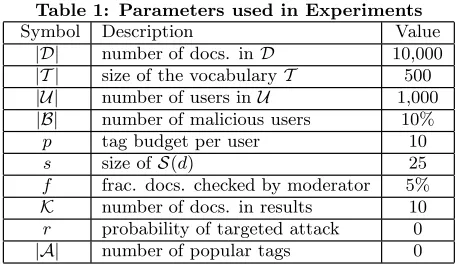
Table 1: Parameters used in Experiments
Symbol Description Value
|D| number of docs. inD 10,000
|T | size of the vocabularyT 500
|U| number of users inU 1,000
|B| number of malicious users 10%
p tag budget per user 10
s size ofS(d) 25
f frac. docs. checked by moderator 5%
K number of docs. in results 10
r probability of targeted attack 0
|A| number of popular tags 0
Then,SpamF actor(t) for tagtis given by the formula:
SpamF actor(t) =
P
∀di∈DKw(di)∗
1
i
HK
(3)
where
w(di) =
1 ifdiis a bad document;
0 ifdiis a good document.
andHK is theKth harmonic number, i.e., it is the sum
of the reciprocals of the firstKnatural numbers, i.e.,
HK=
X
i∈[1..K]
1
i (4)
A documentdis “bad” if it is included in the results for tag query t, butt is not a correct tag ford, i.e.,t /∈ S(d). SpamFactor measures the spam in the result list introduced by bad documents. This is captured by the factor w(di) in
the formula, which returns 1 if di is a bad document and
0 otherwise. SpamFactor is affected by both the number of bad documents and their position in the list. Higher Spam-Factor represents greater spam in the results. TheKth
har-monic number is used as denominator in the calculation of SpamFactor in order to normalize values between 0 and 1.
7.
EXPERIMENTS
We have developed a simulator in Java that simulates the behavior of a tagging system based on the model described in this paper. We have conducted many experiments under several modifications of the parameters involved. Table 1 summarizes all parameters considered and their default val-ues. Due to space constraints, here we only highlight some of our results. All experimental results along with detailed explanations can be found in [14].
7.1
Experimental Results
7.1.1
Random Attacks
Figure 1: Impact of the number of bad users
spam documents will be few and towards the bottom of the result list. Thus, looking at Figure 1, we conclude that for Boolean and Occurrence-based searches, a very small per-centage of malicious users (e.g.,<2% of|U|) with limited tagging power (p=10) as compared to the document collec-tion size (D=10,000) does not bias results significantly. Ex-cessive SpamFactor is observed for growing bad user pop-ulations (> 12%). This observation is critical because in practice many users may accidentally assign incorrect tags (lousy taggers), therefore unintentionally generating spam.
SpamFactor for Boolean results is higher because they are randomly selected from documents associated with a query tag, thus they may include more bad documents. Using coincidences works substantially better than using occur-rences, cutting spam by a factor of 2. The reason behind this improvement is that coincidence factors are computed taking into account not only the postings that associate a document to a query tag, but also information about the users that have made these postings. Thus, they exploit a greater number of postings in order to generate results for a tag. This leads to more informed decisions regarding which documents to return and justifies low Coincidence-based SpamFactor. However, as bad users proliferate, effec-tiveness of this scheme also deteriorates. A high coincidence factor could actually correspond to a bad user. Still, using coincidence factors retains its factor-of-2 advantage.
A trusted moderator helps reduce spam in the system, but it may take a significant effort in order to have a pos-itive impact. Figure 2 shows SpamFactor as a function of |U|when a trusted moderator examinesf= 5% of the doc-uments. For Boolean results, the moderator can cut Spam-Factor almost by a factor of 2. This improvement does not change with the number of users in the system, because with |U|growing, bad postings are uniformly distributed over all documents. Thus, the number of bad postings coming from different users found in the same fraction of documents does not change significantly. On the other hand, the moder-ator’s relative effectiveness for Occurrence-based searches slowly decreases with|U|. The reason is that, after a certain point in the figure, unmoderated Occurrence-based results greatly benefit from the increasing number of users in the system thus reducing the gap between the moderated and unmoderated curves. Overall, the best results are returned in moderated coincidence-based searches.
Note that the initial degradation of Boolean and Occurrence-based results shown in Figure 2 is due to sparse postings generated by the few users in the system. So, the pool of
Figure 2: Impact of the number of users
Figure 3: Impact of the tag budget
documents matching any tag is undersized, and bad docu-ments also surface in the results. As |U|increases, so does the number of malicious postings, causing more bad docu-ments to appear in the results. Once a sufficient number of postings has accumulated, Boolean results do not degrade any further, while Occurrence-based results improve with |U|due to re-occurring postings.
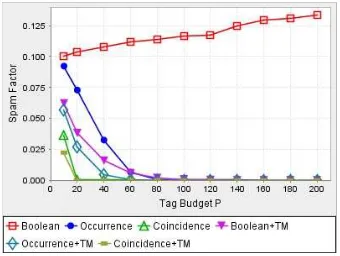
Another interesting outcome of the experiments is that the moderator’s impact is not always the same on all search schemes. Figure 3 shows SpamFactor for moderated and un-moderated results as a function of tag budget, ranging from 2 to 500 for a moderate bad user population (|B| = 10% of the overall user population). We first observe that un-moderated Boolean and Occurrence-based results are not affected in the same way: SpamFactor increases for the for-mer and decreases for the latter. The reason is that when users provide more postings in the system, duplicate good postings accumulate, helping Occurrence-based searches to generate better results, while Boolean still make random de-cisions. Coincidence-based results are even better because the coincidence factors are computed by taking into account common postings over the whole collection, thus they are boosted as the tag budget grows. However, the intervention of a moderator has a dramatic impact on Boolean searches: with p growing, moderated SpamFactor improves and the gain from having a moderator grows. This effect is due to the fact that when users contribute more tags, once a mod-erator finds a bad posting, then a possibly larger number of bad postings is eliminated at once by removing the corre-sponding tagger.
Over-Figure 4: Impact of targeted attacks
all, a system that supports coincidences-based search backed up by a moderator is more tolerant to spamming.
7.1.2
Targeted Attacks
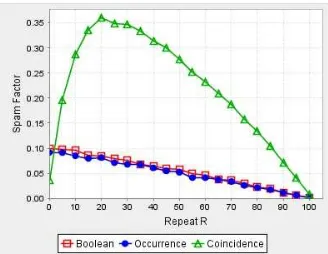
In this subsection, we study the effect of colluding users. Figure 4 shows SpamFactor as a function of the probability r that bad users attack the same document (Targeted at-tack model). Ifr= 0, then we observe the random bad user tagging behavior, while r = 1 means that all users attack the same document. Withrgrowing, targeted bad postings proliferate resulting in an amplified SpamFactor for the tag used in the targeted attacks. However, the number of bad postings for the rest of the documents and tags is reduced. Consequently, Boolean and Occurrence-based SpamFactor decrease withr. Coincidence-based SpamFactor initially de-grades fast withr, because coincidence factors of bad users are boosted, which means that all bad postings (apart from the targeted attack ones) are promoted in searches. How-ever, as r increases, the number of different bad postings decreases, so the influence of bad users is restricted to fewer documents and tags. Therefore, Coincidence-based Spam-Factor starts decreasing after a certain point.
Consequently, under targeted attacks, there is little one can do to protect searches for the attacked tag, but all other searches actually fare better. Moreover, we see that while using coincidences was a good strategy with “lousy but not malicious” users, it is not such a good idea with colluding bad users. However, with focused attacks, it may be eas-ier for a moderator to locate spammed documents. For in-stance, the moderator may examine documents that have an unusually high number of tags, or postings by users with un-usually high coincidence factors. We expect such a focused moderator approach to work very well in this scenario.
7.1.3
Attacks Based on Tag Popularity
In this subsection, we study how vulnerable tag searches are to malicious attacks that exploit tag popularity in a tag-ging system. As an example, we will focus on Occurrence-based searches. We studied all meaningful combinations of good and bad user models: (Good = random, Bad = random), (Good =biased, Bad =random), (Good =biased, Bad =biased), (Good =biased, Bad =extremely biased) and (Good =biased, Bad = outlier). Also, we considered two different searcher models: A naive searcher may use any tag in his searches. We simulate this behavior with a set of random queries. A community member may query popular tags more often. We simulate this behavior by a set
of queries that follow the biased tag distribution.
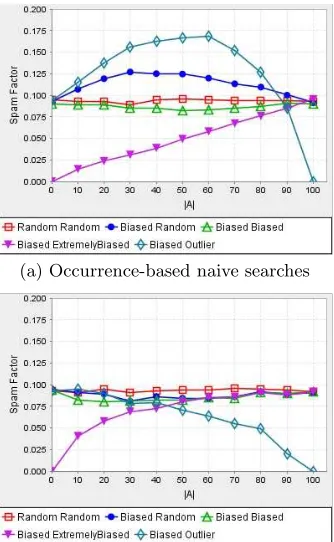
For each combination of user models, we study the effect of varying the number|A|of popular tags on SpamFactor. We assume that popular tags may occur in the postingsm= 4 times more often than unpopular ones. Figure 5 summarizes the corresponding experimental results. Random good and bad user models do not generate popular tags and thus do not depend on|A|. Moreover, for|A|= 0% and|A|= 100%, the biased tag distribution becomes random. Thus, the bi-ased (good/bad) user models become random (good/bad) user models. Therefore, SpamFactor curves corresponding to all combinations but the ones that involve the Extremely Biased and the Outlier bad user models coincide at these two points. For the Extremely Biased behavior, SpamFac-tor is 0 for|A|= 0%, because there are no popular tags to use in bad postings. For the Outlier model, SpamFactor is 0 for|A|= 100%, since there are no unpopular tags to use. A general observation on Figure 5 is that random searches are more vulnerable to spam. In particular, random and outlier malicious attacks are the worst sources of spam for this category of searches. Let us discuss the Outlier model in more detail. A discussion of the other models is analogous and can be found in [14].
With the Outlier model, we observe that for random searches (Figure 5(a)), two conflicting phenomena take place with|A| growing: On one hand, unpopular tags receive increasingly more spam postings. This results in re-occurring bad post-ings multiplying, and thus in SpamFactor increasing. On the other hand, with|A|growing, there are fewer unpopular tags. Consequently, spam is confined to a smaller set of tags, while the “healthy” tags proliferate. These two conflicting phenomena reach a balance point, where maximum Spam-Factor is observed. From this point forward, SpamSpam-Factor decreases to zero. In comparison, SpamFactor for commu-nity searches (Figure 5(b)) always decreases, because these searches consider spam postings only when unpopular tags are queried and this happens less often as|A|increases.
Overall, the existence of popular tags provides many op-portunities for malicious users to misuse tags and spam searches. Naive or first-time users are most vulnerable. Ran-dom noise in postings as well as misused unpopular tags constitute the worst sources of spam for naive searches. Bad users mimicking good users and using popular tags for their postings can have a smaller impact on the system, in the worst case being as disruptive as lousy taggers (given a mod-erate number of bad users in the system). Community mem-bers may be less confused by spam postings, since they more often query about tags contributed by their community.
8.
CONCLUSIONS AND FUTURE WORK
measure-(a) Occurrence-based naive searches
(b) Occurrence-based community searches
Figure 5: Impact of the number of popular tags
countermeasure battles that must be constantly fought to combat spam. Undoubtedly, the bad guys will counter-attack this proposal, and so on. We hope that the model we have proposed here, and the results it yields, can provide useful insights on how to wage these ongoing “spam wars.” We also believe that our approach helps one quantify (or at least bound) the dangers of tag spam and the effectiveness of countermeasures.
There are also other interesting aspects of the problem and possible future directions to look into. For instance, if tags are related, e.g., there is a tag hierarchy, can we devise smart algorithms that take into account tag relationships? If users can also use negative tags, e.g., this document isnot about “cars”, what would be the impact on searches?
Acknowledgements. We thank M. Deschamps for tak-ing part in the initial development stages of the simulator.
9.
REFERENCES
[1] 3spots: url: http://3spots.blogspot.com/2006/01/all-social-that-can-bookmark.html.
[2] CiteUlike: url: http://www.citeulike.org/. [3] Del.icio.us: url: http://del.icio.us/. [4] Flickr: url: http://www.flickr.com/. [5] Rawsugar: url: http://rawsugar.com/. [6] Slideshare: url: http://slideshare.net/.
[7] C. Brooks and N. Montanez. Improved annotation of the blogosphere via autotagging and hierarchical clustering. InProceedings of the 15th International Conference on World Wide Web, 2006.
[8] S. Farrell and T. Lau. Fringe contacts: People tagging
for the enterprise. InCollab. Web Tagging Workshop in conj. with WWW2006.
[9] S. Golder and B. A. Huberman. Usage patterns of collaborative tagging systems. Journal of Information Science, 32(2):198–208, 2006.
[10] Z. Gy¨ongyi and H. Garcia-Molina. Web spam taxonomy. In 1st Intl. Workshop on Adversarial Information Retrieval on the Web (AIRWeb), pages 39–47, 2005.
[11] Z. Gy¨ongyi, H. Garcia-Molina, and J. Pedersen. Combating spam with TrustRank. In30th Intl. Conf. on Very Large Databases (VLDB), pages 576–587, 2004.
[12] M. Henzinger. Link analysis in web information retrieval.IEEE DE Bulletin, 23(3):3–8, 2000.
[13] A. John and D. Seligmann. Collaborative tagging and expertise in the enterprise. In Collab. Web Tagging Workshop in conj. with WWW2006.
[14] G. Koutrika, F. A. Effendi, Z. Gy¨ongyi, P. Heymann, and H. Garcia-Molina. Combating spam in tagging systems. Technical report, available at
http://dbpubs.stanford.edu/pub/2007-11, 2007. [15] R. Kumar, J. Novak, and A. Tomkins. Structure and
evolution of online social networks. InKDD, pages 611–617, 2006.
[16] C. Marlow, M. Naaman, D. Boyd, and M. Davis. Position paper, tagging, taxonomy, flickr, article, toread. InHypertext, pages 31–40, 2006.
[17] G. Mishne. Autotag: collaborative approach to automated tag assignment for weblog posts. In Proceedings of the 15th International Conference on World Wide Web, 2006.
[18] T. Ohkura, Y. Kiyota, and H. Nakagawa. Browsing system for weblog articles based on automated folksonomy. InProceedings of the WWW 2006 Workshop on the Weblogging Ecosystem: Aggregation, Analysis and Dynamics, at WWW 2006, 2006. [19] P. Schmitz. Inducing ontology from flickr tags. In
Collab. Web Tagging Workshop in conj. with WWW2006.
[20] S. Sen, S. Lam, A. Rashid, D. Cosley, D. Frankowski, J. Osterhouse, F. M. Harper, and J. Riedl. Tagging, communities, vocabulary, evolution. InCSCW’06, 2006.
[21] S. Wasserman and K. Faust.Social Network Analysis: Methods and Applications. Cambridge University Press, Cambridge, 1994.
[22] B. Wu, V. Goel, and B. Davison. Topical TrustRank: Using topicality to combact web spam. InWWW, pages 63–72, 2006.