Learning groups: The effects of group diversity on the quality of
group reflection.
Abstract:
This study explores the quality of reflection, and how group diversity affects group reflection by final year accounting and finance undergraduates using Mezirow’s (1991) reflection model. Group work and reflective writing are now common assessment features in UK higher education. They affect students’ perception of their learning experience (Ledwith and Seymour, 2001; Chirema, 2007) and enhance the acquisition of transferable skills by students. Using content analysis and independent t test, this study reports the prevalence of process and content reflection, but limited instances of premise reflection. Gender
composition seems to matter for group outcome. Group nationality diversity and whether a group has more placement1 students do not seem to affect the quality of group reflection for
the students in the sample. The study includes policy implications for the continued use of learning groups and reflection in assessments in higher education.
Keywords: Assessment of group reflection, Learning group, Group diversity, Group work, Accounting and Finance.
1Placement is a mode of undertaking degree programme in the UK where a student voluntarily undertakes a
Introduction
This study addresses the question of whether or not accounting and finance
undergraduates undertake reflection on their learning, and the quality of their reflection when working in a group situation.
Understanding the presence and the quality of reflection in students’ reflective statements in a group setting is important because both reflection and group work are increasingly being used in higher education as assessment methods, and they affect students’ learning
experience and performance. Enhancing students’ learning experience and their academic performance are specific objectives that are relevant to accounting educators anywhere in the world. Therefore this study is useful to an international accounting education audience.
This study applied Mezirow’s (1991) reflection model on the content of student group reflection to assess their quality. Given the importance of group work in higher education and evidence showing that group diversity could impact group outcome, the study explores the relationship between the quality of group reflection and some group diversity variables. The study used content analysis to measure the quality of reflection and applied independent t test to generate deeper understanding of the relationship between the quality of group reflection and selected group diversity features.
Although previous studies have examined the quality of reflection in students’ reflective statements, they are predominantly in health and allied disciplines. Furthermore, existing studies on reflection have focused entirely on individual reflection (Chirema, 2007; Schön, 1983). However, reflection in a group situation is likely to be inter-personal and could be affected by group diversity features (Akindayomi, 2015; Elfenbein and O’Reilly III, 2007).
Contributions of the study
The study contributes to the reflection, group work and group diversity literature by analysing the quality of the reflection in the reflective statements of accounting and finance undergraduates, and extending the literature on the assessment of the quality of reflection to the accounting and finance disciplines. Unlike extant literature that mainly focuses on individual reflection, this study explores group reflection and therefore deepens our
understanding of reflection in a group context. The study also extends the empirical context of research in group work and diversity by exploring the effects of group diversity features on learning groups in educational setting. Furthermore, the study highlights the importance of appropriate group selection, faculty training, student support and appropriate group task as part of the key success factors for group work in higher education.
The rest of the study is structured as follows: section 2 presents the literature and develops the research questions for the study, section 3 presents the study design and methods, section 4 presents the results and additional analysis, section 5 presents the discussion and section 6 presents the conclusion and limitation.
Literature review
This section reviews the relevant literature on reflection, group work and group diversity. It then justifies the group diversity features considered, and presents the research questions addressed in this study.
Reflection: Meaning and Theoretical Models
Reflection has many different definitions (Plack et al., 2005). For example, Boyd and Fales (1983) define reflection as the process of identifying lessons from past experiences.
According to Coulson and Harvey (2013:401), reflection is a tool for promoting learning and higher order thinking skills, developing professional practice and facilitating and structuring learning through experience’. These studies seem to imply that reflection is an important tool in the learning process, through which students assess, understand and learn based on their own experiences (Marriott, 2009).
To stimulate effective reflection by students, studies (Moon, 2006; Bell et al., 2011) have suggested the use of a journal. According to Moon (2006:2), a learning journal is ‘an essential vehicle for reflection’. It is the product of the writer’s reflection process. These studies imply that students benefit from keeping learning journals by documenting, reviewing and sharing whatever they learn. It can therefore be argued that keeping learning journals has the potential to increase students’ understanding. Based on the discussion above, this study takes the view that keeping a learning journal enhances effective reflection on learning experience.
Mezirow’s reflection model
Although previous studies (e.g. Schön, 1983; Boud et al., 1985) have suggested several theoretical models to explain reflection, Mezirow’s (1991) model of reflection seems more persuasive because compared to other models; Mezirow (1991) makes a clear
distinction between reflective and non-reflective actions and also provides a categorisation of reflection. Mezirow (1991) categorised non-reflective action into habitual action, thoughtful action and introspection (i.e. the last two rows in Figure 1 below). He describes habitual actions as actions that are based on habit and partial review of experiences and describes thoughtful action as the ‘selective review of prior learning rather than a deliberate appraisal or reappraisal of it’ (p.107). According to Mezirow (1991), introspection relates to what we feel about ourselves and others without the reflective element that makes us question how and why we feel the way we do.
Furthermore, Mezirow (1991) categorised reflective action into content, process and premise2 reflection. He described content reflection as the reflection based on ‘what we
perceive, feel or act upon’ (p. 107). It is the reflection on what we learnt, and describes the learner’s desire and ability to establish a link between past knowledge and experience, and
2 The study used premise reflection interchangeably with critical reflection based on the description in Mezirow
the contents of current learning. Mezirow (1991) describes process reflection as an ‘examination of how one performs the functions of perceiving, thinking, feeling, or acting and an assessment of the efficacy in performing them’ (p. 108). Finally, he describes premise reflection as the state of ‘becoming aware of why we perceive, think, feel or act as we do’ (p. 108). Mezirow (1991) considers premise reflection as a higher order reflection, because of the transformational thinking involved. This may indicate the ability to contextualise
meanings and processes in order to arrive at a critical perspective on issues. He suggested that the level of reflective thinking is increasing bottom up, in the order shown in figure 1 below3.
This study uses Mezirow’s (1991) reflection model described above to analyse the quality of reflection reports submitted by a cohort of accounting and finance undergraduates in a UK university. The next sub-section highlights the debates relating to the assessment of the quality of reflection.
Premise reflection (P)
Content reflection (CR)
Process reflection (PR)
Content and process reflection (PCR)
Thoughtful action (TA) Introspection (INS)
Habitual action (HA)
Figure 1: Categories of reflective action
Source: Adapted from Kember (1999)
The assessment of the quality of reflection
3The arrow besides the ‘reflective action’ indicates that the quality of reflection is increasing bottom up in
reflective actions. Thus, the first two rows from bottom indicate non-reflective actions. Reflective actions in the third row are considered equal because they do not lead to changed premise or critical perspective. However, the level of reflection at this stage is lower than premise reflection in the last row which indicates the highest level of reflective action.
Reflective actions
A major controversy in the literature surrounds whether reflective journals should be assessed at all, aside from the debate on how to assess them. Some authors argue that
reflection is inherently complex and subjective and it is not practically possible to reduce them to satisfactory measurable quantity (Brookfield, 1987; Bourner, 2003). Others feel that the measurement of reflection is not the primary objective of asking students to reflect, rather it is to encourage them to develop the ability to question their taken for granted assumptions about their learning and knowledge development (Lucas and Tan, 2014).
However, proponents of assessing reflective journals argue that the purpose of asking students to maintain reflective journals is to encourage them to engage in actual reflection and this objective would be defeated if there is no mechanism of knowing whether students actually reflect or not (Kember et al., 2008; Loo and Thorpe, 2002). Based on the arguments that the primary objective of asking students to reflect on learning is to enhance their learning experience and because it is necessary to assess this process in order to discern if students are indeed learning through reflection, this study takes the view that assessing the quality of reflection is consistent with the pedagogical aspiration of using reflection as an additional learning mechanism in higher education. We provide a review of the existing literature on the assessment of the quality of reflection in students’ reflective statements in the next section.
Previous studies on the assessment of the quality of student reflection
Studies on the assessment of reflection report conflicting results probably due to the different reflection models used. These studies are mainly within health and allied fields (Plack et al., 2005) and their findings may not be applicable to other disciplines. Assessing the quality of reflection in reflective statements is challenging and complex (Kember, 1999). This is because reflection is subjective and person-specific. Consequently, existing studies (Plack et al., 2005; Bell et al., 2011) have concentrated, and rightly so, on achieving consistency and reliability in identifying and correctly categorising reflection in students’ reflective writing and they have generally reported reasonable inter-coder agreements.
reflection. These findings are similar to the results in Thorpe (2004) who reports a high reflection component in the assessment of 52 journals completed by nursing students. She also found that 15%-39% of the students are non-reflectors and at least 12% of the students are critical reflectors. On the other hand, Bell et al. (2011) report a 65% non-reflection and 35% reflection in the content of the journals examined. Similarly, Samkin and Francis (2008) report a 60% non-reflection in their assessment of 20 reflective journals maintained by third year financial accounting students.
However, none of these studies considered reflective writing in a group context and only one examined reflection within accounting and finance subject area. Reflection in a group context is likely to be different to individual reflection because it will probably require students to interact with each other in order to develop, ‘negotiate, compromise and mutually reach agreement’ on the content of their reflective report (Akindayomi, 2015:103). Given the increasing use of group work in higher education (Akindayomi, 2015; Curşeu and Pluut, 2013), and the requirement for students to produce reflective reports, it is important to understand the nature of reflective reports produced by students and to establish if indeed students reflect on their learning. Consequently, the first aim of this study is to assess the quality of group reflection in the group reflective reports prepared by the final year
accounting and finance students in a UK university’s Business School in order to identify if they contain reflection and the types of reflection they contain using Mezirow’s (1991) reflection model described earlier. Therefore, the first research question of this study is:
RQ1: What is the quality of the reflection in accounting and finance students’ group reflective statements?
Group work and group diversity
This sub-section explains group work and group diversity. It also justifies the choice of group diversity features used in the study. A summary of the key points is then provided.
Group work in higher education
There is a growing use of group work4 in higher education (Akindayomi, 2015; Elliot
and Reynolds, 2014). This could be class based e.g. group discussion or group tasks; or outside class e.g. group assignments. The pedagogical aspirations of work-based learning are
4 This paper uses Group work interchangeably with collaborative and teamwork learning based on outside class
part of the primary foundations for the use of group work in higher education (Davies, 2009). This type of learning develops from the objective to link students’ learning approaches and experiences to the acquisition of transferable skills that are required in a work environment (Daly et al., 2015). Proponents of this idea argue that group work equips learners with important team skills (Curşeu and Pluut, 2013) and group reflection requires interaction between the group members. Ideally, this will involve debates and discussions, and will require several communication skills, which may involve group engagements, contests, negotiations, concessions and consensus (Akindayomi, 2015). Thus, reflection in such a situation is an interdependent cognitive task (Curşeu and Pluut, 2013), which requires active involvement of group members. Learning in groups enhances students’ problem solving skills as they learn to share and modify their views in the context of other ideas (Daly et al., 2015). Group work is also crucial in a work environment and introducing students to their use in higher education could enhance student employability.
However, recent literature evidence suggests that there is no consensus on the probity of using group work in higher education (Daly et al., 2015; Akindayomi, 2015; Ledwith and Seymour, 2001). This is because despite its perceived benefits, group work can be
counterproductive, for example, due to the free-rider problem (Davies, 2009) where a member of the group puts in less effort but obtains equal benefit. Some students consider group work to be stressful and improvident because of the amount of time and effort needed to organise group meetings and achieve group objectives (Livingstone and Lynch, 2000). Literature suggests that students believe that their individual assessment is a better reflection of their ability than group work (Ledwith and Seymour, 2001). In order to improve the effectiveness of group learning, Daly et al. (2015) note the importance of lecturers using appropriate strategy in supporting students to develop group work skills, for example,
through preliminary alliance building activities. This observation is important because lack of experience and training on the part of lecturers using work group could hinder the
development of group work skills (Elliot and Reynolds, 2014). The debate on the merits of group work in higher education is inconclusive and its success may depend on the expertise and approach used by lecturers adopting this approach to learning.
Group diversity
diversity may be relevant in understanding the impacts of group diversity on group outcome (i.e. group reflection) in higher education and provides appropriate research questions based on the discussions in the section.
Group diversity describes the different types of unique features through which a learning group can be distinguished (Elfenbein and O’Reilly III, 2007). Existing literature on group work, mainly in the work environment, argue that the group outcome depends on group diversity because they enrich work groups with diverse experience, skills and competence (Kakabadse et al., 2015). Within an academic setting, Curşeu and Pluut (2013) show that group diversity and the quality of teamwork affect group outcome if there is sufficient diversity in learning groups which ensures that each member of the group brings something new to facilitate learning within the group.
Although there are endless list of diversity features through which a group could be distinguished (Elfenbein and O’Reilly III, 2007; Van Knippenberg et al.,2004; Milliken and Martins, 1996; Williams and O’Reilly, 1998), Van Knippenberg et al.(2004) note that practically, empirical research tend to focus on limited number of these diversity features, prominent amongst which are gender, race/ethnicity, nationality, age, tenure, educational and functional backgrounds. Current literature on group work in an educational setting provides limited guidance on the relative importance of the various group diversity features to group outcome. Thus, whilst there are several group diversity factors that could possibly affect group outcome, this study focuses on gender, nationality and placement experience for a number of reasons.
Extant studies observed that these features (Curşeu and Pluut, 2013:91) are ‘salient’ group features that affect group outcomes in an internationalised higher education
provide additional explanations on these diversity features and propose appropriate research questions.
Gender
Group gender diversity permits diverse perspectives and tolerance of the ‘different others’, which can enhance group awareness, flexibility and dynamics (Singh and
Vinnicombe, 2004:486). A single gender group has a higher predisposition to groupthink which could constrain its perspectives and experiences (Kakabadse et al., 2015; Andrevski et al., 2014). Whereas a mixed group would benefit from diverse opinions and experiences that should enhance the quality of group reflection.
Although studies on the relationship between reflection and group diversity are limited, relevant literature within critical thinking skills and communication report gender difference in group situations (Naber and Wyatt, 2014; Wangensteen et al., 2010; Facione et al., 1995). For example, communication scholars argue that females tend to show
cooperation, agreement and focus on building networks, while males are more assertive, opinionated, task focus and categorical in their discourse (Wegge et al., 2008; Myaskovsky et al., 2005). Based on the literature above, it can be argued that the desire to build networks and show cooperation during group dialogue may affect the actual process and quality of group reflection in female dominated groups, since reflection requires challenging taken for granted assumptions which at times may be inconsistent with building network or seeking agreement. It can also be argued, based on the literature above that, being task focused, groups with more males may be able to display openness and assertiveness in group dialogue and may therefore be able to engage in reflection.
On the other hand, male dominated groups may become dysfunctional due to
individual members becoming conceited, making group reflection ineffective (Wegge et al., 2008; Myaskovsky et al., 2005). The arguments above suggest that group gender diversity could possibly affect group outcome. Based on the argument above we seek to explore whether group gender difference impacts the quality of group reflection. Our second research question is:
Placement and the quality of group reflection
Students on the same year of a programme can be grouped in several ways. For example, it is possible to distinguish students based on whether they undertake placement or not (Crawford and Wang, 2015). Existing literature reports mixed findings on the effects of work experience on students’ performance, behaviour and decision making. While some studies found that work experience increases student emotional intelligence (Cooke et al., 2011), improves their academic performance (Surridge, 2009; Gracia and Jenkins, 2003) and lead to better ethical decisions (Eweje and Brunton, 2010), other studies reports absence of placement effects (Lucas and Tan, 2014; Lowry, 2003). In terms of reflection, placement students may have greater awareness and be more conscious of their learning than non-placement students, due to their exposure and work experience. Similarly, it is possible that placement students have greater reflective capacity and produce higher quality group reflection than non-placement students due to their exposures, maturity and experience.
Lowry (2003:16), in a study of students’ ethical awareness that explored the appropriate stage at with business ethics could be integrated into a Business School’s curriculum and compared ethical awareness of second year business undergraduate students to the final year placement students. The study finds that placement students were lower in ethical awareness than second year students, and suggests that this may be due to placement students’ ‘ethical bracketing’, a situation where their experiences caused them to reconsider their ethical dispositions, and results in their limited ethical inclinations. Similarly, placement students could suffer from ‘reflection bracketing’. This could be, for example, where their work experience led to their ‘reflective disengagement’. This may be in a situation where they consider that reflection has little real life practical usefulness in the work place. Lucas and Tan (2014: 796) note that ‘placement experience does not appear to support students’ cognitive development’, just as anecdotal evidence suggests that students take a normative view of reflection and only engage in it if they have to, for example, for the purpose of assessment. Consequently, this study explores whether placement experience affects group outcome. The research question is formulated as:
Nationality
Higher education is internationalised, and Chinese students are one of the largest groups (Crawford and Wang, 2015). One of the areas of interest in the literature is the Chinese students’ learning style, where growing number of studies paint a homogenous picture of the Chinese learner who learns through rote-learning and memorisation, dependents on the teacher and may be alien to collaborative and reflective learning
(Grimshaw, 2007; Cooper, 2004). These perceptions, in the context of reflection, imply that the Chinese learner may have a lower propensity to engage in reflective learning compared to the Western learner since it is new to them.
Furthermore, given that deep learners are more likely to be reflective learners (Leung and Kember, 2003) and tend to perform better than surface learners (Cassidy and Eachus, 2000; Kember et al., 1995), one would expect that Western students should outperform their Chinese counterparts. However, literature evidence gives conflicting indications. Although Crawford and Wang (2015) report that international students and especially Chinese students underperform UK students, this finding is in conflict with the arguments in Cooper (2004) where Chinese students were reported to consistently outperform Australian students. Furthermore, in the context of reflection, it may be too simplistic to suggest that students’ propensity for reflection is predictable simply due to their nationality. This is because
reflection is cognitive and reflective tendency should be nationality neutral (Chirema, 2007). This study therefore explores whether nationality diversity could affect the quality of group reflection. The research question is:
RQ4: To what extent does the group nationality diversity affect the quality of group reflection?
Study design and methodology
The study
This study concentrates on students in a Business School at a UK post-19925
university that has 4000 students and 250 faculty members. The accounting and finance department forms a key part of the school, representing the largest student cohort at both undergraduate and postgraduate levels. The department receives a large number of direct entry students from China who normally join in the second year of a three-year BA in Accounting and Finance, BA Accounting and Business and BA in Accounting and
Management programmes. Some students go straight into the final year of the programmes. The duration of the undergraduate programme is three years; four years for students that choose to do placement at the end of their second year. This study is based on an assessment component of the Auditing and Assurance module, which is a 15 credit module out of the maximum of 120 credits that a student could take in any academic year, and the 360 credits that a student needs to pass to gain a Bachelor’s degree in the UK. It is a compulsory final year module for all BA Accounting and Finance students and is an elective for other
programmes with accounting components. The total number of students enrolled on this exempting6 module during the period of this investigation was 255. Assessment on the
module had two components, the examination and a group based course work. This study is based on the course work component, which accounts for 30% of the total module mark. The next section discusses the group formation.
Group formation
The literature presents two approaches to group formation in a collaborative learning environment. Firstly, where lecturers assign students to groups either randomly or selectively and secondly, where students self-select their group members7 (Chapman et al., 2006; Davies,
2009; Strauss et al., 2011). There is no consensus in the literature on the best approach. For example, whilst Chapman et al. (2006) observe that lecturer assigned groups may allow greater diversity and balance of skills amongst student groups, and if done randomly, it may
5 UK universities can be broadly divided into two types: the traditional and the post-1992 universities. The
traditional universities are older and the post-1992 universities are former polytechnics or institute of higher educations that were granted university status in 1992.
6 Exemptions are award of merit granted by professional accountancy organisations (such as Institute of
Chartered Accountants in England and Wales, Association of Chartered Certified Accountants) in the UK and Ireland to recognise students’ previous knowledge or qualifications so that they do not have to write a professional paper if they are deemed to have acquired the required knowledge from doing an exempting module as part of their university degree. University department seeking professional body’s exemptions for a module would usually have to show that their syllabus covers the contents of the professional paper to be qualified for the exemption.
be seen to be fair by students, Bacon et al. (2001) note that such selection process may not really be fair as lecturers have the chance to potentially determine students’ performance based on the group they decided to place them in.
A major concern with self-selected group is that students may prefer to work only with their friends, a problem Chapman et al. (2006:560) referred to as ‘cronyism’. Cronyism may affect group outcome if friendship gets in the way of group tasks and if it affects group cohesion, for example, if the other group members become left out, a phenomenon that Bacon et al. (2001:9) referred to as the ‘remainder problem’. On the other hand, Myers (2012) reports higher commitment, trust, relational satisfaction and more effective learning when students were allowed to work with their friends in self-selected groups than assigned groups. Similarly, Chapman et al. (2006) in an experimental study on the effects of group selection methods on group outcome, report that self-selected groups seem to have higher sense of friendship, better communication, and better outcome than assigned group. Based on the arguments above, students were allowed to form a group of five for the group assignment at the beginning of the academic year in September 20128. However, consistent with
suggestions by Davies (2009), students were provided extensive briefing on the implications of group selection. The next section discusses the group task.
Group task
The success of a group work depends, among other things, on the suitability of the task (Curşeu and Pluut, 2013). Davies (2009:570) suggests that additive tasks ‘where each member of the group adds something to the task i.e. there are inputs from each group member forming a composite whole’ are the most suitable for group work. Although individual tasks are independent, they are also integral part of the overall task, where the output from one task serves as part of the input in the other task. This type of task ensures that each member of the group interacts with the different task components (Strobe et al., 1996). Our study reports the outcome of an additive task, where students were required to undertake an empirical research on auditor independence and to write a 5000 page essay based on the research and a reflective report. The reflective report accounted for 10% of the total assignment mark. Although students kept individual reflective journals, they had to submit a single group reflection
8 Although this study did not explicitly control for the impacts of friendship on group selection and outcome,
report, further ensuring group interactions (Akindayomi, 2015). The group reflection report was a minimum of 100 words and a maximum of 1000 words. The assignment including the reflective statement was submitted in April 2013 allowing the group to mature in their interaction (Daly et al., 2015; Davies, 2009).
Data
This section describes the data used in this study. It explains the data and the ethical considerations regarding data collection and usage.
The data for this investigation was based on the reflective report submitted by the final year students on the auditing and assurance module described earlier. The reflective reports form the basis of the measurement of the quality of group reflection, using content analysis. Information regarding gender, nationality and placements were obtained at departmental level through the module enrolment list and students database. Appropriate university ethical approval was obtained for the study. Students’ confidentiality and anonymity were assured. We collected and anonymised the group reflection from the 41 groups. Consistent with Kember et al.’s (2008) suggestion, we based our assessments of the quality of reflection on the entire entry by each group using paragraph as unit of analysis. We describe the sample selection in the next section.
Sample selection
The module had 255 students, ideally, there should be 51 groups however, some groups consisted of less than five members; a few groups had six members. To be included in the study, a group must have submitted a group reflective statement and have a group score in the assignment. Eleven groups did not include a group reflection. Thus, the final analysis was based on 41 groups with an average of five members in a group. The sample size in this study is comparable to previous group based studies (Stewart and Johnson, 2009; Elfenbein and O’ Reilly III, 2007). Table 1 below shows the sample selection procedure. The next section describes the variables and their measurement.
Table 1: Sample selection criteria
Description Number
Expected number of groups (5 in a group) 51
Actual number of groups 52
Less groups without reflective statements 11
Total groups in the study 41
Variable measurement
This section explains the variables, their measurements and the sources of the data used. It starts with the explanations of the measurement of the quality of group reflection variable and then the diversity features.
The quality of group reflection
We based our measure of reflection on the Mezirow’s (1991) reflective model explained in section 2 because it offers a clear description of the concept and the process of reflection. We used content analysis to derive the quality of group reflection.
Content analysis
Content analysis ‘is a systematic and objective means of describing and quantifying phenomena’ (Elo and Kyngas, 2008; 108). It enhances the empirical testing of phenomena through quantification of narrative information which could lead to better understanding of a phenomenon that otherwise may be inaccessible to empiricism (Krippendorff 1980).
Although content analysis is growing in popularity within accounting and finance research (Guthrie et al., 2012) it should only be used if the concept in the research can be adequately reduced to data that describes the phenomenon being studied (Elo et al. 2014; Elo and Kyngas, 2008). It is common to use coding scheme in studies with content analysis (Guthrie et al., 2012). We discuss our coding scheme in the next section below.
Coding scheme
To enhance our use of content analysis, we followed Kember et al. (2008) and Bell et al.‘s (2011) suggestions to maintain a clear coding scheme. Our coding scheme involves the following steps:
1. Each reflective writing is read more than once to familiarise the coder with its content
3. The coder then reads the reflective statements again with the aim of classifying them along the Mezirow (1991) model.
4. Coders allocate HA, TA, INS, CR, PR, PCR9, P (see figure 1 above) for each of the
dimensions identified in the group reflective statements. We allocated 1 point for each of process, content and process and content reflection and allocated 2 points for premise reflection to reflect that it is higher10.
5. All the reflection scores are added to derive a total (No score is awarded to non-reflective statements i.e. HA, TA, INS).
6. Group reflection is the sum of the total reflection scores awarded in a reflective statement to a group.
Implementation of coding scheme
Two researchers with considerable experience in using content analysis in empirical investigations did the coding (Elo et al., 2014). Inter coder agreement calculated according to the method outlined in Krippendorff (1980,pp 138-139) was 85%. An example of the coding procedures is shown below:
This is the reflective statement of group AA8 (Group 8 in the Auditing and Assurance assignment)
What new things you have learnt through the process of the research?
We have covered numerous aspects during this assignment. The research has allowed us to be more active and takes hands on approach, when conducting our primary research. We have learnt the significance if auditors independence and its importance in decisions making for users of financial statements. We have become much more aware of the issue of auditors independence and the current debate surrounding this topic (CR).
What did not go well and could have done differently?
We have recognised our limitations of our study and feel that whilst conducting the interviews, we should have recorded the conversations electronically to validate our research. (PR) However, we did note down their responses but we were compromised due to being unable to record responses fully. Moreover, we could have planned our assignment schedule better through utilising out time more efficiently.(PR)
What worked really well?
We have worked extremely well as a team and delegated responsibilities based upon the individual strengths of team members to maximise the quality of work (PR). All the members had attended and contributed to the report and helped each-other when it was necessary. We valued everyone’s opinion and respected all the views, which has aided us in producing this quality report. We incorporated the use of Dropbox and WhatsApp to keep in regular contact with one another, as well as uploading documents to a shared file for all group members to
9 We included ‘process and content’ reflection consistent with Kember (1999).
10 Our results were similar even when we allocated 1 mark for premise reflection. This may be because there
view and make amendments as deemed necessary (PR).
What new knowledge, awareness and skills you have gained?
As a group, we have been able to develop skills in preparing objective questionnaires. We have been able gather relevant and appropriate information from secondary sources in order to evaluate our findings. Also, from gathering the information we have learnt the importance of confidentiality and its processes (PCR).
For example, in the first paragraph of the example reflective statement above, we identified features that fall within Mezirow’s (1991) definition and description of content reflection. Mezirow (1991) described content reflection in terms of what we perceive, see, think or act upon. The first sentence in the first paragraph of our analysed reflective statement described the coverage of the assignment, the second sentence reflects on what the
assignment had made possible. The fact that the assignment has made them, the students, to be ‘more active and take hands on approach when conducting the research’. The next sentence identified what has been learnt i.e. the content of the assignment, specifically on auditor independence, the debate around this and its importance to users of financial
statements. Overall, this first paragraph of the reflective statement is clearly focusing on the contents of the assignment. The students, through the first paragraph of the reflective
statement, ‘perceived’ that the assignment has made them to have a hands on approach; they ‘think’ they now have a better understanding of the importance of auditor independence to users of financial statements and ‘perceived’ that they understand the debate around this more than before. Thus, we categorised this paragraph as a content reflection. We analysed the remaining parts of the reflective statement in a similar way to that highlighted above, and sum up all the reflection in it as below:
Reflective element = 6 (4 process, 1 content and 1 content and process reflection)
We followed similar procedure for all the remaining 40 reflective statements. This process generates the quality of group reflection score.
Diversity measures
Method of Analysis
To answer the first research question, we analysed the various composition of the group reflection to identity the type of the reflection that are present in the group reflective reports. We used percentages to illustrate the differences in the types of reflection contained in the group reflective reports. To answer the three remaining research questions, we used mean difference analysis. This involves comparing the mean reflection scores of each group type to discover whether a particular group feature leads to difference in the mean group reflective scores. We used independent mean t-test to clarify if the differences are statistically significant or not. The next section presents the results of the investigation.
Results
This section presents the study results. The section starts with the descriptive statistics and then presents the other findings from the investigation and additional analysis.
Descriptive statistics
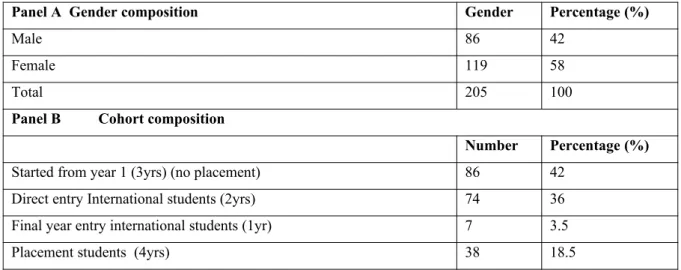
Tables 2 and 3 below present the descriptive statistics. Table 2 comprised two panels. Panel A shows the demographic descriptive statistics of the sample. Female students
constitute 58% of the sample, and panel B shows that the majority of the students joined in the first year and did not go on placements. Panel B also shows that 36% of the samples joined in the second year, a large proportion of these were Chinese students. Approximately 19% of the total sample went on placement. This is smaller than the proportion reported in Crawford and Wang (2015). Furthermore, the last two rows in Table 3 below shows that the mean group size was 5 and the average group score from the assignment was 71%.
Table 2: Gender and cohort composition of the sample
Panel A Gender composition Gender Percentage (%)
Male 86 42
Female 119 58
Total 205 100
Panel B Cohort composition
Number Percentage (%)
Started from year 1 (3yrs) (no placement) 86 42
Direct entry International students (2yrs) 74 36
Final year entry international students (1yr) 7 3.5
Total 205 100
In terms of the distribution of the group based on the diversity features considered in this study, there were three groups without a female student, 25 groups without a placement student and 25 groups without a Chinese student. Over seventy percent of the groups have 5 members. The following four sub-sections present the results of the four research questions.
What is the quality of the reflection in the group reflection reports?
We answered this question by analysing the contents of the reflective reports
submitted by the groups using Mezirow (1991) model as explained in section 2. The coding procedures and schemes were explained in section 3. Table 3 below presents the findings on the group reflective reports from the 41 groups in the study. Recall, that we provided a detailed explanation of the meaning and descriptions of the Mezirow’s (1991) reflection model in section 2. In summary, whilst process reflection focuses on ‘how’ learning took place i.e. the method, content reflection addresses ‘what’ has been learnt and premise reflection is the higher order reflection (i.e. critical reflection) which is assumed to lead to learning transformation, for example, changed behaviour or perception.
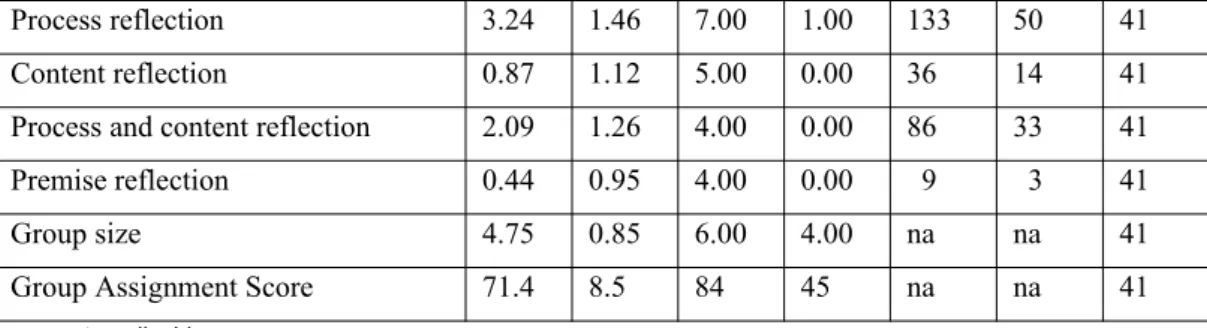
All the reflective statements have elements of process reflection. The average
reflective report has 3 process reflection, 1 content reflection, 2 process and content reflection and no premise reflection. No journal had more than 2 (i.e. a score of 4) premise reflection. Following the summation of all the reflection in all the reflective reports by categories, we found that there were 264 total reflection in the journals of which 133 representing 50% were process reflection, 36(14%) were content reflection, 86(33%) were process and content reflection and 9(3%) were premise reflection. The findings indicate that students in the sample concentrate more on the process of learning in their reflection reports, followed by the content of their learning. The findings also show limited evidence of premise reflection in the content of the group reflection submitted. The majority of the reports do not contain any premise reflection and the highest had just two.
Table 3: Descriptive statistics
Variables Mean Std Max Min Total % Obs
Process reflection 3.24 1.46 7.00 1.00 133 50 41
Content reflection 0.87 1.12 5.00 0.00 36 14 41
Process and content reflection 2.09 1.26 4.00 0.00 86 33 41
Premise reflection 0.44 0.95 4.00 0.00 9 3 41
Group size 4.75 0.85 6.00 4.00 na na 41
Group Assignment Score 71.4 8.5 84 45 na na 41
na= not applicable
To what extent does the gender composition of a learning group affect the quality of group reflection?
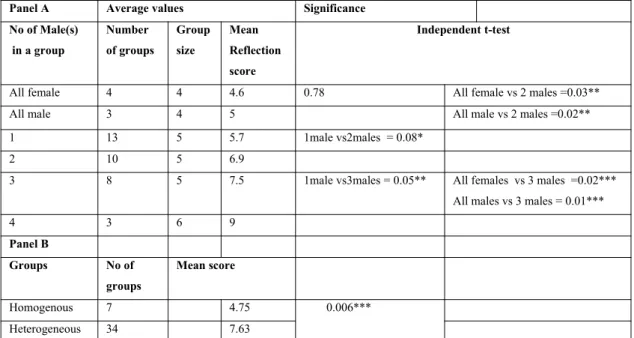
We addressed this question through mean comparison of the mean reflection scores for the various groups in the sample based on gender composition. Table 4 panel A presents the results of this analysis. It shows that there were 4 female and 3 male only groups, and shows the number of males relative to females in the remaining groups. The table also shows that the mean reflection score for the male only groups is fractionally higher than the mean score for the female only groups but the difference is not statistically significant using independent mean t-test as shown in Table 4. Furthermore, as the number of males in a group increases compared to females, we found that the mean reflection scores increase
progressively. For example, when there was one male in a group relative to females in the group, the mean reflection score was 5.7, and this increased to 6.9 when there were two males in a group relative to females, and to 9 when there were four males in a group relative to females. And the differences are statistically significant as shown in Table 4. Furthermore, there were four groups with equal number of males and females in a group of four students with a mean reflection score of 6.25(not tabulated). This is higher than the mean score in all male or all female groups but lower than when the number of males in a group increased beyond two in a group irrespective of the size of the group.
To provide further analysis, in panel B Table 4, we partitioned the groups into homogenous (all male and all female only groups) and heterogeneous groups and compared the mean reflection scores for these groups using independent mean t-test. The table shows that there is a statistically significant difference in the means scores with the heterogeneous groups scoring higher.
Panel A Average values Significance No of Male(s)
in a group
Number of groups Group size Mean Reflection score Independent t-test
All female 4 4 4.6 0.78 All female vs 2 males =0.03**
All male 3 4 5 All male vs 2 males =0.02**
1 13 5 5.7 1male vs2males = 0.08*
2 10 5 6.9
3 8 5 7.5 1male vs3males = 0.05** All females vs 3 males =0.02*** All males vs 3 males = 0.01***
4 3 6 9
Panel B
Groups No of groups
Mean score
Homogenous 7 4.75 0.006***
Heterogeneous 34 7.63
***, **, * indicate significance at 1%, 5% and 10% levels respectively. The test recognised the unequal variance and Welch’a approximation
To what extent does the number of placement students in a learning group affect the quality of group reflection?
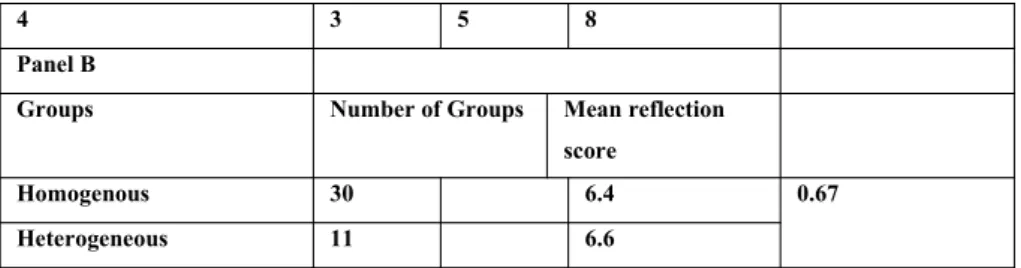
The third research question in this study explores whether group composition based on whether a student went on placement or not affects its reflective quality. Table 5 panel A presents the results of our analysis. It shows that there were five groups with all placement students and 25 groups with no placement students. The all-placement group had a mean reflection score of 5.8 compared to 6.7 for the no-placement group, but the difference is not statistically significant using independent mean t-test. The two groups with two placement students have the highest mean reflection score of 11. On the other hand, the six groups with just one placement student in the group have the lowest mean reflection score of 5.3 whilst groups with four placement students have a mean reflection score of 8. Panel B reports the result of comparing the reflective quality of the homogeneous and heterogeneous groups. The results from this analysis do not seem to show any specific consistent pattern. None of the differences are statistically significant.
Table 5: Placement and the quality of group reflection
Panel A Average values Significance
No of placement student in a group No of group Group size Mean Reflection Score Independent t-test
All placement 5 4 5.8 0.66
0 25 5 6.7
1 6 4 5.3
4 3 5 8 Panel B
Groups Number of Groups Mean reflection score
Homogenous 30 6.4 0.67
Heterogeneous 11 6.6
To what extent does the nationality composition of a learning group affect the quality of group reflection?
Similarly, we used mean difference to explore the impact of nationality composition of a learning group on the quality of group reflection. Table 6 below presents the results of our analysis. It shows that there are 13 groups with wholly Chinese students compared to 25 groups with no Chinese student. There were two groups with two Chinese students and one group with three Chinese students. The all-Chinese learning groups have a marginally lower (6.6) mean reflection score compared to the groups without any Chinese student (6.9). The groups with two Chinese students have the highest mean reflection score of 7 compared to the lowest score for the only group with three Chines students. None of the differences are statistically significant. However, when we partitioned the groups into homogenous and heterogeneous groups we observed that heterogeneous (9.6) groups have a higher and marginally significant mean reflection score compared to homogeneous (6.7) groups.
Table 6: Nationality and the quality of group reflection
Panel A Average values Significance
No of Chinese students in a group
No of group
Group size Reflection score
Independent t-test
All 13 5 6.6 0.38
0 25 5 6.9
2 2 5 7
3 1 5 5
Panel B
Groups No of
groups
Mean reflection score
Homogenous 38 6.7 0.06*
Heterogeneous 3 9.6
***, **, * indicate significance at 1%, 5% and 10% levels respectively. The test recognised the unequal variance and Welch’a approximation
Given that extant literature (Davies, 2009) notes that group size could affect group outcome and that reflection enhances student performance (Chirema, 2007), this sub section presents the results of the additional analyses on the correlations between the quality of group reflection, group size and group score in the assignment for which the reflection forms a component.
Table 7 below presents the results. It shows that there is a statistically significant positive correlation between group reflection score and both group size (0.326) and group assignment score (0.390) and these are significant at 5% level. These suggest that higher group size is correlated with higher reflection score which is correlated with higher score in the group assignment. The next section discusses the results based on the literature.
Table 7: Quality of group reflection, Group size and Group Assignment score Reflection score Group size Group Assignment score Reflection score 1.000
Group size 0.326** 1.000
Group Assignment score 0.390** 0.395** 1.000 **represents significance at 5% level
Discussion
This section discusses the results presented in section 4 above in the context of the extant literature.
difficult to engage in critical reflection and it may therefore be necessary to allocate sufficient time to providing necessary supports to enhance the quality of students’ critical reflection because previous studies show that it impacts on student experience and performance (Moon, 2006; Bell et al., 2011).
Furthermore, using mean analysis and independent mean t-test, we find that gender composition of learning groups seems to matter for group outcome for the sample in this study. The quality of group reflection increased progressively with increase in the number of males in a group relative to females and the differences were statistically significant. Also heterogeneous groups seem to have higher reflection quality than homogeneous groups. These results suggest that the gender composition of the group matters for group outcome. These findings are consistent with reported findings in studies (Fallan and Opstad 2014; Curşeu and Pluut, 2013) that report gender difference in academic performance and cognitive complexity amongst learning groups respectively. It suggests that faculty members using group work should pay attention to the gender composition of the group because it affects outcome. Whilst the debate on the best approach to group formation remains unresolved, whatever method of group formation that is adopted should recognise the gender diversity in learning group because it makes a difference. It is important to note that 11 groups did not submit reflection reports. It is possible that the result could be different depending on the composition of these groups. For example, if the groups are homogeneous there is a potential that it could affect the outcome of the investigation but this will also depend on the quality of the group reflection from these groups.
surprising that there seems to be no clear benefits of placement experience on the quality of group reflection in this study.
Similarly, we find that group nationality diversity does not have any statistically significant impact on the quality of group reflection produced by students in the sample. Our findings conflict with Curşeu and Pluut (2013) in this instance, but supports the fact that heterogeneous groups have higher reflective scores albeit marginally. Our additional analyses show that group size is positively correlated with reflection quality and this is also positively correlated with group score in the assignment. Our finding on group size supports Davies’ (2009) warning about the importance of group size for group outcome.
Conclusion
This study explored the quality of reflection and the impacts of gender, placement experience and nationality diversity on the quality of group reflection for final year
accounting and finance students in a UK university’s Business School. Reflection in a group context is different from individual reflection. Group reflection is externally constructed, and it is an example of high interdependent cognitive tasks.
Overall, our study highlights a number of important points that should be considered in using group work in higher education and the nature of reflection in reflective reports produced by accounting and finance undergraduates. We demonstrate that the level of critical reflection in the group reflective reports produced by accounting and finance undergraduates is low. This may indicate lack of understanding of the reflective process and may suggest the need for module leaders to spend more time in providing clear explanations of the objectives and process of reflection for students before asking them to reflect on learning and write reflective reports.
environment. However, there should be an effective support system that can address students’ concerns and which they can find accessible to raise issues relating to group work.
This is because although the use of group assignments in higher education assessment is now very popular, it is however, important that programme and module leaders responsible for quality issues in assessment pay attention to the composition of learning groups. If, as we have found, learning groups’ gender diversity may be related to group outcome e.g. the quality of group reflection, then students who are reluctant to be in certain groups because of their composition may be justified. However, what would then be more important is how lecturers making use of group work help students to form effective groups without defeating the main objectives of collaborative learnings especially in an atmosphere of increasing internationalisation of higher education. The practice where academics leave students to form their own group without any guidance may be counterproductive. Similarly, studies have shown that assigning students into groups does not make it fair as lecturers may effectively, albeit inadvertently, be determining the performance of a cohort by so doing. Academics using group work need to ensure that there is fairness in group composition. A situation where some groups are larger than others may lead to unfair advantage given our results.
Although we found that groups with more female members underperform groups with more male members in reflection quality, this is still open to a lot of empirical investigations, and we would like to encourage future studies to consider the group dynamics and the role of gender in this. It is also important to understand clearly how group interactions serve as feedback to individual reflection within a group reflection context. For example, how do group members arrive at consensus on the content of group reflection and how group members’ personality traits may affect this? This research highlights pertinent but under-researched issues within higher education thereby providing direction for future studies.
Limitations
This research has a number of limitations. First, it is based on the students in a university and on a module, therefore results from this study may not be generalised.
Secondly, there are several other diversity variables that could possibly affect group outcome which we did not consider in order to retain the main focus of this current study.
not quality of reflection. Nonetheless, findings from this study provide a veritable basis for future studies on group work and group reflection.
Reference
Akindayomi, A., (2015). Customized Assessment Group Initiative: A Complementary Approach to Students' Learning. Accounting Education, 24(2), pp.102-122.
Andrevski, G., Richard, O. C., Shaw, J. D., and Ferrier, W. J. (2014). Racial Diversity and Firm Performance The Mediating Role of Competitive Intensity. Journal of
Management, 40(3), 820-844.
Bacon, D., Stewart, K., and Anderson, E.(2001). Methods of assigning players to teams: A review and novel approach. Simulation and Gaming 32: 6–17.
Bell, A., Kelton, J., McDonagh, N., Mladenovic, R., and Morrison, K. (2011). A critical evaluation of the usefulness of a coding scheme to categorise levels of reflective thinking.
Assessment and Evaluation in Higher Education, 36(7), 797-815.
Boud, D., Keogh, R., and Walker, D. (1985). Reflection: Turning Experience into Learning. New York, NY: Kogan Page/Nichols.
Bourner, T. (2003). Assessing reflective learning. Education+ Training, 45(5), 267-272.
Boyd, E. M., and Fales, A. W. (1983). Reflective learning key to learning from experience.
Journal of Humanistic Psychology, 23(2), 99-117.
Brookfield, S. (1987). Developing critical thinkers. Milton Keynes: Open University Press.
Cassidy, S. and Eachus, P. (2000). Learning style, academic belief systems, self-report student proficiency and academic achievement in higher education. Educational Psychology, 20(3), 307-322.
Chapman, K., M. Meuter, D. T., and Wright, L. (2006). Can’t we pick our own groups? The influence of group selection method on group dynamics and outcomes. Journal of
Management Education 30(4), 557–69.
Chirema, K. D. (2007). The use of reflective journals in the promotion of reflection and learning in post-registration nursing students. Nurse Education Today, 27(3), 191–202.
Collins, A. (1990). Cognitive Apprenticeship and Instructional Technology. In Idol, L. and Jones, B. F. (Eds.), Educational Values and Cognitive Instruction. Hillsdale, NJ: Lawrence Erlbaum.
Cooper, B. J. (2004). The enigma of the Chinese learner. Accounting Education, 13(3), 289-310.
Coulson, D., and Harvey, M. (2013). Scaffolding student reflection for experience-based learning: A framework. Teaching in Higher Education, 18(4), 401-413.
Crawford, I. and Wang, Z. (2015). The effect of work placements on the academic performance of Chinese students in UK higher education, Teaching in Higher Education, 20(6), 569-586.
Curşeu, P. L., and Pluut, H. (2013). Student groups as learning entities: The effect of group diversity and teamwork quality on groups' cognitive complexity. Studies in Higher
Education, 38(1), 87-103.
Daly, A., Hoy, S., Hughes, M., Islam, J. and Mak, A.S., (2015). Using Group Work to Develop Intercultural Skills in the Accounting Curriculum in Australia. Accounting Education, 24(1), pp.27-40.
Davies, W.M., (2009). Group work as a form of assessment: common problems and recommended solutions. Higher Education, 58(4), pp.563-584.
Elfenbein, H. A., and O’Reilly, C. A. III. (2007). Fitting in: The effects of relational demography and person-culture fit on group process and performance. Group and Organization Management, 32, pp109 142.
Elliott, C. J., and Reynolds, M. (2014). Participative pedagogies, group work and the international classroom: an account of students' and tutors' experiences. Studies in Higher Education, 39(2), pp307-320.
Elo, S., Kääriäinen, M., Kanste, O., Pölkki, T., Utriainen, K., and Kyngäs, H. (2014). Qualitative Content Analysis A Focus on Trustworthiness. SAGE Open, 4(1),
2158244014522633.
Elo, S., and Kyngäs, H. (2008). The qualitative content analysis process. Journal of advanced nursing, 62(1), pp107-115.
Eweje, G., and Brunton, M. (2010). Ethical perceptions of business students in a New
Zealand university: do gender, age and work experience matter? Business Ethics: A European Review, 19(1), 95-111.
Facione P.A., Giancarlo C.A., Facione N.C. and Gainen J. (1995) The disposition toward critical thinking. The Journal of General Education pp 44, 1–25.
Fallan, L. and Opstad, L. (2014). Beyond gender performance in accounting: does personality distinction matter?. Accounting Education, 23(4), pp.343-361.
Grimshaw, T. (2007). Problematizing the construct of ‘the Chinese learner’: Insights from ethnographic research. Educational Studies, 33(3),pp 299-311.
Guthrie, J., Ricceri, F. and Dumay, J. (2012). Reflection and projections: a decade of intellectual capital accounting research. The British Accounting Review, 44(2), pp.68-82.
Kakabadse, N.K., Figueira, C., Nicolopoulou, K., Hong Yang, J., Kakabadse, A.P. and Özbilgin, M.F. (2015). Gender Diversity and Board Performance: Women's Experiences and Perspectives. Human Resource Management, 54(2), pp265-281.
Kember, D. (1999). Determining the level of reflective thinking from students' written journals using a coding scheme based on the work of Mezirow. International Journal of Lifelong Education, 18(1), 18-30.
Kember, D., Jamieson, Q.W., Pomfret,M. and Wong, E.T.T. (1995). Learning approaches, study time and academic performance, Higher Education, 29, pp329–343.
Kember, D., McKay, J.,Sinclair, K., and Wong, F. (2008). A four‐category scheme for coding and assessing the level of reflection in written work, Assessment and Evaluation in Higher Education, 33(4), pp369-379
Krippendorff, K. (1980). Content Analysis: An Introduction to its Methodology. Sage Publications, Newbury Park.
Ledwith, S., and Seymour, D. (2001). Home and away: Preparing students for multicultural management. International Journal of Human Resource Management 12, no. 8: 1292–1312.
Leung, D.Y. and Kember, D. (2003). The relationship between approaches to learning and reflection upon practice. Educational Psychology, 23(1), pp.61-71.
Livingstone, D., and Lynch, K. (2000). Group project work and student-centred active learning: two different experiences. Studies in Higher Education, 25(3), pp 325-345.
Loo, R., and Thorpe, K. (2002). Using reflective learning journals to improve individual and team performance. Team Performance Management: An International Journal, 8(5/6), 134-139.
Lord, B. R., and Robertson, J. (2006). Students' experiences of learning in a third-year management accounting class: Evidence from New Zealand. Accounting Education: an international journal, 15(01), 41-59.
Lowry, D. (2003). An investigation of student moral awareness and associated factors in two cohorts of an undergraduate business degree in a British university: Implications for business ethics curriculum design. Journal of Business Ethics, 48(1), pp7-19.
Marriott, P. (2009). Students' evaluation of the use of online summative assessment on an undergraduate financial accounting module. British Journal of Educational Technology, 40(2), pp 237-254.
Mezirow, J. (1991). Transformative Dimensions of Adult Learning. Jossey-Bass: San Francisco
Milliken, F., and Martins, L. (1996). Searching for common threads: Understanding the multiple effects of diversity in organizational groups. Academy of Management Review, 21,
402–433.
Moon, J. (2006). Learning journals: A handbook for reflective practice and professional development. 2nd ed. London/New York: Routledge.
Myaskovsky, L., Unikel, E., and Dew, M. A. (2005). Effects of gender diversity on performance and interpersonal behavior in small work groups. Sex Roles, 52, 645–657.
Myers, S. A. (2012). Students' perceptions of classroom group work as a function of group member selection. Communication Teacher, 26(1), 50-64.
Naber, J., and Wyatt, T. H. (2014). The effect of reflective writing interventions on the critical thinking skills and dispositions of baccalaureate nursing students. Nurse education today, 34(1), pp67-72.
Plack, M. M., Driscoll, M., Blissett, S., McKenna, R., and Plack, T. P. (2005). A method for assessing reflective journal writing. Journal of Allied Health, 34(4), 199-208.
Samkin, G., and Francis, G. (2008). Introducing a learning portfolio in an undergraduate financial accounting course. Accounting Education: an international journal, 17(3), 233-271.
Schön, D. A. (1983). The reflective practitioner. San Fransisco: Jossey-Bass.
Singh, V., and Vinnicombe, S. (2004). Why so few women directors in top UK boardrooms? Evidence and theoretical explanations. Corporate Governance: An International Review, 12(4), pp479-488.
Stewart, M. M., and Johnson, O. E. (2009). Leader—Member exchange as a moderator of the relationship between work group diversity and team performance. Group and Organization Management, 34(5), pp507-535.
Strauss, P., U, A., and Young, S. (2011). ‘I know the type of people I work well with’: student anxiety in multicultural group projects. Studies in Higher Education, 36(7), pp815-829.
Surridge, I. (2009). Accounting and finance degrees: is the academic performance of placement students better?. Accounting Education: an international journal, 18(4-5), 471-485.
Thorpe, K. (2004). Reflective learning journals: From concept to practice. Reflective practice, 5(3), 327-343.
Van Knippenberg, D., De Dreu, C. K., and Homan, A. C. (2004). Work group diversity and group performance: an integrative model and research agenda. Journal of applied
psychology, 89(6), 1008-1022
Wangensteen, S., Johansson, I. S., Björkström, M. E., and Nordström, G. (2010). Critical thinking dispositions among newly graduated nurses. Journal of advanced nursing, 66(10), p2170-2181.
Wegge, J., Roth, C., Neubach, B., Schmidt, K.H. and Kanfer, R. (2008). Age and gender diversity as determinants of performance and health in a public organization: the role of task complexity and group size. Journal of Applied Psychology, 93(6), p.1301.