Development of multiple media documents
S.J. Morris, A.C.W. Finkelstein
Imperial College,
Department of Computing,
180 Queen’s Gate,
London SW7 2BZ, UK
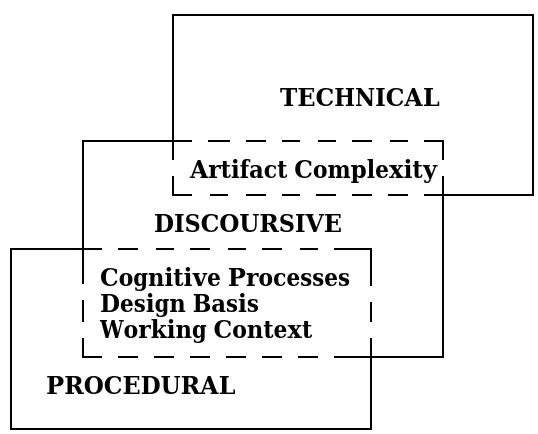
Abstract: Development of documents in multiple media involves activities in three different fields, the technical, the discoursive and the procedural. The major development problems of artifact complexity, cognitive processes, design basis and working context are located where these fields overlap. Pending the emergence of a unified approach to design, any method must allow for development at the three levels of discourse structure, media disposition and composition, and presentation. Related work concerned with generalised discourse structures, structured documents, production methods for existing multiple media artifacts, and hypertext design offer some partial forms of assistance at different levels. Desirable characteristics of a multimedia design method will include three phases of production, a variety of possible actions with media elements, an underlying discoursive structure, and explicit comparates for review.
Keywords: multimedia document, design method, discourse
1
Introduction
The accelerating pace at which new multimedia systems and software become available might
suggest that many problems in this field are now solved. Removal of technological constraints on
the use of multiple media in single artifacts or documents has indeed expanded their potential use
greatly, but not without generating a new set of questions and issues. Such areas of uncertainty
centre around the problems of how best to develop new multiple media artifacts in a multimedia
computer environment. Multiplication of the number of media brings with it novel characteristics
as well as a new technical scale. An understanding of these characteristics will be an essential
constituent of good design methods for these new means of preparing and communicating
information. This paper will draw boundaries around the overlapping fields of activity involved,
outline the major development problems, suggest a model for development activities, describe
existing partial solutions and related work, and offer some conclusions about what characteristics
2
Fields of Activity
A variety of specific problems and general issues condition any type of methodical development of
computer based documents incorporating multiple media. Such problems and issues are
ill-defined and straddle the boundaries of three different fields of activity, the technical, the
discoursive and the procedural; these fields already exist in their own right and offer a variety of
insights. We now delineate these fields and set problem definition in a suitable context.
The technical field is the field of the machine. It incorporates the translation of individual media
from analogue to digital form, their creation and manipulation in digital form, their subsequent
storage, retrieval and eventual display, and the capabilities required for their transmission
elsewhere. This field also encompasses the integration of separate media with each other and the
mechanics of manipulation and interaction with any user. The development of hardware and
software platforms for multimedia systems forms much of the activity. Such work is only a
subsidiary concern of our work because our principal intent is to provide practical guidance to
augment existing design techniques within the software engineering discipline.
In the discoursive field the activities of the human communicator as message generator or
receiver are paramount. The nature of the document as a communicative object, as something that
is a vehicle for human thought, is the concern of this field. The definition of discourse may be
traditional, by the OED a treatment of a subject in which it is handled or discussed at length. From
such a pragmatic definition flows the segregation of discourse, by convention and long practice,
into a number of modes: narrative, description, argumentation, exposition and other, always less
used, forms such as lyric poetry (Chatman, 1990). This categorisation in effect provides an
abstract division according to general purpose. Production of a discourse in the modes of
argument or exposition will involve the use of language, whether in verbal or other forms, so as to
persuade or influence others. Hence both these modes employ the techniques of suasion that
properly constitute rhetoric. The definition of discourse may alternatively be in a more abstract
form based on studies derived from linguistics and its semiological extensions. Discourse
becomes any valid sequence of statements in their context and discourse analysis becomes a
method for analysing the structure of texts or utterances longer than a sentence, taking into
account both their linguistic content and their sociolinguistic context (Polanyi, 1987).
In the procedural field the human designer is the principal participant. Its concern is the design
activity itself, its constituent parts, their order of production and the context within which the
activity takes place. This field impinges closely on the discoursive field because it incorporates
theoretical and practical analyses of the manner in which all forms of discourse are
comprehended and produced. Related material also comes from the field of software engineering,
TECHNICAL
Artifact Complexity
DISCOURSIVE
PROCEDURAL
Cognitive Processes
Design Basis
Working Context
Figure 1 Overlapping fields of activity and the associated development problems
3
Major Development Problems
W e will now consider the major problems of multiple media document development, located where
the fields of activity overlap (Figure 1). The complexity of the final artifact constitutes a group of
problems combining technical and discoursive issues: diversity of media, differentiation between
temporal and spatial media, links within and between media, levels of interactivity, and
technical handling. The overlap between the discoursive and procedural fields is the general
location of the other three major problems: understanding of the comprehension and production
processes, the choice between strategy or structure as the basis for design, and the working context.
3.1 Artifact complexity
The overlap between the technical and discoursive fields is the general location of the first major
development problem, which is the potential complexity of the final artifact. The potential
complexity of the final artifact has been apparent for a long period in those works which, although
not computer based, incorporated multiple media in a single object.
3.1.1 Diversity of media
All the traditional media persist in the computer environment, with some additions. In
combination these media, the intermediate agencies between creator and user and between
In the technical arena the media consist of:
text - all forms of written language;
graphics - vector based or bilevel representation of any image of a type otherwise drawn
with a pen or a similar instrument;
image - any multilevel or bitmap based image; sound - all audio signals;
video - linear sequences of graphics or images that provide the illusion of motion when
displayed in rapid succession (usually in excess of twenty five images per second);
numeric data - all forms including mathematical symbols; database entities and attributes (in general sense); and
hypertext and hypermedia - a problematic media type consisting of linked elements of
other types.
In the arena of discourse, and particularly where linguistic analysis has been applied,
conglomerations of heterogeneous codes displace media. The categorisation of media now
becomes one of :
text - written ‘natural’ language in any form;
graphics - a two dimensional representation of information using signs from a
monosemic system whose meanings are specified or are known beforehand, or from a
notation in the strict sense (Goodman, 1969);
image - a visual representation whose interpretation involves polysemic elements whose
meanings are deduced from the collection in which they appear (Bertin, 1983),
alternatively one that indicates nothing other than itself as its own ‘pseudo-presence’
(Metz, 1974);
video or moving pictures - sequences of graphics or images in animated form as defined
technically;
speech - spoken natural language;
sound - the remainder of any sound track including music and real noises proper to their
sources; and
other sign systems - numbers and mathematical symbols, computer languages and
database entities.
It is essential to distinguish between separate systems of signs used for communication. From the
practical point of view such discrimination should allow the document producer to avoid the use of
3.1.2 Differentiation between temporal and spatial media
The need to differentiate between temporal and spatial media adds a further dimension to the
complexity of the final artifact. Text and image exemplify two important classes distinguished by
their perceptual characteristics. Text controls temporally its reception by its audience; it is clear to
the reader where to start and to stop (Chatman, 1990). This temporal characteristic carries with it a
necessary linear structuring. Language is used linearly because each word or cluster of words
stands for an intellectual concept and such concepts can only be combined in succession
(Arnheim, 1970). Images on the other hand do not regulate the temporal flow or spatial direction of
audience perception; they present themselves simultaneously in their entirety. The general
distinction between the visual arts as essentially spatial and the verbal arts as temporal goes back
to the late eighteenth century (Lessing, 1984). However, while single images and graphics may in
practice be presented in their entirety and be considered theoretically as an aesthetic totality, it is
not altogether certain that the reading of text and the scanning of pictures differ radically in
perceptual terms (Kolers, 1977).
Notwithstanding such caveats, the dichotomies of the temporal and the spatial and of the linear
and the non-linear remain; they will exert a powerful complicating influence on multimedia
documents and they will constitute an essential consideration in their design and structure.
3.1.3 Links within and between media
Complexity involves not only the combination of many and different elements, but also their
connection in a manner that is not easily disentangled or analysed. Problems of juxtaposition
and interrelation of different media have existed for as long as technical production methods have
allowed the incorporation of more than one medium in a single document; the oldest examples are
illustrated books. Such problems are merely compounded in computer based documents which
m a y, if required, call upon the full range of available technical media. This important
quantitative difference is accompanied by an essential qualitative difference brought about by the
ability to link media elements of the same or different kinds. The first exploitations of this
linking ability form the existing body of hypertexts. A variety of link types exist in various
hypertext implementations. The detailed nature of hypertext links is not immediately relevant in
this context; most recent ideas are unified in the ‘link component’ concept of the Dexter Hypertext
Reference Model (Halasz & Schwartz, 1990; Grønbaek, 1992).
3.1.4 A continuum of interactivity
The availability of links connecting parts of a multimedia document opens the way for new
relationships between the document and its user. A continuum of potential accessibility to the user
a multimedia document with ‘closed access’, where the user is a passive receiver and cannot
interact in any way other than to interrupt attention or withdraw it. Such documents already exist
in the form of commercial video presentations. At the other extreme is a hypermedia document
with ‘open access’ allowing a completely free passage within and between all media elements.
Such documents are unlikely to be constructed, except in the form of descriptive multimedia
databases, because of the ‘navigation’ and ‘cognitive overload’ problems already identified with
hypertexts (Conklin, 1987). Between these two extremes are the degrees of ‘restricted access’
implied in the number of alternative paths that are available between the nodes containing text or
any other type of media element.
3.1.5 Technical handling problems
Outstanding technical problems still inhibit any systematic document development. Source
material exists in a variety of non-digital forms; the required amounts of digital data strain
current storage and compression technologies; partial methods of media integration are offered
in different commercial products and experimental systems. These problems add further
constraints to the task rather than form part of its essential definition and there is a body of
relevant literature (Davies & Nicol, 1991; Williams et al., 1991).
3.2 Discourse comprehension and production processes
The second major problem area related to document development is the general understanding of
the comprehension and production processes involved. Ideally there should be a firm foundation
for any design method constructed from an understanding of the cognitive processes involved in
the production and comprehension of each discoursive medium. Some components of such an
understanding already exist, although few are directly applicable and most work concentrates on
the single medium of text.
In one general model (Flowers & Hayes, 1980) the long term memory of the writer, the task
environment and the writing process itself are interconnected sub-domains of the overall task.
Such a model supports a variety of general strategies, although none is implicit in the model itself.
A more recent model provides a closer relationship between its own structure and possible
production strategies (Sharples & Pemberton, 1988; 1990); it combines ‘representational items’
with ‘representational structures’ in a matrix form. Transitions from cell to cell in different
sequences suggest alternative writing strategies.
This relationship between model and production strategy, although associated in this work with a
confined segment of media, indicates an important general element of any overall document
3.3 Strategy or structure as design basis
The third main development problem concerns the nature of the design philosophy that will
underlie any method. The first alternative is a descriptive approach based on some form of static
structure; the second is an approach which is more dynamic and process orientated and which
employs in some way strategies for action on the part of the producer or on the part of the person
attempting comprehension. The first approach is well developed in software engineering as well
as in the fields of linguistics and psychology; the second exists only within discourse analysis.
In the descriptive approach the structure of the end-product acts as a guide for the relationship
between the parts of the method. A layered model may define the product structure; the associated
method comprises a set of stages arranged in a sequence corresponding, at least in part, to the
ordering of the layers. Models of language and the use of language, both in linguistics and
psychology, account for linguistic objects in terms of the ‘levels’ of morphonology, syntax,
semantics and the pragmatics of composition. Comprehension is understood to take place in
stages corresponding to these levels. Such layers or levels of abstraction do not necessarily dictate
an order of generation, but do fix a relationship that precludes simultaneous instantiation of
elements at different levels. In software engineering parallels with the linguistic models are
clearest where similar terminology is used in ‘linguistic’ models, as in the Command Language
Grammar (CLG) representation for user interfaces in interactive systems (Moran, 1981). CLG
addresses the problem that systems may be designed without a conceptual model in mind, but
assumes explicitly that the model of the designer and the model of the user are essentially
identical.
Only in part of the field of discourse analysis has there been any attempt to combine an
understanding of both the comprehension and production of discourse, even if the bias is heavily
on the former (van Dijk & Kintsch, 1983). An approach called ‘strategical’ because of its more
dynamic and process orientated characteristics replaces the earlier predominantly ‘structural’
approach. Strategies are concerned with the establishment of local and global coherence in a
‘textbase’, the semantic representation of the input discourse. Emphasis is upon the continual
feedback between less and more complex units composed of the semantic ‘propositions’ which
define the textbase, and upon the non-sequential growth of these units. A set of ‘propositional
strategies’ enables the construction of propositions themselves; ‘local coherence strategies’
establish meaningful connections between successive sentences in the discourse, and
‘macrostrategies’ provide ‘macropropositions’. Such macropropositions may themselves be
connected to form a ‘macrostructure’ of the text, a theoretical account of its gist, theme or topic.
There are also ‘schematic strategies’ because many discourse types exhibit a schematic structure
based on convention, a ‘superstructure’ which organises global content.
comprehension, is the assumption that language users do not plausibly have two completely
different and independent systems of strategies for production and understanding. However the
production process cannot simply be a reversal of the process of comprehension because the initial
data and goals of the speaker or writer and of the listener are different and they remain different
through subsequent stages (ibid).
The nature of the multiple media document as a computer based artifact suggests that a descriptive
structural approach would provide a suitable basis for design. On the other hand, the nature of the
document as discourse and the lessons of discourse analysis would support the more process
orientated strategic approach.
3.4 The working context of development
The fourth major development problem is the lack of a clear overall working context for multiple
media document development. The number and variety of persons and skills involved in related
activities, particularly in parts of book publishing and the whole of film making, even if
drastically reduced in scale, suggest a complex situation. Such diversity is associated with
interwoven organisational and collaborative arrangements. The assumption must be that
individual authorship may not be the norm, especially for commercial products. The role of the
author may be held jointly by two or more collaborators, possibly with the different skills
associated with different media, and the work of the author or authors may be mediated within an
hierarchical organisational structure. Working relationships of a cooperative or collaborative
nature in writing, which assume a joint responsibility and division of tasks and labour, are
already the subject for study and a framework for research exists (Sharples et al., 1991). Work is
mediated if a person or persons comes between the principal producer and the final product in a
relationship in which the mediator may predetermine or amend its form or content. Mediated
working arrangements are as common as collaborations and may be more appropriate where
production activities require the deployment and direction of diverse skills.
The processes of review, revision and editing are essential and closely related parts of any
mediated activity. These processes are also an integral part of the individual act of writing and
the study of this act has identified important characteristics. The review process is akin to
revision in that both may be distinguished from text generation by the fact that they involve some
explicit process of comparison, generally between some segment of text and some representation of
knowledge, intention or assignment; the result is some attempt to change the text (Bartlett, 1982).
The comparate, that with which something is compared, is the essential prerequisite for any form
of review or editing. It has an important role in a whole range of editing process, including
traditional publishing (Butcher, 1975; Chicago, 1982) and film production (Reisz & Millar, 1968),
and a variety of software engineering techniques including ‘document inspection’ (Fagan,1986)
The conclusion is that, whether as a collaborative or mediated activity, multimedia design will
incorporate implicitly, but preferably explicitly, comparates that will facilitate review, revision
and editing. This will provide an essential element of a satisfactory working context. Other
issues, such as the combination of different skills required by different media, remain open.
4
Development at three levels
As an initial step towards a comprehensive solution to the problems of multimedia document
development, we propose a model of development activities with three layers or levels.
Presentation
Discourse Structure
Media Disposition / Composition
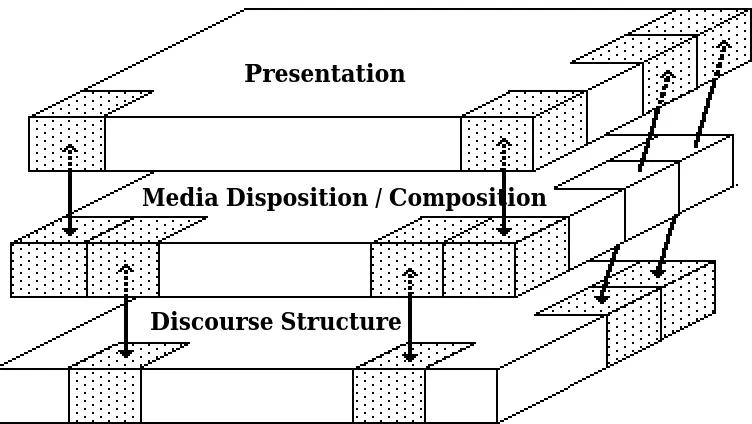
Figure 2 Three levels for multimedia document development
Pending the emergence of any such unified approach to design, any method must allow
development to take place on at least three different levels. These are the levels of discourse
structure, media disposition and composition, and presentation. Each may have its own design
rules and its own representations. There may also be intermediate representations. Work may
progress sequentially, simultaneously (as illustrated in Figure 2) or in some set of temporal
combinations according to the method proposed. The overall objective is to make as explicit as
possible, to the producer and to collaborators or mediators, the transformation of the abstract
4.1 Level of discourse structure
The level of discourse structure is the most abstract. It will contain three general types of
discourse: description, argument and narrative. The other modes mentioned earlier are of less
importance in this context. Description renders explicitly the essential properties of an object for
their own sake. Implicit description may take place within any other type of discourse as a
subsidiary activity, for example in moving pictures where the primary focus of attention may
frequently be elsewhere (Chatman, 1990). This is one example of the ability of media to perform
two or more representational functions at one time.
For the purpose of discourse, argument is defined as any process of reasoning intended to establish
or subvert a position. Although this would encompass formal types of argument based on
mathematics and formal logic, the emphasis here will be on the informal types commonly used in
general intercourse (Perelman & Olbrechts-Tyteca, 1968). Argument and exposition have an
indistinct boundary; the latter subsumes the former. Argument presupposes a difference of
opinion, while exposition merely requires an absence or confusion of opinion, whose clarification
implies an argument in favour of its own preferability (Chatman, 1990).
Narrative is a sequence of events characterised by plot, character and setting. It is unique among
discourse types in having a ‘doubly temporal logic’ (ibid) entailing both an ‘external’ movement
through time, the duration of presentation, and also an ‘internal’ progression, the duration of the
sequence of events that constitutes the plot. Chatman also emphasises the importance of double
functions not only of media but also of discourse types, which may form an underlying structure or
an overriding surface representation, for example the surface narrative form of fables or of
television commercials which present arguments in clear stages.
4.2 Level of media disposition and composition
At this level the choice, disposition and composition of individual media elements take place.
Choice concerns the selection of the medium to be employed as the vehicle for each element of the
discourse structure at each stage of its development. This must recognise the close existing
relationship between certain media and standard discourse types, born out of the dominant
historical position of text and the more recent cultural influence of moving pictures. It also
involves the issue of whether there is to be a dominant media type for the principal discourse
elements, with subsidiary media for any subordinate parts. This is the basic issue of disposition.
Media disposition at this level implies the formalisation of any hypertextual links at this same
level, rather than in the discoursive level. It has yet to be demonstrated that hypertext (and by
extension hypermedia) is the priviledged medium of any particular mode of discourse, or that it is
discourse, albeit of a kind with new technological demands and offering new opportunities for
expression different from those of existing media. The capacity to provide a chosen degree of
‘restricted’ or ‘open’ access may alter discourse in unpredictable ways; in the interim there is a
certain need to provide design asistance that will allow the integration of this capacity into
existing modes of discourse.
The composition of individual elements takes place at this level, at least in the sense of the
creation of their full content. Analyses originating in linguistics would reject any such
distinction between form and content on the grounds that the latter must itself have some form of
its own. The practical value of the distinction lies in the possible avoidance of fixing prematurely
the final representation and in the provision of the essential comparates for any review.
4.3 Level of presentation
The level of presentation involves both the design of the appearance of the final artifact and its
representation as a computer based object. The design has spatial and semantic aspects. The
former involves the elements as displayed individually; the latter incorporates their appearance
when involved in the possible combinations allowed by media disposition, plus the representation
of the means of ‘navigation’ or access. The structure of the computer based object, its presentation
to the machine, relates both to internal technical factors and to the structure required for
transmission to other machines and reproduction by them.
5
Partial solutions and related work
At each of the suggested levels of activity some assistance is already available, from generalised
discourse structures at the first level, from production methods for existing multiple media
artifacts and from design methods for hypertext and hypermedia at the middle level, and from
‘structured documents’ at the third level. The following sections outline the contributions and
their possible value.
5.1 Composition with generalised discourse structures
The techniques of classical rhetoric are important in the context of discourse structure because they
offer both a comprehensive, staged method and a developed conception of internal structure. Their
primary objective is to exert an effect on an audience; as such they can support both argumentative
and expository purposes (Corbett, 1990). They thus encompass an important, but incomplete, set of
discoursive modes. In the classical method the initial need to find arguments to support the
assigned case or point of view motivates the first of five main stages, ‘discovery’ ( inventio). The
‘disposition’ ( dispositio). Its standard six parts provide an ordered internal structure. The third,
fourth and fifth stages are style (elocutio) which is concerned with the choice of words, their
composition in phrases and clauses and the use of figures of speech, memorisation (memoria) and
delivery ( pronuntiatio). The general practical value of classical rhetoric as a means of
preparing, marshalling and presenting arguments endures, as does its example as a structured
method of great sophistication and pervasive influence. One contemporary use of three partial
stages in the context of hypertext forms part of the discussion below.
The claim that ‘superstructures’ may be part of a more general theory of discourse and semantic
practices (van Dijk, 1979) is not yet developed. The more limited development of this concept
beyond linguistics provides potentially useful frameworks for a variety of both general and
specialised discourse types. Graphical representations of knowledge structures already provide
the basis of systems such as gIBIS (Conklin & Begeman, 1988). There are also precedents in the
‘descriptive’ mode of software engineering where an exemplary structure for requirements
specification is an important objective for some authors (Heninger et al., 1978).
Long study of the narrative has provided schematic structures for stories such as that provided by
van Dijk (van Dijk, 1979). This incorporates five categories of elements: setting, complication,
resolution, evaluation, and coda or moral. Together they form an hierarchical structure definable
in terms of formation rules which specify the rank and ordering of the categories and which may
be recursive . The categories provide the functional slots for the content of the discourse, in this
formulation made up of the ‘macrostructures’ or ‘macropropositions’ referred to above. Pragmatic
structure for reasoning and argumentation (Toulmin, 1958; Perelman & Olbrechts-Tyteca 1968)
provide the basis for a similarly constructed arrangement of argument incorporating setting,
premises, facts, warrant, backing, and conclusion . The same approach is usable for more
specialised activities that are either highly conventionalised, as in the case of scholarly papers , or
very general as in the case of newspaper articles (van Dijk, 1979).
These varied conventional discoursive structures offer clear guidelines for document design, at
least in single media, which may be more generally applicable.
5.2 Production methods for existing multiple media artifacts
W ell developed design procedures already exist which employ staged representations in different
single media. Creation of multiple media documents in the form of film and animation has been
well established for some time, the design processes are well understood and the stages of
production follow clearly defined paths. The controlled transformation and amalgamation of
single media elements result in a single artifact integrating at least three media. Filmmakers
and animators operating in the dominant narrative mode of their field employ such methods; each
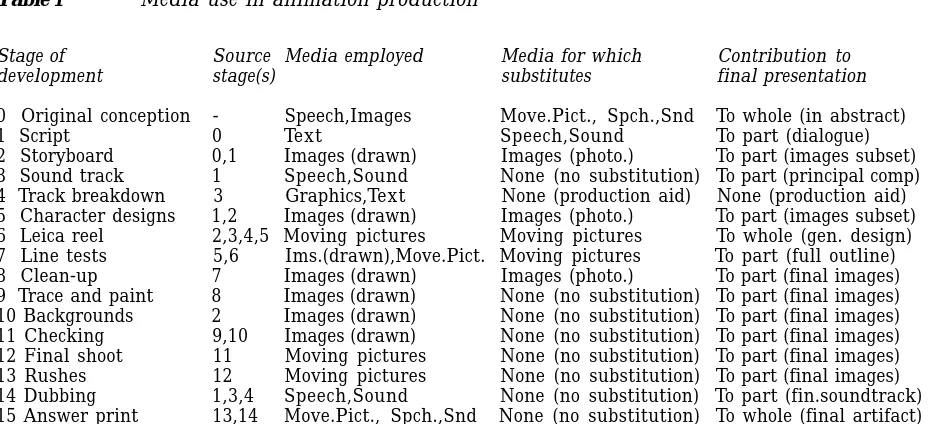
Tables 1 summarise the roles of individual media in the animation process.
Table 1 Media use in animation production
Stage of Source Media employed Media for which Contribution to development stage(s) substitutes final presentation
0 Original conception - Speech,Images Move.Pict., Spch.,Snd To whole (in abstract)
1 Script 0 Text Speech,Sound To part (dialogue)
2 Storyboard 0,1 Images (drawn) Images (photo.) To part (images subset) 3 Sound track 1 Speech,Sound None (no substitution) To part (principal comp) 4 Track breakdown 3 Graphics,Text None (production aid) None (production aid) 5 Character designs 1,2 Images (drawn) Images (photo.) To part (images subset) 6 Leica reel 2,3,4,5 Moving pictures Moving pictures To whole (gen. design) 7 Line tests 5,6 Ims.(drawn),Move.Pict. Moving pictures To part (full outline) 8 Clean-up 7 Images (drawn) Images (photo.) To part (final images) 9 Trace and paint 8 Images (drawn) None (no substitution) To part (final images) 10 Backgrounds 2 Images (drawn) None (no substitution) To part (final images) 11 Checking 9,10 Images (drawn) None (no substitution) To part (final images) 12 Final shoot 11 Moving pictures None (no substitution) To part (final images) 13 Rushes 12 Moving pictures None (no substitution) To part (final images) 14 Dubbing 1,3,4 Speech,Sound None (no substitution) To part (fin.soundtrack) 15 Answer print 13,14 Move.Pict., Spch.,Snd None (no substitution) To whole (final artifact)
Film and animation procedures present special cases whose methods are directly applicable to
‘closed access’ multiple media documents. More importantly they show the general importance of
media substitution, amalgamation and transformation as the means for moving from an
underlying discoursive structure to a final presentational form.
5.3 Hypertext and hypermedia design methods
There is a sharp contrast between the pragmatic basis of methods established for film production
and the theoretical origins of the few methods proposed for hypertext and hypermedia. Currently
these are the only alternatives available that might suggest possible design frameworks for
multiple media documents. Design at a conceptual level in a system independent manner is one
important theme of this work. The description of the ‘global’ properties of an application, such as
its representational structures, navigational patterns, operational semantics, overall
visualisation and display aspects, precedes the ‘local’ creation of individual nodes and their
content (Garzotto et al., 1991). This distinction is generalised in the concept of
‘authoring-in-the-large’ and ‘authoring-in-the-small’. This concept provides the basis for an iterative model of
hypertext authoring, a seven stage process, advocated in the HYTEA project (Schiff, 1992). The
aim of this project is to support the system of choice of the developer rather than to provide a system
of its own, the assumption that ‘authoring-in-the-large’ can be considered and supported somewhat
independently of ‘authoring-in-the-small’. A similar assumption underlies an alternative nine
stage method (Morris & Finkelstein, 1992). This delays authoring of application content until its
final stage; it also requires creation of global models of both the subject domain and, in a
Both these approaches have their origins in software engineering and echo its terminology
(DeKremer & Kron, 1976). An alternative approach takes as its starting point the ideas of local
and global coherence from discourse analysis combined with a tripartite structure from classical
rhetoric (Thüring et al., 1991). The three parts are ‘content’, ‘structure’ and ‘organisation’
corresponding to ‘invention’, ‘disposition’ and ‘presentation’ (apparently a kind of amalgamation
of ‘style’ and ‘delivery’). This approach is the foundation for SEPIA, a ‘co-operative hypermedia
authoring environment’ (Streitz et al., 1992).
Hypertext and hypermedia studies appear to be edging towards design methods that have a
diversified rather than monolithic structure, but at present do not offer any comprehensive help.
5.4 Presentation via ‘structured documents’
The problems of defining the presentational qualities of the highest level of textual entities, the
‘pragmatics’ of the layered linguistic model, have received considerable attention because of the
increased importance of document portability. This work is a major part of what might be termed
the ‘artifact driven’ approach to document development which began with word processing
applications. The fundamental concept is ‘mark-up’ (Coombs et al., 1987). Originally used only
for editing typesetting instructions, it is now employed in a general sense, often in the context of
‘structured documents’ (André et al., 1989), to refer to any data added to a document to convey
information about it in a machine environment.
Products of the artifact orientated ‘structured document’ approach, such as SGML (Goldfarb, 1990)
and by extension Hytime (Newcomb et al., 1991), will increase portability and improve
presentational capabilities and thus complement, rather than displace, any design solutions.
6
Conclusions
This section summarises the principal points already made and suggests some desirable
characteristics of any design method for multimedia documents.
❇ The development of computer based multiple media documents requires a new framework
of ideas that will support the merger of concepts from hitherto discrete fields of activity and study.
The nature of the document as a communicative object, as a vehicle for human thought, places it
within the field of discourse. Any number of diverse media types and elements may act as a
carrier for an instance of discourse. The computer environment opens the prospect of maximum
❇ Understanding of the cognitive processes involved in the comprehension and production of
discourse would provide important guidance for any design method, but such knowledge is only
partial even for single media. The working context for document development is clearer because
of experience with existing multiple media enterprises, such as film making, which require the
deployment and direction of diverse skills and are essentially mediated activities. The
boundaries of development procedure and discourse also cross in all these activities.
❇ The nature of the document as a computer based artifact suggests that a descriptive
structural approach would provide a suitable basis for design. On the other hand, the nature of the
document as discourse and the lessons of discourse analysis would support a more process
orientated strategic approach. The procedures used in existing practical methods for multiple
media production suggest a version of the latter in which structure still has an important, but not
dominant role.
❇ Pending the emergence of a unified approach to design, any method must allow for
development to take place on at least three different levels: discourse structure, media disposition
and composition, and presentation. The discourse level provides the opportunity for clear
structural definition; the media disposition and composition level will facilitate the maximum
use of the multiple media available; the presentational level safeguards the necessity for usability
and portability. The overall objective is to make as explicit as possible, to the producer and to
collaborators or mediators, the transformation of a representation of the abstract communicative
object into the communicative artifact realised before the user.
❇ Existing techniques and studies offer different types of assistance at each level. Classical
rhetoric and modern discoursive ‘superstructures’ may give direct guidance at the discourse level.
At the presentation level ‘structured documents’ and ‘mark-up’ languages will act only as
complements to any design method. At the level of media disposition and composition film and
animation processes may provide immediate parallels. Hypertext methods do not yet appear
sufficiently developed.
It is possible to identify some desirable characteristics of a method for developing multimedia
documents.
❇ Existing multiple media methods for film and animation suggest a pragmatic distinction
between three general phases of ‘pre-production’, ‘production’ and ‘post-production’. Although
there may be a general correspondence with the three levels of activity identified, elements at any
level may be fixed during any phase. This acknowledges the importance of the process orientated
approach to comprehension and production, as yet insufficiently developed to provide the basis for
❇ The method needs to provide for a number of possible actions with media elements. A
version of one element may precis or paraphrase another of the same type. In a complementary
fashion another element may provide an amplified version. One media type may substitute for
another and stand as a preliminary or alternative representation of the same material. Explicit
transformation from one type to another is also required. Amalgamation of elements of the same
or different types will provide the necessary composite whole. Taken in the order of precis,
paraphrase, substitute, transform, amplify and amalgamate these actions might act as the
framework for a variety of ‘top down’ design.
❇ Explicit identification of media substitutes and transformations should facilitate the
provision of explicit comparates essential to the mediated environment that is likely to provide the
working context.
❇ Unless the overall objective in particular circumstances is the generation of an
experimental form of discourse in hypertext or hypermedia, the method should provide for a
particular discourse mode to form the underlying structure. This mode may have a different
mode as an overlying or subsidiary structure. It may also employ conventional ‘superstructures’
as guides. Conventional media associated with common discourse types are likely to dominate at
the ‘closed’ extreme of the interactivity spectrum and hypermedia, in single or multiple
dimensions, towards the ‘open’ extreme.
References
André, J., Furuta, R., & Quint, V. (Eds) Structured Documents, Cambridge: CUP, 1989.
Arnheim, R. Visual thinking. London : Faber, 1970.
Bartlett, E.J. Learning to revise: Some component processes. In M. Nystrand (Ed.), What
writers know, the language, process and structure of written discourse. New York: Academic
Press, 1982.
Bertin, J. Semiology of graphics; translated by W.J.Berg. Madison, Wis.: University of Wisconsin Press, 1983.
Bloedow, J. Filmmaking foundations. Boston: Focal Press, 1991.
Butcher, J. Copyediting : the Cambridge handbook. Cambridge: CUP, 1975.
Chatman, S.B. Coming to terms : the rhetoric of narrative in fiction and film. Ithaca, N.Y. : Cornell University Press, 1990.
Chicago Manual of Style, 13th Ed. Chicago: University of Chicago Press, 1982.
Conklin, C. & Begeman, M.L. gIBIS : A hypertext tool for exploratory policy discussion. ACM
Transactions on Office Information Systems, Vol 6 No 4, pp303-331, October 1988.
Coombs, J.H., Renear, A.H., & DeRose, S.J. Markup systems and the future of scholarly text processing. Communications of ACM, Vol 30 No 11, pp933-947, November 1987.
Corbett, E.P.J. Classical rhetoric for the modern student, 3rd ed. New York: Oxford University Press, 1990.
Davies, N.A. & Nicol, J.R. A technological perspective on multimedia computing. Computer
Communications, Vol 14 No 5, June 1991.
DeRemer, F. & Kron, H.H. Programming in the large versus programing in the small, IEEE
Transactions on Software Engineering Vol SE-2 No 2, 1976.
van Dijk, T.A. Macrostructures : an interdisciplinary study of global structures in discourse, interaction, and cognition. Hillsdale, N.J.: Erlbaum, 1979.
van Dijk, T.A., & Kintsch, W. Strategies of discourse comprehension. New York: Academic Press, 1983.
Fagan, M.E. Advances in software specifications. IEEE Transactions on Software Engineering, Vol SE12 No 7, p744, July 1986.
Flower, L.S. & Hayes, J.R. The dynamics of composing: making plans and juggling constraints. In L.W. Gregg & E.R. Steinberg, Cognitive processes in writing: an interdisciplinary approach. Hillsdale, NJ: Erlbawm, 1980
Garzotto, F., Paolini, P., & Schwabe, D. Authoring-in-the-large: Software engineering techniques for hypertext application design. In Proceedings of Sixth International Workshop on
Software Specification and Design, p193, October 1991.
Goldfarb, C.F. The SGML Handbook, Oxford: Clarendon Press, 1990.
Goodman, N. Languages of art: An approach to a theory of symbols. 2nd ed. Indianapolis,Ind.: Hackett, 1976.
Grønbaek, K. & Trigg, R.H. Design issues for a Dexter-based hypermedia system. In ECHT ‘92,
Proceedings of Fourth ACM Conference on Hypertext, Milan, December 1992. New York: ACM
Press, 1992.
Halasz, F.G. & Schwartz, D. The Dexter Hypertext Reference Model. In Proceeedings of NIST
Hypertext Workshop, Gaithersburg, MD, January 1990
Heninger, K.L., Kallender, J.W., Parnas, D.L. & Shore, J.E. NRL Memorandum Report 3876, Software Requirements for the A-7E Aircraft. Washington, DC: Naval Research Laboratory, November 1978.
Kolers, P. Reading Pictures and Reading Text. In D. Perkins & B. Leondar (Eds.), The arts and
cognition. Baltimore: Johns Hopkins University Press, 1977.
Metz, C. Film language : a semiotics of the cinema; translated by M. Taylor. New York: Oxford University Press, 1974.
Moran, T. P. The Command Language Grammar: a representation for the user interface of interactive computer systems. International Journal of Man-Machine Studies, Vol 15, pp3-50, 1981.
Morris, S.J. & Finkelstein, A.C.W. An experimental hypertext design method and applications in the field of art history. Computers and the History of Art, Vol 2 Part 2 pp 45-63, 1992.
Newcomb, S.R., Kipp, N.A. & Newcomb, V. T. “Hytime” The hypermedia/time-based document structure language. Communications of the ACM., Vol 34 no 11, pp67-83, November 1991.
Perelman, C., & Olbrechts - Tyteca, L. The new rhetoric: A treatise on argumentation; translated by J. Wilkinson & P. Weaver. Notre Dame: University of Notre Dame Press, 1968.
Polanyi, L. (Ed.) Discourse structure. Norwood, NJ: Ablex, 1987.
Reisz, K., & Millar, G. The technique of film editing. 2nd ed. Sevenoaks, Kent: Focal Press, 1968.
Schiff, J. (Ed.) Esprit Project 5252, HYTEA - Hypertext Authoring, Public report, Munich: Siemens-Nixdorf Informationssyteme AG (NSI), November 1992.
Sharples, M., Goodlet, J., Beck, E., Wood, C., Easterbrook, S., Plowman, L., & Evans, W. A framework for the study of computer supported collaborative writing. Cognitive Science Research Report CSRP 190, University of Sussex, 1991.
Sharples, M & Pemberton, L. Representing writing: An account of the writing process with regard to the writer ’s external representations. Cognitive Science Research Report CSRP 119, University of Sussex, 1988.
Sharples, M & Pemberton, L. Starting from the writer: Guidelines for the design of user-centred document procesors. Cognitive Science Research Report CSRP 154, University of Sussex, 1990.
Silverman, B.G. Survey of expert critiquing systems: Practical and theoretical frontiers.
Communications of ACM, Vol 35 No 4, pp106-127, April 1992.
Streitz, N., Haake, J., Hanneman, J., Lemke, A., Schider, W., Schütt, H. & Thüring, M. SEPIA: A cooperative hypermedia authoring environment. In ECHT ‘92, Proceedings of Fourth ACM
Conference on Hypertext, Milan, December 1992. New York: ACM Press, 1992.
Thüring M., Haake, J.M. & Hanneman, J. What’s Eliza doing in the Chinese room ? Incoherent hyperdocuments -- and how to avoid them. In Hypertext '91, Proceedings of Third ACM
Conference on Hypertext, , San Antonio, Texas, December, 1991. New York: ACM Press, 1991.
Toulmin, S. The uses of argument. Cambridge: Cambridge University Press, 1958.
White, T. The animators workbook. New York: Watson-Guptill, 1986.