1
Multimodal Ligand Binding Studies of Human and Mouse G-coupled Taste
Receptors to Correlate with their Species-Specific Sweetness Properties
Fariba M. Assadi-Porter1,2,3*,#, James Radek1,#, Hongyu Rao1, Marco Tonelli1,2
1Department of Biochemistry, 2National Magnetic Resonance Facility at Madison, 3Department
of Integrative Biology, University of Wisconsin – Madison, Madison, Wisconsin, 53706
Key words: Sweet taste receptor, ligand binding, G-coupled protein receptors (GPCRs),
saturation transfer difference (STD), nuclear magnetic resonance spectroscopy (NMR),
differential scanning calorimetry (DSC), circular dichorism (CD) spectroscopy
# Contributed equally
*Corresponding author:
Fariba M. Assadi-Porter
E-mail: [email protected]
2
Abstract
Taste signaling is a complex process that is linked to obesity and its associated metabolic
syndromes. The sweet taste is mediated through a heterodimeric G protein coupled receptor
(GPRC) in a species-specific manner and at multi-tissue specific levels. The sweet receptor
recognizes a large number of ligands with structural and functional diversities to modulate
different amplitudes of downstream signaling pathway(s). The human sweet-taste receptor has
been extremely difficult to study by biophysical methods due to inadequate methods for
producing large homogeneous quantities of the taste-receptor protein and a lack of reliable in
vitro assays to precisely measure productive ligand binding modes leading to activity upon their
interactions with the receptor protein. We report a multimodal high throughput assays to monitor
ligand binding, receptor stability and conformational changes to model the molecular interactions
between ligand-receptor. We applied saturation transfer difference nuclear magnetic resonance
spectroscopy (STD-NMR) complemented by differential scanning calorimetry (DSC), circular
dichroism (CD) spectroscopy, and intrinsic fluorescence spectroscopy (IF) to characterize
binding interactions. Our method using complementary NMR and biophysical analysis is
advantageous to study the mechanism of ligand binding and signaling processes in other GPCRs.
Keywords
Heterodimeric G protein coupled receptor . saturation transfer difference nuclear magnetic
resonance spectroscopy . differential scanning calorimetry . circular dichroism . intrinsic
3
INTRODUCTION
Human sweet taste receptor is a heterodimeric complex of the proteins hT1R2 and
hT1R3. The complex is a member of the G-protein-coupled receptor class (GPCR) which share a
common design of a seven transmembrane heptahelical domain with an extracellular N-terminus
and intracellular C-terminus as well as a signaling pathway controlled by heterotrimeric
G-proteins that stimulate the synthesis of intracellular second messengers such as cyclic AMP,
inositol phosphate and Ca2+ ions. It has been further grouped as a class C glutamate receptor, of
which there are 4 other families: Class A rhodopsin family, class B secretin family, class D
adhesion family and class E frizzles/smoothened family. The class C GPCR share a common
structure of a large amino-terminal domain (ATD) which serves as the principle ligand-binding
domain, followed by a short cysteine-rich region (CRR) tied the transmembrane domain (TMD)
and intercellular C-terminal domain [1],[2].
The sweet-taste receptor has been shown to bind a large ensemble of molecules such as
sugars, artificial sweeteners, sweet-tasting proteins and some D-amino acids that mediate the
sweet taste response (Fig 1A). Regions of the complex that bind specific ligands include the
ATD of hT1R2: non-caloric sweeteners aspartame, neotame, sucralose and monellin, a
sweet-tasting protein; the ATD of T1R3: cyclamate, neohesperidin dihydrochalcone and lactisole; and
the ATD and CRR of hT1R3: sweet-tasting proteins brazzein and neoculin [3-7]. Both proteins
have been shown to bind natural sugars glucose and sucrose with distinct affinities even though
the individual contributions of each protein to the interaction are unknown.
One of the major difficulties in studying the molecular details of the function of this
4
using recombinant technology. The mouse versions of T1R2 ATD and T1R3 ATD have been
successfully produced, but only in small quantities and as fusion proteins [8]. Recently, human
(h)T1R3 ATD was purified and characterized [9]. Here we describe multi-modal screen
methodologies that are required for complex heterodimeric sweet taste receptor. First we will
describe, procedure for producing both highly purified proteins for human (h) or mouse (m)
fusion protein SUMO-T1R2 ATD and protease cut T1R2 ATD [10]. Gel filtration
chromatography demonstrated that the protein exists in a dimeric configuration. Second, we
describe several complementary methods for the study of the constructs and their interaction
with small ligands and their secondary conformational changes that have elicit a sweet-taste
response in human taste panel tests [11] and by the heterologous calcium assay in over
expressing HEK211 cells in culture [12]. We show by circular dichroism spectroscopy a
decrease in the overall α-helical content of the construct upon binding to ligands that have elicit
a sweet-taste response in human taste panel studies [11] and by the heterologous calcium assay
in culture [12]. In addition, there appears to be an overall decrease in thermal stability in the
tertiary structure of the SUMO-hT1R2 ATD fusion protein upon binding of neotame, a small
sweet-taste inducing molecule. Saturation transfer difference spectra confirmed that molecules
eliciting a CD response also gave positive difference spectra. Finally, we show that circular
dichroism spectroscopy and saturation transfer difference spectroscopy can be useful in studying
allosteric effects of one sweet-taste responding molecule over another, as described by the
heterologous calcium assay for sweet-taste response [12]. In this work, we demonstrate that we
can study the highly purified sweet-taste protein and it’s binding of target molecules using
5
RESULTS
We report here the results of experiments using multimodal biophysical techniques that probe the
interaction of human and mouse T1R2 ATD with small ligands that are known to elicit a
sweet-taste response. The production and purification of functional sweet-sweet-taste receptor proteins has
been a challenge due to its large size and number of cysteines that need to be oxidized in the
right form in order to be functionally correct.
Protein production and purification of ATDs. We report the successful construction and
conditions that allow for the study of functionally relevant proteins. The constructs used in this
study were from extracellular amino terminal domains (ATDs) of the receptor and contain ligand
binding sites (figure 1A). The ATD region of the protein was cloned into both a HIS tag vector
with a TEV cleavage site and a SUMO vector. The proteins were purified to near homogeneity
as described by the 12% SDS-PAGE profiles (figure 1B). The protein was in the form of a
homodimer from either construct as determined by molecular weight standards from gel filtration
column (figure 1C).
Figure 1.
6
B)
C)
160- 110- 80- 60- 50-
40-
30- 20-
15-
7
Figure 1. A) Model of sweet receptor and its proposed interaction sites with sweet ligands. B)
SDS-PAGE of the expression and purification of human and mouse proteins. Lanes shown are:
M. Novex Sharp Pertained Protein Standard (kDa); 1. –IPTG, total proteins; 2. +IPTG, total cell
proteins containing His-TEV-ATD-hT1R2 (~56 kDa); 3. Pellet: His-ATD-hT1R2; 4.
Supernatant: hT1R2; 5. Refolded hT1R2; 6. FPLC purified
hT1R2; 7. +IPTG, total proteins, His-TEV-ATD-mT1R2 (~63 kDa); 8. Pellet of
His-ATD-mT1R2+IPTG; 9. Supernatant of His-ATD-mT1R2; 10.Refolded His-ATD-mR2; 11. Purified
ATD-mT1R2, by FPLC; 12. -IPTG; 13. +IPTG, Sumo-TEV-ATD-hT1R2; 14. cut
His-Sumo-Tev-ATD-hR2 ( ATD-hT1R2, ~54 kDa and His-Sumo-Tev, ~12.5 kda); 15. FPLC
purified ATD-hT1R2. C) Tev protease cleaved ATD protein peaks off the Superdex 200 prep
grade FPLC column.
Ligand binding to the receptor T1R2 and T1R3 ATDs results in secondary structural
8
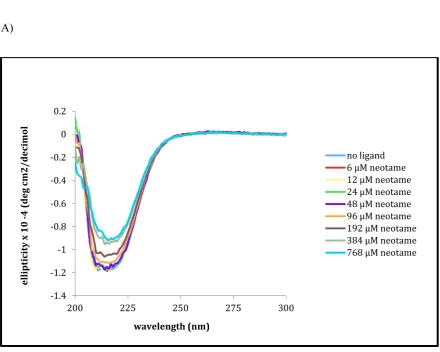
We used CD to monitor changes in the ATD secondary structure after addition of relevant
ligands concentrations to ATD. There was a small but measurable increase in the overall molar
ellipticity values upon addition of neotame (human specific binding ligand) resulting in a loss of
about 5% of α-helix on the protein. Neotame showed binding to the His-hT1R2 ATD by CD
(figure 2A). Changes in ellipticity at 209 and 219 nm with increasing concentrations of neotame
and titrations with different concentrations of neotame are shown in figure 2B. On the other
hand, non-sweet monosodium glutamate (MSG), produced no change in the CD profiles
especially at 209 and 219 nm values (figure 2C).
Figure 2. A) B) -1.4 -1.2 -1 -0.8 -0.6 -0.4 -0.2 0 0.2
200 225 250 275 300
9
C)
-1.2 -1.15 -1.1 -1.05 -1 -0.95 -0.9 -0.85 -0.8 -0.75 -0.7
0 500 1000
ell
ip
tic
ity
x
10
-4
(de
g
cm
2/d
ecimol
[ligand] μM
Change at 219 nm with ligand
209 nm
10
D)
-1.4 -1.2 -1 -0.8 -0.6 -0.4 -0.2 0 0.2
200 225 250 275 300
e
llipticity x
1
0
-4 (
deg c
m
2/d
e
cimo
l
wavelength (nm)
no ligand
6 μM MSG
12 μM MSG
24 μM MSG
48 μM MSG
96 μM MSG
192 μM MSG
384 μM MSG
11
Figure 2. Circular dichroism spectra of His tagged human and mouse T1R2 ATD ± ligands.
Panel A) human T1R2 ATD ± neotame, Panel B) changes in ellipticity at 209 and 219 nm with
increasing concentrations of neotame; panel C) human T1R2 ATD ± MSG; panel D) addition of
saturating concentrations of either neotame, sucralose or MSG to mouse T1R2 ATD.
Figure 2D demonstrates that when mouse His-T1R2 ATD was substituted for the human
counterpart, neotame at a concentration (500 μM) affected a no loss of ellipticity decrease
compared to the human protein (compare figure 2A and 2D). Sucrose also showed a small
decrease in ellipticity upon binding to the mouse protein as with the human protein. Whereas
MSG, the negative control, showed no change in ellipticity as was expected. A summary of
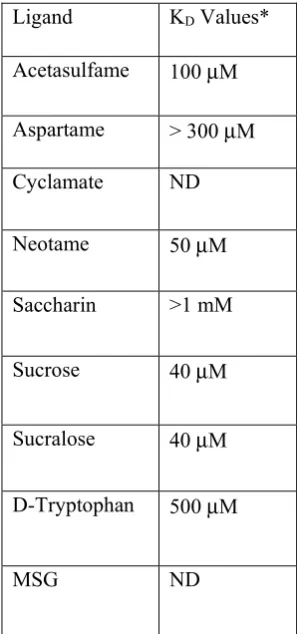
measured Kd values for other sweeteners are reported in Table 1.
-1.2 -1 -0.8 -0.6 -0.4 -0.2 0 0.2
200 225 250 275 300
e
llipticity
x
10
-4
(deg cm
2/d
e
ci
m
ol
wavelength (nm)
12
Table 1. KD values measured by CD.
Ligand KD Values*
Acetasulfame 100 μM
Aspartame > 300 μM
Cyclamate ND
Neotame 50 μM
Saccharin >1 mM
Sucrose 40 μM
Sucralose 40 μM
D-Tryptophan 500 μM
MSG ND
Intrinsic fluorescence measurements indicates ligand binding affects tryptophans in T1R2
and T1R3 ATDs. Intrinsic fluorescence measurements were also performed in order to exploit
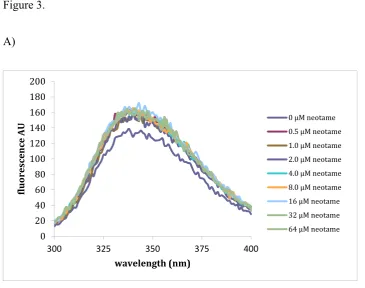
the changing environment around the tryptophans as a marker for ligand binding. In figure 3A,
neotame was added to the human HIS T1R2 ATD in increasing concentrations. Fluorescence
intensity was found increase upon addition of neotame with a maximal value occurring at 10
μM. Interestingly, adding sucralose produced the opposite effect of a decrease in fluorescence
intensity (figure 3B-D) and also tight binding (1/2 maximal value was less than 5 μM). MSG
produced no change in intrinsic fluorescence intensity over the same concentration range of the
13
in changing intrinsic fluorescence intensity, while sucralose, as with the human protein produced
a decrease in the fluorescence intensity with a half-maximal value of 10 μM. These results are in
accordance with the fact that neotame does elicits a sweet-taste response in the human, but not
the mouse.
Figure 3.
A)
B) 0 20 40 60 80 100 120 140 160 180 200
300 325 350 375 400
fl
u
or
es
cen
ce
A
U
wavelength (nm)
14 C) D) 0 50 100 150 200
300 325 350 375 400
flu o rescen ce A U wavelength (nm)
0 µM sucralose
0.5 µM sucralose
1.0 µM sucralose
2.0 µM sucralose
4.0 µM sucralose
8.0 µM sucralose
16 µM sucralose
32 µM sucralose
64 µM sucralose
0 50 100 150 200
300 325 350 375 400
fl
uoresence AU
wavelength (nm)
0 µM MSG
0.5 µM MSG
1 µM MSG
2 µM MSG
4 µM MSG
8 µM MSG
16 µM MSG
32 µM MSG
15
E)
F) 50 75 100 125 150 175 200
0 10 20 30 40 50 60 70
fl
u
orescence AU
[ligand] μM
neotame MSG sucralose
-100 0 100 200 300 400 500 600
300 325 350 375 400
fl
uorescence un
its
wavelength (nm)
16 F) G) H) 0 50 100 150 200 250 300 350 400 450 500
300 325 350 375 400
fl u or es cen ce in ten sity wavelength (nm)
0 µM neotame
0.5 µM neotame
1.0 µM neotame
2.0 µM neotame
4.0 µM neotame
8.0 µM neotame
16 µM neotame
32 µM neotame
64 µM neotame
0 100 200 300 400 500 600
300 325 350 375 400
fl
u
orensence in
tensity
wavelength (nm)
0 µM MSG
0.5 µM MSG
1.0 µM MSG
2.0 µM MSG
4.0 µM MSG
8.0 µM MSG
16 µM MSG
32 µM MSG
17
Figure 3. Intrinsic fluorescene emission spectra (excitation at 280 nm) of His tagged human and
mouse T1R2 ATD. Panel A) human T1R2 ATD ± neotame; B) human T1R2 ATD ± sucralose;
C) human T1R2 ATD ± MSG; D) changes in intrinsic fluorescence signal at 336 nm in the
presence of human T1R2 ATD and increasing concentrations of either neotame, sucralose or
MSG; panel E) mouse T1R2 ATD ± sucrose; F) mouse T1R2 ATD ± neotame; panel G: mouse
T1R2 ATD ± MSG; H) changes in intrinsic fluorescence signal at 336 nm in the presence of
mouse T1R2 ATD and increasing concentrations of either sucrose, neotame, or MSG.
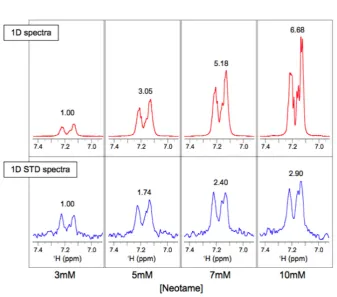
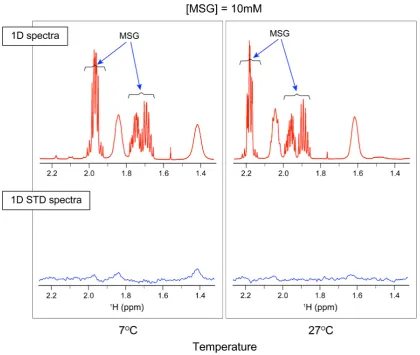
Monitoring direct ligand binding by saturation transfer difference spectroscopy (STD). We
used STD to monitor ligand protons binding to functionally relevant ligands to the human and
mouse T1R2 ATD (figure 4A). Neotame showed increasing signal in STD spectra, whereas,
MSG molecule produced no change in the STD profiles (no STD peaks) (figure 4B) similar to
CD results in figure 4A over the same range of concentrations. MSG was chosen as a negative
control as it is known to interact with only the umami receptor (T1R1) only. Changing
temperature from 7-37 oC did not affect binding of MSG to the receptor.
100 150 200 250 300 350 400 450 500 550 600
0 20 40 60 80
fl
u
orescence i
n
tensity
[ligand] μM
18
Figure 4
A)
19
Figure 4. Saturation transfer difference spectra of His tagged human T1R2 ATD. A) human
T1R2 ATD ± neotame at 270C; B) human T1R2 ATD ± MSG measured at 7 and 270C.
Monitoring the thermal stability of the tertiary structure of the human and mouse
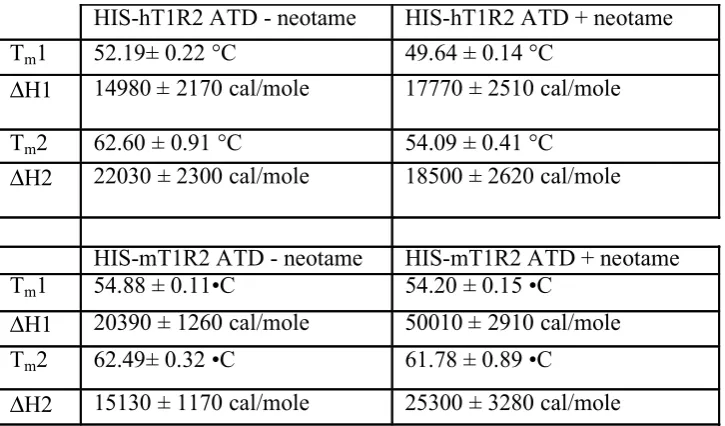
HIS-T1R2 ATD in the ligand-bound and unbound state. DSC was used to study the thermal
stability of the tertiary structure of the human and mouse His-T1R2 ATD in the ligand-bound
and unbound state. Table 2 shows summary of values determined from DSC for the thermo
profiles of apo and neotame bound form of human and mouse ATDs. Thermo profile for the
unbound protein best fit deconvoluted into two two-state transitions. Addition of the ligand
20
small loss of overall enthalpy (ΔH). These results suggest that the loss of α-helix upon binding
may be correlated to an overall thermal destabilization of the protein-ligand complex. In contrast,
when the mouse counterpart of the T1R2 ATD was used and interacted with neotame, only small
decreases in Tm were observed (< 1 °C for each transition), and the overall ΔH increased for the
protein in the presence of ligand (Table 2). These results demonstrate a useful method for
discerning the thermal stability of the species-specific T1R2 ATD protein in the presence and
absence of ligand.
Table 2. Summary of DSC measurements for the apo and neotame bound states of human and
mouse ATDs.
DISCUSSION AND CONCLUSIONS
In order to better understand the mechanism by which the sweet taste response is generated, we
have used a set of methodologies to describe binding events that appear to correlate to sweet HIS-hT1R2 ATD - neotame HIS-hT1R2 ATD + neotame
Tm1 52.19± 0.22 °C 49.64 ± 0.14 °C
ΔH1 14980 ± 2170 cal/mole 17770 ± 2510 cal/mole
Tm2 62.60 ± 0.91 °C 54.09 ± 0.41 °C
ΔH2 22030 ± 2300 cal/mole 18500 ± 2620 cal/mole
HIS-mT1R2 ATD - neotame HIS-mT1R2 ATD + neotame
Tm1 54.88 ± 0.11•C 54.20 ± 0.15 •C
ΔH1 20390 ± 1260 cal/mole 50010 ± 2910 cal/mole
Tm2 62.49± 0.32 •C 61.78 ± 0.89 •C
21
taste. Earlier work [8] described the ATD region of T1R3 as a soluble, folded and functional
protein. We extend the work now to include the equivalent portion of human T1R2 and
compared with mouse T1R2 which have species-specific binding properties. We have used the
recombinant protein that contains the ATD region of human T1R2 as a model system to target
small molecule ligands. It is important to note that the material we are working with appears as a
homodimer as monitored by gel filtration chromatography. This suggests that the ATD region of
human T1R2 is capable of dimerization with an identical partner that is in a form that resembles
its heterodimeric counterpart.
The CD and STD and DSC experiments, taken together, appear to provide a roadmap to binding
of the small molecules effectors of the sweet taste response. Small molecules (MSG) that do not
affect a positive response and regions of the protein (SUMO) thought not to be involved the
binding process proved to be negative controls when tested. These experiments provide both a
more local molecular and a more global picture of the ATD region of T1R2 and what transpires
in the initial event of the binding of a sweet taste response.
Recently, Dong and colleagues [13] have used fullerenol as a model for the sweet-taste receptor
to investigate the binding affinities of structural enantiomers of sweet-taste ligands. Their basic
findings demonstrated a correlation between sweet intensity and binding energy. Our
methodologies would be well suited to confirm these results using the actual protein-binding
interface. In addition, these results would give a more detailed description of the events that lead
to either a productive or destructive binding event.
In addition, others [12] have used taste receptor molecules to study the binding of various small
sweet molecules. That study utilized transiently transfected cells and cellular responses to sweet
22
information on the molecular actions that involve a sweet-taste response in the receptor itself.
Our model system for studying these interactions, in contrast, can lead to uncovering the seminal
details that occur in a productive sweet taste response.
We have described a system by which we can both produce to purity the ATD region of the
human and mouse T1R2 and quantify by a series of biophysical techniques the crucial events
leading to a successful sweet taste response. We suggest that these methods can be applied to a
wide range of expansions of the research. Just to name a few, we can use our expression and
purification system on the equivalent ATD regions of T1R3 and T1R1, and use site-directed
mutagenesis to elucidate important amino acids in these binding events. We can also study a
much wider range of sweet tasting ligands as well as those that are inhibitors as well as
enhancers of sweet taste response.
In conclusion, we describe a novel methodological system to purify and study biophysical the
interactions involved in the sweet taste response.
MATERIALS AND METHODS
Production and Purification of T1R2 ATD constructs from mouse and human.
The ATD region of the protein was cloned into a 8xHis tag vector with either a TEV cleavage
site or in a SUMO vector [10]. The human constructs ranged from residues Asn24−Met494 for
human (ATD-hT1R2) in the SUMO fusion, or Ser25-Thr489 in the 8xHis-Tag. The mouse
8xHis-Tev-ATD-mT1R2 construct ranged from residues Gly2−Pro466. DNA coding for the
amino terminal ligand binding domain of the sweet taste receptor from ATDs was expressed as
inclusion bodies in Escherichia coli BL21-CodonPlus(DE3)-RIPL cells grown at 37 °C in 1L of
LB medium. The purification procedure follows with modifications as previously described [9,
23
against a buffer containing 50 mM Tris.acetate(pH 8.0), 50 mM KCl, 2 mM Zw3-14 and 2 mM
DTT. The amino terminal domain (ATD) was purified to homogeneity on a Superdex 200 prep
grade FPLC column and analyzed by 12% SDS-PAGE. The protein concentration was
determined by the Bradford method using bovine serum albumin as the standard [14]. The yield
from the 1 liter of culture media was 5-10 mg of final protein.
Saturation Transfer Difference Spectroscopy (NMR-STD). The ligand binding activity of
ATD-T1R2 for all ligands was confirmed with a NMR-STD binding assay as previously
described [11, 15]. Aliquots of the pure labeled SUMO-T1R2 protein were incubated with
desired titrating ligands at 0.5-20 fold molar excess and concentrated to a final concentration of
~0.05 mM in 10 mM phosphate buffer (pH 7.4) containing 150 mM NaCl, 2.7 mM KCl, 5 mM
DTT, 5X protease inhibitor (Roche) and 0.05% NaN3. Mono sodium glutamate (MSG,
non-sweet molecule) was used as a negative control. STD NMR data collection and analysis was as
previously described [15].
Circular Dichroism Spectroscopy (CD)
CD spectra were recorded at 25 °C in an Aviv circular dichroism spectrometer Model 202SF
equipped with a Peltier temperature control. Samples were added to a 0.01 cm path length quartz
cuvette with a concentration of the ATD (from human and mouse) of about 0.3 mg/mL (4.5 mM)
in 10 mM Tris-HCl, 150 mM NaCl, 10% glycerol, pH 7.4. Increasing concentrations of ligands
(neotame and sucrose) were included with the protein (0-64 mM) for the binding studies and
MSG was used as a negative control. Data was collected every 1 nm with an averaging time of 5
seconds. The spectral bandwidth was 1 nm. Spectra were corrected for buffer and ligands
contributions and converted to mean ellipticity in deg cm2 dmol-1. The % α-helix was computed
24
Intrinsic Fluorescence Spectroscopy (Fl)
Samples were prepared in the same way as with the CD experiments. Experiments were
performed at 25 °C on Carey Eclipse instrument (Agilent, 5301 Stevens Creek Blvd, USA).
Spectra were substracted from the buffer ± ligand backgrounds before presentation. Curves at
340 nm were a best fit to the data by a regression/trend line.
Differential Scanning Calorimetry (DSC)
DSC was performed using a Microcal VP-DSC microcalorimeter. Samples of His-T1R2 ATD at
about 20 mM were dialyzed against 4 x 1 liter of 10 mM Tris-HCl, 150 mM NaCl, 10% glycerol,
pH 7.4 in the absence or presence of 0.2 mM ligand for 16 hours at 4° C prior to use. Buffer
without protein was hermetically sealed in the reference and sample compartments and repeated
thermograms were generated from 10-95 °C and at 1 °C/min. After confirming that the repeated
buffer/buffer thermoprofiles were identical, the protein sample was exchanged in the sample
compartment and scanned against the reference buffer. Data was analyzed using the Microcal
software package. The thermogram were background subtracted, normalized for concentration to
ΔCp (mcal deg-1) and baselines established on the pre- and post-transitional data. The Tm (°C)
and ΔH (kcal mol-1) were determined from the corrected curves using non-2-state transitional
curve fitting.
Conclusions.
We have described complementary experimental strategies for studying the conformational and
binding variations that occur in the ATD domain of T1R2 of the human and mouse sweet
receptor. This domain contains majority of the proposed binding pockets for small molecule
sweeteners that upon binding leads to the productive execution of downstream sweet taste
25
methods could provide important tools for mapping binding sites of natural and synthetic
sweeteners for this complex GPCR.
Acknowledgements
This work was supported grants from the U.S. National Institutes of Health to (NIH) grant R01
DC009018 (to F.M.AP) and the National Magnetic Resonance Facility at Madison, which is
supported by NIH grants from the National Center for Research Resources (5P41RR002301-27
and RR02301-26S1) and the National Institute for General Medical Sciences (8 P41
GM103399-27). The FL, CD and DSC were collected using instruments in the Biophysical core laboratory at
UW-Madison.
Authors Contributions
FAP designed experiments, STD data collection and analysis, and wrote manuscript. HR
prepared ATD constructs and protein purification, JR collected CD, DSC, and FI and wrote the
manuscript. MT helped with STD-NMR data collection. All authors involved in writing the
manuscript and preparing figures.
Conflict of Interests
The authors declare no conflict of interest. The founding sponsors had no role in the design of
the study; in the collection, analyses, or interpretation of data; in the writing of the manuscript,
26
REFERENCES
1. Kobilka B.K. G protein coupled receptor structure and activation, Biochemica et Biophysica Acta 2007,1768, 794-807.
2. Temussi P.A. Sweet, bitter and umami receptors: a complex relationship, Trends in Biochemical Sciences 2009, 34, 296-302.
3. Li X.; Staszewski L.; Xu H.; Durick K.; Zoller M.; Adler E. Human receptors for sweet and umami taste, Proc. Natl Acad. Sci. USA2002, 99, 4692–4696.
4. Nelson G.; Chandrashekar J.; Hoon M.A.; Feng L.; Zhao G.; Ryba N.J.; Zuker C.S. An amino-acid taste receptor, Nature 2002, 416, 199–202.
5. Jiang P.; Ji Q.; Liu Z.; Snyder L.A.; Benard L.M.; Margolskee R.F.; Max M. The cysteine-rich region of T1R3 determines responses to intensely sweet proteins, J. Biol. Chem. 2004, 279, 45068–45075.
6. Xu H.; Staszewski L.; Tang H.; Adler E.; Zoller M.; Li X. Different functional roles of T1R subunits in the heteromeric taste receptors, Proc. Natl Acad. Sci. USA2004,101, 14258–14263.
7. Zhao G.Q.; Zhang Y.; Hoon M.A.; Chandrashekar J.; Erlenbach I.; Ryba NJ.; Zuker C.S. The receptors for mammalian sweet and umami taste, Cell 2003, 115, 255–266.
8. Nie Y.; Vigues S.; Hobbs J.R.; Conn J.R.; Munger S.D. Distinct contributions of T1R2 and T1R3 taste receptor subunits to the detection of sweet stimuli, Curr. Biol. 2005, 15, 1948–1952.
9. Maîtrepierre E.; Sigoillot M.; Le Pessot L.; Briand L. Recombinant expression, in vitro refolding, and biophysical characterization of the N-terminal domain of T1R3 taste receptor. Protein Expr Purif2012 83, 75-83.
10. Assadi-Porter F.M.; Patry S.; Markley J.L. Efficient and rapid protein expression and purification of small high disulfide containing sweet protein brazzein in E. coli. Protein Expr Purif 2008 58, 263-268.
11. Assadi-Porter F.M.; Maillet, E.L.; Radek, J.T.; Quijada, J.; Markley, J.L.; Max M. Key Amino Acid Residues Involved in Multi-Point Binding Interactions between Brazzein, a Sweet Protein, and the T1R2–T1R3 Human Sweet Receptor, J. Mol. Biol. 2010, 398, 584–599.
27
13. Dong W.; Chen G.; Chen Z.; Deng S. Thermodynamics of the enantiomers of amino acid and monosaccharide binding to fullerenol used as an artificial sweet taste receptor model, Food Chemistry2013, 141, 3110-3117.
14. Bradford M.M. Rapid and sensitive method for the quantitation of microgram quantities of protein utilizing the principle of protein-dye binding. Anal. Biochem. 1976, 72, 248–254.
15.Assadi-Porter F.M.; Tonelli M.; Maillet E.; Hallenga K.; Benard O.; Max M.; Markley J.L. NM detection of the binding of functional ligands to the human sweet receptor, a heterodimeric family 3 GPCR. J Am Chem Soc.2008, 130, 7212-3. doi: 10.1021/ja8016939.
16. Chen, Y.; Yang, J.T.; Martinez, H.M. Determination of the secondary structures of proteins by circular dichroism and optical rotatory dispersion. Biochemistry1972, 11, 4120–4131.