Improved Protein Function Classification Using
Support Vector Machine
Ravdeep Singh Student of M.Tech Department of CSE
LLRIET, Moga
Prof. Rajbir Singh Associate Prof. & Head
Department of IT LLRIET, Moga
Dheeraj Pal Kaur Assistant Prof. (ECE)
Department of ECE LLRIET, Moga
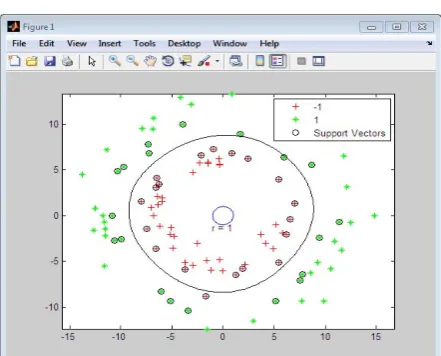
Abstract-Machine learning technique is introduced as a method for the classification of proteins into functionally distinguished classes. Protein function classification is one of the most important problems in modern computational biology. Studies are conducted on a number of protein classes including RNA-binding proteins; protein homodimers, proteins responsible for drug absorption, proteins involved in drug distribution and excretion, and drug metabolizing enzymes. Support vector machine in drug discoveries and designing based on two data sets of protein with their various physic-chemical properties. Some binary classification problems do not have a simple hyper plane as a useful separating criterion. For those problems, there is a variant of the mathematical approach that retains nearly all the simplicity of an SVM separating hyper plane. The mathematical approach using kernels relies on the computational method of hyper planes. All the calculations for hyper plane classification use nothing more than dot products. Therefore, nonlinear kernels can use identical calculations and solution algorithms, and obtain classifiers that are nonlinear. The resulting classifiers are hyper surfaces in some space S. In our research, 100 different sequences of proteins are generated with two datasets, which are then classified with their physico-chemical properties independently. In addition, one two dimensional class points inside the unit disk is generated and another class of points in the annulus from radius 1 to radius 2. Then a classifier is generated on the basis of the data with the Gaussian radial basis function kernel. The default linear classifier is obviously unsuitable for this problem, since the model is circularly symmetric. Our results in the form of graphs have shown the non-linear classification of two type of data sets and then with use of curve fitting tool various other parameters are shown up which distinguish the two data sets accurately.
General Terms
Protein Database, ExPASy webserver, physico-chemical properties
Keywords
Protein function Classification, Support Vector Machine
1. INTRODUCTION
Proteins are large, complex molecules that play many critical roles in the body. They do most of the work in cells and are required for the structure, function, and regulation of the body’s tissues and organs. Proteins are made up of hundreds or thousands of smaller units called amino acids, which are attached to one another in long chains. There are
20 different types of amino acids that can be combined to make a protein.
Support Vector Machines is based on statistical learning theory and is tremendously being used in data mining. The central idea is to non-linearly map the data set into a high dimensional space and use a linear discriminator to classify the data into two subsets. Its success has been demonstrated in the areas of regression, classification, and decision tree construction. The SVM classifier is widely used in bioinformatics (and other disciplines) due to its highly accurate, able to calculate and process the high-dimensional data such as gene expression and flexibility in modeling diverse sources of data .SVMs belong to the general category of kernel methods. A kernel method is an algorithm that depends on the data only through dot-products. When this is the case, the dot product can be replaced by a kernel function which computes a dot product in some possibly high dimensional feature space. This has two advantages: First, the ability to generate non-linear decision boundaries using methods designed for linear classifiers. Second, the use of kernel functions allows the user to apply a classifier to data that have no obvious fixed-dimensional vector space representation. The prime example of such data in bioinformatics are sequence, either DNA or protein, and protein structure.
For improved protein function classification we have employed SVM toolbox and distributive computing toolbox for our process. SVM has been used for the classification purpose whereas distributive computing toolbox used to do same process on two divided cores of processor of our machine.
2. METHODOLOGY
our 2 data sets.After Study of various web servers for computing the phsico-chemical properties of the proteins we came to know about ExPASy webserver. ExPASy is the SIB Bioinformatics Resource Portal which provides access to scientific databases and software tools in different areas of life sciences including proteomics, genomics, phylogeny, systems biology, population genetics, transcriptomics. We explored tools for proteomics and found our tool of interest as Protparam. Then we gave protparam an input in the form of protein sequences one by one and it gave us output in the form of physic-chemical properties of that proteins. We repeated the process until calculation of physic-chemical properties of all the protein sequences is achieved. Flow chart of process is show below.
2.1 Flow Chart of present work
2.2 Physico-Chemical Properties
The physico-chemical properties we have calculated are:-
1. Extinction coefficients - Extinction Coefficient is a protein parameter that is commonly used in the laboratory for determining the protein concentration in a solution by spectrophotometry. It describes to what extent light is absorbed by the protein and depends upon the protein size and composition as well as the wavelength of the light. 2. Estimated half-life - The half-life is a prediction of the time it takes for half of the amount of protein in a cell to disappear after its synthesis in the cell 3. Instability index - The instability index provides
an estimate of the stability of your protein in a test tube. Statistical analysis of 12 unstable and 32 stable proteins has revealed that there are certain dipeptides, the occurence of which is significantly different in the unstable proteins compared with those in the stable ones.
4. Aliphatic index - The aliphatic index of a protein is defined as the relative volume occupied by aliphatic side chains (alanine, valine, isoleucine, and leucine). It may be regarded as a positive factor for the increase of thermostability of globular.
5. Grand average of hydropathicity - The GRAVY value for a peptide or protein is calculated as the sum of hydropathy values of all the amino acids, divided by the number of residues in the sequence 6. Theoretical pI - Protein pI is calculated using pKa
values of amino acids. The pKa value of Amino acids depends on its side chain. It has an important role in defining the pH dependent characteristics of a protein
2.3 Classification of protein data sets
After generation of datasets we generated an environment in matlab to achieve classification between two data sets. This involved the coding of Gaussian kernel non-linear process. After this process we imported our data sets into the matlab and then classified them using the Gaussian kernel non-linear process. Here it is important to mention that all the proteins will be classified according to individual physic-chemical property separately which means we will do classification six times according to each physico-chemical property. Our process will classify the proteins and then create plots which will define the classification on the visual basis. Then according to our objectives we used distributive computing toolbox. In this process we divide our processor into 2 equal parts and then proceed with our same classification method. The results expected are same with only time difference will be there in two processes. Then we employed the curve fitting tool for viewing our results of classification in additional way. We have calculated some more parameters and generated some more plots using this tool.
Start
Retrieval of protein sequence from RCSB protein data bank
Physico-chemical properties computing using protparam at ExPASy webserver
Classification of protein data sets by using Gaussian kernel non-linear process
i SVM
Generation of data sets in excel form
Generation of plots according to classification
Repeating the same process using distributive computing toolbox
3. RESULTS AND DICUSSIONS
After classification process we came across some good results defining the differentiation of two protein datasets. We have plotted the results of SVM classification as well we have also used curve fitting tool to validate our results and to calculate some more parameters. All the plots and results we have calculated are following:
Figure 1: Plot of classification of data sets on basis of Aliphatic index.
Figure 2: Plot of classification of data sets on basis of Theoretical
Figure 3: Plot of classification of data sets on basis of Instability index
Figure 4: Plot of classification of data sets on basis of Grand average of Hydropathicity
Figure 5: Plot of classification of data sets on basis of Extinction coefficients
Figure 7: Gaussian classification of Aliphatic index
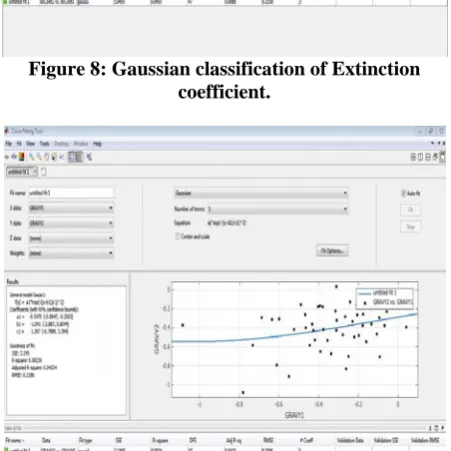
Figure 8: Gaussian classification of Extinction coefficient.
Figure 9: Gaussian classification of Grand average of hydropathicity.
Figure 10: Gaussian classification of Theoretical
Figure 11: Gaussian classification of Estimated half-life
4. CONCLUSIONS
classification of two type of data sets and then with use of curve fitting tool various other parameters are shown up which distinguish the two data sets accurately.
ACKNOWLEDGMENTS
I wish to express sincere gratitude and indebtedness to Supervisor, Prof. Rajbir Singh (Assoc. Prof. & Head, Department of Information Technology) for his valuable guidance, attention-grabbing views and obliging nature which led to the successful completion of this study. I lack words to express my cordial thanks to the members of Departmental Research Committee (DRC) for their useful comments and constructive suggestions during all the phases of the present study as well as critically going through the manuscript.
Words fail the author to express his deep sense of gratitude towards his family members for their moral and financial support and encouragement without which the author would not have been able to bring out this thesis.
REFERENCES
[1] B. Scholkopf et al. (1997) “Comparing Support Vector Machines
with Gaussian Kernels to Radial Basis Function Classifiers”, Signal
Processing, IEEE Transactions Volume.45 Issue.11 pp.2758 - 2765. [2] Gulsah Altun et al.(2006) “Hybrid SVM kernels for protein
secondary structure prediction ”, Granular Computing, 2006 IEEE
International Conference pp. 762 - 765
[3] Y.Radhika et al.(2009)“Atmospheric Temperature Prediction using
Support Vector Machines”, International Journal of Computer
Theory and Engineering, Vol. 1, pp:793-820.
[4] Haibin Cheng et al(2010) “Efficient Algorithm for Localized
Support Vector Machine” , Knowledge and Data Engineering, IEEE
Transactions Volume:22 , Issue: 4 , pp: 537 - 549
[5] Li Liao (2003) “Combining pairwise sequence similarity and
support vector machines for remote protein homology detection”,
JOURNAL OF COMPUTATIONAL BIOLOGY Volume 10, pp: 857–868.
[6] Mehmet Gonen(2011) , “Multiple Kernel Learning Algorithms”, Journal of Machine Learning Research, Vol.12, pp.2211-2268. [7] Chih-Wei Hsu et al (2010), “A Practical Guide to Support Vector
Classification” , National Taiwan University, Taipei 106, Taiwan,
[8] Asa Ben-Hur(2010) “A User's Guide to Support Vector Machines”, 10th ACM International conference of Computer and Information Technology (CIT ) , pp.155- 162 .
[9] Christina Leslie et al.(2004) “Mismatch string kernels for
discriminative protein classification”, Journal Bioinformatics
Volume:20 Issue: 4, pp: 467-476
[10] Jason Weston (2004) “Semi-supervised protein classification using cluster kernels”, Vol. 7, No.3, pp.1–8.
[11] Alexandros Karatzoglou(2006) “Support Vector Machines in R”, Journal of Statistical Software, Vol.15, Issue. 9.
[12] Lars Juhl Jensen et al. (2003) “Functionality of System Component”
Conservation of Protein Function in Protein Feature Space Genome Res. 13(11): 2444–2449.
[13] Rong She et al. (2003) “Frequent-Subsequence-Based Prediction of
Outer Membrane Proteins” Proceedings of the ninth ACM SIGKDD
international conference on Knowledge discovery and data mining, pp. 436-445.
[14] Ravi Gupta et al. (2008) “A Time-Series-Based Feature Extraction
Approach for Prediction of Protein Structural Class” EURASIP J
Bioinform Syst Biol 2008:235451.
[15] Kai-Yan Fenget al(2005) “Boosting classifier for predicting protein
domain structura lclass” Biochemical and Biophysical Research
Communications 334 pp:213–217
[16] Manpreet Singh et al. (2012) “Machine Learning Classifiers for
Human Protein” International Journal of Computer Science and
Telecommunications Volume 3, Issue 10 pp:21-25
[17] Andrey Fomenko et al.(2006)”Prediction of protein functional
specificity without an alignment” OMICS Volume: 10 Issue:1 pp:
56-65
[18] Manpreet Singh et al.(2007) “Human Protein Function Prediction
using Decision Tree” IJCSNS International Journal of Computer
Science and Network Security, VOL.7 No.4 pp:92-98.
[19] Leslie et al. (2003) “Mismatch string kernels for SVM protein
classification” Neural Information Processing Systems 15”, pp.
1441-1448
[20] Ankita Srivastava et al.(2014) “A Novel Data Mining Approach for
Protein Function Prediction” International Journal of Emerging
Research in Management &Technology ISSN: 2278-9359 (Volume-3, Issue-5)
[21] Terrence S. Furey et al (2000) “Support vector machine classification and validation of cancer tissue samples using
microarray expression data” oxford journal vol:16, issue:10,
pp:906-914.
[22] Datta S (2004) “DFT based DNA splicing algorithms for prediction
of protein coding regions”, Page(s): 45 - 49 Vol.1, Conference
Publications.
[23] Jennifer Harrow et al. (2009) “Identifying protein-coding genes in
genomic sequences” Genome Biology.
[24] Mehmet Gonen et al. (2011) “Multiple Kernel Learning Algorithms”
Journal of Machine Learning Research Vol:12 pp: 2211-2268
AUTHORS
Rajbir Singh is an Associate Professor & Head, Department of Information Technology of Lala Lajpat Rai Institute of Engineering & Technology Moga ([email protected]), India. He received his B.E (Honor) degree in Computer Science and Engineering from MD University, Rothak, Haryana and M-Tech degree in Computer Science and Engineering from Punjab Technical University, Jalandhar Pb. (INDIA). He has authored 03 books on Computer Science. His main field of research interest is Bio-Informatics and Data mining. He works on the Gene Expression, Phylogenetic Trees and Prediction of Protein Sequence & Structure.