ROAD CONDITIONAL MAPPING USING TERRESTRIAL LASER SCANNING METHOD
UNIVERSITI TEKNOLOGI MALAYSIA
iii
s
FIRDAUSI MUSA GARBA
ROAD CONDITIONAL MAPPING USING TERRESTRIAL LASER SCANNING METHOD
A project report submitted in partial fulfilment of the requirements for the award of the degree of
Master of Science (Geoinformatics)
Faculty of Geoinformation and Real Estate Universiti Teknologi Malaysia
All praises be to Almighty Allah for seeing me throughout my life up to this moment to empower me write this thesis from the scratch to the very end. First and foremost, my deep gratitude goes to my supervisor Assoc. Prof. Zulkepli Majid for his guidance, encouragement and support during this research. He motivated me greatly to work in this thesis. His willingness to motivate me contributed extremely to my success. I have learned a lot from him and I am fortunate to have him as my mentor and supervisor. My thanks to all the members of staff of the Department of Geoinformatic, Universiti Teknologi Malaysia, Mr Lau, Mr Razali and all those I have not mentioned.
My sincere appreciation to my beloved parents and in-laws Alhaji Musa Garba, Hajia Amina Suleiman; Haj Zainab and Mal. Abdullahi for their endless prayer, support and encouragement throughout the period of my study. Also to my husband Engr. Auwalu Muhammad Abdullahi who sponsored my education and motivated me, without your support this dream of mine will never come true. Thank you so much. To my son Muhammad Zahruddeen, having you has always been a source of inspiration and encouragement to me. I love you so much.
I am also highly grateful to Engr. Isyaku Abubakar and his wife Binta Kabir for taking good care of my son during the period of my study. I would like to use this opportunity to extend my gratitude to my beloved brothers and sisters. I am grateful words alone cannot define my appreciation. I pray Allah (S.W.A) reward you abundantly. I would like to acknowledge my classmates and friends worthy of mention Habiba Ibrahim Mohammad and the entire class of MGHG2015/2016.
Road transportation plays a vigorous part in the lives of people worldwide, because it bond people for commercial activities or pleasure by connecting small and large cities, urban and rural areas as well as connecting a country with its neighbour. To support the safe movement of people, goods and services, road and their features are carefully designed and constructed to increase road traffic safety, improve the efficient use of the overall network and reduce the harm such as death, injuries and property damage. Crack is the common surface distress of asphalt pavements it is necessary to detect the crack as early as possible to reduce maintenance cost. Terrestrial laser scanning is one of the most capable remote sensing techniques, which can be used to detect and analyse road distress at all levels The main objectives of this research were to acquire the road data using terrestrial laser scanning and close-range photogrammetry method, measure the width, length and area affected by the crack from point cloud data and also to verify the result using close-range photogrammetry and manual method. Ten lengths of the crack ware measured, ten width and area affected by the crack was also measured from point cloud data. The results obtained from point cloud data was verified using close-range photogrammetry and manual measurements. The results shows the potential of terrestrial laser scanning to detect, measure and analyse the road crack with root mean square error of the measured lengths between terrestrial laser scanning and close-range photogrammetry 0.015m and that of terrestrial laser scanning and manual method was 0.018m while the root mean square error of the measured widths between terrestrial laser scanning and close-range photogrammetry 0.001m and that of terrestrial laser scanning and manual method was 0.001m.
Pengangkutan jalan raya memainkan peranan yang penting dalam kehidupan
manusia di seluruh dunia, kerana ia membantu manusia untuk aktiviti komersial atau
berseronok dengan menghubungkan bandar-bandar kecil dan besar, kawasan bandar
dan luar bandar serta menghubungkan negara dengan jirannya. Bagi menyokong
pergerakan manusia, barangan dan perkhidmatan, jalanraya dan ciri-ciri jalanraya
direka dengan teliti dan dibina untuk meningkatkan keselamatan, meningkatkan
kecekapan penggunaan rangkaian secara keseluruhan dan mengurangkan bahaya
seperti kematian, kecederaan dan kerosakan harta benda. Keretakan adalah masalah
permukaan biasa dan turapan adalah perlu untuk mengesan keretakkan seawal
mungkin untuk mengurangkan kos penyelenggaraan. Pengimbasan laser daratan
adalah salah satu teknik penderiaan jauh paling mampu dan boleh digunakan untuk
mengesan dan menganalisis kerosakan jalan raya di semua peringkat. Objektif utama
kajian ini adalah untuk memperoleh data jalan menggunakan pengimbasan laser
daratan dan kaedah fotogrametri jarak dekat dimana ukuran lebar, panjang dan
kawasan terjejas akibat keretakan diperolehi daripada data titik awan dan
mengesahkan keputusan pengukuran dengan menggunakan fotogrametri jarak dekat
dan kaedah manual. Sepuluh panjang keretakan diukur, sepuluh lebar dan kawasan
terjejas akibat keretakan juga diukur dari data titik awan. Keputusan yang diperolehi
daripada data titik awan telah disahkan menggunakan fotogrametri jarak dekat dan
ukuran manual. Keputusan menunjukkan potensi pengimbasan laser daratan untuk
mengesan, mengukur dan menganalisis retak jalan raya dengan punca kuasa dua
terdikit panjang diukur antara pengimbasan laser daratan dan jarak dekat
fotogrametri ialah 0.015m dan unca kuasa dua terdikit pengimbasan laser daratan dan
kaedah manual adalah 0.018m manakala punca unca kuasa dua terdikit dua lebar
diukur antara pengimbasan laser daratan dan jarak dekat fotogrametri 0.001m dan
TABLE OF CONTENTS
CHAPTER TITLE PAGE
DECLARATION iv
DEDICATION v
ACKNOWLEDGEMENT vi
ABSTARCT vii
ABSTRAK viii
TABLE OF CONTENTS ix
LIST OF TABLES xiii
LIST OF FIGURES xiv
LIST OF ABBREVATIONS xvii
LIST OF APPENDICES xix
1 INTRODUCTION 1
1.1 Introduction 1
1.2 Problem statement 2
1.3 Aim of Study 4
1.4 Objectives of Study 4
1.5 Research Question 5
1.7 Study Area 6
1.8 Significant of the Study 7
1.9 Thesis Content 7
2 LITERATURE REVIEW 9
2.1 Introduction 9 7
2.2 Road 9
2.3 Classification of Road 11
2.4 Historical Development of Road In Malaysia 13
2.5 Road Development 13
2.6 Road crack 14
2.6.1 Alligator cracking 18
2.6.1.1 Severity Levels 19 2.6.1.2 Location Of Alligator Crack 20 2.6.1.3 Causes Of Alligator Crack 20 2.6.1.4 Measurement Of Alligator Crack 21 2.6.1.5 Suggested Renovation of Alligator Crack 21
2.7 Terrestrial Laser Scanner (TLS) 21
2.7.1 Types Of Terrestrial Laser Scanner Survey 23
2.7.2 TLS Execution 24 How Does TLS Work
2.7.3 Classification Of Terrestrial Laser Scanner 24
2.7.4 Full Field-Of-View 26
2.7.5 Application of Stationary TLS 26
2.8 Photogrammetry 27
2.8.1 Types Of Photogrammetry 27
2.8.3 Advantage of Photogrammetry 29 2.8.4 Dis Advantage of Photogrammetry 29 2.9 Related Works
2.10 Summary
30 35
3 METHODOLOGY 36
3.1 Introduction 36
3.2 Phase I Planning and Preliminary Study 37
3.2.1 Planning 38
3.2.2 Preliminary Study 38
3.3 Phase II Data Collection 38
3.3.1 TLS Data Collection 41
3.3.2 Photogrammetry Data Collection 42
3.4 Phase III Data Processing 43
3.4.1 TLS Data Processing 43
3.4.1.1 Data base Creation 44 3.4.1.2 Registration of 3D Point Cloud 45
3.4.1.3 Filtering 47
3.4.2 Photogrammetric Data Processing 50 3.4.2.1 Calibration of camera 50 3.4.2.2 Photogrammetric Processing 53
3.5 Phase IV Measurement 54
3.5.1 Cyclone Measurement 54
3.5.2 PhotoModeler Pro5 Measurement 55 3.5.3 Manual Measurement
3.6 Summary
4 RESULTS AND ANALYSIS 57
4.1 Introduction 57
4.2 Measurement of Length 58
4.3 Measurement of Width 59
4.4 Area of the Crack 61
4.5 Comparison Between the Measurements 61
4.6 Root mean square error (RMSE) 63
4.7 Assessment of The Crack Measurements 63
4.8 Summary 64
5 CONCLUSION AND RECOMMENDATION 65
5.1 Introduction 65
5.2 Accomplishment of Objectives 66
5.3 Conclusion 66
5.4 Recommendations for Future Works 5.5 Summary
67 68
REFERENCES 69
APPENDIX A APPENDIX B APPENDIX C
LIST OF TABLES
TABLE NO TITLE PAGE
1.1 Research Objectives and Research Question 5
2.1 Administrative Agencies for Federal Road Maintenance 11 2.2 Administrative Agencies For State Road Maintenance 12
2.3 Road Categories and Length 13
2.4 Classification of Laser Scanner 25
4.1 Comparison of measurements between TLS and Photogrammetry
62
LIST OF FIGURES
FIGURE NO. TITLE PAGE
1.1 Image showing road cracking 4
1.2 1.3
Map of University Teknology Malaysia Study Area
6 7
2.1 Image showing road 10
2.2 High severity transverse cracking 14
2.3 High severity longitudinal cracking 15
2.4 High severity alligator cracking 16
2.5 Pothole surrounded by alligator cracking 17
2.6 Rutting (0.5 inches or greater) 17
2.7 Measuring alligator crack width on roadway 19
2.8 Terrestrial laser scanner 22
2.9 Static tripod-mounted TLS setup 23
2.10 Mobile laser scanner 24
2.11 Aerial digital photogrammetry 27
2.12 Terrestrial digital photogrammetry 28
2.13 Road distress location on the digital map 30
magnetic powder
2.15 Off-ramp looking north 32
2.16 Scan of same off-ramp looking north 33
2.17 An image of a road segment with serious distress collected from the UAV platform
34
3.1 Workflow of the study 37
3.2 Leica scan station C10 40
3.3 Workflow of data collection using TLS and Photogrammetry
40
3.4 Scanner setup 41
3.5 Sony DSC-828 camera 42
3.6 Photogrammetry data collection 43
3.7 Creation of data base and importing the data 44
3.8 Database created 45
3.9 Target naming 46
3.10 Selection scan world for registration 46
3.11 Registration error 47
3.12 Intensity point cloud before filtering 48
3.13 Color point cloud before filtering 48
3.14 Intensity point cloud after filtering 49
3.15 Color point cloud after filtering 49
3.16 Software interface to start calibration 51
3.17 Calibration grid added to the projects 51
3.18 Executing calibration 52
3.19 Camera parameters 52
3.20 3D view of the crack 53
4.1 Cyclone length measurement 58
4.2 PhotoModeler Pro5 length measurement 59
4.3 PhotoModeler Pro5 width measurement 60
LIST OF ABBREVATIONS 3D ALS GIS GPS LiDAR TLS OECD MHA STLS MTLS GNSS EDM DEM UV Three Dimensional Airborne Laser Scanning
Geographic Information System Global Positioning System Light Detection and Ranging Terrestrial Laser Scanner
Organization for Economic Co-operation and Development Malaysian Highway Authority
APIP BPNN UAV MLS GVF GRF RMSE RMSD
LIST OF APPENDICES
APPENDIX TITLE PAGE
A Calibration Grid 73
B Automatic Camera Calibration 74
C Importing Image and computing colors for scan 75
CHAPTER 1
INTRODUCTION
1.1 Introduction
Road transportation is an important part of human lives across the world. It connects people and links cities for commercial activities and pleasure. Urban and rural areas are also connects to a neighbouring countries through roads. To support the migration of people, industrial products and services, road and other transportation medias are designs and constructs carefully to enhance safe road transportation, and improve the quality of the whole network and reduce the harm such as death, injuries and property damage (Guan et al. 2015) accurate information about the road condition is a key issue for the overall management of transportation infrastructure. The public road networks are corrupting in many places, as necessary investments are postponed or withdrawn. In order to organise available means in a most serviceable way, the evaluation and geo-referenced mapping of the road quality is an essential prerequisite for maintenance management (Miraliakbari et al. 2014).
space, it is tough to acquire the third dimension. These approaches are time consuming and huge as well (Sairam et al. 2016).
It is known that a good road infrastructure of a country is a pre-requisite to the development of a nation (Sufiyan and ir zulakmal, 2009) road surface crack discovery plays significant part in gauging the road condition and deliver the necessary road maintenance. Crack is the common surface distress of asphalt pavements it is necessary to detect the crack as early as possible to reduce maintenance cost (Li et al. 2014) roads are significant artificial infrastructure that show distress because of their continuous usage, therefore it‟s necessary to maintain them to confirm accurate pavement performance (Henrique, 2009) roads especially bitumen road are important as major transportation and communication ways in recent civilizations. Because of weather condition and loads from vehicles road surface frequently experience distress from time to time (Patrick et al. 2012).
Currently, laser scanning has become a supplementary technique for geodetic applications. The use of laser scanners is constantly growing. There are different laser scanners available from different companies (Schulz et al. 2004) the arrival of a high accuracy terrestrial laser scanner means that the inspector/surveyor can be in a safer location, away from high speed traffic and obtain huge amounts of detailed data rapidly and cost efficiently (Garry, 2007).
1.2 Problem statement
Base on literature review as mentioned earlier in the introduction certain problems need to be addressed.
safety problem has been increasing from time to time; due to this reason transportation problem became a research motivation (Danli, 2013) road administrators need additional information about the road network and it‟s surrounding for several reasons such as urban planning, road network management etc. (Darko et al. 2014).
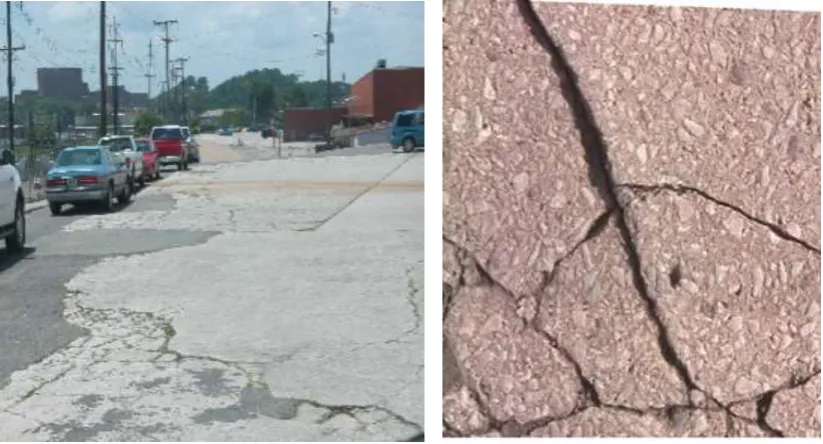
Ordinarily pavement condition data were collected by human inspectors who travel along the road to measure the distress and come out with a report. This method is time consuming, costly and is not safe (Sufiyan and ir zulakmal, 2009) rehabilitation and road conservations is not only time-consuming, but it also creates traffic instabilities and is also very costly, these have made visual inspection less capable (Patrick et al. 2012) Figure 1.1 shows an example of road crack.
Figure 1.1. Image showing road cracking (Yu et al, 2005).
1.3 Aim of Study
The aim of this study is to investigate the crack measurement performance of TLS to detect, to measure and analyse road crack from point cloud data.
1.4 Objectives of Study
To achieve the aim and purposes of this study, the following objectives have been established:-
i. To acquire the road crack data using TLS and close-range photogrammetry method.
ii. To measure the width, length and area affected by the crack from point cloud data.
1.5 Research Question
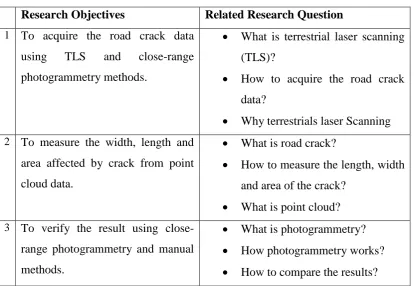
The following research questions are addressed and have been answered in order to fulfil the research objectives.
Table 1.1: Research Objectives and Research Question
Research Objectives Related Research Question 1 To acquire the road crack data
using TLS and close-range photogrammetry methods.
What is terrestrial laser scanning (TLS)?
How to acquire the road crack data?
Why terrestrials laser Scanning 2 To measure the width, length and
area affected by crack from point cloud data.
What is road crack?
How to measure the length, width and area of the crack?
What is point cloud? 3 To verify the result using
close-range photogrammetry and manual methods.
What is photogrammetry? How photogrammetry works? How to compare the results?
1.6 Scope of Research
The scope of this research is as stated below.
This research only focused on the alligator crack.
Data of the crack was collected using TLS Leica Scan Station C10.
Cyclone and photoModeler Pro5 software were used to process the data.
1.7 Study Area
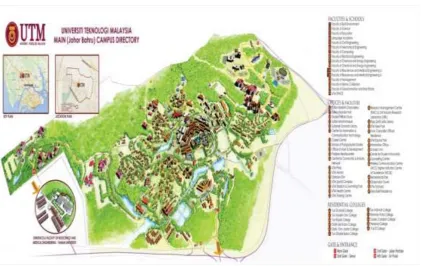
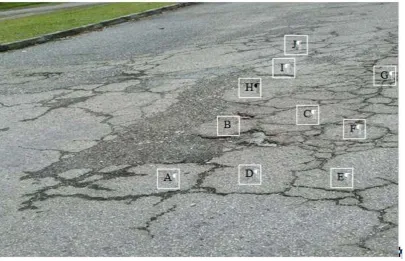
This research was carried out at University Teknology Malaysia Skudai Johor Bahru. Figures 1.2 and 1.3 shows the map of University Teknology Malaysia and image of the study area.
Figure 1.3. Study Area.
1.8 Significant of the Study
The purpose of this study is to detect any trouble (such as road surface crack) at the initial stage so that maintenance can be performed on the right time before the renovation charges become too expensive.
The current road conditional mapping will help management to have additional information about the road condition and it‟s surrounding for better management.
1.9 Thesis Content
Introduction, Literature review, Methodology, Result and analysis, conclusion and recommendation.
Chapter 1 Introduction:- this chapter provides a brief explanation on the overview of the whole research, which includes background of the study, problem statement, aim and objectives, scope of the study , study area and also the significance of the study.
Chapter 2 Literature Review:- this chapter provide literature review on all the suitable information about road condition mapping, terrestrial laser scanning (TLS) , photogrammetry and other related data that was gained from previous studies on paper, book, and internet were discussed in this chapter.
Chapter 3 Methodology: - this chapter explain the methodology and overall work flow of this study. Starting with planning and preliminary study, data acquisition, data processing, and measurement which, were used to map the road crack.
. Chapter 4 Result and Analysis:-this chapter provides the results obtained from the point cloud data, photogrammetry and manual and discussions that was carried out in this study.
REFERENCES
Arthur, N. (2010) Carroll Municipal–Arthur n. Neu Airport Pavement Management Report.
Babic, L. Pribicevic, B. and Dapo, A. (2012) Mobile Laser Scanning (MLS) in transport infrastructure documentation and research. Ekscentar (15):96-99.
Bornaz, L. and Rinaudo, F (2004) Terrestrial Laser Scanner Data Processing. 1-6. Caltrans (2011) Terrestrial Laser Scanning Specification Surveys Manual.
California Department of Transportation. 1-33.
Chunsun Zhang (2008) UAV-Based Photogrammetric Mapping System For Road Condition Assessment. Proceedings of the International Archives of the Photogrammetry, Remote Sensing and Spatial Information Sciences.
(XXXVII.). Beijing, 627-632.
Darko, B. Fiolic, M. and Prusa, P. (2014) Mobile Laser Scanning Method for Road Markings Data Collection. Proceedings of the International Scientific Conference on Development Possibilities of Croatian Transport
System-Anniversary of EU Membership. 1-11.
Danli (2013) Optimising Detection of Road Furniture (pole like objects) in Mobile Lasser Scanning data. Thesis on Masters of Science of Geoinformation
Science and Earth Observation. University of Twente. 1-56.
Federal Highway Administration Manual (IRI) (2006-2009) Pavement Distress Identification (PDI) for the NPS Road Inventory Program [Manual] (4): 1-30.
Guan, H. Li, J. Yu, Y. Chapman, M. and Wang, C. (2015) Automated road information extraction from mobile laser scanning data. Intelligent Transportation Systems IEEE Transactions 16(1) 194-205.
Henrique Oliveira and Paulo Lobato Correia (2009) Supervised Crack Detection and Classification in Images of Road Pavement Flexible Surfaces. 150-184.
<http:// int. search. myway.com/assets/C/myway-favicon.ico.> [24 November 2016] <http:// www. Google map.com> [24 November 2016]
<http://www.jkr.gov.my/app-jkr/index.php?setlang=en> [11 August 2016]
Karwan Ghazi Fendi, Sarhat Mustafa Adam, Nick kokkas and Martin Smith (2013) An approach to produce a GIS database for Road Surface Monitoring. Duhok
polytechnic. 13-14.
Kumar, P. Paul L. and Conor P. M. (2015) Parameteric Analysis for Automated Extraction of Road Edges from Mobile Laser Scanning Data. Proceedings of the Joint International Geoinformation Conference on the Annals of the
Photogrammetry, Remote Sensing and Spatial Information Sciences. Kuala
Lumpur, Malaysia, October 28-30. 215-221.
Kumar, P. Conor, P. M. Paul L.,and Timothy, M. (2014) Automated road markings extraction from mobile laser scanning data. International Journal of Applied Earth Observation and Geoinformation. (32): 125–137.
Lichti, D.D. Stewart, M. P. Tsakiri, M. and. Snow, A. J (2000) Calibration and Testing of a Terrestrial Laser Scanner. Proceedings of the International Archives of Photogrammetry and Remote Sensing. Amsterdam B5 (XXXIII):
485-492.
Li, Sun, Ning, Tan (20014) Automatic Pavement Crack Recognition Based on BP Neural Network. Swarm Intelligence in Transportation Engineering Original
Mark W. Smith (2015) Direct Acquisition of Elevation Data: Terrestrial Laser Scanning. British Society for Geomorphology. 1-14.
Matthews, Neffra A. (2008). Aerial and close-range photogrammetric technology: providing resource documentation, interpretation, and preservation. 1-62.
Miraliakbari A. Hahn M. and Mass H. G. (2014). Development of Multi_Sensor System for Road Condition Mapping. Symposium on the International Archives of the Photogrammetry, Remote Sensing and Spatial Information
Sciences. November 17-20 Denver, Colorado, USA, 265- 272.
Mustaffar, M. Ling, T. C. and Puan, O. C (2008) Automated Pavement Imaging Program (APIP) for Pavement Cracks Classification and Quantification A photogrammetric Approach. Proceedings of the International Archives of the Photogrammetry Remote Sensing and Spatial Information Science, Beijing part
B4, (XXXVII):367-372.
Organisation for Economic Co-operation and Development (OECD) (2004-02-26). Glossary of Statistical Terms. Retrieved 2007-07-17.
Patrick Liq Yee Tiong, Mushairry Mustaffar and Mohd Rosli Hainin (2012) Road Surface Assessment of Pothole Severity by Close Range Digital
Photogrammetry Method. World Appl. Science Journal (6):867-873.
Pavement Identification Manual (2011) [Manual] Office of Materials and Road Research Pavement Management. 1-51.
Sairam, N. Nagarajan, S. and Ornitz, S. (2016) Development of Mobile Mapping System for 3D Road Asset Inventory Sensors 16(3) 367. 1-50.
Schulz, THorsten, Ingensand and Hilmar. (2004) Terrestrial laser scanning-investigations and applications for high precision scanning.s 1-14.
Sharlene Pillay (2015) Aerial photogrammetry. Surveying and Land Information Department, EThekwini Municipality. pp 1-13.
Tarvo Mill, Artu Ellmann, Katrin Uueküla, Vahur Joala (2011) Road Surface Surveying Using Terrestrial Laser Scanner and Total Station Technologies Proceedings of the international conference of Environmental Engineering
Vilnius, Lithuania May 19–20,s 1142-1147
Yu, S. J. (2005) Digitizing and 3D Modeling of Road Surface using an Integrated Multisensory Approach Thesis Presented for the Masters of Science Degree.
1-77.
Viktor Jemec, Jože Jurman and Janez Grum (2007) Evaluation of Defects and Cracks in Carriage Axles Using Non-Destructive Testing. NDT for Safety
Prague, Czech Republic.107-118.
Vu Trinh C (2010) Airfield pavement inspection reference manual. [Manual] Florida department of transportation aviation office. 1-66.
Zhao, G. Chen, H. Li, X and Zou, X. (2013) Integrated Calibration Between Digital Camera and Laser Scanner From Mobile Mapping System For Land Vehicle.