AN IMPROVED METHODOLOGY FOR THE EVALUATION OF HUMAN
ERROR PROBABILITIES IN A SEISMIC PSA
Dr. Jens-Uwe Klügel NPP Gösgen, 4658 Daeniken, Switzerland (
)
ABSTRACT: An improved methodology for the evaluation of human error probabilities for post-accident actions has been developed. The basis for the methodology consists in the assumption that the confusion of operators after an earthquake strongly correlates with the observed damage of plant equipment and infrastructures in the surroundings of the plant. Baseline human error probabilities obtained by standard HRA methods are adjusted by introducing conditions under which operator actions after an earthquake must be considered as guaranteed to have failed. For this purpose a psychological shock threshold for operator actions was introduced based on the exceedance of the earthquake damaging threshold (CAV=0.16gs, NRC RG 1.166) and of a critical, design-specific strong motion duration as an additional criterion affecting human performance under seismic loading. A set of empirical correlations was developed to perform site-specific calculation of the CAV value and uniform strong motion duration. A detailed Monte Carlo procedure was developed to calculate the probability of exceedance of the psychological shock threshold using the site-specific sce-nario earthquakes developed from the results of the PEGASOS project (SSHAC level 4). The uncertainties of the threshold level were considered by assuming a uniform distribution of the threshold level within an interval of possible values
.
1 INTRODUCTION
The treatment of human error under seismic loading is a critical issue with respect to the results of a seismic PSA. The following approaches are typically used:
• all short-term operator actions after an earthquake are guaranteed to have failed (typically related to a time window of 20 min),
•
human error probabilities are gradually changing (human performance is deteriorating) with an increasing acceleration level [1]. Typically, a simple linear relationship is assumed (e. g. between operational earthquake acceleration and a certain strong earthquake ground motion responsible for failing the actions)• a psychological shock threshold exists, failing all operator actions beginning from a certain acceleration level. The psychological shock is caused by the observation of strong ground motion accompanied by the occurrence of damage at the plant site and in the surroundings (important infrastructure such as streets and bridges) of the plant site. Damage to infrastructures in the surroundings of the plant is assumed to prevent the access of additional staff members to the plant site. Below the threshold level the basic human error rates are applied (psychological shock model).
Moreover, it is assumed that all operator actions have failed if access to the service area is not possible because of seismic damage to structures to be entered after an earthquake. These approaches are usually combined with the calculation of baseline human error probabilities using traditional methods of human reliability analysis (HRA), for example according to THERP [2]. In Switzerland, the third approach is commonly used. All operator actions were considered as guaranteed to have failed, if the peak ground acceleration at the site exceeded twice the peak ground acceleration associated with the safe shutdown earthquake (SSE). This assumption corresponded to the assumption that all actions had failed if the site intensity of an earthquake exceeded the safe shutdown site intensity by one unit (for example intensity IX was observed for a site with a safe shutdown earthquake intensity of VIII). This roughly corresponds to a change of the peak ground acceleration by a factor of 2 (exactly true only for the MCS scale). This assumption was supported by the observation that the psychological shock associated with the impact of an earthquake correlates with the observed damage in the plant area or in its neighbourhood (1]). Unfortunately, modern PSHA (Probabilistic Seismic Hazard Analysis) studies such as the PEGASOS study [3] deliver seismic hazard curves and hazard spectra containing contributions of non-damaging earthquakes [4] due to neglecting energy conservation principles. Experience from past earthquakes has shown that low-energy low magnitude earthquakes near the site of a plant can cause relatively high accelerations, although they do not exceed the limits of an operational earthquake defined by a critical CAV (Cumulative Absolute Velocity) value of 0.16gs according to US NRC RG 1.166 [5]. Therefore, the direct relationship between measured peak ground accelerations and damage (intensity) is lost. Another important factor with respect to the restoration of the link between PSHA results, damage at the plant site and human reliability analysis is the duration of the strong motion period. Short-term peak vibrations caused by near-site low magnitude earthquakes (even exceeding the critical CAV value) usually do not have the same energy content as the ground vibrations caused by more distant, high magnitude events (for simplicity assuming the same spectral shape of the response spectrum) if nonlinear failure modes are allowed. This difference in the energy content can be captured by considering strong motion duration as an additional parameter affecting the potential damage at the plant site, and therefore also affecting human performance during and after an earthquake. To incorporate the results from such “sophisticated” PSHA studies like PEGASOS into plant specific seismic PSA (Probabilistic Safety Assessment) in a way that is consistent with the
assumptions used in earlier studies the methodology for the evaluation of human error probabilities needed to be improved.
2
General Approach
According to the proposed methodology the human error rate for post-accident calculations is represented consisting of two terms:
, ,
HE seis HE baseline GF
P
=
P
+
P
(1)
Here
P
HE seis, is the total probability of failure of the post-accident operator action considered,P
HE baseline, is the probability of failure of the post-accident operator action according to the baseline human reliability model (HRA) used in the PSA model andP
GF is the probability of a “guaranteed failure” of the operator action due to inaccessibility of the required service area or due to a long-lasting psychological shock. This term also includes the effect of damage to plant areas usually not modeled in PRA (e. g. inaccessibility of walking paths, doors, effects from debris loads and potentially triggered external fires outside buildings, damage to non-safety grade operational instrumentation). Therefore,P
GF is modeled as consisting of two terms:• a term describing inaccessibility to service areas and failure of instrumentation directly modeled in the PSA model,
• a second term describing damage to infrastructures, operational instrumentation and the associated increasing confusion of operators modeled as a long term lasting psychological shock.
In an event tree code the first term can be modeled logically by the failed states of corresponding top events of the event trees, while the second term is “lumped” into a separate top event questioning specific criteria for inducing the
“guaranteed failure” state of all post-accident operator actions considered in the model for the analyzed accident sequence. According to our discussion we present the probability of “guaranteed failure” of post-accident operator ac-tions as consisting of two parts, a directly quantified part
P
GF direct, and the part modeled by the “lumped” top event,shock
P
:,
GF GF direct shock
P
=
P
+
P
(2)
The following criteria are used for failing operator actions according to the second term:
• exceedance of the damaging threshold of earthquakes defined by a value of CAV of 0.16 gs, [5] and
• exceedance of a plant specific value for the uniform strong motion duration [6] corresponding to a specific fraction of the typical length of the time history records used for the seismic design of structures.
The uniform duration length is suggested to be selected between 0.5 to 0.8 times the strong motion duration of the safe shutdown earthquake defined for the nuclear power plant. It is suggested to use a uniform distribution (as a non-informative characteristic) for the fraction of the strong motion duration of the safe shutdown earthquake to address the existing epistemic uncertainties associated with the method.
3
EVALUATION PROCEDURE AND APPLICATION
3.1 General Procedure
The quantification of the probability of “guaranteed failure” according to the second term in equation (2) requires the development of a site-specific model for the calculation of CAV and for the uniform duration of earthquakes in dependence of earthquake magnitude and distance between earthquake location and the site of the nuclear power plant. In addition, the results of the PSHA must be decomposed into terms of controlling events for different probabilities of hazard exceedance (the probability of exceedance for the different uniform hazard spectra). By random sampling of these controlling events following the bootstrap paradigm and evaluating the exceedance of the criteria given in section 2, the term in equation (2) can be evaluated for different probabilities of exceedance of the given seismic hazard. The results obtained can be used directly in the quantification of the seismic PSA, for example representing them in the format of a double-delta distribution with the corresponding mean.
3.2 Application for the Goesgen PSA
The procedure was applied to the update of the Goesgen site specific seismic PSA. A set of empirical correlations was developed to perform the site-specific calculation of the CAV value and the uniform duration. For this purpose a reduced dataset obtained from the published WUS database [4] for the specific site conditions (shear wave velocity Vs30 between 300 and 500m/s) was used. These equations are for uniform duration:
( )
( )
5(
)
1 2 3
log
log
1
ub
d
b
b M
b
R
pga
= +
+
+
+
(3)
and for the cumulative absolute velocity, (equation (4) and the associated peak ground acceleration (equation(5)):
(
)
( )
(
)
21 2 3 4 5
log CAV = +b b M+b log R +b R+b M−5.0
(4)
(
)
( )
(
)
21 2 3 4 5
log pga = +c c M+c log R +c R+c M−5.0
(5)
Here R is defined as the square root of squares of the Joyner-Boore distance,
D
JB , and an additional regression parameter, h, statistically emulating the effect of focal depth:(
)
0.5 2 2 JBR
=
D
+
h
(6)
Additionally, the residuals of equations (3) to (5) have been considered in the Monte-Carlo sampling procedure to address the uncertainty associated with the potential incompleteness (lack of explanatory variables, therefore the model is an incomplete “deterministic” model) of the developed model in the form of:
E
=
εσ
(7)
Here
ε
is approximated by a normal variate with zero mean and standard deviation ofσ
. The parameters of equations (3) to (5) with the associated values of the standard deviation are provided in table 1.Table 1. Parameters of empirical equations (3) to (6)
Parameter b1(c1) b2(c2) b3(c3) b4(c4) b5(c5) h
σ
log(du) -0.099174 0.32521 -0.90306 N.A. -0.014763 14.992 0.2217
log(pga) -3.2922 0.73851 -1.4135 0.0036421 -0.17693 11.94 0.22051 log(CAV) -5.9266 1.3811 -2.0284 0.0036717 -0.26281 17.952 0.37226
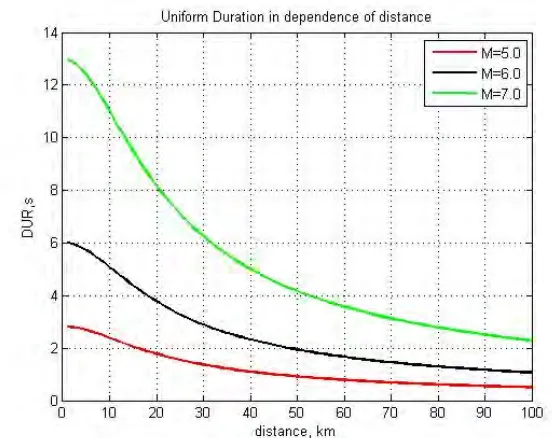
Figure 1 shows the dependency of uniform duration on distance for different magnitude values.
Figure 1. Dependency of uniform duration on distance and magnitude for Goesgen site conditions
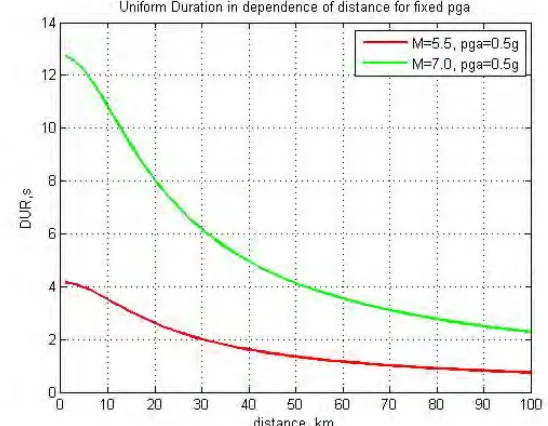
Figures 2 and 3 show the dependency of uniform duration on distance for different magnitude values while retaining the pga values fixed. The direct effect of pga on uniform duration in addition to attenuation effects with distance is obviously low (coefficient b5 is low in equation (3)). Nevertheless these figures are important with respect to the discussion about damaging effects of earthquakes. They illustrate that the uniform duration for a low magnitude
earthquake is significantly lower than for a high magnitude earthquake even if the peak ground accelerations caused by these different earthquakes are the same. This difference in the energy content is neglected in the current PSHA methodology (frequencies from earthquakes of different sizes leading to the same accelerations are simply added [7]) leading to a violation of energy conservation principles. The resulting uniform hazard spectra (UHS) represent a weighted mixture of earthquakes of different energy content. A later hazard disaggregation leads to the preferable selection of low energy controlling events (due to their higher frequency contribution) and may lead to false decisions with respect to the design of critical infrastructures.
Figure 2. Uniform duration in dependence on distance and magnitude for fixed pga (0.5g).
Figure 3. Uniform duration in dependence on distance and magnitude for fixed pga (0.7g).
The PEGASOS study served, despite the well known weaknesses of the SSHAC methodology [7] applied for PEGASOS (see [8], [9], [10]), as an input for the seismic hazard in this analysis.
The PEGASOS study followed the SSHAC procedures at its most elaborate level (level 4) treating the uncertainty of the estimation of the seismic hazard solely by expert elicitation. The study consisted of 4 subprojects with a different number of experts involved:
• subproject 1 - seismic source characterization
• subproject 2 - ground motion characteristics defining the seismic hazard at reference rock conditions (defined by a shear wave velocity of 2000 m/s)
• subproject 3 – site effects and • subproject 4 – hazard quantification.
The decomposition of the seismic hazard into controlling events was derived by disaggregation for rock conditions (output of subproject 2). Because in subproject 1 four different expert groups and in subproject 2 five different experts were involved, a total of 20 different hazard curves were developed to describe the variability of the Goesgen-specific hazard at reference rock conditions. Two different disaggregation methods were used to address epistemic uncertainties associated with the non-unique choice of disaggregation methods:
• the approach according to NRC RG. 1.165[11] and • the approach suggested by Bazzurro and Cornell [12].
The disaggregation was performed for three distance ranges: • below 16 km denoted D1
• from 16 km to 40 km denoted D2 • and larger than 40 km denoted D3.
as well as for a set of spectral frequencies (1Hz, 5Hz, peak ground acceleration pga). The resulting controlling events were interpreted as a bivariate discrete probability distribution, reflecting the epistemic uncertainty of controlling seismic events for each probability of hazard exceedance. These discrete probability distributions consisted of about 80 to 120 data pairs for each of the considered hazard probabilities (probabilities of exceedance of the corresponding distance-specific uniform hazard spectra). The data pairs were ordered by magnitude (ascending) and used directly for the random sampling process. This discrete bivariate sampling process allowed for consideration of the correlation between
magnitude and distance. The sampling process was performed separately for each of the distance ranges. Table 2 shows an example of the format of the discrete bivariate probability distribution of controlling events obtained for the Goesgen site specific hazard. By random sampling of the controlling events (ordered in ascending order by magnitude) and calculating the exceedance of the criteria defined in section 2 the probability of a guaranteed failure of operator actions was evaluated. For the critical fraction of the strong motion duration of the safe shutdown earthquake a uniform distribution in the interval between 7.5 and 12.5 s was used. This corresponds to the criteria explained in section 2. The quantification was performed for different hazard probabilities
Table 2. Format of the discrete bivariate probability distribution – example for spectral frequency of 1 Hz and hazard probability of 1E-3/a, distance range D1 (<16km)
Disaggregation Method 1 (NRC)
Disaggregation Method 2
[12] Expert Combination,
SP1/SP2
M D, km M D, km
EG1a Bommer 5.25 13.6 5.15 14.2 EG1a Bungum 5.75 13.6 5.55 14.2 EG1a Cotton 5.25 13.6 5.05 14.2 EG1a Sabetta 5.25 13.6 5.25 14.2 EG1a Scherbaum 5.25 8.8 5.35 14.2 EG1b Bommer 5.25 12.0 5.25 15.0 EG1b Bungum 5.75 12.0 5.35 10.6 EG1b Cotton 5.25 12.0 5.15 15.0 EG1b Sabetta 5.25 12.0 5.25 15.0 EG1b Scherbaum 5.25 12.0 5.35 15.0 EG1c Bommer 5.25 13.6 5.05 15.4 EG1c Bungum 5.25 10.4 5.35 11.8 EG1c Cotton 5.25 13.6 5.05 15.4 EG1c Sabetta 5.25 13.6 5.05 15.4 EG1c Scherbaum 5.25 13.6 5.25 15.4 EG1d Bommer 5.25 12.0 5.25 11.4 EG1d Bungum 5.75 12.0 5.45 11.4 EG1d Cotton 5.25 12.0 5.15 11.4 EG1d Sabetta 5.25 12.0 5.15 11.4 EG1d Scherbaum 5.25 12.0 5.35 11.4
3.3 Results
It is understandable from the physical nature of earthquakes that a simple linear dependency of the human error probability for post-accident actions on peak ground acceleration is insufficient to describe human performance after an earthquake. Simple ground motion characteristics such as peak ground acceleration (this is also valid for other spectral accelerations) if not directly derived from an intensity-based PSHA are insufficient to describe either the damaging effects of earthquakes or the human performance of plant operators after an earthquake. The reason for this consists in the different damaging effects of earthquakes of different magnitudes due to their different energy content. Table 3 shows the results of the calculations for the different distance ranges and the different hazard exceedance probabilities. It is interesting to compare them with the associated peak ground accelerations on rock (note that these accelerations are caused from truly damaging earthquakes(after restoration of energy conservation principles); they shouldn’t be mixed with measured pga values).
Table 3. Probability of guaranteed failure of operator actions in dependence on distance range, hazard probabilities and peak ground accelerations on reference rock
Hazard exceedance probability
pga, [g] Distance range
Probability of guaranteed failure of operator actions 10-3 0.024 D1 0.0 10-4 0.23 D1 0.075 10-5 0.52 D1 0.350 10-6 0.98 D1 0.480 10-3 0.035 D2 0.0 10-4 0.17 D2 0.0383 10-5 0.3 D2 0.179 10-6 0.52 D2 0.326 10-3 0.031 D3 0.0 10-4 0.11 D3 0.0133 10-5 0.18 D3 0.0245 10-6 0.26 D3 0.059
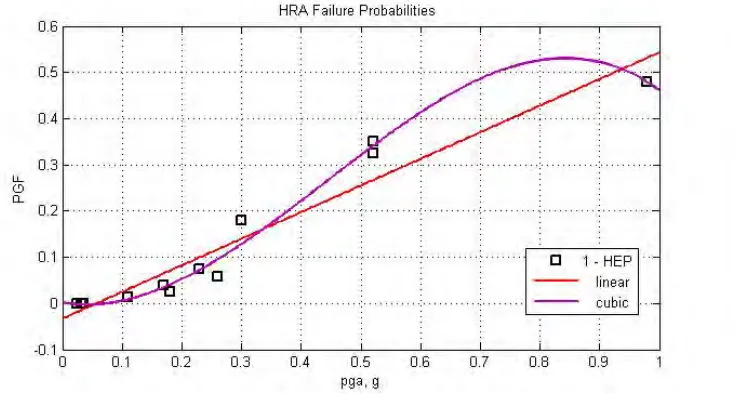
Figure 4 compares the calculated (rather sparse) data points with a linear and a cubic fit. It shows that after elimination of non-damaging and low energy earthquakes from the results of a PSHA, a more simple correlation can be derived between human error probabilities to perform a post-accident action and pga from the remaining (and truly controlling) events .
Figure 4. Probability of a guaranteed failure of post-earthquake operator actions in dependence on pga. Comparison with linear and cubic fit.
The new approach for the evaluation of human error probabilities for post-accident actions was implemented into the seismic PSA of Goesgen replacing the old approach, which was based on the assumption of a complete failure of
operator actions in dependence on instrumental peak ground accelerations. This led to a reduction of core damage frequency of about 30% (sensitivity study).
4 CONCLUSIONS
An improved methodology for the evaluation of human error probabilities of post-accident actions after an earthquake was developed and applied to the update of the Goesgen plant-specific seismic PSA. It was shown that human error probabilities cannot simply be correlated with instrumental peak ground acceleration neglecting the energy content of different earthquakes. The analysis performed indicates that even in case of high acceleration levels, there is still a residual chance for successfully performing post-accident actions.
5 References
1. Yokobashi, M., Oikawa, and T., Muramatsu, K. 1998. Consideration of the Effect of Human Error in a Seismic PSA, in A. Mosleh and R.A. Bari (Eds): Probabilistic Safety Assessment and Management, PSAM4, Berlin Heidelberg New York. Springer-Verlag.
2. Swain, A.D. and Guttmann, H.E., 1983. Handbook of Human Reliability Analysis with Emphasis on Nuclear Power Plant Applications, NUREG/CR-1278.
3. Abrahamson, N.A., Coppersmith, K.J., Koller, M., Roth, P., Sprecher, C., Toro, G., and Youngs, R. 2004. Probabilistic Seismic Hazard Analysis for Swiss Nuclear Power Plant Sites (PEGASOS Project), Vol. 1-6, Wettingen, Nagra.
4. EPRI.2005. Program on Technology Innovation: Use of CAV in Determining Effects of Small Magnitude Earthquakes on Seismic Hazard Analyses, TI-1012965.
5. NRC RG 1.166
6. Bolt, B.A. 1973. Duration of Strong Ground Motion, Proc. Fifth World Conf. Earth. Eng., Rome, pp. 1304-1307. 7. Senior Seismic Hazard Analysis Committee (SSHAC), 1997. Recommendations for Probabilistic Seismic Hazard
Analysis: Guidance on Uncertainty and Use of Experts. NUREG/CR-6372.
8. Klügel, J.-U., 2007. Error Inflation in Probabilistic Seismic Hazard Analysis, Engineering Geology, 90, pp. 186-192. 9. Klügel, J.-U. 2005. Problems in the application of the SSHAC probability method for assessing earthquake hazards
at Swiss nuclear power plants. Engineering Geology, 78, pp. 285-307.
10. Klügel, J.-U, Mualchin, L. and Panza, G. F., 2006. A scenario-based procedure for seismic risk analysis. Engineering Geology, 88, pp. 1-22.
11. NRC RG 1.165
12. Bazzurro, P., and Cornell, C.A. 1999. Disaggregation of Seismic Hazard, BSSA, 89 (2), pp. 501-520.