FEATURES EXTRACTION SCHEME FOR BEHAVIORAL BIOMETRIC AUTHENTICATION IN TOUCHSCREEN MOBILE DEVICES
ALA ABDULHAKIM ABDULAZIZ
FEATURES EXTRACTION SCHEME FOR BEHAVIORAL BIOMETRIC AUTHENTICATION IN TOUCHSCREEN MOBILE DEVICES
ALA ABDULHAKIM ABDULAZIZ
A thesis submitted in fulfilment of the requirements for the award of the degree of
Doctor of Philosophy
Advanced Informatics School Universiti Teknologi Malaysia
DEDICATION
A special feeling of gratitude to my loving parents, Abdulhakim and Asmran whose words of encouragement and push for tenacity ring in my ears. My brothers and sister have never left my side and are very special to me.
I also dedicate this thesis to my many friends and my other family members who have supported me throughout the process. I will always appreciate all they have done to me, especially my uncle Jamil Alariki for helping me to get scholarship and financial support.
ACKNOWLEDGEMENT
In the Name of Allah, Most Gracious, Most Merciful, all praises and thanks are due to Allah, peace and blessings be upon His Messenger. I express my appreciation to Allah for giving me the strength, patience, courage, and determination in completing this work.
I would like to express my most sincere appreciation to my supervisor Prof.Dr. Azizah Abdul Manaf for the continuous support in my Ph.D. program, for her patience, motivation, enthusiasm, and immense knowledge. She has been extremely helpful and offered me all the necessary support needed to succeed in every stage of my thesis, as such; I owe her a duty to be appreciative. Her guidance helped me all the time of my research and writing of this thesis. I could not have imagined having a better supervisor and mentor for my Ph.D. study.
ABSTRACT
ABSTRAK
TABLE OF CONTENTS
CHAPTER TITLE PAGE
DEDICATION iii
ACKNOWLEDGEMENT iv
ABSTRACT v
ABSTRAK vi
TABLE OF CONTENTS vii
LIST OF TABLES xiv
LIST OF FIGURES xvi
LIST OF ABBREVIATIONS xx
LIST OF APPENDICES xxii
1 INTRODUCTION 1
1.1 Research Overview 1
1.2 Research Background 3
1.3 Problem Statement 9
1.4 Research Questions 10
1.5 Research Objectives 11
1.6 Scope of Study 11
1.7 Significance of the Study 12
1.8 Thesis Organization 13
1.9 Summary 14
2 LITERATURE REVIEW 15
2.1 Introduction 15
2.2 Prevalence of Mobile Devices 15
2.4 Mobile Devices Security Threats and Controls 20
2.5 Authentication 21
2.5.1 Something in Your Possession (Token, ATM
card) 22
2.5.2 Something You Know (password) 23 2.5.3 Something of Who You Are (Biometrics) 23
2.6 An Overview of Biometrics 25
2.6.1 Biometrics Types 27
2.6.1.1 Physical Biometrics 28
2.6.1.2 Behavioral Biometrics 29
2.7 General Scheme of Biometric 29
2.7.1 Enrolment Process 29
2.7.2 Authentication process 30
2.8 Evaluation of Biometrics Scheme 32
2.8.1 False Rejection Rate (FRR) 33
2.8.2 False Acceptance Rate (FAR) 34
2.8.3 Equal Error Rate (EER) 34
2.8.4 Accuracy 35
2.8.5 ROC Curve 35
2.9 Overview of Touch Screen and Its Features 36 2.9.1 Touch Features based Gesture Behavioral
Biometric 38
2.9.2 Types of Touch Gesture 40
2.9.2.1 Zoom 40
2.9.2.2 Dwell 40
2.9.2.3 Rotate 41
2.9.2.4 Scroll 41
2.9.3 Advantages of Touch Features based Gesture
Behavioral Biometric 42
2.10 Feature Normalization 43
2.10.1 Min-max normalization 43
2.10.2 Z-score normalization 44
2.11 Features Selection Approach 45
2.11.1 Filter Approach 46
2.11.2 Wrapper Approach 48
2.11.3 Embedded Approach 49
2.11.4 Feature Selection Comparison 50
2.12 Classification Algorithm 52
2.12.1 Decision Trees Classification 53
2.12.2 Rule-based Classification 54
2.12.3 Probabilistic methods Classification 55 2.12.4 Instance-based Classification 56 2.12.5 Support Vector Machine Classification 58 2.12.6 Neural Networks Classification 61 2.13 Related Work on Touch Gesture Biometric
Authentication Scheme 62
2.14 Discussion on Touch Gesture Biometric
Authentication Scheme 70
3 RESEARCH METHODOLOGY 73
3.1 Introduction 73
3.2 Research Procedure 73
3.3 Operational Framework 74
3.4 Methodology Phases 75
3.4.1 Literature Review Phase 77
3.4.2 Data Collection Phase 78
3.4.2.1 Design and Implementation 80
3. SQLite Database 85
3.4.2.2 Data Acquisition 86
3.4.3 Enrollment Phase 86
3.4.3.1 Feature Extraction 87
3.4.3.2 Data Preparation 88
3.4.3.3 Features Normalization 88
3.4.3.4 Features Selection 89
3.4.4 Authentication 90
3.4.4.2 Weka Tool 91 3.4.5 Evaluation of the Proposed Touch Gesture
Authentication Scheme 92
3.5 Software and Hardware Requirements 92
3.6 Summary 93
4 FEATURES IDENTIFICATION, EXTRACTION AND
NORMALIZATION 94
4.1 Introduction 94
4.2 Feature Identification 94
4.3 Finger Touch Features 97
4.4 The Feature Extraction Algorithms 100
4.4.1.1 Position 102
4.4.1.2 Touch Minor Up 102
4.4.1.3 Touch Minor Down 104
4.4.1.4 Time 104
4.4.1.5 Finger Pressure Up 105
4.4.1.6 Finger Pressure Down 106
4.4.1.7 Acceleration 106
4.4.1.8 Distance 107
4.4.1.9 Finger Size Up 109
4.4.1.10 Finger Size Down 109
4.4.1.11 Speed 110
4.4.1.12 Touch Major Up 111
4.4.1.13 Touch Major Down 112
4.5 Extracted Features Discussion 113
4.6 Feature Normalization 116
4.6.1 Time Normalization 118
4.6.2 Distance Normalization 118
4.6.3 Speed Normalization 119
4.6.4 Acceleration 120
5 FEATURES SELECTION AND CLASSIFICATION
ALGORITHMS 122
5.1 Introduction 122
5.2 Features Selection Algorithms 122
5.2.1 Attribute Evaluator 123
5.2.2 Search Method 125
5.2.2.1 Best First Search Algorithm 126
5.2.2.2 Genetic Algorithm 126
5.2.2.3 Greedy Stepwise Search Algorithm 128 5.2.2.4 Random Search Algorithm 129 5.2.2.5 Forward Selection Algorithm 130
5.3 Classification Algorithms 132
5.3.1 Bayesian Classifier 133
5.3.1.1 Naïve Bayes Classifier 133 5.3.1.2 Bayes Net Classifier 135
5.3.2 Lazy Classifier 136
5.3.2.1 K-Star Classifier 136
5.3.3 Meta Classifier 137
5.3.3.1 Bagging Classifier 137
5.3.4 Trees Classifier 138
5.3.4.1 J48 Classifier 139
5.3.4.2 Random Forest Classifier 140
5.4 Performance Evaluation 141
5.4.1 Confusion Matrix 141
5.4.2 Receiver Operating Curves 143
5.5 Summary 145
6 RESULTS, ANALYSIS AND DISCUSSIONS 146
6.1 Introduction 146
6.2 Implementation Procedure 146
6.3 Features Extraction Implementation 147
6.4 Features Normalization Analysis 150
6.5 Features Selection Analysis 152
6.5.2 Genetic Algorithm Features Selection
Analysis 153
6.5.3 Greedy Stepwise Features Selection Analysis 155 6.5.4 Random Search Algorithm Feature Selection
Analysis 156
6.5.5 Forward Feature Selection Analysis 158 6.6 Features Selection Result Discussion 160
6.7 Classification Analysis 162
6.7.1 Naïve Bayes Analysis 163
6.7.2 Bayesian Network Analysis 164
6.7.3 K-Star Analysis 166
6.7.4 Bagging Analysis 167
6.7.5 J48 Analysis 169
6.7.6 Random Forest Analysis 170
6.8 Summary of Classification Results 172
6.9 Analysis on the Proposed Touch Gesture Biometric
Scheme 176
6.9.1 False Rejection Rate 179
6.9.2 False Accept Rate 179
6.9.3 Equal Error Rate 180
6.9.4 Accuracy 181
6.10 ROC Curve Analysis 182
6.11 Comparative Study 183
6.12 Summary 189
7 CONCLUSION 190
7.1 Introduction 190
7.2 Conclusion 190
7.2.1 Identify and Extract Finger Touch Features 191 7.2.2 Develop Features Selection and
Classification Algorithms 192
7.2.3 Develop Touch Gesture-Based Behavioral
7.3 Research Contribution 194 7.4 Recommendations for Future Research 196
7.5 Limitation 197
REFERENCES 198
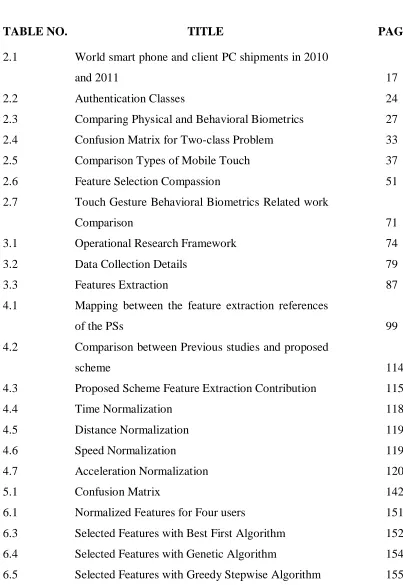
LIST OF TABLES
TABLE NO. TITLE PAGE
2.1 World smart phone and client PC shipments in 2010
and 2011 17
2.2 Authentication Classes 24
2.3 Comparing Physical and Behavioral Biometrics 27
2.4 Confusion Matrix for Two-class Problem 33
2.5 Comparison Types of Mobile Touch 37
2.6 Feature Selection Compassion 51
2.7 Touch Gesture Behavioral Biometrics Related work
Comparison 71
3.1 Operational Research Framework 74
3.2 Data Collection Details 79
3.3 Features Extraction 87
4.1 Mapping between the feature extraction references
of the PSs 99
4.2 Comparison between Previous studies and proposed
scheme 114
4.3 Proposed Scheme Feature Extraction Contribution 115
4.4 Time Normalization 118
4.5 Distance Normalization 119
4.6 Speed Normalization 119
4.7 Acceleration Normalization 120
5.1 Confusion Matrix 142
6.1 Normalized Features for Four users 151
6.3 Selected Features with Best First Algorithm 152
6.4 Selected Features with Genetic Algorithm 154
6.6 Selected Features with Random Search Algorithm 157 6.7 Selected Features with Forward selection Algorithm 158
6.8 Feature Selection user Profile Dataset 162
6.9 Feature Selection Dataset with Naïve Bayes
Classification Accuracy 163
6.10 Feature Selection Dataset with Bayesian
Classification Accuracy 165
6.11 Feature Selection Dataset with K-Star Classification
Accuracy 166
6.12 Feature Selection Dataset with Bagging
Classification Accuracy 168
6.13 Feature Selection Dataset with J48 Classification
Accuracy 169
6.14 Feature Selection Dataset with Random Forest
Classification Accuracy 171
6.15 Summary of Dataset Accuracy per Classification
Algorithm 173
6.16 Performance Measurement Result 177
6.17 Touch Gesture Biometrics Related work Result
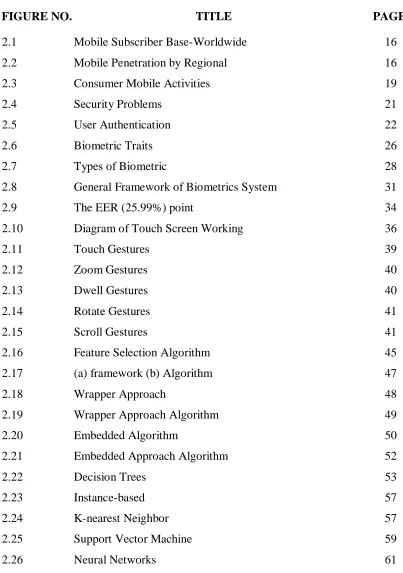
LIST OF FIGURES
FIGURE NO. TITLE PAGE
2.1 Mobile Subscriber Base-Worldwide 16
2.2 Mobile Penetration by Regional 16
2.3 Consumer Mobile Activities 19
2.4 Security Problems 21
2.5 User Authentication 22
2.6 Biometric Traits 26
2.7 Types of Biometric 28
2.8 General Framework of Biometrics System 31
2.9 The EER (25.99%) point 34
2.10 Diagram of Touch Screen Working 36
2.11 Touch Gestures 39
2.12 Zoom Gestures 40
2.13 Dwell Gestures 40
2.14 Rotate Gestures 41
2.15 Scroll Gestures 41
2.16 Feature Selection Algorithm 45
2.17 (a) framework (b) Algorithm 47
2.18 Wrapper Approach 48
2.19 Wrapper Approach Algorithm 49
2.20 Embedded Algorithm 50
2.21 Embedded Approach Algorithm 52
2.22 Decision Trees 53
2.23 Instance-based 57
2.24 K-nearest Neighbor 57
2.25 Support Vector Machine 59
2.27 Touch Fingertip Movement 63
2.28 The Proposed Architecture 64
2.29 The Proposed architecture 65
2.30 Gesture authentication Architecture 66
2.31 Touch-dynamics-based authentication 67
3.1 Research Procedure 74
3.2 Research Methodology Flowchart 76
3.3 Implementation Procedure 80
3.4 Eclipse Android Emulator SDK Platform 81
3.5 Application Screenshot 82
3.6 Creating SQLite Database 83
3.7 Create Table 84
3.8 Feature Selection 89
3.9 Overview Authentication process 90
4.1 Finger Touch Event 95
4.2 Feature Component 96
4.3 Number of extracted features by previous studies 100
4.4 Minor Axis 103
4.5 Touch Minor Up Algorithm 103
4. 6 Touch Minor Down Algorithm 104
4.7 Finger Pressure up Algorithm 105
4.8 Finger Pressure down Algorithm 106
4.9 Distance Historical points. 108
4.10 Distance Algorithm 108
4.11 Finger Size up Algorithm 109
4.12 Finger Size down Algorithm 110
4.13 Major Axis 111
4.14 Touch Major up Algorithm 112
4.15 Touch Major down Algorithm 112
4.16 Percentage for each features used among the
previous studies 113
5.1 Feature Selection in Weka 123
5.2 Wrapper approach for feature selection 125
5.4 Forward Selection Search Iteration 130
5.5 Classification Algorithms 132
5.6 Bayes Net applied in Classification 135
5.7 Bagging Classification 138
5.8 Decision Tree Classification 138
5.9 J48 Tree Classification 139
5.10 Random Forest Classifier 140
5.11 ROC curves: (a) regions of a ROC graph (b) 144
6.1 Enrolment Screen 147
6.2 Features Extraction Screen 148
6.3 Screen Shot of Enrolled Touch Gestures 149
6.4 Screen Shot of Touch Gesture Data Set 150
6.5 Comparison between Date Set before and after
Normalization 151
6.6 Best First Algorithm Accuracy 153
6.7 Genetic Algorithm Accuracy 154
6.8 Greedy Stepwise Algorithm Accuracy 156
6.9 Random Search Algorithm Accuracy 157
6.10 Forward selection Search Algorithm Accuracy 159 6.11 Naïve Bayes Classification Analysis (a) A
comparison between 164
6.12 Bayes Net (a) A comparison between correctly and
incorrectly 165
6.13 K-Star (a) A comparison between correctly and
incorrectly classified 167
6.14 Bagging (a) A comparison between correctly and
incorrectly classified 168
6.15 J48 (a) Compare between correctly and incorrectly
classified instances 170
6.16 Random Forest (a) A comparison between correctly
and incorrectly 171
6.17 A comparison of classification accuracy amongst
classifiers. 172
6.19 Equal Error Rate for user number three from ROC
Curve in Weka 181
6.20 Classification Accuracy in Weka 182
6.21 Regions of a ROC Graph 183
6.22 A comparison of the proposed scheme in terms of
accuracy 185
6.23 A comparison of the proposed scheme in terms of
Equal Error Rate 186
6.24 A comparison of the proposed scheme in terms of
LIST OF ABBREVIATIONS
AC - Accuracy
API - Application Program Interface ATM - Automated Teller Machine
BPNN - Back-Propagation Neural Networks CER - Cross-over Error Rate
DAG - Directed Acyclic Graphs
DTW - Dynamic Time Warping
EER - Equal Error Rate
FAR - False Acceptance Rate
FN - False Negatives
FP - False Positives
FRR - False Rejection Rate
IDE - Integrated Development Environment
JDK - Java Development Kit
JRE - Java Runtime Environment
K-NN - K-Nearest Neighbor
LCD - Liquid Crystal Display
MAX Maximum
MEMS - Micro-Electro-Mechanical Systems
MIN - Minimum
NN - Neural Networks
NSF - National Science Foundation
PAN - Personal Area Network
PIN - Personal Identification Number RBFN - Radial Basis Function Network ROC - Receiver Operating Characteristic
SAW - Surface Acoustic Wave
SMS - Short Message Service SQL - Structured Query Language
SVM - Support Vector Machine
TN - True Negatives
TNR - True Negative Rate
TP - True Positives
TPR - True Positive Rate
UI - User Interfaces
LIST OF APPENDICES
APPENDIX TITLE PAGE
A Source Code of the Proposed Scheme 215
B Data Collection Guidelines Form 227
C Touch Gesture Database 229
D Experimental Result for Features Selection Algorithms 234 E Experimental Result for Classification Algorithms 239
F Confusion Matrix 254
CHAPTER 1
INTRODUCTION
In this chapter, the research problem background and statement are stated, and then followed by research objectives, which used to handle and treat these problems. Furthermore, other aspects such as research scope, and significance of the research are determined. Finally, the chapter concluded with thesis organization and summary.
1.1 Research Overview
Currently common mobile authentication mechanisms such as passwords, PINs have failed to keep up with the pace of challenges presented with use of ubiquitous devices over the internet, since they can easily be lost or stolen (Crawford, 2010). Thus, it is important to develop authentication mechanisms that can be adapted to such environment. Biometric-based person recognition is a good alternative to overcomes the difficulties of password and token approaches (El-Abed et al, 2010; Jain and Kumar, 2010; Shanmugapriya and Padmavathi, 2011). In addition unlike PINs, passwords, tokens, biometrics cannot be easily stolen or forgotten.
An important characteristic of biometric authentication is that there is an explicit connection with the user's identity, since biometrics rely entirely on behavioral and physiological characteristics of the human being. Thus, require the physical presence of the human being in question to explicitly provide the required biometric authentication actions for the device authenticate. Derawi et al, 2010 mentioned that there are a variety of biometric authentication options that have so far emerged which can be used on a mobile phone. These options include but not limited to, face recognition through the camera, fingerprint, voice recognition, keystroke and gesture recognition via touch screen or camera.
Android mobile devices recently brought face recognition to the masses by enabling user authentication through the front-facing camera. Even though intuitive and fast, this type of authentication suffers from typical computer vision limitations. According to Wang et al (2015) face recognition performance degrades under poor or different lighting conditions than the ones used during training. Given that mobile devices constantly follow their users, such fluctuations on the environmental conditions are common.
fitted. However, as phone manufacturers push for devices with large edge-to-edge displays, physical buttons are quickly replaced by capacitive buttons that can be easily embedded into the touch screen, eliminating the real-estate required by a fingerprint sensor. Embedding fingerprint sensors into touch screens behind gorilla glass is challenging, and has not been demonstrated.
This research focuses one of the mentioned biometric authentication methods, namely touch gesture recognition. According to Zhang et al (2015) most of the latest mobile phones have embedded sensors which can be used for touch gesture mobile biometric authentication. Touch gestures, as a kind of behavioural biometric, are basically the way users swipe their fingers on the screen of their mobile devices. They have been used to authenticate users while users perform basic operations on the phone. In these methods, a behavioural feature is extracted from the recorded screen touch data and a discriminative classifier is trained on these extracted features for authentication.
While the user performs the gesture, it leverages the touch screen sensor to extract touch user‘s finger features (size, pressure, timing and distance). When combined, the information from touch sensors provides ides a detailed view into how the individual user performs the gesture, and, as it shows in this research, it can be used as a sensor finger touch to authenticate the user. Attackers willing to bypass this authentication mechanism, face a much harder task as they have to simultaneously reproduce the timing, placement, size, and pressure of each finger touch. This thesis presents a mechanism of user authentication in mobile devices based on gestures as the behavioral biometrics. Results from experiments conducted in this research work affirm that user authentication through gestures is promising, viable and can be used in mobile devices.
1.2 Research Background
users of such phones usually are concerned about their sensitive data stored in the phone than the phone itself (Kuhn and Johnson, 2013). In essence, when a smartphone is lost, the consequences that come with it are dire, they include privacy intrusion, user impersonation, and sometimes severe financial loss. As a first defense step, user authentication is essential to protect a system (Crawford, 2010). Currently, user authentication systems for mobile phones are mainly based on three techniques: passwords, physiological biometrics and behavioral biometrics (Meng et al, 2013).
Password authentication has well-known drawbacks, for instance, passwords can often easily be guessed and stolen through ―shoulder surfing‖ (Meng et al, 2013). Ross et al (2008), have come up with a list of attacks such as password guessing, shoulder surfing and password log-in mobile applications among others; in most cases these attacks are easily launched to compromise password based authentication systems. Furthermore, even the best password can be stolen by dictionary and brute force attacks (Karnan et al, 2011). Moreover, password authentication method bring insufficient security level because writing them down, using simple passwords, or reusing passwords make them easy to break.
In order to alleviate these pitfalls that are associated with password authentication, ongoing research is focused on biometric authentication mechanisms that can be used with mobile phones. Previous studies (Sesa-Nogueras and Faundez-Zanuy, 2012; El-Abed et al, 2010; Jain and Kumar, 2010; Shanmugapriya and Padmavathi, 2011; Karnan et al, 2011) have reported that biometric-based person recognition is a good alternative to overcome the difficulties of password authentication. Biometric authentication is an authentication mechanism that uses human behavioral or physiological characteristics that are measurable, to define and represent the identity of a user.
difficult and intrusive for collectability, Low degree of user acceptability (Jain and Kumar, 2010). Banerjee and Woodard (2012), reported that the use of biometrics such as face, fingerprints and signature requires additional tools to acquire the biometric which leads to an increase in costs.
In contrast, behavioral biometrics authentication rely upon a person's actions or habits to uniquely identify that person. Behavioral biometrics authentication may include signature recognition, mouse dynamics, touch gesture and keystroke dynamics. Behavioral biometrics can be an alternative to physical biometrics, therefore address some of the earlier pitfalls of physical biometrics. In addition, behavioral biometrics are easily implementable since they can be implemented at the software level (Yampolskiy and Govindaraju, 2010). These biometrics can be unobtrusive and easily collected, without the user's knowledge (Bours, 2012). In addition, collection of data about the behavioral biometrics does not often require any special hardware and therefore it is cost effective (Jamil and Khan, 2011).
Traditional biometric methods include fingerprints, face or voice recognition have been used in mobile devices for user authentication. However, face or voice recognition have an issue not very well suited in every situation. The authentication method must be able to cope with very different environments for example relatively dark or noisy. In addition, Fingerprints rely on specific scanners which are not available on every smartphones today. Furthermore, embedding fingerprint sensors into touch screens behind gorilla glass is challenging, and has not been demonstrated (Wang et al, 2015). In the other hand, another traditional biometric method is keystroke authentication. keystroke authentication used traditional keyboards could only provide temporal information for example time interval between keystroke and time interval of a key being pressed (Trojahn and Ortmeier, 2013).
related to a specific user. Trojahn and Ortmeier (2013) said that touch screen mobile devices can provide very specific data of finger pressure, finger size or (relative) position where a touch has been hit. In addition, some features from the touch screen authentication method can be used because of the capacitive display.
With the increased popularity of touchscreen mobile phones, touch gesture behavior is increasingly becoming important in comparison to its counterpart the keystroke behavior, since almost all smartphones use the touch screen as the main input method (Meng et al, 2013). A gesture based authentication system would make it more difficult for a shoulder surfer to replay the password, even if he observes the entire gesture. Subtleties like force, speed, flexibility, pressure, and individual anatomical differences would prevent the casual observer of the password (Niu and Chen, 2012).
Many touch gesture behavioral biometrics authentication schemes have been produced for smartphones authentication. Burgbacher et al (2014), proposed authentication scheme for smartphones and other touch screen-based devices that combine behavioral biometrics from the fingertip movement on touch screens. They developed an android application which collects behavior features from the touch screen such as a sequence of x and y positions representing the location of the finger touch, and a timestamp for each location. The proposed authentication scheme and recognition algorithms are assessed by 42 users with 90% accuracy. The weakness of their proposed authentication scheme is concerning the small session number in which the data was collected. Because the data from a single subject was obtained in only one session may have influenced the performance of the system. In addition, one way to improve the proposed scheme could be to involve more features such as the fingertip pressure and finger size.
algorithms to classify their touch data namely Naive Bayes (NBayes), decision tree and k-nearest neighbour (IBK). However, the WEKA platform tool was used for data extraction to avoid any implementation bias. The evaluation was conducted using 50 participants with Android phones. Their study evaluation results show that their proposed authentication mechanism positively affects the performance of authentication by having good authentication accuracy with an average FAR of 7.74% and an average FRR of 6.65%. The accuracy of authentication can further be improved by adding more appropriate classifiers, such as bagging classifier or random forest classifier and also consider other touch gesture related features like the touch distance.
Xu et al (2014) suggested a touch-based authentication framework to authenticate user. The authentication proceeds in a passive way while the user performs her normal touch operations. As a first attempt, they investigated the underlying fundamentals of touch operations as biometrics. In other words, they evaluated whether the data features are distinctive among various users and they manage to achieve 8.67% average equal error rate. They have conducted a real-world experiment involving over 30 users. They collected four types of touch features which are x and y coordinates, time, size, pressure, and saves their touch data sequences for further analysis. There is a quite implementation issue of their touch-based authentication framework. Examples design a user-friendly mechanism to obtain data samples for training purpose rather than runs silently as a smartphone background service.
Wolff (2013) looked at the different sensors provided by mobile phones, and show that data collected from these sensors can distinguish mobile users by analyzing the user‘s interaction with the device. He extracted additional features, inducing the direction of a gesture, the end point, the distance between the beginning and end of a gesture, the gesture speed, and the lateral variance on a gesture. He was able to correctly identify the user with 83% accuracy. The weakness of his work is having small number of user to test and evaluate the scheme. A larger scale study incorporating more users is needed in order to realize a more accurate authentication mechanism that can identify them based on data of their touch gesture biometric.
Meng et al (2013) utilized accurate user authentication mechanism which a behavioral feature set that is related to touch dynamics. Results from this experiment show that the neural network classifier is accurate enough to authenticate a variety of users; however, there was an error rate of 7.8% on the selected features used in that experiment. They suggested that using other classifiers, involving more participants and also gather more data on touch gesture biometrics, may help in even getting a more accurate and efficient mechanism.
In their behavioural biometrics touch screen study, Kolly et al (2012) investigated whether they could differentiate users based on their behaviour on the touch screen. To accomplish that objective, they collected data on touch events for 5 users; and realized that they could identify a user with an accuracy of 80% there about. The data collected was on basic touch properties like pressure, time and position. The weakness of his work is having a small number of users to test and evaluate the scheme. As such, a large scale study that incorporates more users is preferred such that more data can be collected, hence realize a more accurate mechanism to identify users based on data from their touch gesture behavior biometric.
authentication accuracy, using more several known machine learning algorithms (e.g., Naive Bayes, decision tree) for classification and features selection algorithm. The second issue is extracting few touch features from individual touches, such as touch duration and touch direction which is not enough to distinctive among various users (Sitova et al, 2015; Xu et al, 2014; Meng et al, 2013; Trojahn and Ortmeier, 2013). It can extract all possible touch gesture features, such as fingertip pressure and finger size to distinctive among various users. Finally, conducted experiment with small number of user to test and evaluate the authentication scheme (Angulo and Wästlund, 2012; De Luca et al, 2012; Kolly et al, 2012; Wolff, 2013).
The aim of touch gesture is to develop scheme that enhance the authentication accuracy and performance of determination users based on their touch gesture behavioral biometrics. From the existing works, scheme (Angulo and Wästlund, 2012; De Luca et al, 2012; Kolly et al, 2012; Wolff, 2013) collected and tested their methods in small group of users and advice to include more users and larger sample size in order to make a more robust determination on the ability to identify users. This research develop a scheme to extract and study more touch gesture features and tested in large group of user by using multiple classification techniques, hence this will increase the accuracy with good performance authentication.
1.3 Problem Statement
authentication. While these touch gesture features they used in their schemes have shown potential and provided promising results, there is still space for extracting and analyzing new touch features from individual touches to substantially improve authentication accuracy.
In fact, the touch gesture features used in their schemes are speed, time, position, and finger size and finger pressure. However, extracting few touch features from individual touches is not enough to distinctive among various users accurately. Therefore, in order to secure mobile devices and protect users‘ data, it is very crucial to enhance user authentication scheme for mobile phones. One fundamental mobile security problem is user authentication, and if not executed correctly, leaves the mobile user vulnerable to harm like impersonation or unauthorized access.
The key idea is to combine the features that can be extracted from mobile sensors when human finger touch mobile screen with an extended features by preforming mathematics calculations. The best features subset choosed based on performing different feature selection algorithms which aims to speed classification algorithms and enhance authentication accuracy. Several machine learning classifier used to authenticate users this is due to the fact that the performance of a classifier may be fluctuant in terms of different training datasets. For instance, an algorithm may achieve a very good authentication result regarding a set of user inputs, but its performance may drop quickly for another set of user inputs (Veniamin Ginodman et al,2014). This strategy is crucial to perform high-accuracy user authentication, outperforming all the prior touch gesture behavioral biometric authentication sachems for mobile devices.
1.4 Research Questions
i. What are the current user authentication systems and schemes for touch gesture-based behavioral biometrics that are used on mobile phones?
ii. What are the touch features have been used in previous studies and how the previous studies extract the features?
iii. How can the touch gesture-based behavioral biometrics schemes be improved to distinguish users based on their touch dynamics and also obtain enhanced authentication accuracy?
1.5 Research Objectives
In order to answer the research questions stated above, the research objectives were identified as follows:
i. To identify and extract finger touch features for touch gesture-based behavioral biometrics authentications scheme on mobile phones.
ii. To develop five different features selection algorithms and six different classification algorithm based on the extracted features.
iii. To develop touch gesture-based behavioral biometrics scheme and determine its authentication accuracy on user‘s touch dynamics.
1.6 Scope of Study
i. The study was delimited to the data acquisition, feature extracting, features selection and classification process of behavioral biometrics. There were four biometrics performance requirements (false reject rate, false accept rate, equal error rate and accuracy) used to evaluate and target the enhancement of behavioral biometrics authentication.
ii. The proposed scheme controls the user activities by providing a guideline during the data collection process in such way the features will be extracted. The extracted features were normalized by scaling its values using the Min-Max normalization technique, to that they are within a certain specified range.
iii. The touch-gesture behavioral biometric authentication data was collected from students and staff of the Universiti Teknologi Malaysia and were duly informed about the purpose of this work.
iv. The implementation of feature extraction and the graphical user interface are done using Java Eclipse with an Android phone. SQLite database was used to store data for the extracted features. Testing, data analysis and evaluation were done using WEKA machine learning toolkit (WEKA tool).
1.7 Significance of the Study
The outcomes of this research would greatly contribute to behavioural biometric authentication schemes for mobile devices. The significance of this research are:
i. It established scheme based on touch gestures authentication in order to secure against shoulder surfers, even those with video cameras, because it is hard to estimate the force and timing of gestures correctly solely with brute force.
confirm the authorized user based on his finger touch features, which is
providing an additional security level of verification. Even if the touch
gesture is revealed by unauthorized user, the difficulty of breaking the
authentication is increased.
iii. It identifies and understands the extracted features from finger contacted the touch screen, it started to record and save the trace by recording raw touch finger movement features.
iv. Another important implication of this scheme extend beyond touch gesture authentication; it might be applied to any biometric source such as keystroke dynamics, signature or gait.
v. Touch gestures authentication scheme introduce dataset captured from 84 subjects over six sessions. This dataset will be available to researchers to facilitate progress in this field.
vi. The implication of this scheme is that unlike the existing schemes, our scheme used five different feature selection algorithms to choose the most significant feature subset. This was a process to speed classification algorithms, enhance prediction accuracy and comprehensibility.
1.8 Thesis Organization
were chosen due to their various advantages that can provide protection security. It concluded with a review of the existing touch gesture behavioral biometrics.
Chapter three describes research procedures and research phases (literature review phase, data collection phase, enrolment phase, and authentication phase). Chapter four presents the systematic literature review for feature identification and extraction. It also provides a brief review of previous studies for touch features used in their schemes. Chapter five elaborates the five different features selection algorithms and six different classification algorithms. It illustrates technical and practical performance evaluation of the proposed scheme.
Chapter six provides the analysis and discussion of the results. A number of experimental studies into the analyzing and testing linguistic features using a pattern classification method based upon six different classification algorithms. Furthermore, a comparative study between the algorithm proposed in this research and other touch gesture behavioral biometrics techniques for authentication is also presented and discussed. Chapter seven presents review and the main conclusions from the research. It identifies the main methods used and discusses their implications in the research. It discusses the contributions of this research as well the recommendation and future works.
1.9 Summary
REFERENCES
ABI (2012). Smart, the Next Wave of Bluetooth. ABl research. Retrieved March 2, 2015, from http://www.abiresearch.com/research/product/1013429-smart-the-next-wave-ofbluetooth/.
Ade, R., and Deshmukh, P. (2014). Instance-based vs Batch-based Incremental Learning Approach for Students Classification. International Journal of
Computer Applications, 106(3), 37-41.
Aggarwal, C. C. (2014). Data Classification: Algorithms and Applications. Data Mining and Knowledge Discovery Series. CRC Press.
Aha, D. W. and Bankert, R. L. (1996). A comparative evaluation of sequential feature selection algorithms. Proceedings of the Fifth International
Workshop on Artificial Intelligence and Statistics. Springer New York,
199-206.
Al Shalabi, L., and Shaaban, Z. (2006). Normalization as a preprocessing engine for data mining and the approach of preference matrix. Proceedings of the
International Conference on Dependability of Computer Systems, Szklarska
Poreba 207-214.
Ali, H. and Salami, M. (2009). Keystroke pressure based typing biometrics authentication system by combining ANN and ANFIS-based classifiers. 5th International Colloquium on Signal Processing & Its Applications (CSPA),
Kuala Lumpur, 198-203.
Ali, J., Khan, R., Ahmad, N., & Maqsood, I. (2012). Random forests and decision trees. International Journal of Computer Science Issues (IJCSI), 9(5), 272-278.
Angulo, J. and Wästlund, E. (2012). Exploring touch-screen biometrics for user identification on smart phones. Advances in Information and Communication
Araujo, L. C., Sucupira Jr, L. H., Lizarraga, M. G., Ling, L. L. and Yabu-Uti, J. B. (2005). User authentication through typing biometrics features. IEEE
Transactions on Signal Processing, 53(2), 851-855.
Arthi, K.,. Nandhitha, N.M. and Roslin, S (2013). A Study and Evaluation of Different Authentication Methods and Protocols. International Journal of
Computer Science and Management Research, 2(1), 549-555.
Aruna, S., Rajagopalan, S. and Nandakishore, L. (2011). An Empirical Comparison of Supervised Learning Algorithms in Disease Detection. International
Journal of Information Technology Convergence and Services–IJITCS. 1(4),
81-92.
Aung, W. T. and Hla, K. H. M. S. (2009). Random forest classifier for multi-category classification of web pages. Services Computing Conference,
APSCC 2009. IEEE Asia-Pacific. Singapore, 372-376.
Ashbourn, J. (2004). Practical Biometrics: From Aspiration to Implementation.
London: Springer.
Banerjee, S. P. and Woodard, D. L. (2012). Biometric Authentication and Identification using Keystroke Dynamics: A Survey. Journal of Pattern
Recognition Research,7(1), 116-139.
Battles, M. D. Gartner identifies the top 10 strategic technology trends for 2013.
Gartner Symposium. Retrieved 23-Oct-2013, from
http://www.gartner.com/newsroom/id/2209615
Berg Insight (2011). Mobile Money in Emerging Markets. Berg Insight’s VAS
research series. Retrieved February 20, 2012, from
http://www.berginsight.com/ReportPDF/ProductSheet/bi-mm1-ps.pdf. Bhalla, M. R. and Bhalla, A. V. (2010). Comparative Study of Various Touchscreen
Technologies. International Journal of Computer Applications IJCA. 6(8), 12-18.
Bimbot, F., Bonastre, J.-F., Fredouille, C., Gravier, G., Magrin-Chagnolleau, I., Meignier, S., Merlin, T., Ortega-García, J., Petrovska-Delacrétaz, D. and Reynolds, D. A. (2004). A tutorial on text-independent speaker verification.
EURASIP journal on applied signal processing, 4 , 30-451.
Bolón-Canedo, V., Sánchez-Maroño, N. and Alonso-Betanzos, A. (2013). A review of feature selection methods on synthetic data. Knowledge and information
Bonastre, J.-F., Bimbot, F., Boë, L.-J., Campbell, J., Reynolds, D., and Magrin-Chagnolleau, I. Person authentication by voice: a need for caution. The Proceeding of 8th European Conference on Speech Communication and
Technology, Geneva, Switzerland, 33–36.
Bonev, B. (2010). Feature selection based on information theory. Universidad de
Alicante. Kochi University of Technology, Spain, PhD Thesis.
Bours, P. (2012). Continuous keystroke dynamics: A different perspective towards biometric evaluation. Information Security Technical Report, ELSEVIER, 17(1-2), 36-43.
Bragdon, A., Nelson, E., Li, Y. and Hinckley, K. (2011). Experimental analysis of touch-screen gesture designs in mobile environments. Proceedings of the
SIGCHI Conference on Human Factors in Computing Systems, New York,
403-412.
Buchoux, A. and Clarke, N. L. (2008). Deployment of keystroke analysis on a smartphone. Proceedings of the 6th Australian Information Security
Management Conference, Western Australia, 7-48.
Burgbacher, U., Pratorius, M., and Hinrichs, K. (2014). A behavioral biometric challenge and response approach to user authentication on smartphones.
Proceedings of the International Conference on Systems, Man and
Cybernetics (SMC), San Diego California, 3328-3335.
Burr, W. E., Dodson, D. F., Newton, E. M., Perlner, R. A., Polk, W. T., Gupta, S. and Nabbus, E. A. (2011). Electronic Authentication Guideline. National
Institute of Standards and Technology, NIST Special Report 800–63-1.
Cai, Z., Shen, C., Wang, M., Song, Y. and Wang, J. (2013). Mobile authentication through touch-behavior features. Lecture Notes in Computer Science,
Biometric Recognition, Springer International Publishing, 386-393.
Caruana, R. and Freitag, D. (1994). Greedy Attribute Selection. The Proceedings of
11 International Conference on Machine Learning, Morgan Kaufmann,
28-36.
Cateni, S., Vannucci, M., Vannocci, M. and Colla, V. (2012). Variable Selection and Feature Extraction through Artificial Intelligence Techniques. Multivariate
Analysis in Management, Engineering and the Science. 103-118.
Cheng, J., Grainer, G., Kelly, J., Bell, D. and Lius, W. (2002). Learning bayesian networks from data: An information-theory based approach. University of Alberta, Canada, PhD Thesis.
Chong, A. Y.-L., Chan, F. T. and Ooi, K.-B. (2012). Predicting consumer decisions to adopt mobile commerce: Cross country empirical examination between China and Malaysia. Decision Support Systems, 53(1), 34-43.
Chouaib, H., Terrades, O. R., Tabbone, S., Cloppet, F. and Vincent, N. (2008). Feature selection combining genetic algorithm and adaboost classifiers. 19th
International Conference on Pattern Recognition (ICPR). Tampa Florida,
1-4
Cisco, I. (2009). Data Leakage Worldwide: Common Risks and Mistakes Employees Make. Cisco Systems. Retrieved September 2 2012, from http://www.cisco.com/en/US/solutions/collateral/ns170/ns896/ns895/white_ paper_c11-499060.pdf
Clarke, N. L. and Furnell, S. (2007). Authenticating mobile phone users using keystroke analysis. International Journal of Information Security. 6(1), 1-14. Clarke, N. L., Furnell, S. M. and Reynolds, P. L. (2002). Biometric authentication for mobile devices. Proceeding of 3rd Australian Information Warfare and
Security Conference, Perth, Australia, 61-69.
Cooper, D. (2012). Canalys: More smartphones than PCs shipped in 2011. Canalys
survey. Retrieved April 4 2013, from
http://www.engadget.com/2012/02/03/canalys-more-smartphones-than-pcs-shipped-in-2011/.
Crawford, H. (2010). Keystroke dynamics: Characteristics and opportunities. Eighth
Annual International Conference on Privacy, Security and Trust, Ottawa,
Canada, 205-212.
Crawford, H. A. (2012). A framework for continuous, transparent authentication on mobile devices. University of Glasgow, United Kingdom, PhD Thesis. Cufoglu, A., Lohi, M. and Madani, K. (2009). A comparative study of selected
classifiers with classification accuracy in user profiling. World Congress on
Computer Science and Information Engineering, Los Angeles, California
De Luca, A., Hang, A., Brudy, F., Lindner, C. and Hussmann, H. (2012). Touch me once and i know it's you!: implicit authentication based on touch screen patterns. SIGCHI Conference on Human Factors in Computing Systems, Vancouver, Canada, 987-996.
Derawi, M. O., Nickel, C., Bours, P. and Busch, C. (2010). Unobtrusive user-authentication on mobile phones using biometric gait recognition. Sixth International Conference on Intelligent Information Hiding and Multimedia
Signal Processing (IIH-MSP). Darmstadt, Germany, 306-311.
Devasena, C. L. (2014). Adeptness Comparison between Instance Based and K Star Classifiers for Credit Risk Scrutiny. International Journal of Innovative
Research in Computer and Communication Engineering. 2(1), 20-28.
Devijver, P. A. and Kittler, J. (1982). Pattern recognition: A statistical approach. Prentice-Hall London.
do Nascimento, M. V., Batista, L. V. and Cavalcanti, N. (2014). Comparative study of learning algorithms for recognition by hand geometry. IEEE International
Conference on Systems, Man and Cybernetics (SMC), San Diego California,
423-428.
Du, P., Xia, J., Zhang, W., Tan, K., Liu, Y. and Liu, S. (2012). Multiple classifier system for remote sensing image classification: a review. Sensors, 12(4), 4764-4792.
El-Abed, M., Giot, R., Hemery, B. and Rosenberger, C. (2010). A study of users' acceptance and satisfaction of biometric systems. IEEE International
Carnahan Conference on Security Technology (ICCST), San Jose California,
170-178.
EN 50133 (1997). Alarm systems. Access control systems for use in security applications. System requirements. BSI.
Feizi-Derakhshi, M.-R. and Ghaemi, M. (2014). Classifying Different Feature Selection Algorithms Based on the Search Strategies. International Conference on Machine Learning, Electrical and Mechanical Engineering
(ICMLEME). Dubai, United Arab Emirates, 8-9.
Feng, T., Liu, Z., Kwon, K.-A., Shi, W., Carbunar, B., Jiang, Y. and Nguyen, N. (2012). Continuous Mobile Authentication using Touchscreen Gestures.
IEEE Conference on Technologies for Homeland Security (HST),
Fierrez-Aguilar, J., Ortega-Garcia, J., Gonzalez-Rodriguez, J. and Bigun, J. (2005). Discriminative multimodal biometric authentication based on quality measures. Pattern Recognition. 38(5), 777-779.
Frank, M., Biedert, R., Ma, E., Martinovic, I. and Song, D. (2013). Touchalytics: On the applicability of touchscreen input as a behavioral biometric for continuous authentication. Information Forensics and Security, IEEE
Transaction on Information Forensics and Security, 8(1), 136-148.
Gafurov, D., Snekkenes, E. and Buvarp, T. E. (2006). Robustness of biometric gait authentication against impersonation attack. Proceedings of the First
International Workshop on Information Security ((IS'06), Montpellier,
France, 51-59.
Grenga, A. J. (2014). Android Based Behavioral Biometric Authentication via Multi-Modal Fusion. Graduate School of Engineering and Management, Air
Force Institute of Technology, Air University: DTIC Document.
Gupta, S., Kumar, D. and Sharma, A. (2011). Data mining classification techniques applied for breast cancer diagnosis and prognosis. Indian Journal of
Computer Science and Engineering (IJCSE). 2(2), 188-195.
Guse, D. (2011). Gesture-based User Authentication for Mobile Devices. Technischen Universität Berlin, Germany, Master Thesis.
Hamzaçebi, C. and Kutay, F. (2007). Continuous functions minimization by dynamic random search technique. Applied Mathematical Modelling. 31(10), 2189-2198.
Henry, P. and Luo, H. (2002). WiFi: what's next?. IEEE Communications Magazine, 40(12), 66-72.
Holmes, J. H. (1999). Quantitative methods for evaluating learning classifier system performance in forced two-choice decision tasks. Proceedings of Second
International Workshop on Learning Classifier Systems, Orlando Florida,
250-257.
Hoogsteder, V. (2010). Our presentation from Mobile World Congress 2010–Mobile application stores state of play. Accessed ( 07.11. 14)
Horning, N. (2010). Random Forests: An algorithm for image classification and generation of continuous fields data sets. Proceeding of the 5th International Conference on Geoinformatics for Spatial-Infrastructure Development in
Hossain, M. R., Oo, A. M. T. and Ali, A. S. (2013). The combined effect of applying feature selection and parameter optimization on machine learning techniques for solar Power prediction. American Journal of Energy
Research. 1(1), 7-16.
IBG (2010). How is biometric defined?. International Biometric Group. Retrieved December 5, 2012, from http://www.biometricgroup.com/reports/biometric_ definition.html97.
Jain, A., Bolle, R. and Pankanti, S. (2002). Introduction to biometrics. In Biometrics
Personal Identification in Networked Society, Norwell, Kluwer, 1, 1-41.
Jain, A. K. and Kumar, A. (2010). Biometrics of next generation: An overview. Second Generation Biometrics. Springer Berlin, Germany.
Jain, A. K., Ross, A. and Prabhakar, S. (2004). An introduction to biometric recognition. IEEE Transactions on Circuits and Systems for Video
Technology, 14(1), 4-20.
Jamil, D. and Khan, M. N. A. (2011). Keystroke Pattern Recognition Preventing Online Fraud. International Journal of Engineering Science and Technology
(IJEST), 3(3), 1953-1958.
Jeon, S., Bang, J., Byun, K. and Lee, S. (2012). A recovery method of deleted record for SQLite database. Personal and Ubiquitous Computing. 16(6), 707-715. Jie, Y. L., Yi, Z. X., Da, C. and Siting, Z. (2012). Development and implementation
of Eclipse-based file transfer for Android Smartphone. 7th International
Conference on Computer Science & Education (ICCSE 2012), Melbourne,
Australia, 568-571.
Jo, H.-H., Karsai, M., Kertész, J. and Kaski, K. (2012). Circadian pattern and burstiness in mobile phone communication. New Journal of Physics. 14(1), 1-17.
Kalyani, G. and Lakshmi, A. J. (2012). Performance assessment of different classification techniques for intrusion detection. Journal of Computer
Engineering (IOSRJCE), 7(5), 25-29.
Kaspersky. (2012). Perception and knowledge of IT threats: the consumer‘s point of view. Kaspersky survey lab, Retrieved March- 2, 2012, from https://www.kaspersky.com/downloads/pdf/kaspersky-lab_ok-consumer-survey-report_eng_final.pdf
Kenny, P., Ouellet, P., Dehak, N., Gupta, V. and Dumouchel, P. (2008). A study of interspeaker variability in speaker verification. IEEE Transactions on Audio,
Speech, and Language Processing, 16(5), 980-988.
Kesavaraj, G. and Sukumaran, S. (2013). A study on classification techniques in data mining. 4th IEEE International Conference on Computing,
Communications and Networking Technologies (ICCCNT), Tiruchengode,
India, 1-7.
Kitchenham, B. and Charters, S (2007). Guidelines for Performing Systematic Literature Reviews in Software Engineering, Keele University and
University of Durham, UK, EBSE Technical Report, Version 2.3.
Kohavi, R. and John, G. H. (1997). Wrappers for feature subset selection. Artificial
intelligence. 97(1), 273-324.
Kolly, S. M., Wattenhofer, R., & Welten, S. (2012, November). A personal touch: Recognizing users based on touch screen behavior. Proceedings of the Third
International Workshop on Sensing Applications on Mobile Phones. New
York, USA, 1-5.
Komatineni, S and MacLean, D. (2012). Pro Android 4 (Vol. 1). New York: Apress. Koreman, J., Morris, A., Wu, D., Jassim, S., Sellahewa, H., Ehlers, J., Chollet, G.,
Aversano, G., Bredin, H. and Garcia-Salicetti, S. (2006). Multi-modal
biometric authentication on the SecurePhone PDA. Second Workshop on
Multimodal User Authentication, Toulouse, France,1-8.
Kotsiantis, S., Kanellopoulos, D. and Pintelas, P. (2006). Data preprocessing for supervised leaning. International Journal of Computer Science. 1(2), 111-117.
Kuhn, M. and Johnson, K. (2013). Applied predictive modeling. Springer, London, Limited Document, 4.1.
Kumar, R. and Verma, R. (2012). Classification algorithms for data mining: A survey. International Journal of Innovations in Engineering and Technology
Kumar, V. and Minz, S. (2014). Feature Selection: A literature review. Smart
Computing Review, 4(3), 211–229.
Lavesson, N. (2003). Evaluation of classifier performance and the impact of learning algorithm parameters. Master’s thesis, Department of Software
Engineering and Computer Science, Blekinge Institute of Technology,
Sweden.
Lee, S. (2012). Creating and Using Databases for Android Applications.
International Journal of Database Theory & Application. 5(2), 99-106.
Li, L., Zhao, X. and Xue, G. (2013). Unobservable Re-authentication for Smartphones. Proceedings of the 20th Network and Distributed System
Security Symp (NDSS). San Diego, United States, 1-16
Ling, C. X., Huang, J. and Zhang, H. (2003). AUC: a statistically consistent and more discriminating measure than accuracy. Proceedings of the 18th
International Joint Conferences on Artificial Intelligence (IJCAI), San
Francisco, USA, 329-341
Liu, H. and Yu, L. (2005). Toward integrating feature selection algorithms for classification and clustering. , IEEE Transactions on Knowledge and Data
Engineering. 17(4), 491-502.
Marcano-Cedeño, A., Quintanilla-Domínguez, J., Cortina-Januchs, M. and Andina, D. (2010). Feature selection using sequential forward selection and classification applying artificial metaplasticity neural network. 36th Annual
Conference on IEEE Industrial Electronics Society (IECON), Glendale,
United States, 2845-2850.
Mantyjarvi, J., Lindholm, M., Vildjiounaite, E., Makela, S.-M. and Ailisto, H. (2005). Identifying users of portable devices from gait pattern with accelerometers. IEEE International Conference on Acoustics, Speech, and
Signal Processing (ICASSP), Montreal, Canada, 2, ii/973 – ii/976.
Meng, Y. and Wong, D. S. (2014). Design of touch dynamics based user authentication with an adaptive mechanism on mobile phones. Proceedings
of 29th Annual ACM Symposium on Applied Computing, Gyeongju, Korea,
1680-1687.
Meng, Y., Wong, D. S. and Schlegel, R. (2013). Touch Gestures Based Biometric Authentication Scheme for Touchscreen Mobile Phones. Information
Metropolitan Police Service (2011). Safeguarding your mobile phone. Metropolitan
police. Retrieved March 1, 2015, from
http://www.met.police.uk/crimeprevention/phone.htm.
Monaco, J. V., Bakelman, N., Cha, S.-H. and Tappert, C. C. (2012). Developing a Keystroke Biometric System for Continual Authentication of Computer Users. European Intelligence and Security Informatics Conference (EISIC), Odense, Denmark, 210-216.
Moskovitch, R., Feher, C., Messerman, A., Kirschnick, N., Mustafic, T., Camtepe, A., Lohlein, B., Heister, U., Moller, S. and Rokach, L. (2009). Identity theft, computers and behavioral biometrics. IEEE International Conference on
Intelligence and Security Informatics (ISI'09), Dallas Texas, United States,
155-160.
Murphy, K. P. (2007). Performance evaluation of binary classifiers,University of
British Columbia, Technical Report. Springer.
Ngugi, B., Kahn, B. K. and Tremaine, M. (2011a). Typing Biometrics: Impact of Human Learning on Performance Quality. Journal of Data and Information
Quality (JDIQ). 2(2), 1-21.
Ngugi, B., Tremaine, M. and Tarasewich, P. (2011b). Biometric keypads: Improving accuracy through optimal PIN selection. Decision Support Systems. 50(4), 769-776.
Niu, Y. and Chen, H. (2012). Gesture authentication with touch input for mobile devices. Security and Privacy in Mobile Information and Communication
Systems. Springer Berlin Heidelberg, 94,13-24.
Nookala, G. K. M., Pottumuthu, B. K., Orsu, N. and Mudunuri, S. B. (2013). Performance analysis and evaluation of different data mining algorithms used for cancer classification. International Journal of Advanced Research
in Artificial Intelligence (IJARAI). 2(5), 49-55.
Pappa, G. L. and Freitas, A. A. (2010). Automating the Design of Data Mining Algorithms: An Evolutionary Computation Approach. Natural Computing. NewYork, Springer.
Patel, V. R. and Mehta, R. G. (2011). Impact of Outlier Removal and Normalization Approach in Modified k-Means Clustering Algorithm. International Journal
Patil, T. R. and Sherekar, M. S. (2013). Performance Analysis of Naive Bayes and J48 Classification Algorithm for Data Classification. International Journal
of Computer Science and Applications. 6(2), 331-336.
Pettey, C. and Goasduff, L. (2013). Gartner Says Worldwide Mobile Application Store Revenue Forecast to Surpass $15 Billion in 2011. Gartner survey.
Retrieved March 9, 2013, from
http://www.gartner.com/it/page.jsp?id=1529214.
Phyu, T. N. (2009).Survey of classification techniques in data mining. Proceedings of the International MultiConference of Engineers and Computer Scientists
(IMECS), Kowloon, Hong Kong, 18-20.
Portio Research (2012). Portio Research Mobile Factbook 2012. Portio Research.
Retrieved March 18, 2014, from
http://www.portioresearch.com/media/1797/Mobile%20Factbook%202012.p df.
Pratama, S. F., Muda, A. K., Choo, Y.-H. and Muda, N. A. (2011). Computationally Inexpensive Sequential Forward Floating Selection for Acquiring Significant Features for Authorship Invarianceness in Writer Identification. International Journal of New Computer Architectures and their Applications
(IJNCAA). 1(3), 581-598.
Portmann, D. Z. M. and Indulska, A.-H. T. J. (2009). Ubiquitous Intelligence and Computing. 6th International Conference on Ubiquitous Intelligence and
Computing, Brisbane, Australia, 193-203.
Pylvänäinen, T. (2005). Accelerometer based gesture recognition using continuous HMMs. Pattern Recognition and Image Analysis. 413-430.
Qi, Y. (2012). Random forest for bioinformatics. Ensemble machine learning.
Springer. New York, USA.
Qin, Z. (2006). Naive Bayes classification given probability estimation trees. Machine Learning and Applications, 2006. Proceedings of 5th International
Conference on Machine Learning and Applications (ICMLA'06), Orlando
Florida, 34-42.
Rejer, I. and Lorenz, K. (2013). Genetic algorithm and forward method for feature selection in EEG feature space. Journal of Theoretical and Applied
Ren, X. and Wu, X.-W. (2012). A novel dynamic user authentication scheme.
International Symposium on Communications and Information Technologies
(ISCIT), Queensland, Australia, 713-717.
Rokach, L. and Maimon, O. (2010). Data Mining and Knowledge Discovery.
Springer Science+ Business Media. Handbook, Second edition, 167-192.
Ross, A., Nandakumar, K. and Jain, A. K. (2008). Introduction to multibiometrics.
Springer. Handbook of Biometrics, 271-292.
Sae-Bae, N., Ahmed, K., Isbister, K. and Memon, N. (2012). Biometric-rich gestures: a novel approach to authentication on multi-touch devices.
Proceedings of t2012 ACM annual conference on Human Factors in
Computing Systems. Austin Texas, United States, 977-986.
Saevanee, H. (2014). Continuous User Authentication Using Multi-Modal Biometrics. , School of Computing and Mathematics, Plymouth University, England, PhD Thesis.
Saeys, Y., Inza, I. and Larrañaga, P. (2007). A review of feature selection techniques in bioinformatics. bioinformatics. 23(19), 2507-2517.
Sandberg, R. and Rollins, M. (2013). A Brief Introduction to Android Development. The Business of Android Apps Development. Springer. Handbook, Second edition, 39-50.
Sandnes, F. E. and Zhang, X. (2012). User Identification Based on Touch Dynamics.
9th International Conference on Ubiquitous Intelligence and Computing and
9th International Conference on Autonomic and Trusted Computing,
Fukuoka, Japan, 256-263.
Santra, A. and Christy, C. J. (2012). Genetic Algorithm and Confusion Matrix for Document Clustering. International Journal of Computer Science Issues
(IJCSI). 9, 322-328.
Saravanan, P., Clarke, S., Chau, D. H. P. and Zha, H. (2014). LatentGesture: active user authentication through background touch analysis. Proceedings of
Second International Symposium of Chinese CHI. Ontario, Canada, 110-113.
Sae-Bae, N., Memon, N. and Isbister, K. (2012).Investigating multi-touch gestures as a novel biometric modality. IEEE Fifth International Conference on
Biometrics: Theory, Applications and Systems (BTAS), Arlington, Virginia,
Sae-Bae, N., Memon, N., Isbister, K. and Ahmed, K. (2014). Multitouch gesture-based authentication. IEEE Transactions on Information Forensics and
Security, 9(4), 568-582.
Saeys, Y., Inza, I. and Larrañaga, P. (2007). A review of feature selection techniques in bioinformatics. bioinformatics. 23(19), 2507-2517.
Seo, H., Kim, E. and Kim, H. K. (2012). A Novel Biometric Identification Based on a User‘s Input Pattern Analysis for Intelligent Mobile Devices. International
Journal of Advanced Robotic Systems. 9, 1-10.
Sesa-Nogueras, E. and Faundez-Zanuy, M. (2012). Biometric recognition using online uppercase handwritten text. Pattern Recognition. 45(1), 128-144. Singh, N. and Khan, R. (2014). Equal Error Rate and Audio Digitization and
Sampling Rate for Speaker Recognition System. Advanced Science Letters.
20(5-6), 1085-1088.
Shahzad, M., Liu, A. X. and Samuel, A. (2013). Secure unlocking of mobile touch screen devices by simple gestures: you can see it but you can not do it. 19th
annual international conference on Mobile computing & networking. New
York, United States, 39-50.
Shanmugapriya, D. and Padmavathi, G. (2009). A survey of biometric keystroke dynamics: Approaches, security and challenges. International Journal of
Computer Science and Information Security. 5, 115-119.
Shanmugapriya, D. and Padmavathi, G. (2011). An Efficient Feature Selection Technique for User Authentication using Keystroke Dynamics. International
Journal of Computer Science and Network Security (IJCSNS). 11(10),
191-195.
Shanmugapriya, V. and Padmavathi, G. (2010). Keystroke Dynamics Authentication Using Neural Network Approaches. Information and Communication
Technologies. 101(3), 686-690.
Sherly, K. (2012). A Comparative Assessment of Supervised Data Mining Techniques for Fraud Prevention. International journal of soft computing
and engineering, 1. 1-6.