IMPROVED TWO-PHASE SOLUTION STRATEGY FOR MULTIOBJECTIVE FUZZY STOCHASTIC LINEAR PROGRAMMING PROBLEMS WITH
UNCERTAIN PROBABILITY DISTRIBUTION
ABDULQADER OTHMAN HAMAD AMEEN
IMPROVED TWO-PHASE SOLUTION STRATEGY FOR MULTIOBJECTIVE FUZZY STOCHASTIC LINEAR PROGRAMMING PROBLEMS WITH
UNCERTAIN PROBABILITY DISTRIBUTION
ABDULQADER OTHMAN HAMAD AMEEN
A thesis submitted in fulfilment of the requirements for the award of the degree of
Doctor of Philosophy (Mathematics)
Faculty of Science Universiti Teknologi Malaysia
iii
iv
ACKNOWLEDGEMENT
Praise be to A llah, God of the creation, Lord of the world. I would like to thank my creator for given me the strength to complete this research.
I would like to express my deepest thanks and gratitude to my highly distinguished Dr. Zaitul Marlizawati Zainuddin for her encouragement, inspiring guidance, and valuable suggestions throughout the progress of this work. She tirelessly provided guidance throughout the initial exploration, the background search, and finally the writing of the thesis.
Special appreciation goes to my wife Adiba E. Daghtachin for all her love and support during the years of my study; I could not have completed this without her patience.
v
ABSTRACT
vi
ABSTRAK
vii
CHAPTER TITLE PAGE
DECLARATION ii
DEDICATION iii
ACKNOWLEDGMENT iv
ABSTRACT v
ABSTRAK vi
TABLE OF CONTENTS vii
LIST OF TABLES xii
LIST OF FIGURES xiv
LIST OF ABBREVIATIONS xvi
LIST OF SYMBOLS xxi
LIST OF APPENDICES xxiii
1 INTRODUCTION 1
1.1 Introduction 1
1.2 Motivation 2
1.3 Background of the Problem 5
1.3.1 Introduction to Background of the Problem 5 1.3.2 Multiobjective Fuzzy Linear Programming
Problem 8
1.3.3 Multiobjective Stochastic Linear Programming
Problem 12
1.3.4 Deterministic Multiobjective Linear Programming
Problem 16
1.4 Problem Statement 17
1.5 Research Questions 19
1.6 Research Objectives 20
1.7 Scope of the Study 20
1.8 Significance of the Study 21
1.9 Research Framework 23
1.10 Outline of the Thesis 27
2 LITERATURE REVIEW 28
2.1 Introduction 28
2.2 Introduction to Multiobjective Fuzzy Stochastic
Linear Programming Problems 28
2.3 Some Basic Definitions 29
2.3.1 Linear Programming Problems 29
2.3.2 Multiobjective Programming Problems 30 2.3.3 Multiobjective Stochastic Problems 30
2.3.4 Fuzzy Linear Program 31
2.3.5 Fuzzy Stochastic Linear Programming Problems 32
2.4 Related Works 32
2.4.1 Multiobjective Stochastic Linear
Programming Problems 33
2.4.2 The Flowchart of the Literature Review of the Multiobjective Stochastic Linear
Programming Problems 46
2.4.3 Multiobjective Fuzzy Linear Programming
Problems 47
2.4.4 The Flowchart of the Literature Review of the Multiobjective Fuzzy Linear Programming
Problems 57
2.4.5 Multiobjective Fuzzy Stochastic Linear
Programming Problems 63
2.4.6 The Flowchart of the Literature Review of the Multiobjective Fuzzy Stochastic Linear
Programming Problems 82
ix
2.5 Types of Ranking Functions 89
2.6 Summary 91
3 RESEARCH METHODOLOGY 93
3.1 Introduction 93
3.2 Problem Formulation 93
3.3 Preliminaries of the Fuzzy Concept 95
3.3.1 Basic Definitions 96
3.3.2 Multiobjective Fuzzy Linear Programming
Problems 100
3.3.3 Multiobjective Stochastic Linear
Programming Problems 101
3.3.4 Multiobjective Fuzzy Stochastic Linear
Programming Problems 101
3.3.5 Feasible Solution Set 102
3.4 Fuzzy Transformation 103
3.4.1 Fuzzy Transformation in the Problem
Formulation 103
3.4.2 Fuzzy Transformation of the Probability
Distribution 104
3.5 Linguistic Hedges of the Probability Distribution 107
3.6 Stochastic Transformation 112
3.7 The Recourse Approach 113
3.8 The Equivalence Between MFSLP Problems and
Their Deterministic Applications 118
3.8.1 M aleki’s Lemma in the Equivalence Between
FLP Problem and Its Deterministic Application 118 3.8.2 The Equivalence Theorem Between MFSLP
Problems and Their Deterministic Applications 119
3.9 Sen’s Method for MLP Problems 123
3.10 Deterministic Linear Programming Problem: Basic
Definitions 124
3.11 An Adaptive Arithmetic Average Method 126
x
3.12.1 Complete Optimal Solution 132
3.12.2 Pareto Optimal Solution 133
3.12.3 Dominated Solution 133
3.12.4 Weak Pareto Optimal Solution 133
3.12.5 The Relationship Among Solutions 134 3.12.6 Solution Algorithm of the Pareto Optimal
Solution 135
3.13 Solution Algorithm for Solving MFSLPPFI 137
3.14 Operational Frameworks Flowchart 138
3.15 Summary 141
DEVELOPMENT OF THE IMPROVED TWO-PHASE
SOLUTION STRATEGY FOR MFSLPPFI 142
4.1 Introduction 142
4.2 M FSLPPFI’s Mathematical Formulation 143
4.3 Phase One: Fuzzy Transformation 144
4.4 Phase Two: Stochastic Transformation 145 4.5 Multiobjective Deterministic Linear Programming
Problems 148
4.5.1 Sen’s Method for MLP problems 149
4.5.2 An Adaptive Arithmetic Average Method 150
4.6 Pareto Optimal Solution 151
4.6.1 Pareto Optimal Solution for Multiobjective
Linear Programming Problems 152
4.6.2 Pareto Optimal Solution for Bilevel Linear
Programming Problems 154
4.7 The Relationship Among the Solutions 155 4.8 Solution Algorithm for Development of the Improved
Two-Phase Solution Strategy for MFSLPPFI 155
4.9 Operational Framework Flowcharts 157
4.10 Summary 160
APPLICATIONS 161
4
xi
5.1 Introduction 161
5.2 Example One: MFSLPPFI without RA 161
5.3 Pareto Optimal Solution 183
5.4 Example Two: Fuzzy Stochastic Linear Programming Problem with Fuzzy Linear Partial Information on
Probability Distribution (FSLPPFI) with RA 196
5.5 Example Three: A Real Life Problem 209
5.5.1 A Compromise Solution by the Adaptive
Arithmetic Average Method 238
5.5.2 A Compromise Solution by Sen’s Method 241 5.5.3 A Compromise Solution by Weighted
Average Operator 244
5.5.4 Pareto Optimal Solution for MLP Problem 251 5.5.5 Pareto Optimal Solution for BLP Problem 257
5.6 Analysis of the Results 266
5.7 Summary 272
6 CONCLUSIONS AND FUTURE WORKS 273
6.1 Introduction 273
6.2 Summary 273
6.3 Contributions 276
6.4 Future Works 279
REFERENCES Appendices A - D
xii
TABLE NO. TITLE PAGE
2.1 Literature review summary for MSLP problem 42
2.2 Literature review summary for MFLP problem 54
2.3 Literature review summary for MFSLP problem 76
2.4 Types of ranking functions 90
5.1 The quantities in kilograms of Raws materials and Products 162 5.2 The fuzzy stochastic parameter and its states 163
5.3 The stochastic parameter and its states 165
5.4 The solution of objective functions 177
5.5 The compromise solution 179
5.6 The compromise solution: Sen’s method 182
5.7 XP for MLP problems: Part-I 188
5.8 XP for MLP problems: Part-II 189
5.9 XP for BLP problems: Part-I 194
5.10 XP for BLP problems: Part-II 195
5.11 Comparison between XPs 196
5.12 The quantity of raw materials and productions 197 5.13 The fuzzy stochastic parameters and their states 198 5.14 The fuzzy stochastic penalty costs and their states 199
5.15 The stochastic parameters and their states 204
5.16 The stochastic penalty penalty cost parameters and their states 204
5.17 LP optimum solution 209
5.18 The quantities in kilograms of Meat, Flour and Products 211 5.19 The fuzzy stochastic parameters and their status-I 212 5.20 The fuzzy stochastic parameters and their status-II 213
5.21 The stochastic parameters and their status 216
5.22 The solution of objective functions 237
5.23 The compromise solution by the AAAM 250
5.24 The compromise solution by Sen’s Method 250
5.25 The compromise solution by weighted average operator 250
5.26 xP for MLP problems: Part-I 256
5.27 xP for MLP problems: Part-II 256
5.28 xP for BLP problems 262
5.29 Comparison between xPs 263
5.30 Result comparison and relationship among them: Part-I 264 5.31 Result comparison and relationship among them: Part-II 265
xiv
FIGURE NO. TITLE PAGE
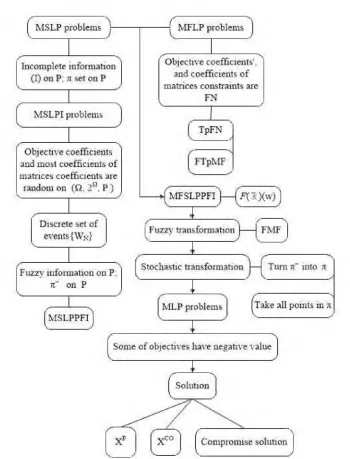
1.1 Scenario leading to the statement of the problem 18
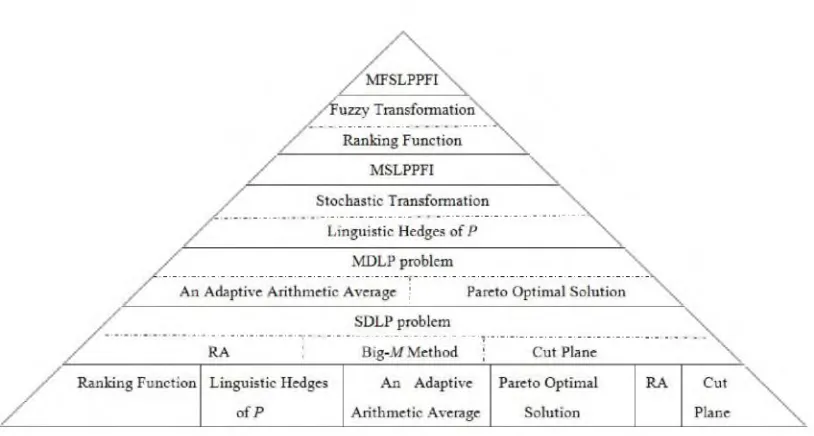
1.2 Summary of academic contributions 23
1.3 Conceptual framework: Part-I 25
1.4 Conceptual framework: Part-II 26
2.1 The MSLP problems’s flowchart of the literature review 46 2.2 The MFLP problem’s flowchart of the literature review-I 57 2.3 The MFLP problem’s flowchart of the literature review-II 58 2.4 The MFLP problem’s flowchart of the literature review-III 59 2.5 The MFLP problem’s flowchart of the literature review-IV 60 2.6 The MFLP problem’s flowchart of the literature review-V 61 2.7 The MFLP problem’s flowchart of the literature review-VI 62 2.8 The MFSLP problem’s flowchart of the literature review-I 82 2.9 The MFSLP problem’s flowchart of the literature review-II 83 2.10 The MFSLP problem’s flowchart of the literature review-III 84 2.11 The MFSLP problem’s flowchart of the literature review-IV 85 2.12 The MFSLP problem’s flowchart of the literature review-V 86 2.13 The MFSLP problem’s flowchart of the literature review-VI 87 2.14 The MFSLP problem’s flowchart of the literature
review-VII 88
3.1 The membership function 96
3.2 The fuzzy random variable 97
3.3 Trapezoidal fuzzy number 99
3.4 Triangular fuzzy number 99
3.5 Theoretical framework of fuzzy transformation via R ( F ) 105
3.6 Theoretical framework of a-cu t technique 106
3.7 Linguistic hedges of P 109
3.8 Theoretical framework of defuzzifier of P 111
3.9 Theoretical framework of stochastic transformation for
MSLP problem: Part-I 114
3.10 Theoretical framework of stochastic transformation for
MSLP problem: Part-II 115
3.11 Theoretical framework of RA 117
3.12 Theoretical framework for an AAAM 130
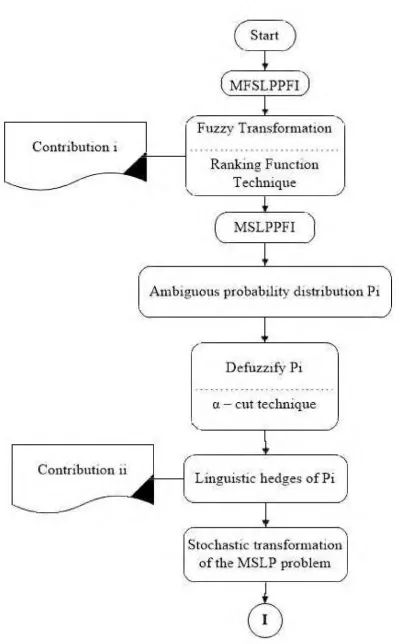
3.13 Theoretical framework for the pareto optimal solution 136 3.14 M FSLPPFI’s operational framework flowchart: Part-I 139 3.15 M FSLPPFI’s operational framework flowchart: Part-II 140 4.1 Theoretical framework of DITSS-MFSLPPFI: Part-I 158 4.2 Theoretical framework of DITSS-MFSLPPFI: Part-II 159
5.1 Linguistic hedges of p i 167
5.2 Linguistic hedges of p 2 169
5.3 Linguistic hedges of p 3 171
5.4 Fuzzy assertion of p i 205
5.5 Fuzzy assertion of p 2 206
5.6 Fuzzy assertion of p 3 206
5.7 Linguistic hedges of p i 219
5.8 Linguistic hedges of p 2 221
5.9 Linguistic hedges of p 3 223
5.10 Linguistic hedges of p 4 225
xvi
AAAM - Adaptive Arithmetic Average Method BLP - Bilevel Linear Programming
BP - Bilevel Programming
CC - Chance Constraint
CCA - Chance Constrained Approach
CCCP - Compromise Chance Constrained Programming CCP - Chance Constrained Programming
CP - Compromise Programming
DE - Differential Evolution
DLP - Deterministic Linear Programming
DM - Decision Maker
EMO - Evolutionary Multiobjective Optimization EMP - Evolutionary Multiobjective Programming FDSA - Fuzzy Dual Simplex Algorithm
FFLP - Fully Fuzzy Linear Programming
FLP - Fuzzy Linear Programming
FLPF - Fuzzy Linear Programming with
Fuzzy Linear Partial Information on Probability Distribution
FMF - Fuzzy Membership Function
FMO - Fuzzy Multiobjective Optimization FMP - Fuzzy Multiobjective Programming FNLP - Fuzzy Number Linear Programming
FP - Fuzzy Programming
xvii
FRC - Fuzzy Random Coefficient
FRMLP - Fuzzy Random Multiobjective Linear Programming
FRP - Fuzzy Random Programming
FRSMP - Fuzzy Robust Stochastic Multiobjective Programming FSGP - Fuzzy Stochastic Goal Programming
FSLP - Fuzzy Stochastic Linear Programming
FSLPPFI - Fuzzy Stochastic Linear Programming Problems with
Fuzzy Linear Partial Information on Probability Distribution FSOP - Fuzzy Stochastic Optimization Programming
FSP - Fuzzy Stochastic Programming
FTpMF - Fuzzy Trapezoidal Membership Function FTr MF - Fuzzy Triangular Membership Function
FULPAL - Fuzzy Linear Programming based on Aspiration Levels
FV - Fuzzy Variable
FVLP - Linear Programming Problem with Trapezoidal Fuzzy Variables
GA - Genetic Algorithm
GP - Goal Programming
i.e. - That Is To Say
IFRLP - Integrate Fuzzy Robust Linear Programming IMSLP - Interval-Parameter Multistage Stochastic Linear
Programming
KKT - Karush-Kuhn-Tuker
LHS - Left Hand Side
LMOP - Linear Multiple Objective Problems
LP - Linear Programming
LSP - Linear Stochastic Programming MCA - Multicriteria Approach
MCDM - Multicriteria Decision Making
xviii
MFP - Multiobjective Fuzzy Programming
MFRP - Multiobjective Fuzzy Random Programming
MFSLP - Multiobjective Fuzzy Stochastic Linear Programming MFSLPPFI - Multiobjective Fuzzy Stochastic Linear Programming
Problems with Linear Partial Information on Probability Distribution
MFSLPPI - Multiobjective Fuzzy Stochastic Linear Programming Problems with Incomplement Information on
Probability Distribution
MFSNLPPFI - Multiobjective Fuzzy Stochastic Non Linear Programming Problems with Linear Partial Information on Probability Distribution
MFSP - Multiobjective Fuzzy Stochastic Programming MILP - Multiobjective Integer Linear Programs MIP - Multiobjective Integer Programming
MLDPP - Multilevel Decentralized Programming Problems MLLP - Multilevel Linear Programming
MLP - Multiobjective Linear Programming
MMP - Multiobjective Mathematical Programming MNLP - Multiobjective Nonlinear Programming MO - Multiobjective Optimization
MOLP - Multiobjective Optimization Linear Programming
MP - Multiobjective Programming
MPOS - M-Pareto Optimal Solution
MSFLP - Multiobjective Stochastic Fuzzy Linear Programming MSIP - Multiobjective Stochastic Integer Programming MSLP - Multiobjective Stochastic Linear Programs
MSLPF - Multiobjective Stochastic Linear Programming with
Fuzzy Linear Partial Information on Probability Distribution MSLPI - Multiobjective Stochastic Linear Programming with
xix
MSLPPFI - Multiobjective Stochastic Linear Programming Problems with Fuzzy Linear Partial Information on Probability Distribution MSLPPI - Multiobjective Stochastic Linear Programming Problems
with Linear Partial Information on Probability Distribution MSP - Multiobjective Stochastic Programming
MSPI - Multiobjective Stochastic Program With Incomplete Probability Distribution
NLP - Nonlinear Programming
pLEP - P-Level Efficient Points
PP - Possibilistic Programming
RA - Recourse Approach
RFV - Random Fuzzy Variable
RHS - Right Hand Side
RVC - Random Variable Coefficient
SDLP - Single-objective Deterministic Linear Programming SFGP - Stochastic Fuzzy Goal Programming
SFLP - Stochastic Fuzzy Linear Programming
SGP - Stochastic Goal Programming
SLP - Stochastic Linear Programming SLPF - Stochastic Linear Programming with
Fuzzy Linear Partial Information on Probability Distribution SLPFI - Stochastic Linear Programming with
Fuzzy Linear Partial Information on Probability Distribution SLPI - Stochastic Linear Programming with
Linear Partial Information on Probability Distribution SMP - Stochastic Multiobjective Programming
SNLP - Stochastic Nonlinear Programming
SP - Stochastic Programming
SPI - Stochastic Program With Linear Partial Information on Probability Distribution
xx
STrFN - Symmetric Triangular Fuzzy Numbers Tp FN - Trapezoidal Fuzzy Number
xxi
LIST OF SYMBOLS
□
(ft, 2° , P) A
0
0Li
<
F
F (R)(w)
F (R) F (R) F(S) inf N Pf P pLFP R R n R ( F ) S S M
End of Proof Probability space Fuzzy Set
The Value of The Objective Function
The Value of The Maximum Objective Function The value of the Minimum Objective Function Essentially Less Than or Equal To
Almost Less Than or Equal To Lower Probability of Event A G w
The Set of All Trapezoidal Fuzzy Stochastic Discrete Number Events
The Set of All Trapezoidal Fuzzy Numbers The Set of All Fuzzy Numbers
The Set of Symmetric Trapezoidal Fuzzy Numbers Infimum
Natural Numbers Problem Formulation Probability Distribution P- Level Efficient Points Real Numbers
N- Dimensional of Real Number Ranking Function
The Set of All Feasible Solution
xxii
S N - Summation of All Values of Minimum Objective
T - Transpose
T - The Set of The Interval [0,1]
= - Vector Minimization Problem
X - A Universal Set
Y - Maximum Expectation Function of Compromise Function
n - Determinate Polyhedral Set
n - Fuzzy Polyhedral Set
xxiii
LIST OF APPENDICES
APPENDIX TITLE PAGE
A Algebra Properties of Trapezoidal Fuzzy Numbers 300
B Sensitivity Analysis 301
C Optimal Solution and Convex Set 306
CHAPTER 1
INTRODUCTION
1.1 Introduction
A Linear Programming (LP) problem is a mathematical programming problem with a single linear objective function subject to a linear constraint set and the assumption that parameters are known with certainty. LPs involving more than one conflicting objective functions are called Multiobjective Linear Programming (MLP) problems.
An MLP problem is called a Multiobjective Stochastic Linear Programming (MSLP) problem when the parameters in the MLP problems are random and represented by probability distributions. MLP problems are called Multiobjective Fuzzy Stochastic Linear Programming (MFSLP) problems when the parameters in the MLP problems are fuzzy random and represented by probability distributions.
2
Incomplement on probability distribution (MFSLPI) problems. When the linear inequalities on the probabilities of the states are fuzzy, the problem is called Multiobjective Stochastic Linear Programming Problem with Fuzzy Linear Partial Information on probability distribution (MSLPPFI), or Multiobjective Fuzzy Stochastic Linear Programming Problem with Fuzzy Linear Partial Information on probability distribution (MFSLPPFI) problems.
1.2 Motivation
Real life problems are complicated and are subject to change. And this is just as true in LP problems where the assumption that all the coefficients of an LP model are known with certainty rarely holds in practice. In addition, whether in normal living or in professional settings, there may be various conflicting objectives that need to be considered in making decisions. Therefore, it is more appropriate to extend an LP problem to either a Fuzzy Linear Programming (FLP) problem, a Stochastic Linear Programming (SLP) problem, or a Fuzzy Stochastic Linear Programming (FSLP) problem.
An LP problem could have fuzziness and randomness occur separately or concurrently. Due to two different types of uncertainties, a fuzzy number is assigned to incomplete, inaccurate information in the LP problem. On the other hand, the stochastic variable represents arbitrariness or possibility of events. There are random changes in fuzzy numbers in factual life. For instance, the assessment of tolerance of machining products could be estimated as a fuzzy number. The production lot could vary from time to time, cycle-by-cycle in values. Moreover, random variable could be modeled as fuzzy tolerance values.
3
and constraints could be fuzzy random variables. However, it is complex to resolve accurately the values of these parameters, especially those factors which are unpredictable due to uncertainties in the environment which results in varying parameters. These conditions happen frequently in long-term planning, advance strategies, engineering design and financial modeling, in which the described surroundings (objectives, constraints, coefficients) cannot be evaluated specifically and with certainty (Luhandjula and Gupta, 1996; Hop, 2007b).
An explanatory example of FSLP problem is in production planning. A large reduction in total cost could be considered as an objective that can be represented as a fuzzy stochastic variable since the cost components such as cost of inventory holding, materials, manpower and operation time and machine maintenance. Production output may depend on variables such as speeds, feed rates, and machine running time. Machine running time goes up-and-down and is usually difficult to assess accurately. Fuzzy random variables can be used to model available resources, demand, and other constraint coefficients. Such supposedly statistical data depend on environmental conditions including seasonal changes, market price fluctuation, suppliers’ efficiency and cost and benefit of defensive maintenance.
Unstable state of equipment results in loss in production output. To reduce untimely breakdowns, defensive maintenance is the way to active sustainability. Regular inspection, repair, and component replacement as scheduled are preventive measures. Such measures are usually cost effective in terms of materials, wages, and loss of production due to down-time for preventive works. The uncertainty in length of the down-time is caused by the complexity of inspection, repair and/or replacement jobs and the maintenance culture of the staff.
4
as fuzzy random variables (Hop, 2007b). These instances motivate us to suggest a new model for resolving MFSLPPFI.
By and large real life problems usually include some levels of uncertainties in the values of various parameters. Quoting the philosopher Nietzche: “No one is gifted with immaculate perception”.
Counterfeit certainty is awful science which carries the risks of making wrong enunciation of critical choices. Just assuming values to unknown variables will not result in much loss of values if they do not play important roles. But, in many real situations, building the model based on such assumed values runs the risk of pointing to wrong directions in the analysis. Assuming that the parameters are exactly prescribed may lead to an oversimplified and inflated picture of the certainty.
The principle of “ garbage in, garbage out ” shows clearly what disasters can happen when inaccurate data are falsely given preset values. This is more likely to creating the model which churns out meaningless outcomes. It is imperative that when a probabilistic explanation of unidentified elements is used, it should be cast as an SLP problem (Charnes and Cooper, 1963; Kall, 1976; Luhandjula, 2006). The presence of intrinsic or informational ambiguity, should be transformed to result in FLP problems (Liu and Liu, 2002; Liu, 2003; Liu, 2002; Sakawa, 1993; Verdegay, 1984).
5
When there are multiple parameters in an FSLP problem, we obtain an MFSLP problem. Since we cannot avoid complexities in real life, such problems demand to be on center stage.
In many SLP/FSLP problems, the probability distribution is supposed to be identified. But in some cases, we only have partial information on the way the probability distribution behaves. For example selecting a portfolio based on various criteria in the financial market, finding an optimal multiobjective/ multiattribute model for products, the demand on a new product of a client, the amount time to prepare raw materials, production time of a new product and profit of it...etc, are all random phenomena which have to be modeled stochastically.
1.3 Background of the Problem
This section is divided into four subsections that cover relevant information on the previous studies and issues surrounding the area being researched. It begins with attempts to understand and apply MSLPPFI, Multiobjective Fuzzy Linear Programming (MFLP), and MFSLP problems.
1.3.1 Introduction to Background of the Problem
6
constraints and goals are fuzzy random variables (Luhandjula, 2006). Hop (2007a, 2007b, 2007c) has proposed a few models to measure attainment of such problems.
Iskander (2005) considered the FSLP problem as:
j=i
Xj > 0 , j = 1, n.
where x j , j = 1, ...,n are nonnegative decision variables, c j, j = 1, ...,n are fuzzy coefficients in the objective function, bi}i = 1,..., m are random variables with known
the FSLP problem by utilizing two possibility as well as two necessity dominance indices previously used by Dubois and Prade (1983). The Chance Constraint (CC) approach, where feasible solutions satisfying uncertain constraints under certain probability are selected, and the a-cu t technique are used to obtain the deterministic crisp LP problem. The researchers did not consider MFSLP problems, and did not take into consideration the case where the coefficients in the objective, the Left Hand Side (LHS) of the constraints, as well as its Right Hand Side (RHS) are Fuzzy Stochastic Variables (FSVs). They dealt only with the LHS variables with known distribution functions.
Luhandjula (2006) formulated an FSLP problem as:
Min c(w)x
s.t. A i ( w ) x ^ bi(w); i = 1 , . . . , m (1.2) n
n
( 1.1)
distribution functions, while a ij- represents the fuzzy coefficient of the jth decision variable in the ith stochastic constraint. The author suggested an approach for solving
7
where c(w ),A i (w) and bi (w) are random variables on (Q, 2° , P ); in which Q = {w1, ..., wN} a finite set of possible states of nature, 2° is the power set of Q and P the vector of probabilities p i = P ({w = wi }). The symbol ~ expresses the fact that some flexibility are allowed in satisfying the objective and constraints in the linear flexible programs and Linear Stochastic Programs (LSPs) (Zimmermann, 1976; Kall, 1976). The solution of the problem needs combining symmetrical solution techniques (Luhandjula, 1983; Luhandjula et al., 1997) and asymmetrical solution techniques (Chakraborty et al., 1994; Chakraborty, 2002; Luhandjula, 1983). It is noted that Luhadjula did not consider certain FSVs for the coefficients, but applied flexible programs to the system. This lead to a bargaining between the objective function and the constraints, thus weakening the results.
Hop (2007a) considered a Fuzzy Stochastic Goal Programming (FSGP) as;
( ck)wx ; (gk)w j k 1,1
n ^
s.t. (a ij)wx j < (bi)w (1.3)
j=i
x j > 0; w e Q; i = 1, 2,..., m; j = 1, 2,..., n; k = 1, 2,..., 1
where a ,b are (m ,n ) and (m, 1) matrices of constraint coefficients, (c k)w is (1,n ) matrix of Fuzzy Random Coefficients (FRCs), and (gk)w are given fuzzy random goals required to maximally satisfy both sides. In other words; if (ck)wx < (gk)w the lower attainment values should be maximized. Otherwise, if (ck)wx > (gk)w the upper attainment values should be maximized. The author suggested a model to measure attainment value of the FSGP, and a new measure was used to derandomize and defuzzify the FSGP problem to obtain the standard form LP problem.
8
Max cx n
s.t. (a ij)wx j < (bi)w; i 1 ,...,m (1.4)
j=i
x j > 0; w e Q; i = 1,..., m; j = 1,..., n; k = 1,..., 1
has been considered (Hop, 2007b), where c is (1, n) matrix. A, b are (m, n), and (m, 1) matrices of fuzzy random variable constraint coefficients defined on a probability space (Q, 2°, P ). The problem was reformulated into its corresponding deterministic LP problem by the restrictions on the superiority and inferiority degrees, as the penalty for the violation to fuzziness and randomness. The author did not consider MFSLP problem but only the single optimization problem. On the other hand Recourse Approach (RA) was utilized to convert the problem from fuzziness and randomness to its corresponding deterministic form. This study focused on the FSLPPFI and highlighted on three aspects which are fuzziness, randomness, and whether a function is deterministic, from the beginning of the problem until solution is found, in solving the Singleobjective Deterministic Linear Programming (SDLP) problem:
1.3.2 Multiobjective Fuzzy Linear Programming Problem
9
Max z = c j X j, j =1
n ^
s.t. ajjXj < bj , i = 1, 2,..., m 0,
j=i (1.5)
n
a ijXj > bi , i = mo + 1, m, j =1
Xj > 0 , j = 1, n,
where ajj = (aL , a j , a j , ) , bj = (bL, bU, a j, ^j), and Cj = (cL, c ^ , Wj, n j) are in the set of all Trapezoidal Fuzzy Numbers (F (R )), i = 1 , m, j = 1 , n. They modified the FLP problem using a comparison of fuzzy numbers by using areas determined by the membership functions, and introduced an effective method to solve this kind of problems. In addition, they proposed a new method for solving LP problems with fuzzy unknowns via an auxiliary program to the original LP and connecting these LPs via relationships between them.
Cadenas and Verdegay (2000) used Ranking Function ( R ( F )) in MFLP problems, Multiobjective Mathematical Programming (MMP) problems, Vector Optimization Programming (VOP) problems, and Fuzzy Multiobjective Optimization (FMO) problems. MMP problems in their conventional cases were transformed into uni-objective mathematical programming problems either by using the weighted approach or the constant approach (kth-objective A-constraint), then finding the non inferior solutions. For the FMO problem, which was the extension of the VOP problem in the fuzzy environment with fuzziness in the constraints and in the objective functions, the following formulation had been developed and studied;
Min [c{x, c 2 x ,..., cnx]
s.t. Ax < b (1.6)
10
where each c f , j = 1, 2 ,..., n is a N - vector of fuzzy numbers. The existence of the fuzzy goals had been considered and assumed as follows:
Find x e Rn
(1.7) s.t. cjx < Zj; j = 1,..., n
g Ax < b
g x > 0
where < means that there was a membership function; ^ : R ^ [0,1], i = 1 ,..., m, g
Vx e R N.
The obtained problem was:
Min [c1x, c2x , ..., cnx]
s.t. Ax < ^ - 1(a) (1.8)
x > 0, a e [0 , 1]
where ^ -1 was an m -vector constraint inverse of the membership function i = 1 ,..., m , Va e [0,1].
A Fuzzy Number Linear Programming (FNLP) problem in the form of
Max z = cx R(F)
s.t. Ax = b, (1.9)
x > 0
11
Ganesan and Veeramani (2006) introduced and defined a kind of FLP problem with TpFNs in its symmetric form as:
max z « c j Xj j=i n
s.t. a jX j ^ bi , i = 1, 2, m 0,
j=i ( 1.10)
n
a ijXj >; bi; i = mo + 1, m 0 + 2, m, j=i
Xj >; 0 Vj = 1, 2, n
where a ij G R, cj ,Xj ,b i G F(S)s ( The Set of Symmetric Trapezoidal Fuzzy Numbers). The solution for the problem was obtained without converting it to a crisp LP problem.
Some properties in FNLP problems have been explored by Mahdavi-Amiri and Nasseri (2006) when they used a linear ranking function to introduce the dual of the following FNLP problem, where several duality results were presented:
max z = cx
R(F)
s.t. Ax < b, (1.11)
R(F) x > 0
where = , < were equality and inequality with respect to the R ( F ) respectively, R(F) R(F)
A = (aij)(m,n), c = (c 1, c2, Cn), b = (bi, b2, bm) T and a ij, bi, ci G F(R).
12
max z = cX R(F)
s.t. Ax < b, (1 12)
R(F) X > 0,
R(F)
had been considered by Mahdavi-Amiri and Nasseri (2007), where b G (F (R ))m, A G R (m,n), cT G R n are given and x G (F(R ))n is to be determined , and a linear ranking function on TPFN; a = (aL, a u , a , / 3) defined as: R ( F ) ( a ) = The dual problem on FVLP was established to deduce duality results, those results are then used to develop a dual algorithm to solve the problem by using the primal simplex tableau. It should be noted all these studies did not consider the MFLP problems in the optimization problems but contented themselves with single FLP problem. They also did not use the linear ranking function R ( F ) as a tool to transform the FLP problem to its corresponding deterministic LP problem. R (F )s were used only as a tool to compare FVs.
1.3.3 Multiobjective Stochastic Linear Programming Problem
As related to the stochastic part of the MFSLPPFI, the first work on SLPPFI was presented by Ben Abdelaziz and Masri (2005a). The problem was modeled as:
Min cT(w)x
s.t. T (w )x — h(w) > 0 (1.13)
X G X
13
of probabilities p i = P ({w = wi }) . The set X is a polyhedral set of feasible solutions that includes the deterministic constraints of the problem on the probability space (ft, 2° , P ).
In this work, the partial information on the probability distribution P was with in two ways:
• The probability was generated by stochastic inequalities on n
pi = 1,pi > 0, i = 1, . . . ,n } (1.14)
where A = (aij-) and b = (bi) were respectively (s, N ) and (s, 1) fixed matrices.
• Either the probability was generated by fuzzy inequalities on n, or the probability distribution was approximated on n by
Pi = 1,Pi > 0, i = 1, . . . ,n | (1.15)
where A and b were as defined above, and ^ was a fuzzy inequality which meant that Ap was almost equal or less than b.
The solution was obtained by first applying the fuzziness on the Stochastic Linear Programming with Fuzzy Linear Partial Information on probability distribution (SLPF), then through Stochastic Programming (SP) using Chance Constrained Approach (CCA), for minimizing expected value of the random objective functions on n, and RA after the solution when the deviation or shortage had been obtained.
Ben Abdelaziz and Masri (2010) also studied the Multiobjective Stochastic Linear Programming with Incomplement on probability distribution (MSLPI) problems:
n = < p = (p1, ..., P n )* : Ap ^ b. N
E
i=114
Min Z = C (w )x = [c1(w )x ,..., cn(w)x]
s.t. T (w )x — h(w) > 0 (1.16)
x G X~
They addressed the SP, and used the Chance Constrained Programming (CCP) approach as possible resolutions thus sustaining the indeterminate restraint probability level. They extended this method to the MSLPI as follows:
Min Z = C (w )x
s.t. P [T (w )x — h(w) > 0] > a , V P G n (1.17) x G
by using stochastic inequalities on n as in (1.4), and denoting F as the inferior likelihood purpose interrelated to the set as:
F (A ) = inf { P ( A ) /P G n} ; VA G ft (1.18)
This problem is equivalent to:
F [T (w )x — h(w) > 0] > a . (1.19)
15
Min C (x, w)
s.t. F [(T (w )x — h(w) > 0)] > a x G X
( 1.20)
Next, to minimize the value of;
Y (x) = MaxP en E P [C (x,w )] ( 1.21)
with some extra hypotheses by the Decision Maker (DM) the CCCP problem became:
Min MaxPenE P [C(x, w)]
x G X , £(w) > 0
They solved this optimization problem in Singleobjective Deterministic Linear Programming (SDLP) problem under two basic conditions:
(i) detail the form of the lower probability function F and,
(ii) the compromise function C (x ,w ) , or a weighted sum of the gap between the stochastic objective functions values C (w )x and the ideal values c* for x under
For the value of F , the notion of P-Level Efficient Points (pLEP) was used, and for the CP some hypotheses had been used in addition to the modified L-shaped method.
s.t. F [(T (w )x — h(w) > 0)] > a ( 1.22)
16
It must be mentioned that the limitations of the study by Ben Abdelaziz and Masri (2010) are the incomplete information in a linear way and the low value of the minimax solutions. They did not consider the situation where a feasible decision for the deterministic constraints did not satisfy the uncertainty constraints (i.e. deviation or shortage occurs). There are implicit loops of iterations in their solution algorithm when using L-shaped method. Finally, they did not consider fuzzy probability distributions and only depended on a CP approach to the MSLPI. In addition only maximum extreme points of P had been used. Also the probability distributions had been used on the maximum extreme points for the discrete events in the continuous interval of P .
1.3.4 Deterministic Multiobjective Linear Programming Problem
In Deterministic Linear Programming (DLP) problems of the MFSLPPFI; the following mixed deterministic multiobjectives Max/Min problem
n
Max E p Z i = E p
^2
C ij(w )xj ; i = 1,..., r, j =1n
iMin E pgnZi E pgn ^ ^ Ci j (w )xj , i r + 1 ..., S, (1 23) j =1
s.t. P (L (w )x — l(w )) > 0) > a , VP G n, x G X
with conflict in the same constraints can be solved by using an appropriate technique to get an optimal solution for the original problem.
Sen (1983) provided a solution to this kind of problem when he obtained a single value corresponding to each of the objective functions being optimized individually, subjected to constraints as follows:
17
where 6 , i = 1,..., r, r + 1,..., s the decision variable may not necessarily be common to all optimal solutions in the presence of conflicts among objectives. But the common sets of decision variables among objective functions were necessary in order to select the best compromised solution. After that, he determined the common set of decision variables from the combined objective function formulated below:
s.t. P (L (w )x — l(w )) > 0) > a , VP G n, x G X
VZi and 6 > 0 , i = 1,..., r, r + 1, ...s.
This methodology was highly efficient in its application in operation research to get optimal solutions and was thus considered one of the most appropriate methods in finding solutions. However the author did not mention whether the values of the objective functions were or were not positives. Figure 1.1 presents the scenario leading to the problem considered in this study.
1.4 Problem Statement
This study will focus on the development of an improved two-phase solution strategy of the MFSLPPFI. The phases are the defuzzification of the problem to its stochastic counterpart and the conversion of the stochastic problem to deterministic problem. Specifically we transform MFSLPPFI into its corresponding MSLPPFI through Fuzzy Trapezoidal Membership Function (FTpMF) on the Trapezoidal Fuzzy Numbers (TpFNs), then convert the resulting MSLPPFI into MLP problems through stochastic transformations via CCP approach in stochastic constraints, and using stochastic transformations in the objective functions by implementing expectation of the random events after employing the linguistic hedges of P to get the certain
18
19
probability distributions over intervals of P . In addition, an efficient solution method to the resulting deterministic problem will also be developed.
1.5 Research Questions
The problem statement raises several research challenges. These challenges will be addressed by providing answers to the following questions:
(i) • How to address the fuzziness in the probability distribution? • W hat membership function to use?
(ii) • How to convert the FSP problem to SP problem? • W hat fuzzy transformation technique to be used? (iii) How to convert the SP problem to deterministic problem?
• W hat stochastic transformation technique to be used?
• W hat to do if the deterministic constraints do not fully satisfy the uncertain constraints?
(iv) How to solve the deterministic problem efficiently?
• How to avoid the implicit loops in L-shaped method? ( The L-Shaped method is a decomposition method that is useful for solving problems that have the problem of a master problem and several sub problems represented by the side model, and it is an outer linearization procedure that approximates the convex objective term in the stochastic program by successively appending supporting hyper planes (Birge, 1988)).
20
1.6 Research Objectives
The following are the objectives in dealing with MFSLPPFI:
(i) To address the MFSLPPFI problem through membership function.
(ii) To transform the MFSLPPFI problem into MSLPPFI problem by using the ranking function as the fuzzy transformation technique. To use linguistic hedges in the probability distribution.
(iii) To transform the MSLPPFI problem into MLP problem by using the CCP Approach via fuzzy transformation in the probability distribution by using the a-cu t technique.
(iv) To introduce recourse function in the stochastic transformation technique. (v) To find a pareto optimal solution for the deterministic MLP.
(vi) To solve the deterministic MLP problem by using B ig-M method instead of L- Shaped method to avoid implicit loops in the solution algorithm. And using the cutting-plane method.
(vii) To find a relation between the pareto optimal solution set and the compromise solution set, and compare between them.
1.7 Scope of the Study
21
1.8 Significance of the Study
This research focuses on developing the transformation techniques for the MFSLPPFI. The proposed techniques will convert the problem to deterministic problem which can be solved easily. The main contributions of this research on the advancement of knowledge are summarized as follows:
(i) Development of a fuzzy transformation technique that transforms an MFSLPPFI into an MSLPPFI problem through a ranking function. This is proposed to soften the rigid requirements of the DM to considering the fuzziness and/or randomness of the DMs judgm ent in real life optimization problems when he/she dealing with the optimization problem by considering the fuzziness and/or the randomness in objectives, goals and constraints in the problem. Moreover, the DM would be able to use the ranking function as a defuzzifying tool to transform the MFSLPPFI problem into an MSLPPFI problem in various real life situations. (ii) Development of a stochastic transformation technique that transforms an
MSLPPFI problem into an MLP problem using CCP approaches, Linguistic hedge and a-cu t technique. The stochastic technique allows the DM to consider the expectation optimization model, the variance minimization model, and the probability optimization model with optimistic/pessimistic values under partial uncertainty of the probability distribution for real life problems. In addition, the DM will be able to recognize the interval values of the probability distribution by dealing with these interval values as linguistic hedges via a-cu t technique on fuzzily imprecise variables with probabilistic uncertainty. Furthermore, the development of the stochastic transformation technique supports the DM to detail the form of the lower probability function for the stochastic constraints via the CCP approach. This will lead to the compromise function for the objective functions in the MSLPPFI problem.
22
uncertainty constraints. The significance of the recourse function approach is to provide a tool to help DM in industrial or productive optimization problems to create efficient models where continuous sufficient supplies of the raw materials and the basic resources for production are required.
(iv) Development of an Adaptive Arithmetic Average Method (AAAM) which transforms an MLP problems into its corresponding SDLP problem, instead of using Sen’s method and others we found those in literature review. Sen’s method is restricted to positive values of objective functions only, whereas AAAM is more general since it is valid for all real numbers. In addition, this approach leads to the compromise solution in less iterations and elapsed time in the solution algorithm.
(v) Development of pareto optimal solution to the deterministic MLP problems. Significantly, this solution finds the complete optimal solution as a compromise solution among conflicting objective functions in the MLP problems.
(vi) Development of the cutting-plane method as the solution technique to the associated MLP problem. Significantly, the cutting-plane method is to help the DM to reduce the obtained solution as an optimum solution for the objectives at the extreme point of the feasible constraints in the optimization problem.
Figure 1.2 shows the significance of the study in the advancement of the knowledge.
23
Figure 1.2 Summary of academic contributions
are believed to be able to have positive impacts on organization productivity and competitiveness in many industries.
1.9 Research Framework
Figure 1.3 and 1.4 shows the research framework and the relative knowledge areas related to each component of the MFSLPPFI. In what follows, some major components of the conceptual framework will be briefly described.
24
An AAAM will be used to transform the resulted MDLP problems into its corresponding SDLP problem. The research uses B ig-M method to solve the SDLP problem. If the solution does not satisfy the uncertain constraints it should be penalized by using RA, and if is it not an extreme point of the feasible constraints, then cut-plane method should be used to introduce it as an extreme point of the feasible constraints.
25
27
1.10 Outline of the Thesis
The organization of the thesis is as follows:
Chapter 1 provides the introduction to the study domain of this thesis that is MFSLPPFI. The chapter later discusses the background of the problem, statement of the problem, research objectives and contributions.
Chapter 2 provides the literature review of the study areas. Related background works on the study domain are also discussed here.
Chapter 3 provides research methodology where the research activities that will be carried out towards achieving the objectives of this research are presented.
Chapter 4 provides the development of the improved two-phase solution strategy for the MFSLPPFI.
Chapter 5 provides the applications to support the problem statements, research methodology and development of the improved two-phase solution strategy for the MFSLPPFI, through numerical examples.
REFERENCES
Abbas, M. and Bellahcene, F. (2006). Cutting plane method for multiple objective stochastic integer linear programming. European Journal o f Operational Research. 168(3): 967-984.
Allahviranllo, T., Lotfi, F. H., Kiasary, M. K., Kiani, N. A. and Alizadeh, L. (2008). Solving full fuzzy linear programming problem by the ranking function. Appl. Math. Sci.. 2(1): 19-32.
Amid, A., Ghodsypour, S. H. and O’Brien, C. (2006). Fuzzy multiobjective linear model for supplier selection in a supply chain. IntJ.Production Economics.
104(2): 394-407.
Aouni, B. and Torre, D. L. (2010). A generalized stochastic goal programming model.
Applied Mathematics and Computation. 215(12): 4347-4357.
Aouni, S., Ben Abdelaziz, F. and Martel, J. M. (2005). Decision-makers Preferences Modeling in the Stochastic Goal Programming. European Journal o f Operational Research. 162: 610-618.
Arkin, V. I. and Evstigneev, I. V. (1987). Stochastic Models o f Control and Economic Dynamics. London: Academic Press.
Aubin, J. P. (1979). Mathematical Methods o f Game and Economic Theory. North- Holland, Amsterdam: Springer.
Azaron, A., Brown, K. N., Tarim, S. A. and Modarres, M. (2008). A multiobjective stochastic programming approach for supply chain design considering risk.
International Journal o f Production Economics. 116(1): 129-138.
Bazaraa, M. S., Jarvis, J. J. and Sherali, H. D. (2005). Linear Programming and Network Flows, third ed. New York: John Wiley.
281
Bector, C. R. and Chandra, S. (2005a). Fuzzy Mathematical Programming and Fuzzy Matrix Games, Studies in Fuzziness and Soft Computing. Berlin, Germany:
Springer.
Bector, C. R. and Chandra, S. (2005b). Fuzzy Mathematical Programming and Fuzzy Matrix Games.Studies in Fuzziness and Soft Computing. Berlin Heidelberg:
Springer.
Bector, C. R., Chandra, S. and Vidyottama, V. (2004a). Duality in linear programming with fuzzy parameters and matrix games with fuzzy pay-offs. Fuzzy Sets and Systems. 146: 253-269.
Bector, C. R., Chandra, S. and Vidyottama, V. (2004b). Matrix Games with Fuzzy Goals and Fuzzy Linear Programming Duality. Fuzzy Optimization and Decision Making. 3(3): 255-269.
Bellman, R. F. and Zadeh, L. A. (1970). Decision making in fuzzy environment. Manag.Sci.. 17: 141-146.
Ben Abdelaziz, F. (2012). Solution approaches for the multiobjective stochastic programming. European Journal of Operational Research. 216(1): 1-16.
Ben Abdelaziz, F., Lang, P. and Nadeau, R. (1995). Theory and Methodology Distributional efficiency in multi-objective stochastic linear programming. European Journal of Operational Research. 85(2): 399-415.
Ben Abdelaziz, F., Lang, P. and Nadeau, R. (1999). Dominance and efficiency in multicriteria decision under uncertainty. Theory and Decision. 47(3): 199-211. Ben Abdelaziz, F. and Masri, H. (2001). Application of goal programming in
a multiobjective reservoir operation model in Tunisia. European Journal of Operational Research. 133(2): 352-361.
Ben Abdelaziz, F. and Masri, H. (2005a). Stochastic programming with fuzzy linear partial information on probability distribution. European Journal of Operational Research. 162(3): 619-629.
Ben Abdelaziz, F. and Masri, H. (2005b). Stochastic programming with fuzzy probability distribution. European Journal of Operational Research.
282
Ben Abdelaziz, F. and Masri, H. (2010). A compromise solution for the multiobjective stochastic linear programming under partial uncertainty. European Journal of Operational Research. 202(1): 55-59.
Bertocchi, G. and Kehagias, A. (1995). Efficiency and optimality in stochastic models with production. Journal of Economic Dynamics and Control. 19(1-2): 303-325. Bezdek, J. C. (1993). Fuzzy models - what are they, and why?. IEEE Trans, Fuzzy Sys..
1(1): 1-9.
Bialas, W. F. and Karwan, M. H. (1984). Two-level linear programming. Manag. Sci.. 30(8): 1004-1020.
Biehl, M., Prater, E. and Realff, M. (2007). Assessing performance and uncertainty in developing carpet reverse logistics systems. Computers and Operations Research. 34(2): 443-463.
Birge, J. R. (1988). An L-shaped method computer code fo r multistage stochastic linear programs, in: Y Ermoliev, R.J.-B. Wets (Eds.), Numerical Techniques fo r Stochastic Optimization Problems. Berlin: Springer.
Bitran, G. R. (1980). Linear multiobjective problems with interval co-efficient. Management Science. 26(7): 694-706.
Buckley, J. J. (1983). Fuzzy programming and the Pareto optimal set. Fuzzy Sets and Systems. 10(1-3): 57-63.
Buckley, J. J. and Feuring, T. (2000). Evolutionary Algorithm Solution to Fuzzy Problems. Fuzzy Sets and Systems. 109(1): 35-53.
Bunn, D. W. and Paschentis, S. N. (1982). Linear programming with uncertain parameters: an applications review. Computers in Industry. 3(4): 283-296. Caballero, R., Cerda, E., del M. Munoz, M., Rey, L. and Minasian, S. (2001). Efficient
solution concepts and their relations in stochastic multiobjective programming. Journal of Optimization, Theory and Applications. 110(1): 53-74.
Cadenas, J. M. and Verdegay, J. L. (2000). Using ranking functions in multiobjective fuzzy linear programming. Fuzzy Sets and Systems. 111(1): 47-53.
283
Campos, L. and Verdegay, J. L. (1989). Linear programming problems and ranking of fuzzy numbers. Fuzzy Sets and Systems. 32(1): 1-11.
Chakrabortty, S., Pal, M. and Nayak, P. K. (2013). Intuitionistic fuzzy optimization technique for Pareto optimal solution of manufacturing inventory models with shortages. European Journal o f Operational Research. 228(2): 381-386.
Chakraborty, D. (2002). Redefining chance-constrained programming in fuzzy environment. Fuzzy Sets and Systems. 125(3): 327-333.
Chakraborty, D., Rao, K. R. and N.Tiwani, R. (1994). Interactive decision making in mixed fuzzy stochastic environment. Operational Research. 31: 89-107.
Chanas, S. (1983). The use of parametric programming in fuzzy linear programming.
Fuzzy Sets and Systems. 11(1-3): 229-241.
Chanas, S. and Zielinski, P. (2000). On the equivalence of two optimization methods for fuzzy linear programming problems. European Journal o f Operational Research.
121(1): 56-63.
Chankong, V. and Haimes, Y. Y. (1983). Multiobjective decision making: theory and methodology. Amsterdam: North-Holland.
Charles, V., Ansari, S. I. and Khalid, M. M. (2011). Multiobjective stochastic linear programming with general form o f distributions. International Journal o f Operational Research and Optimization. 2(2): 261-278.
Charles, V., Udhayakumar, A. and Uthariaraj, R. V. (2010). An approach to find redundant objective function(s) and redundant constraint(s) in multi-objective nonlinear stochastic fractional programming problems. European Journal o f Operational Research. 201(2): 390-398.
Charnes, A. and Cooper, W. W. (1962). Programming with linear fractional function.
Naval Research Logistics Quarterly. 9(3-4): 181-186.
Charnes, A. and Cooper, W. W. (1963). Deterministic equivalents for optimizing and satisfying under chance constraints. Operations Research. 11: 18-39.
Chen, C., Line, C. and Huang, S. (2006). A fuzzy approach for supplier evaluation and selection in supply chain management. Int. J. Production Economics.
284
Chen, Z. L., Li, S. and Tirupati, D. (2002). A scenario based stochastic programming approach for technology and capacity planning. Comput. Oper Res.. 29(7): 781 806.
Chiang, J. (2001). Fuzzy linear programming based on statistical confidence interval and interval-valued fuzzy set. European Journal of Operational Research.
129(1): 65-86.
Chou, S. Y., Lin, J. S. and Julian, P. (2009). A Note on "Solving Linear Programming Problems Under Fuzziness and Randomness Environment Using Attainment Values”. Information Sciences. 179(32): 4083-4088.
Cohon, J. L. (1978). Multiobjective programming and planning. New York: Academic Press.
Contini, B. (1978). A stochastic approach to goal programming. Oper Res.. 16(3): 576-586.
Deb, K. and Sinha, A. (2009a). Constructing test problems fo r bilevel evolutionary multiobjective optimization. IEEE.
Deb, K. and Sinha, A. (2010 ). An efficient and accurate solution methodology for bilevel multiobjective programming problems using a hybrid evolutionary local- search algorithm. Evolutionary Computation.. 18(3): 403-449.
Deb, K. and Sinha, A. (2009b). An evolutionary approach for bilevel multiobjective problems. Communications in Computer and Information Science. 35: 17-24. Berlin Heidelberg: Springer.
Deb, K. and Sinha, A. (2009c). Solving bilevel multiobjective optimization problems using evolutionary algorithms. Vol. 5467. Springer.
Dehghan, M., Hashemi, B. and Ghatee, M. (2006). Computational methods for solving fully fuzzy linear system. Appl. Math. Comput.. 179(1): 328-343.
Delgado, M., Verdegay, J. L. and Vila, M. A. (1989). A general model for fuzzy linear programming. Fuzzy Sets and Systems. 29(1): 21-29.
Dempe, S. and Bard, J. (2001). Bundle trust-region algorithm for bilinear bilevel programming. J Optim Theory Appl. 110(2): 265-268.
285
Dubois, D. and Prade, H. (1988). Combining fuzzy imprecision with probabilistic uncertainty in decision making. Technical Report. Verlag: Springer.
Ebrahimnejad, A. (2011). Sensitivity Analysis in Fuzzy Number Linear Programming Problems. Mathematical and Computer Modelling. 53(9-10): 1878-1888. Ebrahimnejad, A. and Nasseri, S. (2010). A Dual Simplex Method for Bounded
Linear Programmes with Fuzzy Numbers. International Journal of Mathematics in Operational Research. 2(6): 762-779.
Ebrahimnejad, A., Nasseri, S., Lotfi, F. H. and Soltanifar, M. (2010). A Primal- dual Method for Linear Programming Problems with Fuzzy Variables. European Journal of Industrial Engineering. 4(2): 189209.
Ebrahimnejad, A., Nasseri, S. and Mansourzadeh, S. M. (2011). Bounded Primal Simplex Algorithm for Bounded Linear Programming with Fuzzy Cost Coefficients. International Journal of Operations Research and Information Systems. 2(1): 100-124.
Fampa, M., Barroso, L., Candal, D. and Simonetti, L. (2008). Bilevel optimization applied to strategic pricing in competitive electricity markets. Comput. Optim. Appl.. 39(2): 121-142.
Fang, S. C. and Hu, C. F. (1996). Linear programming with fuzzy coefficients in constraints. Comput. Math. Appl.. 37(10): 63-76.
Fortemps, P. and Roubens, M. (1996). Ranking and defuzzification methods based on area compensation. Fuzzy Sets Systems. 82(3): 319-330.
Galperin, E. A. (2004). Balance set and Pareto solutions in linear spaces with application to ongoing optimal resource allocation investment planning, production, and control problems with multiple objectives. Mathematical and Computer Modelling. 40(1-2): 137-149.
Ganesan, K. and Veeramani, P. (2006). Fuzzy linear programming with trapezoidal fuzzy numbers. Ann. Oper Res. 143(1): 305-315.
286
Garcia-Aguado, C. and Verdegay, J. L. (1993). On the sensitivity of membership functions for fuzzy linear programming problems. Fuzzy Sets and Systems.
56(1): 47-49.
Gil, M. A., Lopez-Diaz, M. and Ralescu, D. A. (2006). Overview on the development of fuzzy random variables. Fuzzy Sets and Systems. 157(19): 2546-2557.
Goh, M., S., J. Y. and Meng, F. (2007). A stochastic model for risk management in global supply chain networks. European Journal o f Operational Research.
182(1): 164-173.
Goicoechea, A., Hansen, D. R. and Duckstein, L. (1982). Multiobjective decision analysis with engineering and business applications. New York: John Wiley and Sons.
Haimes, Y. Y., Hall, W. A. and Freedman, H. T. (1975). Multiobjective optimization in water resources systems: the surrogate worth trade-off method. Amsterdam: Elsevier.
Hajkowicz, S. and Collins, K. (2007). A review of multiple criteria analysis for water resource planning and management. Water Resources Management. 21(9): 1553
1566.
Hajkowicz, S. and Higgins, A. (2008). A comparison of multiple criteria analysis techniques for water resource management. European Journal o f Operational Research. 184(1): 255-265.
Haneveld, W. K. K. and Vlerk, M. H. V. D. (1999). Stochastic integer programming:General models and algorithms. Annals o f Operations Research.
85(1-2): 39-57.
Hashemi, S., Nasrabadi, M. M. E. and Nasrabadi, M. (2006). Fully fuzzified linear programming, solution and duality. J. Intell. Fuzzy Syst. 17(3): 253261.
Haven, E. (2005). The financial relevance of fuzzy stochastic dominance: a brief note.
Fuzzy Sets and Systems. 152(3): 467-473.
Hirota, K. (1981). Concepts of probabilistic sets. Fuzzy Sets and Systems. 5: 31-46. Ho, W., Xu, X. and Dey, P. (2010). Munlti-criteria decision making approaches
287
Hop, N. V. (2007a). Fuzzy stochastic goal programming problems. European Journal of Operational Research. 176(1): 77-86.
Hop, N. V. (2007b). Solving fuzzy(stochastic) linear programming problems using superiority and inferiority measures. Information Sciences. 177(9): 1977-1991. Hop, N. V. (2007c). Solving linear programming problems under fuzziness
and randomness environment using attainment values. Information Sciences. 177(14): 2971-2984.
Hulsurkar, S., Biswal, M. P. and Sinha, S. B. (1997). Fuzzy programming approach to multi-objective stochastic linear programming problems. Fuzzy Sets and Systems. 88(2): 173-181.
Hwang, C. L. and Masud, A. S. M. (1979). Multiple objective decision making: methods and applications. Berlin: Springer-Verlag.
Inuiguchi, M. and Ramik, J. (2000). Possibilistic linear programming: a brief review of fuzzy mathematical programming and a comparison with stochastic programming in portfolio selection. Fuzzy Sets and Systems. 111(1): 3-28.
Inuiguchi, M., Ramik, T., Tanino, T. and Vlach, M. (2003). Satisficing solutions and duality in interval and fuzzy linear programming. Fuzzy Sets and Systems.
135(1): 151-177.
Iskander, M. G. (2001). On solving stochastic fuzzy goal programming problem using a suggested interactive approach. The Journal of Fuzzy Mathematics. 9(2): 437 446.
Iskander, M. G. (2002). Comparison of fuzzy numbers using possibility programming: comments and new concepts. Computers and Mathematics with Applications. 43(6-7): 833-840.
Iskander, M. G. (2003). Using different dominance criteria in stochastic fuzzy linear multiobjective programming: a case of fuzzy weighted objective function. Mathematical and Computer Modeling. 37(1-2): 167-176.
288
Iskander, M. G. (2004b). A possibility programming approach for stochastic fuzzy multiobjective linear fractional programs. Computers and Mathematics with Applications. 48(10-11): 1603-1609.
Iskander, M. G. (2005). A suggested approach for possibility and necessity dominance indices in stochastic fuzzy linear programming. Applied Mathematics Letters.
18(4): 395-399.
Iskander, M. G. (2008). A computational comparison between two evaluation criteria in fuzzy multiobjective linear programs using possibility programming. Computers and Mathematics with Applications. 55(11): 2506-2511.
Jamison, K. D. and Lodwick, W. A. (2001). Fuzzy linear programming using a penalty method. Fuzzy Sets and Systems. 119(1): 97- 110.
Jimenez, M. and Bilbao, A. (2009). Pareto-optimal solutions in fuzzy multi-objective linear programming. Fuzzy Sets and Systems. 160(18): 2714 - 2721.
Jones, A., Kaufmann, A. and Zimmermann, H.-J. (1986). Fuzzy sets theory and application. Dordrecht, Holland: D. Reidel Publishing Company.
Kall, P. (1976). Stochastic Linear Programming. Springer-Verlag.
Kara, S. S. and Onut, S. (2010). A two-stage stochastic and robust programming approach to strategic planning of a reverse supply network: The case of paper recycling. Expert Systems with Applications. 37(9): 6129-6137.
Katagiri, H. and Ishii, H. (2000). Linear programming problem under fuzziness and randomness. Proceedings o f International Conference on Applied Stochastic System M odeling. 97-106.
Katagiri, H., Ishii, H. and Sakawa, M. (2004a). On fuzzy random linear knapsack problems. Central Eur J OperRes. 12: 59-70.
Katagiri, H., Kato, K. and Sawaka, M. (2003a). An interactive satisficing method based on the fractile optimization model using possibility and necessity measure for fuzzy random multiobjective linear programming problem, in: proceedings of the Asia Pacific. Management Conference. 1: 795-802.
289
Katagiri, H., Sakawa, M. and Ishii, H. (2004b). Fuzzy random bottleneck spanning tree problems using possibility and necessity measures. European J. OperRes..
152(1): 88-95.
Katagiri, H., Sakawa, M. and Ishii, H. (2005a). A study on fuzzy random portfolio selection problems using possibility and necessity measures. Sci. Math.Jpn.. 61(2): 361-369.
Katagiri, H., Sakawa, M., Kato, K. and Nishizaki, I. (2004c). A fuzzy random multiobjective 0-1 programming based on the expectation optimization model using possibility and necessity measures. Mathematical and Computer Modelling. 40(3-4): 411-421.
Katagiri, H., Sakawa, M., Kato, K. and Nishizaki, I. (2008a). Interactive multiobjective fuzzy random linear programming: maximization of possibility and probability. European Journal of Operational Research. 188(2): 530-539.
Katagiri, H., Sakawa, M., Kato, K. and S.Ohsaki (2005b). An interactive fuzzy satisficing method based on the fractile optimization model using possibility and necessity measures for a fuzzy random multi-objective linear programming problem. Electronics and Communications in Japan, Part III: Fundamental Electronic Science (English translation of Denshi Tsushin Gakkai Ronbunshi.
88(5): 20-28.
Katagiri, H., Sakawa, M., Kato, M. and Nishizaki, I. (2008b). Interactive multiobjective fuzzy random linear programming: maximization of possibility and probability. European Journal of Operational Research. 188: 530-539.
Katagiri, H., Sakawa, M. and Nishizaki, I. (2006). Interactive decision making using possibility and necessity measures for fuzzy random multiobjective 0-1 programming problem. Cybern Syst. 37(1): 59-74.
Katagiri, H., Sawaka, M. and Ishii, H. (2001). Multiobjective fuzzy random linear programming using e-model and possibility measure. Proceedings of Joint Ninth IFSA and World Congress and 20th NAFIPS International Conference. 2295 2300.