AT&T
April 1990
DEFINITY
®
Communications
System
and System 75 and System 85
While reasonable efforts were made to ensure that the information in this document was complete and accurate at the time of printing,
AT&T can assume no responsibility for any errors. Changes or corrections to the information contained in this
document may be incorporated into future issues.
Prepared by
AT&T Technical Publications Department Denver, Colorado
Copyright © 1990 AT&T All Rights Reserved
ABOUT THIS DOCUMENT
PURPOSE
INTENDED AUDIENCES
PREREQUISITE SKILLS AND KNOWLEDGE
HOW THIS DOCUMENT IS ORGANIZED
HOW TO USE THIS DOCUMENT
TRADEMARKS AND SERVICE MARKS
RELATED SOURCES
HOW TO MAKE COMMENTS ABOUT THIS DOCUMENT
1. INTRODUCTION
FUNDAMENTALS OF DS1 SIGNALS
Channels
Framing Formats
Signaling Types
Line-Coding Formats
IMPORTANT CONCEPTS
Common-Channel Signaling
Alternate Voice/Data (AVD) Trunks
Bearer Capability (BC)
ISDN Call Processing
CBC Service Selection
Networking Restrictions and ISDN-PRI Limitations
2. NETWORK CONNECTIONS AND CONFIGURATIONS
NETWORK DIFFICULTIES
Hyperactivity
Glare
xix
xix
xx
xx
xx
xxii
xxii
xxii
xxiii
1-1
1-1
1-7
1-10
1-14
1-16
1-22
1-22
1-22
1-23
1-25
1-28
1-29
2-1
2-1
2-1
2-2
DS1/DMI PRIVATE-NETWORK CONNECTIONS
Generic 1, Generic 2, System 75, or System 85 to Another System
Host Computer to Another System
IBM®
IDNX Multiplexer to Another System
Other Vendor Digital Switch to Another System
Analog Switch to Another System
OPS to Another System Via a D4-Channel Bank
DS1/DMI PUBLIC-NETWORK CONNECTIONS
4ESS to Another System (Special-Access Connection)
5ESS to Another System
DACS to Another System
Analog CO to Another System Via a D4-Channel Bank
DS1/DMI TERMINAL-EQUIPMENT CONNECTIONS
CDM
CEM to a BCM32000
ISDN-PRI PRIVATE-NETWORK CONNECTIONS
System 85 R2 to a System 85 R2V4, Generic 1, or Generic 2
System 85 or Generic 2 ISDN-PRI to Another Vendor’s Digital Switch
ISDN-PRI PUBLIC-NETWORK CONNECTIONS
System 85 R2V4, Generic 1, and Generic 2 to a 4ESS
Synchronization
System 85 R2V4, Generic 1, or Generic 2 to a DACS
System 85 or Generic 2 ISDN-PRI to a 5ESS
3. DS1 TRANSMISSION AND CABLING
METALLIC CABLING OPTIONS
DSX-1 Distance Limitations
Network Channel Terminating Equipment (NCTE)
On-Premises Cabling
Off-Premises Cabling
NONMETALLIC CABLING OPTIONS
CEM AND CDM CABLING CONFIGURATIONS
LINE EQUALIZER AND COMPENSATION SETTINGS
System 85 Traditional Modules 3-9
Generic 1 and Generic 2 Universal Modules 3-9
4. THE DIGITAL LOSS PLAN
LOSS-PLAN IMPLEMENTATION AND PROVISIONING
Generic 2
Generic 1
PORT-TO-PORT LOSS VALUES
DS1/DMI/ISDN-PRI PORT LOSSES
TERMINATING A DS1 AT A CHANNEL BANK
Tie Trunk Ports
CO DID Trunk Ports
OPS Ports
5. SYNCHRONIZATION OF DIGITAL FACILITIES
THE NEED FOR SYNCHRONIZATION
SYNCHRONIZATION HIERARCHY
System 85 and Generic 2 Synchronization Architecture
System 85 and Generic 2 Synchronization Software Operation
CHANGES TO THE SCS SOFTWARE MADE AVAILABLE VIA SOFTWARE PATCHES
System 75 and Generic 1 Synchronization Architecture
System 75 and Generic 1 Synchronization Software Operation
The External Synchronization Clock
NETWORK SYNCHRONIZATION AND ENGINEERING
Selecting a Timing Source for the Switch
Internal Reference Selection Rules
External-Reference Selection Rules
AVAILABILITY OF SYNCHRONIZATION SOURCES
CONCLUSIONS ON SYNCHRONIZATION
USE OF GENERIC 2 AS A SYSTEM CLOCK REFERENCE
ISDN-PRI Trunk Facilities (ANN35 or TN767 with TN755)
Line-Only Mode DS1/DMI-BOS (ANN11_ or TN767)
4-1
4-2
4-2
4-3
4-4
4-6
4-6
4-6
4-6
4-7
5-1
5-1
5-3
5-7
5-9
5-11
5-11
5-12
5-14
5-18
5-18
5-19
5-27
5-28
5-29
5-29
5-29
Line+Trunk Mode DS1/DMI-BOS (ANN35 or TN767 with TN555) 5-30
DMI-MOS (ANN35 or TN767 with TN755) 5-30
USE OF GENERIC 1 AS A SYSTEM CLOCK REFERENCE 5-30
Trunk-Mode ISDN-PRI (TN767) 5-30
Trunk-Mode Interface (ISDN-PRI + Robbed Bit) (TN767) 5-30
Line-Only Mode DS1/DMI-BOS (TN767) 5-31
Trunk-Mode DS1/DMI-MOS (TN767) 5-31
6. PORT TYPES/INSTALLATION COMPATIBILITIES
GENERIC 1 DS1/DMI-BOS
Operating Mode
Supported Port Types
GENERIC 1 ISDN-PRI
SYSTEM 85 DS1, TRADITIONAL MODULES (ANN11)
Operating Modes
Line+Trunk Mode Port Grouping Rules
Supported Port Types
SYSTEM 85 DS1 OR DMI-MOS, TRADITIONAL MODULES (ANN35)
Operating Mode
Port Grouping Rules
Supported Port Types
7. ADMINISTRATION OPTIONS AND REQUIREMENTS
SYSTEM 85 (R2V1 THROUGH R2V4)
Procedure 275 Word 4:
Procedure 276 Word 1:
Procedure 250 Word 1:
Procedure 260 Word 1:
Procedure 262 Word 1:
Procedure 354 Word 3:
Procedure 000 Word 4:
Procedure 210 Word 2:
ISDN Service — Enable/Disable
Other Feature Groups
DS1 — Carrier Designation
DS1/DMI/ISDN-PRI Physical Interface
ISDN Board Parameters
NPA-NXX Digits Assignment
NPA-NXX Index Designator
LDN, NPA, and NNX Attendant Partition Assignments
Procedure 010 Word 4:
Procedure 100 Word 1:
Procedure 100 Word 2:
Procedure 100 Word 3:
Procedure 101 Word 1:
Procedure 103 Word 1:
Procedure 116 Word 1:
Procedure 107 Word 1:
Procedure 108 Word 1:
GENERIC 2
Line Side (B-Channel) BC and ISDN Routing Options
Trunk Group Type, Signaling, and Dial Access (ID) Code
Trunk Group Data Translations
ISDN Trunk Group Signaling Options
ISDN Trunk Group, SMDR, Digital Loss Plan, and AVD Assignments
Trunk Group Digit Collection and Trunk-Side BC
DS1/DMI/ISDN-PRI Trunk Assignments
Name Database
Name Database
Name Database
ARS Assignments and IXC/ISDN Network Identifier
ARS and ISDN Trunk — Network Characteristics
AAR Assignments and IXC/ISDN Network Identifier
AAR and ISDN Trunk — Network Characteristics
ISDN Trunk Verification by Terminal, Attendant, and ATMS
ISDN Trunk Group Terminating Test Line Number (Digits)
ISDN Service — Enable/Disable
Other Feature Groups
SC/DS1 — Carrier Designation
DS1/DM1/ISDN-PRI Physical Interface
Additional DMI-MOS/ISDN-PRI Facility Options
ISDN-PRI D-Channel Backup
ISDN-PRI Codeset Map Assignments
ISDN-PRI Receive/Transmit Codeset Mapping
NPA-NXX Digits Assignment
NPA-NXX Index Designator
LDN, NPA, and NNX Attendant Partition Assignments
BCCOS Routing Options
BCCOS Data Options
Line Side (B-Channel) BC and ISDN Routing Options
Trunk Group Type Signaling and Dial Access (ID) Code
Trunk Group Data Translations
ISDN Trunk Group Signaling Options Procedure 012 Word 1:
Procedure 012 Word 2:
Procedure 012 Word 3:
Procedure 309 Word 1:
Procedure 309 Word 5:
Procedure 321 Word 1:
Procedure 321 Word 5:
7-22 7-23 7-26 7-27 7-30 7-33 7-35 7-38 7-40 7-41 7-42 7-44 7-46 7-47 7-48 7-49 7-51
Procedure 275 Word 4:
Procedure 276 Word 1:
Procedure 250 Word 1:
Procedure 260 Word 1:
Procedure 262 Word 1:
Procedure 262 Word 2:
Procedure 262 Word 3:
7-51 7-52 7-53 7-54 7-65 7-67 7-69
Procedure 280 Word 1:
Procedure 354 Word 3:
Procedure 000 Word 4:
Procedure 210 Word 2:
Procedure 014 Word 1:
Procedure 014 Word 2:
Procedure 010 Word 4:
Procedure 100 Word 1:
7-71 7-72 7-74 7-75 7-76 7-78 7-80 7-81 7-84
Procedure 100 Word 2:
Procedure 101 Word 1:
Procedure 103 Word 1:
Procedure 116 Word 1:
Procedure 012 Word 1:
Procedure 012 Word 2:
Procedure 012 Word 3:
Procedure 279 Word 1:
Procedure 309 Word 1:
Procedure 309 Word 5:
Procedure 321 Word 1:
Procedure 321 Word 5:
Procedure 107 Word 1:
Procedure 108 Word 1:
ISDN Trunk Group, CDR, and Digital Loss Plan
Network Trunk Group Translations
DS1/DMI/ISDN-PRI Trunk Assignments
Name Database
Name Database
Name Database
Network Facilities Coding
ARS Route Tables
ARS–ISDN BCCOS
AAR Tables (Generic 2)
AAR–ISDN and Other Feature Parameters
ISDN Trunk Verification by Terminal, Attendant, and ATMS
ISDN Trunk Group TTL Number (Digits)
SYSTEM 75 (R1V2 AND R1V3)
Network Synchronization Options
Trunk Group/Trunk Group Members
GENERIC 1
Network Synchronization Options — DS1 and ISDN-PRI Applications
Trunk Group/Trunk Group Members — DS1 Trunk Applications
Processor Interface Data Module — ISDN-PRI Applications
Processor Channel Assignments — ISDN-PRI Applications
Interface Links — ISDN-PRI Applications
Trunking Considerations — ISDN-PRI Applications
Network Facilities — ISDN-PRI Applications
Trunk Group — ISDN-PRI Trunk Applications
Trunk Group Usage Allocation — ISDN-PRI Applications
Usage Allocation Plan Assignment Schedule — ISDN-PRI Applications
Trunk Group Member Assignments — ISDN-PRI Trunk Applications
SID Prefix Table — ISDN-PRI Applications
Routing Patterns — ISDN-PRI Applications
Hunt Group — ISDN-PRI Applications
Terminating Extension Group — ISDN-PRI Applications
8. MAINTENANCE AND ALARMS
GENERIC 1 AND GENERIC 2 ISDN-PRI MAINTENANCE PHILOSOPHY
GENERIC 2 MAINTENANCE CAPABILITIES AND CONCERNS
Generic 2 Maintenance Procedures
Summary of Generic 2 Maintenance Capabilities
GENERIC 1 MAINTENANCE CAPABILITIES AND CONCERNS
Generic 1 Maintenance Procedures
Summary of Generic 1 Maintenance Capabilities
ALARMS
Circuit Pack Alarms
Facility Alarms
A. ADMINISTRATION REQUIREMENTS
B. SAMPLE INSTALLATION AND MAINTENANCE PROBLEMS
TRANSLATIONS-BASED PROBLEMS
TRUNKS AND TRUNK GROUPS
CDMs
CEMs
D4-Channel Banks
SYNCHRONIZATION-RELATED PROBLEMS
Loss of or No Synchronization
Leavenworth Loop
D4 Synchronization Problems
Digital CO Synchronization Problems
DACS
TYPICAL PHYSICAL INTERFACE CONNECTION PROBLEMS
Specific Cabling Options
System 85 DS1/DMI to System 85 DS1/DMI — Colocated Arrangement
System 85 DS1/DMI to System 75 DS1/DMI — Colocated Arrangement
System 85 DMI to Host Computer
System 85 DS1/DMI Direct to a NCTE
System 85 DS1/DMI-BOS to a CEM or CDM
C. ADMINISTRATIVE PROCEDURE SUMMARY
PROCEDURE 000 WORD 3 (Generic 2 Only)
PROCEDURE 000 WORD 4 (System 85 R2V4 & Generic 2)
PROCEDURE 010 WORD 4 (System 85 R2V4 & Generic 2)
ISDN Routing Parameters (System 85 R2V4 & Generic 2)
BC (System 85 R2V4 Only)
PROCEDURE 012 (System 85 R2V4 & Generic 2)
PROCEDURE 100 WORD 1 (System 85 R2V4 & Generic 2)
PROCEDURE 100 WORD 2 (Generic 2 Only)
PROCEDURE 100 WORD 3 (System 85 R2V4 & Generic 2)
PROCEDURE 103
PROCEDURE 107 WORD 1 (System 85 R2V4 & Generic 2)
PROCEDURE 108 WORD 1 (System 85 R2V4 & Generic 2)
PROCEDURE 116 WORD 1 (System 85 R2V4 & Generic 2)
PROCEDURE 210 WORD 2 (System 85 R2V4 & Generic 2)
PROCEDURE 260 WORD 1 (System 85 R2V4 & Generic 2)
PROCEDURE 262 WORD 1 (System 85 R2V4 & Generic 2)
PROCEDURE 262 WORD 3 (Generic 2 Only)
PROCEDURE 275 WORD 4 (System 85 R2V4 & Generic 2)
PROCEDURE 279 WORD 1 (Generic 2 Only)
PROCEDURE 280 WORD 1 (Generic 2 Only)
PROCEDURE 309 WORD 5 (System 85 R2V4 & Generic 2)
Field 4, ISDN Trunk Type
Field 5, Network Service Value
BC (System 85 R2V4 and Generic 2)
PROCEDURE 321 WORD 5 (System 85 R2V4 & Generic 2)
PROCEDURE 354 WORD 3 (System 85 R2V4 & Generic 2)
PROCEDURE 420 (System 85 R2V4 & Generic 2)
B-22
C-1
C-1
C-3
C-3
C-3
C-4
C-5
C-5
C-6
C-7
C-7
C-8
C-9
C-9
C-9
C-9
C-9
C-11
C-11
C-11
C-11
C-13
C-13
C-13
C-16
C-17
C-17
D. TRUNK TYPE AND SIGNALING TYPE COMPATIBILITY TABLES
ABBREVIATIONS AB-1
GLOSSARY
INDEX
D-1
GL-1
LIST OF FIGURES Figure 1-1. Figure 1-2. Figure 1-3. Figure 1-4. Figure 1-5. Figure 1-6. Figure 1-7.
System 85 R2V4 ISDN Configuration
Generic 2 ISDN Network Configuration
Generic 1 ISDN Network Configuration
D4 Framing
DS1 Extended Superframe Format
DS1 Signal, Framing Format, and ESF Superframe (24 Frames)
Alternate Mark Inversion
Example of B8ZS Line Coding
ISDN Message Signaling Format
On-Premises Metallic-Cable Configurations
Off-Premises Metallic Cable Configuration
Nonmetallic Cabling Configurations
CEM and CDM Cable Configurations
End-to-End Loss Configuration Using Combination Tie Trunks Figure 1-8. Figure 1-9. Figure 3-1. Figure 3-2. Figure 3-3. Figure 3-4. Figure 4-1. Figure 5-1. Figure 5-2. Figure 5-3. Figure 5-4. Figure 5-5.
Options for Synchronization
Synchronization Hierarchy
Stratum Levels for the Synchronization Hierarchy
SCS (Generic 2)
Duplicated Synchronization Architecture and Cross Coupling
Tone-Clock Synchronizer (Nonduplicated, Generic 1)
Public-Network External Clock
External Clock
External-Clock Interface
External-Clock Duplicated Synchronization
External and Internal Reference Levels
Nonpublic Network without Digital Switches
Proper Use of Backup Facilities
Improper Use of Backup Facilities
Optimal Diverse Routing
Less Than Optimal Diverse Routing
Figure 5-17. Figure 5-18. Figure 5-19. Figure 5-20. Figure 6-1. Figure 6-2. Figure 7-1. Figure 7-2. Figure 7-3. Figure 7-4. Figure 7-5. Figure 7-6. Figure 7-7. Figure 7-8. Figure 7-9. Figure 7-10. Figure 7-11. Figure 7-12. Figure 7-13. Figure 7-14. Figure 7-15. Figure 7-16. Figure 7-17. Figure 7-18. Figure 7-19. Excessive Cascading Minimized Cascading
Excessive Synchronization from One Node
Minimized Synchronization from One Node
Physical and Virtual Carrier Slot Relationships, Line-Only Mode
Physical and Virtual Carrier Slot Relationships, Line+Trunk Mode
Procedure 275 Word 4: (System 85 R2V4)
Procedure 276 Word 1:
Procedure 250 Word 1: R2V4)
Procedure 260 Word 1: (System 85 R2V4)
Procedure 262 Word 1:
Procedure 354 Word 3:
Procedure 000 Word 4: R2V4)
Procedure 210 Word 2: R2V4)
Procedure 010 Word 4: R2V4)
Procedure 100 Word 1:
Procedure 100 Word 2: R2V4)
Procedure 100 Word 3: Translations (System 85
Procedure 101 Word 1: R2V4)
Procedure 103 Word 1: R2V4)
Procedure 116 Word 1:
System COS and Miscellaneous Service Assignments
Feature Group COS (System 85 R2V4)
System Configuration, Carriers (System 85
System Configuration, Circuit Pack Assignments
ISDN Board Parameters
NPA–NXX Assignment (System 85 R2V4)
NPA–NXX/Partition Assignment (System 85
Attendant Partition Assignments (System 85
Terminal COS Restrictions (System 85
Trunk Group Translations (System 85 R2V4)
Trunk Group Data Characteristics (System 85
Trunk Group/Trunk Type — Signaling Type R2V4)
Additional Trunk Group Translations (System 85
Network Trunk Group Translations (System 85
DS1 Trunk Assignments to Equipment/Circuit Location (System 85 R2V4)
Procedure 012 Word 1: R2V4)
Procedure 012 Word 2:
Procedure 012 Word 3:
Procedure 309 Word 1:
Name Database Establish Key (System 85
Name Database Entry (System 85 R2V4)
Name Database (System 85 R2V4)
ARS (System 85 R2V4)
Figure 7-20. Figure 7-21. Figure 7-22. Figure 7-23. Figure 7-24. Figure 7-25. Figure 7-26. Figure 7-27. Figure 7-28. Figure 7-29. Figure 7-30. Figure 7-31. Figure 7-32. Figure 7-33. Figure 7-34. Figure 7-35.
Procedure 309 Word 5: ARS and Transit Network Identifiers (System 85 R2V4)
Procedure 321 Word 1: AAR (System 85 R2V4)
Procedure 321 Word 5: AAR and Transit Network Identifiers (System 85 R2V4)
Procedure 107 Word 1: ATMS Terminating Test Line Assignment (System 85 R2V4)
Procedure 108 Word 1: ISDN Terminating Test Line Assignments (System 85 R2V4)
Procedure 275 Word 4: System COS and Miscellaneous Service Assignments (Generic 2)
Procedure 276 Word 1: Feature Group COS (Generic 2)
Procedure 250 Word 1: System Configuration — Carriers (Generic 2)
Procedure 260 Word 1: Additional DMI-MOS/ISDN-PRI Circuit Pack Assignments (Generic 2)
Procedure 262 Word 1: Additional DMI-MOS/ISDN-PRI Facility Options (Generic 2)
Procedure 262 Word 2: ISDN-PRI D-Channel Backup (Generic 2)
Procedure 262 Word 3: ISDN-PRI Codeset Map Assignments (Generic 2)
Procedure 280 Word 1: ISDN-PRI Receive/Transmit Codeset Mapping (Generic 2)
Procedure 354 Word 3: NPA-NXX Digits Assignment (Generic 2)
Procedure 000 Word 4: NPA-NXX Index Designator
Procedure 210 Word 2: LDN, NPA, and NNX Attendant Partition Assignments
Procedure 014 Word 1: BCCOS Routing Options
Procedure 014 Word 2: BCCOS Data Options
Procedure 010 Word 4: Terminal COS Restrictions (Generic 2)
Procedure 100 Word 1: Trunk Group Type Signaling and Dial Access (ID) Code (Generic 2)
Procedure 100 Word 2: Trunk Group Data Translations (Generic 2)
Procedure 100 Word 3: ISDN Trunk Group Signaling Options (Generic 2)
Procedure 101 Word 1: ISDN Trunk Group, CDR, and Digital Loss Plan (Generic 2)
Figure 7-44. Figure 7-45. Figure 7-46. Figure 7-47. Figure 7-48. Figure 7-49. Figure 7-50. Figure 7-51. Figure 7-52. Figure 7-53. Figure 7-54. Figure 7-55. Figure 7-56. Figure 7-57. Figure 7-58. Figure 7-59. Figure 7-60. Figure 7-61. Figure 7-62. Figure 7-63.
Procedure 116 Word 1: DS1/DMI/ISDN-PRI Trunk Assignments (Generic 2)
Procedure 012 Word 1: Name Database (Generic 2)
Procedure 012 Word 2: Name Database (Generic 2)
Procedure 012 Word 3: Name Database (Generic 2)
Procedure 279 Word 1: Network Facilities Coding (Generic 2)
Procedure 309 Word 1: ARS Route Tables (Generic 2)
Procedure 309 Word 5: ARS-ISDN BCCOS (Generic 2)
Procedure 321 Word 1: AAR Route Tables (Generic 2)
Procedure 321 Word 5: AAR-ISDN and Other Feature Parameters (Generic 2)
Procedure 107 Word 1: ATMS TTL Assignment (System 85 R2V4)
Procedure 108 Word 1: ISDN Trunk Group TTL Assignment (Generic 2)
DS1 Circuit Pack Screen
Synchronization Plan Screen
Trunk Group Screen, Page 1
Trunk Group Screen, Page 2
Trunk Group Screen, Page 1 (DMI)
DS1 Circuit Pack Screen, Common-Channel Signaling
DS1 Circuit Pack Screen, ISDN-PRI Signaling
Synchronization Plan Screen
Trunk Group Screen, Page 1 (Tie)
Trunk Group Screen, Page 2 (Tie)
Trunk Group Screen, Page 3 (Tie)
Data Module Screen
Processor Channel Assignment Screen
Interface Links Screen
Network-Facilities Screen
Trunk Group Screen, Page 1 (ISDN-PRI)
Trunk Group Screen, Page 2 (ISDN-PRI)
Trunk Group Screen, Page 2 (ISDN-PRI) for Cases 1-8
Trunk Group Screen, Page 3 (ISDN-PRI)
Trunk Group Screen, Page 4 (ISDN-PRI)
Trunk Group Screen, Page 5 (ISDN-PRI)
Figure 7-76. Figure 7-77. Figure 7-78. Figure 7-79. Figure 7-80. Figure 8-1. Figure A-1. Figure A-2. Figure A-3. Figure A-4. Figure A-5. Figure A-6. Figure B-1. Figure B-2. Figure B-3. Figure B-4. Figure B-5. Figure B-6. Figure B-7. Figure B-8. Figure B-9. Figure B-10. Figure B-11. Figure B-12. Figure B-13. Figure B-14. Figure B-15.
SID Prefix Table Screen
SID Prefix Table Screen, Sample Application
Routing Patterns Screen
Hunt Group Screen
Terminating Extension Group Screen
Facilities Generating the RFA
DS1 Circuit Pack Screen
Trunk Group Screen, Page 1 (MEGACOM)
Trunk Group Screen, Page 1 (MEGACOM 800)
Trunk Group Screen, Page 1 (MEGACOM 800 DNIS)
Trunk Group Screen, Page 1 (SDN)
Synchronization Plan Screen
Incorrect Translations (Procedure 260)
Correct Translations (Procedure 260)
Incorrect Assignment of Trunks
Correct Assignment of Trunks
System 75 or System 85 with CDMs
Translation Effects on the CEM
Arrangement for a Complex CEM Installation
System 75/System 85 to a D4-Channel Bank
Internal Timing (No Synchronization)
Leavenworth Loop on the Primary Reference
Leavenworth Loop on the Secondary Reference
No Synchronization Reference Assigned at Location A
No, Primary, or Secondary Sync Reference Assigned at Location A
Compatible Synchronization References
Synchronization from DACS Node
LIST OF TABLES TABLE 1-1. TABLE 1-2. TABLE 1-3. TABLE 3-1. TABLE 4-1. TABLE 4-2. TABLE 5-1. TABLE 6-1. TABLE 7-1. TABLE 7-2. TABLE 7-3. TABLE 7-4. TABLE 7-5. TABLE 7-6. TABLE 7-7.
24th-Channel Signaling Arrangement
Data-Module Capabilities
BCCOS
System 85 Traditional Module Equalizer Settings (Metallic Cable)
Digital Loss Plan Encodes
Digital Loss Plan (Port-to-Port Losses)
SCS References Switches
Supported Digital Facilities
DS1 Administration — Channel Versus Line Assignments
Trunks Supporting Signaling Type 20
DS1/ISDN-PRI Administration — Channel Versus Trunk Assignments
Network Service/Feature Options
Administration Summary
Equipment Parameters and Permitted Translation Encodes
TN767 Compensation Values
Codeset Differences
Trunks Supporting Signaling Type 20
DS1/ISDN-PRI Administration — Channel Versus Trunk Assignments TABLE 7-8. TABLE 7-9. TABLE 7-10. TABLE 7-11. TABLE 7-12. TABLE 7-13. TABLE 8-1. TABLE B-1. TABLE B-2.
Network Services/Network Features
Line Compensation Settings
Line Compensation Values
Minor/Major Alarm to Errored Seconds Conversions
50-Pin (25-Pair) Connector Configurations
System 75 Versus System 85 Cable Comparisons
15-Pin Connector Arrangement (System 75/85 Perspective)
8-Position Modular Jack Pin Assignments (System 75 and System 85 Perspective)
Internal Definition Translations
System 85 R2V4 to Generic 2 IE Opcode Translations
TABLE C-3.
TABLE C-4.
TABLE D-1.
TABLE D-2.
TABLE D-3.
TABLE D-4.
User-to-User IE Opcodes C-12
Codeset Map Number to Incoming and Outgoing Translations C-12
Trunk/Signaling Cross References D-2
R2V4 Alternate Signaling Type Translations D-6
Signaling Type Compatibility D-7
PURPOSE
Over the past several years, basic digital signal level 1 (DS1) service has evolved to include new capabilities and thereby support more sophisticated applications. The three prime applications are:
1 .
2 .
3 .
Digital multiplexed interface with bit-oriented signaling (DMI-BOS)
Digital multiplexed interface with message-oriented signaling (DMI-MOS)
Integrated Services Digital Network primary rate interface (ISDN-PRI)
Since these three applications merely build on each proceeding application, and extend basic DS1 service, they are covered in a single document. This document is reissued (as issue 4) to:
1 .
2 .
Include coverage for the 551V ST network channel-terminating equipment (NCTE) (also called the channel service unit or CSU)
Upgrade System 85 R2V4 administration procedures to include:
● ●
Coverage for issue 7 of the maintenance and administration panel (MAAP) flip charts
Additions and corrections to the administration procedures
● Clarifications on the use of trunk type 120 (ISDN-dynamic) and other trunk types for
providing Call-by-Call (CBC) Service Selection
Add coverage for DEFINITY®
Communications System Generic 2 ISDN-PRI 3 .
4 .
5 .
Add coverage for System 75XE DS1/DMI
Add coverage for DEFINITY Communications System Generic 1 ISDN-PRI
This document describes System 75 and System 75XE DS1/DMIs as well as Generic 1 and Generic 2 ISDN-PRI. It introduces and defines the concepts and terminology that are unique to DS1/DMI/ISDN-PRI. Also included are descriptions of DS1/DMI/ISDN-PRI applications (for both private and public networks), engineering procedures and considerations, cabling and connection arrangements, and administration requirements, restrictions, and limitations.
INTENDED AUDIENCES
Since this document contains information ranging from the brief tutorial to the detailed requirements, it should prove useful to several groups of readers, including:
● ● ● ● ● ● ●
Marketing personnel
Technical consultants
Network engineers
Installation personnel
System administrators
Account teams
Customers
PREREQUISITE SKILLS AND KNOWLEDGE
While there are no prerequisite skills assumed in this document, a basic understanding of telephony and networking is required. The GLOSSARY and ABBREVIATIONS appendixes of this document are provided to assist you in understanding the terminology used herein. See the Related Sources heading later in this preface, About This Document, for a list of other documents that discuss similar topics.
HOW THIS DOCUMENT IS ORGANIZED
This document consists of the following chapters:
1.
2.
3.
4.
5.
INTRODUCTION — Provides a high-level functional description of the DS1/DMI/ISDN-PRI channels, available framing formats, signaling options, and line coding formats.
NETWORK CONNECTIONS AND CONFIGURATIONS — Describes functional connection arrangements to private network facilities (private endpoints) and to public network facilities (public endpoints). Included along with the public network discussions are Switched Access connections and services. This section also describes connection arrangements using digital multiplexer transmission equipment.
DS1 — TRANSMISSION AND CABLING — Describes cable distance limitations versus cable size, permitted cable types, the DSX-1 interface specification, the need and function of customer service units, on- and off-premises cable configurations, metallic and nonmetallic cable options, and equalizer and compensation settings.
THE DIGITAL LOSS PLAN — Describes transmission loss concepts, the analog and digital loss plans and the differences between them, and the user or installer impact (switch settings and administration values).
6. PORT TYPES/INSTALLATION COMPATIBILITIES — Describes the DS1/DMI circuit pack operating modes, slot restrictions, and administration considerations and restrictions. This section also includes a table that lists the available port types and shows their compatibility on a system, release, version, and circuit-pack suffix basis.
7. ADMINISTRATION OPTIONS AND REQUIREMENTS — Covers the following information:
— Describes those procedures that are required for DS1 services, what the available field encode options are, and the considerations for choosing the options for System 85
— Describes those procedures that are required for DS1 services, what the available field encode options are, and the considerations for choosing the options for DEFINITY Generic 2
— Describes the administration screens that are required for DS1 services, any unusual or special field requirements or considerations, and options for System 75 and System 75XE
— Describes the administration screens that are required for DS1 services, any unusual or special field requirements or considerations, and options for Generic 1
8. MAINTENANCE AND ALARMS — Describes the diagnostic capabilities and alarms provided by DS1/DMI/ISDN-PRI. This part also provides information on methods of alarm analysis and alarm resolution.
● APPENDIXES
A.
B.
C.
D.
ADMINISTRATION REQUIREMENTS — Provides screens showing administration field examples for System 75 (RlV2 and R1V3) special-access connections.
SAMPLE INSTALLATION AND MAINTENANCE PROBLEMS — Describes, with examples, some of the more typical field problems, such as translation-based, synchronization-related, and physical-interface connection problems.
ADMINISTRATIVE PROCEDURE SUMMARY — Describes the administrative procedures used on DEFINITY Generic 2 that relate to the ISDN-PRI, including how pertinent administrative fields relate to ISDN-PRI level 3 message contents and general feature operation.
TRUNK TYPE AND SIGNALING TYPE COMPATIBILITY TABLES — Provides
● ● ●
tables that define trunk type to signaling type compatibility for System 85 R2V1, R2V2, R2V3, R2V4, and Generic 2.
ABBREVIATIONS
GLOSSARY
INDEX
NOTE: Although this document applies specifically to DS1/DMI and to ISDN-PRI, the
Generic 2 Remote Group Interface (RGI) is also a DS1 application. As such, portions of chapter 1, Introduction, chapter 3, DS1 Transmission and Cabling, chapter 4, The Digital Loss
Plan, and chapter 8, Maintenance and Alarms, may also apply in a general sense to the RGI.
HOW TO USE THIS DOCUMENT
How you will use this document will depend on several factors such as the amount of training you have received or your personal preferences for working with something new. You may want to read this document from cover to cover, use it merely as a reference when questions arise, or find that something in between these two extremes will best suit your needs. At the very least, you should make sure that you are familiar with how the document is organized and what it contains. This can be accomplished by reading this preface, About this Document, and then carefully scanning the document, taking special note of all headings.
The Table of Contents and the Index are provided for those times when you have problems finding information about a specific topic.
TRADEMARKS AND SERVICE MARKS
● 5ESS, ACCUNET, DATAPHONE, DEFINITY, DIMENSION, MEGACOM, and UNIX are
registered trademarks of AT&T.
● ESS is a trademark of AT&T.
● IBM is a registered trademark of International Business Machines Corporation.
● MS-DOS is a registered trademark of Microsoft Corporation.
RELATED SOURCES
The following documents may be referenced to obtain additional information on specific subjects.
DP2 Channel Service Unit User’s Manual
AT&T DEFINITY 75/85 Communications System Generic 1 Maintenance
AT&T DEFINITY 75/85 Communications System Generic 1 and System 75 and System 75 XE Feature Description
AT&T DEFINITY 75/85 Communications System Generic 2 Administration Procedures
AT&T DEFINITY 75/85 Communications System Generic 2 Maintenance Procedures
AT&T DEFINITY 75/85 Communications System Generic 2 Maintenance Repair Strategies
AT&T Network and Data Services Reference Manual
AT&T System 85 Release 2 Version 4 Administration Procedures
BCM32000 — Description, Installation, and Maintenance — Digital Transmission Systems
999-100-189
555-204-105
555-200-201
555-104-506
555-104-117
555-104-118
555-025-201
555-103-506
Channel Division Multiplexer Installation and Maintenance Manual 365-165-101IS
Channel Expansion Multiplexer Installation and Maintenance Manual 365-160-101IS
D4-Channel Bank Channel Units — Application Engineering 855-351-105
DEFINITY Communications System Generic 1.1 to 4ESS Via ISDN PRI Access 555-037-234
DEFINITY Communications System Generic 2 Administration Procedures 555-104-506
DEFINITY Communications System Generic 2 Maintenance Repair Strategies 555-104-118
DEFINITY Communications System Generic 2.1 to 4ESS Via ISDN PRI Access 555-037-237
Digital Multiplexed Interface (DMI) Technical Specification Issue 3.2 555-025-204
ESF T1 Channel Service Unit User Manual 999-100-305
ISDN-BRI Reference Manual 555-025-102
Performance Quality Analysis 190-404-120
System 85 R2V4 to 4ESS Via ISDN PRI Access 555-037-232
System 85 R2V4 to DEFINITY Communications System Generic 1.1 via ISDN PRI 555-037-233
Access
HOW TO MAKE COMMENTS ABOUT THIS DOCUMENT
Reader comment cards are behind the table of contents of this document. While we have tried to make this document fit your needs, we are interested in your suggestions for improving it and urge you to complete and return a reader comment card.
If the reader comment cards have been removed from this document, please send your comments to:
AT&T
Technical Publications Department Room 31c32
Digital signal level 1 (DS1) trunks (trunks that carry 24 multiplexed channels on a single 1.544M-bps stream and use a bit-oriented signaling (BOS) interface) were introduced in 1962 to replace older analog transmission equipment used between toll offices. At the same time, D-type channel banks (channel banks that convert analog data to digital data or vice versa) were also introduced. One D-type channel bank (D4) is used at both the send and receive ends of a DS1 facility. At the send end, a D4-channel bank does analog-to-digital conversions on 24 analog channels (trunks) and multiplexes these channels to the DS1 format. At the recieve end, a D4-channel bank does an inverse operation.
Since System 75, System 85, and DEFINITY®
Communications System Generic 1 and Generic 2 are digital switches, the analog-to-digital-to-analog conversions used in D4-channel banks are unnecessary. So in place of this DS1/D4 arrangement, digital switches can use a DS1 and a digital multiplexed interface or DMI (an interface that multiplexes voice or data onto 23-bearer channels and either data or signaling onto a twenty-fourth channel). The DS1/DMI arrangement does the same functions as a DS1/D4 arrangement. The signal remains digital and unaltered all the way to the receive end. At the receive end, appropriate loss is added according to the digital loss plan if the signal is converted back to analog. Further discussion on the subject of loss adjustments is contained in chapter 4, The Digital Loss Plan.
Some of the reasons for the recent exponential growth in the use of digital transmission facilities on customer premises are:
●
●
● ● ● ●
Advances in integrated circuit (IC) technology that permit DS1/DMI circuitry to be placed on one circuit pack
Merging of mature digital carrier capabilities with those of new digital PBX capabilities in the move toward an all-digital network
Growth of customer-premises switch size to a level comparable to that of a central office (CO)
Congestion of trunking facilities
High costs associated with analog copper tip-and-ring facilities
Acceptance of and movement to the Integrated Services Digital Network (ISDN)
For these and other reasons, DS1/DMIs are revolutionizing private branch exchange (PBX) facility interfaces by reducing their costs, increasing their function, and permitting new applications.
FUNDAMENTALS OF DS1 SIGNALS
The DS1 protocol is the lowest level for multiplexing digital voice and digital data signals. This protocol consists of 24 64K-bps channels (each known as a DS0 channel or a digroup) plus framing bits. The 24 DS0 channels and framing bits are multiplexed together to form a 1.544M-bps signal.
The bit stream of the DS1 protocol (1s and 0s) is transported over a DS1 line in a special way. The 1s are represented as alternating positive and negative pulses (called an alternate mark inversion (AMI) or bipolar signal); the 0s are represented as the absence of pulses. Two formats known as a DS1 line-coding formats can be used for encoding 1s into the bipolar bit stream. The DS1 channels, signaling, framing, and line-coding formats are all described in this section.
Two applications of DS1 service, known as DMI with bit-oriented signaling (DMI-BOS) and DMI with message-oriented signaling (DMI-MOS), are actually two different types of DMI interfaces. The term DMI-BOS is used when a DS1/DMI is optioned to provide BOS and when the interface is used to transport:
a. Data modes 0, 1, and 2 of 64K-bps digital data between the switch and a BOS-compatible
computer (also mode 3 if calls are circuit switched)
b . Both 64K-bps data and voice between two customer-premises switches
c . Both 64K-bps data and voice between customer-premises switches and the public network
The term DMI-MOS is used when a DS1/DMI is optioned to provide message-oriented signaling and when the interface is used to transport:
a. 64K-bps digital data (modes 0 through 3) between the switch and a MOS-compatible computer
over private network facilities
b. 64K-bps digital data between two customer-premises switches
Both DMI-BOS and DMI-MOS have the same channel structure, framing formats, and line-coding considerations, as well as metallic-cable considerations. Two significant differences between DMI-BOS and DMI-MOS are:
a. The way signaling information is encoded into the 24th channel
b. DMI-MOS bearer channels can transmit link-access procedure on the D-channel (LAPD) data
(mode 3)
NOTE: The DMI-BOS and DMI-MOS are two separate, incompatible DS1 interfaces.
Communication between the two is permitted by the switch interworking functions, which are described later.
A DMI uses 24 channels in a 23B + 1D arrangement. This means that a DMI uses 23 channels to carry either voice or data (called the bearer or "B" channels) and one channel to carry either data or signaling (called the data or “D” channel). The DMI is also the forerunner of the ISDN-PRI. The term ISDN-PRI, when used alone, refers exclusively to ISDN-PRI features or capabilities.
Over the past few years, ISDN has emerged as a powerful driving force in the evolution of business communication products and services. The increased demand for products that contain internationally sanctioned (CCITT) standard interfaces exists because of:
● Widespread confusion in the market place about multiple vendor/multiple proprietary interfaces
The term ISDN refers to the collection of international recommendations that are evolving toward adoption as a CCITT telecommunications standard. These recommendations are based on the following objectives:
1.
2.
3.
To provide the user with end-to-end digital connectivity (which in theory will be independent of the network provider)
To use the end-to-end digital connections as shared (integrated) facilities, thus permitting the same channel to be used alternately for voice, data, or imagery/video
To permit users access to these new services by a limited set of multipurpose customer interfaces (each interface being CCITT approved)
The long-range goal is to provide the full set of ISDN services and features on digital customer-premises switches, digital COs, and to provide these services end-to-end through the public digital network.
The CCITT ISDN recommendations define two (functionally different) types of communication interfaces. They are known as the ISDN primary rate interface (ISDN-PRI) and the ISDN basic rate
interface (ISDN-BRI). ISDN-PRI recommendations (like DS1) are associated with trunk access, while
ISDN-BRI recommendations are associated with line (or user terminal) access.
Initially, the CCITT recommendations were identified by their standardization committee as the “I” series documents (I.412, I.431, I.441, and I.451). Later, another CCITT development committee used the I-series documents to develop another series of documents called the "Q" series (Q.921 or Q.931). Recommendations are designed to be compatible with the Open Systems Interconnection (OSI) 7-layer model. Both ISDN-PRI and ISDN-BRI include recommendations for layers 1, 2, and 3. Recommendations for the PRI are similar in function but not identical to those for the BRI. The BRI and the PRI are compared as follows.
Layer 1 PRI defines functions provided by the physical layer. It requires use of a DS1 and is based on recommendations I.211, I.412, and I.431. These layer 1 functions include the physical connector, the creation of the bit stream by multiplexing the information B-channels and signaling D-channel, the orderly sharing of the D-channel, timing, synchronization, framing, and line coding.
Layer 2
Layer 3
PRI defines the signaling-channel (data-link) protocol. This layer includes the LAPD protocol (the focus of the Q.921 recommendations). The LAPD protocol permits many logical links to be multiplexed into one D-channel. It also
provides flow control and error recovery for each logical link.
PRI defines the network-layer protocol, which consists of the Q.931
recommendations. It provides the methods (messages) to establish, maintain, and terminate network connections between communicating ISDN applications. The message set includes over 200 messages, which provide many
services/features that are not available without ISDN. Some of these include:
● ● ● ●
Call establishment messages (alerting, call proceeding, connect, setup)
Call information phase messages (resume, suspend)
Call disestablishment messages (disconnect, release)
The BRI terminates at a subscriber’s residence or office. There, it connects either to an ISDN compatible terminal or to a conventional terminal via a terminal adapter. The BRI channel structure consists of a 2B + 1D format. Each B or bearer channel provides a 64K-bps information channel. Each D-channel provides a 16K-bps signaling channel.
NOTE: Specific descriptions for BRI layers 1, 2, and 3 are not included here. Another
document that fully describes ISDN-BRI architecture, specific administration requirements, and service provisioning is being developed. (Refer to ISDN-BRI Reference Manual (555-025-102) for more information.)
When connecting customer-premises switches to the public network, consider the features and services supported on each end of the connection. At the time of this publication, the AT&T public network supported the following services:
● Switched digital service
● M E G A C O M®
● MEGACOM 800
● Call-by-call (CBC) Service Selection
● Automatic number identification (ANI)
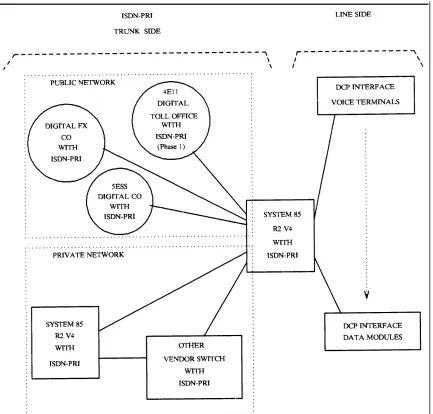
System 85 R2V4 supports ISDN-PRI but not ISDN-BRI. However, System 85 R2V4 uses the line-side digital communications protocol (DCP) to provide end-to-end digital connectivity. The DCP channel structure consists of 2I + 1S channel format. Each I-channel provides a 64K-bps information (voice/data) channel, while the S-channel provides an 8K-bps signaling channel. The DCP is similar to ISDN-BRI, both in structure and in function. The DCP was AT&T’s early attempt to offer (what at that time was) the evolving BRI standard. Figure 1-1, System 85 R2V4 ISDN
Figure 1-1. System 85 R2V4 ISDN Configuration
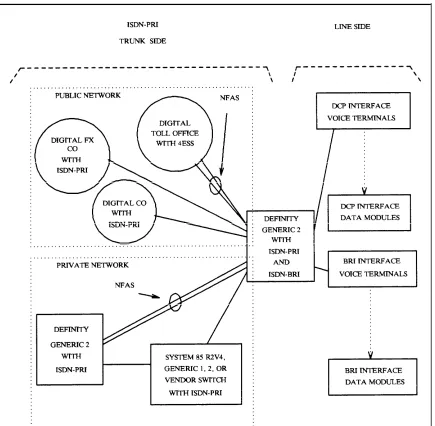
Generic 2 provides a signaling method called nonfacility-associated signaling (NFAS). NFAS allows a D-channel on one PRI facility (sometimes called a PRI pipe) to provide signaling for B-channels on another PRI pipe. With NFAS, if two or more PRI pipes are present, an optional D-channel backup feature is available. One D-channel is administered as the primary D-channel on one DS1 and the secondary D-channel on another DS1. Only one D-channel per primary-secondary pair can be active at a time. If the primary D-channel fails, the signaling function is switched automatically to the secondary (sometimes called the backup) D-channel. Without D-channel backup, D-channel failure results in loss of service for all calls passing through a PRI pipe.
Generic 2 offers ISDN-BRI, however, some BRI capabilities are not initially available. Figure 1-2,
Figure 1-2. Generic 2 ISDN Network Configuration
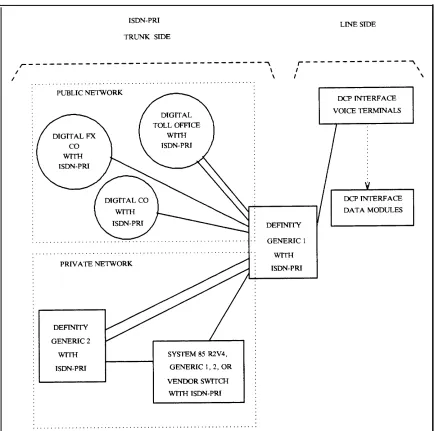
Generic 1 and Generic 2 provide ISDN-PRI but do not support wideband channels. Additionally, ISDN-BRI is not currently supported in Generic 1. However, end-to-end digital connections are permitted via line-side DCP-interface voice terminals and DCP-interface data modules. Figure 1-3,
Figure 1-3. Generic 1 ISDN Network Configuration
Channels
Voice Analog voice date is encoded into 64K-bps pulse-code modulation (PCM) samples using an encoding technique known as the Mu-255 law. Details of this encoding technique are not given here. The important point is that each DS1 channel can transport PCM-encoded 64K-bps voice signals.
Voice-grade data
Digital data
Voice grade data is also called PCM Data and voiceband analog data. Modems receive digital data, convert the data to an analog voiceband signal, and transmit it over analog phone lines. Whenever the modem connects to a digital switch, the modem analog output signal undergoes the same PCM encoding process as voice. Therefore, the modem output is termed voice-grade data.
This two-step process of first converting digital data to analog data and then to 64K-bps PCM data is necessary for transmitting data on DS1/DMI facilities that are either administered for robbed-bit signaling (RBS) or routed over a
combination of digital and analog sections.
An attribute of voice-grade data is that signaling information can be inserted into the least-significant bit (LSB) of the PCM words without destroying the data. This capability cannot be done for those DS1 facilities that transmit digital data (described below).
Voice-grade data calls placed over DS1/DMI facilities, which use RBS, require the use of a modem to permit this two-step conversion. Actually, the modem pool (modem-to-switch) interface does this conversion.
NOTE: Voice-grade data is limited to speeds provided by the modem
(typically 19.2K-bps or less). However, DS1 channels accommodate data at rates up through 56K-bps.
Digital data operates at 64K-bps and 56K-bps rates. Computers and data terminals generate digital data. The computer ports and data terminals interface to data modules. Data modules transmit the digital data (in digital form) to the switch. When this digital data is switched into a DS1/DMI channel without any intervening processes (such as modem pool conversion or embedded signaling information), the channel is said to provide 64K-bps data capability (also known as mode-1 data). The important point here is that when a DS1/DMI signal consists of digital data, every bit that goes in at one end must come out the other end unaltered; otherwise, the data would be destroyed.
Data modules support 56K-bps digital data over robbed-bit facilities.
NOTE: Although the digital data channels transmit synchronous 64K-bps
To properly transmit digital data, the following conditions must be met:
●
●
●
The data communications protocol must meet the 1s-density requirement (see
Line-Coding Formats later in this chapter).
24th-channel signaling must be administered (except for mode 1 data which can use robbed-bit facilities). (See 24th-Channel Signaling later in this chapter.)
The transmission link must consist of an end-to-end digital facility.
Signaling information for the other 23 channels (24th-channel signaling).
B-Channels
For System 85 R2V4 and Generic 1, ISDN-PRI B-channels are identified as channels 1 through 23. For Generic 2, ISDN-PRI B-channels may be identified as channels 1 through 23 when a DS1 facility provides a D-signaling channel or channels 1 through 24 it does not. ISDN-PRI B-channels can only be used for trunk applications. Each B-channel can be used to transmit 64K-bps digitized voice and either restricted digital data or unrestricted digital data.
D-Channels
When a DS1 link contains a D-channel, it is said to use facility associated signaling (FAS). When a DS1 link does not contain a D-channel, it is said to use nonfacility-associated signaling (NFAS). With NFAS, the call-control signaling for the 24 B-channels is associated with a D-channel on another DS1 link. Generic 1 and Generic 2 have NFAS. Earlier products provide FAS only.
ISDN-PRI facilities permit D-channel signaling only over the 24th channel. The full bandwidth (64K-bps) of the D-channel supports the signaling requirements for the associated B-channels. A fundamental difference between the D and B-channels is that each B channel provides a continuous and independent communications link, while the D-channel is used exclusively by the switch to provide call-control signaling and feature services for the associated B-channels.
D-Channel Backup (Generic 2)
Since some network charges are based on the number of D-channels, cost savings are realized by using NFAS and having large groups of B channels. However, the reliability of a large group of B-channels may be decreased because of the dependence on a single D-channel. The D-channel backup capability improves reliability by providing two D-channels. These two channels are called the
primary D-channel (D1) and the secondary D-channel (D2). Only one D-channel is active at a time,
that is, when the primary D channel is active the secondary is idle (and vice versa). If the primary channel fails, the secondary channel switches to the active state.
Circuit-Switched Versus Packet-Switched Channels
A circuit-switched channel provides the full bandwidth of a channel to the single terminating application on an end-to-end basis. For example, the full 64K-bps B-channel bandwidth is continuously available for both calling and called users.
As a contrast, a single packet-switched channel divides the bandwidth of a channel into multiple logical channels. The logical channels use a channel's bandwidth on an as-required and multiplexed basis. The order in which the logical channels are multiplexed is controlled by a packet switching protocol, such as X.25. A System 85 R2V4, Generic 2, and Generic 1 ISDN-PRI provide only circuit switched B-channels. External hardware may be used for providing packet switched channels and thus provide access to a variety of packet networks.
Framing Formats
A frame is a set of 24 8-bit time slots grouped as a single transmission unit. Each DS1 frame has 192 bits (24 x 8), plus 1 bit (called a framing bit) that is inserted at the beginning of each frame. Since each frame repeats time slots in the same sequence as previous frames, time slots representing a single conversation or data stream form a channel. DS1 frames repeat the 24-channel sequence in the same order as previous frames at an 8,000 frames per second rate.
There are two methods or formats for providing framing. Either format may be chosen, depending on the equipment and application. The type of framing used at both equipment ends of a DS1 transmission facility must be identical. The framing format does not place any requirement on the type of signaling or line coding to be used.
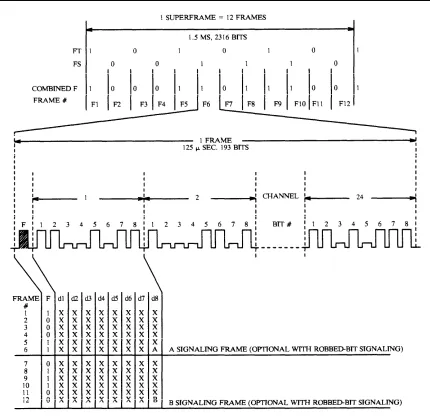
D4 Framing
Figure 1-4. D4 Framing
The D4 framing is the format compatible with D4-channel banks. The D4 framing is the only framing format supported by all equipment used with System 75 and System 85 DS1 (such as CEMs and CDMs).
ESF Framing
Initially, this format was called F , pronounced “F sub e,” for framing extended. It is now callede
extended superframe (ESF). The ESF framing format was developed after the D4 format. Not all
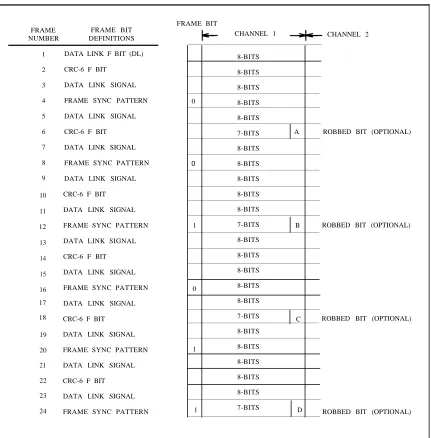
equipment used with a DS1/DMI-BOS interface supports ESF. Specifically, most D4-channel banks (unless they are configured as LIU-3ESF or equivalent) and CDMs do not currently support ESF framing. (See figure 1-5, DS1 Extended Superframe Format.)
FRAME BIT FRAME
NUMBER
FRAME BIT
DEFINITIONS CHANNEL 1 CHANNEL 2
1 2 3 4 5 6 7 8 9
DATA LINK F BIT (DL)
CRC-6 F BIT
DATA LINK SIGNAL
FRAME SYNC PATTERN
DATA LINK SIGNAL
CRC-6 F BIT
DATA LINK SIGNAL
FRAME SYNC PATTERN
DATA LINK SIGNAL
0 0 1 B 8-BITS 8-BITS 8-BITS 8-BITS 8-BITS 7-BITS 8-BITS 8-BITS 8-BITS 8-BITS 8-BITS 7-BITS 8-BITS 8-BITS 8-BITS 8-BITS 8-BITS 7-BITS 8-BITS 8-BITS 8-BITS 8-BITS 8-BITS 7-BITS
A ROBBED BIT (OPTIONAL)
10 11 12 13 14 15 16 17 18
CRC-6 F BIT
DATA LINK SIGNAL
FRAME SYNC PATTERN
DATA LINK SIGNAL
CRC-6 F BIT
DATA LINK SIGNAL
FRAME SYNC PATTERN
DATA LINK SIGNAL
ROBBED BIT (OPTIONAL)
0
C ROBBED BIT (OPTIONAL)
19 20 21 22 23 24
CRC-6 F BIT
DATA LINK SIGNAL
FRAME SYNC PATTERN
DATA LINK SIGNAL
CRC-6 F BIT
DATA LINK SIGNAL
FRAME SYNC PATTERN
1
1 D ROBBED BIT (OPTIONAL)
Figure 1-5. DS1 Extended Superframe Format
end, one framing bit is inserted in each succeeding 193rd bit-position of the DS1 signal. The receive end uses the framing pattern to synchronize the end of one 24-channel block and the beginning of the next, to identify the channels that contain embedded signaling information, and to detect errors.
NOTE: This 4K-bps facility data link is designed to maintain and supervise a DS1 facility.
However, this link is used by a System 75 and System 85 DS1s only for transmitting yellow alarms.
Each 24-frame entity, spanning one ESF cycle, is called the ESF superframe. Figure 1-6, DS1 Signal,
Framing Format, and ESF Superframe (24 Frames), shows an ESF superframe.
NOTE: For RBS, frames 6, 12, 18, and 24 carry signaling information.
The CRC is used at the receive end to detect transmission errors. The CRC is calculated at the transmit end and multiplexed into the DS1 signal. At the receive end, the CRC is recalculated using the data in the received ESF superframe and then compared with the received CRC. If a transmission error (such as one caused by a noise hit) results in the CRC being in error, a misframe occurs. The DS1 interface counts misframes and uses the count for processing DS1 facility performance indicators, such as bit error rates, major alarms, and minor alarms.
The ESF reframing algorithm can determine the correct framing pattern embedded in the DS1/DMI/ISDN-PRI signal even if the 8-bit words for the 24 channels carry a bit sequence identical to the framing pattern. Because of this and its superior error detection capabilities, the ESF format should be used (rather than D4 framing) whenever an application permits.
Signaling Types
DS1/DMI provides four distinct and different types of signaling. One type is called robbed-bit
signaling (RBS). The other three types are variations of 24th-channel signaling called A T & T proprietary signaling, DMI bit-oriented signaling (DMI-BOS), and DMI message-oriented signaling
(DMI-MOS). The type of signaling used does not place any requirements on the type of framing or line coding. However, a direct relationship exists between the type of signaling used and the type of signals transmitted over the channels. A facility that uses RBS transmits voice or voice-grade data; a
facility that uses 24th-channel signaling transmits voice or digital data.
Robbed-Bit Signaling
Robbed-bit signaling (RBS) replaces (that is, robs) the least significant bit (LSB) of each channel’s 8-bit word in every 6th frame. It then replaces this word with the signaling information for that channel. For D4, the 6th and 12th frames carry RBS; for ESF, the 6th, 12th, 18th, and 24th frames carry RBS (refer to figures 1-4 and 1-5, respectively).
Because the signaling information is carried embedded in each channel’s 8-bit word, RBS signaling is also called inband signaling.
Facilities using RBS cannot be used to transmit 64K-bps data.
24th-Channel Signaling
24th-channel signaling permits DS1 channels to use the full 64K-bps bandwidth on the other 23 channels. This type of signaling provides clear channels (clear, except for 1s-density issues). Ones-density issues are those issues associated with the facility being used. (See Line-Coding Formats for more information.) 24th (D-channel) signaling places the signaling bits (or LAPD message bytes) for channels 1 through 23 into the 8-bit word of the 24th-channel.
For AT&T proprietary signaling, a complete set of signaling information is sent every 24 frames. This 24-frame period is not synchronized to the 12-frame superframe format of D4 framing or to the 24-frame superframe format of ESF framing. Each signaling word contains the equivalent of a channel identification number and the signaling state for that channel. The channel identification is necessary since the channel signaling information is not directly related to a particular frame number and does vary as with multilinked facilities.
For DMI-MOS (and ISDN-PRI), each word on the 24th-channel carries a multiword LAPD message within the signaling channel. Messages are transmitted only when signaling is required for one of the other 23 channels along with header and trailer data that identifies the channel for which the signaling is sent. Individual words have no meaning.
The channel identification, its associated signaling, and their relationship to a frame number are related to the concept of superframe synchronization (see the Superframe Synchronization section later in this chapter).
Table 1-1, 24th-Channel Signaling Arrangement, depicts one sample frame number and signaling channel relationship (many other relationship rotations are possible).
TABLE 1-1. 24th-Channel Signaling Arrangement
D4 ESF D4 ESF
Signaling Superframe Superframe Signaling Superframe Superframe Frame No. Frame No. Frame No. Frame No. Frame No. Frame No.
1 11 7 13 11 19
2 12 8 14 12 20
3 1 9 15 1 21
4 2 10 16 2 22
5 3 11 17 3 23
6 4 12 18 4 24
7 5 13 19 5 1
8 6 14 20 6 2
9 7 15 21 7 3
10 8 16 22 8 4
11 9 17 23 9 5
12 10 18 24 10 6
Some types of public network equipment were incompatible with 24th-channel signaling and, as a result, another type of 24th-channel signaling called DMI-BOS, was developed. For DMI-BOS, specific 24th-channel bit locations carry framing and alarm data, and signaling information for the other 23 channels. Unfortunately, DMI-BOS and AT&T proprietary signaling are not compatible. DMI-BOS must be used only for connections to host computers and other vendor’s equipment that meets the DMI technical specification for BOS.
For System 75, the TN722 provides only AT&T proprietary signaling. However, the TN722B can be administered to provide either AT&T proprietary signaling or DMI-BOS.
The CCITT Q.921 ISDN-PRI recommendations require that MOS-type signaling be used. In DMI-MOS, signaling is done with messages that consist of a series of information elements (IEs). The type of IEs used for a particular signaling message are generally determined by the conditions. (See the Summary heading later in this chapter for a description of the different types of IEs.)
For System 85 R2V4 and Generic 1, each ISDN-PRI facility uses the 24th channel as the D (signaling) channel. A Generic 2 switch introduced FAS (administered as 23B + 1D), and NFAS (administered as 24B).
Line-Coding Formats
Line coding is the pattern data assumes as it is propagated over a communications channel. Governing line coding is a set parameters that must be defined for all digital transmissions. These transmission parameters specify the voltage level and patterns in which 1s and 0s can appear on the line.
The parameters chosen for a given transmission stream must meet the requirements set by the hardware through which the data is transmitted. Most notable among these requirements are two established by the AT&T network. The first of these requirements dictates the voltage levels at which ones and zeros are transmitted. Alternating mark inversion line coding was adopted to fulfill this requirement. The second requirement, known as the ones density requirement states that in every stream of 15 consecutive digits, a one must appear. Zero code suppression (ZCS) and 8-bit zero substitution (B8ZS) were adopted to meet this requirement. Both ZCS and B8ZS ensure that a one appears in each consecutive octet in every transmission stream. These line coding formats are described next in more detail.
Alternate Mark Inversion
All transmissions generated by DS1s are encoded in the alternating mark inversion (AMI) line coding format. With AMI, a DS1 signal is a continuous stream of “1s” (encoded as +3V and –3V pulses) and “0s” (encoded as 0V pulses). For every 1 in the bit stream, a pulse occurs; for every 0, no pulse occurs. The pulses of successive 1s are of opposite polarity regardless of the number of intervening 0s (lack of pulses). That is, a the polarity of a 1’s pulse alternates plus or minus between successive ones. This type of line coding is called bipolar or alternate mark inversion (AMI). (See figure 1-7,
v(t)
+3
t
- 3
0 1 0 1 1 0 1 1 1
Figure 1-7. Alternate Mark Inversion
1s-Density Requirement
On the receive side, a DS1 uses the received bipolar pulses of the DS1 signal to recover the 1.544M-bps clock signal that transmitted the bit stream. To do this, the bipolar signal must contain enough pulses (1s) to allow the clock recover circuit to remain synchronized with the bipolar signal. This is known as the 1s-density requirement.
If there are not enough 1s, the clock frequency drifts causing the bits to be received at a different rate than they were transmitted. If this continues, a surplus or deficiency of bits will accumulate at the receiving end. Eventually this surplus or deficiency will equal an entire frame’s worth of bits (192). Then, an entire DS1 frame is either repeated or deleted to compensate for the differences in transmitting and receiving clock frequencies. This is called a slip. (Slips can also be caused by incorrect switch synchronization as discussed in the Synchronization of Digital Facilities chapter.)
The 1s-density requirement specifies that a minimum 1s-density average of 12.5% be maintained and that a maximum of 15 consecutive 0s can occur in the bit stream. If this requirement is not met, it is assumed that an error has occurred and that the network equipment will insert a series of ones into the bit stream to compensate.
Zero Code Suppression and Bipolar with 8 Zero Substitution
Restricted Channel
A restricted channel is a digital transmission facility restricted to transmissions in which an all-0s octet (eight 0s in a single time slot) is never transmitted. In restricted channels, the line equipment’s transmitters use ZCS line coding. This format monitors the 24 DS0 channels and prevents eight consecutive 0s (the all-0s octet) from being transmitted. On detecting eight 0s, the line-coding format forcibly changes the second LSB to a 1 when it is transmitted because too many 0s causes loss of synchronization. This ensures that the 1s-density requirement is met but the receivers in these facilities have no way of knowing which 1s were 0s when transmitted and the data is destroyed. Therefore, user data transmitted in the DS0 channels with ZCS must be restricted to not generate the all-0s octet (hence the name restricted channels).
ZCS line coding is done in one of two ways:
● For data, a data communications protocol that does not produce the 0s octet is used. The
high-level data link control (HDLC) protocol, or those protocols built on HDLC (such as the DCP, PRI, and BRI signaling protocols and DMI modes 2 and 3), do not generate an all-0s octet (when the signal is inverted before transmission) and therefore meets these requirements. Data mode 0 does not generate an all-0s octet if the data terminal equipment (DTE) transmits the HDLC protocol to the data module. (Data mode 0 is used only when a customer provides HDLC.)
For ISDN applications the LAPD protocol is used to make D-channel signaling messages. LAPD is an HDLC-based protocol. The D-channel is inverted before it is transmitted and, therefore, ZCS is never activated.
● For voice, 64K-bps PCM encoding is sent from the voice terminal over one of the I channels
(DCP) or B-channels (ISDN-BRI) for call processing. At the DS1 board, when an all-0s octet is encountered on an outgoing call stream, the second least-significant bit of the octet is forcibly changed to a 1 before transmission. When the outgoing call is transmitted from a DS1 board, the board cannot discriminate between originating channel types. Since PCM does not generate an all-0s octet, the ZCS line-coding format does not affect 64K-bps PCM voice.
Unrestricted or Clear Channel
An unrestricted channel is a transmission facility that has no restrictions on the number of consecutive 0s so arbitrary insertions of 1s will not occur (as with ZCS line coding). The line equipment’s transmitters and receivers in these facilities use bipolar with 8 zero substitution (B8ZS) line coding. This format monitors the DS1 bit stream, detects strings of eight consecutive 0s (not restricted to an individual octet), and encodes these 0s (including framing bits) into a unique bipolar pulse sequence (called a bipolar violation) that meets the 1s-density requirement. This sequence is detected at the receiver and converted back to eight consecutive 0s. Therefore, digital data can be transmitted on these channels without concern about its content (hence, the name unrestricted o r
UNCODED
BIT STREAM 010011 00000000 111 00000000 00000000 01
PULSE
STREAM 0 + 0 0 - + 0 0 0 + 0 - + - + - 0 0 0 - + 0 + - 0 0 0 - + 0 + - 0 +
VIOLATIONS BASED ON POLARITY OF LAST 1 TRANSMITTED
Figure 1-8. Example of B8ZS Line Coding
Applications requiring B8ZS line coding are currently in the minority, but it is expected that in the long term they will be in the majority. The B8ZS provides no substantial advantages for voice and voice-grade data signals over ZCS. However, if the data communications protocol does not already maintain proper 1s-density, then B8ZS is essential for transmitting unrestricted digital data. Even if the AT&T network contains unrestricted facilities, the access facilities through the local exchange may not, which means that you would still be required to use the ZCS option.
Differences Between ZCS and B8ZS
Differences between ZCS and B8ZS include:
1.
2.
3.
4.
ZCS requires that user data be presented via a data communications protocol that does not generate the all-0s octet, while B8ZS has no such restrictions
ZCS monitors each B-channel (not including the framing bits), while B8ZS monitors the entire DS1 facility (including framing bits)
ZCS maintains 1s-density at the expense of altering the data, while B8ZS maintains 1s-density without altering the data
When detecting the all-0s octet with ZCS, the transmit side inserts a 1 in the second LSB,
which will not be corrected from by the receiving side. When detecting eight consecutive 0S
Bipolar Violations
As noted earlier, the DS1 bit stream is transmitted as a series of pulses. Successive pulses, regardless of the number of intervening spaces (0s), are of opposite polarity. A bipolar violation is the occurrence of two consecutive identical pulses, that is, when two positive or two negative pulses are received in a row, regardless of the number of intervening 0s.
Usually, bipolar violations are caused by noise hits on the DS1 bit stream. For B8ZS, strings of eight 0s are encoded into special sequences that include bipolar violations. Some network-interface equipment, primarily most network channel-terminating equipment, or NCTE (also called
customer-service units or CSUs), and network transmission equipment (network high-speed multiplexer), will
remove bipolar violations. Therefore, if an application requires B8ZS line coding, then the end-to-end transmission facilities must support B8ZS. Otherwise, the B8ZS encoding will be destroyed. Additional NCTE information is provided in chapter 3, DS1 Transmission and Cabling, and chapter 7, Administration Issues, Options, and Requirements.
A Generic 2 DS1 interface does not process bipolar violations, because they are removed by most NCTEs.
Communication Protocols and 1s-Density Requirement
As mentioned earlier, there are other methods (communication protocols) used to prevent strings of 0s from occurring in the DS1 bit stream. One such protocol is used with System 75 and System 85 as described next.
System 75 and System 85 digital ports interface to data modules. These data modules encode user data consistent with the DMI specification. The DCP is specifically designed to prevent generation of the all-0s octet when using DMI modes 1-3 and, therefore, either the ZCS or B8ZS line-coding formats may be used. But since the ZCS format has no special equipment requirements, ZCS is the preferred format.
Table 1-2, Data-Module Capabilities, summarizes the capabilities of the data modules that can be used on Generic 2 for communications over an ISDN-PRI link. For further details on each data module, refer to About This Document for a list of related data module documents. For complete definitions of the four DMI modes (0 through 3), refer to Digital Multiplexed Interface (DMI)