i
GENETIC ALGORITHM APPROACH IN SOLVING MINISUM FACILITY LOCATION PROBLEM WITH FIXED LINE BARRIER
NURFARHANI BINTI MOHD SHABRI
A dissertation submitted in partial fulfilment of the requirements for the award of the degree of
Master of Science (Mathematics)
Faculty of Science Universiti Teknologi Malaysia
iii
iv
ACKNOWLEDGEMENT
I would like to say Alhamdulillah and thanks to all people who have helped and inspired me during my study.
In the first place I would like to record my gratitude to my beloved supervisor, Dr. Zaitul Marlizawati Zainuddin for the great supervision, advice, and guidance from the very early stage of this research as well as giving me extraordinary experiences throughout this dissertation. The most needed, she provided me unflinching encouragement and support in various ways. I am truly grateful for having such a wonderful supervisor.
I would like to thank my family who always support me in my journey of education. They have given me so much comfort, care and love, either financially or spiritually, of which word could not express and will forever be remembered in my heart.
v
ABSTRACT
vi
ABSTRAK
vii
TABLE OF CONTENTS
CHAPTER TITLE PAGE
TITLE DECLARATION DEDICATION ACKNOWLEDGEMENT ABSTRACT ABSTRAK
TABLE OF CONTENTS LIST OF TABLES LIST OF FIGURES
i ii iii iv v vi vii xi xii
1. INTRODUCTION
1.1 Introduction to Facility Location Problem 1.2 Background of Study
1.3 Statement of Problem 1.4 Objectives of Study 1.5 Scope of Study 1.6 Significance of Study
1.7 Outline of Report
1 1 2 5 7 8 8 8
2. LITERATURE REVIEW
2.1 Introduction
2.2 Facility Location Problem
2.3 Related Works on Facility Location Problem with
viii
Barriers
2.3.1 Definition of Minisum Problem (Weber Problem)
2.3.2 Related Works on Minisum Problem with Barrier
2.3.3 Development of Formulation of Minisum Facility Location Problem with Fixed Line Barrier
2.4 Basic Concepts of Genetic Algorithm
2.5 Main Parts of Genetic Algorithm (GA) Process 2.6 Summary 15 17 18 21 22 23
3. RESEARCH METHODOLOGY
3.1 Introduction
3.2 Research Methodology 3.2.1 Literature Review 3.2.2 Description on Problem
3.2.3 Formulation of Minisum Single Facility
Location Problem with Fixed Line Barrier (Mix Integer Non Linear Model of Problem) 3.2.4 Implementation of LINGO in solving MINLP
Model for Single Facility Location Problem 3.2.5 Development of Genetic Algorithm (GA)
Procedure and Implementation of Developed GA using C++ Programming
3.3 Weiszfeld Algorithm for Continuous Facility Location Problem
3.4 Introduction of Genetic Algorithm in Location Problem
3.5 Terminologies in Genetic Algorithm 3.5.1 Individual and Chromosome Design
ix
3.5.2 Population
3.5.3 Fitness Function Representation 3.5.4 Genetic Operators
3.5.4.1 Chromosome Crossover 3.5.4.2 Chromosome Mutation 3.5.4.3 Reproduction (Selection) 3.5.5 Selection of Parent
3.5.5.1 Roulette Wheel Selection 3.5.5.2 Random Selection
3.5.5.3 Ranking Selection 3.5.5.4 Tournament Selection 3.5.6 Replacement (Termination)
3.5.7 Stopping Criteria (Termination Criteria) 3.6 Basic Genetic Algorithm (GA) Procedure 3.7 Summary 34 35 37 37 38 40 41 41 43 43 43 44 44 45 45
4. IMPLEMENTATION OF LINGO AND GENETIC
ALGORITHM IN SOLVING MINISUM FACILITY LOCATION PROBLEM WITH FIXED LINE
BARRIER 4.1 Introduction
4.2 Data of Small Case Problem for Minisum Facility Location Problem with Line Barrier
4.3 Genetic Algorithm Procedure in Solving Minisum Multi-Facility Location Problem with Fixed Line Barrier
4.4 Genetic Algorithm Implementation for Minisum Multi-Facility Location Problem with Fixed Line Barrier
4.4.1 Chromosome Representation 4.4.2 Initial population
x
4.4.3 Fitness Function
4.4.4 Calculation of Fitness Value 4.4.5 Selection of Parent
4.4.6 Crossover 4.4.7 Mutation
4.4.8 Construction of New Population
4.5 Computational Results for Single Facility Problem for Solving 10-Customer Points Problem
4.6 Computational Results for Multi-Facility Problem for Solving 50-Customer Points Problem
4.7 Summary
55 56 60 60 62 66 69
71
78
5. CONCLUSION AND RECOMMANDATIONS
5.1 Introduction 5.2 Summary 5.3 Conclusion
5.4 Recommendations
79 79 79 80 82
REFERENCES 83
xi
LIST OF TABLES
TABLE NO. TITLE PAGE
4.1 Data of Parameter Values for the Fixed Points 48
4.2 Initial Population for Simple Case Problem 54
4.3 Calculation of Distance for Facility 1 in Chromosome 1 for Initial Population
57
4.4 Calculation of Distance for Facility 2 in Chromosome 1 for Initial Population
58
4.5 Calculation of Fitness Value for Chromosome 1 {(1.3, 2.6), (3.8, 1.0)} for Initial Population
59
4.6 Initial Population Sorted in Decreasing Order 59
4.7 The Selected Parents 60
4.8 Allocation of Customer Points to the Nearest Facility for )} 6 . 9 , 9 . 8 ( ), 3 . 6 , 5 . 2 {( 3 s 63
4.9 New Solution inserted in Population 66
4.10 New Population 67
4.11 Solution Population for Small Case Problem 68
4.12 Allocation of Customer Points to the Nearest Facility for the Optimal Solution{(2.9081,3.3988),(6.0,8.2)}
68
4.13 Data for 50-Customer Problem 71
4.14 Passage Points on Line Barrier 73
4.15 Solutions for the 50-Customers Problem for Multi-Facility Problem
xii
LIST OF FIGURES
FIGURE NO. TITLE PAGE
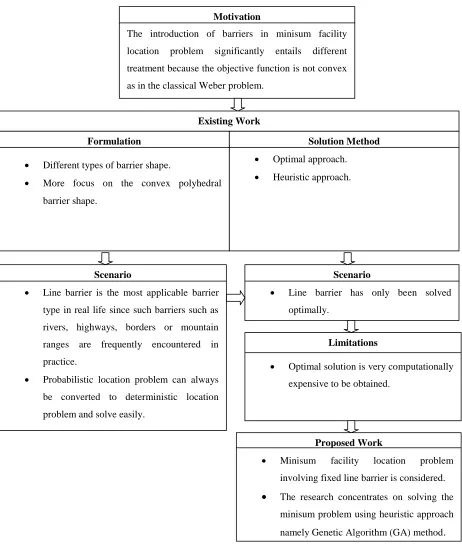
1.1 Scenario leading to the Research Problem 6
2.1 Framework of Facility Location Problem with Barrier 16
3.1 Operational Framework of the Study 25
3.2 Example of a Chromosome or Individual in Integer Format 33 3.3 Example of a Chromosome or Individual in Binary Format 33 3.4 Binary Representation with respect to Location Point 33
3.5 Simple Example of a Population 34
3.6 An Integer Representation of One-point Crossover 38 3.7 A Binary Representation of One-point Crossover 38 3.8 A Binary Representation of Two-point Crossover 38 3.9 A Binary Representation of Chromosome Mutation 40 3.10 Roulette Wheel for Chromosomes based on Fitness in
Percentages
42
3.11 Outline of the Basic Genetic Algorithm Procedure 46 4.1 10-Customer Points Problem for Facility Location Problem
with a Line Barrier
49
4.2 Flow Chart of Process for Genetic Algorithm 51 4.3 Population Representation for Multi-Facility Location
Problem
53
4.4 Population Representation for Single Facility Location Problem
54
xiii
4.6
4.7 4.8
Location of 50-Customer Problem and Barrier with Passages
No. of Facility versus Optimal Total Distance No. of facility versus No. of Iterations
74
1
CHAPTER 1
INTRODUCTION
1.1 Introduction to Facility Location Problems
A facility location problems occur when we need to consider locating a facility on the plane to serve a finite set of existing demand points with different demand levels. The majority of traditional location problems in continuous space assume that a new facility is a point in space that is to be located with respect to some objective defined by its distances to a set of demands at specific fixed points in that space. In other words, a facility location problem usually formulated as a minimization or maximization problem with an objective function involving distances between the facility and demand points.
2
1.2 Background of Study
When locating a facility on the plane to serve a finite set of existing demand points with different demand levels, one of the objectives would be to find a location such that the sum of the distances from the facility to the demand points is minimized. As been stated earlier, this problem is known as the minisum facility location problem or was more specifically known as the classical Weber problem. In the past, most work on the facility location literature focused on locating a facility on a continuous plane. If the facilities were assumed to be located at any point on a continuous location plane, it means that the solution space is continuous, that is, it is feasible to locate facilities on every point in the plane without any restrictions or barriers.
However, realistic facility locations problems always involve the consideration of restrictions imposed by barriers. Barriers are regions where travelling as well as locating new facilities is prohibited. Examples of barriers include lakes, parks, military areas, and many more. Barriers also take place because of disasters and accidents that cause damage to road networks. Apart from that, the other examples of barriers would be impassable areas on the shop floor like machines, subassembly areas, input–output docks, and others.
3
relevance than general facility location problems, they have not been given much attention until lately, due to the computational complexities associated with these problems [2]. The introduction of barrier regions significantly entails different treatment since the objective function is not convex as in the classical facility location problem especially in the Weber problem.
In addition, the available literature on location problems in the presence of barriers can also be classified according to the following criteria such as shape of barriers (arbitrary, polygonal, circular, rectangular, polyhedral etc.), size of new facility (infinitesimal or finite size), travel metric used (Euclidean, rectangular, etc.), type of objective (median or center) [4]. Literature has so far only treated some particular types of metrics and barrier shapes such as one circular barrier, and the Euclidean distance or closed polyhedral barriers.
The literature in this area started with Kartz and Cooper [5] that considered the Weber problem as well as Euclidean distance and one circular barrier regions. The author used a heuristic based approach in finding the solution. Later, some properties of the problem were analyzed by Klamroth [6] that divided the feasible region into some convex regions. However, construction of these convex regions becomes cumbersome hence is not desired. Then, Bischoff and Klamroth [7] proposed a heuristic approach which was the genetic algorithm in finding the solution to the problem in order to get over this difficulty.
4
Klamroth [10] suggested a slightly different approach to overcome the difficulty. It means that the author also used optimal approach in order to solve the problem.
Next, Klamroth [11] introduced a linear line barrier with given passages for Weber problem. He considered a fixed line barrier with passages that divides the plane into two sub-planes and he used optimal approach in solving the problem. Then in year 2010, Canbolat and Wesolowsky [2] had considered the probabilistic line barriers in location problem and it was also solved optimally. In 2012, Canbolat and Wesolowsky [12] also proposed their new work in facility location problem area by considering the fixed line barrier region and provide an optimal solution methodology based on an Outer Approximation (OA) algorithm.
Hence, we can conclude that measuring distances in the presence of barriers plays an important role in location problems with barriers, specifically in minisum facility location problem. Despite a large number of works concerning the shortest path problem in the presence of barriers, a few studies have employed an analytical approach. Analytical expressions for the barrier distance are necessary to examine relationships between variables, for example, how the location and the size of a barrier affect the barrier distance.
5
idealized case of barriers is that it is linear since it is frequently encountered in practice or in real life.
In many applications, the solution for the problem is not feasible because of its complexity due to large number of variables and also too long computations times. Hence, if we solve the problem optimally, it will be computationally expensive to be obtained. Based on the works discussed earlier, it can be seen that most of the problems are solved by using exact method or optimally for small size problem. The scenario leading to the research problem can be summarized as in Figure 1.1.
1.3 Statement of Problem
6
Figure 1.1: Scenario leading to the Research Problem
Scenario
Line barrier has only been solved
optimally.
Limitations
Optimal solution is very computationally
expensive to be obtained.
Proposed Work
Minisum facility location problem
involving fixed line barrier is considered. The research concentrates on solving the
minisum problem using heuristic approach
namely Genetic Algorithm (GA) method. Motivation
The introduction of barriers in minisum facility
location problem significantly entails different
treatment because the objective function is not convex
as in the classical Weber problem.
Existing Work
Solution Method
Optimal approach. Heuristic approach. Formulation
Different types of barrier shape.
More focus on the convex polyhedral
barrier shape.
Scenario
Line barrier is the most applicable barrier
type in real life since such barriers such as
rivers, highways, borders or mountain
ranges are frequently encountered in
practice.
Probabilistic location problem can always
be converted to deterministic location
7
1.4 Objectives of Study
The objectives of the study are as follows:
(1) To solve the Mix Integer Non Linear Programming (MINLP) model of the problem for single facility using LINGO software.
(2) To develop basic Genetic Algorithm (GA) procedure for solving the minisum facility location problem with fixed line barrier.
(3) To implement the developed Genetic Algorithm procedure to the generated data using C++ programming.
(4) To investigate the performance of population size of parameter settings in the Genetic Algorithms.
1.5 Scope of Study
8
1.6 Significance of Study
This research focuses in developing the Genetic Algorithm procedure for solving minisum problem with fixed line barrier. The proposed technique will be able to solve large size problem with less computational effort. The main contributions of this research are summarized as follows:
i) Development of Genetic Algorithm procedure for solving minisum problem with fixed line barrier.
ii) Evaluation of the performance of the proposed algorithm in solving the problem.
iii) As a reference for solving real minisum facility location problem involving fixed line barrier.
1.7 Outline of Report
In general, this dissertation is divided into five chapters. In Chapter 1, an overview of this study had been addressed. This chapter includes the introduction of problem, background of study, statement of problem, objectives of study, scope of study, and also the significance of study.
9
Meanwhile in Chapter 3, it includes the research methodology of the problem and also the operational framework of the study. This chapter also briefly discusses the solution method that we used to solve the minisum facility location problem with fixed line barrier namely genetic algorithm.
83
REFERENCES
[1] Masamichi, K. and Kushimoto, S. (1997). A Single Facility Minisum Location Problem under the A-Distance. Journal of the Operations Research Society of
Japan. (40): 10-20.
[2] Canbolat, M. S. and Wesolowsky, G. O. (2010). The Rectilinear Distance Weber Problem in the Presence of a Probabilistic Line Barrier. European Journal of
Operational Research. (202): 114-121.
[3] Brimberg, J. and Wesolowsky, G. O. (2002). Minisum Location with Closest Euclidean Distances. Annals of Operations Research. (111): 151-165.
[4] Sarkar, A., Batta, R., and Nagi, R. (2007). Placing a Finite Size Facility with a Centre Objective on a Rectangular Plane with Barriers. European Journal of
Operational Research. (179): 1160-1176.
[5] Kartz, I. and Cooper, L. (1981). Facility Location Problem in the Presence of Forbidden Regions. European Journal of Operational Research. (6): 166-173.
[6] Klamroth, K. (2004). Algebraic Properties of Location Problems with One Circular Barrier. European Journal of Operational Research. (154): 20-35.
[7] Klamroth, K. and Bischoff, M. (2007). An Efficient Solution Method for Weber Problems with Barriers Based on Genetic Algorithms. European Journal of
84
[8] Aneja, Y. P. and Parlar, M. (1994). Algorithms for Weber Facility Location in the Presence of Forbidden Regions and Barriers to Travel. Transportation
Science. (28): 70-76.
[9] Butt, S. E. and Cavalier, T. M. (1996). An Efficient Algorithm for Facility Location in the Presence of Forbidden Regions. European Journal of
Operational Research. (177): 22-41.
[10] Klamroth, K. (2001a). A Reduction Result for Location Problems with Polyhedral Barriers. European Journal of Operational Research. (130): 486-497.
[11] Klamroth, K. (2001b). Planar Weber Location Problems with Line Barriers.
Optimization. (49): 517–527.
[12] Canbolat, M. S. and Wesolowsky, G.O. (2012). A Planar Single Facility Location and Border Crossing Problem. Computers and Operations Research.
(1): 1-10.
[13] Andreas, K. and Andreas, D. (2005). Facility Location Models for Distribution System Design. European Journal of Operational Research. (162): 4-29
[14] Tompkins, J. A., White, J. A., Bozer, Y. A., and Tanchoco, J. M. A. (2010).
Facilities Planning. 4th. ed. USA: John Wiley & Sons.
[15] Drezner, Z. and Hamacher, H.W. (2004). Facility Location: Applications and
85
[16] Hillier, F. S. and Lieberman, G. J. (2010). 9th ed. Introduction to Operations
Research. New York, USA: McGraw-Hill International Edition.
[17] Plastria, F. (2011). The Weiszfeld Algorithm: Proof, Amendments and Extensions. Eiselt, H.A. and Marianov, V. Foundations of Locational Analysis. (357-389). New York, USA: Springer.
[18] Kuhn, H. W. (1967). On a Pair of Dual Nonlinear Programs. Abadie, J. (ed).
Nonlinear Programming. Chapter 3. New York: John Wiley and Sons.
[19] Gamal, M. D. H. and Salhi, S. (2003). A Cellular Heuristic for the Multi-Source
Weber Problem. University of Birmingham.
[20] Topcuoglu, H., Corut, F., Ermis, M., and Yilmaz, G. (2005). Solving the Uncapacitated Hub Location Problem using Genetic Algorithms. Computers and
Operations Research. (32): 967–984.
[21] Sivanandam, S. N. and Deepa, S. N. (2008). Introduction to Genetic Algorithm. New York, USA: Springer Berlin Heidelberg.
[22] Li, X. and Gar-On Yeh, A. (2005). Integration of Genetic Algorithms and GIS for Optimal Location Search. International Journal of Geographical Information
Science. (19): 581-601.
[23] Dominguez-Marin, P., Nickel, S., Hansen, P., and Mladenovic, N. (2005). Heuristic Procedures for Solving the Discrete Ordered Median Problem. Annals
86
[24] Babaie-Kafaki, S., Ghanbari, R., Nasseri, S. H., and Ardil, E. (2008). Solving Bus Terminal Location Problem using Genetic Algorithm. World Academy of
Science, Engineering and Technology. (14):764-767.
[25] Qin, X. (2009). A Social Vulnerability-Based Genetic Algorithm to
Locate-Allocate Transit Bus Stops for Disaster Evacuation in New Orleans, Louisiana.
Master of Science, Department of Geography and Anthropology, Beijing Normal University.
[26] Wan Alias, W. N. I. (2007). Genetic Algorithm for Vehicle Routing Problem with
Backhauls. Master Dissertation thesis, Universiti Teknologi Malaysia (UTM)
Skudai.
[27] Coley, D. A. (1999). An Introduction to Genetic Algorithms for Scientists and
Engineers. USA: World Scientific Publishing Co. Pte. Ltd.
[28] Jaramillo, J. H., Bhadury, J., and Batta, R. (2002). On the use of Genetic Algorithms to Solve Location Problems. Computers and Operations Research. (29): 761-779.
[29] Holland, J. H. (1992). Adaptation in Natural and Artificial Systems. USA: MIT Press Cambridge.
[30] Sivaraj, R. and Ravichandran, T. (2011). A Review of Selection Methods in Genetic Algorithm. International Journal of Engineering Science and
87
[31] Miller, B. I. and Goldberg, D. E. (1995). Genetic Algorithms, Tournament Selection, and the Effects of Noise. University of Illinois at Urbana-Champaign. (51): 1-13.
[32] Lozano, M., Herrera, F., and Cano, J. R. (2005). Replacement Strategies to Maintain Useful Diversity in Steady-State Genetic Algorithms. Advances in Soft
Computing. (1): 85-96.
[33] Brimberg, J., Hansen, P., Mladenovic, N., and Taillard, E. D. (2000). Improvements and Comparison of Heuristics for Solving the Uncapacitated Multisource Weber Problem. Operations Research. (48): 444-460.
[34] Michalewicz, Z. (1999). Genetic Algorithms + Data Structures = Evaluation
Programs. Third, Revised and Extended Edition. New York: Springer-Verlag
Berlin Heidelberg.
[35] Salhi, S. and Gamal, M. D. H. (2003). A Genetic Algorithm Based Approach for the Uncapacitated Continuous Location-Allocation Problem. Annals of
Operations Research. (123): 203-222.
[36] Alander, J. T. and Koljonen, J. (1994). Effects of Population Size and Relative Elitism on Optimization Speed and Reliability of Genetic Algorithms. Indexed Biblography of Genetic Algorithms Theory and Comparisons (University of
Vaasa). (1): 1-7.