DEVELOPING KNOWLEDGE EXPERT REPOSITORY SYSTEM FOR IT PROFESSIONALS AT CICT, UTM
ZAM ZARINA BINTI ISHAK
A project report submitted in partial fulfillment of the requirements for the award of the degree of
Master of Science (Information Technology – Management)
Faculty of Computer Science and Information System Universiti Teknologi Malaysia
iii
Dedicated to my mother and father whose love, encouragement and values will always guide and inspire me.
PATIMAH SERJAN
ARWAHYARHAM ISHAK BIN HASANUDDIN and
To my loving friend, MOHAMAD HAFIZ and beloved siblings (CT, EJAT & PALI) In the hope that they will be encouraged to trive for the best throughout their lifetime s
iv
ACKNOWLEDGEMENT
First and foremost I thank Allah that I am able to complete my Master’s project even thought I have to faced many challenges and circumstances. I wish to express my sincere appreciation to my supervisor, Dr. Azizah Abdul Rahman, for encouragement, advice and guidance.
v
ABSTRACT
vi
ABSTRAK
vii
TABLE OF CONTENTS
CHAPTER TITLE PAGE
DECLARATION ii
DEDICATION iii
ACKNOWEDGEMENTS iv
ABSTRACK v
ABSTRAK vi
TABLE OF CONTENTS vii
LIST OF TABLES xiii
LIST OF FIGURES xv
LIST OF ABBREVIATIONS xvii
LIST OF APPENDICES xviii
1 PROJECT OVERVIEW 1
1.1 Introduction 1
1.2 Problem Background 2
1.3 Problem Statement 3
1.4 Problem Objectives 4
1.5 Importance of Study 4
1.6 Project Scope 5
1.7 Summary 5
2 LITERATURE REVIEW 7
viii 2.2 Introduction to Knowledge Management
2.2.1 Knowledge Evolution 9 9 2.2.2 Knowledge Management Definition 12 2.2.3 Fundamental Processes of Knowledge
Management
13
2.2.4 Knowledge Sharing 14
2.2.4.1 SECI Model 15 2.2.5 Knowledge Networks Strategies 17
2.2.5.1 Mentoring 17
2.2.5.2 Coaching 18
2.2.5.3 Communities of Practices 19
2.3 Knowledge Management System
2.3.1 Knowledge Management System Architecture 2.3.2 Knowledge Management System Category
19 19 21 2.4 Knowledge Repository
2.4.1 Concept of Knowledge, Expertise and Competence
2.4.2 Competence System
2.4.3 Example of Expert Repository System 2.4.3.1 The Competence Management
System at Volvo IT
2.4.3.2 Competence Management System at Guide
2.4.3.3 The Expert Seeker People-Finder System at Kennedy Space Center 2.4.3.4 The Global Competence Planning
System at Ericsson
22 22 23 24 24 27 28 29
2.5 Introduction to IT Professionals
2.5.1 Categories of IT Professionals 2.5.2 IT Professionals Skills
2.5.2.1 Skills Definition
2.5.2.2 Characteristics of Skills 2.5.2.3 IT Skills Classifications
ix 2.5.3 Soft Skills
2.5.4 Business Skills
40 44
2.6 IT Skills Level 46
2.7 IT Skills Portfolio Management 48 2.7.1 Three Key Principles 49 2.7.2 The process of IT Skills Portfolio
Management
51
2.8 Summary
2.9
53
3 METHODOLOGY 55
3.1 Introduction 55
3.2 Project Methodology 55
3.3 Project Operational Framework 57
3.4 Project Initiation and Planning Phase 58
3.5 Analysis Phase
3.5.1 Gather Information 3.5.2 Framework verification 3.5.3 Define System Requirements
3.5.1.1 Unified Modeling Language (UML) 3.5.4 Prioritize System Requirement
3.5.4.1 Three Tier Model of Client Server Architecture
3.5.4.2 Hardware 3.5.4.3 Software 58 59 59 60 60 61 61 62 64
3.6 Design System Phase 68
3.7 Develop Prototype 68
3.8 Build Final System 70
3.9 Perform Testing and User Acceptance Test 3.9.1 Testing
3.9.2 User Acceptance Test
70 70 71
3.10 Finalized System and Report Writing 72
3.11 Project Schedule 72
x
4 FINDINGS 74
4.1 Introduction 74
4.2 Organizational Analysis
4.2.1 Introduction to CICT 4.2.2 CICT Vision and Mission
4.2.3 CICT Objective
4.2.4 CICT Organization Structure 4.2.5 IT Professionals at CICT
4.2.5.1 Career Stages and Development at CICT
4.2.6 Departments at CICT
4.2.6.1 Academic Computing Division 4.2.6.2 Infrastructure & Service Division 4.2.6.3 Administrative Computing Division 4.2.6.4 ICT Training and Consultancy Unit 4.2.6.5 ICT Research and Planning Special
Unit 74 75 76 76 77 78 78 82 82 83 84 85 86
4.3 Framework Analysis 87
4.3.1 Development of IT Expertise Framework 87 4.4 Analysis and Design of Knowledge Expert Repository
System
102
4.4.1 Analysis of Proposed System 102
4.5 Analysis Conceptual Design (To-Be Process) 105 4.5.1 Use Case and Class Diagram 105
4.6 Input and Output Specification 107
4.7 Interface Design 109
4.8 Database Design 110
4.9 Stakeholders 110
4.10 Summary 111
5 IMPLEMENTATION AND TESTING 112
5.1 Introduction 112
xi
5.2.1 Unit Testing 113
5.2.2 Integration Testing 113
5.2.3 System Testing 114
5.2.4 User Acceptance Test 117
5.3 Programming coding 120
5.4 User Manual 120
5.5 Summary 120
6 ORGANIZATIONAL STRATEGY 121
6.1 Introduction 121
6.2 IT Expertise Framework Implementation 121
6.3 System Implementation 123
6.4 Summary 126
7 CONCLUSION 127
7.1 Conclusion 127
7.2 Achievements 127
7.3 System’s Strength 129
7.4 System’s Limitation 130
7.5 Future Enhancement 130
7.6 Contributions 131
7.6.1 Academic Contributions 131
7.6.2 KERYS 131
7.7 Commercialization 132
7.7 Summary 132
REFERENCES 133
xii
LIST OF TABLE
TABLE NO. TITLE PAGE
2.1 Example of IT/IS Skill Classifications (Nakayama &
Sutcliffe, 2005) 39
2.2 Soft Skill needed by IT Professionals (Bailey and
Stefaniak, 2000) 41
3.1 Hardware Specification for System Development 63 4.1 PTK Syllabus for Information Technology Officer
(System Analyst) 80
4.2 PTK Syllabus for Information Technology Assistant
Officer (Programmer) 81
4.3 Academic Computing Division goals and objectives 82 4.4 Academic Computing Division function and division 83 4.5 Infrastructure and Service Division goals and objectives 84 4.6 Units and Function at Infrastructure & Service 84 4.7 Goal and objectives of Academic Computing Division 85 4.8 Goal and objectives of ICT Training and Consultancy
Unit 86
4.9 Summary of IT Skills Classification 90
4.10 Categorizing of IT Skills 91
4.11 IT Expertise Framework Details 97
xiii
4.13 IT Skill Level for KERYS 101
4.14 Expert Repository Comparison 103
4.15 Proposed system 104
4.15 Input Specification 108
4.16 Output Specification 109
5.1 Black-box testing 109
5.2 UAT Participants 116
xiv
LIST OF FIGURES
FIGURE NO. TITLE PAGE
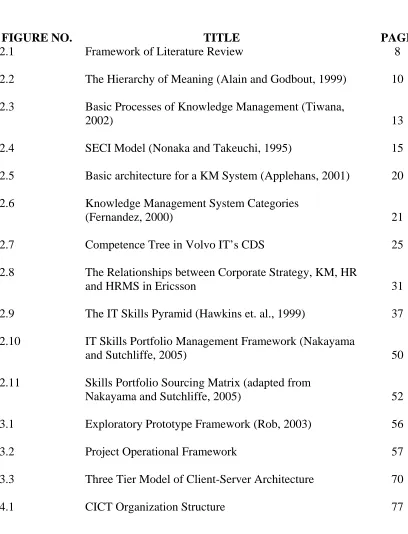
2.1 Framework of Literature Review 8
2.2 The Hierarchy of Meaning (Alain and Godbout, 1999) 10 2.3 Basic Processes of Knowledge Management (Tiwana,
2002) 13
2.4 SECI Model (Nonaka and Takeuchi, 1995) 15 2.5 Basic architecture for a KM System (Applehans, 2001) 20 2.6 Knowledge Management System Categories
(Fernandez, 2000) 21
2.7 Competence Tree in Volvo IT’s CDS 25
2.8 The Relationships between Corporate Strategy, KM, HR
and HRMS in Ericsson 31
2.9 The IT Skills Pyramid (Hawkins et. al., 1999) 37 2.10 IT Skills Portfolio Management Framework (Nakayama
and Sutchliffe, 2005) 50
2.11 Skills Portfolio Sourcing Matrix (adapted from
Nakayama and Sutchliffe, 2005) 52
3.1 Exploratory Prototype Framework (Rob, 2003) 56
3.2 Project Operational Framework 57
3.3 Three Tier Model of Client-Server Architecture 70
xv 4.2 Career stages of Information System Officer or System
Analyst at CICT 78
4.3 Career stages of Information System Officer or
Programmer at CICT 79
4.4 Framework methodology 87
4.5 IT Expertise Framework 95
4.5 Use Case Diagrams 106
4.6 Class Diagram 107
6.1 Framework Implementation Steps 122
xvi
LIST OF ABBREVIATIONS
CDS Competence Database System
CICT Center of Information and Communication Technology FSKSM Faculty of Science Computer and Information System KERYS Knowledge Expert Repository System
KM Knowledge Management
KMS Knowledge Management System
UAT User Acceptance Test
UML Unified Modeling Language
xvii
LIST OF APPENDICES
APPENDIX TITLE PAGE
A Knowledge and abilities required by IT Professional according to job cluster
138
B The job function detail on each of the specialties 143
C Interview question 150
D Project schedule 151
E Flow chart 153
F Use Case Description 160
G Sequence Diagram 165
H Interface Design 171
I Database Design 182
J UAT question 186
K Programming coding 188
CHAPTER 1
PROJECT OVERVIEW
1.1 Introduction
Knowledge worker are becoming an increasingly important segment and valuable asset in the organization. In today’s world, knowledge workers play a major role in a success of organization, and the management of knowledge has become as important as management of physical asset (Mills and Friesen, 1992; Winter and Dowling, 1991; Nonaka, 1999). Although the term “Knowledge Worker” was introduced by Peter Drucker over 40 years ago, the level of interest in Knowledge Management and Knowledge Worker has only started in Asia over the past 3 to 5 years.
As Malaysia aspires to become a develop country by the year 2020, it is vital for the nation to transform itself into a knowledge-based economy or k-economy. The k-economy has created a growing need for knowledge worker that will form a backbone of the future. The National IT Agenda and the Multimedia Super Corridor (MSC) are designed to explore and exploit the potential of ICT to create knowledge-savvy society. As Malaysia become more knowledge-based, it becomes more important to retain highly skilled knowledge workers.
2 Information technology plays a fundamental role in supporting knowledge work in organizations but technology alone does not ensure the effectiveness of the knowledge environment and it cannot ensure that people share and use each other’s knowledge.
One of the main aims of KM is to provide an environment for optimal sharing of knowledge between individuals and groups. An important thing characteristic of firms that have successful knowledge management system is that knowledge sharing is part of the ongoing habits and practices of the organization (McDermott & O’Dell, 2001).
Alavi and Leidner (1999) defined KMS as an emerging line of systems which target professional and managerial activities by focusing on creating, gathering, organizing, and disseminating an organization’s knowledge as opposed to information or data. The purpose of KMS are to support organizational members to capture and retrieve knowledge, find and interact with experts, and thereby collaborate and co-operate more effectively (Lindgren, 2002).
1.2 Problem Background
Information communication and technology (ICT) is rapidly changing. New IT products emerge and current ones change rapidly. Rapid changes in information communication and technology cause the skills and knowledge required of IT professionals to change and lead to new roles for IT professionals. Furthermore, the rapid innovations in ICT, resulting in fast changing skills requirements and the need of knowledge sharing and knowledge transfer among the IT professionals to keep update and upgrade their skills.
3 Computer Science and Information System (FSKSM) who are really experience and expert in ICT area. So, they need to collaborate and share knowledge as well as their expertise to assist IT professionals in line with university’s policy which is to recognize ICT problems and solve them in a short time. Furthermore, IT professionals need to upgrade their skills and competency to guide them in developing their career path.
One of the ways to organize expertise in organization is by developing knowledge repositories that attempt to manage knowledge by holding pointers to experts who posses specific knowledge within an organization. Despite the considerable research interest shown in various types of knowledge management systems, not much academic work can be found on information technology support for managing competence (Lindgren, R. and Stenmark, D., 2002).
At the moment, there is no expert repository that stores and gathers IT professional skills, expertise and experience in UTM. Due to this, management faces problem in assigning suitable jobs or tasks to each workers based on their expertise. Without a proper expert repository, the management difficult to identify the gap between the skills they have and the skills needed by the IT professional. Thus, the management did not send them for training to upgrade their knowledge.
1.3 Problem Statement
4 i) What are the appropriate skills, knowledge and ability that required by the IT
professionals?
ii) How knowledge expert repository can be used to manage IT skills and support IT Professional’s career development?
1.4 Project Objectives
i) To study the required skills, knowledge and ability required by the IT professionals.
ii) To formulate IT Expertise Framework as a standard guidelines for managing IT
skills.
iii) To develop Knowledge Expert Directory (KERYS) that able to store and gather expertise information and managing career development for IT Professional’s in CICT and UTM based on IT Expertise Framework.
iv) To formulate organizational strategy for IT university community by providing an effective ways and medium to solve problems, share expertise information and knowledge that encourages collaboration and commitment towards lifelong learning.
1.5 Importance of Study
It is hoped that result of this project will give a positive impact to the IT professionals in CICT and UTM. By developing expert repository for IT Professional at UTM, it help IT professionals to accelerate long life learning and increase commitment to the organization.
5 Furthermore, KERYS can help CICT’s top management to analyze the gap between skills they needed and skills they have and also managing resource planning and budget for future staff intake.
Besides that, the system can help IT professionals to communicate solutions to problems. The system will provide expertise information by searching features. They can refer to the expertise experience and opinion in order to solve problems that related to IT topic. By doing this, it also can help to improve ICT services, thereby providing quality service to clients especially university community. The implication is the productivity of work will increase because they can respond faster to the client. It is also to enforce the university’s policy which is to recognize ICT problems and solve them in a short time.
1.6 Project Scope
i) The study only covers IT professionals include Information System Officer (System Analyst) and Information System Assistant Officer (Programmer) at CICT, computer technicians and lecturers at all faculties in UTM.
ii) The end product of this project will be IT expertise framework and web-based Knowledge Expert Repository System that provide them a venue to share expertise information, discuss problems and collaborate.
iii) The IT expertise framework will be assigned based on the CICT services.
1.7 Summary
133 REFERENCES
Ackerman, M.S. (1994). Augmenting the Organizational Memory: A Field Study of Answer Garden. Proceedings of Computer-Supported Cooperative Work (CSCW 94).
Ackerman, M. S. and McDonald, D. W. (1996). Answer garden 2: Merging organizational memory with collaborative help. In Proceedings of the ACM Conference on Computer-Supported Cooperative Work (CSCW'96), 97-105. Alain and Godbout, (1999), Filtering Knowledge: Changing Information Into
Knowledge Assets. Journal of Knowledge Management Practice,1.
Alavi, M. and Leidner, D. E. (2001). Review: Knowledge Management and Knowledge Management Systems: Conceptual Foundations and Research Issues. MIS Quarterly, 25(1), 107-136.
Allee, V. (1997).The Knowledge Evolution: Expanding Organizational Intelligence. Butterworth-Heinemann,
Allee, V. (2000) Knowledge networks and communities of practice. OD practitioner, 32 (4), 4-13.
Applehans et. al (2001). Managing Knowledge: A Practical Web-Based Approach. Addison-Wesley.
Bahrami, A. (2000). Object Oriented Sy stem Development Using Unified Modeling Language. Boston: McGraw-Hill Book Company.
Bailey, J.L. and Stefaniak,G. (2002). Preparing the information technology
workforce for the new millennium.
ACM SIGCPR Computer Personnel,
20
(4), 4-15.
Baxter, S; and Lisburn, D. (1994). Reengineering Information Technology- Success through empowerment. London: Prentice Hall.
Bohlander et. al (2001). Managing Human Resources. New York: Thomas Learning. Boland, J., and Tenkasi, R.V. (1995). Perspective Making and Perspective Taking in Communities of Knowing, Organization Science, 6(4):350--372.
Boxall, P. (1996). The strategic HRM debate and the resource-based view of the firm. Human Resource Management Journal, 6 :3, 59-75.
Brown, J.S. and Duguid (2001).Knowledge and organization: A social-practice perspective. Organization Science 12(2), 198-213.
134 Engineering. 12(5), 19-22.
Carstensen, P., H. & Snis, U. (2002), Here is the knowledge- where should I put it? Computing Workshop, 27-33.
Charvat, J.P. (2002). Rational Rose simplifies software development.
Davenport, T.H. and Prusak, L. (1998) . Working Knowledge: How organizations manage what they know. Harvard Business School Press, Boston.
Denning, P. (1998). Computing the Profession. Educom Review 33, 26-30. Drucker, P.F. (1993). Post-Capitalist Society Oxford: Butterworth Heinemann. Earl, M. (2001). Knowledge Management Strategies: Towards Taxonomy. Journal of Information Systems, 18(1), 221-223.
Grant, R. M. (1996). Toward a Knowledge-based Theory of the firm. Academy of Management Executive, 17, 109-122.
Grant, R. M. (2001). Managing Industrial Knowledge: Creation, Transfer and Utilization. London: Sage Publications.
Hansen, M. T., Nohria, N., and Tierney, T. (1999). What’s You Strategy for Managing Knowledge? Harvard Business Review, March-April, 106-116.
Hawkins et. al. (2002). Technology Everywhere: A Campus Agenda for Educating and Managing Workers in the Digital Age. A Publication of EDUCAUSE.
Hedlund, G. (1994). A model of Knowledge Management and N-Form Corporation. Strategic Management Journal, 15, 73-90.
Horibe, F. (1999). Managing Knowledge Workers: New Skills and attitudes to unlock the intellectual capital in your organization. Canada: John Willeys & Sons Canada Limited.
James, K. C. (2003). Job Family Specification Standard for Administrative Work the Information Technology Group. Retrieved May 2, 2005, from
http:///www.opm.gov/fedclass/gs2200.
Jacobs, R.L. (1999). Structured on the job training. Handbook of human performance technology (2nd ed). San Francisco: Jossey-Bass Pfeiffer.
Keen, P.G.W. (1988). Roles and Skills Base for the IS Organization. ICIT Press, Washington.
135 Lindgren, R. (2002). Competence Visualizer: Generating Competence Patterns of Organizational Groups. Proceedings of the 35th Annual Hawaiian International Conference on System Science.
Lindgren, R., & Stenmark, D. (2002). Designing Competence Systems: Towards Interest- Activated Technology. Scandinavian Journal of Information Systems, Vol. 14.
Liebowitz, J. & Wilcox, L. (1997). Knowledge Management and its integrative elements. CRC Press.
Liebowitz, J. et. al. (1998). Knowledge Organizations: What Every Manager Should Know. London.
Markus, M.L.(1996). The Futures of IT Management. Data Base for Advances in Information Systems, 27: 4, 68-84.
Marquarrdt, M.J and Kearsley, G. (1999).Technology-based learning: Maximizing human performance and corporate success. Boca Raton, FL: St. Lucie Press.
McDermott, R. and O’Dell. (2001). Overcoming cultural barriers to sharing knowledge. Journal of Knowledge Management, 5(1), 76-84.
McGee, M. K (2003). Good as gone. Information Week, (September 8), 18-20.
Munkvold, B. E. (2003). Implementing Collaboration Technologies in Industry: Case Examples and Lesson Learned. London: Springer-Verlag.
Murray, M (1999). Performance improvement with mentoring. Handbook of human performance technology (2nd ed.). San Francisco: Jossey-Bass Pfeiffer.
Nakayama, M. & Sutclife, N. (2005). Managing IT Skills Portfolio- Planning. Acquisition and Performance Evaluation. London: Idea Group Publishing
Newell, J. et. al. (1999). The intranet as a Knowledge Management tool? Creating new electronic fences. Managing Information Technology Resources in the next millennium. K.M. Hersley, Idea Group Publishing.
Nonaka, I. (1994). A Dynamic Theory of Organizational Knowledge Creation. Organizational Science, 5(1), 14-37.
Nonaka, I., Toyama R., and Konno, N. (2001). SECI, ba and leadership: A unified model of dynamic knowledge creation. Long Range Planning, 33, 5-34.
Nonaka, I and Takeuchi, H (1995) The knowledge-creating company: how Japanese companies create the dynamics of innovation. New York: Oxford University Press.
136
Rob, P. (2003). Introduction to Software Design. Department of Information and Software Engineering George Mason University, Virginia.
Stazs, C. (2001). Assessing skills for work: two perspectives. Oxford Economic Papers, 3: 385 – 405.
Segars, A.H. & Hendrickson, A.R (2000).Value, Knowledge, and the Human Equation: Evolution of the Information Technology Function in Modern Organizations, Journal of Labor Research, 21: 3, 431-445.
Stokes, S. (1995).Remaking the IS Staff, Information Strategy: The Executive’s Journal, 37-42.
Sumanth, D., Omachonu, V. & Beruvides, M. (1990).A review of the state of the art of research on white collar/ knowledge worker productivity, International Journal of Technology Management, Vol. 5, No. 3, 337-55.
Tiwana, A. (2003). The Knowledge Management Toolkit: Practical Techniques for Building a Knowledge Management System. New York: Prentice-Hall.
Tsoukas,H. (1996). The Firm as a Distributed Knowledge System: A Constructivist Approach, Strategic Management Journal, 17, 11-25.
Wickramasinghe, N., & Ginzberg, M. J. (2001). Integrating knowledge workers and the organization: the role of IT, International Journal of Health Care Quality Assurance, 14(6), 245-253.
Wong, S., Von Hellens, L. & Orr, J. (2000). Nontechnical Skills and Personal Attributes: The Soft Skills Matter Most. 6th Australian Women in Computing Workshop, 27-33.
Wynekoop, J.L. & Walz, D.B.(2000). Investigating Traits of Top Performing Software Developers, Information Technology & People, 13: 3, 186-202. Zack, M. H. (1999), Managing Codified Knowledge, Sloan Management Review, Summer 1999, 40:4,45-58.